Home Blog Page 3603

Overworked and underpaid, Nepal’s nurses quit jobs to head abroad

MEDICALERT-UK-UNSPLASH

KATHMANDU – For Nepali nurse Anshu, being picked for a job programme in Britain was long overdue recognition of her years of study and work – and a chance to boost her earnings.

“I finally feel my work has been valued,” said the 28-year-old, who asked to be identified only by her first name. She hopes her current monthly salary of 26,000 rupees ($196) at a private hospital in Nepal will rise to more than 10-times that in Britain.

But as she and several dozen other nurses prepare to leave, the bilateral government pilot under which they were recruited has fuelled concerns about an acute shortage of nurses and other medical professionals in the South Asian country.

Though only 43 nurses were accepted for the pilot phase, an official at the country’s Department of Foreign Employment (DoFE) told Context a second phase was planned and that Britain eventually wanted to recruit 10,000 Nepali nurses.

While that would help Britain plug labour gaps in the National Health Service (NHS), it could exacerbate Nepal’s shortages, nursing officials said.

“The situation is already worrying,” said Hira Kumari Niraula, director of Nepal’s Nursing and Social Security Division (NSSD), a government body involved in the provision of public health services.

“Recently we started community health nursing and school nurse programmes to make nursing service available in needy communities. But the challenge is in many places we are not able to find nurses who are willing to work,” Niraula added.

Nepal currently has less than half of the 45,000 nurses that it needs working in the country’s hospital, rural clinics and other healthcare facilities, according to the NSSD.

It is among 55 countries included in a World Health Organization red list of nations facing a severe shortage of healthcare workers.

“We are in a shortage situation but the government is encouraging nurses to migrate. Then who will stay in Nepal?” Niraula said.

The DoFE has defended the agreement signed with Britain, saying such accords ensure migrant nurses’ rights and help deter illegal migration and labour exploitation.

“There is news that Nepali nurses are being cheated, abused, and exploited abroad as they take backdoor entries,” said DoFE information officer Kabiraj Upreti. “This agreement can be a milestone.”

‘NO FUTURE’

From Zimbabwe to the Philippines, concern is growing about the loss of qualified medical staff attracted by better salaries to take up health and care jobs in countries such as Britain, Australia, Canada and the United States.

In Nepal, more than one-third of the 115,900 nurses registered with the Nepal Nursing Council (NNC) have sought documents to practice overseas.

About half of Nepal’s migrant nurses went to the United States, followed by Australia and Dubai. Just over 500 have already migrated to Britain.

But the causes of the country’s medical staffing shortfall go beyond migration, said Roshan Pokharel, secretary of the Ministry of Health and Population.

“We are very much aware that a large number of health workers are migrating. But that’s not their problem. It’s our problem that we are not able to provide permanent, long-term, and stable jobs to our health workers,” Pokharel said.

“Government has allocated only around 4% of the total budget to the health sector which is just not enough,” he added.

Limited financial resources for healthcare in the country of 30 million mean the lure of better-paid jobs abroad is stronger than ever for many nurses.

Tired of demanding working conditions and low pay, Grishma Basnet, 25, who works in the intensive care unit (ICU) at a private hospital in the capital, Kathmandu, has applied to work in the United States and is awaiting news on where she will go.

“I have to look after three patients in the ICU, whereas the global standard is one nurse should only look after one patient in the ICU. Isn’t this exploitation?,” said Basnet, who said she earned 15,000 rupees per month at present.

“Why should I stay in this country? There is no future here,” she said. — Thomson Reuters Foundation

Debates on economic ‘Cha-cha’ begin

An aerial view shows the Ortigas business district in Pasig City, Philippines, June 10, 2022. — REUTERS

By Beatriz Marie D. Cruz, Reporter

THE DEPARTMENT of Finance (DoF) on Monday asked Philippine lawmakers to ease foreign ownership limits in the 1987 Constitution for key sectors such as public utilities, mining, education, mass media and advertising to attract more investments.

But the government of President Ferdinand R. Marcos, Jr. should keep land ownership exclusive to Filipinos and Filipino-owned companies, Finance Undersecretary Zeno Ronald R. Abenoja told the House of Representatives Committee of the Whole at a hearing on Monday.

“This effort to fully liberalize and lift such restrictions (will) contribute to a policy environment that will make the economic regime more adaptable and responsive to current social and economic realities,” he said.

The Philippines is hard-pressed to attract foreign direct investments to boost capital flows and finance development projects amid weak infrastructure, high energy costs, complex regulations and political instability that make it the least attractive destination in Southeast Asia.

“The whole intention of opening up the economy is to introduce more dynamism in the economy, better access to technologies and know-how and improve our productivity,” National Economic and Development Authority (NEDA) Secretary Arsenio M. Balisacan separately told BusinessWorld on the sidelines of the hearing.

Congressmen on Monday began deliberations on the House Resolution of Both Houses No. 7, which proposes to lift economic restrictions in the ownership of public utilities, educational institutions and advertising.

It proposes to insert the phrase “unless otherwise provided by law” in Articles 12, 14, and 16 of the Constitution, which restricts foreign ownership in these sectors.

“The DoF is proposing the insertion of the phrase ‘unless otherwise provided by law’ to the provision on the public utilities as well as the nationality requirement for co-production, joint venture or production sharing for the exploration, development, and utilization of natural resources, as in the case of mineral resources,” Mr. Abenoja said.

The Constitution currently mandates the state protect Filipino enterprises against unfair foreign competition and trade practices, and limits land ownership to Filipino citizens and corporations that are at least 60% Filipino-owned.

Mr. Abenoja said the DoF also recommended to include the phrase in the Charter for the “outright deletion” of restrictions on foreign investment in the sectors of mass media, educational institutions, and advertising.

NEDA’s Mr. Balisacan said amending the Constitution’s economic provisions would help the Philippines achieve its goal of reducing the poverty rate to a single-digit level by 2028.

“The NEDA believes that no less than massive amounts of investments in both physical and social infrastructure, as well as human capital, are needed to attain such a feat… We must lift restrictions on critical sectors such as public utilities, education, mass media, and advertising so that we can realize their untapped potential and enable them to contribute to the country’s economic progress,” he told lawmakers.

Mr. Balisacan said opening up the public utilities sector to foreign investors would improve water and energy distribution, as well as address financing gaps in infrastructure.

“In the education sector, this initiative will ensure that Filipinos can access global knowledge, skills, and technology that can nurture a culture of innovation, positioning the Philippines as a competitive hub for knowledge exchange in the region,” he said.

Mr. Balisacan said foreign investments in mass media would increase the global profile of local media, as well as allow the industry to modernize and expand.

Amending the Charter would allow Philippine laws to keep up with developments in the global economy, Monetary Board member Romeo L. Bernardo said.

“Reducing, if not removing restrictive provisions, will facilitate increase in foreign capital investment and hasten the growth of the economy which in turn can expedite the ability of the nation to realize inclusive economic growth,” Mr. Bernardo told congressmen.

For his part, Foundation for Economic Freedom President Calixto V. Chikiamco said the Philippines is the only country that details economic restrictions in its Constitution.

“Eliminating the restrictive economic provisions in the Constitution is also necessary to allow for greater flexibility and agility in policy making so we can adapt to evolving economic needs and realities in both domestic and global settings,” Mr. Chikiamco told the committee.

However, NEDA’s Mr. Balisacan said Charter change (Cha-cha) is only a “complementary strategy” in unlocking the country’s economic potential.

“To be sure, this initiative will not solve all our economic ills… Let me emphasize that we only reap the benefits I mentioned if we also address the other problems involving energy costs, inadequate connectivity infrastructure, slow bureaucratic processes, inconsistent local and national regulations, and highly concerning learning poverty and malnutrition,” he said.

“Conversely, a policy environment promoting openness to foreign investment can exert more significant pressure on the government to urgently address the complex challenges.

IBON Foundation executive director Jose Enrique A. Africa opposes economic Charter change, telling lawmakers that it is unnecessary.

“If we change the Constitution, we will be losing a legal leverage precisely for the same kind of protective industrial policies that other countries are doing today, including advanced countries like the United States, EU (European Union), Japan, China, and many other countries,” Mr. Africa said.

Meanwhile, Senate President Juan Miguel F. Zubiri said President Ferdinand R. Marcos, Jr. wants a Charter change plebiscite to be held at the same time as the 2025 midterm elections.

P56-billion subway loan to be approved in March

PHILSTAR FILE PHOTO

By Luisa Maria Jacinta C. Jocson, Reporter

A LOAN DEAL worth around P56 billion, which represents the third tranche of funding for the Metro Manila Subway project, is expected to be approved next month, according to the Department of Finance (DoF).

“For our part, the DoF is fully committed to securing the funding for this project. We aim to finalize the loan agreement for the third tranche of financing by March 2024,” Finance Secretary Ralph G. Recto said during a press briefing on Monday.

The latest loan is worth around P55.7 billion (¥150 billion), and will be funded by the Japan International Cooperation Agency (JICA).

The loan agreement for the first tranche worth around P38.8 billion (¥104.5 billion) was signed in 2018, while the deal for the second tranche worth P94.1 billion (¥253.3 billion) was inked in 2022.

The loan deals for the fourth and fifth tranches, with a combined estimate of P151.1 billion (¥406.6 billion), are still under discussion.

Data from the DoF showed that each loan has a maturity period of 40 years. This includes a 12-year and 13-year grace period for the first and second tranches, respectively.

The project, which would mark the country’s first-ever subway system, is currently at a 40% overall accomplishment rate, according to the Transportation department.

The 33-kilometer subway will have 17 stations from Valenzuela to Bicutan with a spur line to Terminal 3 of the Ninoy Aquino International Airport (NAIA). It is expected to be fully completed by 2029.

“We hope that we should be able to dig and operate additional tunnel-boring machines. Right now, there are (five) tunnel-boring machines, and we’re expecting to have more within the year,” Transportation Secretary Jaime J. Bautista said at the same briefing.

Meanwhile, the Department of Transportation (DoTr) said that the awarding of the three remaining contract packages for the project will be delayed to the third quarter from initially the first quarter.

These include contract package 105 for the Kalayaan Avenue and Bonifacio Global City underground stations, contract package 108 for the Lawton and Senate-DepEd stations, and contract package 109 for the Terminal 3 station.

Mr. Bautista said that the department is also in the process of procuring for the operations and maintenance (O&M) for the Metro Manila Subway, Metro Rail Transit Line 3 (MRT-3) and North-South Commuter Railway.

“We’re working with a transaction advisor so that they can advise us on the parameters, terms and conditions… so we’re still working on this. Hopefully, we should be able to have something before the end of the year,” he added.

The subway is expected to cut travel time from Valenzuela to NAIA to 35 minutes from one hour and 30 minutes. It is expected to benefit 519,000 commuters everyday.

“The construction of this massive project has already generated 5,469 jobs for both skilled and unskilled. This will provide a vital boost to our labor market. It is estimated that more than 5,500 workers will benefit from employment opportunities once the subway fully operates in 2029,” Mr. Recto said.

An earlier study by JICA showed that traffic congestion in Metro Manila alone cost the economy at least P3.5 billion per day in losses. Without effective intervention, this would increase to P5.4 billion daily by 2035.

“The Metro Manila Subway’s direct economic benefits will allow us to save about P2.5 billion daily or P930.26 billion annually through reduced vehicle costs, travel time, and carbon emissions,” Mr. Recto said.

Poverty, corruption persist 38 years after ‘People Power’ uprising

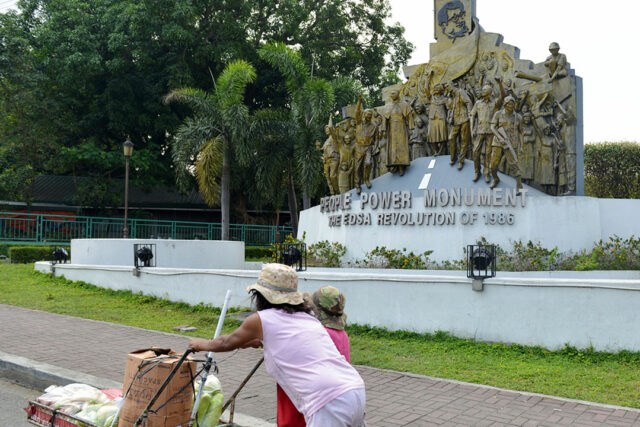
People pass by a replica of EDSA People Power monument along Congressional Road, in Dasmariñas City in this file photo taken on Feb. 24, 2023. — PHILIPPINE STAR/EDD GUMBAN

By Kyle Aristophere T. Atienza, Reporter

JANDHEL SANDOVAL wasn’t born yet when Filipinos marched along a major thoroughfare in the Philippine capital region 38 years ago to end the dictatorship of the late Ferdinand E. Marcos, whose two-decade rule was marked by human rights violations and corruption. 

The 22-year-old college student said “People Power” has come to symbolize freedom and democracy, but he isn’t sure its so-called gains have meant much for ordinary people like him, especially now that corruption and poverty persist.

“Living on an island with scarce resources like water and electricity, the relevance of EDSA seems to have diminished over the years,” said Mr. Sandoval, who grew up in Oriental Mindoro, an island-province that has been ruled by dynasties and which is known for almost-daily blackouts. “EDSA’s ideals have remained largely unrealized — socioeconomic challenges persist or have worsened.”

Filipinos took to the streets in 1986 to protest the excesses of the regime of Ferdinand Marcos, who according to government estimates stole as much as $10 billion (P559 billion) from the Filipino people.

The street uprising sent the Marcos family into exile in the United States, three years after the assassination of opposition leader Benigno “Ninoy” S. Aquino, Jr., Mr. Marcos’ political nemesis, at Manila’s international airport.

Ninoy’s death revitalized opposition to the Marcos regime and catapulted his widow, Corazon, into the political limelight. She later served as President for six years until 1992.

Thirty-eight years later, the former president’s son and namesake nicknamed Bongbong — among the first to return to the Philippines from exile in 1991 — is now Philippine President. His sister Imee is a senator, while their mother Imelda had been a congresswoman who represented their hometown in Ilocos Norte for most of the time since she came back three decades ago.

Mr. Marcos Jr.’s son Sandro, 29, is now a congressman representing Ilocos Norte’s first district, a position that his grandmother held for 24 years.

“When you have a majority of people supporting President Bongbong Marcos, who is his father’s proud namesake, and a similar majority saying that the spirit of EDSA is alive, there needs to be conversations about what it means for those two things to be true at the same time,” Francis Joseph A. Dee, a grandson of Ninoy, said in an e-mail.

“There has to be a recognition that the post-EDSA regime left some people behind or didn’t do enough for them,” he said. “We shouldn’t see this as an attack on the spirit of EDSA but as a reminder that democracy is an imperfect system.”

“It’s incumbent on pro-democratic forces not just to defend democracy but to listen to and ultimately deliver for the people,” he added.

A WR Numero Research poll in December found that 45% of Filipinos held a positive view of the EDSA uprising, while 57% expressed a positive view of the late dictator’s martial rule. A February 2023 poll by the Social Weather Stations showed that 62% of Filipinos believed EDSA’s spirit is still alive.

This shows that many Filipinos don’t want to return to a dictatorial form of government, said Michael M. Pante, a history professor at the Ateneo de Manila University.

While the Marcoses managed to return to power, it does not mean Filipinos want a one-man rule or their freedom curtailed, he added. “The difficulty faced by Charter change initiatives attests to this.”

Mr. Marcos and his allies in Congress are pushing to amend the post-dictatorship 1987 Constitution, including lifting foreign ownership limits to attract more investments.

Jose Enrique A. Africa, executive director of think tank IBON Foundation, blames past governments’ neglect of the agriculture sector and failure to develop the country’s industrial base for low-paying jobs.

“The Charter’s wisdom of a developmental state is more relevant than ever today when even advanced economies are reverting to the kind of protection, self-reliance and independence so wisely enshrined in the 1987 Constitution,” he said in a Facebook Messenger chat.

‘POPULIST DEMAGOGUES’
Discontent in Philippine democracy, which led to the presidential victory of firebrand leader Rodrigo R. Duterte in 2016, was largely fueled by economic issues, Temario C. Rivera, who heads the Center for People Empowerment in Governance, said in an e-mail.

“The post-EDSA decades dramatized the hollowness of restoring the formal trappings of democracy without addressing the deep material privations and inequalities among our people,” he said. He added that EDSA birthing was a “highly contested and contradictory” process.

The broad Left movement sought changes to address systemic inequality, while the traditional elite had largely been content with restoring the institutions of democracy “without the necessary economic and social reforms that ensure the success of electoral democracies,” Mr. Rivera said.

“The politicized faction of the military engaged in various mutinies to seize power, but its leaders eventually embraced the electoral arena as a less costly path to power,” he added.

Mr. Marcos and tandem mate Vice-President Sara Duterte-Carpio, daughter of his successor, won by a landslide in the 2022 presidential election.

“While the rise and continuing popularity of Duterte seem to negate the spirit of EDSA, most Filipinos who continue to support him still cling on to that promise of change that defined his campaign in 2016,” Mr. Pante said.

“EDSA was also like that — a promise of substantive change,” he said. “What went wrong, however, was the hollowness of that rhetoric of change when Duterte was in power, which was masked by disinformation and the facade of progress courtesy of palliatives like the ‘Build, Build, Build’ program and anti-drug campaign.”

Mr. Pante said people should expose this hollowness because many of these palliatives are being continued by the Marcos government.

Cracks in the ruling coalition have emerged in recent months, with Mr. Marcos and Mr. Duterte trading blows over drug use amid major policy differences.

Mr. Duterte, whose deadly war on drugs is being investigated by the International Criminal Court, has accused Mr. Marcos of pushing Charter change to stay in power. He has also criticized his successor’s decision to give the US expanded access to Philippine military bases.

Opposition forces have stepped up unity efforts which, for now, are directed at thwarting the push to amend the Constitution. 

Opposition groups led by Bagong Alyansang Makabayan, Laban ng Masa, Akbayan Party and the Liberal Party commemorated the 38th anniversary of the 1986 People Power uprising with protests along the EDSA highway and in other parts of the country.

The country is several months away from the filing of candidacies for the 2025 midterm elections, and opinion polls seem to indicate another big loss for the opposition. The Vice-President was the top pick for President in 2028.

“The movement that will really give life to the promises of EDSA can’t just be built on the advocacy of good governance but one that can clearly articulate a positive identity for the Filipino people and offer a set of policies that will bring that identity to life,” said Mr. Dee, the grandson of the Aquinos.

“EDSA gave us an identity once — the bastion of democracy in Asia,” he said. “For EDSA to really be accepted as a basis for our national identity again, we need to figure out a way to make its democratic institutions deliver for people.”

The opposition should form a broad political coalition that doesn’t have to start as one solid national party but as a dispersed movement of like-minded people and groups, Mr. Rivera said. It should carry a common platform of government with an “industrialist program” and selectively run for positions in local and national contests “where the likelihood of success is greater.”

“The cynicism of certain groups toward EDSA stems from a genuine dislike for the same structural flaws that haunted the country during martial law,” said Mr. Pante, the historian.

“It is just a matter of demonstrating to these groups that their desire for change should not translate to hating EDSA or being dependent on the work of populist demagogues, but on working together as a people to build movements that reflect the true democratic desires of ordinary Filipinos,” he said.


DoE: Around 50 firms keen on energy resource exploration in PHL

PHILSTAR FILE PHOTO

AROUND 50 local and international oil and gas exploration and production companies have shown interest in participating in the bidding for the exploration of various energy resources in the Philippines.

The Department of Energy (DoE) on Monday launched the bidding for coal, petroleum, and native hydrogen exploration in the Bangsamoro Autonomous Region in Muslim Mindanao (BARMM) and other parts of the country.

“We are very pleased that known oil and gas exploration and production players in Asia, North America, and Europe, including local players, have come to this event and displayed a keen interest in evaluating our country’s petroleum potential,” Energy Undersecretary Alessandro O. Sales said in a statement.

Some of the companies that were present during the launch include Baseline Unlimited, Inc.; The PhiloDrill Corp.; Helios Aragon Pte. Ltd.; V1 Countrywide Realty Corp.; Asia Axis, Inc.; PXP Energy Corp.; and Western Sulu Gulf Oil Corp.

Also attending the event were representatives from ExxonMobil Corp.; Prime Energy Resources Development B.V.; Minsupala Energy and Mineral Resource Development Corp.; Oriental Petroleum and Minerals Corp.; Freedom Renewable Energy Corp.; and Triangle Energy Ltd.

The DoE unveiled four pre-determined areas (PDA) for coal and petroleum exploration in the BARMM.

The only pre-determined area for coal exploration is located in the municipalities of Kapai and Tagoloan, Lanao del Sur covering a total area of 14,856 hectares.

For the Bangsamoro petroleum exploration, the first area covers Cotabato City and the provinces of Lanao del Sur, Maguindanao del Norte and Maguindanao del Norte. It spans 229,240 hectares and is situated in the Cotabato Basin.

“Petroleum exploration in the basin dates back to the presence of oil in a water well drilled in Datu Piang, Maguindanao del Sur in 1916. A total of 14 wells have been drilled in the area, 10 of which had oil and gas shows,” the DoE.

The PDA-BP 2 and 3 are both located in the Sulu Sea Basin with areas of 780,000 hectares and 532,083 hectares, respectively.

To date, six wells have been drilled within PDA-BP 2, of which three are gas discoveries, and one with evidence of oil and gas, the DoE said. 

On the other hand, seven wells have been drilled within PDA-BP 3, of which four had gas shows, and one had oil and gas shows.

“Some of you might ask, why insist on petroleum and coal. Are we ignoring the renewable energy resources of Bangsamoro? Let me explain that with respect to petroleum and coal, this is a joint responsibility of the national and BARMM government,” Energy Secretary Raphael P.M. Lotilla said in his speech.

“For the renewable energy resources, these are within the framework of the BARMM government, and we will be working with them. We commit ourselves and give them full support in the development of renewable energy resources of the region,” he added.

Under the 2024 Philippine bid round, two pre-determined areas are being offered for the development and production of petroleum, which are situated in northwest Palawan and southern Cebu.

The first area in the offshore northern Palawan covers 100,000 hectares. It includes five wells, which led to the discovery of the Calauit and Calauit South oil fields, with an estimated reserve of 5.5-6.1 million barrels of oil (MMbbls).

The second area, or the Visayan basin, covers 58,638 hectares with an estimated resources of 26.3-31.9 MMbbls.

Meanwhile, two pre-determined areas for native hydrogen exploration adjacent to the northern portion of the Zambales Ophiolite Complex and the western portion of Central Luzon were also up for bidding.

Both are located in the provinces of Zambales and Pangasinan which covers an estimated 134,096 hectares and 96,439 hectares, respectively.

Edgar Benedict C. Cutiongco, president of the Philippines Petroleum Association, said that it is time to open the exploration to all investors.

“In general, oil and gas is high risk, but high risk would give you high rewards, right? That’s the business plan of upstream oil and gas companies… we invest, and we are risk takers,” he told reporters on the sidelines of the launch.

As an example, Mr. Cutiongco said that the drilling well in an offshore area would cost at least $10 million, depending on the water depth.

“In the future, we want, in fact, to be able to export, right? If we are able to find more gas, and they will be more than enough for our production, if we are able to find more gas for our domestic consumption, then we can aspire to even export,” DoE’s Mr. Lotilla said.

The deadline for the submission of bids for coal PDA is on April 26, while the bids for PDAs for native hydrogen and petroleum should be submitted on Aug. 27.

The Energy department said that companies can submit their application for a petroleum service contract (PSC) within the prescribed 180-day period following the publication of the PDAs on Feb. 26.

Submission for coal operating contract (COC) application is within the 60-day period.

The notices of qualification for the BARMM COCs will be announced on July 24, while those for BARMM PSCs will be announced on Nov. 21.

Meanwhile, the list of qualified bidders for the development and production of petroleum and hydrogen exploration will be released on Sept. 24.

“I encourage you to further evaluate these petroleum potentials. We have the best contractual terms to offer that could match and compete with other countries,” Mr. Sales said. — Sheldeen Joy Talavera

MPIC: Public listing for toll road firm with SMC possible this year

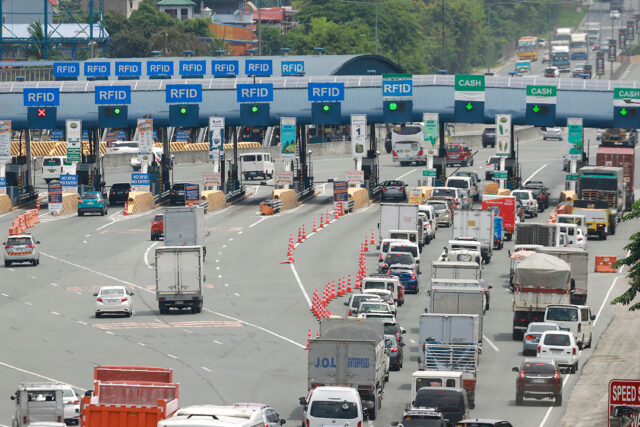
VEHICLES approach the NLEX Balintawak toll plaza, May 18, 2021. — PHILIPPINE STAR/ MICHAEL VARCAS

PANGILINAN-LED Metro Pacific Investments Corp. (MPIC) is hoping to complete and publicly list its planned joint venture with San Miguel Corp. (SMC) within the year. 

“We are at the stage where we are exchanging information about our tollways. [It is] looking good, in combination, it will be a significant company in the Philippines with starting EBITDA (earnings before interest, taxes, depreciation, and amortization) of around P50 billion,” MPIC Chairman, President, and Chief Executive Officer Manuel V. Pangilinan told reporters on Monday.

Last year, Mr. Pangilinan described the possible joint venture as a potential candidate for listing on the Philippine Stock Exchange (PSE).

“This is doable. It is not a very complex business. So, with the commitment of both parties, I do not see why we cannot do it within the year,” he said on Monday.

The valuation of the planned joint venture company also includes Metro Pacific Tollways Corp.’s (MPTC) Indonesian assets. 

“That assumes it includes at least our Indonesian assets. That still will be discussed with them,” he said. 

MPIC’s tollways unit MPTC, through Metro Pacific Tollways Asia, holds 76.31% share in PT Nusantara Infrastructure in Indonesia. 

Aside from securing the approval of its foreign shareholders, Mr. Pangilinan has said that among the issues that need to be addressed for the possible merger is that both companies will have to go to Congress to apply for a franchise for their operations.

MPTC had earlier announced that it would defer its initial public offering to 2025, citing the company’s intention to weigh its options amid a plan to form a joint venture company with SMC.

To recall, MPIC said it was planning to list its tollways unit MPTC on the stock market after the parent firm’s delisting from the PSE in October.

“We look forward to what regulatory approvals may be needed from Indonesia and the Philippines. We are simply exchanging information now so we will have an idea of the tollways. It is good to have significant companies for listing,” he said. 

MPIC is one of the three key Philippine units of Hong-Kong based First Pacific Co. Ltd., the others being Philex Mining Corp. and PLDT Inc.

Hastings Holdings, Inc., a unit of PLDT Beneficial Trust Fund subsidiary MediaQuest Holdings, Inc., has a majority share in BusinessWorld through the Philippine Star Group, which it controls. — Ashley Erika O. Jose with a report from Sheldeen Joy Talavera

Classic ‘East meets West’ tale Shōgun gets new adaptation

Historical fiction series premieres on Disney+

IN feudal Japan, political intrigue can do as much damage to a lord as a swift strike from a samurai’s sword. English navigator John Blackthorne (played by Cosmo Jarvis) quickly discovers this as he is shipwrecked in Japan and enters its complex society, where he must navigate a web of alliances.

At the heart of it all is warlord Yoshii Toranaga (played by Hiroyuki Sanada), who is deeply embroiled in power struggles and life-threatening politics. The two characters become unlikely allies in the FX original series Shōgun, which is an adaptation of James Clavell’s historical fiction novel of the same name, published in 1975. The novel had already been adapted in 1980 as a nine-hour TV series starring Richard Chamberlain and Toshiro Mifune.

The new show premiered on Feb. 27 on Disney+, where it will have a total of 10 episodes.

Joining Jarvis and Sanada is Anna Sawai, who plays interpreter Lady Toda Mariko, a character that serves to bridge the two leads but also finds her own place as a woman from a disgraced noble line.

Though people may think Shōgun is yet another “East meets West” tale, its original novel’s legacy as a cultural landmark was the inspiration for the show to set its own bar, according to its creators Rachel Kondo and Justin Marks.

“For us in the West, the landscape was changed by this book. It is a grave responsibility for us as writers to approach this iconic tome, and what we ended up finding out was how we could update it for today,” Ms. Kondo said at a press conference on Feb. 20 that was livestreamed online from Tokyo.

Mr. Marks added that while James Clavell’s Shōgun really helped bring wider cultural awareness of Japan in the 1970s, the world’s cultural climate today allows for a “true East meets West effort.”

“What jumped out at us, with the collaboration of our lead actor and producer Hiroyuki Sanada, is that we need to have a production that is ‘East meets West.’ I don’t think we realized just how many departments and advisors we would hire from Japan to do it right. The standards have [been] raised telling these stories today so we wanted to be authentic as we could,” he said.

For Mr. Sanada, who nurtured a long career in Japan and is now a sought-after Japanese actor in Hollywood (The Last Samurai, 47 Ronin, John Wick: Chapter 4), Shōgun can be the standard for international productions.

“I think it will be a huge step for people in the film industry. Our teamwork was the most important secret weapon for this dream project — every day we checked every detail on set, the decorations, how to wear kimonos, the look of each extra. If people work together, no matter how difficult, we can make miracles. This is a great message to send to the world,” he said in Japanese.

Cosmo Jarvis, as the principal Western character in the cast, saw Mr. Sanada as an “omnipotent presence on set.”

“He was always around, guiding particularly the more junior actors and creating a good environment to work,” he said. “I would frequently confer with him about things Blackthorne should be learning as an outsider in Japan.”

Meanwhile, Anna Sawai said that, as a Japanese-New Zealand actress that grew up watching a lot of Western media, there is still has a lot more work to do to bring representation of Japanese women beyond “the sexy lady or the submissive lady or the one that does action.”

“I joined this project because I wanted to see more depth, to see myself in these characters,” she added.

Set in the 1600s, a pivotal moment in Japanese history, the series aims to show respect for the culture as well as build a world of intrigue and complex human drama.

Another motivation for Mr. Sanada is to bring his character and real-life historical figure Lord Tokugawa’s achievements to light.

(Tokugawa Ieyasu was the first shōgun of the Tokugawa Shogunate, which ruled from 1603 to 1868. He was known as one of Japan’s “Great Unifiers.”)

“Human beings do not seem to change, but he created a very peaceful world for many years and that kind of hero is what is needed now. That was the driving force for me to take this role,” he said.

For showrunners Mr. Marks and Ms. Kondo, influences like jidaigeki (Japanese period drama) and revered director Akira Kurosawa inspired them, so their intention was to delve into “the psychology of the characters and the experience of what it was like to be alive at the time.”

“There are lessons we still fail to learn time and time again, like the lesson of encountering other cultures with the spirit of generosity, to listen first and act later. These are themes and ideas that Shōgun grapples with, that we also grappled with throughout production,” said Mr. Marks.

Shōgun is out now on Disney+. — Brontë H. Lacsamana

Gov’t partially awards T-bills

BW FILE PHOTO

THE GOVERNMENT made a partial award of the Treasury bills (T-bills) it offered on Monday amid reduced market appetite and liquidity following its retail Treasury bond (RTB) offering.

The Bureau of the Treasury (BTr) raised P14.8 billion from its offering of T-bills on Monday, lower than the planned P15 billion, even as total bids reached P35.765 billion or more than twice the amount on the auction block.

Broken down, the Treasury raised P5 billion as planned from the 91-day T-bills as tenders for the tenor reached P8.115 billion. The three-month paper was quoted at an average rate of 5.71%, 11.8 basis points (bps) higher than the 5.592% seen for a partial award last week. Accepted rates ranged from 5.674% to 5.725%.

The BTr likewise borrowed the programmed P5 billion via the 364-day debt papers as demand totaled P15.24 billion. The average rate of the one-year T-bill inched up by 0.6 bp to 6.085% from the 6.079% quoted last week. Accepted yields were from 6.05% to 6.096%.

Meanwhile, the government raised just P4.8 billion from the 182-day securities, below the P5-billion program, despite bids for the tenor reaching P12.41 billion. The average rate for the six-month T-bill stood was capped at 5.971%, down by 0.1 bp from the 5.972% fetched for a full award last week, with accepted rates at 5.925% to 5.999%.

At the secondary market on Monday before the auction, the 91-, 182-, and 364-day T-bills were quoted at 5.6226%, 5.9045%, and 6.1323%, respectively, based on PHP Bloomberg Valuation Service Reference Rates data provided by the BTr.

“​The partial awarding at today’s T-bill auction reflected reduced appetite by the BTr amid pending issuance of the recently concluded RTB 30 offering last week,” a trader said in an e-mail on Monday.

The government raised a record P584.86 billion from its offer of five-year retail bonds that ended on Friday, the BTr said in a statement over the weekend.

Of the total, P212.72 billion was awarded at the rate-setting auction for the 30th tranche of RTBs held on Feb. 13.

An additional P372.14 billion was raised during the nine-day public offer period, with P128.69 billion of this being new money and P243.45 billion coming from the bond exchange component of the offering.

The BTr will issue the bonds on Feb. 28, Wednesday. The papers carry a coupon rate of 6.25%.

T-bill rates mostly rose due to easing expectations of an early rate cut by the US Federal Reserve, Rizal Commercial Banking Corp. Chief Economist Michael L. Ricafort added in a Viber message.

The T-bill auction on Tuesday was the last for the month. The BTr raised P61.3 billion from the short-term securities in February, above the P60-billion program, even after making partial awards in two auctions after the government upsized its planned issuance in one offering.

On Tuesday, the BTr will offer P30 billion in fresh 20-year Treasury bonds.

The government borrows from local and foreign sources to help fund its budget deficit, which is capped at 5.1% of gross domestic product this year or P1.39 trillion. — A.M.C. Sy

Meralco: Strong sales, generation boost core income to P37B

MANILA ELECTRIC Co. (Meralco) saw a 37% increase in its core net income to P37.1 billion in 2023, driven by strong energy sales and power generation, the company said on Monday.

“Meralco’s 2023 performance has exceeded expectations… This year, we expect to move forward with our long-term goal of achieving sustainable energy security through our investments in utility scale power generation projects, including exploring the possible adoption of nuclear energy in the country,” Meralco Chairman and Chief Executive Officer Manuel V. Pangilinan said in a statement.

Consolidated revenues rose by 4% to P443.6 billion, driven by the higher sales volumes in the company’s higher distribution business.

Energy sales volume improved by 4% to 51,044 gigawatt-hours (GWh), said Betty C. Siy-Yap, Meralco’s senior vice-president and chief finance officer.

Higher energy sales were seen in the residential and commercial volumes, she said.

The commercial segment reached 17,403 GWh in 2023, up 9% due to “strong business recovery,” particularly in the demand from hotels and leisure sectors.

The residential segment saw a 4% increase to 17,781 GWh, attributed to higher usage of cooling appliances amid El Niño.

Sales volume in the industrial segment slipped by 1% to 14,113 GWh as the semiconductor industry posted a negative year-end sales.

“We also saw very strong contributions from our generation driven by continued contribution of Pacific Light Power Limited in Singapore and San Buenaventura Power Limited,” Ms. Yap said at the briefing.

Singapore-based Pacific Light, a subsidiary of Meralco PowerGen Corp. (MGen), reported that its core net income grew by 34% to P16.2 billion.

San Buenaventura Power Ltd. Co. booked a core net income of P2.5 billion, down 30% while Global Business Power Corp. managed to turn around its last year’s core net loss of P2.7 billion to P505 million.

MGen’s renewable energy arm, MGen Renewable Energy, Inc., reported a core net income of P67 million, up by 132%.

Meanwhile, Jose Ronald V. Valles, Meralco’s first vice-president and head of its regulatory management, said that two companies withdrew their bids for the 260-megawatt  (MW) procurement.

“I understand that today was the date of submission of the bid but the two bidders have withdrawn their expressions of interests and therefore resulted in failed bidding,” he said.

He said that the company would report to the Department of Energy and request a second round of bidding.

To recall, 1590 Energy Corp. (1590 EC) and San Roque Hydropower, Inc. (SRHI) had expressed interest to participate in the 260-MW bidding.

1590 EC owns and operates the 225-MW diesel power plant in Bauang, La Union. It is owned by Vivant Energy Corp., a wholly owned subsidiary of listed Vivant Corp.

SRHI, formerly known as Strategic Power Development Corp., is a subsidiary of San Miguel Global Power Holdings, serving as the administrator of the 345-MW San Roque hydroelectric power plant through an independent power producer administrator agreement.

Meralco has launched the biddings for the 260-MW peak requirement and 400-MW baseload requirement as it expects power demand to increase in the summer months.

Meralco’s controlling stakeholder, Beacon Electric Asset Holdings, Inc., is partly owned by PLDT Inc.

Hastings Holdings, Inc., a unit of PLDT Beneficial Trust Fund subsidiary MediaQuest Holdings, Inc., has an interest in BusinessWorld through the Philippine Star Group, which it controls. — Sheldeen Joy Talavera

Oppenheimer steamrolls toward Oscars with SAG Award wins

CILLIAN MURPHY, seen here in a scene from Oppenheimer, won best movie actor at the SAG Awards for his work in the film.

LOS ANGELES — Historical epic Oppenheimer picked up more prizes on Saturday at Hollywood’s Screen Actors Guild (SAG) Awards, bolstering the movie’s chances to score the best picture trophy at next month’s Oscars.

The film about the race to build the first atomic bomb took the top honor — best movie cast — handed out by members of the SAG-AFTRA actors union at a red-carpet ceremony in Los Angeles.

Cillian Murphy, who played scientist J. Robert Oppenheimer, won best movie actor, and co-star Robert Downey, Jr. best supporting actor.

Irish actor Mr. Murphy said he took up the profession after trying to make a career as a musician and often felt like an “interloper.”

“This is extremely special to me because it comes from you guys,” Mr. Murphy told his fellow actors as he accepted his award.

SAG-AFTRA’s choices are closely watched because actors form the largest group of voters for the Academy Awards, the film industry’s top prizes.

At the moment, Oppenheimer appears unstoppable. Director Christopher Nolan’s drama already has claimed trophies at the Golden Globes, the British Academy Film Awards, and other ceremonies. Honors from Producers Guild of America, another key predictor of Oscars success, were to be announced on Sunday.

In other SAG accolades, the best actress trophy went to Lily Gladstone, star of Killers of the Flower Moon. Ms. Gladstone played a member of the Osage Native American community that suffered a string of murders in 1920s Oklahoma over their oil-rich land.

“My friends, fellow actors, I feel the good in what you have done,” Ms. Gladstone said. “We bring empathy into a world that so much needs it.”

Da’Vine Joy Randolph won supporting actress for playing a grieving mother in The Holdovers. “How lucky are we to get to do what we do. I wake up every day overwhelmed with gratitude to be a working actor,” Ms. Randolph said.

The awards streamed live on Netflix for the first time, part of the company’s efforts to expand its live programming.

SAG-AFTRA staged a four-month strike against Hollywood studios last year to fight for higher pay and protections from artificial intelligence.

“It is especially meaningful to be here with us all together again, for this occasion, after going through a very difficult time with the strike,” actor Idris Elba said in opening remarks.

In television categories, FX restaurant dramedy The Bear claimed best cast in a TV comedy and acting honors for stars Jeremy Allen White and Ayo Edebiri.

“I am so honored to be in this community,” Jeremy Allen White said. “I wanted to be part of this my whole life. I had no backup plan.”

HBO’s Succession secured best TV drama cast for its final season about the battle for control of a family’s media dynasty.

Elizabeth Debicki, who played Princess Diana in Netflix series The Crown, won best TV drama actress. The Last of Us star Pedro Pascal was named best actor in a TV drama and appeared stunned when he walked on stage.

“I’m a little drunk,” Mr. Pascal said as he held his trophy. “I thought I could get drunk… I’m making a fool of myself. Thank you so much!”

SAG-AFTRA also handed out a lifetime achievement honor to Barbra Streisand, the award-winning actress, producer, director, singer, and writer. — Reuters


And the winner at the Screen Actors Guild Awards is…

LOS ANGELES — The following is a complete list of winners at the 30th Annual Screen Actors Guild (SAG) Awards on Saturday for the best performances in film and television. The ceremony was streamed live on Netflix.

FILM
Best Cast in a Motion Picture: Oppenheimer

Best Male Actor in a Leading Role: Cillian Murphy, Oppenheimer

Best Female Actor in a Leading Role: Lily Gladstone, Killers of the Flower Moon

Best Male Actor in a Supporting Role: Robert Downey, Jr., Oppenheimer

Best Female Actor in a Supporting Role: Da’vine Joy Randolph, The Holdovers

TELEVISION
Best Ensemble in a Drama Series: Succession

Best Ensemble in a Comedy Series: The Bear

Best Male Actor in a Drama Series: Pedro Pascal, The Last of Us

Best Female Actor in a Drama Series: Elizabeth Debicki, The Crown

Best Male Actor in a Comedy Series: Jeremy Allen White, The Bear

Best Female Actor in a Comedy Series: Ayo Edebiri, The Bear

Best Male Actor in a Television Movie or Limited Series: Steven Yeun, Beef

Best Female Actor in a Television Movie or Limited Series: Ali Wong, Beef

STUNTS
Outstanding Action Performance by a Stunt Ensemble in a Television Series: The Last of Us

Outstanding Action Performance by a Stunt Ensemble in a Motion Picture: Mission: Impossible – Dead Reckoning Part One — Reuters

BDO net profit up by 29% to P73.4 billion

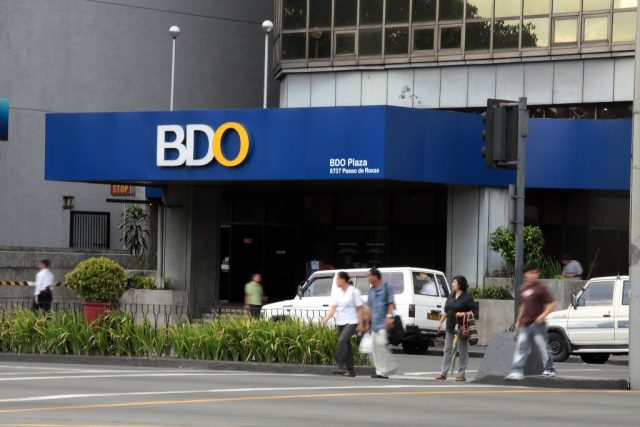
BW FILE PHOTO

BDO UNIBANK, Inc. saw its net profit rise by 28.67% year on year in 2023 amid continued growth across its core businesses, it said on Monday,

The Sy-led bank’s attributable net income stood at P73.41 billion last year, up from P57.05 billion in 2022, its financial statement disclosed to the stock exchange showed.

This translated to a return on common equity of 15.2% and a return on assets of 1.7%, up from 15.2% and 1.5%, respectively.

“BDO’s strong business franchise and market leadership, healthy capital position, and robust financial performance bolster the bank’s foundation for long-term sustainable growth and profitability, despite continuing challenges in the macroeconomic environment,” it said in a statement.

Net interest income climbed by 24.9% to P186.39 billion last year from P149.23 billion previously, driven by the 9% expansion in its customer loans, BDO said, noting it saw growth across all market segments.

Broken down, interest income rose to P240.196 billion from P169.071 billion, while interest expense grew to P53.809 billion from P19.839 billion.

The bank’s net interest margin stood at 4.6% in 2023, up from 4.1% the previous year.

Other operating income climbed by 17.45% to P84.02 billion in 2023 from P71.53 billion a year prior, supported by earnings from its fee-based and treasury or foreign exchange businesses.

The bank’s pre-provision operating profit rose by 27% to P113.6 billion, it said.

“Revenues expanded at a slightly faster pace than operating expenses growth mostly from volume-related costs, continued network expansion and IT (information technology) investments,” BDO said.

Operating expenses rose by 19.53% year on year to P156.83 billion in 2023 from P131.21 billion previously.

BDO’s gross nonperforming loan (NPL) ratio improved to 1.85% at end-2023 from 1.95% previously. Its NPL coverage ratio was at 185%.

Meanwhile, total deposits with the bank rose by 10.76% to P3.57 trillion last year from P3.22 trillion in 2022, with its current and savings account or CASA ratio at 72%.

BDO’s assets grew by 9.89% to P4.48 trillion at end-2023 from P4.07 trillion in 2022.

Total equity was at P518.55 billion, up by 12.37% from P461.46 billon.

The bank’s capital adequacy ratio was at 14.9%, up from 14.5% a year prior, while its common equity tier 1 ratio stood at 13.8%, rising from 13.4% previously.

The Sy-led lender had 1,720 local branches and two foreign branches as of Dec. 31, 2023, with 2,863 on-site automated teller machines (ATMs), 1,939 off-site ATMs, and one mobile ATM.

BDO’s shares dropped by P4.10 or 2.67% to close at P149.50 each on Monday. — AMCS

A Brown raises P1.44B from preferred shares offering

A BROWN Co., Inc. (ABCI) announced on Monday that it had successfully raised P1.44 billion through a follow-on offering as part of its fundraising efforts.

The offering involved Series B and C preferred shares, which were subsequently listed on the Philippine Stock Exchange, ABCI said in a regulatory filing.

The offering was oversubscribed by 1.44 times the base amount, it also said.

The company issued a total of 7,431,750 Series B preferred shares and 6,941,000 Series C preferred shares, which were listed on Feb. 23.

ABCI’s offering originally comprised 10 million preferred shares, including Series B and C, priced at P100 apiece, with an oversubscription option for an additional five million shares.

The proceeds from the offer would be used for the development of ABCI’s residential projects in Luzon and Mindanao, land banking efforts, and general corporate purposes, the company said.

“The Series B and Series C preferred shares have a dividend rate of 8.25% and 8.75% per annum, respectively. The offering was well received by the investor community allowing the dividend yields to be priced at the low end of the range,” it added.

The company tapped PNB Capital and Investment Corp. as the lone issue manager and bookrunner as well as the lead underwriter for the offering.

For the first nine months, A Brown logged a 21% increase in its net income to P484.5 million as its revenue climbed by 24% to P1.1 billion.

The completion of the company’s electron beam (e-beam) and cold storage facility in Tanay, Rizal is slated for next month, with anticipated earnings contributions this year. E-beam technology is an economical option for commercial sterilization methods and is used in various agricultural products and medical devices.

ABCI is a Mindanao-based property developer that has various interests in other sectors such as power generation, public utilities, and agribusiness.

On Monday, ABCI shares rose by 1.52% or one centavo to 67 centavos apiece. — Revin Mikhael D. Ochave

ADVERTISEMENT
ADVERTISEMENT