CONCEPCION Industrial Corp. (CIC) and its associate Concepcion Midea, Inc. (CMI) said they posted a 10.5% increase in group net sales in the fourth quarter (Q4), while earnings declined amid cost pressures and industry headwinds.
Fourth-quarter group net sales, which include contributions from CMI, rose to P6.3 billion from P5.7 billion in the same period a year earlier, CIC said in a statement on Thursday.
The company said its teams delivered steady results through targeted operational management amid a challenging environment.
“Our performance in the fourth quarter reflects the resilience of our diversified portfolio and provides a solid foundation as we move into 2026,” CIC Chief Finance and Operating Officer Rajan Komarasu said.
CIC’s consolidated net sales, which exclude its associate, reached P4.6 billion, up 2.2% from P4.5 billion a year earlier. Consolidated net income, however, fell 29.7% to P196 million from P278.7 million in the prior year.
“While 2025 presented industry-wide challenges, CIC demonstrated resilience through disciplined execution and a steadfast focus on our priorities. We are taking meaningful steps to position the company for future opportunities and long-term value creation,” CIC Chief Executive Officer Ariel Fermin said.
For full-year 2025, total group net sales, including CMI’s contributions, reached P25.9 billion, up 10.2% from P23.5 billion in 2024.
During the same period, CIC’s consolidated net sales stood at P18.5 billion, rising 2.2% from P18.1 billion a year earlier. Consolidated net income, however, declined by 8.3% to P1.1 billion.
“We extend our sincere appreciation to our shareholders and partners for their continued trust and support,” Mr. Fermin added.
CIC generates revenue through subsidiaries Concepcion-Carrier Air Conditioning Co., Concepcion Durables, Inc., Cortex Technologies Corp., and Tenex Services, Inc., which sell and service air conditioners, refrigeration, and laundry and kitchen appliances.
It also operates Concepcion-Otis Philippines, Inc., which handles elevators and escalators, and Teko, its appliance repair and maintenance platform.
In the third quarter, CIC reported a 24.7% decline in attributable net income to P107.2 million, as rising costs and external headwinds weighed on profitability despite higher revenues.
Third-quarter gross revenues rose 2.4% to P3.88 billion from P3.79 billion a year earlier, driven by stronger sales in refrigeration, laundry, and other appliances, as well as commercial products. The increase was partly offset by weaker demand for residential air conditioners.
At the local bourse on Thursday, CIC shares fell 0.72% to P13.70 apiece. — Alexandria Grace C. Magno
As the world progresses, wellness has become a defining priority. No longer confined to medical treatment or crisis response, health is increasingly understood as a lifelong pursuit shaped by daily habits, environmental factors, and informed decision-making.
Wellness is no longer defined solely by the absence of disease. It is recognized as a dynamic state of overall well-being that enables individuals to function optimally, adapt to stress, and maintain balance across different areas of life. Rising rates of chronic illness, stress-related conditions, and lifestyle-driven health issues have reinforced the need for a more comprehensive understanding of wellness. As a result, individuals are placing greater emphasis on long-term health maintenance rather than short-term remedies. This shift has encouraged more deliberate lifestyle choices, from nutrition to physical activity to mental health practices.
A defining feature of modern wellness strategies is their holistic nature. Holistic health approaches recognize that physical, mental, emotional, and social well-being are interconnected and must be addressed collectively.
Physical health remains a foundational pillar, encompassing regular movement, balanced nutrition, restorative sleep, and preventive medical care. However, mental and emotional well-being have gained equal importance as individuals face increasing levels of stress.
Practices such as mindfulness, meditation, stress management, and emotional regulation are widely embraced as tools for psychological resilience.
Mental and emotional well-being
Mental and emotional health have become central components of wellness as well. Increased awareness of stress-related conditions, anxiety, and burnout has prompted a more open and informed approach to psychological well-being.
Emotional resilience is now recognized as essential to overall health, influencing decision-making, relationships, and physical outcomes. Practices that support mental well-being (i.e., reflective journaling, mindfulness exercises, counseling, and social connection) are increasingly normalized and valued.
It is also important to note that mental health is no longer viewed as separate from physical health. Studies continue to demonstrate strong links between psychological well-being and immune function, cardiovascular health, and chronic disease risk.
Addressing mental and emotional needs is, therefore, a critical element of any comprehensive wellness strategy.
Beyond basic factors
Wellness also encompasses dimensions that extend beyond traditional health metrics. Financial stability, work-life balance, and lifestyle structure are increasingly recognized as influential factors in overall well-being.
Financial stress can have significant physical and emotional consequences, contributing to anxiety, sleep disruption, and reduced quality of life. As a result, financial literacy, responsible planning, and informed decision-making are seen as integral to holistic wellness.
Similarly, lifestyle balance (i.e., time management, rest, and personal fulfillment) plays a key role in sustaining health. Establishing routines that allow for recovery, recreation, and meaningful engagement supports long-term resilience and satisfaction.
Environment and social factors also play a critical role in holistic wellness. Access to safe spaces, clean environments, supportive relationships, and meaningful engagement contributes significantly to overall health.
By fostering balance across the aforementioned dimensions, holistic approaches promote sustainable well-being rather than temporary relief.
Preventive care as proactive strategy
Photo by Freepik
Preventive care has become a central element of wellness, reflecting a broader shift from reactive treatment to proactive health management. Rather than waiting for symptoms to emerge, preventive strategies focus on early detection, risk reduction, and informed lifestyle adjustments.
Routine health assessments, screenings, and checkups enable individuals to identify potential concerns before they develop into more serious conditions.
Preventive care also gives importance to education, equipping people with the knowledge needed to understand health risks and make informed choices.
Lifestyle-based prevention plays an equally important role. Nutrition guidance, regular physical activity, adequate sleep, and stress management are widely recognized as effective tools for reducing risk of chronic disease. When these practices are adopted consistently, they contribute not only to longevity but also to improved daily functioning and vitality.
Preventive care, therefore, empowers individuals to take greater control of their health outcomes while reducing the long-term burden on healthcare systems.
Technology in wellness
Advances in technology continue to shape how wellness is monitored, managed, and sustained. At present, digital health tools have become integral to everyday life, providing individuals with greater access to information, personalized insights, and preventive support.
Wearable devices and health applications enable continuous tracking of physical activity, sleep patterns, heart rate, and other health indicators. These tools offer real-time feedback, helping individuals recognize patterns and make timely adjustments to their habits.
Telehealth services further enhance accessibility, allowing people to consult healthcare professionals without geographical or logistical barriers.
By analyzing individual data trends, technology can support tailored recommendations that align with personal goals and health profiles. While these innovations offer significant benefits, they also underscore the importance of data privacy, digital literacy, and responsible use.
When used thoughtfully, technology serves as a powerful enabler of preventive and holistic wellness.
Building sustainable habits
A key challenge in prioritizing wellness is consistency. Short-term initiatives and temporary behavior changes often fail to produce lasting results. Hence, emphasis is placed on building sustainable habits that can be maintained over time.
This involves setting realistic goals, understanding personal motivations, and creating supportive environments that reinforce healthy behavior. Incremental improvements, rather than drastic changes, are more likely to lead to long-term success.
Self-awareness and adaptability are also essential. As life’s circumstances evolve, wellness strategies must be reassessed and adjust accordingly.
A sustainable approach that recognizes wellness is not static, but responsive to changing needs and conditions.
Prioritizing wellness reflects a broader understanding that health is a foundational asset influencing every aspect of life. Holistic approaches and preventive care strategies offer a structured, proactive pathway toward sustained well-being, resilience, and improved quality of life. By integrating physical health, mental well-being, preventive practices, and supportive lifestyle choices, individuals can make meaningful steps toward a healthier future.
Wellness, when approached thoughtfully, becomes not merely a personal goal but a lifelong investment — one that yields benefits across personal, social, and societal dimensions.
As awareness continues to grow, the emphasis on prevention, balance, and holistic care is set to define the future of health, empowering individuals to thrive in an increasingly interconnected and demanding world. — Krystal Anjela H. Gamboa
Digital solutions and artificial intelligence (AI) lie at the core of many responses coming both from Government and civil society groups to address the recent corruption scandals and the public clamor for genuine transparency in the budget process. For instance, Senate Bill No. 1506, or the Citizen Access and Disclosure of Expenditures for National Accountability (or the CADENA Bill) builds on the use of blockchain technology and digital portals to ensure transparency and accountability in the budget making and monitoring processes. It was reported to be on a fast-track lane for approval, having passed third reading at the Senate in December last year. Two weeks ago, the Executive’s economic managers also unveiled what they call “Big Bold Reforms,” most of which expectedly focused on streamlining processes to promote ease of doing business, relying largely on a digitally-transformed the bureaucracy. Then, just a few days ago, the President was also reported to have signed the National Digital Connectivity Plan with a vision towards a Digitally Connected Philippines.
It is thus not surprising that these conversation highways will land — indeed, MUST land — at some point on some fundamental questions: How do we ensure that our power system will have the capacity to support a Digitally Connected Philippines? What does this digital transformation mean for our power system? What impact does AI have on the way the different components of our power systems (grid and off-grid) work? What form (or forms) of power infrastructures do we need to realize and sustain these reforms to generate positive transformation?
Today, discussions around the impact of AI on power have been focused largely on smart grids, advanced metering infrastructure (AMI) and data centers — all presenting opportunities to pursue economic progress and with issues that are valid and deserve proper attention.
We will need, however, to push the debates beyond these current limits if we are to truly seize this opportunity in history to forge a better future for our country.
In April last year, I had a chance to share publicly some of my reflections on this topic at the Meralco Power Academy’s Giga Summit 2025. I shared at the summit some learnings I gathered from a small experiment I did, asking a generative AI tool the question: “How do you make power rates affordable in Metro Manila, Philippines?” The responses provided by the AI tool (consistently, I must say, in two iterations) sparked some interesting conversations and a couple of snickering from the audience.
Over the recent holidays, I was able to reflect more deeply on these questions as I finished reading Richard Susskind’s How to Think About AI: A Guide for the Perplexed. I have been following the work of Professor Susskind for some time, as he is among the pioneers in the space of legal technology and the impact of AI on professions since the 1980s. His latest book challenges the reader to confront the imminent reality that “balancing the benefits and threats of artificial intelligence — saving humanity with and from AI — is the defining challenge of our age.”
Let me share just five points to consider as we pursue this collective discourse on powering our country’s future in a digital economy.
1. We need to imagine differently. One of the basic principles in public policy (and in any problem-solving exercise, actually) is to ensure that you are asking the right question or that you are being clear about the problem you would like to solve before you start formulating solutions. As we begin to fashion a future that is digitally connected and AI-intensive, this exercise becomes more complex, and the scenarios become more nuanced.
Take the case of data centers. As the Government positions the Philippines to be the location of choice for data center investors and developers, we need to make sure we are asking the right questions to craft the policy. If we focus only on increasing the country’s generation capacity to ensure that data center locators will have sufficient power supply for their operations, we are likely to miss the various dimensions of the challenge, such as, proper siting, appropriate power sourcing, optimal operating or business lifecycle, and rate allocation design, among others — all of which need to be considered in crafting the policy on data center hosting. It is not simply a matter then of addressing the impact on demand, although that in itself is already a daunting task. As Susskind notes in respect of the impact of AI in planning, the “bigger question perhaps is the extent to which AI systems will have changed civilization and humanity by 2050.”
In other words — and this, in my view, is the first challenge posed by AI on public policy — we need to try to exceed the limits of our imagination, to project the demand on our systems (not just in megawatts or megawatt-hours) to behave and operate differently. With AMI and smart grids that can allow real time information on power consumption and rates, for example, will monthly power billings still be relevant? We will need to envision the impact of AI in a world that will no longer function as we know it because the use of AI itself would have changed it. Paraphrasing Susskind, we need to be able to conceive a paradigm of a power system that is different from the one where we all operate in today.
2. Our values — crystalized, articulated and reinforced — will matter more than ever. I spent quite some time on this point during the Giga Summit as the importance cannot be sufficiently underscored. This is true not just on a national or local government level, but for any organization that will be digital at its core. Those who are not clear on their values will render themselves irrelevant and inconsequential.
If we are not clear or aligned on the values that underpin the use of AI, the danger is that the existing ills that AI use seeks to address will just intensify. Inequalities may worsen and incumbencies (both political and economic) may just be fortified. It is true that AI can hasten and make more efficient the resolution of disputes or any exercise of arriving at judgment. It does not, however, guarantee a just result. It is possible, then, that dispute resolution or policy making – made more efficient with the use of AI but anchored on the wrong set of values or in the absence of a set of values accepted by the community – will just make it faster to arrive at an unfair, unjust or inequitable result. Efficiency in decision making is certainly desirable, but it is not necessarily the only value that matters in a just and equitable society.
(To be continued.)
Monalisa C. Dimalanta is a senior partner at Puyat Jacinto & Santos Law (PJS Law). She was the chairperson and CEO of the Energy Regulatory Commission from 2022 to 2025, and chairperson of the National Renewable Energy Board from 2019 to 2021.
THE PESO fell again versus the dollar on Thursday as Philippine gross domestic product (GDP) growth missed the government’s target for a third consecutive year due to the ongoing fallout from a corruption scandal involving government infrastructure projects.
The local unit ended at P58.945 against the greenback, sliding by 20.5 centavos from its P58.74 finish on Wednesday, data from the Bankers Association of the Philippines showed.
The peso opened Thursday’s trading session just slightly weaker at P58.78 against the dollar. Its intraday best was at P58.75, while its worst showing was at P58.95.
Dollars traded declined to $1.329 billion from $1.46 billion on Wednesday.
The peso sank as data released on Thursday showed that GDP growth fell below target in 2025, the first trader said in a phone interview.
“The peso weakened significantly following the weaker than expected Philippine GDP growth and the hawkish policy statements from US Federal Reserve Chair Jerome H. Powell,” the second trader said in an e-mail.
Philippine GDP growth slowed to 3% in the fourth quarter from 5.3% in the same period a year prior and the revised 3.9% print in the third quarter.
This was the slowest print in nearly five years or since the 3.8% contraction in the first quarter of 2021. Outside of the coronavirus pandemic, this was the worst since the 1.8% growth recorded in the fourth quarter of 2009, or during the Global Financial Crisis.
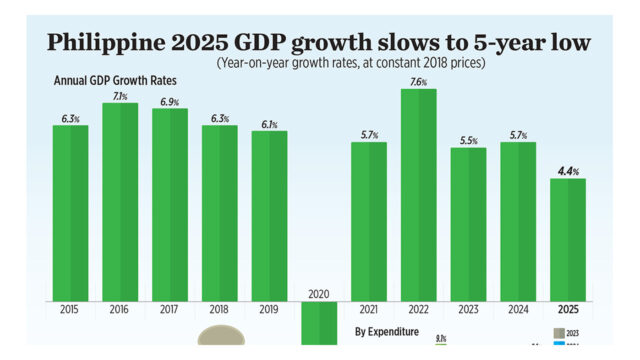
This brought full-year 2025 GDP growth to 4.4%, well below the government’s 5.5%-6.5% goal. This was slower than 2024’s 5.7% and was the weakest annual expansion since the 3.9% in 2011, counting out the 9.5% contraction in 2020 due to the pandemic.
Officials said tighter public spending and weak investor confidence due to the flood control scandal continued to drag growth.
Meanwhile, the Federal Reserve held interest rates steady on Wednesday amid what US Fed chief Jerome H. Powell described as a solid economy and diminished risks to both inflation and employment, an outlook that could signal a lengthy wait before any further reductions in borrowing costs, Reuters reported.
For Friday, the second trader said the peso could rebound ahead of a likely softer US producer inflation report.
The second trader sees the peso moving between P58.85 and P59.10 per dollar on Friday, white the first trader expects it to range from P58.80 to P59.10. — Aaron Michael C. Sy
Bruce Springsteen in a still from the 2024 documentary Road Diary: Bruce Springsteen and the E Street Band.
BRUCE SPRINGSTEEN on Wednesday released a protest song honoring Alex Pretti and Renee Good, two Minneapolis residents killed in what he called the “state of terror” visited on the city by President Donald J. Trump’s aggressive immigration raids. (Listen to the song here: https://tinyurl.com/yc7ubdba.)
Mr. Springsteen said he wrote “Streets of Minneapolis” on Saturday, the day Mr. Pretti, a 37-year-old ICU nurse, was shot dead by US Customs and Border Protection agents. Ms. Good, 37, a mother of three, was shot dead by an ICE agent on Jan. 7.
“It’s dedicated to the people of Minneapolis, our innocent immigrant neighbors and in memory of Alex Pretti and Renee Good,” the singer wrote in a social media post.
In “Streets of Minneapolis” the 76-year-old star sings of the immigration crackdown in the Minnesota city where residents like Mr. Pretti and Good have followed federal agents to record their operations and confront officers. The song lauds Minnesotans for resisting “smoke and rubber bullets” and using “whistles and phones” against “Miller and Noem’s dirty lies.”
Stephen Miller is President Donald J. Trump’s Homeland Security Advisor and Kristi Noem is US Secretary of Homeland Security.
A chorus joins him on the line “ICE out now!”
Following Mr. Pretti’s shooting, Ms. Noem said Mr. Pretti had brandished a gun and Mr. Miller called him an “assassin” who tried to murder federal agents. Both claims were disproved by bystander videos.
In a statement, White House spokesperson Abigail Jackson said Mr. Trump’s administration was “focused on encouraging state and local Democrats to work with federal law enforcement officers on removing dangerous criminal illegal aliens from their communities — not random songs with irrelevant opinions and inaccurate information.”
Mr. Springsteen has been a critic of Mr. Trump in both his terms.
Known by his fans as “The Boss,” the rocker has also written songs that critique mistreatment of veterans and the working class. His 2001 “American Skin (41 Shots)” attacks police brutality and racism, and was inspired by the killing of immigrant Amadou Diallo by New York police.
His latest song ends with the refrain “we’ll remember the names of those who died on the streets of Minneapolis,” and the sounds of protesters chanting. — Reuters
THE ENERGY Regulatory Commission (ERC) said it will assess the potential impact of no longer requiring distribution utilities (DUs) to collect bill deposits from consumers applying for new or additional electricity service.
At an open commission meeting on Thursday, ERC Chairperson and Chief Executive Officer Francis Saturnino C. Juan said the agency will gather data after receiving comments from stakeholders on the proposal.
He noted that some stakeholders had urged the ERC to carefully review the plan to limit the collection of bill deposits.
The initiative forms part of a proposed resolution adopting the Magna Carta for Electricity Consumers, which covers DUs’ collection of bill deposits — an amount paid by customers to power distributors as a guarantee for the payment of electricity bills.
Under the draft, the ERC plans to amend the definition of a bill deposit so that it would “appear not to be a mandatory requirement anymore for connection for an application, for a new application,” Mr. Juan said.
“It is the DU’s prerogative. They may require (payment of bill deposit). Unlike in the previous provision that it would seem it is mandatory for DUs to collect these bill deposits,” he said.
The ERC is also proposing that consumers in good standing for two consecutive years may qualify for an automatic refund of their bill deposits.
Mr. Juan said the agency will collect data to determine whether easing the requirement for bill deposits would have any impact on electricity rates.
“This will help us determine what the proper decision should be once our data is complete, including whether there will be any rate impact,” he said. — Sheldeen Joy Talavera
Sedentary routines now define daily life for millions of people, and health authorities warn the pattern carries growing health risks.
Data from the World Health Organization (WHO) show that physical inactivity stands among the leading risk factors tied to noncommunicable diseases. Adults who do not meet recommended activity levels face a 20% to 30% higher risk of death than those who remain active, according to the agency.
In 2022, about 31% of adults worldwide failed to meet activity guidelines. That figure has risen by roughly five percentage points since 2010. If current patterns hold, inactivity could reach 35% by 2030, placing global targets out of reach and adding pressure to health systems.
Asia-Pacific countries post the highest inactivity rate at 48%, followed by South Asia at 45%. Other regions range from 28% in high-income Western countries to 14% in Oceania.
Globally, 34% of women fall short of activity guidelines compared with 29% of men. In some countries, the gap reaches 20 percentage points. Adults ages 60 and older report lower activity levels than younger groups, a trend that draws concern as populations age.
The agency links rising inactivity to social and environmental factors, including city layouts that favor cars over walking, limited public transport and scarce recreation areas. Cost and safety issues also deter participation in sports and exercise programs.
WHO recommends coordinated efforts across different sectors to increase activity levels in communities. Policies that encourage active mobility, like walking and cycling, make daily movement easier and more accessible. Likewise, schools, workplaces, and healthcare facilities can integrate physical activity into everyday schedules.
For its part, the Department of Health (DoH) has outlined a yearlong framework it calls “PinaSiglang 2026,” a plan that assigns practical habits to each month and frames wellness as a steady routine that fits into everyday life.
The framework places physical activity at the top of the list. The DoH calls on adults to build movement into the day through walking, cycling , or similar aerobic activity. The agency says repeated short sessions matter, especially for people who sit for long hours because of office work or screen-heavy jobs.
In terms of nutrition, the DoH recommends following the government-backed plate guide that divides food into major groups meant to support energy and overall condition. The visual guide, according to the agency, helps people make fulfilling food choices.
The program also calls on immunization. The DoH repeats that vaccines protect against diseases and work best when people follow schedules. Regular medical checkups and routine health visits are likewise encouraged, as they help identify health issues early, even in the absence of symptoms.
Mental wellness is incorporated through short daily meditation sessions. The DoH notes that even a few minutes of focused quiet time can help adults manage stress.
Handwashing anchors the list of habits, with emphasis on proper timing and technique. Experts say clean hands remain a basic defense against common infections.
The DoH also addresses alcohol use, warning that drinking carries health risks even at low levels and should not be viewed as harmless. Meanwhile, tobacco and electronic cigarettes are discouraged under the same lens.
Sexual health education is another component of the program. The DoH notes that access to accurate information helps individuals make informed decisions and reduces the stigma of seeking care, particularly amid rising cases of sexually transmitted infections.
The framework places sleep on equal footing with diet and exercise. Adults are urged to treat adequate rest as a daily requirement rather than a sacrifice. Proper sleep, the DoH explains, supports both physical recovery and mental clarity, reinforcing overall wellness.
By building these habits throughout the year, individuals across demographics can reap the benefits of maintaining an active lifestyle.
For children and adolescents, staying active strengthens bones, develops muscles, and improves motor skills. Movement also supports cognitive growth and mental health, providing young people with the foundation to perform well in school and daily life.
Adults who maintain an active lifestyle show lower rates of cardiovascular disease, high blood pressure, type 2 diabetes, and certain site-specific cancers. Exercise also contributes to better sleep quality, stronger mental health, and a reduced risk of falls in older age. — Mhicole A. Moral
Part I: The dislike for fiscal deficits and the reality of their role in the economy
By Jesus Felipe and Mariel Monica Sauler
THERE APPEARS to be a broad consensus across the different sectors of our society that fiscal deficits are to be avoided. The rationale is that a government cannot spend more than it collects in taxes, certainly not routinely. With some nuances, the business community, government officials, academics, bankers, journalists, and the average person on the street, are aligned in thinking that a fiscal deficit damages the economy. We need to be fiscally responsible, like a good family. Fiscal deficits bring back memories of the 1980s, today even more so in the face of the corruption scandal. On top of this, we have been influenced by the IMF and the World Bank’s policies and way of thinking.
In this three-part series, we will argue that this widespread understanding of fiscal deficits is incorrect. Underlying it are three fundamental errors — deeply entrenched beliefs. One is that the finances of the nation are like those of a family or a firm. Second, that the money that the government uses to make payments is taxes. Indeed, society at large believes that taxes finance spending, in the sense that the government needs to collect taxes prior to spending, and that taxes are used by the central government to spend. And third, that pesos are a resource, something scarce like oil. All three are incorrect, and do not correspond to the reality of government spending and taxation in a modern economy.
In what follows, we elaborate upon a series of arguments, based on facts, that explain what a fiscal deficit is and its role in the economy, and argue that apprehensions about it are, in most cases, groundless. We hope the article contributes to dispelling this widespread belief.
Before we proceed, we stress that it is obvious that government spending has to be judicious and that corruption has to be eradicated. But it is important to understand that running a fiscal deficit is not tantamount to being corrupt or inefficient. Our government might be criticized but not because it runs a deficit.
Let us start with the simple fact, missed by most people, that a government (fiscal) deficit means that the government spent more on services for all of us than it collected in taxes from us. If the government runs a deficit, the private sector must run, on aggregate, a surplus. Naturally, it matters what the government spent on but that is a different issue, however important. This point is crucial so let us stress it: a fiscal (government) deficit occurs when the difference between what the government collects in taxes and what it spends as summarized in the national budget (roads, bridges, schools, hospitals, etc.), is negative. To make this crystal clear, it means that the private sector receives more from the government in terms of infrastructure payments (a company that was awarded a contract to build a road or a school; civil servant salaries) than it pays in taxes. A fiscal deficit increases the net worth, that is, saving, of the private sector. Complain about this? Want to reverse it? It is ironic that the business community does not seem to grasp what a fiscal surplus would do to the private sector, namely, we would pay more in taxes than the government would spend on services. Is this what they advocate?
Looking at the government’s fiscal position in isolation is bad economics. The reason is that there is a crucial connection between the fiscal position (Taxes minus Government Spending, let’s call this difference A) and the other two key sectoral balances of the economy: that of the domestic private sector (Private Saving minus Investment, let’s call this difference B,) and the current account (the foreign sector, essentially exports minus imports, let’s call it C). The three sectoral balances add up to zero by construction as follows: A + B – C = 0 (with these signs). It is the result of how the national accounts are built. This is the same in every country and it has to be so for good economic reasons. Not understanding the economics that underlies the link among the sectoral balances leads to erroneous statements.
As noted above, the three sectoral balances, government, domestic private sector, and foreign sector, add up to zero by construction. This means that if the government runs a deficit of, for example, 5% of GDP (A = -5%), the private sector (jointly domestic and foreign sectors) must run a surplus of 5% of GDP (B – C = +5%). Likewise, if the government runs a surplus of 5% (A = +5%), you can be certain that the private sector will run a deficit of 5% of GDP (B – C = -5%). This is not a theory. It is factual.
We hope the reader starts thinking about what this means and why looking at the fiscal deficit in isolation is dangerous. Let’s put all this in the context of the Philippines economy. We know that in all countries, the domestic private sector prefers to run a surplus (for example, B = +5%). This means that the fiscal balance and the foreign sector must run, together, a deficit of the same size (A – C = -5%). Now consider the following fact. Most of the time the Philippines runs current account deficits (C is negative). The algebra of the sectoral balances tells us that for the domestic private sector to be able to run a surplus (B positive), in the face of a current account deficit, the government has to run a fiscal deficit (A must be negative). There is no other way. This is neither good nor bad but the reality. We are not an exporting nation hence the current account deficit. Moreover, we also know that domestic private sector deficits are a good predictor of crises. If we want to prevent a crisis like the one in 2008-09 in the West (caused by large domestic private sector deficits during the years before), we need to ensure that the government provides the domestic private sector the funds to run a surplus. It is the fiscal deficit what brings macroeconomic stability to our economy.
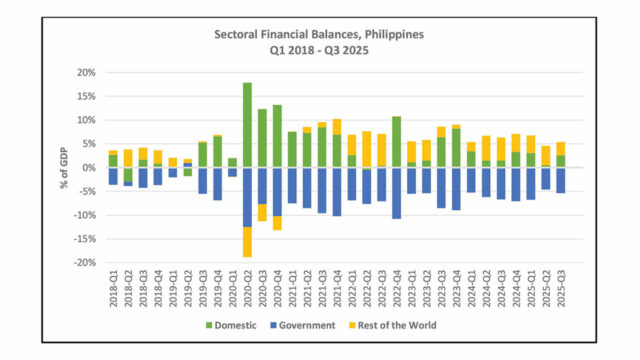
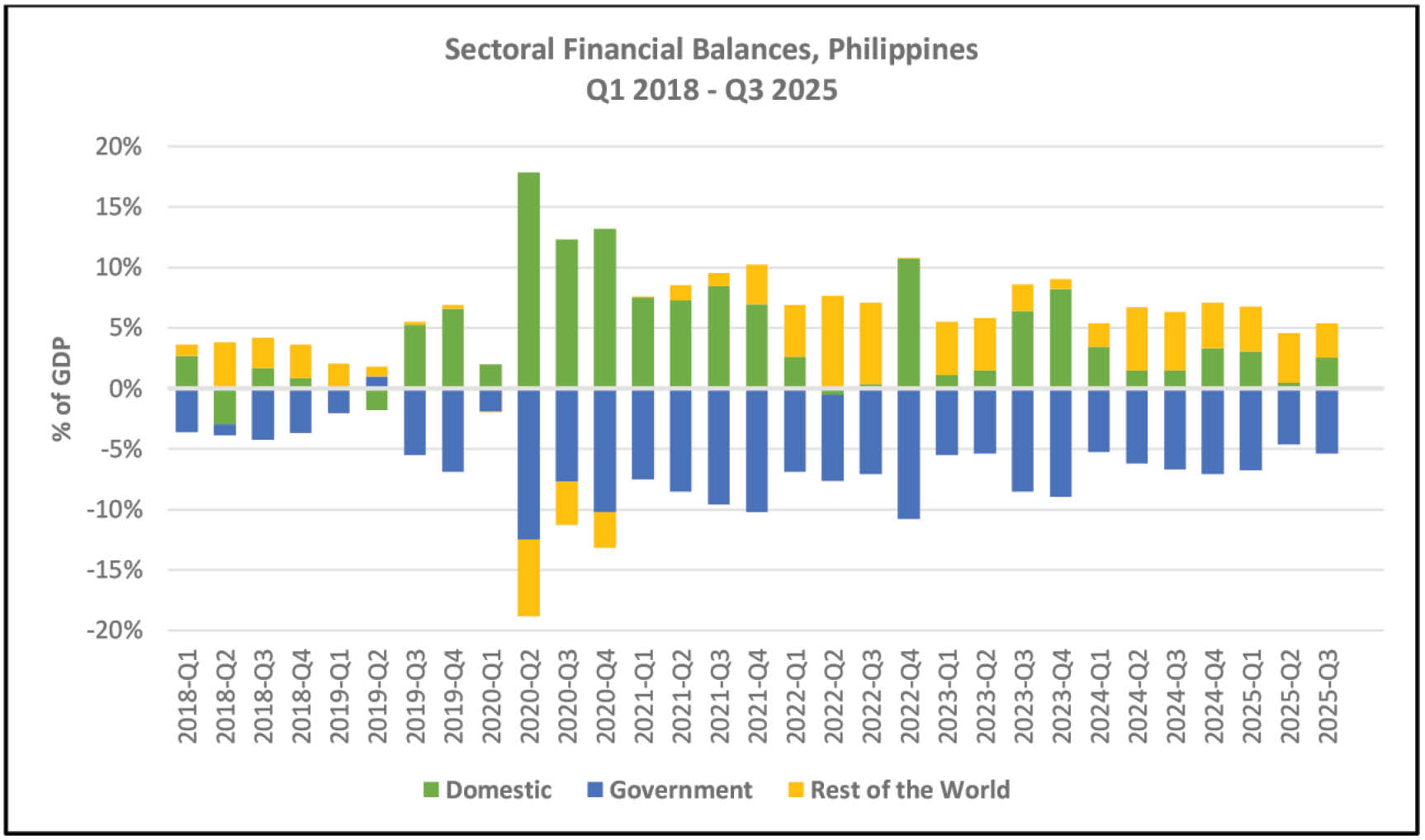
The sectoral balances figure (shown as percent of GDP) documents these arguments. The three bars (sectoral balances) add up to zero, by construction, for each quarter. In most quarters, the Philippines runs a current account deficit (bars above zero in the graph), a fiscal deficit, and a domestic private sector surplus.
Notice the quarters in 2020: large domestic private sector surpluses that mirror large fiscal deficits (up to 10% of GDP). Government deficit hawks do not understand this. Actually, it is the economies with a private sector in deficit the ones that run into crises, as happened just prior to the 2008-09 global financial crisis, not economies with budget deficits above 3%. It was a lack of understanding of private debt that led the entire profession of neoclassical economists to famously miss the build-up of the largest household debt bubble of all time in the 2000s, while simultaneously labeling the period as “the Great Moderation.”
What is difficult to comprehend is that government officials do not seem to understand the economics of the sectoral balances either, and they aim at reducing the fiscal deficit to A = -3% of GDP by the end of the administration, as if it was a great objective and achievement. They think that this helps the economy. This is a self-imposed constraint that reduces the sustainable policy space of the nation. The reason is simple: this forces the overall private sector (B – C) to run a surplus of 3% of GDP. Suppose we run a current account deficit of C = -4%. This implies that the domestic private sector will run a deficit of B = -1% of GDP. We insist that if with the economy that we have, including the current account deficit, the government does not run a deficit, we’d better start reciting all our prayers. The economy would enter a depression.
On the other hand, if we do not want the government to run a fiscal deficit, while maintaining the private sector surplus, we need to change the economy and be able to run a current account surplus (C positive), that is, we need to become Germany, Singapore, or Japan at some point in their history, and have their manufacturing-exporting companies. The current account surplus is the injection into the economy. They do not need another one. In fact, they need to avoid it if such a surplus is large, in which case they have to run a fiscal surplus. Changing the structure of the economy requires an industrial policy, a topic that we leave for another article.
The solution to the corruption scandal is not to kill the fiscal deficit. We would need it with and without corruption. The solution is to improve governance and punish the culprits.
(To be continued.)
Jesus Felipe is a distinguished professor and research fellow at the Carlos L. Tiu School of Economics, De La Salle University. Mariel Monica Sauler is an associate professor and chair of the Carlos L. Tiu School of Economics, De La Salle University. The authors are grateful to Eunice Gerenia, economics student, De La Salle University, for her excellent research assistance.
JAPANESE digital learning platform learningBOX entered the Philippine market with three local partners, seeking to deliver secure, AI-assisted training for businesses and educational institutions.
A memorandum of understanding was signed between learningBOX and its three partners at Shangri-La The Fort in Bonifacio Global City, Taguig, on Tuesday, the company said.
The collaboration seeks to address Philippine skills deficiencies, which is being reflected in unemployment data as companies struggle to find candidates to fill their needs. In October, unemployment was 5%.
The new venture proposes digital learning solutions that could address this issue via scalable tools for employee training and skills verification.
Shintaro Nishimura, director of learningBOX, told BusinessWorld that the platform will allow companies and educational institutions to design industry-specific training programs. “By the end of 2026, we aim to have several local agencies promote these model cases to each industry,” Mr. Nishimura added.
Kotaro Adachi, CEO and co-founder of TechShake Pte. Ltd., an Asian innovation ecosystem enabler, cited the importance of local partnerships and government collaboration. “Even if the technology from overseas is good, it doesn’t work without local relationships,” Mr. Adachi said, noting TechShake’s engagement with the Department of Trade and Industry and the Department of Information and Communications Technology.
“Japan is facing a saturated and aging market, whereas ASEAN countries have a young and growing economy. This trend allows even smaller Japanese companies to expand globally,” Mr. Adachi added.
Dominic de Leon, director of logistics firm Pac Atlantic Group, said he sees the platform facilitating onboarding and continuous learning, particularly in the area of logistics processes and regulatory updates. “The challenge is educating people to use the system properly, but it has the potential to improve efficiency and skills within the workforce,” he said.
Danica Elpidama, business development lead at Digiteer, said such platforms have applications for small businesses and large enterprises alike. “The adoption is positive, especially for Gen Z learners who are already familiar with digital learning environments,” Ms. Elpidama said.
learningBOX provides tools for creating and delivering online exams and training courses with a focus on security and AI-assisted learning. As of August, the platform supports over 850,000 active users and is used by more than 1,600 organizations, including educational institutions and government agencies. The platform was active in over 120 countries and regions as of October 2024. — Erika Mae P. Sinaking
CREDIT INFORMATION CORP. (CIC) generated 27 million reports last year, nearly tripling from 2024, driven by demand from online lenders and e-commerce channels as consumers availed of credit products like buy now, pay later and cash loans.
“[Around] 27 million credit reports generated last year. For the prior year, I think it was only around nine (million). So, it almost tripled,” CIC President and Chief Executive Officer Ben Joshua A. Baltazar told reporters on the sidelines of a central bank event on Friday, adding that they expect to generate “far more” credit reports this year.
Last year’s growth was mainly driven by online lenders, which accounted for about half of the total credit reports generated last year as credit product providers like Shopee, BillEase, or Lazada use CIC data for their underwriting process since they are unable to conduct traditional credit investigation, he said.
“It (online lending) will probably face its own set of risks because it’s largely done online. But it’s a thriving business right now. A lot of Filipinos are consumers. They are putting their earnings into spends. The way we see it right now, there are no internal alarm bells or issues on systemic risk. But what’s important is we have a tool to monitor and be transparent on the financial health of the borrowers,” Mr. Baltazar said.
The inclusion of data on postpaid mobile subscriptions from the country’s major telecommunications companies has allowed CIC to provide more credit information about borrowers, the official said.
“We’re making a push for utilities like electricity, water, maybe even internet for this year. So, that will complete the picture of a person’s financial health.”
Mr. Baltazar added that they are also still looking to onboard insurance information into their database, although there is a pending court case on the matter.
“In other jurisdictions, insurance information is reported. And if, let’s say, lenders find out that they’re actually insured, your credit score goes up. So, this is an opportunity for the insurance sector to be able to improve the value proposition to their clients.”
In 2019, the Makati Regional Trial Court Branch 56 nullified a circular issued by the CIC that required insurers to submit data on premium payments, insurance contracts, and policy loans of its clients.
The court ruled that the requested data are not in line with the basic credit data required to be submitted under the Credit Information System Act.
Mr. Baltazar said the use of credit information makes lending decisions “fairer and more transparent.”
“So, it becomes merit-based now, rather than arbitrary, or in some cases, palakasan (patronage). So, this is exactly the mandate of the law… We’re proud to say that we’re delivering on that mandate,” he said.
“The great thing about it is, if you have a low credit score, you can rehabilitate it and build it up.” — Aaron Michael C. Sy
PHILIPPINE economic growth sharply slowed to a post-pandemic low in the fourth quarter of 2025 as the flood control scandal continued to weigh on government spending, investments and consumer spending, dragging full-year expansion below target for the third straight year. Read the full story.
WINDSOR, England — Britain’s King Charles hosted the first film premiere at a royal palace on Wednesday when a documentary chronicling his lifetime work of championing nature was shown at his historic Windsor Castle home.
Filmed over seven months last year, Finding Harmony: A King’s Vision, which will be shown on Amazon Prime next month, is billed as providing a deeply personal insight into the 77-year-old monarch’s decades of environmental activism and the philosophy which has motivated him.
It shows Charles wistfully reflecting on his experiences, from being dismissed as crazy for talking to plants to his hope that his vision of sustainability, which is being taken up in projects across the world, will save the planet.
“It all boils down to the fact that we are actually nature ourselves, we are a part of it, not apart from it, which is really how things are being presented for so long,” Charles says in the film, which was made in collaboration with the King’s Foundation, a charity he founded in 1990.
“Maybe, by the time I shuffle off this mortal coil, there might be a little more awareness… of the need to bring things back together again.”
PRAISE AND RIDICULE From organic farming to architecture and town planning, the king has long been outspoken on how human behavior needs to be in harmony with nature, drawing both praise for being ahead of his time on green issues as well as ridicule and charges of inappropriate meddling from a man constitutionally required — first as Prince of Wales and now as king — to be above politics.
“All this sort of thing was considered completely bonkers,” he says with a chuckle at one point, while in another scene he is shown collecting eggs from a hen coop bearing the name “Cluckingham Palace.”
Among those who contributed to the documentary is former US Vice-President Al Gore, while actors Kate Winslet, who narrates the film, Judi Dench, and Kenneth Branagh were among the guests joining Charles and Queen Camilla at the 1,000-year-old castle where a cinema has been set up for the occasion.
While the documentary aims to convey a message of hope on the environment, it also comes at a time when US President Donald J. Trump, who is not mentioned in the film, has described climate change as “the greatest con job” in the world.
“It’s rapidly going backwards. I’ve said that for the last 40 years but anyway, there we are,” Charles ruefully says on the battle to save the planet. “So, that’s why I get a bit, anyway… I can only do what I can do, which is not very much.”
The documentary will be available globally to viewers on Amazon Prime from Feb. 6.
“It would be nice to try and see if we can get through to people, but who knows?” Charles says. — Reuters