Home Blog Page 3532

Manila Water: Raw water harvest via backwash recovery system rises by 33%

MANILA WATER Co., Inc. announced on Wednesday that the raw water supply harvested through its “backwash recovery program” has increased by 33% to 40 million liters per day (MLD).

This could support up to 200,000 customers daily, the east-zone concessionaire said in a statement.

The backwash recovery system offers an alternative method of collecting raw water by re-treating the water treatment by-product through cleaning the filter beds, according to Manila Water.

The backwash recovery systems are located at Manila Water’s Balara and East La Mesa treatment plants in Quezon City. There is ongoing construction of a third backwash recovery system at the Cardona treatment plant in Rizal province.

“Aside from the massive investment in constructing new water sources, Manila Water is constantly finding ways to increase the efficiency of its existing facilities,” Manila Water Corporate Communications Affairs Group Director Jeric T. Sevilla said.

The three backwash recovery systems are part of Manila Water’s “larger water security program,” he said.

For 2023, the company’s net income dropped by 6% to P5.59 billion while its revenues grew by 35% to P30.71 billion.

At the local bourse on Wednesday, shares of Manila Water climbed by 30 centavos or 1.39% to close at P21.95 apiece.

The water concessionaire serves the east zone network of Metro Manila, covering parts of Marikina, Pasig, Makati, Taguig, Pateros, Mandaluyong, San Juan, portions of Quezon City and Manila, and several towns in Rizal province. — Sheldeen Joy Talavera

76% of Filipinos plan to travel abroad this year according to Klook travel app

ABOUT 76% of Filipinos have considered traveling internationally this year, with Hong Kong, Singapore, Japan, and Thailand in mind, according to a consumer trends study led by travel platform Klook.

“Domestic tourism maintains interest for Filipinos and people who are traveling. More people are not choosing between domestic or international, they’re going for both if they can,” Klook Philippines General Manager Michelle Ho said in a media briefing on Tuesday.

Klook said Filipinos planning to travel domestically this year reached 92% in 2024.

Tagaytay, Baguio, Boracay, and Palawan are the preferred domestic travel spots and Gen Z especially prefers to travel in big groups of three to six people.

It said local trips usually span four to six days, which can be related to the data that 73% of the respondents take advantage of long weekends.

Filipinos traveling abroad prioritize sightseeing, shopping, and outdoor activities.

“Thailand is gaining a lot of popularity amongst the younger generation… social has a lot to do with that, being able to share different types of content to see what to do in [there],” Ms. Ho said.

ALREADY BOOKED
Klook’s survey found that 63% of Filipinos who have plans to travel have already booked tickets, accommodations, or activities for their trip this year.

“I think when it comes to long weekends, when it comes to our quick getaways, a lot of Filipinos still choose to go on vacations and have more experiential space when they travel with the family and friends,” Ms. Ho said.

She said its bookings have tripled in 2023 with the average basket size increased by 21% attributed to the following international destinations: Hong Kong Disneyland, Tokyo Disneyland, Universal Studios Japan, and Universal Studios Singapore.

The local attraction is Manila Ocean Park.

The travel company’s revenue grew by four times in 2023 from 2022 attributed to promoting local and outbound tourism, she said.

Ms. Ho said 66% of Millennials and Gen Zs in the Philippines were willing to spend up to 50% more now.

The survey started in mid-February last year and covered respondents who were Klook and non-Klook users in Metro Manila.

Among Klook’s partnerships in the previous year were the Professional Association of Diving Instructors (PADI) in the last quarter and the Klook Intramuros Pass.

TAYLOR SWIFT
“Music and sports tourism is going to be big in Asia,” she said.

In 2023, Klook was appointed as an official ticketing partner for The Eras Tour of the singer Taylor Swift and it saw queues go up to two million and sold out its tickets in six hours.

Ms. Swift is currently partway through the six sold-out shows in Singapore.

“In Singapore and what that meant for us is that for anyone who wanted to watch Taylor Swift, they put the concert tickets and the overnight stay as a bundle package,” Ms. Ho said.

She said Filipinos were the top bookers, accounting for a 10% share of the bookings.

SOCIAL MEDIA DRIVERS
In recognition of social media platforms as the main drivers for motivation for travelers, Klook introduced the Klook Kreator Program. With it, influencers post travel content on their pages supported by an affiliate program to get a commission.

Associate Manager, Partnerships, and Affiliates Head Gianna Maxine M. Santos said the survey found that creators with less than 5,000 followers were more successful as it came across as organic compared to those influencers at a celebrity level.

Jax Reyes, Kriz Uy, and David Hizon are among the influencers in the program. — Aubrey Rose A. Inosante

PHINMA Corp. sees strong performance in education, construction materials

PHINMA Corp. is banking on its education and construction materials segments to drive its growth this year, the conglomerate’s chairman said.

“The two major business groups are education and construction materials. Both of them are showing very strong performances,” PHINMA Corp. Chairman and Chief Executive Officer Ramon R. del Rosario, Jr. said on the sidelines of a launch event last week. 

The conglomerate is aiming to continue the growth of its education business, he added.

PHINMA Corp. has business interests in the education sector through its subsidiary, PHINMA Education Holdings, Inc., which manages Horizon Karawang in West Java, Indonesia, as well as other schools in the Philippines such as PHINMA Araullo University in Nueva Ecija

“[The] education [unit] is very stable and on a growth path that has been uninterrupted even during the pandemic. We hope that will continue. We’ve expanded to Indonesia also and we have high aspirations for Indonesia. We hope that Indonesia will show a pattern that is similar to what we are experiencing in the Philippines,” he said. 

He added that the conglomerate is focused on helping the underserved areas.

“In Indonesia and other Southeast Asian countries, there is also a need for this kind of approach. Our success has attracted the attention of international organizations. That’s why we have been encouraged to look at other countries as well such as Vietnam. We will see what we can do there. Although their educational outcomes are much better than ours already, there are also undeserved sectors there,” he said.

Mr. Del Rosario also said that PHINMA Corp.’s construction materials group is benefiting from the government’s infrastructure push.

“We’re riding the boom of the infrastructure program of the government,” he said.

He added that another growth driver for PHINMA Corp. is its venture into insulated panel production, which could also be used for cold storage facilities.

The company is establishing a P500-million insulation panel plant in Pampanga province, which will be capable of producing one million square meters of insulation panels annually.

PHINMA Corp. recorded a 6.5% increase in its 2023 net income to P1.63 billion. The conglomerate’s consolidated revenues rose by 20% to P21.27 billion.

PHINMA Corp. shares rose by 0.50% or 10 centavos to P20 apiece on Wednesday.—Revin Mikhael D. Ochave

PHL tablet shipments to drop further this year — IDC

PRESSFOTO-FREEPIK

THE PHILIPPINE tablet market is projected to decline further this year as more schools and institutions resume face-to-face setups, the International Data Corp. (IDC) said.

IDC sees an additional 1-5% drop in tablet shipments this year after the 39.8% decline seen in 2023.

“Shifting priorities among government agencies over procurement of tablets for educational purposes and as people returned to physical offices led the market to contract [in 2023],” IDC Philippines Senior Market Analyst for Devices Research Angela Jenny V. Medez said in an e-mail last week.

IDC said there was commercial drop in procurements among local government units and the Department of Education for distance learning mode.

For this year, the firm expects tablet shipments to reach a 12-year low.

IDC estimates less than 700,000 tablet shipments to the country this year from the 750,300 units in 2023, based on its latest Worldwide Quarterly Personal Computing Device Tracker.

It also expects Samsung and Cherry Mobile to retain their spot as top performers by market share.

Samsung led the Philippine market with a 29.5% share in 2023. Cherry Mobile followed with a 14.1% share, selling 105,600 units, while Huawei and Xiaomi held 11.8% and 10% shares, respectively, shipping 88,700 and 74,700 units.

“Both vendors offer tablets that conform with the minimum technical specification requirements during procurements and biddings at competitive pricing leading them to win several bids,” Ms. Medez said.

Vendors will need to differentiate themselves from smartphones and personal computers through innovation and unique positioning to stay afloat amid the projected decline in shipments, she added. — Aubrey Rose A. Inosante

Public-Private Partnerships: Unmasking the reality

SEBASTIAN HERRMANN-UNSPLASH

(Part 1)

PUBLIC-PRIVATE Partnerships (PPPs) are long-term contractual arrangements where the private sector provides (builds and sometimes runs) infrastructure assets and services that have traditionally been directly funded by government, such as hospitals, schools, prisons, roads, bridges, tunnels, railways, and water and sanitation plants, and where there is also some form of risk sharing between the public and the private sector. These arrangements started in the 1990s in developed countries and now many developing countries are trying them.

This article is divided into two parts. In the first one, we scrutinize the arguments to justify these contractual arrangements, and the available evidence about their proclaimed benefits. We will discuss Philippine PPPs in the second part.

PPP advocates claim that these arrangements bring financing, efficiency, and innovation. They argue that by using private sector resources and expertise, PPPs have the potential to improve the quantity and quality of service delivery, thus creating better “value for money,” compared to traditional public procurement. These arrangements have increasingly been advertised as the magic solution to the many problems that developing countries face when building infrastructure. The argument also includes the questionable claim that the private sector is more efficient and better able to deliver public services, including energy, education, health, water and sanitation. Certainly, the private sector publicizes these arguments as PPPs open new business areas for some companies.

On these grounds, PPPs have become popular in developing countries, where people have been led to believe that their governments cannot undertake certain infrastructure projects because they do not have the capabilities (poor management and delivery) or because they lack the financial resources.

We read recently a report by the European Public Service Union and the European Network on Debt and Development that summarizes impeccably well the pitfalls of PPPs (PPPs_EN.pdf, nationbuilder.com).

Before getting into the pitfalls, it is important to further elaborate on why developing countries are buying into PPPs — they are bombarded. One reason is that international financial institutions (IFIs) are cheerleaders of these arrangements. Yet, PPPs are poor development advice with a clear political motivation: the privatization of public services. Their advice also comes from the perennial mantra that PPPs address the limited funding resources for local infrastructure or development projects of the public sector. However, sovereign governments like that of the Philippines do not have limited funding resources because these are set in the Peso, the national currency.

Also, developing countries have been duped and led to subscribe to the Sustainable Development Goals (SDGs) of the United Nations’ Agenda 2030. This agenda has set targets for the developing countries in key areas such as infrastructure, health, education, water and sanitation, and gender equality, among others. Developing countries have been told that PPPs are needed to attain them. The problem with the SDGs is that they are no more than a long list of 250 targets that does not amount to development.

Likewise, the Paris Climate agreement requires urgent and immediate action to mitigate and adapt to climate change, particularly in areas such as infrastructure, food systems, and energy. Again, the private sector appears to be the solution.

Finally, the outbreak of COVID-19 has revealed the depth of the inequalities within and between countries, as the crisis induced by the pandemic takes its heaviest toll on the marginalized and most vulnerable communities. Governments across the globe agree about the need for massive investment. This is used as a fourth argument to justify PPPs.

As noted above, PPPs are supposed to solve financial constraints, poor management and delivery (know-how), in developing countries. The know-how problem might be true in very poor countries but this is a problem of both the public and the private sectors. If lack of Government know-how is a problem in a middle-income country like the Philippines (is it really?), the solution should be to expedite learning by the government to acquire the necessary capabilities to design and manage these projects, especially in areas such as education and health, which are the cornerstones of society’s equality.

The financial constraint is an altogether different story. Many governments and international institutions argue that public resources and institutions have to be used to attract private finance to fill a perceived “financing gap.” They have actively promoted PPPs all over the world. We said above that the problem with this argument is that a sovereign government (like that of the Philippines) that uses its own currency cannot have a financing gap.

The report we cite is based on the European experience. It provides plenty of evidence that questions the alleged benefits of PPPs. It draws on case studies across Europe that show that PPPs are proving to be poor value for money. This should be a warning sign for developing countries.

The report outlines the following reasons to question PPPs:

1. PPPs do not bring new money. In a PPP, the public sector does not take a loan to pay for a project. Instead, the private sector arranges the financing and builds the infrastructure. Then the public sector pays a set fee over the lifetime of the PPP contract (at times, users also pay part or all of the fee directly to the private sector company). Therefore, while PPPs might appear to raise new funds due to the private sector taking loans instead of the government, the funding for the project still comes from government budgets and/or end users. This is not noticed because PPP projects are usually recorded off the government’s balance sheet, so they do not (misleadingly) impact on debt figures. Therefore, they create hidden debt.

2. Private finance costs more than government borrowing. The cost of private finance is higher than that of public borrowing. Both the OECD and IMF have warned that governments can nearly always raise capital at a lower cost than the private sector.

3. Public authorities still bear the ultimate risk of project failure. Proponents of PPPs argue that they are able to transfer project risks from the public to the private sector. However, public authorities still bear the ultimate risk of project failure. IFIs advise governments to guarantee profits for their private partners and urge governments to “de-risk” commercial providers to attract their investments.

4. There is a triad of bogus arguments often mentioned to support PPPs, namely that they offer better value for money, that they bring efficiency gains, and that they are transparent. The reality is that PPPs don’t guarantee better value for money, that efficiency gains and design innovation can result in corner-cutting, and that PPP deals are opaque and can contribute to corruption.

PPPs have rarely delivered better “value for money” than reasonably managed public projects. Likewise, PPP promoters argue that private sector companies introduce efficiency in the delivery of infrastructure and public services. Efficiency gains can come from improvements in design, construction, and operations. Yet, the theory is ambiguous and the empirical evidence is mixed. If there have been any efficiency gains, these have resulted from risky cost-cutting and a decline in service quality, e.g., in public infrastructure or healthcare provision. Also, many PPP deals are opaque and can contribute to corruption. Private companies often insist that many aspects of PPPs be kept secret, usually including the contracts themselves.

5. PPPs do not guarantee projects being on time or on budget. There is a general belief that private sector companies are better than the public sector at delivering projects on time and on budget. However, the evidence does not support this claim.

6. PPPs distort public policy priorities and force publicly run services to cut costs. PPPs have to be commercially viable, or private companies will not take part in them. This distorts policy decisions: some projects are not selected because they are not commercially viable; others are selected because they appear to be commercially viable; and some are adjusted to make them more attractive to the private sector, even if this means a decrease in the level of service.

This summary shows that PPPs come at a high cost and have not delivered the expected benefits. For this reason, developing countries ought to rethink the idea altogether. At least, government officials of developing countries need capacity-building to better manage PPPs, as well as the development of standardized contracts or other tools to help these contracts work more smoothly.

The Report makes two recommendations that we share: (i) halt PPPs in the social sectors, including health, education, and water; and, (ii) increase public investment in public services, to be financed by progressive taxation. This is the only way for citizens to get access to the high-quality and universal public services they deserve. Having said this, we acknowledge that there might be room for the private sector to be involved in some public-sector projects but only when indeed there is a clear rationale for it, and avoiding the pitfalls we discussed above.

(To be continued.)


Jesus Felipe is a distinguished professor of Economics at De La Salle University. Pedro Pascual is a board-certified economist with Spain’s Ministry of Economy, and a partner at MC Spencer (Philippines).


Dining In/Out (03/14/24)


Paella Gigante returns to Ayala Malls

A well-loved culinary spectacle returns at the Greenbelt 3 Park in Makati. After a pandemic hiatus, the Paella Gigante will once again be cooked, this time on March 16 at 4 p.m. Spanish dance and music will also be performed while an authentic Spanish paella is cooked on a giant paellera. Guests are encouraged to come in their most colorful attire. Tickets are now available for P500 at the Greenbelt 3 Cinema Ticket Booth, and all proceeds from the event will be contributed to Sociedad Espanola de Beneficencia (a charity aimed to improve the well-being and quality of life of indigent and elderly Spaniards and Filipinos). For inquiries, call 843-0742 or e-mail info@senfil.org.


Newport World Resorts hosts Manila Coffee Festival

From March 15 to 17, Newport World Resorts will play host to this year’s Manila Coffee Festival (MCF) and “KapeTalks,” a series of in-depth discussions advocating the Philippine’s coffee culture and natural heritage. Spread across the three-day coffee lifestyle event, it is crafted to connect coffee makers, growers, and environmental spokespersons to all who enjoy a good cup. This year, the MCF returns to the MGBx Convention Hall at the Marriott Manila. Headlining KapeTalks is Kingson Sian, President and CEO of Newport World Resorts. Other speakers include environmental advocate and coffee enthusiast Howie Severino who will talk about his approaches to sustainability; culinary heritage advocate Dr. Kathleen Apilado who will discuss artisanal sea-salt making practices; and mambabatok Ammin Acha-ur who will talk about the thousand-year-old tradition of indigenous stick-and-thorn tattooing. The MCF is also setting the stage for homegrown talent in music and art. The Performance Theater will feature OPM stars such as Jikamarie, Leanne & Naara, Rangel, and more. Tickets are available at https://mcf24.helixpay.ph/. The Expresso Pass grants unlimited access to the full three days of the festival for P850, while a P350 regular pass can be used for any one day of the festival. A discounted rate of P200 is available for students, senior citizens, and Persons with Disabilities (PWDs) upon presentation of valid IDs at the festival venue. For more information on the Manila Coffee Festival, visit https://www.newportworldresorts.com/manila-coffee-festival-2024


Johnnie Walker introduces Blonde

Johnnie Walker has officially introduced a lighter and brighter style of Scotch whisky with the launch of the new Johnnie Walker Blonde earlier this year. Johnnie Walker Blonde is a sweeter blend of scotch that’s made for mixing, a new whisky that is unexpectedly light. Hydra Bersales, Diageo Philippines Innovations Marketing Manager, said, “Johnnie Walker is a brand built on a philosophy of progress that constantly pushes boundaries. Johnnie Walker achieves this with the launch of Johnnie Walker Blonde, a blend that’s made for curious Scotch lovers or those who are only beginning to discover whisky.” Johnnie Walker Blonde has subtle fruity notes and a smooth vanilla finish and is made from a blend of wheat and fruity malt whiskies. It is available online through Shopee and Lazada and in all leading supermarkets nationwide.


Hilton celebrates women in art and cuisine in March

Hilton properties across the Philippines are poised to hold a month-long celebration of women. At the Hilton Manila, a 10-Hands Culinary Series at Kusina Sea Kitchens pays homage to the contributions of women in the culinary realm. Throughout March, five of the restaurant’s leading female chefs will be showcasing their signature dishes from their respective specialty kitchens. Savor the flavors of Pochero from the Filipino Kitchen, Pad Thai from the Asian Kitchen, Premium Roasts from the Western Kitchen, Black Salmon Roll from the Japanese Kitchen, and an array of sweets at the Dessert Kitchen. The weekday dinner buffet is P2,800++ per person, while the weekend lunch and dinner buffet cost P3,000++ per person, with unlimited flow of beverages, including Barefoot Pink Moscato. Guests can also enjoy the CelebrEat 3+1 promotion at Hilton Clark Sun Valley Resort’s all-day dining buffet restaurant, Olive, where an additional guest gets to eat for free with every three paying adult guests. The spread includes Western roasts, Asian favorites, and an abundant dessert spread. For the month of March, all women diners will also get a complimentary chocolate treat. Olive’s lunch buffets are priced at P1,950 net from Fridays to Saturdays, and P2,400 net on Sundays. Dinner buffets are priced at P2,200 net from Mondays to Thursdays and priced at P2,400 net from Fridays to Sundays. Meanwhile, the resort’s bar, Treat, unveils its Pink Potion cocktail, featuring mint cherry candy-infused vodka, raspberry syrup, white chocolate syrup, peach Schnapps, lemon juice, and vanilla, priced at P450 net. From March 19 to 25, Conrad Manila will be hosting “Breaking the Glass Canvas,!” an art exhibit done in collaboration with Art Anton and The Artists’ Backroom, at the C Gallery. It showcases the works of nine up-and-coming local female artists namely, Flora Baradi, Addie Cukingnan, Anita Del Rosario, Irish Galon, Helena, Lara Latosa, Celeste Lecaroz, Lydia Velasco, and Meneline Wong. Meanwhile, the hotel’s C Lounge invites cocktail enthusiasts to try its exclusive Floral Femme Cocktail which is only available for March at P480++. It’s made of Campari, honey, lemon, and garbanzos. For more information, visit www.conradmanila.com, www.hiltonmanila.com, and www.clarksunvalleyresort.hilton.com.


Sheraton Manila Bay presents Italian Feast

Sheraton Manila Bay launches an Italian Wine Dinner Buffet and Wine Tasting, in partnership with Sommelier Selection, an importer and distributor of estate wines in the Philippines since 2002. Featured wines include Liboll Spumante, Cantine San Marzano, Brunori Azienda, Azienda Agricola Occhipinti, and Edda Lei Bianco. The Italian Wine Dinner and Wine Tasting is available for P3,800 net per person. For more information, call 5318-0788 or e-mail sh.mnlsb.fnb@sheraton.com.

GoTyme expects profitability within three years

GOTYME BANK expects to be profitable within the next three years as it plans to introduce more products and as its customer base continues to grow.

“Our sister company, TymeBank in South Africa, broke even in under five years, making it the fastest profitable standalone digital bank in South Africa. GoTyme Bank is bullish on achieving profitability even faster than TymeBank in South Africa since we’re significantly ahead of them on all key metrics over the same time period,” GoTyme Co-Chief Executive Officer and Chief Commercial Officer Albert Raymund O. Tinio said in an e-mail.

The Gokongwei-backed digital lender began commercial operations in October 2022 and has since grown its customer base to 2.7 million. GoTyme Bank President and Chief Executive Officer Nathaniel D. Clarke said they aim to grow their customer base to five million by the end of this year.

“Throughout the rest of the year, GoTyme Bank plans to introduce new products and services to cater to diverse financial needs,” Mr. Tinio said.

Disbursements for its small business loan product are expected to grow significantly to reach a “sizeable small business lending book size” by the end of this year, Mr. Clarke noted.

GoTyme Bank launched its first loan product for micro, small, and medium enterprises late last year in partnership with PayMongo.

“We have seen great adoption of the loan product through our collaboration with PayMongo while this is still in the early ‘test and learn’ phase with PayMongo’s customer base,” he said.

He added that GoTyme Bank will be introducing dollar-denominated deposit accounts this year, in addition to investment products, rewards and benefits for GoTyme Bank Visa debit card holders.

“The GoTyme Bank Visa debit card is offering more rewards whenever our customers use it shopping abroad, gassing up with Caltex, or flying with Cebu Pacific,” he added.

Mr. Clarke said he is optimistic about the outlook for the digital banking industry as there is a pent-up demand for digital financial services.

GoTyme Bank is a partnership between the Gokongwei group, which holds a 60% stake, and Singapore-based digital banking group Tyme, which has 40%.

It is one of the six online banks that got licenses to operate from the Bangko Sentral ng Pilipinas, with the others being Tonik Digital Bank, Inc., Maya Bank, Overseas Filipino Bank, UNObank, and UnionDigital Bank. — Aaron Michael C. Sy

OPPO starts pre-orders for Reno11 F 5G phone

OPPO Philippines this week started taking pre-orders for the Reno11 F 5G smartphone released last month, which it calls the “portrait expert.”

The Reno11 F 5G is priced at P18,999, OPPO in a statement. The pre-order period started on Tuesday and will run until March 22.

The phone has three colorways: ocean blue, palm green, and coral purple.

Those who will pre-order via OPPO’s official Shopee, Lazada, and TikTok Shop plaforms will receive a QX7 Pro Smart Watch for free.

“This season’s latest must-have device and latest Portrait Expert, the OPPO Reno11 F 5G, is capable of giving ultra-clear photos and videos you can view on a large and bright screen, fitted with long battery life and super-fast charging capabilities, all in a stylish and unique smartphone design,” the brand said.

The Reno11 F has a 64-megapixel (MP) main camera suitable for low-light photography along with 8MP and 2MP lenses in its rear camera array. It also has a 32MP selfie camera.

It comes with the Portrait Expert Engine, which consists of features such as facial recognition, subject and scene separation, clarity, facial enhancement, portrait, and environment merging.

4K HD video recording is also available.

The smartphone features a borderless 6.7-inch AMOLED display with a refresh rate of 120Hz and 900 nits brightness.

It has a 5,000mAh battery and supports fast charging with 67W SUPERVOOC.

The Reno11 F 5G has a IP65 waterproof and dustproof rating. — A.R.A. Inosante

Growing the electronics industry

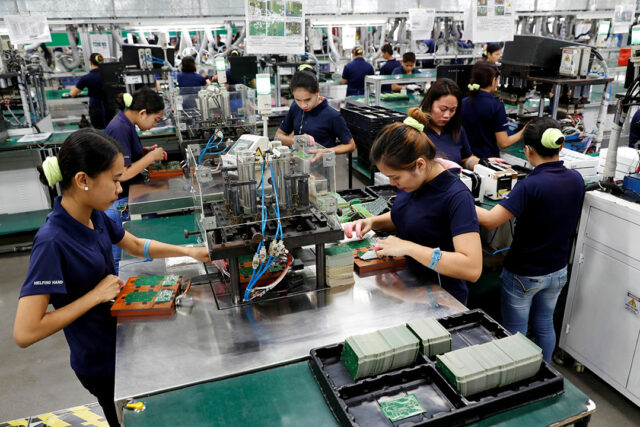
WORKERS at the assembly line of Kinpo Electronics factory in Malvar, Batangas, Aug. 10, 2018. — REUTERS

Visiting US Commerce Secretary Gina Raimondo told a press conference on Monday that US investors were looking at the Philippine semiconductor industry with the target of increasing the number of packaging, testing, and assembly facilities in the country. This is to primarily diversify the US chip supply chain, which she said was too concentrated in a few countries.

Given the Philippines’ proximity to Taiwan, which is a major chip producer, I guess it does make sense for the US to look just a little down south. After all, Taiwan and the Philippines use the same shipping lanes to the West. Ditto for major chip makers South Korea and China. We are all in the same general area of the globe, including Japan, which is reviving its chip-making industry.

And it may be easier for foreign manufacturers now operating in China to relocate to other production hubs in the region, rather than having to go back to their home countries. Taiwan and the Philippines are the options, and perhaps even Vietnam. Japan, in fact, is bent on boosting its chip-making industry ASAP by putting more resources in Japan and in Taiwan operations.

One cannot help but think that present developments in the semiconductor industry are all connected to geopolitics, as a way of limiting the world’s electronic chip dependence on China. Foreign companies now manufacturing in China can move production bases back “home” or to economic allies in the Asian region.

The US Commerce Department has imposed new restriction on exports to China of semiconductors and other technology products amid political tensions. And now, the US government is also offering tax breaks and perks to US electronic companies to move out of China and go to ally countries. Japan has also restrictions on the sale to China of chip-making equipment.

These are unsurprising moves for Japan and the US, which suffered chip shortages because of supply chain issues during the COVID pandemic from 2020 to 2022 and then after. Note that the US, Japan, and Korea are all major automotive manufacturers, and the car industry was among those adversely affected by chip shortages.

And with the electric vehicle industry growing globally, batteries, electronic chips, wiring harnesses, and electronic components are now in even greater demand worldwide. The race is on in securing minerals and other raw materials as well as supplies needed in electronics production. Speed to market requires the proximity of resources to production hubs and customers.

Going back to the US looking at the Philippines, recall that electronics companies Analog Devices, Amkor Technologies, and Texas Instruments, among others, have been operating in the country since the 1970s. Intel also has a plant in the Philippines. And Motorola was here for some time. In short, the US electronics industry has been producing here for the last 50 years.

To date, the Philippines reportedly has 13 semiconductor assembly, testing, and packaging facilities. And then there are numerous electronic manufacturing service providers and assemblers. Wiring harness companies operate here as well, and car components makers as well as producers of consumer durables.

Ms. Raimondo points to the Philippine advantages: talent, expertise, democracy, rule of law, transparency, anti-corruption, and reasonable regulations; in what seemed to be a dig at China. But, of course, this is not to mention the US attempt to strengthen relations with the Philippines to mitigate our stronger pivot to China as a political and economic partner.

Department of Trade and Industry (DTI) Undersecretary and Board of Investments Managing Head Ceferino S. Rodolfo noted that this US initiative was anchored on local “talent development,” and thus the need for “skilling and upskilling” the local talent pool. The US is said to be offering over $50 billion in subsidies to chip makers operating in China to relocate back to the US or its allies.

But American Chamber of Commerce of the Philippines Executive Director Ebb Hinchliffe said the cost of power in the Philippines is the major challenge. “The biggest obstacle is the cost of energy and consistent power. You can’t have a wafer factory or a semiconductor factory to go on and off, because that could cost you a million dollars,” Mr. Hinchliffe said.

Considering the developments in technology now, one industry insider told me that other than the cost of power, the other challenges moving forward are cost of financing and cost of logistics. He mentioned the transition away from the labor arbitrage model, where competitiveness is derived from lower cost of labor in production, because of automation and artificial intelligence.

Simply put, particularly in electronics manufacturing and semiconductors, business owners are bound to invest more in “smart” factories that can efficiently run with fewer workers. This, in a way, will shift labor cost away from factory workers to factory managers, and will push more investments into robotics, automation, and operations with limited human intervention.

Obviously, this transition to new technology will require a big amount of capital, which can drive up the cost of financing. High-technology manufacturing, with automation and artificial intelligence, will also push up the electricity requirement of operations. Then, higher manufacturing efficiency can lead to faster turnaround times and greater demand for logistics.

As technology costs come down, and labor costs drop, cost of energy, financing, and logistics will become more important considerations, and will greatly influence competitive advantage. Manufacturing will more likely gravitate closer to what the insider referred to as points of consumption where logistics, cost of money, and energy costs will also be lower.

He also noted the need to boost the local design talent pool, noting that originality in design and product or process uniqueness would become more important considerations in the future. Thus, there is even greater need to develop downstream industries, with Philippine-designed electronic products making use of locally made chips and locally assembled components.

The greater challenge, I believe, is whether the government, through its policies, can help local manufacturers take advantage of emerging opportunities in the electronics industry. Success cannot rely solely on the private sector. There should be a concerted effort, a stronger public-private partnership, to bring the Philippines to the 22nd Century.


Marvin Tort is a former managing editor of BusinessWorld, and a former chairman of the Philippine Press Council.

matort@yahoo.com

Globe Telecom completes pilot run of hybrid solar power in 26 sites

GLOBE Telecom, Inc. said it plans to deploy hybrid solar power systems across its cell sites after the company completed the pilot test run of the technology across 26 sites.

“Successfully implementing hybrid solar power across multiple sites represents a big leap in our efforts to decarbonize our operations,” Joel R. Agustin, head of network planning and engineering at Globe’s network technical group, said in a media release on Wednesday.

This move allowed the company to generate a total savings of P6.9 million, and a total of 67,000 kilowatt-hours of electricity consumption reduction, Globe said.

“Encouraged by the promising results, Globe is set to progressively deploy its hybrid solar power technology across its cell sites,” the company said.

Globe also said its shift to renewables ensures a reliable source of power as it taps hybrid solar power technologies.

The company is aiming to cut its greenhouse gas emissions by about 50% by 2030 as part of its net-zero roadmap.

At the local bourse on Wednesday, shares in the company closed unchanged at P1,760 apiece. — Ashley Erika O. Jose

The world has too much wine, and farmers are ripping up vines

AUSTRALIAN grape-grower Tony Townsend destroyed half his 14-hectare vineyard last year.

The fields were healthy and vibrant, but he estimates he would have lost about A$35,000 ($23,000) to harvest them. While a heatwave is holding him back from ripping out the rest, he plans to finish the job once the weather cools — losing all the vines he’s tended for the past decade.

“I enjoyed being in the wine industry, but it was just economically unviable to continue this way,” said Mr. Townsend from his farm, where a pile of discarded plants is waiting to be burned.

He lives in Riverland, a region in South Australia that produces about a third of the nation’s crush. Since 2020, a convergence of COVID-fueled cost increases and Chinese tariffs has pushed up supply and depressed prices in the country. While Mr. Townsend was never fully reliant on grape growing for his income and works part-time in wine and food tourism, not every farmer has been so lucky.

“There’s a lot of people that don’t see a future in the wine industry,” said Lyndall Rowe, Chief Executive Officer of Riverland Wine, an industry group representing growers and wine makers.

It’s a problem that’s playing out all around the world. Though global production hit a 60-year low in 2023, a wine glut is persisting, signifying that demand is falling even faster. And while data from the International Organization of Vine and Wine show that global consumption has lagged behind production of wine since at least 1995, the industry has hit an inflection point as changing drinking patterns and lackluster economic conditions look here to stay.

California is currently experiencing “one of the worst imbalances in demand and supply we’ve seen in 30 years,” said Stuart Spencer, executive director of the Lodi Winegrape Commission in the Central Valley. Meanwhile, Australia produced its smallest amount of wine in 15 years in the 2022-23 season but continues to struggle with historically high inventory levels, according to a November report by industry group Wine Australia.

On top of COVID, costs for inputs like fuel and fertilizer have gone up because of the war in Ukraine and insurance premiums are increasing due to climate change, said Richard Halstead, chief operating officer of consumer insights at alcoholic beverage research company IWSR.

“The recent sharp increases in input costs have destabilized wine’s very delicate economic model,” he said.

Meanwhile, secular changes in drinking habits are taking root, with red wine feeling the pain more acutely. More people are drinking lower-alcohol sparkling, rosé, or white wines instead of reds, said Christophe Chateau, spokesperson for the Bordeaux Wine Council. Gen Z consumers are also consuming less alcohol, fueling a boom in nonalcoholic drinks.

In Riverland for example, Lyndall Rowe doesn’t expect many red wine producers, which make up almost all of the region’s output, to be able to sell at a profit this season, while some farmers are replacing the vines with other crops like almonds or watermelons.

In Spain, there is an oversupply of Rioja reds, according to José Luis Benítez, director general at industry group Federación Española del Vino, while demand for white wine is high.

Farmers “are going to have problems down the line in one to two years because you can’t transform reds into whites,” he said.

The French government originally allocated €200 million ($216 million) to help farmers nationwide pull up vineyards and send their wine to be converted into ethanol, promising each farmer €75 per hectoliter. Bordeaux, a major red-wine-producing region, received additional funding to pull up 9,500 hectares of land.

But supply destruction isn’t having a major effect. France overtook Italy to become the largest producer of wine in the world in 2023. Sign-ups for the ethanol scheme were so large that each farmer could only offload half the volume they wanted to, according to Chateau.

Bordeaux growers took part in the wider French farmer protests in January blockading roads across the country over the removal of fuel subsidies and EU green policies. Grape farmers won a further €150 million for uprooting vines and planting alternative crops.

But adjustments are particularly hard for an industry like wine to make. Many wine makers go back generations and are steeped in tradition, while the nature of grape-growing means long lead times and grapes themselves can’t be easily sold and repurposed.

“What you plant today will be funding your children’s salaries — or even your grandchildren’s,” said Mr. Halstead. “So when markets change, it can be incredibly difficult to respond quickly.” A well-maintained vine can last for more than 50 years, meaning that investment cycles tend to be measured in generations, he added.

Brands also haven’t done enough to meet new changes, said Spiros Malandrakis, industry manager of alcoholic drinks at Euromonitor International. For example, by focusing on developing premium brands at a time when people’s budgets are being squeezed means the industry is failing to cultivate a new generation of wine drinkers.

“If there are not cheap, economic, reliable wine brands to go to, you will just leave wine and just go into ready-to-drink cocktails or beer or cheap spirit brands,” said Malandrakis, adding that Gen Z’s use of cannabis has also lessened wine’s appeal.

That leaves no option for many farmers but to leave the industry altogether. A survey carried out by Riverland Wine in 2022 found that about a quarter of the region’s growers are planning on quitting in the next three years.

For Mr. Townsend, once he finishes removing his vines he plans to repopulate the barren land with native plants.

“The money that would’ve been lost from our vines towards the end will now return joy to us tenfold when we get to see the native animals and birds come back to our land,” he said. — Bloomberg

Samsung launches Galaxy A35, A55 smartphones

THE LOGO of Samsung Electronics is seen at its office building in Seoul, South Korea, March 23, 2018. — REUTERS

SAMSUNG Electronics Co., Ltd. on Monday launched in the Philippines its latest midrange Galaxy A Series smartphones, the A55 5G and A35 5G, as well as the Galaxy Fit3 smartwatch.

“We saw a positive response to our Galaxy S24 Series, which we launched last January, and we are excited for our users to experience the Galaxy A55 5G and Galaxy A35 5G as well,” Samsung Electronics Philippines Head of Mobile Experience Blue C. Avelino said in an e-mail.

“We are confident that our latest devices, developed in line with our deep understanding of evolving consumer needs, will be received warmly by our Filipino users,” he said.

The Galaxy A55 is priced at P24,990 for the model with 8GB memory and 256GB storage, while the Galaxy A35’s 8GB+256GB model costs P20,990. Both are available for purchase starting March 18. Models with 128GB storage can be ordered exclusively via Globe Telecom and Smart Communications. 

Meanwhile, the Galaxy Fit3 is priced at P3,490.

The Galaxy A35 and A55 smartphones feature a 6.6-inch screen and Super AMOLED Display with up to 120Hz refresh rate.

Both models have a 50-megapixel (MP) main camera with optical image stabilization.

The Galaxy A55 also has a 12MP ultrawide camera, 5MP macro lens and 32MP front camera, while the Galaxy A35 has an 8MP ultrawide camera, 5MP macro lens and 13MP selfie camera.

The phones’ cameras have a single take feature, dual recording, and are splash resistant, Samsung said.

“Security features such as Knox Vault, as well as new photography capabilities inspired by Galaxy’s flagship camera innovations and… adjust to users’ surroundings with Vision Booster,” Mr. Avelino added.

Galaxy A55 is powered by an Exynos 1480 processor, while the Galaxy A35 has an Exynos 1380 chipset. Both have advanced heat control and a 70% larger cooling system.

The A55 has a glass back panel and metal frame on the side, while the A35 has a plastic frame.

The available colorways for both phones are ice blue, navy, and lilac. — A.R.A. Inosante

ADVERTISEMENT
ADVERTISEMENT