Home Blog Page 2750

Converge rules out Sky Cable acquisition

By Ashley Erika O. Jose, Reporter

CONVERGE ICT Solutions, Inc. is considering expanding its partnership with Lopez-led Sky Cable Corp., but has no plans to acquire the company at this time, its chief operations officer (COO) said.

“Probably not at this time, as the financials are quite challenging,” Converge COO Jesus C. Romero told reporters on the sidelines of a forum last week, referring to Sky Cable.

“What we are doing with the network sharing agreement is helping them dramatically reduce their cost then of course improve the product,” he added.

In July, Converge and Sky Cable announced a commercial agreement to upgrade Sky Cable’s network and services. Under this partnership, Sky Cable will use Converge’s network to enhance its offerings.

Mr. Romero noted that acquiring a company involves the challenge of assuming all its liabilities and debt components.

“We have a good balance sheet; it would be a heavy burden,” he said.

“So, instead [of an acquisition] we can just further cooperate,” he added.

Following the denial of its parent company ABS-CBN Corp.’s franchise renewal in 2020, Sky Cable could no longer provide direct-to-home service, forcing it to focus on its broadband subscriber base.

According to its financial report, Sky Cable’s debt stood at P4.5 billion to date.

“The reluctance to pursue an outright acquisition in the near term probably stems from Sky’s debt burden,” Chinabank Capital Corp. Managing Director Juan Paolo E. Colet said in a Viber message.

Pursuing an acquisition would not make sense for Converge considering the risks, especially since their partnership with Sky Cable is at an early stage, he said.

Earlier this year, Converge expressed interest in acquiring Sky Cable after Pangilinan-led PLDT Inc. withdrew its plan to acquire the unit of ABS-CBN.

“The parties are more focused on exploring ways to expand their collaboration so that Sky has a viable opportunity to grow its business, pay down debt, and return to profitability,” Mr. Colet said.

For Globalinks Securities and Stocks, Inc. Head of Sales Trading Toby Allan C. Arce, Sky Cable is anticipated to expand its reach without incurring significant capital expenditure under its current partnership with Converge.

“This is especially important for a company like Sky, which might lack the financial strength to undertake such an expansion on its own,” Mr. Arce said in a Viber message.

“Converge’s decision to explore further partnerships with Sky while ruling out an acquisition suggests caution on their part. Acquiring Sky, which is burdened with debt, could introduce financial risks to Converge,” he added.

In August, Converge revised its revenue growth forecast for 2024 to between 12% and 14%, up from the earlier estimate of 7-8%, driven by market optimism after stronger second-quarter  earnings.

For the second quarter, Converge registered an attributable net income of P2.74 billion, up 29.8% from the P2.11 billion in the same period last year.

Despite posting increased gross expenses for the April-to-June period at P6.18 billion, 15.1% higher than the P5.37 billion previously, the company managed to register higher earnings on elevated revenues.

CONVERGE’S DATA CENTERS
To capitalize on the growing interest in digitalization, Converge is considering establishing additional data centers in the country, following the planned operation of two data centers in 2025.

Last week, the company said it would open two data centers with a combined capacity of approximately 13 megawatts (MW) next year.

“I think we will open it by the middle of next year,” Mr. Romero said. “The construction is still ongoing.”

The company said its immediate plan is to complete the construction of its two data centers, with additional data center expansions being considered.

“Data center supply is growing. For us, because we only have two and both are full, we need to expand,” he said.

The planned expansion, once realized, would be in a different area, he said, adding that the company has already identified sites for the project.

“We already have identified certain sites but we need to finish these two first. We can go with the third, fourth or even fifth data center but we have not pulled the trigger yet,” he said.

For now, Mr. Romero said the company is considering establishing its data centers in the Visayas or Mindanao.

“Our usual suspects, because our two data centers are in [Luzon] — maybe Cebu or Davao and by the way our submarine cable will land in Davao. Most likely there, or South Luzon,” he said.

Converge’s Pampanga data center has a capacity of 10 MW and offers up to 1,200 racks, while its Caloocan data center has a capacity of three MW and provides up to 290 racks.

Ovialand eyes higher valuation for IPO

OVIALAND.COM

OVIALAND, Inc. plans to launch an initial public offering (IPO) at a higher valuation, potentially next year, depending on market conditions,” the real estate developer’s president said.

“Definitely, (our IPO) will (have) a much higher valuation because the company has grown,” Ovialand President and Chief Executive Officer Pammy Olivares-Vital told reporters on the sidelines of the Shareholders’ Association of the Philippines’ third general membership meeting in Makati City last week.

Ms. Vital said that Ovialand is open to having the IPO next year, depending on investor appetite.

“Right now, we’re still a little indefinite with the listing date. Although we are still actively fundraising. (The IPO is) not for this year, but we’re open for next year,” she said.

In June last year, Ovialand announced that its planned P2.2-billion IPO was deferred due to “poor market conditions.”

“Once the larger IPOs happen, those will be a signal for us that the foreign funds are already open, so we’ll be open to entertaining it. Their success would be an indication for smaller companies like us that foreign funds are back and open,” Ms. Vital said.

Ovialand saw double-digit growth in sales, revenue, and net income for the first half, according to Ms. Vital, without citing specific figures.

“We approached the first half with an aggressive stance. We knew that it was going to be an uphill battle. It was rewarding. We are up double-digit in sales, revenue, and net income. We are eyeing 30% growth annually. It is practically doubling the company every two years,” she said.

“The listing is not the goal. The goal is to expand. There are other ways for us to expand. The goal is to keep on growing our production capacity,” she added.

Ms. Vital also said Ovialand is in the final stages of launching its second development in partnership with Japan’s Takara Leben.

In January, Ovialand and Takara Leben collaborated on their first project, the 6.5-hectare Savana South development in Laguna, which features 657 homes aimed at the premium affordable housing market.

Ovialand has developments in Southern Luzon and Bulacan, including Savana, Santevi, and Sannera in Laguna; Caliya in Quezon; Terrazza de Sto. Tomas in Batangas; and Seriya in Bulacan. — Revin Mikhael D. Ochave

China auto brands Omoda, Jaecoo to expand in PHL

AUTOMOTIVE brands Omoda and Jaecoo, both from China, are set to expand in the Philippines with the opening of a flagship branch in Alabang by the fourth quarter.

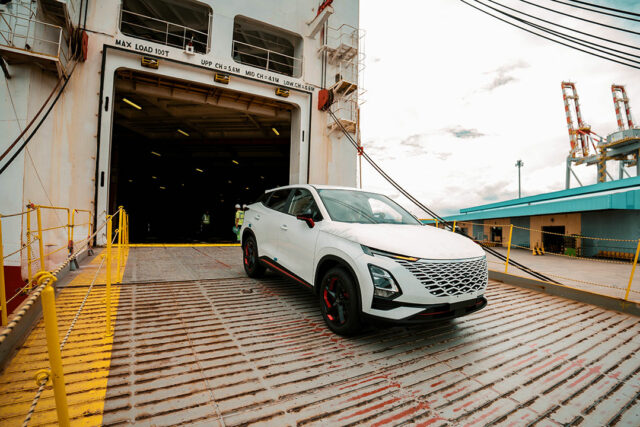
In a statement released over the weekend, Omoda announced that its first car shipment to the Philippines will feature the Omoda 5 and Omoda E5 models.

“The arrival of these vehicles is the first step in solidifying the presence of Omoda and Jaecoo in the Philippine market,” said Marco Chen, country director of Omoda & Jaecoo Motor Philippines, Inc.

“The Omoda 5 and Omoda E5 aim to give Filipinos a taste of automotive engineering that’s unique to Omoda and Jaecoo,” he added.

The two variants will be available at all Omoda and Jaecoo dealerships in Alabang, Pasig, Manila, Quezon City, Ortigas, Calamba, and Iloilo, which are scheduled to open between September and November.

 “In the meantime, interested buyers can test-drive and pre-order the cars through mall displays in SM Aura Premier, Ayala Mall Feliz, Ayala Malls Circuit Makati, Ayala Malls Glorieta, Evia Lifestyle Center, and Ayala Alabang Town Center, starting mid-September,” the company said.

“The first 100 buyers will also receive a special package care from Omoda & Jaecoo Philippines,” it added.

The Omoda 5 is the brand’s crossover sport utility vehicle, while the Omoda E5 is the brand’s first electric vehicle equipped with an NCM (nickel-cobalt-manganese) lithium battery.

Aside from Omoda 5 and Omoda E5, the company is also bringing other Omoda and Jaecoo models to the Philippines, Mr. Chen said.

“To exhibit our commitment to bringing the DNA of our brand’s innovation to the Philippines, we’re also excited to announce that other Omoda and Jaecoo cars such as the Omoda 3, Omoda 7, and Jaecoo J6 are also scheduled to arrive in the Philippines,” Mr. Chen said.

“The arrival date and pricing of these models will be announced soon,” he added.

In terms of warranty, the company aims to offer a seven-year or 200,000-kilometer warranty on its vehicles, with engines receiving a 10-year or one million-kilometer warranty.

“The brand has also teamed up with logistics company DB Schenker to host the vehicles’ spare parts in a local warehouse,” it added. — Justine Irish D. Tabile

TMP says it leads Port of Batangas collections

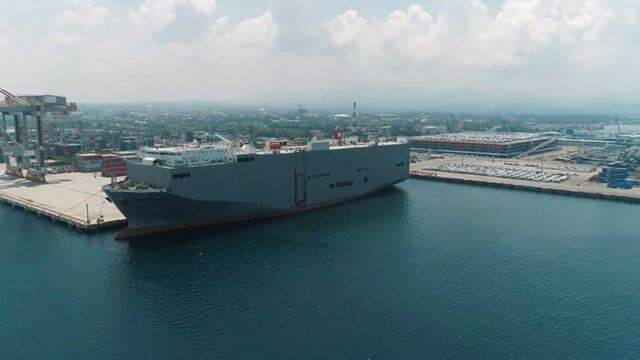
THE BUREAU of Customs (BoC) at Port of Batangas (PoB) collected P18.7 billion in duties and taxes from Toyota Motor Philippines Corp. (TMP) in the first quarter, making TMP its largest revenue contributor, the car manufacturer said.

“This substantial contribution underscores TMP’s significant role in the positive district collection performance as reported by the PoB,” the company said in a statement over the weekend.

The PoB serves as a key gateway for TMP, handling not only Toyota and Lexus models but also production parts and service components from the Asia-Pacific region.

The port is connected to TMP’s Batangas Vehicle Center, located in Barangay Balagtas, Batangas City. This facility acts as a processing and distribution hub for products shipped to Toyota dealerships across Visayas and Mindanao.

TMP said it collaborates closely with the BoC to ensure efficient trade facilitation.

In February 2024, TMP became one of the first organizations to be certified as an authorized economic operator  Level 2 by the BoC.

Toyota noted that the certification indicates compliance with global trade standards and a commitment to quality assurance for its customers.

Being one of the top private contributors to revenue collection, TMP has two representatives appointed as founding members of the newly established PoB Customs Industry Consultative and Advisory Council (CICAC).

According to Customs Memorandum Order No. 02-2024, CICAC will act as a consultative body between the BoC and the business sector to address customs and industry issues. — Justine Irish D. Tabile

Battery assault

PHOTO BY KAP MACEDA AGUILA

BMW Philippines fortifies its BEV portfolio with 2 new models

SMC ASIA CARS Distributors Corp. (SMCACDC) or BMW Philippines has already been known for being a company at the forefront of purveying battery electric vehicles (BEVs). This confidence has resulted in a slew of relevant releases over a relatively short span of time.

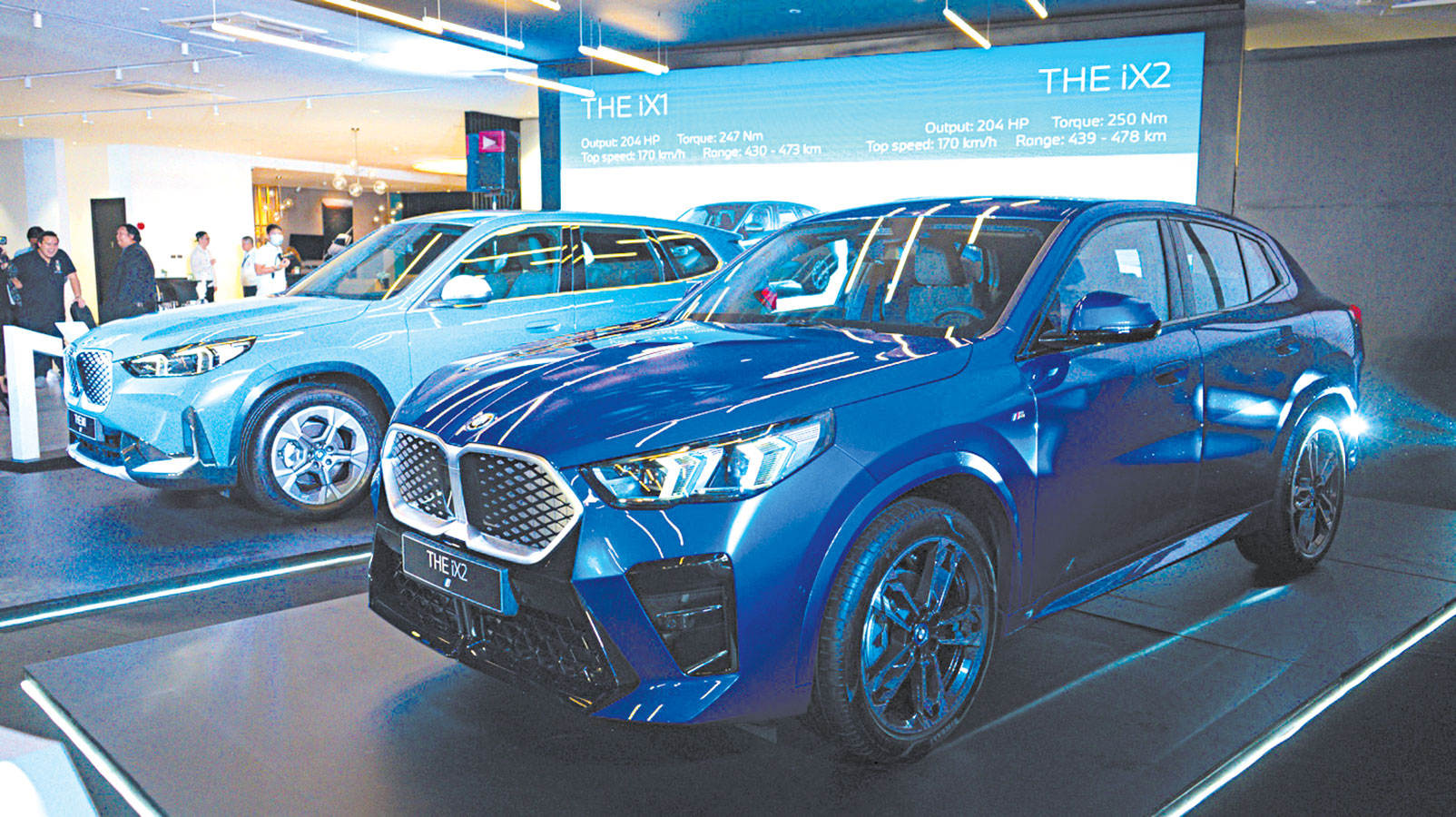
Recently, the Munich-headquartered brand unveiled a “sports activity vehicle” (SAV) — BMW parlance for SUV — and a first-ever “sports activity coupé” (SAC) — both fully electric, and now bring the total number of BMW BEVs here to eight.

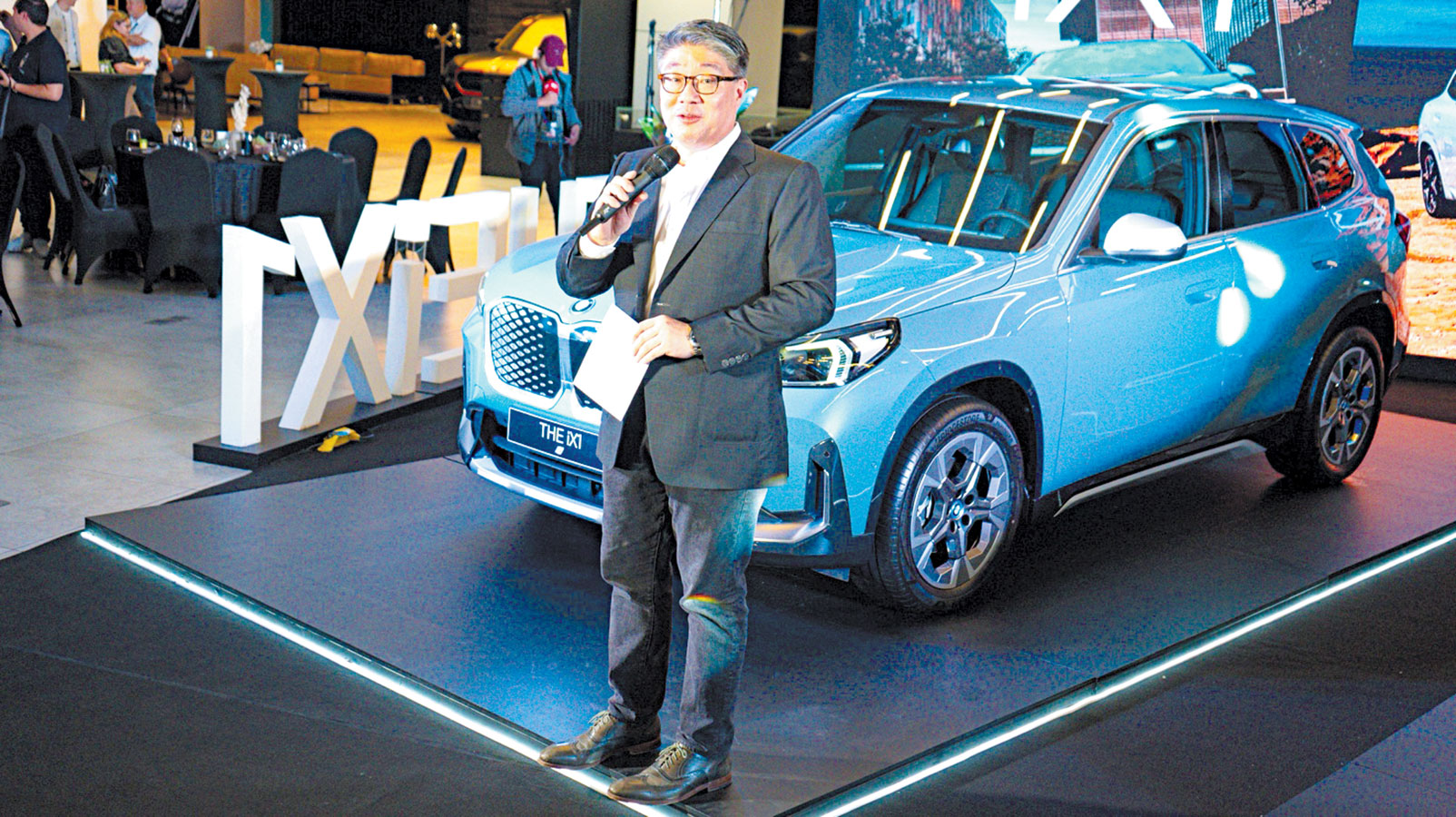
First is the BMW iX1 SAV — in a sole eDrive20 xLine variant. Priced at P3.99 million, it’s now the most affordable BEV for BMW here, and is expected to widen the interest in the powertrain in the luxury segment, owing to its relatively more accessible price point.

BMW is known for deploying a common platform for same-numbered vehicles of different powertrains. This is also the case in the iX1, which shares bones with the X1 (launched in the Philippines in March 2023). Filipino customers now have their druthers on the crossover’s propulsion: diesel fuel or pure electric. In a release, BMW Philippines underscored that “the BMW iX1 will bring the experience of emission-free driving pleasure to a vehicle segment enjoying worldwide growth, making it accessible to a very wide target audience,” leading to an “accelerated ramp-up of electric mobility.”

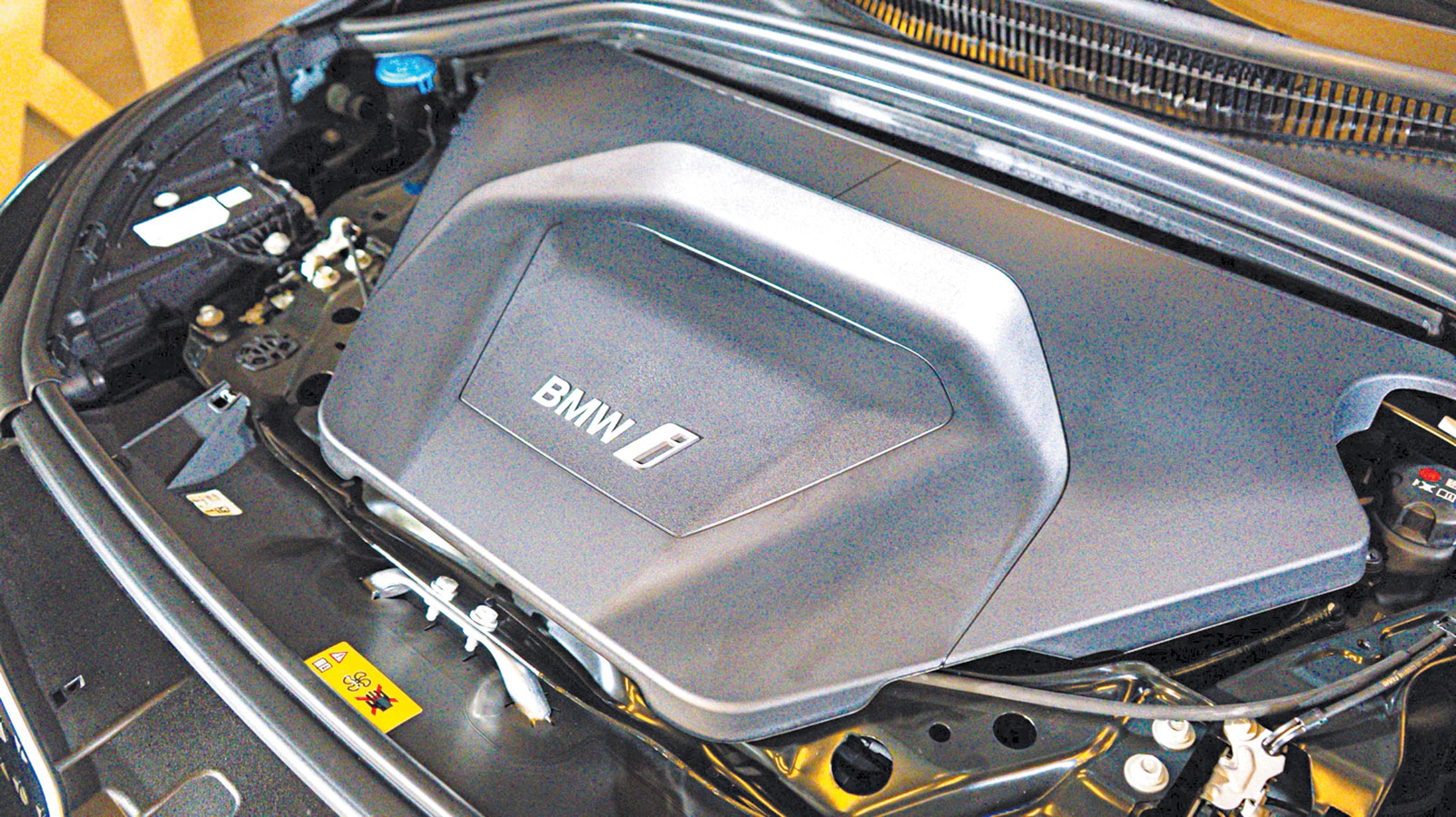
The iX1 eDrive20 xLine has 204hp and 247Nm on tap, and its electric motor — powered by a 64.8-kWh battery — is mated with a single-speed automatic transmission, allowing the vehicle to reach 100kph from a standstill in 8.6 seconds. Top speed is 170kph. BMW reports energy consumption of 17.2kWh to 16.7 kWh per 100 kilometers, translating to a maximum of 473 kilometers of range between full charging cycles.

Said to be inspired by the larger iX, the iX1 gets “muscular proportions, squared-off wheel arches, and signature BMW X styling elements.” Familiar features include sleek LED headlights, a signature kidney grille, and X-shaped design elements. Adaptive LED headlights with advanced lighting functions further an aggressive look.

The BMW iX1 rolls on 18-inch aerodynamic wheels, and comes in any of the following exterior tints: Mineral White, Black Sapphire, Space Silver, Phytonic Blue, San Remo Green, and Cape York Green.

Its inspiration from the BMW iX is apparent in a raised seating position and “premium feel” in the cabin, said the company. A slim instrument panel, BMW Widescreen Display, a floating armrest with a control panel, and a wireless smartphone charging tray in the front center console are some of the other accoutrements within. The sports seats are covered in Veganza leather, and are electrically adjusted (with a memory function). For enhanced safety, a new “interaction air bag” will deploy between the front seats in a crash.

The iX1 also boasts two-zone automatic climate control, a sport leather steering wheel, and BMW Maps as standard features, along with a rain sensor with automatic headlight activation. Four USB-C ports are available, along with two 12V power sockets and a “far greater number” of driver assistance systems. Boot space ranges from 540 liters to 1,600 liters.

The distributor said that every purchase of the model also includes a five-year BMW factory warranty, and a BMW Wallbox charger to be installed in the customer’s home for free.

Meanwhile, the first-ever BMW iX2, which comes here in M Sport guise (eDrive20 M Sport, to be exact), is priced at P4.29 million — similarly tucking in the BMW Wallbox with installation, and a five-year BMW factory warranty.

Entering the premium compact segment, the iX2 is in a fastback form, which leads off with a boldly designed front that bears adaptive LED headlights and a hexagonal grille. BMW emphasized that its profile is “sleek and coupe-like, thanks to a flowing roofline that blends seamlessly into the rear.” Speaking of the rear, it is similarly aggressive in design, with muscular shoulders, horizontal lights, and a spoiler and apron. The iX2 comes in the following exterior colors: Brooklyn Grey, Portimao Blue, Alpine White, and Black Sapphire.

The vehicle’s cabin is said to be modern and sporty, equipped with a dashboard that features the BMW Widescreen Display. Wireless charging and cup holders are integrated into the center console, while the sports seats are similarly available wrapped in premium Veganza, or Alcantara leather. Quilting can be optioned over standard cloth seats. BMW said that the iX2 receives enhanced noise insulation, and a new air bag between the front seats.

Standard on the vehicle are dual-zone climate control, BMW Maps navigation, a leather sport steering wheel, automatic tailgate operation, and multiple device  charging options through four USB-C ports and a 12V power outlet. These are on top of an expanded suite of driver assistance systems and digital services. BMW said that standard equipment in the vehicle “allows for personalized preferences, and premium features such as a mirror package and Harman Kardon sound system.”

Motivation comes from an electric motor providing 204hp and 250Nm of torque — accessed through a single-speed automatic transmission. Acceleration from a standstill to 100kph is 8.6 seconds — on the way to a top speed of 170kph. The iX2 is fitted with a 64.8-kWh battery pack that promises a maximum 478 kilometers of range per full charge. Drilled down, the iX2 consumes “an estimated 16.9 to 15.3 kWh of electricity per 100 kilometers.”

In an exclusive interview with “Velocity,” SMCACDC President Spencer Yu said that the twin launch of BEVs help to showcase the “diversity of BMW products.” He boasted, “We now have a total of eight battery electric vehicles — one of the widest in the industry.” Still, Mr. Yu conceded, “Electrification is still in its infancy in the Philippines. We have a very, very long way to go compared to our ASEAN neighbors, for example. But it’s a good start.”

He declared, “Honestly, ICE (internal combustion engine)-powered vehicles are still here to stay, even in very developed countries, the ICE is still there. But right now, for BMW, roughly 10%-15% of our sales volume is comprised of electrics, depending on the month. We’ll continue to see it there until our charging infrastructure gets up to speed.”

Concluded Mr. Yu, “We’re trying to do this one car at a time, one charger at a time. Eventually, acceptability of EVs by Filipinos will progress.”

Yulo to get Toyota Prado for Olympics feat

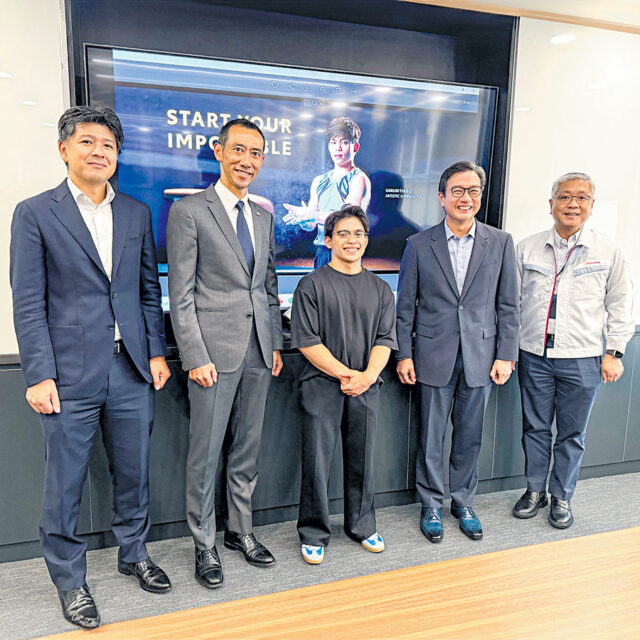
Two-time Olympic gold medalist Carlos Yulo (center) poses with Toyota Motor Philippines (TMP) executives. From left are Marketing Division Senior Vice-President Masahiro Haoka, President Masando Hashimoto, Chairman Alfred V. Ty, and TMP Marketing Division Executive Vice-President Jing Atienza. — PHOTO FROM TOYOTA MOTOR PHILIPPINES

By Kap Maceda Aguila

As Filipino gymnast Carlos “Caloy” Yulo made history at the recent Olympics in Paris, a windfall of benefits awaited him even before he got home.

One of the companies generously giving the double-gold medalist much deserved incentives for his feat is Toyota Motor Philippines (TMP), which has committed to give Mr. Yulo a next-generation Toyota Land Cruiser Prado (which retails for P4.8 million).

According to TMP, Carlos Yulo is actually one of the so-called Global Team Toyota Athletes under its Start Your Impossible program, which sponsors some 250 Olympic and Paralympic competitors around the world. He and para swimmer Ernie Gawilan represent the Philippines. “They are what we call our dual heroes because, aside from being sports heroes, they also have social causes which Toyota supports and will support,” said TMP Marketing Services Vice-President Elvin Luciano to “Velocity.”

In the case of Mr. Gawilan, who champions the protection of the coastline natural environment, he and some 1,900 volunteers engaged in a “National Coastal Clean-up and Mangrove Planting Day” across 35 sites in 2019. For his part, Mr. Yulo is working for food security, in addition, of course, to advocating for sports causes. On its congratulatory social media post for Mr. Yulo last Aug. 14, where TMP announced its decision to gift the athlete with a Land Cruiser Prado, the firm additionally declared, “As part of Toyota’s global Start Your Impossible movement, we are also looking forward to work with you on your chosen advocacy, which is food security, especially for children in need.”

Mr. Luciano told this writer that TMP initially planned to give Mr. Yulo a Toyota Zenix MPV and a Toyota Corolla Cross for his Olympic victories. “But with the significance of Carlos Yulo’s milestone achievement, TMP upgraded the incentive to a Land Cruiser Prado. By the way, we asked him what his preferred color is, and he chose White Pearl,” shared the executive.

Carlos Yulo recently visited the TMP offices in Makati City for a courtesy visit with TMP Chairman Alfred Ty and TMP President Masando Hashimoto — in addition to other TMP executives and staff. The gymnast is expected to drop by again for the official turnover of his new Prado.

Mr. Yulo is expected to return to Paris in September to join the Toyota Asia Paris Paralympic trip.

SM Prime to focus on PHL mall growth, China operations ‘doing well’ — Hans Sy

LISTED property developer SM Prime Holdings, Inc. is prioritizing expansion of its mall business in the Philippines due to competitive advantages, while its operations in China remain stable, Executive Committee Chairman Hans T. Sy said.

“I’m stepping up the (mall) expansion here because we have the advantage. Over there (in China), there’s just so much competition,” Mr. Sy told reporters on the sidelines of the National Retail Conference and Expo in Pasay City last week.

He said that SM Prime’s mall business in China, consisting of eight malls, is “standing on its own” in terms of development. In contrast, the company has 86 malls in the Philippines.

“Organically, it may grow one mall every two years. It’s the momentum that we are building up still,” he said.

“We don’t send money to China anymore. They are the ones making it grow,” he noted. “Contrary to what people are talking about, the malls are doing very well.”

He also said that SM Prime is on track with its reclamation project, adding that there are ongoing talks regarding possible partnerships for development.

The budget for the reclamation is almost P150 billion, according to Mr. Sy.

“We have already caught up. We’re very much on time after the suspension. What we’re doing right now is basic reclamation. We’ve started some negotiations already. It is not something that we will do by ourselves. We definitely have to join with other people,” he said.

“It’s a five-year project. It started two years ago, so we still have three more years to go. When we say five years, at least ready for development. All of the infrastructure, the road, everything will be ready,” he added.

The reclamation is for the 360-hectare SM Smart City development connected to the Mall of Asia Complex. SM Smart City is planned as a mixed-use development similar to the Mall of Asia reclamation project.

SM Prime is set to complete and hand over the project to the Pasay City local government by 2028.

“We will do the whole reclamation, after which when we start dividing the land, that’s where the joint venture comes in. We would have this big case of land, then we will invite some other developers to join up and then do the development,” Mr. Sy said.

SM Engineering Design & Development Corp. President Hans T. Sy, Jr. told reporters separately that the land portion of the reclamation project will be completed by the end of 2025.

“Our timetable right now is that we should see the completion of the land by end of next year, hopefully, and then we still have some infrastructure work that needs to be done,” he said.

“That’s just land. You might see some roads but it’s just the base property. Today, what we see is about 100 hectares,” he added.

For the first half of the year, SM Prime saw a 13% increase in consolidated net income to P22.1 billion as consolidated revenue rose by 8% to P64.7 billion.

SM Prime shares were last traded on Aug. 30, closing at P30.95 per share. — Revin Mikhael D. Ochave

Basic Energy Corp. to hold Annual Stockholders’ Meeting on Sept. 18 via remote communication


Spotlight is BusinessWorld’s sponsored section that allows advertisers to amplify their brand and connect with BusinessWorld’s audience by publishing their stories on the BusinessWorld Web site. For more information, send an email to online@bworldonline.com.

Join us on Viber at https://bit.ly/3hv6bLA to get more updates and subscribe to BusinessWorld’s titles and get exclusive content through www.bworld-x.com.

From war, better lives with clothes

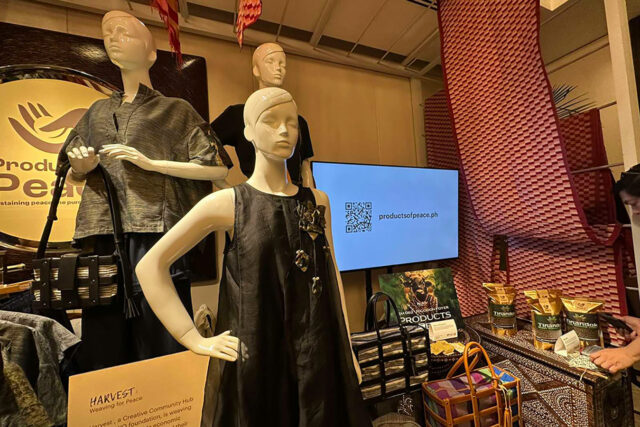
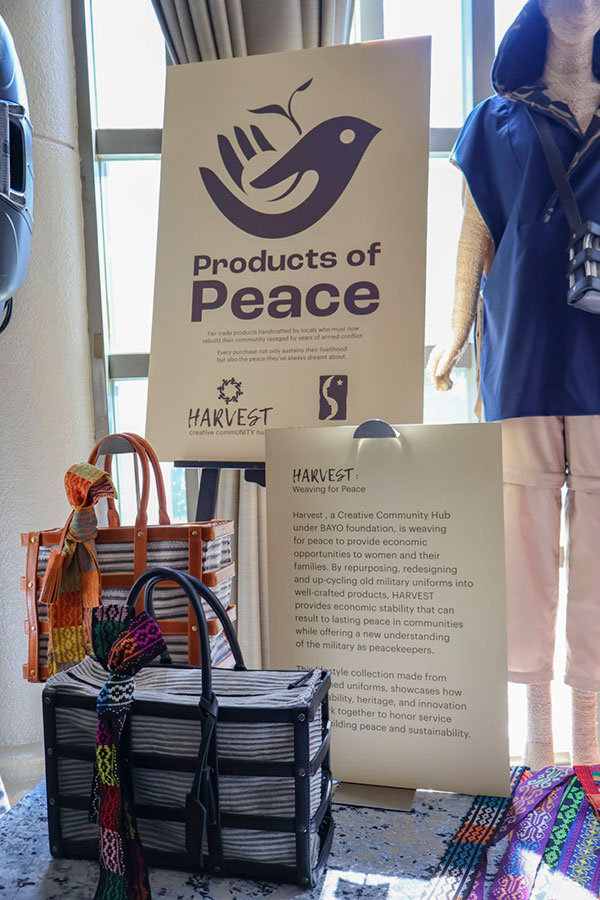
PRODUCTS from Harvest: Woven clothes (above), and bags (left).

HOW OFTEN can you own something that is a true historical record, that also represents a desire for peace?

At this year’s MaArte Fair which ran from Aug. 29 to Sept. 1 at The Peninsula Manila, a prominently placed booth displayed Products of Peace, an initiative by TBWA Philippines which brought together the projects of two women who are now working together to help women achieve peace in the communities where they live.

Sinagtala Philippines is a non-profit organization focused on supporting impoverished communities affected by conflict. It was founded at the height of the Marawi Crisis of 2017, a conflict in Mindanao between the Philippine armed forces and militant groups sympathetic to the terrorist organization ISIS. The conflict lasted five months and wrecked the city. Sinagtala co-founder Jamela Alindogan, covering the conflict as a correspondent for the Doha-based news channel Al Jazeera, started the organization after meeting a weaver displaced by the conflict.

“I spoke to the Philippine military to give us space, and they were able to give us space right at the capital. So we opened a crisis center for women and children,” she said during a press conference on Aug. 30 at The Pen. Sinagtala provided looms and established weaving facilities to help Maranao women channel their emotional distress through their rich weaving heritage. From the lone weaver, they have since had more than 150 graduates from the center.

During the press conference, a weaver appeared on video to speak about her experience in the center. “Nalilimutan namin iyong mga bomba, putukan. Hindi namin naririnig (We’d forget the bombs, the shootings. We didn’t hear them),” she said. She gave her loom a click. “May sound. Sumasabay sa, iyong sa labas (it makes a sound the same time sound comes from outside),” she said of the loom.

This particular exercise gave birth to the boom-boom pattern, spikes and irregularities in the pattern of the cloth they were weaving reflecting an explosion every time a bomb was dropped as they worked.

“For the record, none of these women knew how to weave before the war,” Ms. Alindogan explained, saying that some of them had been teachers and entrepreneurs before the war. “They were weaving as bombs continued to fall. It was very surreal, because people would come, and they would be surprised that there would be a weaving center at the height of [the] Marawi [conflict].”

The weaving center had to close during the COVID-19 lockdowns of 2020 because it was used as a rehabilitation center for suspected COVID-19 patients. They then moved to Jolo in Sulu, also a center of conflict in Mindanao. Jolo had long been a hotbed of Muslim separatist groups. There, the women training to be weavers were wives, widows, daughters, and orphans of the militants.

“In war, we can count the number of fighters. But there is no number [recorded] of the female members of their family,” said Ms. Alindogan. “Women often bear the trauma of conflict.”

HARVEST
Harvest, launched in 2019, is a sustainable social enterprise that turns discarded military uniforms into high-quality handwoven products. By repurposing old uniforms, Harvest not only addresses environmental issues but also provides economic opportunities for the wives and dependents of soldiers who have served in conflict zones. Harvest is a project of the Bayo Foundation, by Bayo clothing brand founder Anna Lagon.

Ms. Lagon’s company was approached by the military to do something about their large supply of damaged uniforms. Soldiers’ uniforms are replaced yearly or every two years, according to Ms. Lagon. “They cannot just donate them, for security reasons. And if they destroy them, it will give more problems,” said Ms. Lagon at the press conference.

What they do is they break down the uniforms either to be used as off-cuts in clothes, or the threads are reused as raw material to be woven. Colored stripes, for example, represent these former uniforms.

Ms. Lagon is herself a descendant of a soldier through her grandfather. “What we will be creating is something for the families. This will now be symbolic… the reminder of how these uniforms fight for us.” The weavers for this project are the family members of soldiers. In tears during the press conference, Ms. Lagon said, “This time, sila naman (it’s their turn).”

“They’ve always been in the battle, sacrificing their lives for us,” she said. “They don’t have to worry too much, because they will be busy.

“We’re not just making clothes. We’re building lives,” she said.

TWO SIDES
The booth at the MaArte Fair was called Products of Peace (they also sold coffee grown on some of the ex-battlefields in Mindanao). The military presence is still strong in Mindanao, and despite the creation of the Bangsamoro Autonomous Region in Muslim Mindanao, a formalized peace has not been achieved between all the separatist groups and the military (no news today about another such conflict is merely breathing room for the next).

The two projects, separately, benefit the people stuck between two sides of the conflict, but now they share space. Ms. Lagon said, “This is actually not a challenge, but an exciting opportunity, to show how we can create and look at the positivity of this… both are suffering. There are different levels of challenges… but you know, we can actually work together.”

“Products of Peace represents not just one side, but both sides. In all angles, if you just look at one vision, of really creating, encouraging peace… I think it will really be a better place for everybody.”

Ms. Alindogan, meanwhile, said that some of their weavers are still married to men on a watchlist kept by the Army. “To be fair to the military, they’ve been our partners since we opened, at the height of the Marawi war,” she said. “We do have a steady partnership with the Philippine Army,” saying that the army provides them with peripheral security, among other forms of assistance. She reiterates however, that within the center, “Kami lang (it’s just us),” and conflict is left at the door.

“We’re all Filipinos. Whatever political spectrum you’re in. A loss of one life is a loss for us all. For me, as a journalist. I do not see opposing sides. I see people I love, who share the same bloodline.”

For more information, follow Sinagtala PH, and HARVEST on Facebook and Instagram, and learn more about Products of Peace at https://www.productsofpeace.ph/. — Joseph L. Garcia

PetroEnergy targets to deliver 500 MW of power by 2028-2029

PETROENERGY Resources Corp. (PERC), the publicly listed energy arm of the Yuchengco Group of Companies, aims to increase its energy capacity to 500 megawatts (MW) by 2028-2029.

“Right now, we have about 145 megawatts capacity and in the next year or so, we will be adding about 100 more megawatts. By 2028 and to 2029, we ambition to be 500 megawatts in terms of capacity,” PERC Senior Vice-President for Corporate Services Arlan P. Profeta said at a forum last week.

Mr. Profeta said that the company is still evaluating whether to participate in the upcoming rounds of the Department of Energy’s (DoE) Green Energy Auction (GEA).

“We’re looking into that also, but I cannot confirm anything right now; all of these are being studied,” he said.

The DoE is set to conduct two rounds of GEA this year, which will cover various renewable energy technologies. The GEA program aims to promote renewable energy as one of the country’s primary sources of energy through competitive selection.

In April, PetroWind Energy, Inc. (PWEI) announced that Phase 2 of the 13.2-MW Nabas wind power project had begun exporting power to the grid.

The Nabas-2 wind power project, located south of the existing 36-MW Nabas-1 wind power project, will add six turbine generators to the 18 turbines already in operation in Phase 1.

PWEI is a joint venture of PetroGreen Energy Corp., the renewable energy holding unit of PERC, and Thailand’s BCPG Public Co. Ltd.

In May, PERC, through its Dagohoy Green Energy Corp. unit, started the installation of photovoltaic panels in its 27-MW direct current solar power project in Dagohoy, Bohol.

For the second quarter, PERC reported a 27.9% increase in its attributable net income to P134.2 million. Gross revenues grew by 9.9% to P847.46 million. — Sheldeen Joy Talavera

Revisit constitutional change after the 2025 elections

PHILIPPINE STAR/EDD GUMBAN

The frenzy earlier in the year on possibly amending the constitution has died down. The focus is now on the midterm elections, including how the political feud between the administration of President Ferdinand Marcos, Jr. and the Duterte family might play out at the ballet box. It makes for good headlines and an interesting storyline: up to possibly three Duterte family members being elected to senate, challenging Marcos and those they blame for the attacks on them and their allies, and setting up the battle in 2028 between Vice-President Sara Duterte and the administration proxy. There would be some economic consequences soon after the 2025 midterms. Wary of a significant shift in policy and personnel in a few years’ time should the Dutertes emerge victorious, family conglomerates and foreign investors could slow down their investments in the second half of Marcos’ term.

The shorthand explanation for this phenomenon is that personalities dominate our politics. Our electorate chooses candidates based on who is most familiar or well-known, which is why some candidates for the senate put up posters a year or more ahead of the elections, because they can exploit a loophole that everyone knows is a loophole. Or why the most popular athletes, celebrities, and radio personalities have a good chance of making it to the highest positions in the land.

The other way is by exploiting the perceptions of a connection, no matter how distant, unreliable, or even unreal. If Pedro, the city councilor, is the cousin of my neighbor, and Pedro claims to know the son-in-law of a politician’s nephew’s driver, then maybe I should support whoever Pedro endorses, on the off chance that my neighbor can approach Pedro should I need something down the road. That, of course, is an exaggeration, but which is also why politicians recognize that local leaders can be invaluable in distributing largesse and organizing local networks that deliver votes.

After the elections, alliances are built around the short-term goals of gaining access to government funds — which is the reason for the multitude of deputy speakers in the House of Representatives, and why principled, consistent opposition is rare. Meanwhile, promises made during elections or an administration’s term hardly have any consequences for a politician’s career.

Paradoxically, many of the debates and discussions around Cha-cha highlighted how its main goal was to amend the economic provisions of the constitution to encourage economic growth. The justification seemed almost apologetic for such an important process, because attempting to do more would deem the process to failure.

But ask any Filipino, and they will give a different answer: the reason our economy is not flourishing, or why politics does not seem to deliver in terms of building a better outlook for them or their families, is that our politics is dysfunctional. Politicians are rarely punished for not fulfilling their campaign promises. A sitting president can paint the rosiest outlook, cater to powerful friends, or make the most outlandish promises, and their party or political allies will not suffer any measurable political consequences in subsequent elections. Bureaucratic or political malfeasances, whether through negligence, corruption, or in catering to vested interests to the public’s detriment, is only punished inconsistently, if at all. Politics and policy are shaped by access, not the fear of being voted out during elections.

Some of the solutions to this fundamental complaint about our system requires that we reexamine whether we should shift to a parliamentary form of government, remove presidential term limits, elect senators at a sub-national level or abandon the party-list system. Because we must address the question of why political accountability is weak, and whether the solution starts with reformulating the constitutional design of government. After all, a president constrained to one term has limited incentives to deliver on an administration’s campaign promises. Or maybe consider the analysis of Adam Przeworski, a professor emeritus of politics at NYU, who argues that the American system of presidentialism has worked only effectively in the United States. Why this is the case is for a future column, but it is an issue that deserves consideration because we adopted the presidential system of government with its concept of fixed-term elections as a historical accident of having been colonized by the United States more than a century ago. In his excellent book, The Crisis of the Middle-Class Constitution, the legal scholar Ganesh Sitaraman argues that the US’ founding fathers designed a constitution when America was relatively unequal, and therefore it was not designed to address inequality of power or wealth in the young country. In contrast, that was exactly the problem we had when our first constitution was being designed. Much land was in the hands of wealthy Spanish families or their local allies, and obviously institutions would evolve in terms of protecting those powers, benefits, and relationship.

Opening up the constitution is a difficult thing. It can lead to intense disputes, draws immense political attention domestically and abroad and is highly unpredictable. The process can result in a worse constitution, possibly just as much, as in something better. But the despondence that people feel today about politicians’ lack of accountability, the prevalence of corruption and the inability of the system to build a better outlook cause many to leave for abroad, even at the terrible cost of familial separation. There is no greater condemnation by a citizenry of a system’s failure than their desire to leave the country of their birth because of lack of hope.

The poor are faulted for voting into power incompetent leaders and corrupt politicians. But elites fail to see something else: former President Rodrigo Duterte won because of this frustration. He threatened to shake up Philippine politics — to kick the chair out from under complacent and complicit bureaucrats, make institutions deliver public goods (particularly in law and order), weaken oligarchs, and change long-standing political alliances that only benefited the elites. Whether or not he really had this intention or knew how to fulfill it can be debated, but many Filipinos who voted for him and support him until today believe this to be the urgent need of politics.

Politics, political parties, and alliances are built along social cleavages. Philippine elites had become complacent in thinking they could define these cleavages and manipulate them along artificial lines. Duterte shook them from that complacency because he promised to deliver on the grievances that people had about power, opportunity, and voice, but the lesson had not been learned. Our problem is not with the personalities in power; they are the side-effects of the failings of the system to deliver real political accountability, and for this reason a reassessment of the design of the political system is needed. The Duterte presidency was not an accident of history, but the result of it.

Any attempt to reopen the constitution after the midterms will, however, be criticized as possibly being an effort by the Marcos administration to eliminate term limits so that the president can run again. One solution is to have a constitutional convention whose term and final output will be delivered after only the next elections. But the issues with our constitution and how our system is designed both politically and socially need to be brought out into the public light and debated, warts and all, risks and all, not be the subject of some opaque signature drive or be treated as an aside.


Bob Herrera-Lim is a political analyst who advises investors globally. He is also a fellow for the Foundation for Economic Freedom.

Country’s biggest MG facility opens in Greenhills

PHOTO BY KAP MACEDA AGUILA

THE FAMOUS automotive row on EDSA just added another piece to its growing collection of marques. MG Greenhills, owned and operated by Britannica United Motors, Inc., was recently inaugurated by executives of MG Philippines and the aforementioned dealership group.

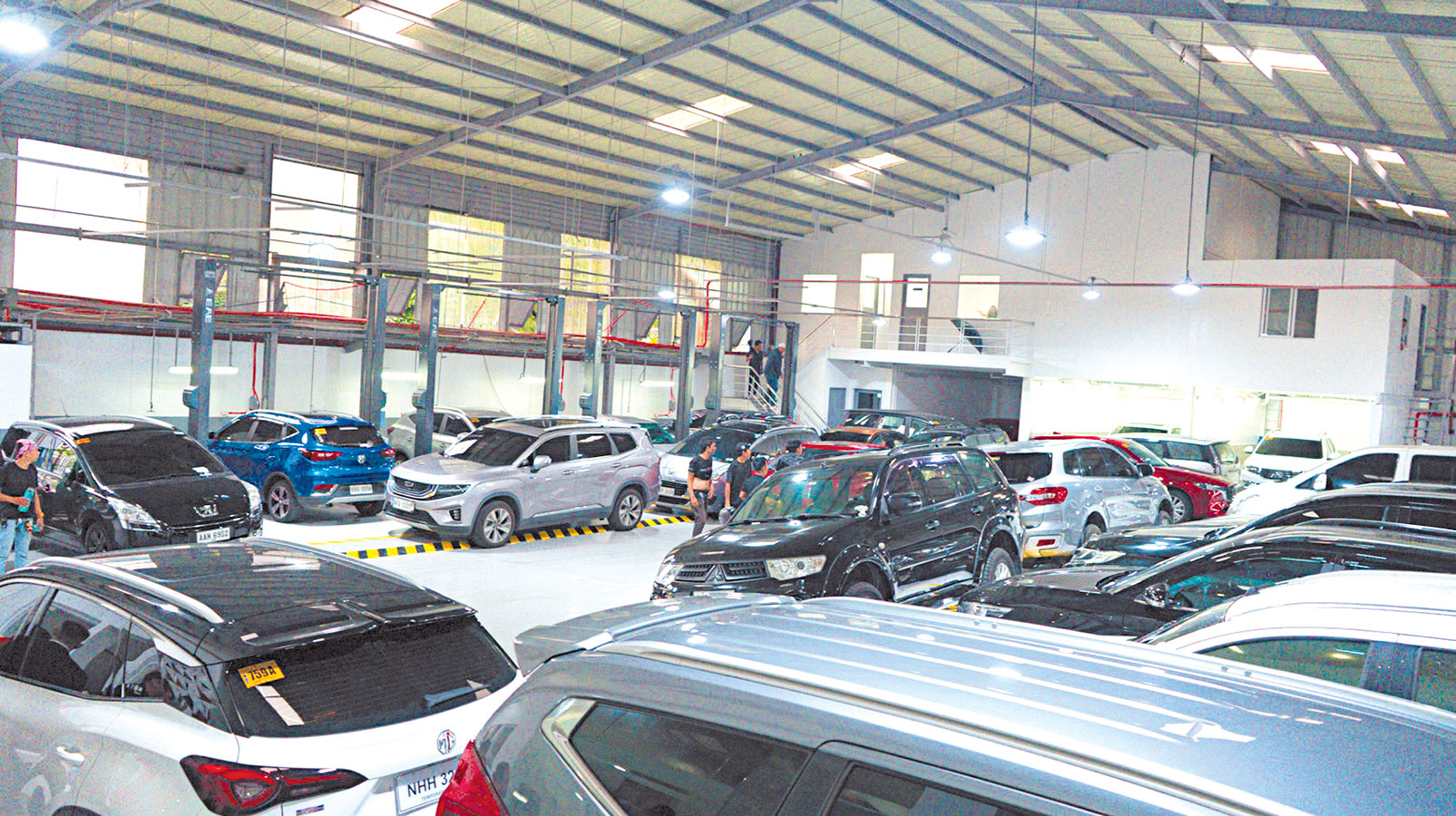
Located at 500 EDSA, Greenhills, San Juan City, MG Greenhills is the largest local facility of the British-heritage auto brand. It stands on a 1,900-sq.m. piece of prime real estate, upon which the 1,650-sq.m. dealership rises. In a release, MG Philippines said it is “another major step in strengthening the presence of MG in the Philippines and giving Filipino motorists access to high-quality MG cars.”

During the inauguration, MG Philippines President Felix Jiang told this writer that the company expects to have around 60 dealerships open by yearend.

Meanwhile, Britannica United Motors, Inc. President Jan Andrew Po said in a separate interview that the group now has nine MG facilities: MG Greenhills, MG Libis, MG Congressional, MG Calasiao, MG Iloilo, MG Bacolod, MG Valencia, MG Davao, and MG General Santos. “We’re still working on MG Tagum now, and we’re going to start on construction at some point,” he told “Velocity.” Additionally, the company is exploring the idea of putting up retail (1S) sites.

MG Greenhills features 19 service bays and 11 lifters, plus a six-car display showroom. “We’re focusing on improving the service infrastructure,” Mr. Po added, and explained that the service areas MG Libis and MG Congressional will be devoted solely for PMS (preventive maintenance service), with major repair work being diverted to MG Greenhills or the MG service center on Quezon Avenue. “Libis and Congressional now become express service centers,” he said.

MG Greenhills is said to boast MG-certified technicians working with the “latest diagnostic tools and equipment, ensuring accurate assessments and effective maintenance.” Britannica promises “clear and upfront pricing, with no hidden charges.” At the dealership, customers wait in comfort in “well-appointed waiting areas with amenities such as free Wi-Fi, refreshments, and entertainment options.”

Britannica can take care of bringing vehicles for repair to Greenhills or Quezon Avenue via tow truck if there are major issues with it, but Mr. Po said that if it still runs, then he suggests the customer bring it straight to either location for a quicker resolution.

The executive credits SAIC Motor Philippines for making spare parts readily available for MG’s PMS customers. “For instance, after the (Typhoon Carina) flooding, we had a total of 19 cars brought in for flood-damage repairs. We’re already done with 15,” Mr. Po shared, and added that they’re currently at 97% fill rate. “(MG Philippines) has reinforced its service process, and investment for parts. Currently, I think the parts inventory is eight times the level it was at three years ago.”

Along with its internal combustion engine (ICE)-powered offerings, MG in the Philippines has already been in the EV (electric vehicle) space for a while now, with several offerings in the BEV portfolio — namely the MG 4, MG Cyberster, MG Marvel R and MG ZS EV. “Awareness about electric vehicles is something that has to be improved still,” he commented.

As it stands though, Britannica boasts of a DC charger in MG Libis, and Mr. Po promised to put more of the same at MG Quezon Avenue and MG Greenhills. Notably, he said that, for the meantime, the charger at Libis is brand agnostic; any EV with a CS2 port can be charged for free.

MG Greenhills is open from Monday to Saturday, 8:30 a.m. to 5 p.m. For inquiries and appointments, contact (0993-GRHILLS). — Kap Maceda Aguila

ADVERTISEMENT
ADVERTISEMENT