Home Blog Page 269

15 Metro Manila trade fairs planned this year

DTI

THE Department of Trade and Industry (DTI) said it is planning 15 trade fairs in Metro Manila this year apart from a number of national ones, providing opportunities for micro, small and medium enterprises (MSMEs).

“We are targeting more MSMEs to join our trade shows,” Trade Secretary Ma. Cristina A. Roque told reporters on the sidelines of the Bagong Pilipinas National Trade Fair on Thursday.

In 2025, the DTI’s trade fairs generated over P660 million in sales, including cash sales, confirmed orders, and ongoing negotiations.

About 1,774 MSMEs benefited from last year’s trade fairs, the DTI said.

“For many participants, repeated exposure across multiple fairs has translated into stronger sales performance and improved readiness for both domestic and export markets,” the DTI said.

The DTI opened its 2026 national trade fair calendar with its Bagong Pilipinas National Trade Fair, which will run between Feb. 18 and 22 in Mandaluyong City.

We are strengthening the trade fair program as a system — one that combines consumer-facing platforms with buyer sourcing and networking opportunities,” Trade Assistant Secretary Nylah Rizza D. Bautista said in a statement.

The 2026 National Trade Fair features about 300 exhibitors showcasing eco-friendly, design-driven, and high-value Filipino products.

The trade show will also highlight the Philippine Sustainability Pavilion, which features furniture, textiles, fashion, and handicrafts made from coconut-based materials, engineered bamboo, natural fibers, plant-based dyes, and native grasses. — Beatriz Marie D. Cruz

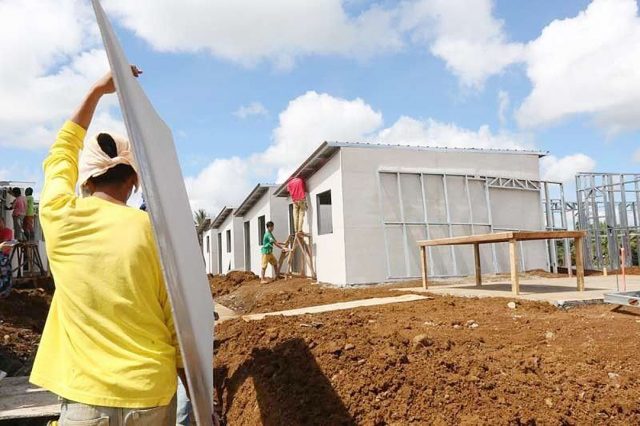
Approved building permits decline 5.9% in December

PHILSTAR FILE PHOTO

APPROVED building permits declined 5.9% year on year in December, the Philippine Statistics Authority (PSA) said in a report, citing slowing economic growth and cautious developer sentiment.

According to preliminary data, the PSA said building projects covered by the permits fell to 11,411 in December from 12,127 a year earlier.

This was a steeper decline than the 2.6% contraction in December 2024, but an improvement over the 10.1% drop seen in November 2025.

In December, construction projects covered 2.67 million square meters of floor area, down 8.2% year on year.

Approved building projects were valued at P33.62 billion, 13.4% lower than a year earlier.

Marco Antonio C. Agonia, an economist at the University of Asia and the Pacific, said the decline in building permits may be attributed to the weaker growth outlook and still-tight monetary conditions.

Economic growth slumped to 3% in the fourth quarter of 2025, bringing the full-year reading to a five-year low of 4.4%, the PSA reported.

“Property developers may have deferred their projects facing lower demand prospects. The fallout of the delay in government disbursements for infrastructure projects (due to the spending freeze) may have also continued to spill over into building permit approvals,” Mr. Agonia said in an e-mail.

Jonathan L. Ravelas, a senior adviser at Reyes Tacandong & Co., said via Viber that the continued decline in building permits reflects a pause rather than a collapse.

“Elevated interest rates, elevated construction costs and developer caution are delaying new projects, especially in residential and smaller-scale builds,” he said.

The key policy rate fell to 4.25% from 4.5%, the lowest in over three years, since the 3.75% in August 2022.

The Monetary Board has lowered borrowing costs by a total of 225 basis points since it began its easing cycle in August 2024.

The PSA also reported that residential projects, which accounted for 63.1% of all permits, fell 7% to 7,203 in December.

These projects were valued at P12.13 billion, down from P17.40 billion a year earlier.

Single homes, which accounted for 87.6% of the residential category, fell 8% year on year to 6,312.

Applications for apartment buildings declined 12.7%, while applications for duplex or quadruplex homes surged 90.6%.

Meanwhile, nonresidential projects, which accounted for 23.4% of the total, contracted 3.6% year on year.

Permits for nonresidential projects were valued at P17.81 billion, slipping 1.2% from a year earlier.

Approved commercial construction applications accounted for 67.6% of all nonresidential projects at 1,802.

Industrial permits fell 12.4% to 205, while institutional projects fell 1.8% to 497 approvals.

Approved permits for additions, or construction that increases the height or area of an existing building, declined by 2.3% to 387 during the period.

Alteration and repair permits recorded an annual drop of 8% to 858, though their value rose 23% year on year to P2.60 billion.

Calabarzon (Cavite, Laguna, Batangas, Rizal, and Quezon) had the most approved construction projects during the period, accounting for almost 25% of the total with 2,838 permits.

This was followed by Central Luzon (with  a 10.6% share and 1,215 permits), and Ilocos Region (8.8% and 1,005 permits).

“What we’re seeing is a waitand see mode,” said Mr. Ravelas.

“The good news is that once borrowing costs ease and demand stabilizes, permits should recover — construction activity typically follows with a lag,” he added.

Mr. Agonia said the construction industry may see a minor boost in 2026.

“The annual decline means 2026 will be compared against a low base, leading to higher growth figures. However, construction appetite may only truly normalize by the second half of the year, when many analysts expect government spending and investor sentiment to recover,” he said.

Mr. Agonia added that he expects more in the coming months depending on how business sentiment improves.

“Some constructive factors to look out for are returning government and private sector capex (capital expenditures), along with the impact of the cumulative rate cuts which may only be felt by the latter half of this year,” he said. — Pierce Oel A. Montalvo


Domestic goods trade hits P562.76 billion in Q4

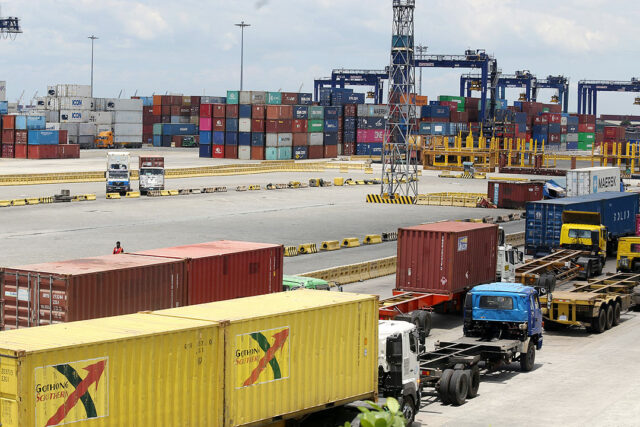
Trucks enter a port in Manila. — PHILIPPINE STAR/EDD GUMBAN

DOMESTIC TRADE in goods amounted to P562.76 billion in the last three months of 2025, the Philippine Statistics Authority (PSA) said in its Commodity Flow in the Philippines report, citing preliminary data.

Trade in goods declined from the P632.02 billion recorded in the third quarter of 2025, the PSA said.

By volume, domestic trade was 9.85 million tons, much weaker than the revised 14.05 million tons recorded in the third quarter.

The PSA noted that total domestic trade measured by volume and value in the fourth quarter is not comparable to the year-earlier data, because of the inclusion of road transport system data starting in the first three months of 2025.

Goods traded by road in the fourth quarter were valued at P324.36 billion; those traded by water were worth P238.04 billion, while those traded by air amounted to P363.07 million.

Domestic trade by value is the outflow value of commodities transported from the place of origin to destination.

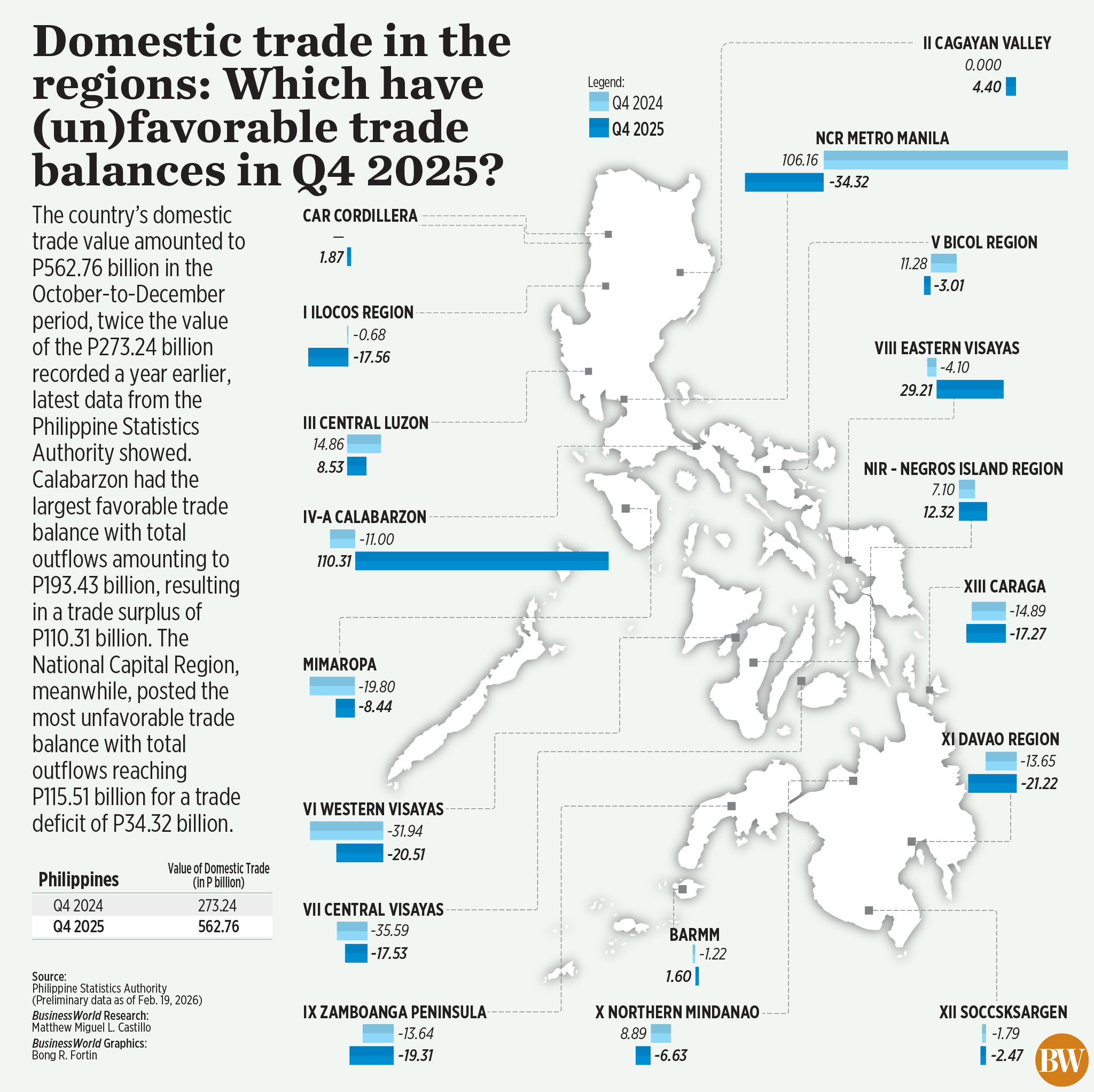
During the period, Calabarzon (Cavite, Laguna, Batangas, Rizal, and Quezon) accounted for 34.4% of domestic outflows with P193.23 billion . Inflows were valued at P83.12 billion.

Metro Manila accounted for 20.5% at P115.51 billion worth of goods. The region had the highest share of inflows at 26.6% with P149.83 billion worth of goods received.

Northern Mindanao accounted for 9.2% of domestic trade amounting to P51.90 billion with inflows valued at P58.52 billion.

Calabarzon also led the country in trade balance — the gap between outflow and inflow values — with P110.31 billion. It was followed by the Eastern Visayas with P29.21 billion, and the Negros Island Region with P12.32 billion. — Matthew Miguel L. Castillo

Mindoro regional lab being built to improve quality of aquaculture

FACEBOOK.COM/MIMAROPAPIA

THE Bureau of Fisheries and Aquatic Resources (BFAR) said its regional office in Mimaropa (Mindoro – Occidental & Oriental, Marinduque, Romblon, and Palawan) has started building a Regional Fisheries Integrated Laboratory in Calapan City, Oriental Mindoro, to enhance disease monitoring and support aquaculture in the region.

The four-storey, 600-square-meter laboratory is funded by the World Bank, in partnership with the National Government, which tapped the BFAR’s Modern and Resilient Livelihood Investments program and the Coastal Resiliency project.

Once operational, the laboratory will provide molecular diagnostics, histopathology, water quality assessment, and environmental monitoring.

The services are intended to help detect and prevent fish diseases, safeguard aquaculture production, and support quality standards for fish supplied to both domestic and export markets.

“The project is expected to directly benefit 583 fisheries households and establishments, while indirectly supporting approximately 1,000 households across 48 municipalities and one city in the region,” the BFAR said in a statement.

It said the construction timeline is 270 days. — Vonn Andrei E. Villamiel

PSEi back at 6,400 level as BSP cuts rates again

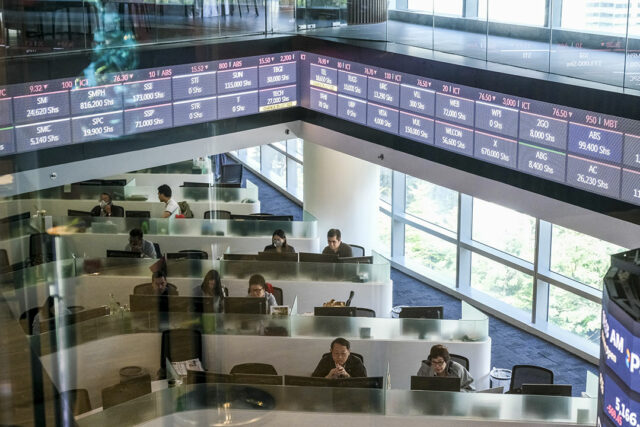
An electronic ticker is reflected on a window at the Philippine Stock Exchange in Bonifacio Global City (BGC) on March 13, 2020. — BLOOMBERG

PHILIPPINE STOCKS returned above the 6,400 line on Thursday as the Bangko Sentral ng Pilipinas (BSP) delivered a sixth straight rate cut to support demand amid weak economic prospects.

The benchmark Philippine Stock Exchange index (PSEi) rose by 0.19% or 12.38 points to close at 6,407.15, while the broader all shares index went up by 0.14% or 5.27 points to end at 3,547.32.

“The PSEi ended higher as bargain hunters resumed taking advantage of attractive valuations following recent declines,” Regina Capital Development Corp. Head of Sales Luis A. Limlingan said in a Viber message.

“Investors continued to assess the impact of the latest rate cut from the BSP, weighing its potential to support liquidity and market sentiment. The move helped improve risk appetite at the margins despite lingering concerns over subdued growth forecasts, allowing the benchmark to finish in positive territory.”

The BSP’s policy-setting Monetary Board slashed benchmark borrowing costs by 25 basis points (bps) for a sixth straight meeting, bringing its key rate to an over three-year low of 4.25%, as expected by all 16 analysts in a BusinessWorld poll.

It has now reduced interest rates by a total of 225 bps since it began its easing cycle in August 2024.

BSP Governor Eli M. Remolona, Jr. said future easing will largely depend on how soon confidence will recover, as weak sentiment has affected demand, making the output gap bigger. “We’re now in a situation where it’s more conditional on what happens to confidence and growth,” he said in a briefing.

“The local bourse bagged modest gains, buoyed by the strong rebounds in SCC and DMC, and complemented by the BSP’s 25-bp rate cut to prop up growth back to normal levels,” AP Securities, Inc. said in a market note, referring to the ticker symbols of Semirara Mining and Power Corp. (SMPC) and its parent DMCI Holdings, Inc. (DMCI).

Shares in both SMPC and DMCI posted large losses earlier this week due to the non-renewal of Semirara Mining’s coal contract. On Thursday, SMPC shares rose by P3.05 or 13.53% to P25.60 apiece. DMCI shares also went up by 80 centavos or 9.41% to P9.30 apiece.

Most sectoral indices closed higher on Thursday. Mining and oil rose by 3.76% or 674.06 points to 18,592.81; industrials increased by 1.2% or 108.64 points to 9,132.08; holding firms went up by 0.6% or 30.50 points to 5,085.65; and financials climbed by 0.06% or 1.31 points to 2,142.54. Meanwhile, property fell by 0.86% or 18.92 points to 2,172.36, and services slipped by 0.06% or 1.70 points to 2,690.26.

Advancers outnumbered decliners, 119 to 89, while 55 names closed unchanged.

Value turnover rose to P5.26 billion with 927.70 million shares traded from the P5.19 billion with 943.82 million issues that changed hands on Wednesday.

Net foreign selling was at P96.93 million versus the P467.67 million in net buying recorded in the previous session. — Alexandria Grace C. Magno

4th impeachment complaint versus VP Duterte sent to House Speaker

Vice President Sara Z. Duterte-Carpio announces her intention to run for president during a press conference in Mandaluyong City, Feb. 18, 2026. — PHILIPPINE STAR/MIGUEL DE GUZMAN

By Adrian H. Halili, Reporter

A FOURTH impeachment complaint against Vice-President (VP) Sara Duterte-Carpio has been sent to the Office of the Speaker after it was received by the House of Representatives.

House Secretary-General Cheloy E. Velicaria-Garafil said her office received the 72-page complaint at 6:34 p.m. on Wednesday and transmitted it on Thursday to Speaker Faustino G. Dy III, in line with House rules.

“The Office of the Secretary General’s role is purely ministerial, confined to receiving and transmitting pleadings and documents filed with the House,” she said in a statement.

Lawyer Nathaniel G. Cabrera filed the complaint on Feb. 19. It alleges that the Vice-President failed to fully disclose assets in her statement of assets, liabilities and net worth (SALN) and may have amassed wealth disproportionate to her lawful income.

Mr. Cabrera is seeking a forensic review of bank records, property transfers and other financial documents to determine whether public funds were converted into private assets and whether her declared net worth accurately reflects her financial position.

The complaint was endorsed by Deputy Speaker Francisco Paolo P. Ortega V and Manila Rep. Bienvenido “Benny” M. Abante, Jr., who heads the House Committee on Human Rights.

It alleges that certain assets, bank accounts, cash holdings and property transactions were omitted, understated or not fully reflected in the Vice-President’s SALNs.

Mr. Ortega said the allegations warrant congressional scrutiny but stressed that endorsement of the complaint does not amount to a finding of guilt.

“This is not a conviction,” he said in a separate statement. “This is a process. When there are sworn statements about large cash transfers and serious red flags in asset declarations, the House cannot look away.”

He added that a declared plan to run for President in 2028 would not affect impeachment proceedings.

“The Constitution is not suspended because someone declares candidacy,” he said. “If there is nothing to hide, transparency should not be feared.”

Mr. Ortega also cited unresolved issues surrounding confidential and intelligence funds as part of broader governance concerns.

Three earlier verified complaints alleging unexplained wealth, misuse of public funds and threats against the President and his family are awaiting plenary action.

Under the Constitution, impeachable offenses include culpable violation of the Constitution, treason, bribery, graft and corruption, other high crimes and betrayal of public trust. Ms. Duterte has denied wrongdoing.

The Vice-President was impeached by the House last year after more than a third of lawmakers backed a complaint that was sent to the Senate. The Supreme Court later voided the proceedings, ruling that constitutional rules were violated when earlier complaints were bypassed.

Ms. Duterte on Wednesday said she would run for President in 2028, becoming the first major political figure to declare her intention to seek the country’s top post amid an escalating feud with President Ferdinand “Bongbong” R. Marcos, Jr.

The 1987 Constitution limits Mr. Marcos to a single six-year term, and he has yet to endorse a successor.

Before announcing her presidential ambition, Ms. Duterte said running with Mr. Marcos in 2022 was a mistake, accusing him of failing to fulfill his campaign promises and of being complicit in what she described as a large-scale corruption scheme involving the 2025 national budget.

The rift between Mr. Marcos and Ms. Duterte has widened in recent months following policy disagreements and political tensions between their camps.

The political dispute has also unfolded against the backdrop of the arrest of her father, former President Rodrigo R. Duterte, by the International Criminal Court over charges of crimes against humanity related to his anti-drug campaign.

Minority senators seek due process safeguards on possible ICC warrants

PHILIPPINE STAR/ GABRIEL BONJOC

SENATORS from the minority bloc have filed a resolution urging Philippine authorities to ensure Filipinos are first afforded due process in local courts before being surrendered to international tribunals, amid reports of possible arrest warrants from the International Criminal Court (ICC).

“It is the sense of the Senate of the Philippines to protect all Filipinos against extraordinary rendition and guarantee them a reasonable time prior to their surrender by or extradition from the Philippines to seek redress from the courts and avail of legal remedies,” Senate Minority Leader Alan Peter S. Cayetano said in a statement, citing Senate Resolution No. 307. A copy of the resolution was not immediately available.

Mr. Cayetano said compliance with international arrest orders must still pass through the country’s legal system.

“If the interpretation is that when there is an arrest order from the ICC or any international court, we will immediately pick it up and take it to another country, it is very dangerous,” he said. “This is not just a matter of one person — it is a matter of our sovereignty and our constitutional framework.”

The resolution comes after the ICC identified several high-profile figures as co-perpetrators in former President Rodrigo R. Duterte’s anti-drug campaign. Among those named were Senators Ronald “Bato” M. dela Rosa and Christopher Lawrence “Bong” T. Go, both allies of Mr. Duterte.

The former President was arrested last year by the International Criminal Police Organization following an ICC warrant and is detained in The Hague, Netherlands, facing charges of crimes against humanity. The Philippines withdrew from the ICC in 2018, with its exit taking effect in 2019.

The minority bloc said the naming of Mr. Go and Mr. dela Rosa in ICC documents makes them vulnerable to extradition without a hearing, stressing that the state must ensure access to legal remedies before any surrender.

“Due process and the rule of law should not be sacrificed at the altar of a blind pursuit of justice,” according to the statement.

Also mentioned in court documents were former Justice Secretary Vitaliano N. Aguirre II; former Philippine National Police chiefs Vicente D. Danao, Jr., Camilo P. Cascolan and Oscar D. Albayalde; ex-National Bureau of Investigation chief Dante A. Gierran; and former Philippine Drug Enforcement Agency head Isidro S. Lapeña.

Mr. Aguirre and Mr. Go have denied the allegations. Mr. dela Rosa has not attended Senate sessions since Nov. 11, 2025, when reports of a possible warrant first surfaced. The ICC has yet to issue arrest warrants against the senators. — Adrian H. Halili

House aims to pass anti-dynasty bill before July SONA

BW FILE PHOTO

THE House of Representatives is moving to pass a bill banning political dynasties by the end of March, aiming to include the measure in President Ferdinand R. Marcos, Jr.’s State of the Nation Address (SONA) in July, a lawmaker said on Thursday.

Lanao del Sur Rep. Ziaur-Rahman Alonto Adiong, who heads the House Suffrage and Electoral Reforms Committee, said congressional leaders are pressed for time to complete discussions on the long-pending measure, which the Marcos administration has flagged as a priority.

“The leadership wants this measure to be done before the Lenten break because they want the anti-political dynasty bill to be part of the SONA of the President,” he told reporters.

Congress is scheduled to adjourn by March 20 and will resume sessions on May 4.

House Senior Deputy Minority Leader Edgar R. Erice said the law must be enacted before 2027 to allow the Commission on Elections to draft implementing rules ahead of the 2028 elections.

Both the House and Senate are conducting public consultations on measures to bar members of political dynasties from seeking public office. Mr. Adiong said stakeholders’ inputs are key to shaping a “responsive and reflective version” of the law.

Senator Loren Regina B. Legarda filed the seventh anti-dynasty bill, Senate Bill No. 1854, which seeks to prevent spouses and relatives within the second civil degree of national or local officials from running in the same district, province, or city. The measure also bars simultaneous or successive candidacy of related people across levels of government.

“This proposed act does not seek to punish families, nor curtail the right of citizens to vote,” Ms. Legarda said in the bill’s explanatory note. “It aims to level the political playing field, expand meaningful electoral choice and restore the primacy of merit, competence and accountability in public service.”

Senate Electoral Reforms Chairperson Ana Theresia Hontiveros-Baraquel said the committee would review all seven bills, considering kinship limits, scope of prohibition and whether the ban should apply simultaneously or successively.

President Marcos has made curbing political dynasties a priority after public backlash over alleged funneling of billions of pesos to congressional districts, making the bill a key part of his governance reform agenda.

Efforts to pass anti-dynasty legislation in previous Congresses stalled, largely due to the Legislature’s dominance by political families.

Eight in 10 lawmakers belong to dynasties, according to the Philippine Center for Investigative Journalism. — Adrian H. Halili

Education reforms focus on retention, morale

PHILSTAR FILE PHOTO

PRESIDENT Ferdinand R. Marcos, Jr. on Thursday pledged that no public school teacher would retire at the entry-level rank as his administration rolled out expanded promotion pathways and billions of pesos in benefits for educators.

The move highlights the government’s focus on teacher retention amid persistent learning challenges.

Speaking at the mass oath taking of newly promoted teachers and school heads under the Expanded Career Progression system in San Jose del Monte, Bulacan, Mr. Marcos said the program addresses years of stalled promotions in the public school system.

“I will not allow your sacrifices to go unrewarded,” he told educators from Bulacan and Pampanga in Filipino. He added that additional senior positions would be opened to ensure no teacher retires as a Teacher I.

The ceremony marked the third batch of promotions under the program, following previous oath takings in Ilocos Norte and the National Capital Region. A total of 1,991 personnel were promoted or reclassified, including teachers advancing from Teacher II to Teacher VII and Master Teacher I to Master Teacher III, as well as school principals moving up from Principal I to Principal IV.

The initiative aims to create more career tracks for teachers and school heads, addressing longstanding barriers such as limited plantilla positions and administrative requirements.

Mr. Marcos said the reforms are part of a broader push to strengthen human capital, stressing that national progress depends on preparing the next generation.

The Philippines faces a learning crisis, with the 2022 Programme for International Student Assessment (PISA) ranking Filipino students 76th out of 81 countries. Results from the 2025 PISA assessment, conducted in 208 schools nationwide, are expected in September.

Education remains a priority for the Marcos administration, with a record P1.34-trillion budget for 2026 — more than 4% of economic output — covering basic education, state universities and colleges and technical-vocational programs.

In addition to promotions, teachers benefit from the Service Recognition Incentive, a P7.37-billion allocation for qualified personnel, a P10,000 annual teaching allowance for school years 2025 and 2026 and a P7,000 medical allowance that started last year. The Yaman ng Kalusugan Program brings free medical services directly to teachers.

Acknowledging teachers’ heavy workloads, which include classroom instruction, elections and community duties, Mr. Marcos called them among the hardest-working public servants. He urged the newly promoted educators to continue shaping students’ academic skills and character.

“Long after the lessons are over, what your students will remember most is how you made them believe in themselves,” he said. — Chloe Mari A. Hufana

Marcos names new NBI director

NBI FACEBOOK PAGE

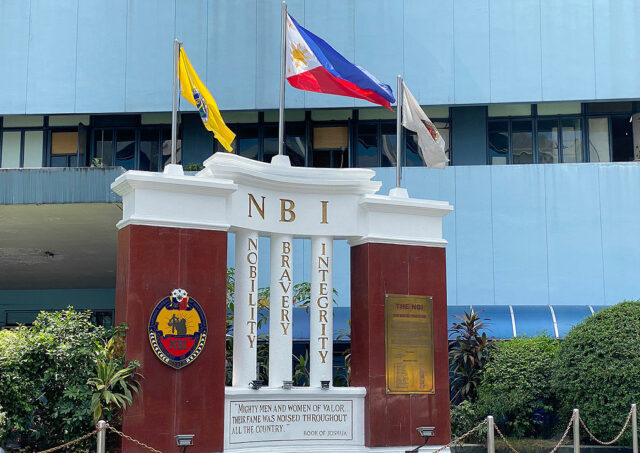
PRESIDENT Ferdinand R. Marcos, Jr. appointed lawyer Melvin A. Matibag, a former Cabinet secretary of his predecessor Rodrigo R. Duterte, as director of the National Bureau of Investigation (NBI).

Malacañang confirmed the move on Thursday but did not elaborate on why incumbent Director Angelito DLP. Magno was fired.

“The trust is there. [Mr. Marcos] saw that Atty. Melvin Matibag could be trusted and could work for the government, but the main reason hasn’t been shared with me in detail yet,” Palace Press Officer Clarissa A. Castro told a news briefing in Filipino.

Mr. Matibag was a Cabinet member of the Office of the President under Mr. Duterte in 2022.

He was also the secretary general of the Partido Federal ng Pilipinas-Laban, Mr. Duterte’s political party.

He is set to take his oath before Mr. Marcos.

The move comes as a feud between the administration and the Duterte clan escalates following Mr. Duterte’s daughter, Vice-President Sara Duterte-Carpio’s announcement of her intention to run as president in 2028 on Wednesday. — Chloe Mari A. Hufana

Sea row deepens Duterte-Marcos rift

PHILSTAR FILE PHOTO

CLASHING strategic visions of how the Philippines should navigate its dispute with China sets another crack between President Ferdinand R. Marcos, Jr. and Vice-President Sara Duterte-Carpio, while affecting alliance structures and investor perception, the GlobalSource Partners said.

GlobalSource country analysts Diwa C. Guinigundo and Wilhelmina C. Mañalac said the dispute in the South China Sea introduces a “fundamentally different dimension” to the Marcos-Duterte divide.

“Such divergence affects alliance structures around the United States or China; defense posture against big power bullying; investor perceptions about strategic peace and viability; and regional credibility,” the analysts said in a Feb. 18 report.

The Duterte prioritized bilateral engagement and economic cooperation with China while downplaying enforcement of the Philippines’ arbitration victory.

By contrast, Mr. Marcos took on a more assertive stance, focusing on sovereignty defense through legal claims, rhetorical and operational pushback against coercion, and efforts to rally international support.

“Unlike prior conflicts, it concerns the Philippines’ position within an evolving regional order shaped by great-power competition and maritime security realities,” they added. — Aubrey Rose A. Inosante

PHL drafting sustainability blueprint

THE Philippine government is drafting a strategic blueprint to manage the country’s economic shift toward a more sustainable and climate-resilient future, under the Philippine Just Transition Framework (JTF).

The Department of Environment and Natural Resources (DENR), through the Just Transition Technical Working Group, said the framework sets out the guiding principles and institutional foundations needed to support a fair transition across policy, regulation, and investment as the economy adjusts to global low-carbon trends.

The 28-page draft was developed based on consultations with government agencies, labor groups, employers, civil society organizations, academic institutions, and private sector stakeholders after it was released for public comments from Feb. 3-9.

The multi-agency roadmap defines the national mission as a “transformative, people-centered shift to a low-carbon, energy-secure, and climate-resilient economy that prioritizes equity, inclusivity, and balance” throughout the transition process.

The policy document cautions that a business-as-usual approach — one that fails to keep pace with the global low-carbon transition — could reduce projected gross domestic product (GDP) growth by up to three percentage points and increase unemployment by 2040.

To address these risks, the framework evaluates three potential development pathways and concludes that a managed “just transition” would deliver the most favorable economic outcomes for the Philippines.

Based on assessments by the Climate Change Commission and the DENR, following this pathway could raise real GDP by more than 16% by 2040.

The draft further projects that a coordinated transition strategy could reduce poverty levels, lifting more than 12 million people above their current economic status by 2050 compared with present trends.

“A just transition requires a whole-of-economy, whole-of-society, and whole-of-government approach and can only be achieved through the meaningful and effective participation of all stakeholders,” the document read.

The technical working group notes that small and medium enterprises, which employ a large portion of the workforce, face a significant “capacity gap” and limited ability to invest in green technologies, leaving them at heightened risk during the transition to low-carbon industries without targeted support.

To address potential labor displacement, the roadmap proposes the creation of an “Early Warning System” to identify at-risk workers and direct them toward reskilling and upskilling programs. The JTF estimates that these targeted interventions could increase female labor force participation by 24 percentage points by 2050 compared with a decarbonization-only scenario.

The framework also addresses public transport modernization, underscoring the need to protect the livelihoods of jeepney drivers and operators through concessional financing and technical assistance.

The 16-agency working group notes that successful implementation will depend heavily on securing stable and predictable access to international climate finance and technology. — Erika Mae P. Sinaking

ADVERTISEMENT
ADVERTISEMENT