Home Blog Page 227

Peso may fall as US, Israel attack Iran

BW FILE PHOTO

THE PESO could depreciate against the dollar in the coming days amid mounting geopolitical risks as the United States and Israel attacked Iran over the weekend.

On Friday, the local unit closed at P57.665 per dollar, weakening by 5.7 centavos from its P57.608 finish on Thursday, data from the Bankers Association of the Philippines showed.

Week on week, however, the peso jumped by 48.5 centavos from its P58.15 close on Feb. 20.

“The dollar-peso traded higher on cautious positioning ahead of the release of US PPI (producer price index), which will clarify the US Federal Reserve’s policy trajectory,” a trader said by phone on Friday.

The peso declined as Chicago Fed President Austan Goolsbee signaled more rate cuts this year, Rizal Commercial Banking Corp. Chief Economist Michael L. Ricafort said in a Viber message.

The US dollar rose on Friday after hotter-than-expected producer price data for January and on concerns about rising tensions between the United States and Iran, Reuters reported.

The PPI for final demand rose 0.5% last month after advancing by a downwardly revised 0.4% in December. Economists polled by Reuters had forecast the PPI gaining 0.3% after a previously reported 0.5% increase in December.

For this week, the trader said the peso could be pressured by the faster-than-expected US PPI data.

The trader added that players will await the release of February inflation data as this could provide clues on the Bangko Sentral ng Pilipinas’ policy path.

Meanwhile, Mr. Ricafort said the peso could be weighed down inflation concerns due to higher oil prices amid potential supply disruptions as the US and Israel launched air strikes on Iran.

The trader sees the peso moving between P57.40 and P57.85 per dollar this week, while Mr. Ricafort expects it to range from P57.50 to P58.

Israel said it launched another wave of strikes on Iran on Sunday, as Iranians grappled with uncertainty after the killing of their supreme leader in US and Israeli attacks that threaten to destabilize the wider Middle East, Reuters reported.

Hours after both nations said an airstrike killed Ayatollah Ali Khamenei in the most ambitious series of attacks on Iran in decades, the country’s state media confirmed the 86-year-old leader’s death on Saturday.

Iran’s armed forces would soon retaliate again with their biggest offensive against US bases and Israel, Islamic Revolutionary Guard Corps vowed in a statement on Sunday.

On Saturday, Tehran warned that it had closed the Strait of Hormuz, the narrow conduit for about a fifth of global oil consumption, raising expectations of a sharp jump in oil prices. — Aaron Michael C. Sy with Reuters

BMW X1 gets a plug-in hybrid powertrain

The BMW X1 xDrive25e M Sport is priced at P3.998 million.

SMC ASIA CAR Distributors Corp., the official importer and distributor of BMW in the Philippines, recently introduced the new BMW X1 xDrive25e M Sport, priced at P3.998 million, through a selling display at the Rockwell Power Plant Mall. Significantly, this is the first time for the compact crossover to come with a plug-in hybrid powertrain — joining the brand’s lineup of electrified models here — and will be the sole motivator for the X1 nameplate moving forward.

In a release, BMW in the Philippines said the arrival of the X1 PHEV is another expression of its “Power of Choice” strategy which provides customers with “the flexibility of both a combustion engine and an electric motor.”

The system submits a total output of 245hp and 477Nm of torque translating to, among others, a standstill-to-100kph time of 6.8 seconds. Electric range is 101 kilometers, enabled by BMW’s fourth-generation battery technology in the X1. The company said this makes it “ideal for daily urban commutes.” Combined with the internal combustion engine (a 1.5-liter, three-cylinder gasoline sipper) range, the X1 can muster up to 764 kilometers.

For now, the X1 PHEV will come in a single M Sport variant, with another one (the X1 xDrive25e xLine) to arrive in “mid-March,” according to a source. That xLine variant is expected to be priced at P3.498 million.

The M Sport gets design accents including an M Aerodynamics package, high-gloss Shadowline trim, and M light-alloy wheels. Aboard is the newest BMW Widescreen Display with iDrive Operating System 9 for “seamless connectivity and intuitive control.” Sport seats are wrapped in M Alcantara/Veganza, and content will find expression through a high-fidelity Harman Kardon loudspeaker system.

The model also comes with BMW ConnectedDrive. Said to be a first in the country, an “integrated data SIM card enables BMW Live Maps with real-time traffic information and route calculation.”

The new BMW X1 xDrive25e M Sport is available in “a limited introductory quantity” with six color choices: Alpine White, Black Sapphire, Space Silver Metallic, M Portimão Blue Metallic, Cape York Green Metallic, and Fire Red Metallic.

For more information, visit www.bmw.com.ph or any authorized BMW dealership nationwide. — Kap Maceda Aguila

Gov’t debt yields go down

YIELDS on government securities (GS) mostly went down last week on strong demand and as players repositioned as the month closed and following updates on the country’s potential re-inclusion in the JPMorgan Chase & Co. Government Bond Index-Emerging Market (GBI-EM) series.

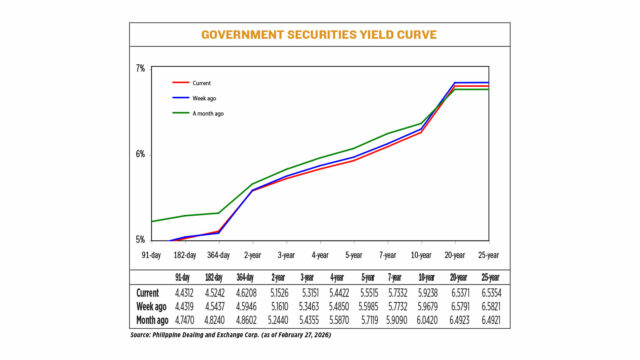
GS yields, which move opposite to prices, fell by an average of 2.69 basis points (bps) week on week at the secondary market, according to PHP Bloomberg Valuation Service Reference Rates as of Feb. 27 published on the Philippine Dealing System’s website.

At the short end of the curve, yields on the 91- and 182-day Treasury bills (T-bills) slipped 0.07 bp to 4.4312% and 1.95 bps to 4.5242%, respectively. Meanwhile, the rate for the 364-day tenor went up by 2.62 bps to 4.6208%.

Rates at the belly declined across the board, with the two-, three-, four-, five-, and seven-year Treasury bonds (T-bonds) dropping 0.84 bp (to 5.1526%), 3.12 bps (5.3151%), 4.28 bps (5.4422%), 4.7 bps (5.5515%), and 4 bps (5.7332%), respectively.

At the long end, yields on 10-, 20-, and 25-year debt papers fell by 4.41 bps (to 5.9238%), 4.2 bps (6.5371%), and 4.67 bps (6.5354%), respectively.

GS volume traded increased to P58.58 billion last week from P44.06 billion previously.

“Overall, the week saw downward pressure on yields, especially at the short to belly portion of the curve, driven by strong auction results, sustained liquidity, and the month-end rush,” the first bond trader said in a Viber message.

The trader said both the T-bill and T-bond auctions last week saw strong demand as investors likely wanted to lock in yields at their current levels on expectations that rates would go down further.

“The decent participation in the three-year and seven-year tenor, to a lesser degree, suggested that investors are comfortable with some duration risk, leading to the flattening yield curve for belly tenors later during the week,” the trader added.

“BTr (Bureau of the Treasury) auctions this past week continued to attract robust demand, with most participants channeling excess liquidity into the Philippine peso-denominated government bonds market as bond yields continue to offer attractive spreads over the BSP’s (Bangko Sentral ng Pilipinas) policy rate,” the second bond trader likewise said in a Viber message.

The trader said the country’s potential inclusion in JPMorgan’s GBI-EM Index drove strong demand for tenors at the belly and the long end.

“Sentiment improved midweek after the National Treasurer shared updates regarding the Philippines’ potential inclusion in the JPMorgan Government Bond Index. Estimated inflows of up to $3 billion, if inclusion materializes, would be meaningful for the local market. Beyond the headline number, the structural implication is deeper foreign participation,” Lodevico M. Ulpo, Jr., vice-president and head of Fixed Income Strategies at ATRAM Trust Corp., said in a Viber message.

National Treasurer Sharon P. Almanza told Bloomberg last week that the Philippines could attract about $3 billion in inflows if its government bonds are added to the foreign bank’s emerging-market index, as it would have an initial weight of about 1%. She said an update on the country’s inclusion bid could come as early as this month.

For this week, Mr. Ulpo said the BTr’s bond auction would be a trading driver as this would test demand for tenors at the belly of the curve.

He added that the release of February inflation data on Thursday (March 5) would be a key catalyst for the market. “A downside surprise would reinforce expectations of continued policy easing and support a further bull flattening. Conversely, an upside print could temper dovish expectations and prompt some profit taking.”

“We could expect relatively neutral movements in the coming weeks with broadly stable macroeconomic conditions. However, upside inflation risks could push the long end of the curve higher. Markets appear to be anticipating a faster local inflation print in February, but any surprise to the upside could spur broad risk-off sentiment,” Marco Antonio C. Agonia, an economist at the University of Asia & the Pacific, said in an e-mail.

“Yields will likely trade sideways with a slight upward bias as the BSP’s expectations on the inflation data anticipate higher CPI (consumer price index). The front end of the curve will likely remain anchored by BSP policy expectations, while the long end will take cues from US Treasury movements and global developments,” the first bond trader said. “Overall, barring any surprise data, the yield curve may continue to be stable or trade slightly higher on local CPI data, supported by strong domestic demand.”

The analysts added that market players will also monitor external developments, such as the movements of US Treasuries, geopolitical news, and US economic data releases. — Isa Jane D. Acabal

Palm oil expansion raises concerns over environment, coconut industry impact

CRAIG MOREY/FLICKR/CC BY-SA 2.0

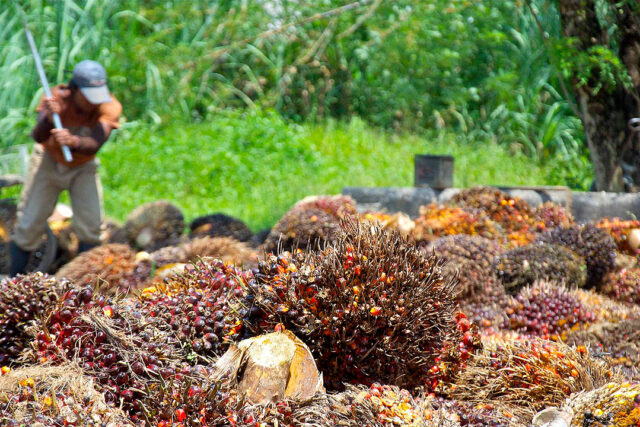
THE government’s plan to expand palm oil production in Mindanao must not come at the expense of the coconut industry or the environment, industry leaders said.

Danilo V. Fausto, president of the Philippine Chamber of Agriculture and Food, Inc., said the government should prioritize the development of the coconut industry.

“We should first accelerate the development of our coconut industry, where the Philippines has a dominant and competitive edge in the world,” he told BusinessWorld via Viber.

Mr. Fausto said the government should invest in post-harvest facilities, logistics, and technology to increase coconut farmer incomes.

In a statement on Friday, the Department of Agriculture (DA) said it is ramping up efforts to expand oil palm plantations in Mindanao to curb imports and bolster the supply of edible oils.

Oil palm yields average about 3.8 metric tons per hectare, compared with less than one metric ton per hectare for coconut. Because of higher yield, oil palm farmers earn at least double the roughly P90,000 that coconut farmers earn annually, the DA said. 

Philippine Coconut Authority (PCA) Administrator Dexter R. Buted said it is working on establishing nurseries in Mindanao and cultivating planting materials on a local basis.

Former Agriculture Undersecretary Fermin D. Adriano said Mindanao is suitable for palm production because it is rarely visited by strong typhoons, but cited land consolidation as a major constraint.

“The main problem is acquiring contiguous lands for palm oil production. You need thousands of hectares. The Malaysians and the Japanese tried in the past but failed to consolidate land for palm oil production,” he told BusinessWorld via Viber.

Former Agriculture Secretary William D. Dar said the DA’s palm oil expansion plans must not disturb forested areas.

“We need to protect our environment while pushing for the expansion of palm oil production in the country,” he told BusinessWorld via Viber.

Mr. Dar said joint ventures between agribusiness companies and clusters of farmers should be encouraged to develop the industry.

“In effect, a public-private-producer partnership will be the best business model anchored on regenerative and resilient agriculture,” he said.

Charles R. Avila, chairman of the Confederation of Coconut Farmers’ Organizations of the Philippines, expressed his opposition to expanding oil palm, citing risks to biodiversity and the potential for exploitative labor practices.

“The conversion of natural vegetation to monoculture plantations, as in oil palm, definitely reduces biodiversity… the industry is associated with exploitative practices, low wages, disappearance of land rights, and precarious working conditions for farm workers,” he told BusinessWorld via Viber.

Mr. Avila also said it was a mistake to task the PCA with overseeing oil palm expansion.

“It is the same PCA that was made to assure the nation that they have the formula to double the income of coconut farmers through its various productivity and social service programs,” he said.

“Does not the government believe its own PCA? Why, then, use (the coconut industry’s) low productivity as an argument to shift to oil palm?” Mr. Avila added. — Vonn Andrei E. Villamiel

Angkas eyes more units, expansion of AngCars services

ANGKAS.COM

RIDE-HAILING APP Angkas, operated by DBDOYC, Inc., is planning to expand the rollout of its four-wheel vehicle services and deploy more units.

“We just rolled it out. We are doing our own pilot test. What our focus really is how (can we) have more EVs (electric vehicles) on the road. We have been working with a lot of vendors in China and in the Philippines so that we can roll out a much larger EV fleet,” Angkas Chief Executive Officer George I. Royeca told reporters on the sidelines of the Association of Southeast Asian Nations (ASEAN) Editors and Economic Opinion Leaders Forum last week.

The ride-hailing app rolled out AngCars, its four-wheel ride-hailing service, in 2024 within Metro Manila.

The company currently has about a thousand units for this service, Mr. Royeca said, adding that it is studying the deployment of more units while also expanding its area coverage.

“We are still not making a dent in the industry, but we are studying how we can really provide a unique value proposition… Right now, we are in Metro Manila but of course we are opening into other provinces as well,” he said.

The rollout of Angkas’ four-wheel service complements its existing two-wheel operations.

Mr. Royeca also expressed optimism that the motorcycle taxi law will soon be legalized, strengthening the company’s position in the market.

Currently, Angkas operates under the pilot study of the Department of Transportation, implemented through the Land Transportation Franchising and Regulatory Board (LTFRB).

The proposed Motorcycles-for-Hire Act, which aims to amend Republic Act No. 4136, seeks to legalize motorcycle ride-hailing services in the country by classifying them as public utility vehicles.

“We are working with the committee on transportation… [The MC taxi legalization] is one of their priorities… I know the Department of Transportation is also working on a Department Order to make sure that we can continue our services,” he said. — Ashley Erika O. Jose

Margiela files made public

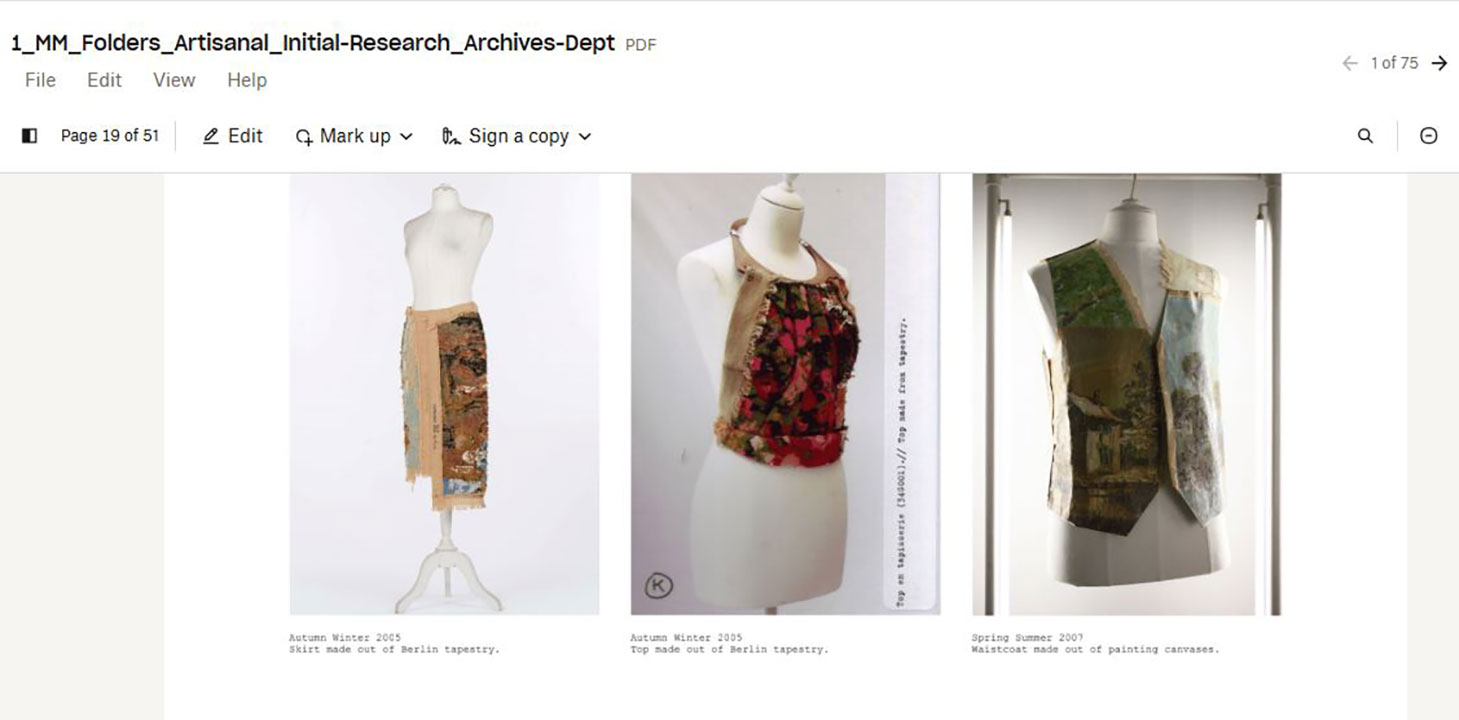
SCREENCAPS of Margiela’s files from Dropbox.

IN AN unprecedented move, Maison Margiela, known widely for its avant-garde approach to fashion, is making its files accessible for all to view. The files were made available earlier this month — prosaically, through several Dropbox folders, just like one would access files in the office.

The folders aren’t a leak or anything illegal. They have been presented as a teaser for a series of exhibitions around China, beginning with their Fall/Winter 2026 show in Shanghai on April 1. Furthermore, the show will be followed by a series of exhibitions and experiences in four cities in China, “each dedicated to a different code that shapes our identity: Artisanal; Anonymity; Tabi and Bianchetto,” ran a press release.

We took a peek at the files: while the actual folder for the upcoming fashion show is empty, the folders for the other exhibition themes are full. The Artisanal folder explores their couture line, with a series of archival looks beginning in 1989 and beyond. Anonymity explores the psychology of their lack of branded labels and the masks at their runway shows. Tabi explores one of their most famous creations, the split-toe Tabi shoe which has influenced fashion both fast and slow, and finally, Bianchetto explores their white overpaint technique, which has become a signature of the brand.

In the 51-page document for the Artisanal line, it says, “Historically, each Artisanal piece was accompanied by a detailed log, recording its intention, the materials used, the hours required, and the unique nature of its construction offering a insight into the labor, time, and craftsmanship behind each piece.” It’s true: dresses from the Spring/Summer 2007 archives are shown made from vintage silk scarves, bowties, and vintage beads.

Meanwhile, Anonymity, in 24 pages, shows the various ways they have attempted to blur and conceal identities, such as through wigs, masks, and veils. Tabi, running 27 pages, shows the evolution of the Tabi silhouette, from the very first Tabi boot in the 1980s. Bianchetto, meanwhile, shows all the things they have painted white: “This gesture introduced paint as a means of leaving a trace, evoking notions of movement and temporality. From the outset, paint functioned as a medium that revealed rather than concealed the passage of time.

“As the project evolves, new files will be added for everyone to explore and collect, revealing new information about the experiences while documenting the journey from concept to exhibition,” said a release. “We invite you to follow the MaisonMargiela/folders, delving into its documents that chart the journey as it unfolds.”

The Maison Margiela files can be accessed through https://www.maisonmargiela.com/maisonmargiela_folders.html.JL Garcia

Crimes against humanity: Inflection point

FAMILIES of extrajudicial killing victims are emotional as they gather at the National Council of Churches in the Philippines (NCCP) in Quezon City. — PHILIPPINE STAR/MIGUEL DE GUZMAN

The inflection is on the word humanity. These are not crimes against humans alone.

There are crimes and there are crimes. For most part, these are wrongs visited on individuals. Often, too, groups, and even fairly large communities, are violated, mostly at frays or breaking points of the ways the many human societies weave themselves together.

Occasionally, the transgressions are shocking, even to humans with a cultivated cynicism. Euphemisms are invented to soften the impact of such deeds on the squeamish, for instance: collateral damage.

Human beings are collectively the only species known to kill for pleasure. But even the brutishness of pathological human predators (for instance, serial killers) are globally assumed to be aberrations that can be neutralized by the various human societies within the order of things each subscribes to.

Crimes against humanity are an entirely different matter. These threaten the definition of being human and transcend boundaries between and among human communities.

HUMANITY
The accusations against former Philippine President Rodrigo Duterte, lodged with the International Criminal Court (ICC), are of crimes against humanity. It bears reiterating: not against humans alone.

The details of each instance of horrendous death — about which Duterte is charged with ordering, or inspiring, or creating the environment for — concern individuals on the wrong side of his “policies.” Without an assiduous press and civil society, the victims would have remained anonymous.

Many Filipinos regard these as crimes against humans that can be processed into retributive outcomes within the Philippine legal system.

There is considerable noise about sovereignty at stake: that the “foreign,” in this case the ICC, transgresses the Filipino right to self-determination. That, yet again, the colonial powers (the hoary ghosts!) are trampling Philippine independence underfoot. Even senators who should know better, snivel thus.

There is even bigger noise about the “right” of Philippine society to its own definition of human rights. They mistakenly cite the beheadings that are part of Saudi Arabia’s criminal justice system, for instance, to argue that crime and punishment are culture based and should allow for radical variation.

And this is the point where “culture” is hauled in to refract the very idea of crimes against humanity.

THE ANONYMOUS
The relative or metaphoric anonymity of the victims of Duterte’s drug war seems to support this abominable twisting of the global consensus on crimes against humanity.

Anonymity allows for victims to be tarred, wholesale, as a threatening group of humans — drug addicts or dealers whose numbers are so large they require extermination as vermin — and consigned to a collective image of a scourge on society.

Typically, these are the poor. Their crimes are (also typically) misdemeanors. Only a few actual drug dealers were brought to punishment, and these and the rest of the cases are extrajudicial kills.

Moreover, the kills were deliberately made out to be pictures that horrify. In fact, maximum horrification. (And woefully, maximum stretch of language use to encompass terror.)

For Filipinos to agree, as a nation, to be terrified into submission to a rule and environment of extrajudicial killings, is to succumb to blindness to the staging, the performance of the terrifying.

And submission and blindness are only possible if the individual victims are not people, really, but a collectivity defined exclusively by the executioners and the source of orders to kill.

To many privileged Filipinos, even to the middle class, the poor are not people.

And when the president of the Philippines avowed that “drug addicts are not human,” the stage was set for impunity.

THE PROPOSITION
To be sure, the overt victims of Dutertean horror-making are individuals with lives to live — many, youth who merit presumption of hopefulness about better futures than the abject circumstances of their time of death.

But what constitutes crimes against humanity is more than their violent ends. Which, yes, indeed, can be or should be dealt within the Philippine criminal justice system.

The larger picture includes dehumanizing the poor and treating them as props to power-mongering, the staging of bodies for a years-long stretch of terrorizing images, the pressuring of the Filipino national community towards acceptance of a politics of fatal hatred, the parading of grisly executions in front of the global community of nations as a Filipino version of justice, and the appropriation of cultural explanation to rationalize validity for this form of madness.

All these are a single proposition to the world: that being human, at this point of human history, includes horror-making as a form of governance. That the victims are inconsequential humans, indeed non-humans.

That the state is entitled to exercise lethal power outside the legal system. That theater as governance can take the form of the theater of the macabre.

That being human includes the deadly irony that extrajudicial killings can be judicial for a “good” cause, which, in the Philippines under Duterte, was the false narrative of national salvation from narco-economics.

This proposition — snuff pornography writ large is a form of humanity — is a crime against humanity.


Marian Pastor Roces is an independent curator and critic of institutions. Her body of work addresses the intersection of culture and politics.


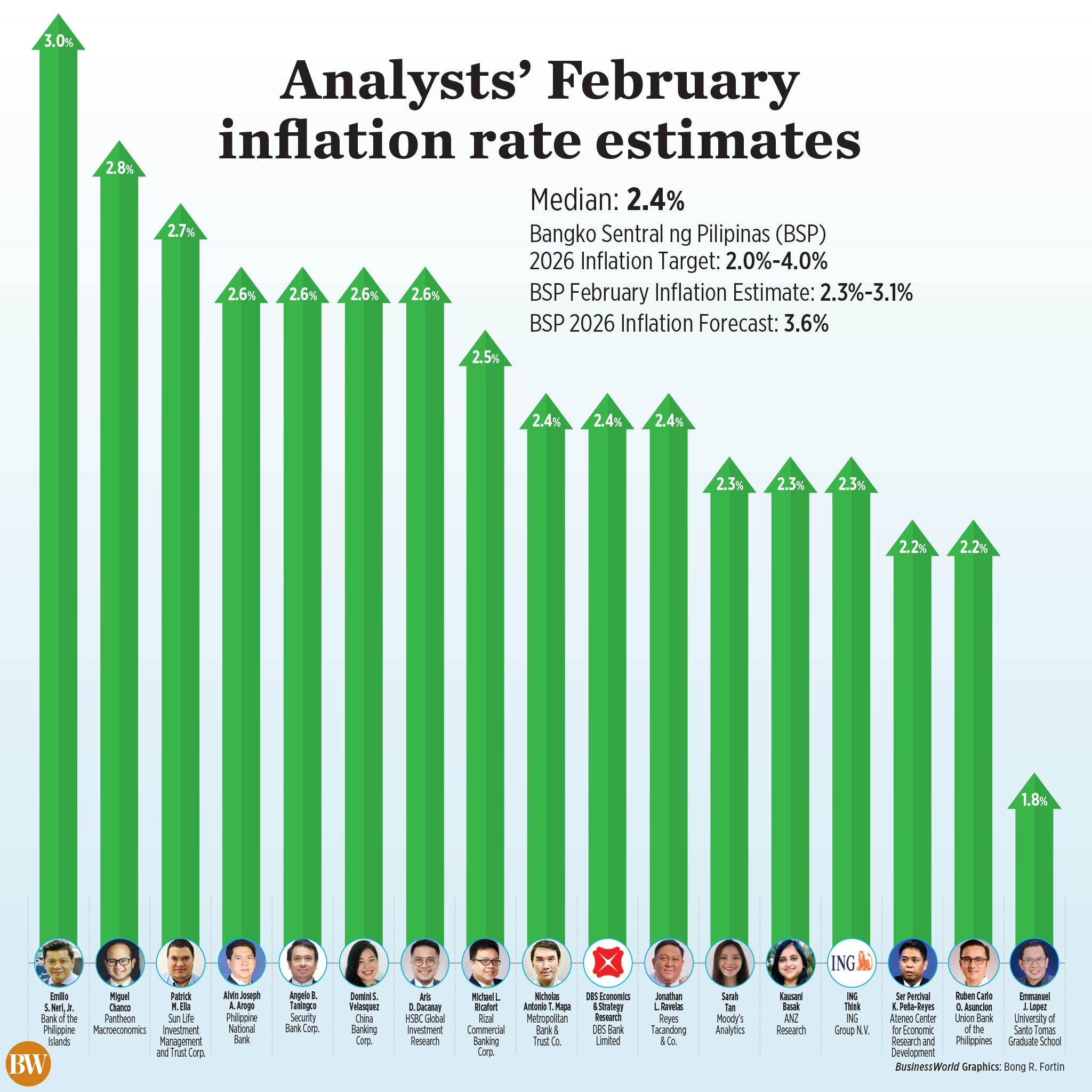
Analysts’ February inflation rate estimates

PHILIPPINE INFLATION may have hit its fastest pace in over a year as price pressures from higher costs of electricity, oil and rice pushed up the headline print in February, analysts said. Read the full story.

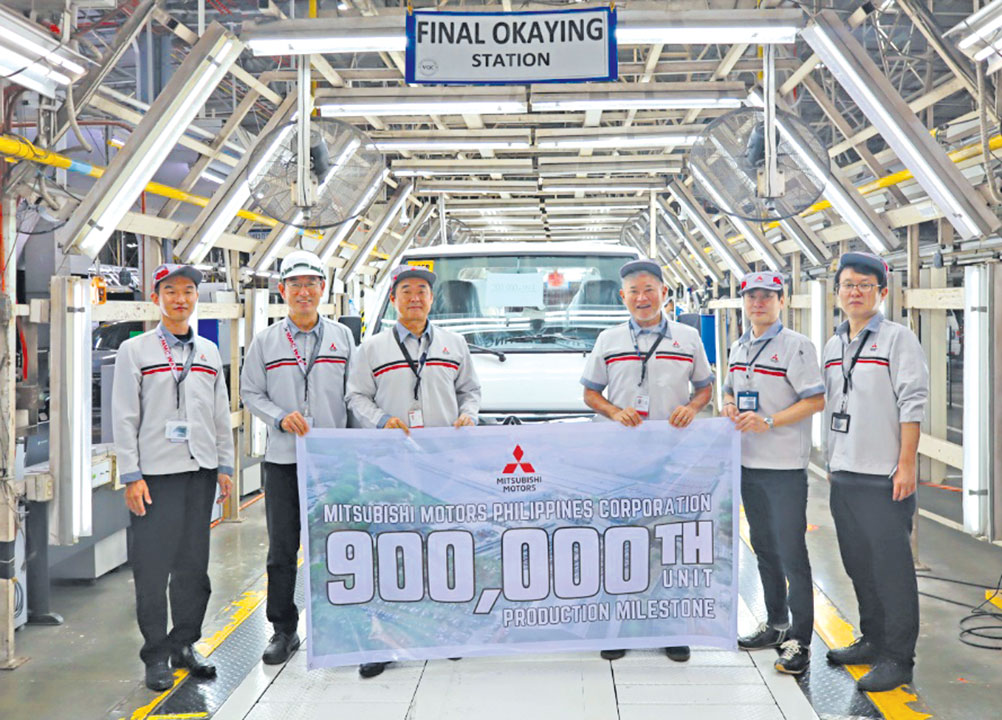
Mitsubishi Motors Philippines has produced 900K L300s

PHOTO FROM MITSUBISHI MOTORS PHILIPPINES CORP.

MITSUBISHI MOTORS Philippines Corp. (MMPC) recently marked a milestone with the local production of its 900,000th unit of the Mitsubishi L300. In a release, MMPC said this reinforces “the company’s long-standing commitment to operational excellence and quality manufacturing in the Philippines.”

The locally produced Mitsubishi L300 continues to be one of the most trusted commercial vehicles in the country, “supporting business continuity and economic activity across industries.”

MMPC said it achieved this milestone through the “consistent demand” for its locally assembled Completely Knocked Down (CKD) models “alongside ongoing kaizen activities implemented by its Manufacturing Division.” MMPC has worked on optimizing the production line, improving efficiency, and strengthening quality across all CKD units.

“The 900,000-unit production milestone of the Mitsubishi L300 reflects the dedication of our people and our commitment to continuous improvement in manufacturing,” said MMPC President and Chief Executive Officer of Ritsu Imaeda. “Through disciplined operations and teamwork across our organization, we have been able to sustain production excellence while delivering vehicles that our customers have relied on for many years.”

Known for durability and reliability, the Mitsubishi L300 has long been a dependable partner for small and medium enterprises, logistics providers, and fleet operators. “Its robust build and practical cargo capacity have made it well-suited for delivery operations and various business applications, helping support daily operations and long-term growth,” said MMPC. Its cost-efficient ownership further makes it a practical commercial vehicle choice. Designed to balance performance, durability, and operating efficiency, it continues to serve as a valuable asset for businesses seeking dependable transportation solutions.

MMPC maintains that as the L300’s production continues, “the company remains focused on strengthening its manufacturing capabilities, upholding quality standards, and supporting the evolving mobility needs of customers.”

German pork import regionalization scheme expected to be in place within three months

REUTERS

THE Department of Agriculture (DA) said it may soon allow pork imports from parts of Germany that are free from African Swine Fever (ASF) instead of blanket bans on all German pork once an outbreak is detected.

Agriculture Undersecretary for Livestock Constante J. Palabrica told reporters that Germany’s application for ASF regionalization could be completed and approved within the next three months.

Mr. Palabrica said Germany first applied for regionalization status two years ago, but the process has been slow due to the rigorous document review conducted by the Bureau of Animal Industry (BAI).

“We require a lot of paperwork and are very strict with the documents. That’s why Germany has yet to be given regionalization status,” he said on the sidelines of the International Farmers Summit in Pasay City.

Mr. Palabrica said delays often stem from slow responses from Germany.

Last year, the DA formally adopted ASF regionalization rules, under which pork products must originate from ASF-free regions, be transported in sealed vehicles directly to approved slaughterhouses, and pass both ante- and post-mortem inspections.

German pork imports were first suspended in 2019 after meat from ASF-affected Poland was found in German shipments.

A subsequent ban was enforced in 2020 after Germany reported its first official ASF case in a wild boar.

Live swine must also come from ASF-free zones, show no clinical signs of infection, and avoid restricted areas during transport.

Once the application is cleared, both countries must sign a bilateral agreement outlining specific animal health requirements.

Other major exporters like Poland, Russia, and Canada have obtained regionalization approval from the Philippines. — Vonn Andrei E. Villamiel

Maynilad pauses Teresa water treatment plant project

MAYNILADWATER.COM.PH

WEST ZONE concessionaire Maynilad Water Services, Inc. has temporarily put on hold its plan to build a water treatment plant in Teresa, Rizal, while exploring alternative locations to improve efficiency.

“Initially, the plan was to build the Teresa treatment plant to get water from Kaliwa Dam. We’ve shelved it for now [and] we plan to relocate it within our concession,” Maynilad Chief Operating Officer Jaime T. Lichauco told reporters last week.

He said that relocating the project within its concession area would be “more efficient” and ensures lower non-revenue water (NRW), or the water lost and not billed to customers due to leaks and illegal connections.

Maynilad President and Chief Executive Officer Ramoncito S. Fernandez said that the proposed water treatment plant may be completed within three to four years.

“It’s in our business plan to build another water source. So, it’s more of relocating the Teresa plant down to inside our concession to avoid additional non-revenue water,” Mr. Fernandez said.

The company previously earmarked around P30 billion as capital expenditure budget to build the water treatment plant that will produce a capacity of 300 million liters per day of potable water.

The facility is initially designed to draw water supply coming from the Kaliwa Dam located across Rizal and Quezon provinces, which is intended to ease the demand on the Angat Dam.

The P15.3-billion Kaliwa Dam project is on track for completion by 2028, according to the latest update from the Metropolitan Waterworks and Sewerage System.

Meanwhile, Mr. Fernandez said that tapping desalination — a technology that provides potable water by removing salt and other impurities from seawater to produce freshwater — as an alternative water source is still on the table for the company but not in the near term.

“Maybe not near term, but we have started looking at it way back. There are concrete opportunities for us to go for desalination specifically in adjacent areas in Manila Bay,” he said.

If pursued, the company plans to tap foreign expertise for the development of a desalination plant.

Maynilad serves Manila, except portions of San Andres and Sta. Ana. It also operates in Quezon City, Makati, Caloocan, Pasay, Parañaque, Las Piñas, Muntinlupa, Valenzuela, Navotas, and Malabon. It also supplies the cities of Cavite, Bacoor, and Imus, and the towns of Kawit, Noveleta, and Rosario, all in Cavite province.

Metro Pacific Investments Corp., which has a majority stake in Maynilad, is one of three Philippine units of Hong Kong-based First Pacific Co. Ltd., the others being Philex Mining Corp. and PLDT Inc.

Hastings Holdings, Inc., a unit of PLDT Beneficial Trust Fund subsidiary MediaQuest Holdings, Inc., has an interest in BusinessWorld through the Philippine Star Group, which it controls. — Sheldeen Joy Talavera

Stemming the obesity epidemic among Filipino children

FREEPIK/JCOMP

More than one billion people worldwide are living with obesity today. In 2025 alone, an estimated 543 million children and adolescents were overweight or obese. By 2035, projections suggest that nearly half of the global population — around four billion people — may be overweight or obese.

These are not just abstract statistics. They represent children whose health, confidence, and future productivity may already be compromised.

An overweight or obese child is more likely to experience stigmatization, bullying, low self-esteem, depression, and anxiety. The psychological burden can be as damaging as the physical one. Beyond the playground, childhood obesity also carries enormous long-term costs in terms of future healthcare expenditure and lost income.

Because childhood obesity often persists into adulthood, millions of children are at heightened risk of developing serious non-communicable diseases (NCDs) such as type 2 diabetes, cardiovascular disease, fatty liver disease, and certain cancers later in life. Globally, NCDs attributable to overweight and obesity contribute to approximately 1.7 million premature deaths annually. The broader economic toll is staggering: the projected global impact of people being overweight and obese is estimated to reach $3.23 trillion by 2030. The World Obesity Federation underscores these urgent realities as it leads the observance of World Obesity Day on March 4. High Body Mass Index (BMI) is not merely a cosmetic concern as it is a major risk factor for ischemic heart disease, stroke, type 2 diabetes, cancers, liver and kidney disease, musculoskeletal disorders such as osteoarthritis and chronic back pain, and even neurological and mental health conditions.

Obesity is no longer a distant or “Western” problem. It is here.

In the Philippines, 40% of adults, 13% of adolescents aged 10 to 19, and 14% of children aged five to 10 are overweight or obese. Four of the five leading causes of death in the country are NCDs — ischemic heart disease, cancers, cerebrovascular disease, and diabetes mellitus — all strongly associated with unhealthy weight.

The economic consequences are equally alarming. In 2019, the cost of overweight and obesity in the Philippines was estimated at $5.06 billion (around P300 billion), equivalent to 1.3% of gross domestic product (GDP). By 2030, this figure is projected to more than double to $11.71 billion, or 4.45% of GDP.

Behind these numbers are Filipino families facing mounting healthcare expenses, lost workdays, and diminished quality of life.

A major driver of the global obesity epidemic is the growing consumption of ultra-processed foods (UPFs). These products undergo multiple industrial processes designed to enhance taste, convenience, and shelf life. They are often energy-dense, high in unhealthy fats, refined starches, free sugars, and salt, and low in fiber and essential nutrients.

If a packaged product contains a long list of ingredients rarely used in home kitchens such as emulsifiers like polysorbates, flavor enhancers, artificial sweeteners, or high-fructose corn syrup, it is likely ultra-processed.

Beyond contributing to weight gain, UPFs are associated with increased risks of cardiovascular disease, type 2 diabetes, and certain cancers. Their aggressive marketing, particularly to children, combined with easy availability and affordability, makes them a powerful force shaping dietary habits from a young age.

Preventing childhood obesity requires integrated, multi-stakeholder strategies that address not only individual choices but also the environments in which those choices are made. The National Nutrition Council, under the Department of Health, is working with partners such as UNICEF and the World Health Organization to advocate for stronger policies. These include clearer front-of-pack labeling, restrictions on marketing unhealthy food and beverages to children, and healthier food standards in schools. The Department of Education, through its School-Based Feeding Program, provides nutritious meals to undernourished learners in public schools. Health and nutrition education are integrated into the K-12 curriculum, teaching students about balanced diets, physical activity, and healthier lifestyle choices. Schools are also encouraged to limit junk food and promote healthier canteen offerings.

But policy alone is not enough.

Obesity must be recognized and treated as a chronic, relapsing disease and not simply a failure of willpower. Integrating obesity prevention and management into primary care is critical. This includes routine screening, counseling, behavioral interventions, and when appropriate, access to evidence-based treatments.

The private sector also has a vital role. Employers can promote workplace wellness programs. Food manufacturers can reformulate products to reduce sugar, salt, and unhealthy fats. The innovative pharmaceutical industry continues to invest in research and development to expand treatment options for people living with obesity and related NCDs, while working with stakeholders to improve access and strengthen health systems.

World Obesity Day is not merely about raising awareness.

If we fail to address childhood obesity today, we risk normalizing early-onset diabetes, heart disease in midlife, and mounting economic strain on families and the healthcare system. But if we act decisively — through smarter policies, healthier food environments, strengthened primary care, and collaborative partnerships — we can alter the trajectory. Stemming the obesity epidemic among Filipino children is not only about reducing numbers on a scale. It is about safeguarding their health, protecting their dignity, and securing a more productive and resilient future for the nation.


Teodoro B. Padilla is the executive director of Pharmaceutical and Healthcare Association of the Philippines, which represents the biopharmaceutical medicines and vaccines industry in the country. Its members are at the forefront of developing, investing and delivering innovative medicines, vaccines, and diagnostics for Filipinos to live healthier and more productive lives.

ADVERTISEMENT
ADVERTISEMENT