Home Blog Page 1869

PSEi rises to 6,800 as BSP signals more rate cuts

PHILIPPINE STAR/KRIZ JOHN ROSALES

PHILIPPINE STOCKS climbed to the 6,800 level on Tuesday as investor sentiment was boosted by the Bangko Sentral ng Pilipinas’ (BSP) projection of more interest rate cuts.

The Philippine Stock Exchange index (PSEi) gained 0.61% or 41.84 points to 6,803.19, while the broader all-share index added 0.32% or 12.48 points to 3,812.18.

“The local bourse managed to settle in the green but gains were trimmed as investors digested the latest statement from the BSP regarding rate cuts,” Luis A. Limlingan, head of sales at Regina Capital Development Corp., said in a Viber message.

On Tuesday, BSP Governor Eli M. Remolona, Jr. said the central bank’s easing cycle is still under way, but they might opt to keep rates steady at their final policy meeting of the year on Dec. 19.

“We’re still in the easing cycle,” he told reporters. “Either we cut in December or we cut in the next meeting, but gradually.”

The BSP cut interest rates by 25 basis points for a second straight meeting on Oct. 16, bringing its benchmark rate to 6%, the lowest since February 2023. It will meet for the last time this year on Dec. 19.

“Investors continued to hunt for bargains as concerns over the prospects of protectionist trade policies in the United States subside,” Philstocks Financial, Inc. Senior Research Analyst Japhet Louis O. Tantiangco said in a Viber message.

“Robust third-quarter and nine-month corporate results also helped in the market’s climb,” he added.

Almost all of the market’s sectoral indices closed higher. Services rose 1.3% or 27.01 points to 2,102.87, while property went up 1.22% or 31.52 points to 2,609.57. Mining and oil gained 0.9% or 68.91 points to 7,702.66.

The industrials index added 0.86% or 81.29 points to 9,458.12, while financials inched up 0.81% or 18.12 points to 2,248.62. Holding firms declined 0.84% or 48.78 points to 5,739.87.

Value turnover shrank to P5.45 billion covering 783.36 million shares from P5.78 billion covering 695.71 million stocks on Monday.

Losers beat winners 111 to 85, while 63 stocks were unchanged. Net foreign selling slipped to P1.15 billion from P1.27 billion. — Revin Mikhael D. Ochave

Peso weakens versus dollar as markets await Fed signals

BW FILE PHOTO

THE PHILIPPINE peso weakened against the dollar on Tuesday as the pair consolidated in the absence of major catalysts and as markets continued to await signals from the US central bank on its next policy decision.

It closed at P58.81 a dollar, weakening by 13 centavos from its P58.68 finish on Monday, according to Bankers Association of the Philippines data posted on its website.

The peso opened at P58.65 against the dollar. Its intraday best was at P58.60, while its worst showing was P58.83 against the greenback. Volume jumped to $1.47 billion from $1.05 billion on Monday.

“The dollar-peso traded in a narrow range due to a lack of major catalysts,” a trader said by phone.

The dollar index, which measures the greenback against a basket of currencies, fell 0.5% to 106.2, with the euro up 0.54% to $1.0598.

The index hit a more-than-one-year high last week of 107.07 and has been rising on expectations that a Trump victory could result in higher tariffs and potentially stoke inflation, which would slow the path of rate cuts by the Federal Reserve.

The market also continued to await signals on the Federal Open Market Committee’s policy decision in December, the trader added.

The peso was dragged down by softened market expectations of a rate cut by the Fed in December, Michael L. Ricafort, chief economist at Rizal Commercial Banking Corp., said in a Viber message.

Markets have pared bets for a quarter-point interest rate cut at the Fed’s next meeting to less than 59%, down from close to 62% a day earlier, according to CME FedWatch.

The trader expects the peso to trade at P58.50 to P58.90 a dollar on Wednesday, while Mr. Ricafort sees it at P58.70 to P58.80. — Aaron Michael C. Sy

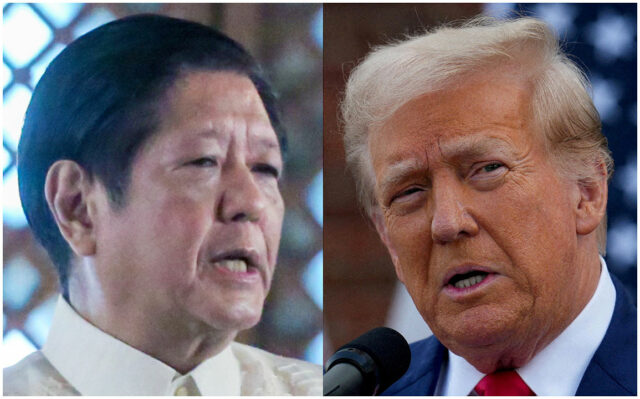
Marcos, Trump affirm deep PHL-US ties in ‘very productive’ phone call

PHILSTAR FILE PHOTO/REUTERS

By Kyle Aristophere T. Atienza, Reporter

PHILIPPINE President Ferdinand R. Marcos, Jr. on Tuesday said he had a “very productive” congratulatory phone call with United States President-elect Donald J. Trump, following an election that has put countries in the Indo-Pacific region on a wait-and-see mode.

“I expressed to him our continuing desire to strengthen the relationship between our two countries,” Mr. Marcos told reporters on the sidelines of his visit to a typhoon-hit province in the Bicol region, based on a transcript from his office.

He said the relationship between the US and the Philippines are “as deep as can possibly be because it has been for a very long time.”

Also on Tuesday, US Defense Secretary Lloyd Austin III, who is in his fourth visit to Manila, said the US alliance with the Philippines would transcend changes in administrations, as he reiterated his support for the Southeast Asian nation.

The Philippines will remain an important country for the United States for many years, Mr. Austin told a press conference during a visit to the Philippine military’s Western Command on the island of Palawan next to the South China Sea.

Both Mr. Austin and Philippine counterpart Gilberto Eduardo Gerardo C. Teodoro, Jr. expressed concerns over China’s conduct in the South China Sea, with the Pentagon chief reiterating Washington’s defense commitments to the Philippines under the 1951 Mutual Defense Treaty (MDT).

Mr. Austin said the treaty would also cover armed attack in the South China Sea, where he said China had used dangerous and escalatory measures to try to assert its expansive claims.

The Philippines and China have been embroiled in repeated spats in the past few years over disputed features within Manila’s exclusive economic zone, sparking regional concerns about a miscalculation and escalation at sea.

China claims sovereignty over almost the entire South China Sea, a conduit for more than $3 trillion in annual ship-borne commerce, putting it at odds with its Southeast Asian neighbors.

US-Philippine ties have reached unprecedented levels under Mr. Biden, with Washington announcing a plan to develop an economic corridor on the main island of Luzon in April following a trilateral meeting among Mr. Marcos, his US counterpart, and Japanese Prime Minister Fumio Kishida.

Last year, Manila gave Washington access to four more military bases under their 2014 Enhanced Defense Cooperation Agreement.

STABLE ALLIANCE
The call, which Mr. Marcos described as “very friendly” and “very productive” signals the continuity of a stable alliance between the two countries, an analyst said.

It “shows the likely stability of the PH-US alliance in the next few years,” said Joshua Bernard B. Espeña, who teaches foreign relations at the Polytechnic University of the Philippines.

“Indeed, Trump shows indicators of skepticism towards Atlanticist multilateral arrangements, but it’s another story towards Indo-Pacific arrangements, such as the bipartisan support towards China policy on lines of trade and defense matters,” he said in a Facebook Messenger chat.

“This complexity coincides with the Philippines under the Marcos administration whose aim is to bolster a large defense network as it can while committing itself to do more as long as the other does the same.”

Following Mr. Trump’s election, US Ambassador to the Philippines MaryKay Carlson cited bipartisan support for foreign military financing to the Philippines.

While there are nuances that will change in every US administration, “the strength of the US-Philippine relations and the importance of the Indo-Pacific to the American people will remain,” she said on the sidelines of an election viewing event in Manila.

She said support from both Democrats and Republicans in the US goes “across the board, not just when it comes to our military-to-military relationship.”

“Trump’s business-minded personality and Marcos’ cosmopolitan outlook provide a compatible hue to the color of the Indo-Pacific strategic environment,” Mr. Espeña said.

“Of course, their personalities should transcend into institutionalization of compatible grand strategies for decades to come.”

Meanwhile, Mr. Marcos said he also “reminded” Mr. Trump that Filipinos in America “overwhelmingly” supported him during the November polls.

“I plan to meet him as soon as I can,” he added. — with Reuters

Marcos says agriculture damage is ‘biggest problem’ after series of typhoons

UNITED STATES NAVAL RESEARCH LABORATORY

PRESIDENT Ferdinand R. Marcos, Jr. on Monday said the country’s “biggest problem” now is the billions of pesos in agriculture damage left by the series of destructive typhoons that hit the country with the most recent one leaving seven dead.

Mr. Marcos on Tuesday said the government was particularly concerned about the damage to agriculture left by Super Typhoon Man-Yi (Pepito), which made a landfall on Catanduanes island in Bicol region late on Saturday and over Aurora on Sunday.

“The biggest problem, of course, was agriculture damage,” he told reporters in Filipino on the sidelines of his visit to Catanduanes, noting that the province of Catanduanes is the center of production of abaca (Manila hemp) in the Philippines.

The Philippines supplies 85% of the world’s abaca fiber, earning about $80 million per year.

Bicol region was the largest producer of abaca in the Philippines, accounting for 40.1% of the country’s production, according to 2019 data from the statistics agency. It also had the largest area planted for abaca, with 43.16 thousand hectares in 2019.

Data from the National Disaster Risk Reduction and Management Council (NDRRMC) on Tuesday morning showed agriculture damage due to Man-Yi and two other typhoons that hit the country in span of just two weeks had hit P8.64 million; while damage to infrastructure had risen to P469.84 million.

National Economic Development Authority (NEDA) Secretary Arsenio M. Balisacan on Friday told BusinessWorld that the government expects the agriculture sector to be among the hardest-hit sectors in the face of cyclones.

“Agriculture, in the third quarter, declined by 2.8%. For the whole year, it’s likely negative for agriculture,” he said.

Jonathan L. Ravelas, senior adviser at professional service firm Reyes Tacandong & Co., said the country’s gross domestic product (GDP) for the fourth quarter will likely decline.

The full year figure for 2024 may hit only 5.8%, lower than the 6-7% expansion that the government has projected for the year.

The GDP for 2025 may also miss the government’s 6.5-7.5% target, with the economist expecting a 6.5% expansion.

“We already saw weak quarters for agriculture,” he said in a Viber message on Tuesday.

Mr. Marcos had already expressed frustration for climate change’s economic impacts, saying in October that its damage to the national economy could reach up to 7.6% of the gross domestic product by 2030.

Due largely to the impacts of weather disturbances and reduced government spending, the Philippine economy grew by 5.2% in the third quarter, lower than the revised 6.4% growth in the second quarter and the government’s 5.7% forecast.

The agriculture sector saw a 2.8% decline year-on-year, which NEDA linked to the El Niño and seven typhoons, including Severe Tropical Storm Trami (Kristine), had caused an estimated P15.8 billion in agricultural damage.

The successive storms disrupted supply chains and delayed harvests, he noted.

A Nov. 6 report by the Philippine Statistics Agency showed agricultural production experienced the steepest decline in nearly four years.

The value of production in agriculture and fisheries at constant 2018 prices fell by 3.7% to P397.43 billion in the July-to-September period, according to the report, worse than the 0.2% decline in the same period a year ago and the 3.8% contraction in the fourth quarter of 2020.

Mr. Marcos, fresh from an aerial inspection in Catanduanes on Tuesday, said that in the “immediate” term, the government is focused on providing reconstruction materials for affected families.

He handed over P50 million to the provincial government for its recovery efforts.

The Philippine weather bureau has lifted all wind signals due to Man-Yi as it weakened into a severe tropical storm and exited the Philippine area of responsibility on Monday afternoon.

NDRRMC said in its Tuesday morning report that seven people died due to a landslide during the onslaught of Man-Yi, 30 people were injured, while two others were reported missing during the typhoons that hit the country within just two weeks.

It said the cyclones had affected 1.8 million individuals, equivalent to nearly half a million families.

NDRRMC said 20 cities and municipalities have declared a state of calamity as of Nov. 19.

Four storms had hit the country in the last two weeks, a phenomenon that the weather bureau said was not odd.

It is expecting two more cyclones to enter the country in December, when the predominantly Catholic nation sees a surge in demand related to Christmas festivities. — Kyle Aristophere T. Atienza


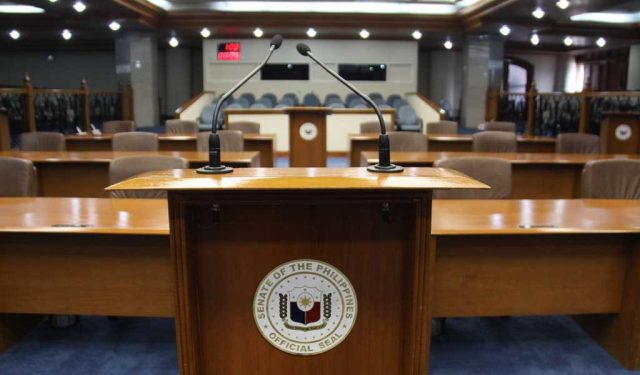
Senate nudged for ‘immediate’ enactment of 2025 budget

BW FILE PHOTO

PHILIPPINE President Ferdinand R. Marcos, Jr. has certified the proposed P6.352-trillion national budget for 2025 as urgent as the Senate wraps up plenary debates on the spending plan this week.

In a letter addressed to Senate President Francis G. Escudero, dated Oct. 29, the President cited the “necessity of the immediate enactment” of House Bill No. 10800, the 2025 General Appropriations Act to ensure “uninterrupted operation” of government functions.

Approving the budget would also ensure vital government projects get proper funding next year and allow the government to “adeptly respond to emerging challenges,” according to a copy of the letter sent to reporters via Viber by Mr. Escudero’s office on Tuesday.

The certification allows Congress to do away with the mandated three-day interval between bill readings. The President had issued a similar certification to House Speaker Ferdinand Martin G. Romualdez to speed up passage of the budget bill.

The House approved the 2025 general appropriations bill in September. It was transmitted to the Senate on Oct. 25.

Senators are in the middle of scrutinizing the spending plans of government agencies before they propose amendments on the floor.  The Senate aims to approve the national budget by the second of December at the latest, in time to submit it to the Palace before Congress goes on break on Dec. 21.

Senator Mary Grace Natividad S. Poe-Llamanzares, who chairs the finance committee, told reporters in a Viber message that the national budget will not be tackled on second reading immediately after plenary debates conclude.

“Today is the last day of the budget debates according to the agreed schedule,” Ms. Poe-Llamanzares said.

“But it won’t go to (seco)nd reading immediately as we need to give time to the senators to prepare their amendments based on the plenary debates.”

Under the 2025 National Expenditure Program (NEP), the Budget department slashed the proposed budgets for agriculture, health, and social welfare sectors by 4.7%, 7.6%, and 3.4%, respectively.

The Senate’s committee report on the budget bill increased the total proposed budget of the Department of Health and its attached agencies next year to P277.996 billion from the P217.388 billion proposed by the Executive branch. This is a nearly 28% increase from the NEP.

Ms. Poe-Llamanzares earlier told the Senate floor that her colleagues would focus on ensuring additional funding for health, education, and livelihood. She also said defense agencies would get budget hikes next year. — John Victor D. Ordoñez

Bill strengthening CHR hurdles House panel

PHILSTAR FILE PHOTO

A HOUSE of Representatives committee on Tuesday approved a measure creating a charter for the Commission on Human Rights (CHR), granting it quasi-judicial authority to expedite its investigation of alleged cases of human rights abuses.

“The bill has laid down, within the limits of the Constitution, the independence, fiscal autonomy powers, functions, structure, and necessary mechanisms of the commission for it to ensure the promotion, protection, and fulfillment of human rights,” Manila Rep. Bienvenido M. Abante, Jr., who heads the House human rights committee, said during the hearing.

The House human rights panel combined nine similar bills expanding CHR’s powers. A copy of the consolidated bill was not immediately made available.

Measures seeking to provide the human rights body with a charter have been filed since the 13th Congress, but have always been mothballed by lawmakers, according to Mr. Abante. Similar measures have been filed in the Senate, which remain pending at the committee level.

The House bill’s approval followed the Philippine Justice department’s move to hold investigation into ex-President Rodrigo R. Duterte for possible violations of international humanitarian laws during his deadly drug war.

The bill formally recognizes the body as the country’s National Human Rights Institution “in accordance with the Paris Principles and other United Nations resolutions” on human rights protection, said Mr. Abante.

Adopted by the United Nations in 1993, the Paris Principles serve as a guideline for the governance, roles and functions of human rights bodies.

Mr. Abante said the bill seeks to provide the CHR with quasi-judicial powers, giving it authority to “decide on the existence of violation of civil, political, economic, social, and cultural rights.”

It also gives the body the power to provide monetary compensation to victims of human rights violations, he added.

“To be able to fulfill this, the Commission shall identify and define each human rights violation and recommend appropriate charges against the perpetrator,” he said. “The Commission shall also determine the amount of monetary compensation to be awarded.”

The bill also expands the investigatory powers of the CHR, being given the ability to issue protection orders, writs of certiorari and mandamus and “other legal remedies” that could help maintain its impartiality and independence when investigating alleged state-backed human rights violations. — Kenneth Christiane L. Basilio

House OKs bill protecting foreign remittances on final reading

PHILIPPINE STAR/MICHAEL VARCAS

THE HOUSE of Representatives has approved on third and final reading a measure protecting foreign remittances from excessive interest rates and fees levied by financial institutions on overseas Filipino workers (OFW).

With a 174-0-0 vote, the chamber approved House Bill (HB) No. 10959, a measure providing a 50% discount on remittance fees imposed on OFWs and their immediate family by banks and other financial intermediaries, while allowing them to claim the discounted amount as a tax deduction.

“This provides incentives to encourage remittance centers to grant the discount. The centers may claim the discounts granted as tax deductions based on the cost of services rendered to OFWs to be treated as ordinary and necessary expenses deductible from their gross income,” Party-list Rep. Jude A. Acidre said in a statement.

Banks will no longer be allowed to raise their remittance fees without prior consultation with the Finance and Migrant Workers departments and the Philippine central bank, according to the measure.

Also on Tuesday, the House approved in a 182-0-0 vote a measure mandating free freight services of relief goods to disaster-stricken areas, a bill seen helping expedite the delivery of much-needed goods and necessities during calamities.

“[HB No. 10924] creates a vital partnership between government and the private logistics sector, requiring free freight services for relief goods while providing tax incentives to participating carriers,” House Speaker and Leyte Rep. Ferdinand Martin G. Romualdez said in a separate statement.

Lawmakers also unanimously voted for a bill enjoining private companies and government institutions to hire senior citizens. HB No. 10985 hurdled the chamber in a 173-0-0 vote, which incentivizes private companies hiring the elderly with a 25% tax deduction on their gross income.

They also voted 179-3-1 to HB No. 10535, which updates the Philippine Tax Code and would encourage domestic distillers to denature locally produced or imported alcohol. — Kenneth Christiane L. Basilio

PHL in talks with Indonesia on transfer of death row inmate

PHILSTAR FILE PHOTO

THE DEPARTMENT of Foreign Affairs (DFA) on Tuesday said it is in talks with the Indonesian government on possibly transferring Mary Jane Veloso, an overseas Filipino workers who has been on death row for drugs for over a decade, to the Philippines.

“The DFA joins the Filipino nation in the hope and prayers for a successful resolution of this issue, one which shall do justice to Ms. Veloso and her family while strengthening the deep bonds of friendship between the Philippines and Indonesia,” the agency said in a statement.

Last week, Indonesia’s Coordinating Ministry for Legal, Human Rights, Immigration, and Correction (Kemenko Kumham Imipas) said in a statement that it is considering the transfer of foreign inmates such as the Filipina overseas worker, as part of “constructive diplomacy.”

“If the request is granted, Mary Jane Veloso will continue to serve her remaining sentence in the Philippines, subject to the conditions determined by the Indonesian court’s ruling,” the Indonesian agency said in a statement, which was translated to English from Bahasa Indonesian.

She had been arrested in 2010 for allegedly smuggling heroin into Indonesia and was sentenced to death in October that year before being granted a stay of execution in 2015.

The DFA asked Indonesia in September 2022 to pardon Ms. Veloso.

Filipino lawyers have defended that Ms. Veloso, who was caught smuggling 2.6 kilos of heroin hidden in the lining of a suitcase, was a victim of human trafficking.

Last year, Philippine President Ferdinand R. Marcos, Jr. said his government has been lobbying for the Indonesian government to grant the overseas worker pardon or even extradition to serve her sentence in the Philippines. — John Victor D. Ordoñez

Amihan has started — PAGASA

THE PHILIPPINES is expected to experience cooler temperatures in the coming months amid the onset of the Northeast Monsoon or Amihan, the Philippine Atmospheric, Geophysical and Astronomical Services Administration (PAGASA) said.

“Over the past several days, the high-pressure area over Siberia has strengthened, leading to a strong surge of northeasterly winds which is expected to affect the northern portion of Luzon beginning today and tomorrow, after the passage of Super Typhoon Pepito (Man-Yi),” PAGASA Administrator Nathaniel T. Servando said in a statement on Tuesday.

The state weather bureau said that the country may face successive surges of northeasterly winds over the next two weeks.

This is expected to increase atmospheric pressure and lead to cooling of surface air temperature over areas in the northern portion of Luzon.

“The development of these meteorological patterns indicates the onset of the Northeast Monsoon season,” Mr. Servando added.

The agency said that the Northeast Monsoon is expected to bring cold and dry air to most of the country due to the increase in northeasterly wind flow.

“Episodes of wind and cold temperature surges, as well as increasing prevalence of rough sea conditions, especially over the seaboards of Luzon are also expected in the coming months,” PAGASA added.

The Philippines experiences the Northeast Monsoon during mid-October or November and is expected to last until March or April of next year. It is typically associated with the year-end holiday season.

“PAGASA will continue to monitor the country’s weather and climatic conditions,” the weather agency said. — Adrian H. Halili

Substitute bill reorganizing NEDA filed

BW FILE PHOTO

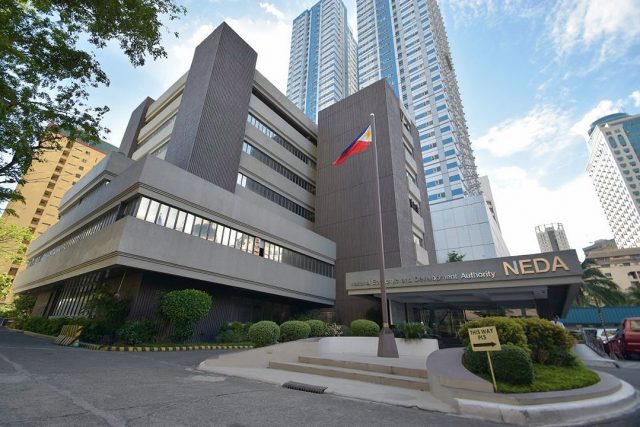
PHILIPPINE Senators have filed a substitute bill seeking the reorganization of the National Economic and Development Authority  (NEDA) into the Department of Economy, Planning and Development (DEPD), with the aim to streamline the agency’s functions.

Under Senate Bill No. 2878, which Senators Sherwin T. Gatchalian, Juan Miguel F. Zubiri and Joseph Victor G. Ejercito filed on Nov. 14, the proposed DEPD would be the primary national economy planning arm of the Executive branch of government.

The NEDA Board shall be reorganized into the Economic Development Council (ED Council), which will be headed by the Philippine President.

The council will be made up of the executive secretary, secretaries of DEPD, Budget and Management, Education, Energy, Finance, Health, Trade and Industry, Transportation, and Public Works among other Cabinet members.

“It shall formulate the country’s continuing, integrated, and coordinated policies, plans, and programs for national development for approval by the Economic Development Council (ED Council),” according to a copy of the measure.

The body must also meet at least on a quarterly basis to come up with programs that promote economic development and address development concerns of national importance.

The ED Council will be supported by the Development Budget Coordination, Economic Development, Investment Coordination, Social Development, Infrastructure, Tariff and Related Matters, National Land Use and Regional Development committees.

The DEPD would be headed by a secretary appointed by the Philippine President and would be tasked to advise the Cabinet on national and subnational economic and social development issues.

It will also be tasked to come up with a long-term development framework by 2050 including detailed national public investment programs involving various sectors.

“It is therefore vital that major programs and projects of different government agencies must be properly reviewed by and coordinated by a national government agency to ensure their consistency with established national and subnational priorities,” according to the bill. — John Victor D. Ordoñez

House panel approves POGO ban bill anew

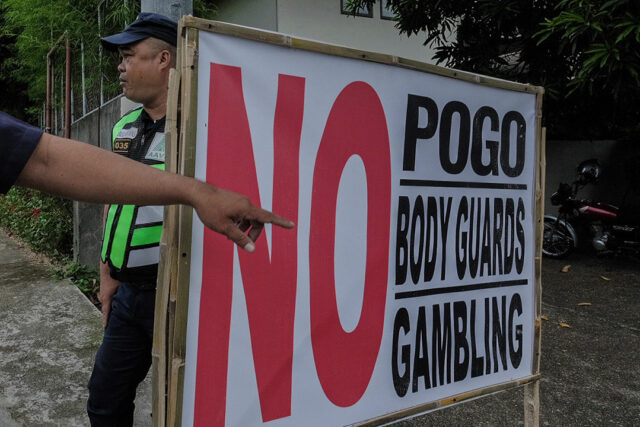
A sign protesting the presence of Philippine offshore gaming operators (POGOs) is seen at a posh residential village in Muntinlupa City, July 13. — PHILIPPINE STAR/RYAN BALDEMOR

A HOUSE of Representatives committee on Tuesday approved a bill seeking to ban online casinos from operating in the country, putting teeth into President Ferdinand R. Marcos, Jr.’s order to outlaw Philippine offshore gaming operations (POGOs) by yearend.

The House games and amusements committee approved House Bill (HB) No. 10987, subject to consolidation with other similar proposals go institutionalize Mr. Marcos’ sweeping ban order on all offshore gaming operations in the country during his July state address.

The panel approved a similar measure in February.

Mr. Marcos, in early November, issued an executive order formalizing his verbal order to close POGOs by the end of 2024. It included provisions calling for a stop on POGO activities, blocking new applications for legal online casinos and putting a halt to license renewals.

There used to be about 300 POGOs throughout the country during its peak in 2019, but it has wound down to 27 as of Nov. 18, Joseph J. Lobo, a regulatory officer at the Philippine Amusement and Gaming Corp. (PAGCOR), told congressmen during the hearing. — Kenneth Christiane L. Basilio

PAGCOR rectifies statement on Bataan BPO firm

THE Philippine Amusement and Gaming Corporation (PAGCOR) clarified its regulatory authority over business process outsourcing firm Central One Bataan Inc., following allegations of illegal activities.

In a recent briefing, a PAGCOR official initially stated that Central One Bataan fell under the jurisdiction of the Authority of the Freeport Area of Bataan (AFAB).

PAGCOR has released a statement to “rectify” this statement on Tuesday.

“Following the letter of the law, Central One Bataan’s involvement in online gaming activities clearly subject the same to PAGCOR’s jurisdiction and regulatory authority,” it said.

However, PAGCOR said Central One Bataan is not one of the companies licensed by PAGCOR to legally operate such activities.

The Republic Act 9728 grants AFAB the power to oversee certain tourism-related activities within the Freeport Area of Bataan including games, amusements, recreational and sports activities subject to the approval and supervision of PAGCOR.

Under the law, AFAB may regulate specific activities and exercise authority within its jurisdiction but its power to issue licenses for gaming operations remains conditional and subject to PAGCOR’s oversight and approval. Aubrey Rose A. Inosante