Home Blog Page 1475

PHL eyeing labor deal with Sweden

PHILSTAR FILE PHOTO

THE PHILIPPINES is looking to forge a labor agreement with Sweden for the protection of overseas Filipino workers (OFWs) located in the European country, the Department of Migrant Workers (DMW) said.

In a statement on Wednesday, the Migrant Workers Secretary Hans Leo J. Cacdac met with Foreign Affairs Assistant Secretary and Ambassador-Designate of the Philippines to Sweden Patrick A. Chuasoto to discuss plans to promote “the rights and welfare of Filipino workers in Sweden.”

“Both officials expressed optimism about the future support and protection of OFWs in Sweden with the possibility of forging a bilateral agreement that promotes regular, ethical, orderly, and sustainable migration of OFWs,” the agency said.

It added that the Philippines is also looking to establish a Migrant Workers Office in Sweden.

The DMW said that it has no existing bilateral labor agreement with Sweden, to date.

Mr. Chuasoto lauded the agency’s efforts to upskill Filipino workers in partnership with the Technical Education and Skills Development Authority. — Adrian H. Halili

Benguet dengue cases up to 316

Public Health Image Library/US Centers Disease for Control and Prevention

LA TRINIDAD, Benguet — The Benguet Provincial Health Office (PHO) reported it has logged 316 cases of dengue infection in the first quarter of 2025, a 17% hike compared to the same period last year.

The capital town of La Trinidad had the highest number with 68, followed by Tublay with 47 and Kapangan with 43 infections. No dengue-related deaths have so far been reported.

The PHO also noted that most of the patients are children, aged five to nine years old.

Benguet Provincial Health Officer Meliarazon F. Dulay stressed that the people should seriously continue the 4 p.m. habit or the “Alas Kuwatro Kontra Mosquito,” which involves turning items that could potentially be a breeding site for mosquitoes upside down. Containers that can hold water will be poured, dried, or covered with a lid.

Ms. Dulay urged the public to be alert in cases that where are symptoms of dengue infections. She said they should seek immediate consultation and build strong resistance by observing healthy living and sanitation. — Artemio A. Dumlao

5 terrorists surrender to Army

COTABATO CITY — Five more local terrorists, including two experts in fabrication of improvised explosive devices, surrendered to the Army in Maguindanao del Sur on Monday.

The five gunmen are members of the now decimated Dawlah Islamiya that had a reputation for extorting money from transportation companies and business establishments and tagged in all deadly bombings in Central Mindanao since 2014, along with its ally, the Bangsamoro Islamic Freedom Fighters.

Both groups are also known for fomenting deep hatred for non-Muslims that members of Mindanao’s Islamic religious community dismiss as sinful and absolutely against their religion’s teachings on tolerance and interfaith solidarity.

Army Major Gen. Donald M. Gumiran, commander of the Army’s 6th Infantry Division, told reporters on Wednesday that the five gunmen agreed to surrender through the intercession of Brig. Gen. Edgar L. Catu of the 601st Infantry Brigade, officials of the 90th Infantry Battalion (IB) and local executives in Datu Saudi Ampatuan in Maguindanao del Sur and nearby towns in the province.

The group turned in their improvised explosive devices, an M1 garand rifle, a bolt action 7.62-millimeter sniper rifle, an M16 assault rifle and a 5.56 M4 rifle before they pledged allegiance to the government in the presence of local leaders and Muslim preachers during a symbolic surrender rite at the headquarters of the 90th IB in Barangay Kabengi in Datu Saudi Ampatuan.

The local government unit of Datu Saudi Ampatuan distributed to each of them rice and other relief supplies and cash incentives that they can spend for their initial needs while undergoing religious reorientation by Islamic theologians. — John Felix M. Unson

Drug dealers nabbed in Ilocos Sur

BAGUIO CITY — Philippine Drug Enforcement Agency (PDEA) operatives in Ilocos Sur aided by local policemen caught an alleged “resurgent” drug trader in San Esteban town before midnight Tuesday.

PDEA-Region 1 Director Joel B. Plaza said the suspect was cornered after he sold two pieces of heat-sealed transparent plastic sachet containing suspected crystal meth (shabu) that weighed more or less two grams, worth P13,600, to undercover government agents.

Aside from the shabu, operatives also seized a glass tooter and a fan knife. Authorities also seized the buy-bust money, among other non-drug evidence against him, added Mr. Plaza.

The arrested drug trader earlier surrendered and promised to reform.

Meanwhile, another “resurgent” drug dealer was caught by PDEA-La Union operatives and local policemen in Caba town in La Union.

PDEA agents confiscated 10 pieces of heat-sealed transparent plastic sachets containing white crystalline substance suspected to be shabu weighing more or less one gram, worth P6,800, from the dealer.

Also seized were a homemade shotgun, two live ammunitions for caliber 12-gauge shotgun, one cigarette pack, and an opened transparent plastic sachet during the sting at around 8:30 a.m. on Wednesday.

Both were separately taken to a PDEA provincial jail facility in Ilocos Sur and in La Union for processing before they are formally sued for illegal drug charges. — Artemio A. Dumlao

PHL shares slip as Trump tariff concerns weigh

PHILIPPINE STAR/KRIZ JOHN ROSALES

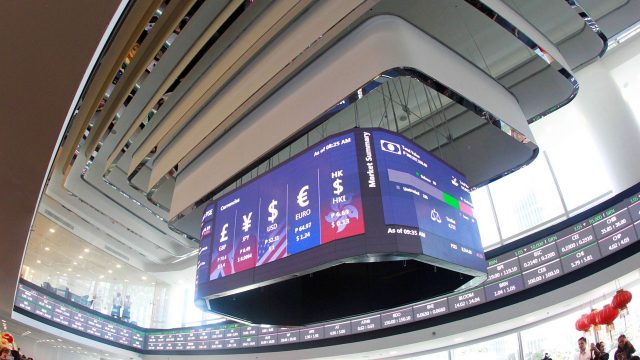
PHILIPPINE SHARES slipped further on Wednesday as losses on Wall Street due to the Trump administration’s trade policies spilled over to the domestic market.

The benchmark Philippine Stock Exchange index (PSEi) shed 0.18% or 11.29 points to end at 6,195.26 on Wednesday, while the broader all shares index inched down by 0.07% or 2.79 points to 3,681.80.

“The market fell further as investors took cues from Wall Street’s fall, driven by recession fears and cautious trading ahead of the release of the US inflation report,” Philstocks Financial, Inc. Senior Research Analyst Japhet Louis O. Tantiangco said in a Viber message.

“The market slipped anew on continued concerns about Trump’s erratic trade policy and a potential slowdown in the US economy,” China Bank Capital Corp. Managing Director Juan Paolo E. Colet said in a Viber message.

Wall Street closed lower on Tuesday. The Dow Jones Industrial Average index fell by 1.14% or 478.23 points to 41,433.48; the S&P 500 index sank by 0.76% or 42.49 points to 5,572.07; and the Nasdaq Composite index lost 0.18% or 32.22 points to end at 17,436.10.

US President Donald J. Trump’s increased tariffs on all US steel and aluminum imports took effect on Wednesday, stepping up a campaign to reorder global trade in favor of the US and drawing swift retaliation from Europe, Reuters reported.

Mr. Trump’s action to bulk up protections for American steel and aluminum producers restores effective global tariffs of 25% on all imports of the metals.

Mr. Trump’s hyper-focus on tariffs since taking office in January has rattled investor, consumer and business confidence in ways that economists worry could cause a US recession and further lag on the global economy.

Mr. Trump initially threatened Canada with doubling the duty to 50% on its steel and aluminum exports to the US but backed off after Ontario province suspended a move to impose a 25% surcharge on electricity exports to the states of Minnesota, Michigan and New York.

Meanwhile, February US consumer price index data were set to be released overnight.

Sectoral indices ended mixed on Wednesday. Services declined by 1.26% or 25.62 points to 2,006.06; mining and oil retreated by 0.8% or 70.36 points to 8,669.05; and financials went down by 0.63% or 15.04 points to 2,345.06.

Meanwhile, property increased by 1.24% or 27.41 points to 2,231.3; industrials climbed by 0.44% or 38.73 points to 8,730.86; and holding firms rose by 0.07% or 3.7 points to 5,202.69.

Value turnover declined to P5.98 billion on Wednesday with 741.54 million issues traded from the P7.71 billion with 753.65 million shares exchanged on Tuesday.

Decliners outnumbered advancers, 127 versus 77, while 40 names were unchanged.

Net foreign buying stood at P2.62 million on Wednesday versus the P350.28 million in net selling recorded on Tuesday. — R.M.D. Ochave with Reuters

Peso drops vs dollar before US inflation report

BW FILE PHOTO

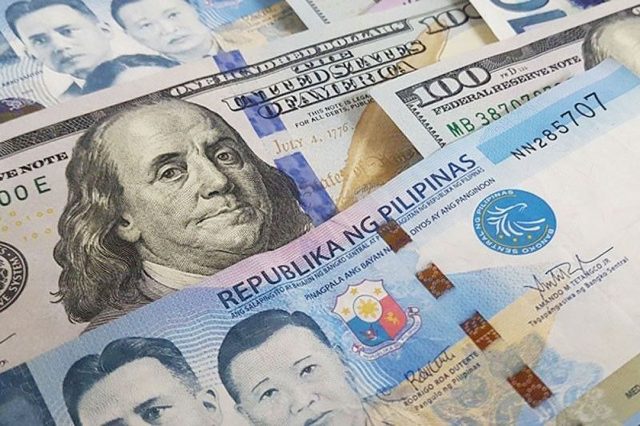
THE PESO weakened anew against dollar on Wednesday on market caution ahead of the February US consumer price index (CPI) data set to be released overnight, which could affect the US Federal Reserve’s policy actions.

The local unit closed at P57.36 per dollar on Wednesday, shedding 13.5 centavos from its P57.225 finish on Tuesday, Bankers Association of the Philippines data showed.

The peso opened Wednesday’s trading session weaker at P57.30 against the dollar. Its worst showing was at P57.395, while its intraday best was at P57.29 versus the greenback.

Dollars exchanged declined to $1.16 billion from $1.38 billion on Tuesday.

“The peso closed lower on a broad dollar rebound in anticipation of the US CPI release tonight, which is expected to be lower year on year, But some players in the market see it as still elevated, which may be reason for the Fed not to cut yet,” a trader said in a phone interview on Wednesday.

The dollar rose slightly amid more developments in the Trump administration’s tariff policies, Rizal Commercial Banking Corp. Chief Economist Michael L. Ricafort said in a Viber message.

For Thursday, the trader expects the peso to move between P57 and P57.50 per dollar, while Mr. Ricafort sees it ranging from P57.20 to P57.40.

The dollar struggled on Wednesday to lift off a five-month low against major peers, as worries about the US economy simmered in view of President Donald J. Trump’s unpredictable trade policies, Reuters reported.

The euro hovered around a five-month peak on increased optimism for an end to the war in Ukraine.

The Canadian dollar was steady after a volatile session on Tuesday, when Mr. Trump pledged to double tariffs on steel and aluminum to 50%, only to reverse course just hours later.

The US dollar index which measures the currency against a basket of six major peers, edged up 0.08% to 103.53 in Asian trading hours, following Tuesday’s slide of 0.46% that took it as low as 103.21 for the first time since Oct. 16.

A run of softer US economic data continued on Tuesday with small-business confidence dropping for a third straight month in February.

Investors have been on edge since Mr. Trump avoided ruling out the possibility that a recession would result from his trade policies in an interview on Sunday with Fox News.

Wednesday’s CPI report may be setting the market up for “a lose-lose situation”, said Julien Lafargue, chief market strategist at Barclays Private Bank.

“A higher-than-expected reading could fuel the stagflation narrative while a weaker-than-expected print could cement recession fears. What the market really needs at this point is better visibility on growth rather than on inflation.” — A.M.C. Sy with Reuters

‘Small-ball’ teams kick off Commissioner’s Cup finals

TNT’S RONDAE HOLLIS-JEFFERSON (24) — PBA.PH

Game on Friday
(Mall of Asia Arena)
7:30 p.m. – TNT vs Barangay Ginebra
(Finals, Game 1)

FOR A CONFERENCE that allowed imports of unlimited height, it’s two teams headlined by “undersized” reinforcements that remain standing in the chase for glory.

TNT’s Rondae Hollis-Jefferson (RHJ) and Barangay Ginebra’s Justin Brownlee (JB), who both officially measure under 6-foot-6, towered above taller counterparts to power their respective crews to the PBA Commissioner’s Cup finals.

This will be the two teams’ second straight title showdown of Season 49, and third overall in the last five conferences — a rivalry that fans in the basketball-crazy country should enjoy while it’s raging.

“We’re lucky at this time right now in the PBA to be able to witness these two special players go at each other,” said Ginebra coach Tim Cone. “I think when we look back 10 years from now, you know, we’re going to remember these times when the rivalry was big between Justin and RHJ.”

Between them, Mr. Hollis-Jefferson and Mr. Brownlee have won five Best Import awards and eight titles combined.

“It’s really I think just the idea of continuity of these guys being in the league and knowing the league, being able to fit well with their respective teams,” said Mr. Cone.

Mr. Hollis-Jefferson entered the PBA in the Season 47 Governors’ Cup, immediately making a huge impact and proving himself a winner in helping the Tropang Giga dethrone the Gin Kings in six games.

After an injury-hit, abbreviated stint in the Season 48 Commissioner’s Cup, a fit RHJ sparked the Tropang Giga to a repeat over Ginebra in the season-opening Governors’ Cup in November, 4-2.

“RHJ has brought a tremendous mentality to the TNT team. He shows up every game, every quarter, every possession and he just inspires his teammates. “You could see it on the floor all the time,” said Mr. Cone.

Mr. Brownlee has been doing Brownlee things since 2016, winning six titles with the country’s most popular ballclub, the last one in the Season 48 Commissioner’s Cup, pre-RHJ arrival.

“For Justin, it’s that comfort that we have with him, the confidence that we have in him, knowing he’s going to show up at big moments; him being a great teammate and being one of the guys, never asking for special treatment,” said Mr. Cone of his prized import and Gilas Pilipinas naturalized player.

The latest installment of the RHJ-JB championship rivalry tips off on Friday at the MOA Arena. — Olmin Leyba

Zus Coffee chasing last bus to quarters in Capital1 showdown

ZUS COFFEE THUNDERBELLES — PVL

Games on Thursday
(PhilSports Arena)
4 p.m. – Nxled vs Farm Fresh
6:30 p.m. – Capital1 vs ZUS Coffee

ZUS COFFEE shoots for the eighth and last quarterfinals seat as it clashes with Capital1 on Thursday in the Premier Volleyball League All-Filipino Conference at the PhilSports Arena.

The Thunderbelles shell shocked the fancied Cignal HD Spikers, 19-25, 25-23, 25-20, 23-25, 15-12, on Tuesday to stay in contention for a seat in the best-of-three quarters against the Petro Gazz Angels.

But ZUS would have to hurdle Capital1 first in their 6:30 p.m. duel to make it a reality.

A setback though would create a three-way tie in Pool A but Cignal would end up advancing since it owns the most FIVB tiebreak points.

“We’re happy because we got a boost before we play Capital1,” said ZUS spiker Chai Troncoso, who unleashed a team-best 21 points in that epic win by the Thunderbelles.

ZUS coach Jerry Yee said they’re eyeing not just to make the next phase but also to become a perennial contender and qualifier.

“For now, we’re still far from being perennial contenders. But we have potential and we will work on that,” he said.

Nxled and Farm Fresh, meanwhile, face off at 4 p.m. in a non-bearing contest in Pool B.

PVL Notes: PLDT has joined Creamline and Petro Gazz as the country’s representatives to the Asian Volleyball Confederation Women’s Champion’s League after the AVC granted a third slot to the host country, which will host it from April 20 to 27 at the PhilSports Arena. — Joey Villar

Capital1 Solar raring to go in PFF Women’s League debut

NEWLY FORMED Capital1 Solar Strikers is filled with excitement as it gears up for its debut in the Philippine Football Federation (PFF) Women’s League.

Owned by sportswomen Milka and Mandy Romero, the country’s newest football team will have Let Dimzon, who has previously coached Kaya FC to the 2023 Women’s League tiara and Far Eastern University to 2015 Women’s Cup diadems, at the helm.

Current and former standouts from the collegiate and pro ranks will make up the core with Emma Young, a 2021 GSC Defensive Player of the Year and 2021 United Soccer Coaches’ First Team All-American, and Arianna del Moral, formerly with Minnesota Aurora FC in the USWL and Birkirkara FC in Malta, as foreign players.

The Romero sisters formed the Strikers on the first anniversary of their volleyball club, the Capital1 Solar Spikers in the Premier Volleyball League.

“We’ve seen the growth of women’s sports here in the Philippines and we’re only here as vessels,” Milka said during Wednesday’s press launch in BGC that was also attended by PFF President John Gutierrez.

“We want to push the legacy that we have experienced ourselves, my sister and I, as players. If we can help one woman, one girl, reach her dream through sports then we’ve done our job.”

Milka previously served as co-captain of the Ateneo women’s football team and a member of the Philippine team.

“It’s full circle for me. And as much as I’m busy with everything, business, you always go back to sports and the community because that’s where we learned everything. And as much as possible, you want to give back, give a platform to more girls not just here in Manila but in other parts of the country.”

Mandy expects the Solar Strikers to give more-established rivals a run for their money.

“It does take time to build a team, to create chemistry. But of course we’re starting out strong also with coach Let at the helm and we also have great players with us. We’re very excited for the future of this team.”

“With the experience of my players, I think we’re ready. Nakikita natin magiging maganda yung competition. So we’re looking forward (to) great results playing against the likes of Kaya Iloilo and Stallion Laguna,” said Ms. Dimzon. — Olmin Leyba

Philippine School for the Deaf pushes boundaries with Milo run

RUNNING is for everyone, including for those who cannot hear their steps.

Two of them were Mhigz Medrano and Aliyah Reese Fernando, who made the giant leap as the Philippine School for the Deaf (PSD) joined the National Milo Marathon Manila leg events for the first time.

“Running is not only for hearing people. The race is for everyone,” beamed Ms. Fernando, through a translation by her teacher Karen Samson, after completing the 3K run at the Mall of Asia Arena concert grounds in Pasay last weekend.

Aside from Mr. Medrano and Ms. Fernando, around 200 students from PSD joined the event as the delegation blazed the trail for persons with disabilities.

Mr. Medrano, for his part, finished the 5K run.

“Other people think that we’re scared to join this kind of activity but we’re not. Though it’s not noticeable with other disabilities, we finally get to join and jive. Everyone is accepted in today’s society and we’re happy for that,” smiled Mr. Medrano, a Grade 11 Technical-Vocational-Livelihood-Information and Communications Technology student.

“Running is about togetherness. There’s no pressure in running,” added Ms. Fernando, also a Grade 11 student.

Both Mr. Medrano and Ms. Fernando ran with their families and friends.

National Milo Marathon events bring together almost 20,000 runners all over the country.

“Milo is incredibly proud and honored to champion inclusivity by welcoming everyone from the PWD (persons with disabilities) community for the first time. We consider this an affirmation of our commitment to making sports accessible to all, empowering every athlete to celebrate their grit and determination to reach success,” said Milo Sports head Carlo Sampan.

“This commitment is further strengthened through our partnerships with Special Olympics, the Department of Education, and the Philippine Sports Commission, as we continue to create more opportunities for PWD athletes to thrive.”

PSD fields varsity teams in badminton, volleyball and basketball, but making the leap to running is just the beginning.

“The PSD excels in ICT but the dream of course is to be known in other fields, not only here in the Philippines but in other countries too. It’s a good start and awareness for us in sports,” said teacher Samson, who joined her students in completing their runs. — John Bryan Ulanday

Rural banks turned digital banks: Boon or bane?

FACEBOOK.COM/SEABANKPHILIPPINES

The Bangko Sentral ng Pilipinas (BSP) lifted the moratorium on new digital banking licenses this year, allowing 10 digital banks to operate in the country. This means that it will grant four available slots for new and existing players if it meets the BSP’s requirements.

This aligned with the central bank’s goal to harness the potential of these banks in bringing positive impact to the financial system while remaining considerate to possible risks.

“New digital bank applicants will be subjected to a rigorous licensing process that will look into their value proposition, business models, and resources capabilities,” the BSP said in a statement.

It reiterated that this follows the standard licensing criteria which includes the assessment of the banks’ ownership and control structure, suitability of shareholders, fitness and propriety of directors and senior management, adequacy of capital, as well as banks’ strategic and operating plan, including an appropriate system of corporate governance and risk management.

The BSP said in an e-mail that its digitalization agenda includes not only traditional banks but also rural banks.

Given this, the agenda will encourage customers to better serve them by making services accessible online on the back of their brick-and-mortar banking operations.

Thanks to BSP’s Rural Bank Strengthening Program (RBSP), coupled with the initiatives of rural banks’ themselves, the rural banking system in the country remains strong and stable, Rural Bankers Association of the Philippines (RBAP) Executive Director Rafael Francisco D. Amparo said in an e-mail.

Launched in 2022 by the central bank, the RBSP is a structured program which aims to strengthen the rural banking landscape to provide better services to rural areas.

Among those expected to apply for digital bank licenses are financial technology (fintech) companies that entered the market through rural banks.

Previously, several rural banks have been used as an entry point for foreign fintech companies to establish digicentric financial institutions.

Among these are Singaporean-based consumer internet company Sea Ltd. and Streetcorner Group, an association between Indonesia-based fintech company Akulaku and nonlife insurer Metropolitan Insurance Co., Inc.

Sea, which owns the e-commerce platform Shopee, acquired Banco Laguna, Inc. in 2020 and later on launched its digital banking app SeaBank in June 2022.

On the other hand, Streetcorner Group started the digital transformation of Rural Bank of Cavite City, Inc. and launched OwnBank in June 2022.

“We believe that these rural banks that transitioned to digital banks were always meant to be digital banks in the first place,” RBAP’s Mr. Amparo said.

He emphasized that these banks’ foreign fintech shareholders recognized the appropriateness of acquiring rural banks as an entry strategy and then developing digital capabilities until reaching maturity as a digital bank.

He said that digitalization provided rural bank clients fast and convenient services to rural bank clients and noted that utmost care should be observed to manage the vulnerabilities that digitalization inadvertently opens.

BE COMPLIANT
The central bank recognizes this value, and the contribution foreign investors bring in to drive growth in the financial system.

However, it still stands its ground: rural banks operating as digital banks should comply with regulatory requirements and upgrade their licenses.

“No bank should be operating as a digital bank using a rural banking license unless they convert their license to a digital banking license,” the BSP said in an e-mail.

“Some of these investors have bought a few rural banks to convert them into digital banking platforms. While new investment is a positive development, it requires careful assessment due to potential regulatory and financial risks,” the BSP said.

“While we do not see material risk at this point, we don’t want digital banks created via the ‘backdoor,’ or operating under rural banking regulations,” it added.

“If a rural bank is acting like a digital bank, then it should comply with the appropriate capital and other regulatory requirements for a digital bank,” the central bank said.

The BSP also emphasized that foreign entities must understand the local financial landscape to manage risks effectively.

The new technology, it said, would help rural banks become more resilient, improve operations, and enable them to offer better financial products and services to their original market through more distribution channels.

It is a good move that rural banks are shifting towards digitalization, however, adherence to regulatory compliances should be considered.

There are possible risks if they fail to meet the requirements set by the central bank.

According to the BSP, rural bank turned digital banks will face higher capital and prudential requirements but will be given a transition period to comply and the central bank will closely monitor its progress and ensure timely regulatory interventions.

The BSP said that complying with the higher capital requirements and specific regulations are among the main measures rural banks should adhere to. 

Rural banks-turned-digital banks must maintain a minimum capital of P1 billion, under the BSP Circular No.1154.

Additionally, the BSP will apply targeted supervisory actions to thrift, rural, and cooperative banks converting to digital banks or digitalizing their operations, setting key indicators to assess their digital operations.

These measures will include regulatory requirements on capitalization, prudential ratios, and governance.

“Ultimately, these digital banks will be supervised based on their risk profile and activities,” the central bank said.

NEOBANKS
Aside from digital banks, another nontraditional financial entity has been gobbling up rural banks — the neobanks.

Neobanks are a digital-only financial intermediaries that operates through applications and websites but still offer services and operations similar to banks (or in this case, rural banks).

RBAP’s Mr. Amparo earlier said that neobanks are the “way forward” for the rural banks.

Netbank (A Rural Bank), Inc., (Netbank), formerly Community Rural Bank of Romblon (Romblon), Inc., is operating as a neobank but with rural banking license.

Founded in 2019 by Gus Poston and David Paulo Dela Paz, it was the first banking-as-a-service platform in the country, which aims to help other fintech companies offer financial products.

“[Netbank] does not hold a digital bank license but operates as a fully digital-focused financial institution, categorized as a neobank,” Netbank Executive Director and Head of Branch operations Alexandra Q. De Chavez said in an e-mail. 

“The Bank plans to retain its rural banking license, utilizing its existing regulatory compliance and service offerings through the previously secured EPFS (Electronic Payment and Financial Services) and EMI (Electronic Money Issuer) licenses,” Ms. De Chavez said.

Salmon, also known as the Rural Bank of Sta. Rosa Laguna, Inc., is another neobank operating under a rural bank license.

The neobank was founded by Pavel Fedorov, George Chesakov, and Raffy Montemayor and its services include buy now, pay later credit products, as well as high-interest rate deposits.

It bought 59.7% of the rural bank in 2024.

Salmon’s chairman, Raffy Montemayor, explained that they are not a digital bank but Salmon is “building a modern bank with branches, ATMs, and other types of physical presence and with customer interactions held offline, online, and everything in between.”

Mr. Montemayor added that Salmon plans to upgrade to a thrift bank license subject to BSP’s approval which will build its presence in the country through various channels and a capital base more than what most digital banks have.

“Unlike digital banks, we will combine physical branches with best-in-class technology solutions, ensuring access to customers both offline and online,” he said in an e-mail.

‘COOPETITION’
If rural banks will convert to digital banks, then it meant that it would face higher capital and prudential requirements. The BSP said that it will monitor these banks’ progress and ensure timely regulatory interventions.

“Rural banks should assess the financial, technological, and operational resources needed for digitalization,” BSP said.

This includes acquiring tech infrastructure and innovations like cloud-based core banking systems, cybersecurity, and fraud management tools.

The central bank also added that management and staff should build the technical expertise necessary for successful digital transformation.

“Digitalization creates unique challenges for the entire financial system,” RBAP’s Mr. Amparo said. “We are confident that the rural banking industry and the entire banking industry for that matter can turn these threats into opportunities for cooperation and collaboration.”

For its part, the central bank sees digital banks as key drivers of financial inclusion contributing innovative financial solutions.

“With the rise of digital-focused rural banks, the BSP anticipates a ‘coopetition’ dynamic among these institutions, benefiting all stakeholders,” the central bank said. — AMPY with KHH

Global trade war looms as Trump’s metal tariffs kick in

STEEL BARS are pictured at a metal-mechanical parts factory in Apodaca, Mexico, March 11, 2025. — REUTERS

WASHINGTON — President Donald Trump’s increased tariffs on all US steel and aluminum imports took effect on Wednesday, stepping up a campaign to reorder global trade in favor of the US and drawing swift retaliation from Europe.

Mr. Trump’s action to bulk up protections for American steel and aluminum producers restores effective global tariffs of 25% on all imports of the metals and extends the duties to hundreds of downstream products made from the metals, from nuts and bolts to bulldozer blades and soda cans.

Mr. Trump’s hyper-focus on tariffs since taking office in January has rattled investor, consumer and business confidence in ways that economists worry could cause a US recession and further lag on the global economy.

The European Commission, the executive arm of the European Union charged with coordinating trade matters, responded swiftly, saying it would impose counter tariffs on 26 billion euros ($28 billion) worth of US goods from next month.

“We are ready to engage in meaningful dialogue,” Commission President Ursula von der Leyen told reporters, adding she had tasked Trade Commissioner Maros Sefcovic to resume his talks to “explore better solutions with the US.”

“We firmly believe that in a world fraught with geoeconomic and political uncertainties, it is not in our common interest to burden our economies with such tariffs.”

China’s foreign ministry said Beijing would take all necessary measures to safeguard its rights and interests, while Japan’s Chief Cabinet Secretary Yoshimasa Hayashi said the move could have a major impact on US-Japan economic ties.

Close US allies Canada, Britain and Australia criticized the blanket tariffs, with Canada mulling reciprocal actions and Britain’s Trade Minister Jonathan Reynolds saying “all options were on the table” to respond in the national interest.

Australian Prime Minister Anthony Albanese said the move was “against the spirit of our two nations’ enduring friendship” but ruled out tit-for-tat duties.

Tariffs and escalating trade tensions are a form of economic self-harm, and a recipe for slower growth and higher inflation,” he told reporters.

The countries most affected by the tariffs are Canada, the biggest foreign supplier of steel and aluminum to the US, Brazil, Mexico, and South Korea, which all have enjoyed some level of exemptions or quotas.

Mr. Trump initially threatened Canada with doubling the duty to 50% on its steel and aluminum exports to the US but backed off after Ontario province suspended a move to impose a 25% surcharge on electricity exports to the states of Minnesota, Michigan, and New York.

That incident whip-sawed US financial markets already jittery over Mr. Trump’s broad tariff offensive. Asian markets were broadly steady on Wednesday, although Australia’s benchmark closed 9.6% below February’s record high.

The US Customs and Border Protection agency cut off imports qualifying for duty-free entry under quota arrangements well before the midnight deadline, saying in a bulletin to shippers that quota paperwork needed to be processed by 4:30 p.m. local time on Tuesday at US ports of entry or the full tariffs would be charged.

The move was welcomed by US steel producers as restoring Mr. Trump’s original 2018 metals tariffs that had been weakened by numerous country exclusions and quotas and thousands of product-specific exclusions.

“By closing loopholes in the tariff that have been exploited for years, President Trump will again supercharge a steel industry that stands ready to rebuild America,” Steel Manufacturers Association President Philip Bell said.

“The revised tariff will ensure that steelmakers in America can continue to create new high-paying jobs and make greater investments knowing that they will not be undercut by unfair trade practices,” Mr. Bell added.

The escalation of the US-Canada trade war occurred as Prime Minister Justin Trudeau prepared to hand over power this week to his successor Mark Carney, who won the leadership race of the ruling Liberals last weekend.

On Monday, Mr. Carney said he could not speak with Mr. Trump until he was sworn in as prime minister. Mr. Trump repeated on social media he wanted Canada as “our cherished Fifty-First State.”

Canadian Energy Minister Jonathan Wilkinson told Reuters that Canada could impose non-tariff measures such as restricting oil exports to the US or levying export duties on minerals, if US tariffs persist.

Canada, with ample hydropower resources that has made primary aluminum production more cost effective than in the US, has built a commanding position in the US aluminum market, as US smelters once revived by Mr. Trump’s tariffs have been idled.

China remains the number two supplier of aluminum and goods made from aluminum but already faces high tariffs to counteract alleged dumping and subsidies, as well as a new 20% tariff that Mr. Trump has imposed over the past month over fentanyl trafficking.

Domestically, nerves are growing over Mr. Trump’s economic agenda. A small business survey on Tuesday showed sentiment weakening for a third straight month, fully eroding a confidence boost following Mr. Trump’s Nov. 5 election victory. A survey of households by the New York Federal Reserve on Monday showed consumers growing more pessimistic about their prospects. — Reuters