Home Blog Page 1168

From classroom to sustainable practice: Arthaland’s Masterclass bridges education and industry

Top left to bottom right: Students from NU — Irish Monique D. Vigil, Cyrus Iverson P. Rodil, Keith Cyrel L. Palles; Green building experts from Arthaland — Engr. Francis August R. Rarugal, Ar. Arianne Rose DC. Lictawa, Ar. Kristina Samantha S. Pobre, Ar. Sandra DL. Dionisio; Students from NU — Anthony L. Ignacio, Edalaine Therese L. Llada, Vhernie D. Lopez; Students from TIP — Love Angel P. Silvania, Dianne C. De Leon; Students from FEU — John Marco A. Tunay, Kyle Bernadeth A. Noche, Ana Maria Z. Miranda, Angelie Jince S. Roque; Students from ADU — Aubrey Ame M. Molinyawe, Jaina Denise I. Tanap, and Austin Paul P. Dela Merced

ARTHALAND, the country’s only real estate developer with a 100% certified sustainable portfolio, recently concluded the third run of its Masterclass, an intensive six-week program designed to equip architecture students with the skills to integrate sustainability into their projects and future practice. By bridging theory and real-world application, the program equips participants with the skills and mindset to deliver measurable, performance-based, and sustainability-focused designs.

Bridging Education and Industry

Launched in 2023 with five students from National University Manila (NU), the program has since grown to include three additional academic institutions: Far Eastern University Manila (FEU), Technological Institute of the Philippines QC (TIP), and Adamson University (ADU). This year, 15 students participated, bringing the total to 30 students over the three-year period. The program demonstrates how industry initiatives can complement higher education efforts to develop future-ready professionals in sustainable architecture and design.

The Arthaland Masterclass has grown deliberately, focusing on meaningful engagement and practical industry exposure rather than rapid expansion. The Masterclass is grounded in sustainability principles across building design, construction, and operations, guided by international standards such as LEED, BERDE, EDGE, and WELL standards. Lessons are designed to align with climate realities and market expectations, ensuring that participants are not only academically prepared but also attuned to the skills increasingly sought in the green building industry.

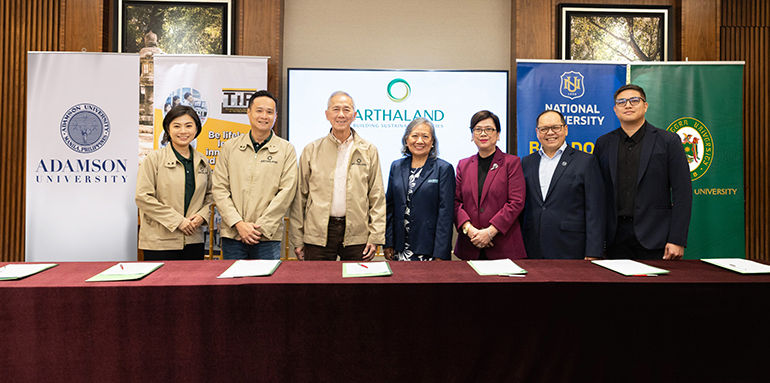
Left to right: From Arthaland, Head of Sustainability Ar. Kristina Samantha S. Pobre, Senior Vice-President Oliver L. Chan, Vice-Chairman & President Jaime C. González; ADU Vice-President for Academic Affairs Dr. Rosula S.J. Reyes, TIP Senior Vice-President for Academic Affairs and Services Dr. Rosalinda P. Valedepeñas, NU President Renato Carlos H. Ermita, Jr., and FEU Dean of the Institute of Architecture and Fine Arts Ar. Isaiah Israel D. Susi

The program culminates in a capstone project where participants reimagine developments through a sustainability lens, supported by mentorship from the company’s sustainability experts. This hands-on approach provides participants with experience that connects classroom learning to the demands of professional practice.

Supporting Academic and Career Pathways

To further prepare participants for a future in green building, Arthaland awards two types of scholarships: one covering a student’s final year of college and another funding a professional EDGE credential. A total of 15 scholarships have been granted since the program began. Notably, 63% of this year’s cohort are women, reflecting the program’s deliberate effort to foster inclusive growth and ensure that the future of sustainable architecture represents diverse voices and perspectives.

“The Arthaland Masterclass was a turning point for me. As a fresh graduate, it bridged the gap between what I learned in school and what sustainability means in practice. It shaped my decision to pursue a career in green building and gave me the confidence to step into the profession with purpose,” said Andrea Nicole Ramos, a former Masterclass scholar who now practices as a green building professional.

Top left to bottom right: Arthaland Head of Sustainability Ar. Kristina Samantha S. Pobre, Senior Vice-President Oliver L. Chan; Arthaland Masterclass scholars Keith Cyrel L. Palles, John Marco A. Tunay, Kyle Bernadeth A. Noche, Love Angel P. Silvania; Arthaland Vice-Chairman & President Jaime C. González; Masterclass scholars Cyrus Iverson P. Rodil, Dianne C. De Leon, Aubrey Ame M. Molinyawe, Vhernie D. Lopez, Ana Maria Z. Miranda and Jaina Denise I. Tanap

Scaling with Purpose, Deepening Its Impact

Now in its third year, the Masterclass has become a model for how industry can collaborate with academia to accelerate the transition to a low-carbon future. By opening its doors and sharing its expertise, Arthaland is helping prepare a generation of architects who are not only knowledgeable but also equipped with the practical experience, values, and vision to thrive in a sustainable and evolving industry.

From a single-university pilot to a multi-institutional program, the Arthaland Masterclass continues to scale with purpose, broadening its reach, deepening its impact, and paving pathways for the country’s next generation of green building professionals.


Spotlight is BusinessWorld’s sponsored section that allows advertisers to amplify their brand and connect with BusinessWorld’s audience by publishing their stories on the BusinessWorld Web site. For more information, send an email to online@bworldonline.com.

Join us on Viber at https://bit.ly/3hv6bLA to get more updates and subscribe to BusinessWorld’s titles and get exclusive content through www.bworld-x.com.

Proving Toyota HEV reliability through real-world use

Toyota units tried, tested, and trusted in PNP Tacloban

As the world shifts into clean and sustainable business practices as the only way forward, the future of mobility follows suit.

Hybrid electric vehicles (HEVs) offer the best of both worlds between conventional engines and full electrification. Compared to traditional internal combustion engine (ICE) vehicles, hybrids offer significantly better fuel efficiency and lower emissions by using an electric motor to assist the engine and recover energy during braking.

Hybrids don’t rely on charging infrastructure, making them ideal for countries like the Philippines where public chargers are still limited. Drivers get the environmental and cost-saving benefits of electrification without the range anxiety or charging delays.

This is why Toyota invested in achieving a perfectly balanced hybrid model to deliver lower carbon emissions, better fuel economy, and proven durability for the benefit of all drivers.

Switching from an ICE vehicle to a Toyota HEV is seamless. It drives and feels just like a regular car, with no noticeable difference for most users in terms of handling or performance.

The key distinction lies in fuel efficiency. Thanks to Toyota’s advanced hybrid technology, its HEVs deliver significantly better fuel economy, making them a smart, practical choice for daily driving.

While the transition to hybrids is easy, some drivers may still have concerns — particularly around topics like battery life, maintenance, and long-term durability. Toyota’s 30-year track record in hybrid development proves there’s little cause for worry. Its hybrid systems are tried, tested, and built to last even under demanding, real-world conditions.

What better way to demonstrate this than by highlighting use cases in some of the most demanding situations to be found in modern society: police use.

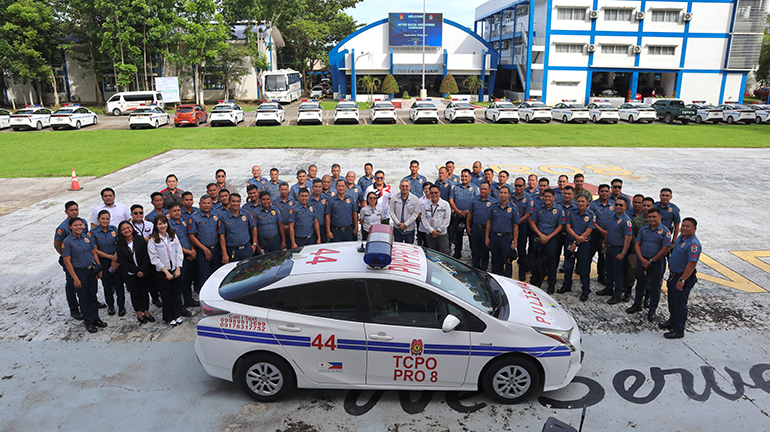
Toyota Motor Philippines (TMP) visited the Police Regional Office (PRO) 8 in Tacloban, Leyte on June 18 for a special Goyokiki activity. Derived from a Japanese term, Goyokiki refers to the practice of visiting and speaking directly with customers to better understand their experiences and needs.

Back in 2017, 49 Toyota Prius units were provided to the Philippine National Police (PNP) Tacloban by Government of Japan. These vehicles have been in active service for eight years, primarily used as patrol units operating 24/7.

The Goyokiki activity was led by Marvin Gardiner, TMP’s Vice President for the CSO Service Planning and Administration Department, together with Dave Fenis, Service Manager of Toyota Tacloban. Officers from PNP Tacloban also participated in the discussions.

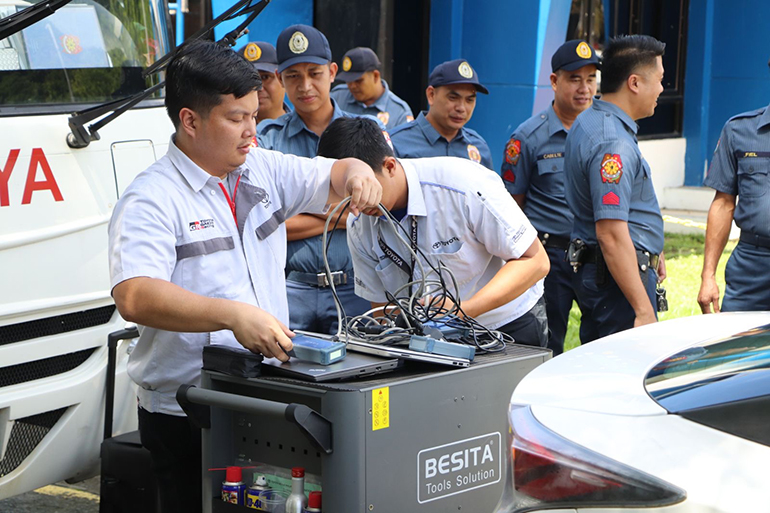
As part of the engagement, the TMP team paid a courtesy call to Police Brigadier General PBGEN JAY R CUMIGAD before conducting interviews with PRO 8’s designated Toyota Hybrid Prius drivers. They also conducted a comprehensive safety inspection and maintenance training to further equip PRO 8 personnel with the knowledge and skills needed for the proper care and operation of hybrid vehicles.

During the visit, 26 of the 49 Prius units were inspected, showing an average mileage of 193,000 kilometers (km) per unit, with the highest at over 300,000 km. These vehicles are equipped with Toyota’s 4th generation hybrid technology and have been subjected to daily driving of up to 300 km in tough conditions.

Despite the high mileage and constant operation, the Prius units remain in strong working condition. Engines, drivetrains, and hybrid batteries continue to perform reliably. A hybrid battery health check revealed an average internal resistance of just 0.020 Ohms across the 26 units, which is a low value indicating excellent power delivery and overall battery health. Minor issues in the underchassis were attributed to road conditions, not defects in the vehicles themselves.

Interviews with PNP officers, who are the vehicles’ actual drivers, revealed very positive results. They reported quick throttle response in Power Mode, performance with no delay compared to traditional gasoline cars, and smooth, reliable operation. They also praised the low cost of ownership, noting that the hybrid batteries and transmissions were still in excellent condition after eight years of use. Maintenance has also been easy, with no issues reported in securing service schedules through Toyota dealers.

“We sincerely thank TMP for going the extra mile to visit Tacloban and support our personnel. Toyota has never neglected us and continues to provide dependable after-sales service,” PLTCOL RODERICK P CONDAG, Acting Chief, RLRDD of PNP, Police Regional Office 8. said in expressing his appreciation to TMP.

As Toyota empowers customers across various sectors to make The Toyota Choice, this activity testifies to the brand’s commitment to legendary Quality, Durability, and Reliability (QDR). Even in the most demanding environments, Toyota Hybrid Electric Vehicles continue to prove themselves as efficient, durable, and cost-effective solutions for real-world use.


Spotlight is BusinessWorld’s sponsored section that allows advertisers to amplify their brand and connect with BusinessWorld’s audience by publishing their stories on the BusinessWorld Web site. For more information, send an email to online@bworldonline.com.

Join us on Viber at https://bit.ly/3hv6bLA to get more updates and subscribe to BusinessWorld’s titles and get exclusive content through www.bworld-x.com.

EPI eyes powering up solar projects through 2026

NICKELASIA.COM

EMERGING POWER, INC. (EPI), the renewable energy (RE) subsidiary of listed mining firm Nickel Asia Corp. (NAC), is progressing toward its 1-gigawatt (GW) RE target by 2030 through the ongoing development of its pipeline projects.

Among EPI’s projects is the development of a 145-megawatt-peak (MWp) solar power project in Zambales.

In a stock exchange disclosure on Wednesday, NAC said its board of directors approved the advancement of P710 million to Northern Palawan Power Generation Corp. (NPPGC), a subsidiary of EPI and the developer of the Cawag solar project.

The project is targeted to be energized in the latter part of 2026.

NPPGC is primarily engaged in the renewable energy business and in the production and generation of electricity, as well as in the processing of alternative fuels for power generation.

NAC said EPI has also commenced pre-development activities for a 50-MWp solar project in Nazareno, Bataan, with construction expected to begin before yearend.

Greenlight Renewables Holdings, Inc. (GRHI), EPI’s joint venture with Shell Overseas Investments B.V., is set to complete Phase 1 of its San Isidro solar power project in Leyte.

Energization is targeted to take place by the fourth quarter of this year, delivering 120 MWp of electricity.

GRHI is also gearing up to begin construction of Phase 1 of the Botocan solar project in Zambales by the fourth quarter of the year. Commercial operations are scheduled in the second half of 2026, with an initial capacity of 45 MWp.

EPI aims to achieve a 1-GW renewable energy capacity by 2028. By year-end, the company expects its total installed capacity to reach approximately 300 MWp.

For the first six months of the year, NAC saw its attributable net income rise by 88% year on year to P2.1 billion, due to higher export prices for saprolite ore.

From January to June, revenues from saprolite and limonite ore increased by 36% to P10.59 billion.

Operating mines sold a combined 7.85 million wet metric tons (WMT) of nickel ore, a 4% decline due to unfavorable weather conditions.

The weighted average ore price rose 44% to $23.87 per WMT. Operating mines realized P56.47 per dollar from ore sales, 2% lower compared to last year.

Exports of saprolite and limonite ore totaled 3.92 million WMT at an average price of $38.31 per WMT, a 75% increase compared to the 4.23 million WMT at $21.95 per WMT last year.

Deliveries of limonite ore to the Coral Bay and Taganito high-pressure acid leach plants amounted to 3.93 million WMT at an average realized price of $6.96 per pound of payable nickel, equivalent to $9.43 per WMT. This compares to last year’s prices of $7.94 per pound and $10.84 per WMT, respectively.

“We expect the recovery in nickel ore prices to continue, supported by tight supply and steady demand from Indonesia, and the ongoing implementation of mining policies in the country,” said NAC President and Chief Executive Officer Martin Antonio G. Zamora.

“With improving weather conditions at our mine sites and the ramp-up of shipments from Manicani, we are well positioned to deliver strong results in the second half of the year.”

Mr. Zamora expects an uplift in the mining firm’s performance this year, supported by the upward trend in nickel exports, the momentum in operations at Manicani, and the nearing completion of the Leyte solar project. — Sheldeen Joy Talavera

2026 gov’t borrowing plan, mix likely steady

BW FILE PHOTO

NEXT YEAR’S government borrowing program could be “more or less” steady from this year and will likely have an 80:20 mix in favor of domestic sources, National Treasurer Sharon P. Almanza said.

“[It will be] more or less the same as this year. If there’s a little increase… [we could add] P100 billion,” Ms. Almanza told reporters on the sidelines of an event on Tuesday.

She added that the National Government (NG) will also keep next year’s financing mix at a 80:20 ratio in favor of domestic sources to minimize foreign currency risks.

“We will aim for 80:20 because we want to continue to minimize our foreign currency exposure. So, part of our debt management strategy really is to reduce our…foreign currency risk… One way to achieve that is [by taking] advantage of domestic liquidity because it’s still very liquid. We can still raise a substantial amount of our requirements onshore,” Ms. Almanza said.

The government’s borrowing program for this year was set at P2.55 trillion under the Budget of Expenditures and Sources of Financing 2025, with P2.04 trillion coming from the domestic market and P507.41 billion from external sources.

However, this was increased to P2.6 trillion after the government updated its fiscal program in June to reflect a wider deficit ceiling of P1.561 trillion or 5.5% of gross domestic product for this year from 5.3% previously. The additional financing requirements will be sourced domestically, Finance Secretary Ralph G. Recto earlier said.

Ms. Almanza said borrowing requirements for the remainder of the year are at under P800 billion.

“The plan to maintain or even increase NG borrowing program in 2026 despite already elevated debt levels signals a continued need for financing amid slower fiscal consolidation,” Philippine Institute for Development Studies Senior Research Fellow John Paolo R. Rivera said in a Viber message.

He added a higher borrowing program for 2026 could result in higher market rates, “especially if market liquidity tightens or inflation expectations rise.”

“Over the medium term, investors may demand higher yields to account for the increased supply and fiscal risks. NG should ensure transparent debt management and credible fiscal signals to avoid crowding out private investment,” he added.

Meanwhile, Rizal Commercial Banking Corp. Chief Economist Michael L. Ricafort said in a Viber message that the government may need more borrowings to fund its budget deficit.

“More borrowings to increase government securities supply and could lead to higher yields than otherwise,” he added.

The NG’s gross borrowings went up by 1.33% year on year to P1.59 trillion in the first six months, latest Bureau of the Treasury (BTr) data showed.

External borrowings rose by 50.46% to P402.35 billion, while domestic debt issuances declined 8.75% to P1.19 trillion.

In January, the NG raised $3.29 billion from its sale of US dollar and euro bonds, almost filling its $3.5-billion commercial borrowing program for this year. 

Meanwhile, in April, the BTr sold P300 billion in new 10-year fixed-rate Treasury notes that were offered under a new issuance format meant to establish a new benchmark bond and targeting institutional investors like corporates, cooperatives, trust funds, retirement funds, and provident funds.

On Tuesday, the government raised an initial P210 billion via its offering of five-year retail Treasury bonds (RTB).

As part of the retail bond offer, the BTr is also conducting a bond exchange program for holders of eligible three-, seven- and 10-year T-bonds set to mature from September this year to February next year.

The latest tranche of RTBs is the first to be made available via an electronic wallet as the government partnered with GCash and Philippine Digital Asset Exchange, Inc. to allow retail investors to buy the notes via its in-app GBonds platform.

GBonds had more than 88,000 users and P41 million in transactions as of Aug. 5, Ms. Almanza said.

She said the government is hoping to team up with more financial institutions, especially those with online platforms, in the future to make government securities more accessible to the public.

“We really want to expand it (government securities) to all. For example, if we can partner with other banks with online platforms, because it’s easier if it’s online.” — Aaron Michael C. Sy

With bated breath

PHILIPPINE STAR/RYAN BALDEMOR

Hmmm, I said to myself, as a news brief caught my eye one rainy July morning.

A Supreme Court division had ordered two store managers jailed for six months for simple theft: they failed in June-October 2009 to give employees their share of service charge payments totaling less than P10,000.

Wouldn’t it be a sight to see top-ranking/influential crooks similarly get what they deserve for stealing millions to billions of pesos of our tax money?

Unlike many of our neighbors, however — including Vietnam which has been pulling away from us in nearly all competitiveness counts — we have yet to convict and jail any “big fish.”

Those of us who have been inured to the spectacle of such crooks laughing all the way to the bank may sneer at such wishful thinking. We have long held the dubious distinction of being one of the most corrupt countries in Asia, with deteriorating annual corruption perception metrics confirming anecdotes among individual entrepreneurs and big businessmen that this problem has been worsening by the year. Understandably, corruption has figured among the top five business concerns in this country for many years now.

JADED
And so, it was with mixed feelings that I listened to President Ferdinand “Bongbong” R. Marcos, Jr. punctuate his July 28 mid-term State of the Nation Address (SONA) with anti-graft/-corruption measures, e.g., providing school laptops that are not overpriced, putting long-idle trains to use, launching a crackdown on erring flood control contractors, and ensuring that national budget realignments do not stray from state priorities spelled out in the National Expenditure Program, etc.

On the one hand, it’s about time that Mr. Marcos finally included corruption in his SONA (an issue absent in his previous speeches, if I recall correctly). But the sporadic loud applause and exaggerated cheers in the audience immediately ruined the moment for many listeners (judging from social media comments and some officials’ reactions afterwards).

Senator Panfilo M. Lacson, Sr. and Baguio Mayor Benjamin B. Magalong would later verbalize what some of us felt as we beheld that spectacle, with Mr. Lacson remarking that “others who applauded were simply shameless hypocrites” who were otherwise involved in flood-control project irregularities, and Mr. Magalong estimating that corrupt politicians get kickbacks amounting to 35-40% of flood control and other infrastructure project costs.

On Tuesday, Senators Paolo Benigno “Bam” A. Aquino IV and Juan Miguel F. Zubiri dragged classroom construction out into the limelight, asking why these projects cost half of official government estimates when spearheaded by private outfits.

Some observers have criticized the latest SONA for failing to lay down the road map for Mr. Marcos’s remaining three years in office and, instead, focusing on improving public and social services. But let’s not forget that his senatorial slate suffered a severe drubbing in the last elections and that it has only been a few days since the administration finally saw some improvement in its public trust ratings. Hence, the need for measures that the masses would feel immediately. Perhaps the public outcry amid the latest floods could no longer be ignored. Perhaps this is an opportunity to go after opponents (just saw yesterday a socmed post claiming that the father of a stalwart of an opposing side is himself a contractor). Perhaps it’s all three.

Mr. Marcos followed up his SONA with a podcast interview in which he expounded on next steps on this matter, saying that:

• the government has “some names” of those responsible for the flood-control mess;

• names of contractors “whose poor work is very obvious” will go on a blacklist of those who “will no longer be allowed to enter into government contracts”;

• contractors “will have to account for the expenditures they made”;

• the government “will have to take the next step” regarding those who “can’t give a proper explanation”;

• some of the worst cases involve foreign-assisted projects (“That’s debt. We’re borrowing money just so these people can steal from it.”)

“They know who they are. Some of them are truly notorious. They’ve been doing this kind of thing for a long time,” Mr. Marcos said, adding that “allies” are not exempt from the upcoming review of projects.

“Someone must be held accountable for the hardships our fellow citizens are going through.”

And, all of a sudden, we see a couple of local governments saying that they are looking at terminating delayed drainage projects.

But that’s just it, Mr. President: it will be difficult to believe that this anti-corruption drive is genuine unless we see at least one prominent high-ranking/influential suspect —  especially if allied with your administration and not just because he/she is a critic — charged, tried, convicted, and thrown in jail… not just some glorified gofer who will stand in as a convenient scapegoat.

PAVING THE ROAD AHEAD
To be fair, leaders of both chambers of Congress promptly moved to open to public and civil society scrutiny opaque legislative procedures that tweak the annual national budget submitted by the Executive. This initiative will focus on (well, hopefully) scrapping the ad hoc “small committee” (composed of only four lawmakers) that works on post-second reading approval insertions (that could drastically change the second-reading version without the knowledge of many lawmakers before they vote on third and final reading) and the bicameral conference committee that is designed only to harmonize conflicting details of versions of the Senate and the House of Representatives but which, in practice, acts virtually as a third chamber that could introduce new provisions absent from either version.

But what else?

Any major reform can always be reversed on a whim of those in power if it is not institutionalized in a law. Let’s pick just a handful from past priority lists of Malacañang and of business chambers that — perhaps due to legislative inaction across Congresses — have disappeared from their latest targets.

1.) Enact a freedom of information (FoI) law.

Such a law would be an indispensable tool of any move to exact accountability of government officials, since it crowd-sources efforts in this drive.

Thus, I still recall how hopeful those in media, civil society, and business felt when former President Rodrigo R. Duterte issued as his second executive order an FoI program covering the Executive branch. But that signal was diluted as Malacañang later added exceptions and the Office of the Ombudsman at that time restricted access to officials’ annual statements of assets, liabilities and net worth (SALNs). Not to mention that journalists had complained of cumbersome processes apparently meant to thwart their inquiries.

In a July 14 statement1 signed by some framers of the 1987 Constitution, civil society groups, journalists, and members of the academe, and issued in time for the latest SONA, the Right to Know, Right Now! Coalition (R2KRN) — which has pushed FoI legislation for the last 25 years across six presidencies and nine Congresses (11th to 19th) — noted that while Mr. Marcos has never included FoI in his SONAs (including the latest one), two draft bills have been circulating since April from the Department of Budget and Management (the lead agency of the Philippine Open Government Partnership) and from the Presidential Communications Office’s Freedom of Information-Program Management Office.2

ML Party-list Rep. Leila M. De Lima notes that it has been 30 years since the first FoI bill was filed. An FoI bill came close to becoming law in the 14th Congress during the presidency of Gloria M. Arroyo (now Pampanga 2nd district representative) when both chambers approved it on final reading, but the House failed to ratify it due to a lack of quorum on the last session day.3

R2KRN said that any FoI law should clarify and limit exceptions; emphasize pro-active disclosure of public officials as a duty; institutionalize permanent, effective oversight; and exclude riders or amendments that could stymie freedom of expression or non-retaliatory use of information by the public.

This just-opened Congress has seen new FoI bills filed, namely: House Bill No. 2897, authored by Reps. De Lima, Edgar R. Erice (Caloocan City, 2nd District), Adrian Michael A. Amatong (Zamboanga del Norte, 3rd District), Arlene J. Bag-ao (Dinagat Islands, Lone District), Jaime D. Fresnedi (Muntinlupa City, Lone District), Cielo Krisel B. Lagman (Albay, 1st District) and Alfonso V. Umali, Jr. (Oriental Mindoro, 2nd District), and Senate Bill No. 720, filed by Sen. Francis N. Pangilinan.

HB 2897, among others, stresses the obligation of government agencies and public officials to disclose and allow scrutiny of information on official acts, transactions, decisions, and research data for policies; would require them to provide a clear process for submitting FoI requests and a status dashboard; and provides a clear timetable for action.

SB 720 — which will cover the Executive, Legislative, and Judicial branches, constitutional commissions and constitutionally mandated bodies, local governments, chartered institutions, government-owned or -controlled corporations (GOCCs), as well as state universities and colleges — provides a legal presumption in favor of access to information,” with the burden of proof that the information requested is exempted from disclosure falling on state offices subjected to the request. Documents covered include SALNs of the President, Vice-President, members of the Cabinet, members of Congress, Supreme Court justices, members of Constitutional Commissions and other constitutional offices, and Armed Forces generals. Government agencies must also regularly upload on their websites information like their annual budgets, itemized monthly collections and disbursements, summaries of income and expenditures, Internal Revenue Allotment use, annual procurement plans and lists, updated plantilla of positions, loans, bids, and contracts, etc.4

2) Relax bank secrecy

Both chambers have also seen bills filed to relax restrictions on access to bank accounts under Republic Act No. 1405, or the Law on Secrecy of Bank Deposits, that was enacted in 1955. Authors have noted that while the law was originally meant to encourage the public to invest their money in government securities and open and maintain bank deposits, it is now used by criminals to hide proof of financial crimes like money laundering, tax evasion, and corruption.

There are two other relevant laws, namely: RA 6426, or the Foreign Currency Deposits Act of the Philippines (1972), and RA 8367, or the Revised Non-Stock Savings and Loan Associations Act of 1997, but these 20th Congress bills did not touch them.

In a 2024 primer, the Bangko Sentral ng Pilipinas (BSP) said that the International Monetary Fund had noted that “the existing secrecy of bank deposits laws of the Philippines restrict the ability of the Bangko Sentral to undertake effective supervision.” The BSP added that “[t]he language of existing laws on bank secrecy makes the Philippines the only country to still have restrictive bank secrecy policy, making it hard for the government to go after tax evaders and money launderers. This, notwithstanding the global trend to shift from secrecy to transparency.”5

HB 7 — filed by Speaker Ferdinand Martin G. Romualdez, as well as Tingong Party-list Reps. Jude A. Acidre and Andrew Julian K. Romualdez — will allow the BSP to examine bank deposits (including foreign currency accounts) under strict conditions when there is “reasonable suspicion of unlawful activity.”6 This bill allows the BSP to examine deposits when the Monetary Board finds reasonable ground to suspect fraud or financial misconduct involving bank officials, stockholders, employees, or those connected to entities under BSP supervision. It also covers investigations of closed banks and includes foreign currency accounts, except those in member-based thrift associations. In order to prevent abuse, the same bill provides that the BSP can share any findings only with the Anti-Money Laundering Council, the Securities and Exchange Commission, the Philippine Deposit Insurance Corp., the Justice department, or the courts, and only when legally necessary. Moreover, no bank officer or employee can be held liable for good-faith compliance, and unauthorized disclosure of any information will be met with stiff penalties.

SB 150, filed by Mr. Zubiri, seeks to exclude government officials (whether elected or appointed, including those in GOCCs and the uniformed services) and employees from the prohibition against disclosure of or inquiry into bank deposits. Exclusion from bank secrecy will include foreign currency deposits in Philippine banks operating in the Philippines as well as foreign banks operating in the Philippines and deposit substitutes.7

3.) Finally, of course, how can we forget a long-desired law that would operationalize the Constitution’s ban on political dynasties?

Such a law has remained elusive for the longest time, but remember that rules for elections in both the Bangsamoro Autonomous Region in Muslim Mindanao and the Sangguniang Kabataan contain anti-dynasty provisions, so maybe there is some hope for such a ban for the entire country.

Mr. Pangilinan has filed a Senate bill (unnumbered as of July 18) that seeks to ban individuals related within the second degree of consanguinity or affinity from holding or running for public office simultaneously at the national and local levels, down to barangay captain.8 In the House, Reps. Antonio L. Tinio (ACT Teachers Party-list) and Renee Louise M. Co (Kabataan Party-list) have filed HB 209, which would bar those within up to the fourth degree of consanguinity or affinity (hence, including first cousins, great aunts and uncles, grandnieces and nephews, and in-laws) from running for or from holding public office simultaneously.9

But while we await any action on these bills, Senate President Francis G. Escudero has provided an alternative in SB 783 that will ban public officials and their relatives up to the fourth degree of consanguinity or affinity from entering into government contracts. These individuals must also cease acting as contractors or suppliers, particularly in flood control and other infrastructure projects. SB 783 builds on RA 12009, or the New Government Procurement Act, as it aims to spare from undue influence “transactions involving supplies, infrastructure, joint ventures, and public-private partnerships, except those deemed highly technical, proprietary, or confidential.”10

Those measures are what come immediately to mind if we are to make sure that any anti-graft and -corruption drive can be sustained, i.e., that Mr. Marcos’s pronouncements on this matter are not a mere shot across the bow. I am sure readers will have their own lists.

And in order to ensure that Malacañang and Congress are on the same page when it comes to priority reforms, let’s resume regular, i.e., quarterly at least, meetings of the Legislative Executive Development Advisory Council that, in the past, have always helped prompt the enactment of such measures needed by the economy as we slug it out in an increasingly competitive regional and global environment (not to mention to make sure that economic expansion lifts many more Filipinos out of poverty).

Coz as things stand, I am sure that ordinary citizens are watching this issue with a dose of skepticism.

So surprise us. Prove us wrong.

1 https://tinyurl.com/249cxvmp

2 https://tinyurl.com/23aqf2d2

3 https://tinyurl.com/2ygtdmca

4 https://tinyurl.com/27r3e8zq

5 IMF Country Report No. 20/296, Financial Sector Assessment Program, Philippines, October 2020, as cited in https://www.bsp.gov.ph/Media_and_Research/Primers%20Faqs/Primer_on_Bank_Secrecy.pdf

6 https://tinyurl.com/23p2oy97

7 https://web.senate.gov.ph/lisdata/4662742631!.pdf

8 https://tinyurl.com/28gn8yjs

https://web.senate.gov.ph/lisdata/4662742631!.pdf

9 https://tinyurl.com/2adoo9z5

10 https://tinyurl.com/288hzn9k


Wilfredo G. Reyes was editor-in-chief of BusinessWorld from 2020 through 2023.

The 1920s are back at Solaire

JAZZ, LIQUOR, men who play, smoke in the air: it’s 2025, but at a floor below Solaire’s main casino, it’s like it’s 1925. At Solaire Resort Entertainment City’s BRB, the people are even reading the newspaper again (my mistake, it’s their menu).

On Aug. 1, Solaire threw a party in this new speakeasy-style bar, making sure that they set the dress code for 1920s decadence (that explained the feathered boas, the furs, the mantillas, the pearl ropes, and the tiaras). This used to be the Baccarat Room & Bar, known for its cigar bar, baccarat room, and gentleman’s club vibe. “We changed the name to BRB and gave it a 1920s theme,” said Sebastian Kellerhoff, vice-president for food and beverage and culinary of Solaire Resort Entertainment City. The cigar bar and the baccarat room were retained.

A jazz band played while we sipped on the Hokey Pokey (Plantation 3 Stars Rum, creme de menthe, cacao, and mint foam) and the Hole in the Wall (Johnnie Walker Black Label, Rosemary Cordial, and Homemade Ginger Beer). More than their Prohibition Era-inspired cocktails, they also boast of a collection of 350 rare whiskies.

“We added signature drinks and bar snacks inspired by the Prohibition era where gin and whiskey were popular,” said Mr. Kellerhoff in an e-mail. “We have bourbon-based cocktails like Dear Mr. Volstead or gin-based cocktails like Dr. Welch.”

These cocktails from the 1920s Prohibition Era of the US, were named by bartenders to thumb their noses at Andrew Volstead, chairman of the House Judiciary Committee which executed the constitutional amendment that prohibited alcohol in the US; and Charles Welch, prohibition crusader and son of the Methodist minister who advocated for the use of alcohol-free wine in churches. The Volstead cocktail is made of Buffalo Trace Whiskey, Cointreau, lemon, mulled wine, and egg white, while the Dr. Welch cocktail has Citadelle Gin, Cocchi Americano wine, Mancino Secco, and grape cordial (the Welch name lives on as the brand of jams and jellies).

As for the menu, we praise the Lobster and Crab Roll (P1,550) as a very indulgent sandwich, with mustard aioli, a full flavor of crab, and even a sprinkling of caviar. We also liked their revival of the Prawn Cocktail, their version smoked, but otherwise served with classic Marie Rose dressing (tomatoes, mayonnaise, Worcestershire sauce, lemon juice, and black pepper); sprinkled with olives, Tabasco, celery, and a spritz of lemon. The cocktails go for about P500 and up (the food is a bit more expensive), so it’s manageable for a luxe night out.

Adding to the place’s feel is the cigar bar: “We possess the largest cigar collection in the country and have recently launched Leaf & Barrel, a membership club for cigar and whisky enthusiasts. Membership is free and simply requires you to attend at least one of our events, which are typically held on the second Wednesday of each month,” said Mr. Kellerhoff.

On Thursdays, ladies who are members of Solaire Rewards can join Ladies’ Night, where they can enjoy a free flow of cocktails from 5 to 10 p.m.

Thankfully, the 1920s theme isn’t a one-night only deal. “We have live entertainment with a jazz band and DJ performances after,” he said.

They’re also building up their reputation as a proper cocktail bar with takeovers: they had Shingo Gokan, founder of Gokan in Hong Kong and Sip & Guzzle in New York, visit last March. On Aug. 23, Mr. Lee from Seoul’s Le Chamber, ranked No. 50 on Asia’s Best Bars 2025, will also take over at the bar.

For more information, visit https://sec.solaireresort.com/dining/baccarat-room-and-bar or follow @solaire_brb on Instagram. For reservations, call 8888-8888. — Joseph L. Garcia

Globe Q2 profit falls 29% on weaker revenues, higher expenses

BW FILE PHOTO

GLOBE TELECOM, INC. saw its second-quarter (Q2) attributable net income drop by 29.46% to P5.46 billion as weaker revenues and higher expenses weighed on its earnings.

“Our second quarter performance underscores the growing impact of our cost and operational efficiency efforts. The sequential growth in revenues, core net income, stable margins, and rising contributions from Mynt reflect not just financial discipline but the operational strength of our entire organization,” Globe President and Chief Executive Officer Carl Raymund R. Cruz said in a stock exchange disclosure on Wednesday.

Its combined revenues for the second quarter declined by 1.92% to P43.47 billion from P44.32 billion in the second quarter of 2024, while the company’s gross expenses climbed to P39.21 billion, marking an increase of 0.72% from P38.93 billion in the comparable period a year ago.

For the first half, the company’s attributable net income plummeted to P12.44 billion, marking a decrease of 14.5% from P14.55 billion in the same period last year, after recording lower revenue for the six months ending June.

Globe’s gross revenue for the January-to-June period declined by 2.68% to P87.23 billion from P89.63 billion in the comparable period a year ago.

Its expenses rose by 1.54% to P79.86 billion from P78.65 billion in the same period last year.

Broken down, earnings from the service business accounted for the majority of the company’s topline, reaching P80.19 billion — a decrease of 2.48% from P82.23 billion a year ago. Service revenues are composed of earnings from its mobile, home broadband, corporate data, and fixed-line segments.

Non-service revenues also declined by 5% to P7.04 billion from P7.40 billion in the same period last year.

Globe’s net income decline was slightly tempered by its affiliates, particularly Globe Fintech Innovations, Inc. (Mynt), the holding company of the e-wallet platform GCash.

Mynt sustained strong performance for the first semester of the year, Globe said, noting that GCash helped mitigate a further decline in its net income.

Mynt’s equity earnings for the six-month period ended June 2025 surged to P3.8 billion, jumping by 78% from P2.1 billion in the same period last year. This accounts for 26% of Globe’s pre-tax net income, more than doubling its 12% contribution from the previous year.

In a separate disclosure, Globe said it is raising up to P25 billion after filing for the registration of up to 20 million non-voting preferred shares at P25 per share, to be offered over a period of three years.

The company has tapped BPI Capital Corp., BDO Capital & Investment Corp., and China Bank Capital Corp. as joint lead issue managers, joint underwriters, and bookrunners for the initial offer shares.

Globe also said it has completed the sale of its stake in Electronic Commerce Payments, Inc. (ECPay) to the parent company of the e-wallet platform GCash.

“[This] disclosure is being amended to reflect the closing of the transaction,” Globe told the stock exchange.

In May, Globe secured the approval of the Philippine Competition Commission (PCC) for the transaction. In 2023, Globe said that it had entered into an agreement with Mynt, the holding company of the e-wallet platform GCash, for the sale of its 77% stake in ECPay for P2.31 billion.

Payment One, Inc., which holds a 23% stake in ECPay, had also agreed to the transaction, allowing Mynt to fully acquire ECPay.

At the stock exchange on Wednesday, shares in the company closed P12, or 0.69% lower, to end at P1,718 apiece. — Ashley Erika O. Jose

Performance of Philippine Agriculture

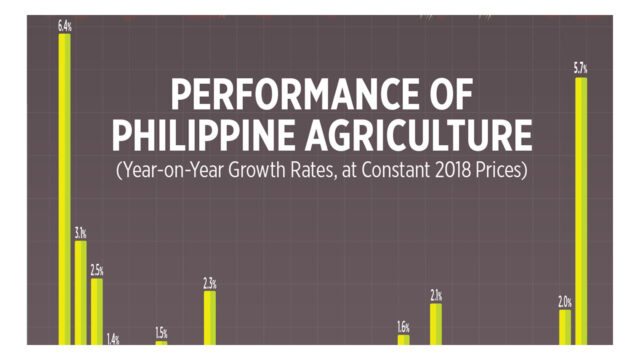
AGRICULTURAL OUTPUT expanded by an annual 5.7% in the second quarter — the fastest pace in eight years — as better weather conditions enabled high-value crops such as rice and corn to post double-digit growth, the Philippine Statistics Authority (PSA) said on Wednesday. Read the full story.

Performance of Philippine Agriculture

World Network looking to tap Filipino developers for apps

WORLD NETWORK, the blockchain-based ecosystem co-founded by OpenAI Chief Executive Officer Sam Altman, is planning to expand its presence in the Philippines by partnering with local developers to build apps to secure digital spaces amid the rising threats brought by growing artificial intelligence (AI) adoption.

“The Philippines has one of the world’s most digitally engaged populations. We’re excited to work with developers and partners here to co-create Mini Apps, designed by Filipinos for Filipinos, that promote trust and usability online,” World Network Chief Product Officer at Tools for Humanity Tiago Sada said in a roundtable interview last week.

Tools for Humanity or the team behind World Network is planning to tap local developers to create a more secure and reliable digital space amid rising AI-driven scams and identity theft, Mr. Sada said.

“By tapping into local developer networks, World aims to build products that are not only technically robust but also culturally and economically relevant — bridging gaps in trust, access, and inclusion,” the company said.

World Network’s Mini Apps allows third-party developers to create applications within its network while enabling secure access to various digital networks.

“With a young, digitally savvy population and a growing middle class eager for new technologies and financial tools, World App’s Mini Apps ecosystem is quickly gaining traction. We’re happy to collaborate with local developers and technologists to build new Mini Apps created by Filipinos,” Mr. Sada said.

Cybersecurity company Netskope said in a recent report that Philippine organizations that rely on software-as-a-service (SaaS) applications must adopt policies to protect their data as AI-driven platforms gain traction, as cloud apps are the top phishing target in Asia, with 5.5 out of every 1,000 individuals clicking on phishing links monthly.

Two SaaS apps, Microsoft 365 and DocuSign, account for a combined 64% of all cloud phishing links clicked in Asia, Netskope said.

In April, World Network said it is planning to introduce its secure and anonymous device WorldID in the Philippines to help combat the rising number of cyberthreats and deepfakes.

WorldID’s verification device Orb is a tool that captures and processes photos to verify human identity, encrypts the data, and stores it on users’ phones.

The company has said that it targets to roll out this device in the country within the year and is also planning to conduct pilot testing of the product in two cities in the capital region.

World Network allows users to have a verified identification through their mobile application. This would allow Filipinos to join its verified networks, prove their humanness online, manage AI agents, and combat bots, misinformation, and deepfakes. — Ashley Erika O. Jose

Flushing Laguna de Bay

LAGUNA LAKE DEVELOPMENT AUTHORITY

While the President recently ordered a review of flood control projects, it would serve the government equally well to revisit the post-disaster needs assessments (PDNAs) conducted after tropical storm Ondoy and Typhoon Pepeng (2009), as well as Typhoon Yolanda (2013).

Our present situation demands a hard look at how both public and private sectors have acted on the recommendations of those PDNAs — whether by implementing, funding, planning, or unfortunately, in some cases, disregarding them.

One cannot help but wonder how much of the damage from more recent typhoons, and even ordinary monsoon rains, could have been mitigated had we followed through on the reports’ recommendations. In 2009, it took a disaster of the magnitude of Ondoy or Pepeng to bring Metro Manila to its knees. Now, 15 years later, mere monsoon rains are enough to paralyze the metropolis.

These PDNAs, prepared with support from the World Bank, the Asian Development Bank, and other development partners, offered blueprints for making the country more resilient. Their recommendations focused on building resilient infrastructure, modernizing flood management, improving planning and disaster risk reduction (DRR), and enhancing institutional coordination.

The NEDA Board* approved the Metro Manila Flood Management Master Plan in 2012. And this led to the upgrading of many pumping stations in the metropolis. While these efforts have contributed to incremental improvements, the question remains: Are we genuinely building back better?

The “Build Back Better” principle is frequently invoked in speeches and planning documents, but its integration into national and local rehabilitation strategies is far from consistent. I believe this principle should be a guiding parameter as the government reviews flood control projects. Are new projects truly designed for resilience, or are we still rebuilding to previous standards, making us vulnerable to the same old risks?

On early warning systems and DRR planning, we have made significant progress. Forecasting is more sophisticated, risk mapping is more accurate, and hazard alerts are now sent directly to mobile phones. High-risk zones are identified, and communities are better informed about impending dangers.

However, while national DRR planning has improved, local implementation remains patchy. The capacity of local governments to enforce DRR measures varies widely. Elections every three years mean that local priorities can shift with every administration, undermining long-term risk management.

Over the last 15 years, Metro Manila has seen even more rapid urbanization, swelling population density, greater encroachment into waterways, and higher sea levels due to climate change. These trends only exacerbate vulnerability, making routine monsoon rains ever more disruptive.

The government needs to urgently fill critical infrastructure and institutional gaps that undermine long-term resilience. Recent flooding, caused not by record-breaking typhoons but by routine monsoon events, underscores the urgency of completing flood management projects identified as early as 2009.

Among the projects identified in 2009 for Metro Manila, I believe the most important are the Upper Marikina Dam and the Laguna Lake-Manila Bay Spillway. These long-term, high-impact projects have long been recognized as central to solving Metro Manila’s flooding problem.

Although a variation is now in the offing. The Upper Wawa Dam, currently under construction as part of the Wawa Bulk Water Supply Project, functions as the practical equivalent of the long-planned Upper Marikina Dam. While designed primarily to supply water, the Upper Wawa Dam also impounds stormwater, mitigating flooding along the Marikina River.

Project construction began in 2021, and by 2024, impounding already started. Full completion and commercial operations are projected for the end of 2025. This dam is the largest new water-supply infrastructure project for Metro Manila in over half a century, since Angat Dam was completed in 1967.

But Wawa Dam’s flood-mitigation benefits are limited by hydrological realities. With continuous heavy rains, the dam can overflow, like what happened on July 21. The dam’s water level went above its spilling level, resulting in overflow into the Marikina River.

Without doubt, Wawa Dam is helpful. But it is not sufficient. While it may keep Marikina from suffering catastrophic floods, it cannot solve the broader issue of how floodwaters can quickly move across the metropolis and out to sea. Simply put, Metro Manila floodwaters must flow out to Manila Bay and not flow back.

This brings us to the equally, if not more, critical Laguna Lake-Manila Bay Spillway. A Parañaque Spillway was first proposed in the 1970s and the idea was revived after Ondoy. While the Manggahan Floodway and Napindan Channel were constructed to divert and regulate floodwaters, the spillway was never built.

Laguna de Bay’s primary natural outlet is the Pasig River, draining west to Manila Bay. However, the Pasig is no longer sufficient to drain excess water from the lake, especially during severe rainfall. The unbuilt spillway was intended to provide a direct, controlled route for floodwaters from Laguna de Bay to Manila Bay, complementing existing infrastructure.

Without it, the Laguna lake functions like a “toilet that cannot be flushed,” its level rising inexorably during storms, with water overflowing into adjacent low-lying communities.

Meanwhile, the Manggahan Floodway continues to divert Marikina River floodwaters into Laguna de Bay. Yet with no spillway to discharge this water onward to Manila Bay, and unless the lake itself is dredged, floodwaters simply accumulate in Laguna de Bay and spill back into the city during high water and high tide. The Napindan Channel helps regulate flows, but it cannot handle the combined load of severe rainfall, siltation, and increased runoff from upstream.

Metro Manila’s geography amplifies its flooding problems. The metropolis sits on an isthmus, a narrow strip of land, just about 10 kilometers wide at its narrowest, between Manila Bay to the west and Laguna de Bay to the east. The two bodies of water are connected by the Pasig River, which meanders across the floodplain.

Metro Manila is a floodplain. Its vulnerability is inherent. Effective drainage infrastructure is thus vital to prevent the city from going underwater, especially during high tide, when the ability of its rivers and creeks to empty into the bay is compromised.

Blame rapid population growth and unplanned urban expansion for shrinking riverbanks and waterways. Urban flooding results from even just routine rainfall, when the only outlet for floodwaters — the Pasig River — is compromised by siltation, informal settlements, and garbage.

The proposed spillway, an underground tunnel, even with realignments under Parañaque, Las Piñas, Muntinlupa, and Pasay, may not be longer than 20 kilometers. Advances in tunneling technology, now being employed for the Metro Manila Subway, make the construction of a spillway tunnel from Laguna de Bay to Manila Bay practical and efficient.

Laguna de Bay, with a surface area of 911 square kilometers, is much larger than Metro Manila’s 620. It has enormous potential as a catchment basin. With proper dredging, restoration of its tributaries, and the construction of a functioning spillway, it can safely absorb and evacuate floodwaters not just from Metro Manila, but from surrounding provinces like Rizal and Laguna.

Metro Manila’s recurring floods are not simply the result of nature’s wrath, but a consequence of more than 50 years of unfinished business: critical infrastructure that remains unbuilt, plans that have gathered dust, and administrations that have struggled to keep the capital safe and dry.

* The National Economic and Development Authority, now the Department of Economy, Planning, and Development.


Marvin Tort is a former managing editor of BusinessWorld, and a former chairman of the Philippine Press Council

matort@yahoo.com

Pickup Coffee launches frappes, rewards club

Has expanded its reach to Mexico

PICKUP COFFEE, the prolific Filipino coffee chain known for its reasonably priced offerings, officially unveiled a new line of beverages.

They now have eight frappuccinos on their menu: Brown Sugar Coffee Jelly, Cafe Mocha, Caramel, Kape Kastila (Spanish Latte), Matcha, Oreo, Triple Choco Chip, and White Mocha.

The chain also launched a rewards program, the Pickup Club, which can be found on its digital app. It offers discounts, anniversary treats, and delivery deals.

“In just three years, Pickup Coffee has grown from a bold idea to something so much bigger than we ever imagined. Today, we’re proud to say that we have over 400 stores nationwide,” said Francis Flores, Pickup Coffee’s country chief executive officer and president, at the launch on July 30 in Parañaque City.

“It’s very inspiring that a local, proudly Filipino brand has this nationwide reach, and we’re continuously growing. Actually, the past few months, we’ve been opening 20 stores every month.”

Pickup Coffee, best known for serving its beverages from food trucks, opened its first concept café, Pickup Prime, in SM Seaside in Cebu City last month. Mr. Flores said that it features “a sleek design with exclusive coffee creations.”

The second Pickup Prime store will be located in Vertis North, Quezon City, he said.

GOING ABROAD
Another milestone that the Filipino coffee chain has achieved is its international expansion — it has opened 40 stalls in Mexico. “That was our test market. We did some studies and saw that they have a similar population [to the Philippines’],” he explained.

There are 132 million people in Mexico, compared to the Philippines at about 116 million.

Mr. Flores said that Mexicans are also even more addicted to coffee, boasting 900 Starbucks branches while the Philippines has 400. “We’re the only value player there for the young market which questions why coffee is so expensive — the same proposition as here,” he said.

As for growth within the country, he explained that Filipinos can expect “a continuous presence from the brand,” in terms of their latest marketing campaign “Feel the Pickup,” and expansion across the archipelago.

Pickup Coffee’s new frappuccino line, with drinks starting at P99, is available in all stores nationwide. — Brontë H. Lacsamana

What are VPNs and will they threaten online safety?

STOCK PHOTO | Image from Freepik

APPS that disguise a user’s location have surged in popularity after the UK introduced age-verification rules as part of its Online Safety Act.

The new restrictions, which went into effect in late July and aim to prevent children from accessing harmful material on the internet, require “age assurance” systems to be implemented across thousands of websites that contain adults-only content. These include pornography sites, dating apps and social media platforms such as Reddit and TikTok.

But it seems that many Britons are reticent to hand over a credit card number or other identification credentials to prove they’re over the age of 18, and are instead opting to use a “virtual private network” (VPN) to make it look like they’re in a different country. As of Aug. 4, VPNs comprised four of the top 10 most downloaded free apps on Apple, Inc.’s App Store in the UK.

VPNs aren’t just a challenge for the UK’s ambitious new effort to govern the internet and keep children safe. As regulators around the world pass rules aimed at reining in access to content on the web — whether to protect kids from harmful posts, suppress speech or restrict access to social media — users are rushing to find tools to subvert such controls.

WHAT IS A VPN?
Whenever you use the internet, your connection is assigned a unique set of numbers called an Internet Protocol (IP) address.

A VPN is basically a digital mask that disguises that IP address. It’s a piece of software that hides what you’re looking at online and where you’re looking from. It does so by routing your internet traffic through an encrypted “tunnel” to the VPN provider’s servers elsewhere in the world.

If you’re browsing the web in London, for example, a VPN can make it appear to an internet service provider and government authorities that you’re surfing online from Barcelona. If someone were to intercept your internet traffic, it would appear as unreadable encrypted code.

WHY DO PEOPLE USE VPNS?
The idea of VPNs emerged three decades ago as a way for employees to log into their office networks remotely over a secure connection. VPNs have gained traction as a tool for privacy protection as people can avoid being tracked by websites and apps for targeted advertising.

People looking for ways to skirt the rules of the internet have found other uses for VPNs. These services can enable access to “geoblocked” content that isn’t available in a user’s home country, such as a show on streaming platform Netflix or a live sports event where the broadcasting rights belong to an overseas network.

In places with harsher censorship and surveillance regimes, such as China and Russia, VPNs have taken off as a means of bypassing government firewalls. Hackers also employ VPNs to conceal their identities.

Several companies, such as Lithuania’s NordSec BV, have turned VPNs into lucrative businesses, charging a subscription fee to companies that want to improve their cybersecurity or consumers trying to avoid ad-trackers or prying eyes.

HOW POPULAR ARE VPNS?
Interest in VPNs tends to rise after governments move to restrict access to content on the web.

The UK’s rules on age verification commenced on July 25 and triggered a dramatic spike in sign-ups for VPN services in the country. On July 27, sign-ups were almost 2,000% higher than the daily average over the 28 days prior to the new rules being in force, according to Top10VPN, a global VPN monitoring platform.

Swiss VPN provider Proton VPN said that it experienced an 1,800% increase in daily sign-ups from UK-based users, on average, in the six days following the implementation of the age checks.

The VPN momentum in the UK has outpaced recent upticks in activity elsewhere spurred by other governments’ rule changes.

In Iran, Top10VPN data indicates VPN demand surged by as much as 707% above average after the government restricted internet access in an attempt to blunt the impact of cyberattacks during the June conflict with Israel.

And when age-verification laws for adult websites kicked into effect in France in June, VPN demand peaked at 570% above normal levels, according to Top10VPN.

ARE VPNS LEGAL?
VPNs are legal in most parts of the world when used for legitimate purposes — for example, by workers connecting remotely to a corporate network, or as an additional layer of security to protect payment information when shopping online.

In jurisdictions where VPNs are allowed, law enforcement agencies have moved to shut services down if they enable criminal activity. In 2022, a joint operation by 10 countries, including Germany, the US and UK, seized the servers of VPNLab.net after an investigation found the network was being used to support the deployment of ransomware and other cybercrime.

Some countries have banned VPNs outright, including Turkmenistan, North Korea and Iraq. Others have restricted their use, requiring VPNs to block certain content, such as in Russia, or only allow access to officially authorized VPN apps that may be monitored by authorities. In China, for instance, VPNs must be approved by the government.

VPNs are sometimes subject to temporary constraints on their usage during what a government deems a crisis.

CAN VPN USERS BE IDENTIFIED?
Although VPNs enhance privacy significantly, users can still be tracked.

“Subpar” VPNs may make a user’s real IP address visible to websites, according to Surfshark, a VPN and antivirus software provider owned by Nord Security. Companies that require users to log in will also have records of their customers’ activity while they’re logged into their accounts.

Government and law enforcement agencies may request access to logs of VPN users’ online activity, although many VPN providers say they don’t keep such data.

Even if a VPN user isn’t identified, a number of websites can detect that a VPN is being used and block the traffic. Websites that want to stop users from breaking local laws or enforce geographic restrictions can identify traffic coming from known VPN IP addresses. They might also look for signs of unusual activity, such as a single IP address generating a high amount of traffic, or traffic coming at odd hours for the location.

And while traffic is encrypted in the VPN tunnel, the information outside of it, such as data stored on a user’s device, is not.

COULD VPNS UNDERMINE THE UK’S ONLINE SAFETY ACT?
The Online Safety Act, which was passed in 2023 and is being rolled out in phases, puts the onus on websites to enforce age checks, not on users to comply. Platforms that fail to implement age-verification measures risk penalties of up to £18 million ($24 million) or 10% of their global revenue, whichever is greater.

But even if age assurance systems are in place, children and teenagers could just use VPNs to circumvent the restrictions, particularly as many VPN apps are free or offer cheap subscriptions. Adults may also use this workaround out of fear that hackers could steal the personal data they submit to verify their date of birth.

VPN apps are legal to download and use in the UK and there aren’t currently any proposals to curtail them. Some UK lawmakers have previously suggested that Ofcom, the media regulator, should investigate the effect of VPNs.

The Department for Science, Innovation and Technology has said that “platforms have a clear responsibility to prevent children from bypassing safety protections. This includes blocking content that promotes VPNs or other workarounds specifically aimed at young users.”

Early data suggests that VPNs haven’t completely neutralized the Online Safety Act’s new age requirements. In the initial days after the rules came into force, the government said there were an additional 5 million age checks on a daily basis, citing data from trade body the Age Verification Providers Association. — Bloomberg