Home Blog Page 1016

Two Filipino pizzerias hailed at Top 50 Pizza

THE CREW of Crosta (L-R): Ingga S. Cabangon Chua, Thomas Woudwyk, and Yuichi Ito — 50TOPPIZZA.IT

TOP 50 PIZZA, which ranks pizzerias around the world and in each region, places Filipino dining outlets Crosta and A Mano in its list again.

The two pizzerias have been consistently included in the list throughout the 2020s. For example, Makati’s Crosta was in the list last year at No. 12, moving down the list to No. 28 this year. A Mano, meanwhile, moved up to No. 49 from No. 70 last year, and its No. 96 debut in 2023.

In the Asia-Pacific regional list, Crosta enjoys the No. 5 spot (tied with Australia’s Shop225), while A Mano occupies No. 7 (tied with New Zealand’s Dante’s Pizzeria).

The website says about Crosta, “With few seats, pizza and high-quality products, and a selection of wines available by the glass, Crosta is a meeting of three very different sensibilities that creates a one-of-a-kind place.”

The pizza place is operated by Ingga S. Cabangon Chua and Thomas Woudwyk; the kitchen is helmed by Japanese chef Yuichi Ito.

“The doughs are of different styles and all of excellent quality. The toppings range from simple and traditional to more complex ones. A must-try is the round pizza with salami, truly balanced and well-made.”

About A Mano, the guide says, “In the menu you will find pasta, risotto, pizza and whatever your choice may be, you will find a selection of products that would make any Italian restaurant envious, in terms of quality. The style of the pizza is a mix between traditional Neapolitan and contemporary.”

A Mano is a venture by Amado Forés (son of late storied chef Margarita Forés*) through AF Hospitality.

Those two pizzerias are not the only ones that made an appearance on the site’s lists. Wildflour Italian made it to No. 42 and Cebu’s Minante Pizzeria got the No. 48 slot on the Asia-Pacific list.

Worldwide, I Masanielli — Francesco Martucci in Caserta, Italy, got the top spot. “A temple of the best of Italian gastronomic culture just a stone’s throw from the Royal Palace,” is how the 50 Top Pizza list described it.

View the complete list here: https://www.50toppizza.it/. Joseph L. Garcia

*https://www.bworldonline.com/arts-and-leisure/2025/07/17/685628/margaritas-son-takes-over/

Yuchengco-led MGI eyes more capacity from Batangas site

PETROENERGY.COM.PH

YUCHENGCO-LED Maibarara Geothermal, Inc. (MGI) is planning an expansion of its Batangas facility to boost geothermal capacity.

In a statement on Wednesday, MGI said it is preparing a deep exploration drilling program in 2026 to test an undrilled sector of the Maibarara field that could yield additional capacity.

MGI President Francisco G. Delfin, Jr. said the company has tapped New Zealand firms for technical support to address challenges in geothermal development and operations.

“MGI is grateful for the services rendered by New Zealand firms that were instrumental in MGI’s early success, from reserve estimation through laboratory services and cooling tower treatment; from downhole surveys through well work-overs, and digital mapping,” Mr. Delfin said.

MGI is a joint venture of PetroGreen Energy Corp. (65%), ACEN Corp. (25%), and PNOC Renewable Corp. (10%). It operates the 20-megawatt (MW) Maibarara-1 and 12-MW Maibarara-2 geothermal projects in Sto. Tomas, Batangas.

In February, the company acquired three lots from state-run Power Sector Assets and Liabilities Management Corp. for P473.17 million. The properties, with a combined area of 58,911 square meters, are located in San Rafael, Sto. Tomas, Batangas, and Calamba, Laguna. — Sheldeen Joy Talavera

Peso slides past P57 on higher jobless rate and weak FDI data

BW FILE PHOTO

THE PESO SLIPPED past the P57-a-dollar mark on Wednesday as traders reacted to weaker domestic economic data, including a higher unemployment rate and slower foreign direct investments (FDI).

It closed at P57.125 against the greenback, down 14.5 centavos from P56.98 on Tuesday, according to data from the Bankers Association of the Philippines website.

The peso opened weaker at P57.10, touched an intraday high of P57.05, and dropped to as low as P57.195 before settling at the close. Trading volume declined to $1.44 billion from $1.72 billion the previous day.

“The dollar-peso closed higher due to weaker unemployment data earlier this morning,” a trader said by telephone.

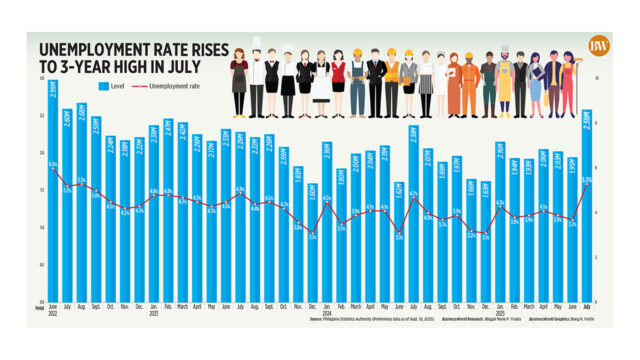
Latest figures from the Philippine Statistics Authority (PSA) showed the jobless rate climbed to 5.3% in July, the highest in three years. The number of unemployed Filipinos rose to 2.59 million from 2.38 million a year earlier and 1.95 million in June.

The increase matched the jobless rate recorded in August 2022 and was significantly higher than the 4.7% posted in July 2024 and the 3.7% in June 2025. Economists said the rise reflected the impact of successive typhoons and monsoon rains, which disrupted hiring during the period.

Weaker foreign investment inflows also dampened sentiment. Preliminary Bangko Sentral ng Pilipinas (BSP) data showed net FDI fell 17.8% to $376 million in June from a year earlier, the lowest since December 2024.

Michael L. Ricafort, chief economist at Rizal Commercial Banking Corp., said the weaker FDI data added pressure on the peso, noting that subdued investor appetite could affect near-term currency movements.

For Thursday, the trader expects the peso to trade at P56.90 to P57.30 a dollar, while Mr. Ricafort sees it moving within P57.05 to P57.25.

The dollar held steady on Wednesday ahead of US inflation data this week that could help shape the outlook for Federal Reserve policy, while a fraught geopolitical backdrop underpinned the likes of the Swiss franc.

Employment data in the last week has shown the US economy created far fewer jobs in the last year than expected, which has made a rate cut from the Fed next week look like a certainty.

Yet it has not dented confidence in the equity market, where stocks trade at record highs, nor has it had much immediate impact on the dollar itself, even as investors weigh the chances of a jumbo half-point cut from the Fed next week.

Israel’s attempted killing of Hamas leaders with an airstrike on Qatar on Tuesday, along with Poland shooting down drones that entered its airspace during a Russian attack in western Ukraine on Wednesday, are keeping investors nervous.

“The market has made up its mind, and probably quite rightly, that the Fed is going to be cutting interest rates,” said Jane Foley, head FX strategist at Rabobank. “But for one, there’s been quite a lot in the price in terms of between now and the end of next year.”

“On the other hand, playing in the same direction is the geopolitical uncertainty. There is the Poland news, there is the Qatar news. None of that is reassuring,” she added.

The euro was subdued against the dollar, but jumped as much as 0.5% against the Polish zloty to 4.268 zloty, its biggest one-day rise in three months.

In terms of Fed expectations, traders are fully pricing in a quarter-point cut next week, with a minor chance of a half-point cut. This week’s reports on wholesale inflation due on Wednesday, and consumer inflation on Thursday, could affect that outside prospect of a larger cut, analysts said.

“The bar for a 50-bp move is high, there would likely need to be a clear downside surprise in core inflation to give doves cover,” said Kieran Williams, head of Asia FX at InTouch Capital Markets.

“Given sticky service prices and the Fed’s preference for signaling gradualism, a jumbo cut next week looks unlikely, but the data will shape how aggressively the market prices the easing path into year-end.” — Aaron Michael C. Sy with Reuters

MPTC targets 2026 CALAX completion with new contractors on board

PHILSTAR FILE PHOTO

MPCALA Holdings, Inc., a unit of Metro Pacific Tollways Corp. (MPTC), has tapped CM Pancho Construction, Inc. (CMPCI) and listed builder EEI Corp. to complete remaining works for the Cavite-Laguna Expressway (CALAX).

In a statement on Wednesday, MPCALA said EEI will handle the P2.7-billion subsection 1 from Open Canal to Kawit, Cavite, while CMPCI will oversee subsection 2 covering Governor’s Drive to Open Canal.

Founded in 1962, CMPCI is engaged in property development and construction services.

MPCALA, the CALAX concessionaire, said the new contracts move the 45-kilometer, four-lane tollway closer to full completion.

CALAX will have eight interchanges and is expected to serve at least 95,000 motorists daily once fully operational.

The expressway is slated for completion in the first half of 2026.

MPTC is the tollway arm of Metro Pacific Investments Corp. (MPIC), one of three main Philippine units of Hong Kong-based First Pacific Co. Ltd., alongside Philex Mining Corp. and PLDT Inc.

Hastings Holdings, Inc., a unit of PLDT Beneficial Trust Fund subsidiary MediaQuest Holdings, Inc., holds a majority stake in BusinessWorld through the Philippine Star Group, which it controls. — Ashley Erika O. Jose

How to become a VIP guest at restaurants in 6 easy steps

By Kate Krader

A YEAR and a half ago, a reader posed a newsletter question to the food editor at Bloomberg Pursuits (me): Do restaurant servers hate diners?

To answer that thought-provoking query, I turned to Adam Reiner, a Bloomberg Pursuits contributor and James Beard-winning writer. He spent more than 20 years waiting tables in New York City, everywhere from theme restaurants in Times Square to Carbone, the Grill, and Babbo.

Now Reiner is publishing his first book, The New Rules of Dining Out: An Insider’s Guide to Enjoying Restaurants (LSU Press; Sept. 19; $30). It’s a de facto handbook for everyone who wants to have a better experience when they sit down at a restaurant, let alone someone who craves VIP treatment. Chapters have titles like, “How to Become a Regular” and “Tricks of the Trade, Power Moves and No-No’s.” (“Excessive spending isn’t the only reliable way of becoming a regular,” he wrote in his book. “Restaurant workers are accustomed to being treated like ‘the help’ so when guests make a genuine effort to get to know them, it can go a long way toward establishing a mutually beneficial relationship.”)

As scoring a prime-time restaurant reservation continues to be the ultimate power play in New York (and beyond), it’s a good time to familiarize yourself with these skills. And, Reiner points out in a recent interview, better dining interactions just might help improve the fragile restaurant ecosystem overall. “Everything felt by diners is felt by restaurants,” he says. Think high food prices and tipping frustrations. “It’s a good time for diners to say, ‘how can I be a better guest’ and make the experience better for everyone,” even if it means leaving your table a little earlier than you want to (see below).

So, do servers actually hate diners? “Generally speaking, I don’t think most servers ‘hate’ diners,” says Reiner. That said, “every restaurant also has a few regulars that a majority of the staff can’t stand,” he adds. “Sometimes you can hear the collective groan when these people walk through the door.”

Don’t be that guy. Here are six rules for being a VIP at restaurants.

• Don’t Glue Yourself to Your Phone

No one is telling you to put your phone in a locker, says Reiner (actually, some restaurants are). “But if you’re constantly engaged in checking your messages you’re missing a chance to connect.” Sure, take pictures — most diners want to get some social media capital from the restaurants they go to — and most places appreciate that. However, if your evening is devoted to a TikTok video, you’re not engaging your server. What’s more, he wrote, “servers are much more likely to ignore a distracted guest that they perceive as disinterested than one who gives their undivided attention.”

• Don’t Ask for General Recommendations

If you’re going to ask your server for suggestions, be specific about what you want and will or won’t eat. Unless you deeply care about your waiter’s favorite dish, frame the question around your own taste. For example, Reiner wrote, “you might say, ‘I’m in the mood for something lighter, and I don’t like anything with too much butter, would you recommend the striped bass or the halibut?’” Otherwise it’s almost always a waste of everyone’s time to know that your server likes the spaghetti with anchovies when you’re not eating carbs.

• Don’t Be a Table Hog

One of the benefits of being a VIP in a restaurant is that you don’t feel rushed out of the place. Still, restaurant economics get more challenging every day. Like it or not, unless you own the place, you’re only renting your table for a couple hours. “Mindful diners will always try to return their table within a reasonable amount of time,” Reiner wrote. “If you don’t want to leave, ask the staff if they can relocate you to the bar for after-dinner drinks.” And, the more you work with a place to accommodate them, the more likely they’ll be to let you linger at future meals.

• Don’t Forget the Busboys/Busgirls

“We can all agree that tipping sucks,” wrote Reiner. “But the system isn’t going away anytime soon, so we might as well make it work for us.” A restaurant’s bussers invariably spend more time monitoring a table than the servers do but never see tips directly from guests. “Slipping them a crisp $20 will help ensure that your water glasses remain full, your bread basket is replenished, and your table will always be cleared in a timely fashion,” he says.

• Don’t Storyboard Your Meal Before You Walk in the Door

If you plan your meal in advance, you might be depriving yourself of a chance to have a singular experience. “If you only stick to crowd favorites, you risk missing out on off-menu specials and seasonal dishes that might not be mentioned in online reviews,” says Reiner. “Taking the time to discuss the menu with your server also helps to build camaraderie. When you predetermine your order, you miss out on this key moment of connection.”

• Don’t Expect VIP Treatment at a Brand New Place

Wait a few weeks — even a few months — before going to a new restaurant. “Restaurants are like newborns,” wrote Reiner. “They need time to grow and mature. Sometimes they spit up on you.” It’s almost always easier to get a reservation after the hype has died down, and by then, there’s also more opportunity to connect with staff like the general managers, who can have a lot to do with your future experiences. — Bloomberg

PUV accident insurance rules updated

PHILIPPINE STAR/EDD GUMBAN

THE INSURANCE COMMISSION (IC) has revised the framework for passenger personal accident insurance covering public utility vehicles (PUV), introducing stricter rules on claims, fund adequacy and public disclosure.

In a circular dated Sept. 8, the regulator said the guidelines update and consolidate rules issued in 2020 under Circular Letter No. 2020-96A.

Under the framework, nonlife insurers are now required to adopt a standard passenger personal accident insurance policy form with an “all risk, no fault” provision to ensure uniform coverage and adequate protection for passengers.

Insurance pools — groups of insurance companies participating in the program — must also adhere to the premium rates set in Circular Letter No. 2018-59.

The IC also adjusted requirements for claim funds, which serve as reserves for payouts. While the minimum remains at P50 million, the regulator may now require higher amounts depending on a pool’s risk profile and coverage data.

The management company or the lead insurer in a pool will be responsible for monitoring fund levels.

If the fund falls below the prescribed threshold, all member insurers will be jointly and solidarily liable to replenish it within a period set by the commission.

The updated rules also set a stricter timeline for claims. Payments must be made within five working days from submission of requirements. Claims settled later without valid justification will be subject to a 12% annual interest rate, computed starting on the sixth working day until actual payment.

To improve accountability, management companies must submit quarterly reports detailing the number of claims received, the average processing time, delayed cases and reasons for delay and total disbursements.

The IC also ordered insurers and pools to boost public awareness. They must disseminate information about the benefits of accident insurance, claim procedures, contact details for assistance and details of the “all risk, no fault” provision to ensure passengers understand their entitlements.

The program was introduced to provide financial protection to passengers of PUVs in the event of accidents, with coverage financed through premiums included in fares. — Aaron Michael C. Sy

Theater actor, director, and playwright George de Jesus III, 54

GEORGE DE JESUS III, a stalwart in the Philippine theater scene where he worked as an actor, director, and playwright, died on Tuesday, Sept. 9. He was 54.

Mr. De Jesus’ passing was announced by his sister, Che de Jesus, on Tuesday morning in a Facebook post.

“It is with a heavy heart that we announce the passing of our beloved brother, George ‘Jon’ de Jesus III,” she said. “We appreciate your thoughts and prayers during this difficult time. We love you and we will miss you, kuya Jon.”

The Philippine Educational Theater Association (PETA), with whom Mr. De Jesus had worked extensively, extended its condolences.

“George generously shared his talent on the PETA stage, delivering memorable performances in productions like Haring Lear, Walang Himala, and Noli Fili Dekada Dos Mil. George was also part of the PETA Broadcast and Film, Inc’s Teleplay Writing Workshop,” it said in a Facebook post.

“His legacy in the Filipino theater community will live on through his work. Our thoughts are with his family and loved ones during this difficult time,” PETA added.

Tanghalang Pilipino, of which he was a member from 1994 to 2001, also paid tribute to Mr. De Jesus on their social media pages, acknowledging his impact on the theater community.

Lubos na nakikiramay ang Tanghalang Pilipino sa pagpanaw ng isang alagad ng sining (Tanghalang Pilipino expresses its deepest condolences on the passing of an artist),” it said in a Facebook post.

Mr. De Jesus performed in many of the company’s productions: Henrik Ibsen’s Hedda Gabler, Calderon de la Barca’s Las Tres Justicias En Una, Moliere’s The Miser and Les Fourberies de Scapin, Mikhail Bulgakov’s Flight, Luis Valdez’s The Shrunken Head of Pancho Villa, Michel de Ghelderode’s Pantaglieze, and Aristophanes’ Lysistrata, to name a few.

A writer, he won multiple Carlos Palanca Memorial Awards for Literature over the years. Some of his award-winning works include Linggo ng Palasapas, Unang Ulan ng Mayo, and Kapit (all one-act plays); Cell Phone (future fiction); Sala sa Pito and Maniacal (full-length plays); and Kung Paano Maghiwalay (screenplay).

His work Paglayang Minamahal was also awarded by the Centennial Literary Competition while his screenplay, Para Walang Unyon, won in the NCCA Teatro Bulawan Playwriting Competition.

Mr. De Jesus co-founded the Egg Theater Company in 2015 ahead of that year’s Fringe Manila festival. They went on to stage many contemporary theater pieces — original plays, translations, and adaptations. These include Martin McDonagh’s The Pillowman and Moliere’s The Learned Ladies and The Misanthrope.

He wrote, directed, and acted in countless productions for Stages Production Specialists, Inc., Virgin Labfest, and Dulaang UP.

His most recent appearance was in the one-act play Minating ni Mariah ang Manto ng Mommy ni Mama Mary, part of this year’s Virgin Labfest.

Mr. De Jesus’ wake takes place from Sept. 10 to 12 at the Solenne and Amore rooms of the Solennelle Funeral Chapels, Valenzuela City. The final service and interment will be on Sept. 13, 10 a.m., at Tierra Santa Memorial Park, also in Valenzuela City. — Brontë H. Lacsamana

The SME’s guide to AI for business

JERRY ILAO (left), president of the Philippine AI Business Association with RJ Ledesma. — THE POD NETWORK ENTERTAINMENT

Entrepreneurs have heard the warnings loud and clear. Adopt AI or be left behind. Embrace digital transformation or become a dinosaur. Adapt or die. And yet, for SMEs, AI for business seems hopelessly cooked in favor of large enterprises. But this isn’t the case at all, according to Jerry Ilao, president of the Philippine AI Business Association (PAIBA). For SMEs to reap the benefits of AI, all they need to do is start.

Mr. Ilao has deep and wide experience in entrepreneurship and the tech industry. I’ve known him since our days in Procter & Gamble when I was in brand and he was in finance. From there, he ventured into entrepreneurship, putting up the ubiquitous Ink All-You-Can business. Clearly bitten by the entrepreneurship bug, he also established Olern, Tellix, Tartino Mobile Optima, and Leappreneur. PAIBA, an organization he co-founded, is dedicated to a single mission: helping SMEs implement AI for business.

“What’s stopping [SMEs] from implementing AI generally is one thing,” he says, “which is knowledge on how to implement AI.”

To provide this knowledge and educate SMEs, PAIBA holds AI Connect sessions every few weeks — all for free. For members of the organization, they also hold AI hackathons to explore the many uses AI can have for Philippine SMEs.

I recently reconnected with him on the RJ Ledesma Podcast. In our conversation, he shared a step-by-step guide on what SMEs need to do to get started with AI for business. Here are some of the highlights:

Get Your Feet Wet. To begin, Mr. Ilao advises entrepreneurs to stop following the latest or hottest tech trends (a.k.a. shiny object syndrome). “Focus on one problem that you want to solve,” he said.

The best way to do this? Just jump in and get your feet wet. There’s nothing wrong with starting with general-use large language models like ChatGPT or Gemini. And the good thing about these general-use AIs is that they can help you in a broad range of tasks, from marketing to customer service, you name it.

By doing this, entrepreneurs can get more comfortable with AI and learn what AI can do for their business. And from there, they can move on to more technical solutions to address that problem they wanted to solve — like integrating AI into business processes or automation.

AI as Your “Thought Partner.” In our conversation, Mr. Ilao gave many use-cases for AI that could be helpful for SMEs. The first was using AI as, what he calls, a “thought partner.”

“When you’re an entrepreneur,” he explained, “you cannot afford a consultant. It’s hard.” But with AI using deep research, it can be equivalent to getting PhD level research.

He recounted, “I did a sample before on market analysis… Sobrang amazed ’yung nag-attend ng session namin because nakalatag na kung ano ’yung SWOT strategy, ano ’yung market opportunities. (Those who attended our session were amazed because we already presented the SWOT strategy, what the market opportunities were.) And that’s done by AI in 10 minutes.”

Another use-case for SMEs is in building company processes. Unlike large corporations, many SMEs cannot spend time and resources on defining and properly designing their processes and systems.

“ChatGPT can do that for you,” he said. “So, travel expense policy, work from home policy, and any SOP from, let’s say, receiving the inventory up to recording it in the system, you can easily do that using ChatGPT.”

The use-cases for SMEs are varied and deep. AI can help design processes for security or spot financial control loopholes — which can be valuable to SMEs who are often prone to theft or fraud.

For marketing, the uses of AI are almost too many to mention. Beyond content creation, SMEs can use AI for market research or e-mail campaigns. Or you can create an AI chatbot to engage customers and provide customer service.

Finally, many Filipino entrepreneurs struggle with finance — a topic close to Mr. Ilao’s heart.

Maraming mga entrepreneurs na medyo waterloo nila ’yung finance (Finance is the waterloo of many entrepreneurs),” he said. “You can ask ChatGPT to help you with that, analyze financial statements.”

Use AI to Help You With AI. Connected to using AI as your thought partner, he advises using AI to help you learn more about AI — a sort of AI inception, if you will.

Want to create a website? Want to edit videos faster? Ask AI if there is an AI that can do that for you.

Want to check if the process you created with AI is safe and secure? Ask AI to look for loopholes or flaws in your process.

Prompt Engineering Basics. Many of the results you get from AI depend on what you input into your prompt. For this reason, “prompt engineering” has become a big thing. It has become a skill that employers seek, and there are even classes on the topic being offered online. Mr. Ilao offered a simple approach to prompt engineering, which he summarized as RTC — Role, Task and Context.

“Role” is all about telling the AI what it is acting as. “AI is very good at many things,” Mr. Ilao said. “Tell the AI kung ano ’yung role na iti-take niya (tell the AI what role it has to take on).” AI can be a marketer, a researcher, a programmer, a content creator and so much more.

“Task” is about defining what you want it to do clearly.

For “Context,” the idea is to give the AI as much information as you can for more targeted results. “Provide as much context as you can to make the AI output very, very specific to your needs,” Mr. Ilao advised.

CAVEATS

With all these game-changing abilities at the fingertips of entrepreneurs, it’s important to remember that there are limits as well as dangers to using AI.

1. Keep a human in the loop. Mr. Ilao says: “I always say that the AI output is a very good first draft. Never the final one.”

In any process — even one that is automated with AI — there should always be a human in the loop. Don’t just accept whatever the AI gives you. The decision process or the output of AI should always be reviewed.

2. Be aware of concerns. Security, confidentiality, intellectual property ownership. These are all valid concerns when it comes to AI for business. Currently, there are no laws that cover AI in the Philippines, but there are common sense practices that you can employ to ensure that your business remains safe.

3. Do not be dependent on AI. Finally, Mr. Ilao warned about how easy it is to become dependent on AI once you start using it.

“Don’t let AI decide for you,” he said. “Just let AI spell out all the information that you need to make an informed decision. Then you’ll decide.

“And in fact, you can take this further. When you decide, let AI challenge you. This is my decision: what am I missing?”


RJ Ledesma (www.rjledesma.com) is a Hall of Fame Awardee for Best Male Host at the Aliw Awards, a multi-awarded serial entrepreneur, motivational speaker, and business mentor, podcaster, an Honorary Consul, and editor-in-chief of The Business Manual. Mr. Ledesma can be found on LinkedIn, Facebook and Instagram.

The RJ Ledesma Podcast is available on Facebook, Spotify, Google and Apple Podcasts. Are there entrepreneurs you want Mr. Ledesma to interview? Let him know at ledesma.rj@gmail.com.


A Brown consolidates energy assets under ABCEI

PHILSTAR FILE PHOTO

LISTED holding company A Brown Co., Inc. (ABCI) is consolidating its energy assets under its wholly owned subsidiary ABC Energy, Inc. (ABCEI), the group’s energy holding firm.

In a regulatory filing on Wednesday, ABCI said its board of directors had approved the transfer of its wholly owned subsidiary Northmin Renewables Corp. (NRC) and its 20% equity interest in Peakpower Energy, Inc. (PEI) to ABCEI.

“The restructuring consolidates these energy-related assets under ABCEI, streamlining management oversight, sharpening operational focus, and strengthening the group’s platform for future growth in the energy sector,” the company said.

ABCI said the transaction will have no financial impact on the group since it is between the parent company and a wholly owned subsidiary.

NRC focuses on renewable energy projects in Northern Mindanao, with pre-development activities for a wind power project currently underway. PEI, meanwhile, develops diesel- and bunker-fired power plants designed to provide peaking capacity for various electric cooperatives in Mindanao.

In July, ABCEI’s board approved the sale of its 20% equity stake in Palm Concepcion Power Corp. (PCPC) to give the A Brown Group additional capital to support its strategic objectives.

PCPC operates a coal-fired power plant on Panay Island.

Based in Mindanao, ABCI has interests in property development, power generation, public utilities, and agribusiness.

Shares in ABCI closed unchanged at P0.72 apiece on Wednesday. — Sheldeen Joy Talavera

Cloud modernization can accelerate financial firms’ shift from old systems

FREEPIK/THIS IMAGE WAS GENERATED WITH AI

CLOUD modernization solutions can help Philippine financial institutions as they move to transition out of their outdated legacy systems, according to US-based software firm Rocket Software, Inc.

“Most financial institutions are very paranoid about cloud security and that’s one of the reasons the adoption rates are in a phased approach,” Praveen Kumar, vice-president for Asia-Pacific at Rocket Software said in a virtual interview.

In the Asia-Pacific, the Philippines, Malaysia, Indonesia, and India are among those that are lagging in terms of cloud adoption, he noted.

“I think the lagging is not because of lack of interest or technology. It’s just that the banking environment has matured to such a level that they’re able to provide very strong services from on-premises (on-prem) software,” Mr. Kumar said.

“So, they’re deciding which of the services go to the cloud and which don’t.”

A 2024 study by the Asian Development Bank (ADB) Institute showed that total cloud spending in Australia, Japan, New Zealand, and Singapore is higher than 0.4% of gross domestic product (GDP).

Conversely, total cloud spending is less than 0.3% of GDP in the Republic of Korea (0.29%) Thailand (0.22%), Philippines (0.19%), India (0.16%), Vietnam (0.13%), and Indonesia (0.10%), the ADB Institute said.

Mr. Kumar said cloud security has evolved from an information technology (IT)-related issue to a company problem, citing the need for financial institutions to educate their staff on secure cloud adoption.

“If you don’t take care of your personal computer, laptop or home device, and that device connects to the cloud enterprise or the enterprise data center, you’re actually posing a risk for the company itself,” he said.

Rocket Software, which entered in the Philippine market in 2008, provides multiple technologies that assist companies in modernizing their legacy systems and moving to the cloud.

“If you move content, data, as well as applications which are residing on-prem but built over the years, we move them to the cloud and put it in a secure environment,” Mr. Kumar said.

“At Rocket, we have solutions, both from a content and a data perspective, where we allow most of your paper content to be available in digital form, and the ability to process some of the workflows digitally without the need for manual interventions,” he said.

Globally, cloud infrastructure spending is expected to reach $461.9 billion by 2029, according to the International Data Corp. — Beatriz Marie D. Cruz

Unemployment rate rises to 3-year high in July

THE PHILIPPINES’ unemployment rate rose to a three-year high of 5.3% in July as a series of typhoons and monsoon rains dented hiring activity, the statistics agency said on Wednesday. Read the full story.

Unemployment rate rises to 3-year high in July

Bangko Sentral term deposit yields fall after Treasury bond maturity

Bangko Sentral ng Pilipinas main office in Manila. — BW FILE PHOTO

By Katherine K. Chan

YIELDS on the Bangko Sentral ng Pilipinas’ (BSP) term deposit facility (TDF) slipped on Wednesday as strong demand followed the maturity of almost P289 billion in government bonds.

Total tenders reached P128.4 billion, well above the P100 billion on offer and higher than the P98.18 billion in bids for the same auction volume a week earlier. The BSP fully awarded both tenors.

For the seven-day deposits, bids hit P55.593 billion, exceeding the P40-billion offer and the P39.548 billion in tenders for the P50-billion issue last week. The central bank accepted the entire P40 billion.

Accepted yields ranged from 5% to 5.185%, narrower than the 4.96% to 5.2498% margin recorded previously. This brought the average rate down by 1.26 basis points (bps) to 5.0975%.

Meanwhile, the 14-day deposits attracted P72.796 billion in tenders, higher than the P60-billion offer and last week’s P58.632 billion for a P50-billion auction. The BSP awarded the full P60 billion.

Rates for the two-week debt ranged from 4.98% to 5.165%, wider than last week. The average yield fell by 1.45 bps to 5.1149%.

“The auction saw good demand as total tenders rose week on week from P98.2 billion to P128.4 billion,” the BSP said, noting bid-to-cover ratios of 1.39x for the seven-day securities and 1.21x for the 14-day tenor.

Michael L. Ricafort, chief economist at Rizal Commercial Banking Corp., said reinvestment demand after the P288.7-billion Treasury bond maturity on Sept. 9 supported the TDF auction.

“The BSP TDF average auction yields were again slightly lower, after the large Treasury bond maturity that could have increased the demand for government securities and reinvestment at still much higher yields,” he said in a Viber message.

He added that the softer yields also reflected the BSP’s recent 25-bp rate cut that reduced the benchmark rate to 5%. The Monetary Board has lowered policy rates by 150 bps since August 2024.

BSP Governor Eli M. Remolona, Jr. and Finance Secretary Ralph G. Recto have signaled a possible additional 25-bp cut this year, though the central bank chief said the easing cycle is nearing its end.

The Monetary Board has two more meetings scheduled for October and December.

ADVERTISEMENT
ADVERTISEMENT