Home Blog Page 10

Arthaland keeps PRS Aa rating for P3-B bonds

ARTHALAND CENTURY PACIFIC TOWER — ARTHALAND.COM

LISTED property developer Arthaland Corp. said it retained its PRS Aa credit rating from Philippine Rating Services Corp. for its P3-billion green bonds, with a stable outlook.

The “PRS Aa” rating indicates obligations of high quality and low credit risk, with the obligor demonstrating very strong capacity to meet its financial commitments, the company said in a statement on Tuesday.

A stable outlook indicates that the PRS Aa rating is likely to be maintained or remain unchanged over the next 12 months.

Arthaland is a real estate developer with a fully certified sustainable portfolio across its residential and commercial projects, recognized by local and international sustainability organizations.

The company’s developments have mainly focused on the upscale and luxury segments, although it entered the midscale market with the launch of Una Apartments in 2022.

The midscale segment has since grown to account for 27% of residential revenues in 2024, the company said.

It also said it accelerated the launch of the third Una Apartments tower following demand for earlier phases.

“In 2024, the company achieved its five-fold growth target for its ‘high growth stage’ (2018-2024), reaching a gross floor area (GFA) of approximately 456,019 square meters (sq.m.),” Arthaland said.

“The company is now entering the ‘next stage’ of its three-tier plan. In this stage, ALCO intends to build a steady pipeline of projects, ranging from single and dual towers to multi-phased projects which will be developed in the long-term,” it added.

Shares in Arthaland Corp. rose by 2.35% to P0.435 each on Wednesday. — Alexandria Grace C. Magno

Century Properties income rises 14% to P2.77B in 2025

CENTURY-PROPERTIES.COM

LISTED property developer Century Properties Group, Inc. (CPG) reported a 14% increase in its 2025 net income to P2.77 billion from P2.44 billion a year earlier.

Revenues rose 12% to P16.40 billion from P14.64 billion in 2024, which the company attributed to construction progress, steady demand, and an expanded project portfolio.

“Our results reflect the strength of our diversified portfolio, the buoyancy of the Philippine housing market, and our focus on operational excellence,” CPG President and Chief Executive Officer Jose Marco R. Antonio said in a statement on Wednesday.

The First-Home Residential Developments (PHirst) segment accounted for the bulk of revenues at P12.3 billion, or 75% of the total.

Premium residential developments contributed P2.6 billion, or 16%, while commercial leasing and property management accounted for P0.9 billion, or 6%, and P0.5 billion, or 3%, respectively.

Earnings before interest, taxes, depreciation, and amortization rose 21% to P5.28 billion, which the company said was supported by a 48% gross profit margin and contributions from both the PHirst and premium segments.

As of end-December 2025, total assets stood at P60.94 billion, while total liabilities reached P36.74 billion, resulting in stockholders’ equity of P24.20 billion.

CPG said it continues to pursue growth through a dual-brand strategy across key provincial corridors.

In its premium segment, the company launched Cerulean Residences, a 25-hectare master-planned project in General Trias, Cavite, as part of its expansion into suburban growth areas.

It also introduced PHirst Impressions Gen Tri, a 23.8-hectare development with more than 1,500 units, offering upgraded house designs, larger lot sizes, and expanded amenities following demand for PHirst Park Homes Gen Tri.

“We continue to ensure that capital is deployed selectively through phased developments, guided by clear return thresholds across both affordable and premium housing segments,” CPG Chief Financial Officer and Head of Investor Relations Rodel V. Marqueses said.

PHirst expanded into Mindanao with the launch of PHirst Park Homes Gen San, extending its geographic footprint.

CPG closed unchanged at P0.68 each on Wednesday. — Alexandria Grace C. Magno

Megaworld to start development of P12-B Batangas wellness township

From left: Maria Carla T. Uykim, head, corporate advisory and compliance, Megaworld; Lourdes T. Gutierrez-Alfonso, president and chief executive officer, Megaworld; Kevin Andrew L. Tan, president and chief executive officer, Alliance Global Group, Inc. (AGI), the parent company of Megaworld; Binod K. Chaudhary, chairperson, Chaudhary Group; Rahul Chaudhary, chairman and president, Narra Wellness Resorts, Inc.; Nadia Uttamchandani; and Arvin Manzano, director and treasurer, Jenab Development. — MEGAWORLD CORP

PROPERTY DEVELOPER Megaworld Corp. said it will begin land development for its P12-billion San Benito Private Estate in Lipa City, Batangas as part of its push to expand township projects outside Metro Manila.

In a statement on Tuesday, the listed company said it will start constructing roads, infrastructure, and other key components of the 25-hectare integrated wellness township in the coming months.

The project is being developed in partnership with CG Hospitality, the operator of The Farm at San Benito, a wellness resort under Marriott International’s Autograph Collection brand.

Megaworld said the township will feature residential lots, private villas, commercial developments, and leisure and wellness amenities, with future residents given access to The Farm’s facilities.

The company earlier disclosed it is investing about P12 billion in the project, one of its three township developments in Batangas, as it expands its footprint in growth areas outside the capital.

“The Philippines remains a premier global destination for medical and wellness tourism,” Alliance Global Group, Inc. President and Chief Executive Officer Kevin L. Tan said, noting that the development aims to tap demand for wellness-oriented communities.

Megaworld is ramping up township expansion nationwide, with its capital expenditure program reaching P65 billion this year, driven largely by projects outside Metro Manila.

The Batangas project is expected to support the company’s strategy of integrating residential, commercial, and hospitality components within large-scale developments while tapping tourism-driven demand.

Megaworld has been expanding its township portfolio across key regional growth centers, positioning integrated developments as a major driver of recurring income and long-term value creation. — Juliana Chloe A. Gonzales

Forget the wine, pair Chinese dishes with sparkling tea

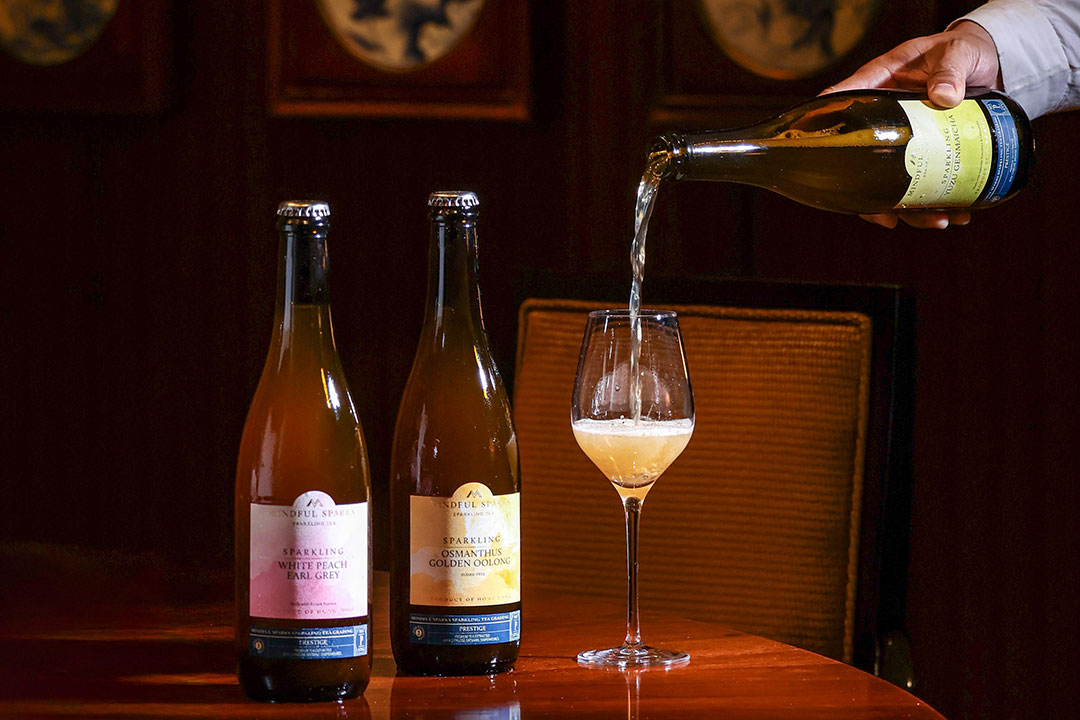
MINDFUL SPARKS’ White Peach Earl Grey, Osmanthus Golden Oolong and Yuzu Genmaicha.

DURING pairing dinners at restaurants, we’re usually given wine or some other alcohol. At a dinner on March 26 at No. 8 at Grand Hyatt Manila, we were given two novelties: one, the food was paired with tea, and two, the tea was sparkling. The evening was thus wholesome, and we were still wide awake at the end of it.

Mindful Sparks, a company from Hong Kong and the official tea partner of the Michelin Guide Hong Kong & Macau in 2024, recently partnered up with the hotel.

The dinner tea pairing was a little bit ad hoc, and our host just ordered off the menu — perhaps the better to enjoy the tea in a more natural setting. Three teas, packaged and poured like champagne, were offered to us: Yuzu Genmaicha, Osmanthus Golden Oolong, and White Peach Earl Grey. We noticed at first sniff that the Yuzu Genmaicha was very fragrant and had a rich, hay-like scent. The Oolong Osmanthus was richly fragrant with floral notes, and we thought it would be our favorite, but we noted that it had a flat taste that would benefit from some sugar (or maybe that was just us). The White Peach Earl Grey tea by itself was very elegant and had a well-balanced and complex taste.

Now on to the dinner: we started out with a West Lake Minced Beef Soup with coriander, tofu, and egg whites. We paired that with the Yuzu (we paired with intuition; the dinner had no rules), and we found the soup filling and warming, with a nice, gentle umami note. This umami note was tempered by the yuzu tea, preventing it from becoming too rich.

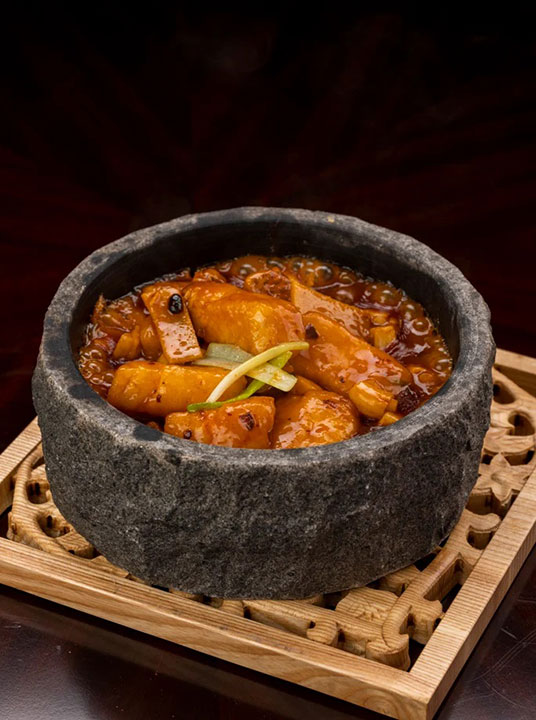
A dish of Spicy Poached Clams was next, which we were sure would benefit what we thought was the blank canvas of the oolong. We were wrong, and gladly so: the oolong gave a little sparkle to the otherwise flavor-packed clams. This was followed by Braised Chilean Sea Bass with ginger, garlic, and black bean. The dish, served sizzling in a rock bowl, combined light flesh with a rich sauce. Paired with the oolong, it brought out the more oceanic flavors of the dish, but playing around by pairing it with the yuzu, we noticed it brought out the fish’s sweetness and delicacy.

Next came a Barbeque Combination Platter with roast duck, air-dried beef, jellyfish, and char siu. With the oolong tea, it gave a canvas for the zing of the jellyfish to come out. The white peach tea, meanwhile, tempered the rather strong flavors of the air-dried beef. The yuzu added sweetness and juiciness to the pork char siu, while the oolong provided further complexity and fragrance to the duck.

We paired a dish of Scallops and Broccoli with the yuzu tea, and the pairing gave some zest to the sweet flesh of the scallops.

We ended the meal with a Peking Duck with all the works: we were surprised at the quality this restaurant could offer, jaded as we were with the multiple ducks to be found in the city. Theirs had a very thin, almost airy skin with a noisy crack: almost as if its fat was bubbling just under the surface, waiting for one’s bite. We didn’t have a hard time pairing this duck with anything: it was perfect by itself and went with everything.

Lucy Chen, restaurant manager at No. 8 China House, said that they started this promotion with sparkling teas because it reminded them of the trendy drink Kombucha (also a bubbly tea drink). “We sense that if we added different scents of tea, and different flavors, that can enhance the tea taste,” said Ms. Chen. “Chinese cuisine sometimes, we think that it’s a little bit greasy, and a little bit heavy,” she said. “With this refreshing and bubbly tea, it will enhance the whole dining experience.”

No. 8 China House doesn’t quite have the buzz we think it deserves (we suppose it’s because of its location, tucked away in the hotel; and the fierce competition from more established names). Ms. Chen, just starting her term last month, is making a few changes. They’re coming up with single, signature-dish set menus to cater to solo diners. “For Chinese cuisine, usually, the ordinary thinking is that it’s for family dinners, or it’s all family-style,” she said.

She’s also planning to push the restaurant to the Filipino Chinese and the Chinese community in the Philippines, and said they’d “Bring out the authentic Chinese cuisine to the Filipino.” She added, “Taste the authentic Chinese cuisine, without going to China. You can taste the real taste outside China.”

The tea collection is available at No. 8 China House (at the 5th floor, Grand Hyatt Manila) for lunch and dinner, served by the glass or bottle alongside free-flowing dim sum for lunch from Mondays to Saturdays, as well as curated tasting menus and à la carte selections offered for lunch and dinner daily. — Joseph L. Garcia

SM Prime expands arena business amid strong demand for live events

IN 2025, the SM MOA Arena hosted more than 200 shows and welcomed over 1.1 million attendees, reflecting steady demand from both international and domestic organizers. — SM PRIME HOLDINGS, INC.

SM PRIME Holdings, Inc. is expanding its arena business with the planned opening of the SM Seaside Cebu Arena in the second quarter of 2026, as demand for large-scale live events continues to grow.

The company said its SM Mall of Asia (MOA) Arena hosted more than 200 events in 2025, drawing over 1.1 million attendees, up 10% from the previous year, reflecting sustained demand from both international and domestic promoters.

“These events reflect the strength of demand for large-scale, professionally managed venues in the Philippines,” SM Prime President Jeffrey C. Lim said in a statement on Wednesday.

Since opening in 2012, the 15,000-seat MOA Arena has staged more than 2,400 shows, including global concert tours, major sporting events, and international pageants, the company said.

SM Prime said it continues to invest in upgrades to maintain competitiveness.

In 2025, the venue completed a $2.1-million installation of a new center-hung LED system to enhance production capabilities and viewing experience, it said.

The upcoming SM Seaside Cebu Arena, located within the SM Seaside City Cebu complex, is expected to expand access to large-scale entertainment in the Visayas and support tourism and regional economic activity, according to the company.

Beyond its flagship arena, SM Prime supports live events through medium-format and outdoor venues across its portfolio, with a combined capacity of about 110,000.

These include the SMDC Festival Grounds, SM Mall of Asia Concert Grounds, and SM Cebu Concert Grounds, which host concerts and large gatherings.

On Wednesday, Shares in SM Prime closed unchanged at P20.00 — Juliana Chloe A. Gonzales

How Spain’s Priorat DOC Classification copies French Burgundy

UNDER the new Priorat classification system, the Coma Blanca (right) is classified as equivalent to Burgundy’s Premier Cru. — SHERWIN A. LAO

WHEN I attended my first Barcelona Wine Week last February, now considered Spain’s most important wine fair, I got my chance to connect with the newer developments happening with the Spanish wine regions. In a previous column, I wrote about the latest Cava quality classification. Now there is another region making headway too — the Priorat DOQ, one of only two DOCs/DOQs (Denominación de Origen Calificada, or Denominación de Origen Qualificada) in Spain — and one of my personal favorites.

In one of my meetings at the Barcelona Wine Week, I found myself presented with two bottles of white wine from Mas d’en Gil: the Coma Calcari 2023 and Coma Blanca 2020, with the former being a “Vi de Vila” and the latter wine proudly bearing the seal of “Vi de Finca Qualificada” or “Vinya Classificada.” For me, this was more than just a tasting moment, it was a glimpse into how Priorat is reshaping its identity through terroir.

I also had a brief chat with Marta Rovira, the current family-member managing director of the Finca Mas dén Gil, founded in the 19th century.

Ms. Rovira proudly mentioned the exciting new terroir-driven classification happening within the Priorat wine region. She also said that two of her wines, Coma Blanca (a white) and Clos Fonta (red) made the prestigious list of Vinya Classificada, an equivalent of the Premier Cru of Burgundy.

The two white wines I tasted showed their characteristics, precision and elegance, embodying what this new classification system is trying to redefine. With this, I decided to feature the new Priorat quality system in this column, that is very much inspired and patterned after the French Burgundy classification.

PRINCIPLE BEHIND THE NEW CLASSIFICATION
The new Priorat DOQ classification, called Els Noms de la Terra (The Names of the Land), is probably the most ambitious classification undertaken by any Consejo Regulator (Regulatory Council) of a Spanish wine region. This new principle reinforces the Burgundy-inspired model, as opposed to the traditional classification of other wine regions which are based mostly on oak-aging terms like Crianza, Reserva, and Gran Reserva. The new classification goes by terroir and even exceeded Rioja’s new village and single-vineyard additions in their labels.

The Priorat DOQ regulatory council identified 12 villages, 459 sites, and 2,000+ vineyards in this wine region. In comparison, Burgundy has 44 villages. Just like in Burgundy, there is special individuality and unique terroir to the vineyards on these sites. The Priorat DOQ has developed a traceability process which guarantees the origin, the provenance of the grapes used for the wines, and the age of the vineyards. The new classification was first introduced in 2019.

The new Five-Tiered Classification (including varietal blends for reds and vineyard age requirement) are:

• Priorat DOQ (Regional wines) — grapes from across the appellation; no grape varietal blend rule, no vineyard age rule

• Vi de Vila (Village wines) — introduced in 2007 and tied to one of 12 villages; 60% minimum of Grenache and/or Cariñena grapes; 90% of vineyards must be at least 10 years old, and the remaining 10% must be at least five years old

• Vi de Paratge (Single-site wines) — since 2017, focused on specific locality; 60% minimum of Grenache and/or Cariñena; 90% of the vineyards must be at least 15 years old, the remaining 10% must be at least five years old

• Vinya Classificada (Premier cru) — single vineyards of recognized quality; 60% minimum of Grenache and/or Cariñena; 80% of the vineyards must be at least 20 years old, the remaining 20% must be at least five years old

• Gran Vinya Classificada (Grand cru) — the pinnacle, reserved for historic, exceptional plots; 60% minimum of Grenache and/or Cariñena; 80% of the vineyards must be at least 35 years old, the remaining 20% must be at least 10 years old

Right now, only three wineries are allowed to use the term Gran Vinya Classificada, namely: Mas de la Rosa by Vall Llach, 1902 Tossal d’en Bou by Mas Doix, and L’Ermita by the region’s most renowned figure, Alvaro Palacios. Burgundy on the other hand, has 33 Grand Cru wines.

ADOPTION
Not all Priorat bodegas use this classification system. The Priorat DOQ classification is still in its adoption phase with only 44% or 51 of Priorat’s 116 bodegas buying in. Yet the presence of giants like Clos Mogador, Scala Dei, Mas Martinet, and  Álvaro Palacios ensures immediate credibility.

This isn’t as polarizing as what happened with Cava DO and the spinoff Corpinnat group as covered in my previous column on Cava.

The leadership of the Priorat DOQ signals that this is not an experiment but a terroir revolution. The challenge lies in educating consumers: while Burgundy drinkers are accustomed to parsing village and cru distinctions, Spanish wine lovers may find the new categories daunting initially.

Still, the payoff is clear — greater transparency, traceability, authenticity, and a premium positioning on the global stage.

THE CHIEF ARCHITECT
No discussion of Priorat’s new classification would be complete without mentioning Alvaro Palacios, the region’s most renowned winemaker and a driving force behind Els noms de la terra. Palacios, whose legendary wine L’Ermita is the most expensive and iconic from Priorat, has long championed the idea that the land itself should define prestige. As a member of the Regulatory Council’s board of directors, he played a pivotal role in shaping the framework that now governs the region’s terroir hierarchy.

His influence is twofold: on one hand, he provides global credibility, ensuring that Priorat’s terroir-first model is taken seriously beyond Spain. And on the other hand, his leadership inspires smaller producers to embrace the system, proving that even the most celebrated estates are willing to submit to rigorous traceability and vineyard classification. Palacios’s L’Ermita was the first wine to qualify as Gran Vinya Classificada, cementing his role as both pioneer and standard-bearer for the movement.

Together with estates like Mas d’en Gil, Palacios demonstrates that Priorat’s future lies in specific terroir recognition. Their participation signals that this is not just a bureaucratic exercise, but a cultural shift, one that elevates Priorat to Burgundy’s level of vineyard-driven prestige while carving out its own proud Catalan identity.

IN CONCLUSION
Priorat’s embrace of Els noms de la terra is more than imitation; it is an adaptation. By borrowing Burgundy’s terroir-first hierarchy and tailoring it to Catalonia’s rugged llicorella soils, Priorat has positioned itself as Spain’s most authentic voice of terroir authenticity. With 51 estates leading the charge, the Priorat DOQ proves that Spanish wine can move beyond oak-aging traditions and into a future where the land and site itself dictate prestige.

The question now is whether Priorat’s daring classification change will remain a singular revolution or become the blueprint for Spain’s next great wine story.


Sherwin A. Lao is the first Filipino wine writer member of both the Bordeaux-based Federation Internationale des Journalists et Ecrivains du Vin et des Spiritueux (FIJEV) and the UK-based Circle of Wine Writers (CWW). For comments, inquiries, wine event coverage, wine consultancy and other wine related concerns, e-mail the author at wineprotege@gmail.com, or check his wine training website https://thewinetrainingcamp.wordpress.com/services/. Also check out his YouTube channel www.youtube.com/@winecrazy.


Top Line taps Uncle John’s as anchor tenant to boost non-fuel revenues

PHILIPPINE STAR/EHDA M. DAGOOC

TOP LINE Business Development Corp. (TOP), operator of Light Fuels service stations, has partnered with Robinsons Retail Holdings, Inc. (RRHI) to make Uncle John’s its anchor tenant across all Tier 1 Light Fuels stations.

Under the partnership, Uncle John’s stores will be integrated into TOP’s full-service Tier 1 Light Fuels stations, which are designed with dedicated commercial spaces for convenience stores, food operators, and other retail tenants.

“Having Uncle John’s as our anchor tenant strengthens customer traffic across our stations while allowing us to diversify revenue through nonfuel sales and leasing income. This supports our strategy of building service-oriented stations that generate multiple income streams,” TOP Chairman, President, and CEO Eugene Erik C. Lapasaran Lim said in a statement on Wednesday.

For Robinsons Retail, the partnership supports Uncle John’s expansion into high-traffic corridors and community hubs, particularly in provincial areas, allowing the brand to bring its ready-to-eat meals and everyday essentials closer to more consumers. “Many of our stations are located in underserved areas in the provinces. Through this collaboration, we are making everyday essentials, both fuel and convenience retail, more accessible to consumers across Visayas,” Mr. Lim said.

Tier 1 Light Fuels stations are positioned along key transport routes and high-traffic areas, enabling both fuel and nonfuel businesses to benefit from steady customer flow. Uncle John’s outlets will be rolled out alongside the opening of new stations.

“The opening of Uncle John’s outlets would depend on the opening of our stations as well. Currently, the stations under construction are in various stages of development and so we cannot provide the exact number of Uncle John’s outlets as well,” Mr. Lim said.

TOP currently operates 18 service stations, with 32 more undergoing construction or renovation. These are expected to be completed in phases by the end of 2026.

Top Line is a Cebu-based firm engaged in commercial fuel trading, depot operations, and retail fuel in the Visayas. It has two subsidiaries: Topline Logistics and Development Corp. and Light Fuels Corp.

Shares in the company rose by 1.42% or 2 centavos to close at P1.43 each. — Juliana Chloe A. Gonzales

It’s not quite sushi, but it sure looks like it

Wooshi opens in Manila

ON THE HEELS of its first restaurants Hey Bo and SaladStop, the SaladStop! Group has opened a third brand, Wooshi.

The first branch opened at Central Square in BGC, sharing space with the SaladStop! Branch there. Rooted in maki rolls and rice bowls, Wooshi presents a modern approach to Japanese-inspired comfort food.

“The tagline is ‘Sushi set free’,” said Adrien Desbaillets, SaladStop! Group chief executive officer. “Hopefully nobody thinks of it as traditional sushi. It’s not, at all. If we were to present this to a Japanese chef, it would probably be quite insulting,” he said with self-deprecation during a group interview at the April 7 opening.

Not bring traditional doesn’t automatically mean a decrease in taste: he’s particularly proud of their Philippine-exclusive Pork N’ Rolls which presents the classic adobo with a twist of flavors of mango strips, white radish pickles, and cilantro mayo topped with chicharon (pork crackling).

We tried other rolls: the Tuna Turner with yuzu shoyu chili crab sauce, and nuts; the vegan Big Bang Tofu with tempura enoki, and toasted almonds; and the Cali Crush, modeled after the California Maki, with crab sticks, avocado, roe and wasabi mayo.

Some of the options use heirloom rice (Mr. Desbaillets says that they work with Filipino farmers).

We will say that the dishes have that clean flavor characteristic of health food options (the very backbone of SaladStop!). We will also say that we dislike the sachet format in which they serve their condiments of soy sauce and wasabi (but then, that might have been a first day thing) due to the potential mess.

“It’s the last piece of the puzzle,” he said about opening Wooshi in the Philippines after their other two concepts. He says that it can be built next to one of the existing concepts: “It’s a little bit more versatile.

“It’s a little bit more of a to-go brand,” he said about this place offering rice rolls and bowls. “I think with Hey Bo and SaladStop!, sometimes you need to sit down.

“I think being rice-based as well, I think, can go a bit further in terms of local adaptation,” he added.

MIDDLE EAST EXPANSION ON HOLD
He did go into the current conflict in the Middle East and how it is affecting their plans as a Singapore-based group. “We were actually going to expand heavily into the Middle East. So that’s on pause,” saying that they were supposed to open a SaladStop! in Dubai this month.

“Unfortunately, we’re seeing it impact our food cost. That’s now going to be (affected by) transportation within each market. What is it going to do to consumer confidence as well?,” he said.

“We are still in a price point that most people will still be okay with” — prices for the rolls start at about P250 and up — “but still.”

But in the Philippines, they’re planning to fully launch their catering arm. “Once you have the three brands, it’s naturally quite easy for us to host an event.”

On another note, Joan Aquino, GoodEats by SSI General Manager (who brought the brand here) says that they’re expanding their SaladStop! Group franchises within Luzon, particularly in Pampanga and Santa Rosa, Laguna, especially with the opening of the SM mall in Nuvali by the end of the year. They also plan to open the Philippine franchise of UK-based bakery Bread Ahead (with an adjoining baking school) by the year’s third quarter. — Joseph L. Garcia

Term deposit yield declines on strong demand, lower oil prices

BW FILE PHOTO

THE CENTRAL BANK’S term deposits fetched a slightly lower average yield on Wednesday as the offer drew strong demand and with global oil prices easing.

The Bangko Sentral ng Pilipinas’ (BSP) seven-day term deposit facility (TDF) attracted P159.177 billion in tenders, more than double the P70-billion plan and above the P121.664 billion in bids for a P60-billion offer last week.

This translated to a bid-to-cover ratio of 2.274 times, higher than the 2.0277 ratio recorded a week ago.

With this, the BSP fully awarded its offering as the average yield eased.

Accepted yields for the one-week papers narrowed to the 4% to 4.215% range from the 4% to 4.2238% margin in the previous auction. This resulted in a weighted average accepted rate of 4.1964%, 1.18 basis points below the 4.2082% recorded the week prior.

“The seven-day BSP TDF average auction yield was again marginally lower… amid excess liquidity in the local financial system amid the matured P282 billion in five-year Treasury bonds a week ago, as manifested by the relatively larger total bids,” Rizal Commercial Banking Corp. Chief Economist Michael L. Ricafort said in a Viber message.

He added that lower global crude oil prices amid the two-week ceasefire between the United States and Iran also brought yields down.

Oil prices fell for a second day on Wednesday on expectations peace talks between the US and Iran may resume and eventually release supply from the key Middle East producing region trapped by the closure of the Strait of Hormuz, Reuters reported.

Brent crude futures fell 52 cents or 0.55% to $94.27 a barrel at 0054 GMT after falling 4.6% in the previous session. US West Texas Intermediate crude was down $1.04 or 1.1% to $90.24 after dropping 7.9% the session before.

Talks to end the war between the US and Israel and Iran could resume in Pakistan over the next two days, US President Donald J. Trump said on Tuesday, after the collapse of negotiations over the weekend prompted Washington to impose a blockade on Iranian ports. This has increased optimism talks could eventually settle the conflict and open up crude oil and fuel flows.

The war has shut the Strait of Hormuz, a key waterway for crude and refined product flows out of the Gulf to global buyers, particularly in Asia and Europe.

The market stands to lose some access to further supply after two US administration officials told Reuters on Tuesday the US will not renew a 30-day waiver of sanctions on Iranian oil at sea that expires this week, and quietly let a similar waiver on sanctions on Russian oil expire over the weekend.

The central bank uses the TDF and BSP bills to mop up excess liquidity in the financial system and better guide market rates towards the policy rate.

The BSP last auctioned off both the seven-day and 14-day deposits on Oct. 29. It has not offered 28-day term deposits for over five years to give way to its weekly offerings of securities with the same tenor.

In its latest Monetary Policy Report, the central bank said it limited its TDF offerings to a single tenor to rationalize its liquidity operations and focus on tenors that would boost monetary policy transmission. As of mid-February, the BSP’s market operations have absorbed P1.2 trillion in excess liquidity from the market, with 9% of this being siphoned off via the TDF. — Aaron Michael C. Sy with Reuters

Dining In/Out (04/16/26)


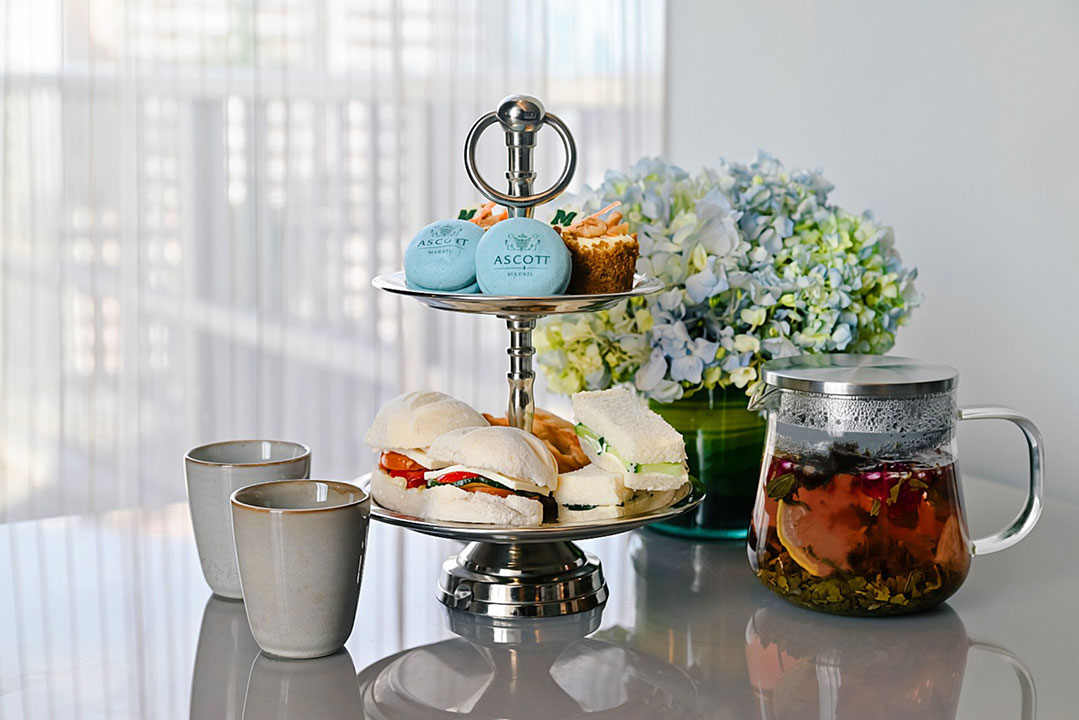
Tea at Ascott Makati

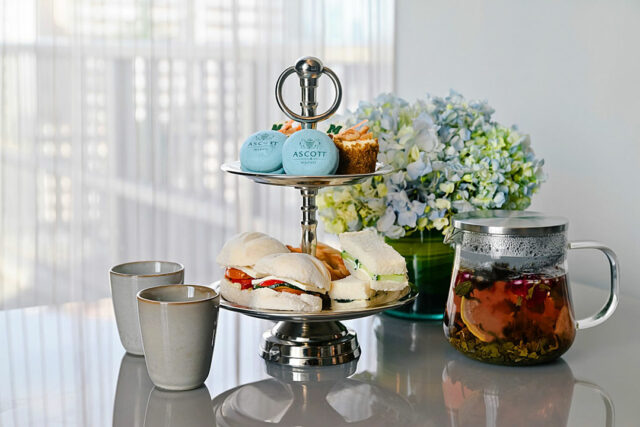
ASCOTT MAKATI ushers in a new season with the latest edition of its Ascott Soirée — Ascott’s global brand campaign that brings together experiences showcasing diverse expressions of fine living. Headlining the campaign is a collaboration between Ascott Makati and Mesclun Restaurant + Café, for an Ascott Afternoon Tea. Guests can try an elegant selection of Mesclun’s most-loved delicacies and new creations, crafted by chef Katrina Kuhn-Alcantara. This includes Mushroom and Spinach Empanaditas, Grilled Vegetable Sourdough, Cucumber Tea Sandwiches, Bonbons, and Carrot Cake. Complementing the menu are custom-blended teas developed in collaboration with Apothecary owner and herbalist Rene McHugh-Rodrigo. Diners can choose between two tea blends: the Glow Citrus & Mint Blend, which is an infusion of lemon, globe amaranth, and peppermint, and the Warm Cinnamon & Spice Blend which combines ginger, cinnamon, and white fennel. The Ascott Signature Afternoon Tea is now available for P1,495 net and is good for two persons. Ascott Makati’s Afternoon Tea is available at Mesclun Restaurant + Café until June 30, from noon onwards.


Lunch at Las Flores

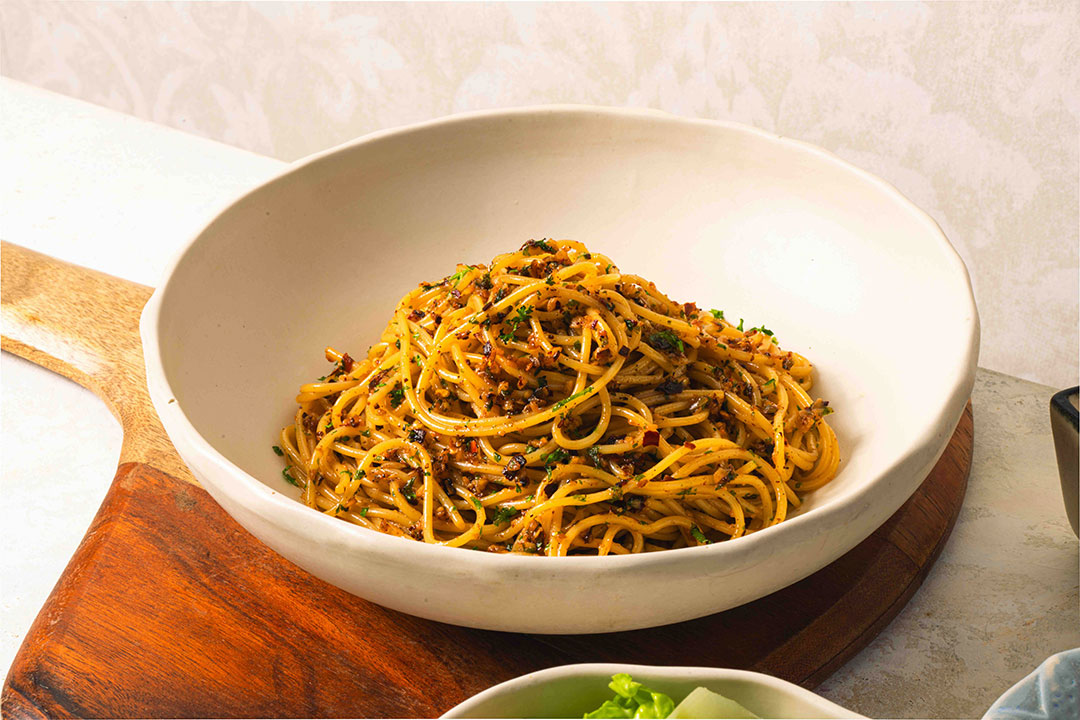
ELEGANCE meets casual Spanish dining as Las Flores introduces its newest offering, the “Let’s Do Lunch” set menu. Available daily from 11 a.m. to 3 p.m., the lunch set pairs the diner’s choice of appetizer with a hearty entrée, complemented by a glass of calamansi iced tea — all for P795. The menu was developed by Executive Chef Pablo Ramirez, together with R&D Chef Ana Aguilar and brand ambassador Marta Baños.  Guests may begin their meal with one of the following appetizers: Salmon Tartare, Beef Carpaccio, Sopas de Verduras (vegetable soup), Green Salad, and Caesar Salad. For entrees, they can choose from Pork & Chicken Paella Canelones, Grilled Salmon Porchetta, and Aglio Olio Pasta. The “Let’s Do Lunch” set is perfect for business meetings, relaxed catch-ups, or a quiet solo break. The offer is available at the following Las Flores branches: BGC, Conrad, Greenbelt, Hann, Okada, and Uptown Ritz. For reservations, visit www.bistro.com.ph or contact 0919-059-0260.


Breakfast at Pancake House

THIS SEASON, Pancake House is leaning into comfort with the launch of the Full House Breakfast, focusing on the “greatest hits” of the morning table — Classic Pancake & Waffle Duo, three crispy bacon strips, three Country sausages or two pieces of sweet ham, two eggs, and grilled tomato — for P499. The all-day offering includes a choice of coffee or tea (hot tea or iced tea) for dine-in, while for takeout it includes a choice of coffee or tea, bottled water, or Minute Maid Orange Juice. Curbside Pick-up & Delivery comes with a choice of bottled water or Minute Maid Orange Juice. Customers can upgrade their meal with Coco Fruit Coolers, a refreshment made with real coconut water and tropical fruit bits for an additional P109. Available from April 1 to June 30 across all Pancake House stores.


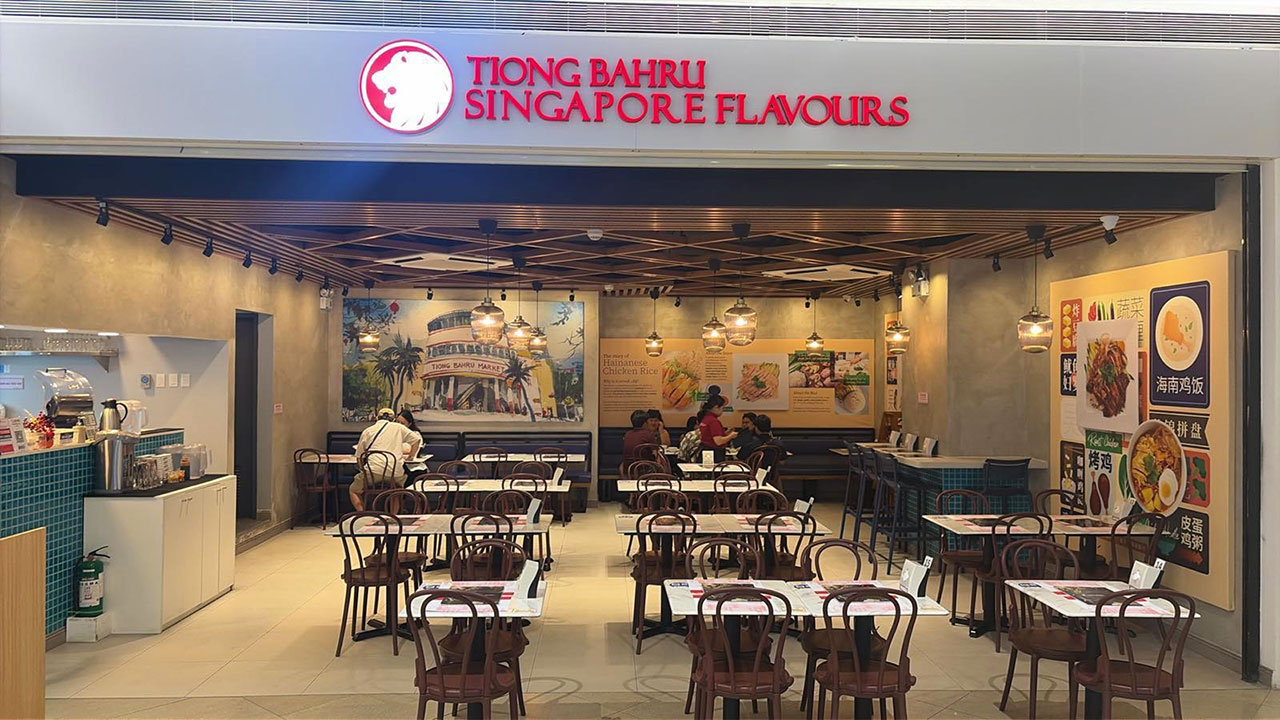
A taste of Tiong Bahru Singapore Flavours

SINCE 2019, Tiong Bahru in the Philippines has been synonymous with the diverse flavors of Singapore. Now, the restaurant chain’s growth continues under the name Tiong Bahru Singapore Flavours. With their menu of timeless classics, the restaurant is the go-to place for authentic Singaporean dishes, like the popular Hainan chicken, anywhere in the Philippines. Now, Tiong Bahru Singapore Flavours, which seeks to capture the sense of cultural diversity that makes Singaporean cuisine so unique, has an expanded menu that includes dishes such as bak kut teh, a pork rib bone broth with slices of pork; laksa, whose deep red broth and textured noodles are a balance of spices.

Globe cable deal seen supporting cloud, data center growth — BMI

BW FILE PHOTO

GLOBE Telecom, Inc.’s participation in the Candle Cable System consortium is expected to support the Philippines’ cloud and data center sector and attract further investment in subsea cable infrastructure, Fitch Solutions unit BMI said.

“Globe Telecom’s participation in the Candle Cable system will significantly boost the Philippines’ international connectivity, supporting regional ambitions for digital hub status through enhanced digital infrastructure resilience and high-speed, low latency networks across the Asia-Pacific region,” BMI said in a report dated April 14.

Globe earlier said it had joined the Candle Cable system consortium to strengthen the country’s digital backbone by linking it to submarine cable networks across Asia.

The Candle Cable system is an 8,000-kilometer subsea network connecting Japan, Taiwan, Indonesia, Malaysia, Singapore, and the Philippines. It has 24 fiber pairs and a total capacity of 570 terabits per second.

The consortium includes Meta, Japan’s SoftBank Corp., IPS, Inc., NEC Corp., Telekom Malaysia Bhd., and Indonesia’s PT XLSmart Telecom Sejahtera Tbk.

BMI said the Candle Cable system and other subsea cable investments could enhance the country’s digital backbone by supporting higher international data traffic driven by artificial intelligence, cloud computing, and 5G adoption.

“Robust growth in the Philippines’ cloud and data center markets, combined with government-backed digital transformation initiatives, positions the country as an emerging digital hub amid rising technology demand,” it said.

BMI added that Globe’s participation could help strengthen international connectivity and support the country’s ambitions to become a regional digital hub through improved infrastructure.

Globe is participating in the consortium as both an investor and a landing party. The cable is planned to land at its Nasugbu station in Batangas, complementing another Philippine landing point in Baler.

The system is expected to begin operations by 2028, Globe said, adding that it is among the higher-capacity cable systems in the region.

The 24-fiber-pair configuration is designed to support higher capacity and lower latency, which could help enable cloud computing, artificial intelligence applications, and enterprise digitalization.

Separately, CreditSights said it is maintaining its market perform recommendation on Globe in relation to its tender offer for $600 million in perpetual securities.

“We advise investors to participate, and view the tender as an opportunity for investors to reinvest the funds into similar-yielding,” it said, adding that it expects limited non-call risks for the perpetual securities.

On Tuesday, Globe launched a tender offer for its outstanding 4.2% senior perpetual capital securities issued in 2021 as part of its liability management program.

The company offered to purchase any and all outstanding securities at $1,000 per $1,000 principal amount, with Morgan Stanley acting as dealer manager.

Shares in Globe Telecom rose by P12 or 0.73% to close at P1,645 each on Wednesday. — Ashley Erika O. Jose

BSP approves relief measures for banks, borrowers amid war shock

BW FILE PHOTO

THE BANGKO SENTRAL ng Pilipinas (BSP) has approved relief measures to help give both banks and borrowers financial flexibility and support continued lending activity in the face of rising costs due to the impact of the Middle East war.

Financial institutions are allowed to grant affected borrowers temporary grace periods of up to six months for loan payments, according to the relief measures approved under Monetary Board Resolution No. 296 dated April 8. They can also defer agricultural loan payments for up to a year, the BSP said.

Loans to affected borrowers may also be temporarily excluded from banks’ past due and nonperforming loan classifications for up to one year.

This comes as Executive Order No. 110 dated March 24 placed the Philippines under a state of national energy emergency for a year due to the Middle East conflict’s impact on fuel supply. Financial institution’s can avail of the relief measures during the duration of the national emergency.

“The crisis resulted in, among others, rising oil prices and disruptions in energy supply. In this context, the Bangko Sentral ng Pilipinas is extending appropriate regulatory relief to support banks and their clients in sustaining economic activity during the period of the energy emergency,” BSP Governor Eli M. Remolona, Jr. said in a memorandum.

“BSFIs (BSP-supervised financial institutions) are expected to exercise prudent judgment in determining the appropriateness of the regulatory relief measures that will be availed. This includes ensuring that applicable relief is extended only where there is evidence of financial pressure or deterioration in the borrower’s repayment capacity attributable to the energy emergency, based on a reasonable and adequately supported assessment,” Mr. Remolona said.

“BSFIs are also expected to ensure that the application of regulatory relief shall remain targeted, proportionate, and consistent with safe and sound banking practices.”

Meanwhile, the BSP also wants banks to do “standardized restructuring” for low-income borrowers, Mr. Remolona told BusinessWorld on the sidelines of the International Monetary Fund-World Bank Spring Meetings in Washington, D.C.

“For those who cannot pay, there shouldn’t be lengthy negotiations with the borrowers. There’s going to be one kind of restructuring. We’re also asking banks to continue to lend to the low-income borrowers,” the BSP chief said.

BSP Deputy Governor Zeno Ronald R. Abenoja said in the same interview that they will implement measures regarding banks’ government securities holdings amid the market volatility caused by the war.

Meanwhile, the central bank is also urging financial institutions to help consumers and businesses by temporarily suspending fees and charges on online banking platforms or e-money services, including InstaPay and PESONet transfers.

“Lower-cost digital transactions may help consumers and businesses by reducing the need for transportation to banks and e-money service providers,” the BSP said. — Bettina V. Roc with a report from Katherine K. Chan

ADVERTISEMENT
ADVERTISEMENT