Home Blog Page 943

Djokovic sets up Sinner showdown; Swiatek secures first Wimbledon semifinal

LONDON — Novak Djokovic’s pursuit of yet more career milestones continued unabated as he reached a record 14th Wimbledon semifinal and a showdown with world number one Jannik Sinner on Wednesday.

The 38-year-old Serb recovered from a set down to beat Flavio Cobolli 6-7(6), 6-2, 7-5, 6-4 and is now only two victories away from an unprecedented 25th Grand Slam title.

Blocking his path next is a rather more formidable Italian in the form of Sinner who eased any worries about an elbow injury to beat American powerhouse Ben Shelton 7-6(2), 6-4, 6-4.

In the women’s quarterfinals, Poland’s claycourt specialist Iga Swiatek broke new ground by reaching her first Wimbledon semifinal, beating Liudmila Samsonova 6-2, 7-5.

The eighth seed will face Switzerland’s unseeded Belinda Bencic who edged out Russian teenager Mirra Andreeva 7-6(3), 7-6(2) to also reach her first semifinal at the grasscourt slam.

By reaching a record-extending 52nd Grand Slam semi, Djokovic also kept alive his hopes of equalling Roger Federer’s men’s record eight Wimbledon singles titles.

It remains a tall order even for a player widely regarded as the greatest of all time, especially with top seed Sinner and Spain’s holder Carlos Alcaraz, the two new powers in men’s tennis, most people’s bet to contest the final on July 13.

But no one should be writing off Djokovic who has won 44 of his last 46 matches at the All England Club and seems to know every single blade of grass on the historic Centre Court.

“It means the world to me that at 38 I am able to play in the final stages of Wimbledon,” Djokovic, who suffered a nasty slip on match point but appeared unscathed, said.

“Competing with youngsters makes me feel young, like Cobolli today. I enjoy running and sliding around the court. Speaking of the young guys, I will have Sinner in the next round so I look forward to that. That is going to be a great match-up.”

SINNER INJURY
Sinner may well have been back home in Italy had Bulgaria’s Grigor Dimitrov not damaged his right pectoral muscle and retired with a two-set lead in the fourth round on Monday.

The three-times Grand Slam champion also sustained an elbow injury early on in that match and there was some doubt about his physical state ahead of his clash with 10th seed Shelton.

But he produced a clinical performance, reeling off seven successive points to win the first-set tiebreak and then pouncing in the 10th game of the next two sets to match his run to the semifinal two years ago when he lost to Djokovic.

Sinner, bidding to become the first Italian to win a Wimbledon singles title, wore a protective sleeve on his right arm but was rock solid against the big-serving Shelton.

“I had quite good feelings in the warm-up today,” Sinner, who dropped only six points on his first serve, said.

“I put into my mind that I’m going to play today. So the concerns were not that big if I would play or not.

“It was just a matter of what my percentage is. Today was very high, so I’m happy.”

Swiatek appears to have finally overcome her grass court demons and the four-times French Open champion could not hide her delight at reaching the semifinal at the sixth attempt.

Former Olympic champion Bencic became the first Swiss woman to reach the semis since Martina Hingis in 1998 after stunning 18-year-old seventh seed Andreeva on Centre Court.

“It’s crazy, it’s unbelievable. It’s a dream come true,” the 28-year-old mother said. “I’m just speechless.”

Bencic will face Swiatek on Thursday after top seed Aryna Sabalenka takes on 13th-seeded American Amanda Anisimova.

The first silverware of this year’s tournament will also be decided on Thursday when Dutchman Sem Verbeek and Czech Katerina Siniakova face Britain’s Joe Salisbury and Brazil’s Luisa Stefani in the mixed doubles final on Centre Court. — Reuters

WNBA’s future

When Caitlin Clark and Napheesa Collier were named captains for the 2025 All-Star Game, it was a veritable statement of where the league stands and where it is headed. One side has the record-smashing sophomore from the Fever. The other heralds Collier, the reigning Defensive Player of the Year awardee from the Lynx. And while they may have taken two very different paths to the same stage, they are jointly determining where women’s basketball is headed.

Needless to say, Clark’s rise in the pro ranks has been nothing short of meteoric. As the league’s most popular player by far, her All-Star Game captaincy was inevitable — and validated by a precedent-setting 1.3 million votes. She has drawn capacity crowds and sparked conversations — both good and bad — far beyond the box scores. And even as she has been at the center of just about every WNBA storyline this season, she has handled the pressure — and opportunity — of superstardom with aplomb.

Meanwhile, Collier has built her legacy through quiet excellence. An Olympic gold medalist, perennial All-Star, union executive, and entrepreneur headlining Unrivaled in the offseason, she represents the WNBA’s growing professionalism and player empowerment. Certainly, her selection as skipper transcends her sterling showing on the court and highlights the respect she has earned off it. She is the voice of a generation that has pushed for bigger salaries and better benefits, not to mention a more pronounced platform.

Significantly, the differences of the leading vote getters showed up in the All-Star draft. Clark used her first pick on Fever teammate Aliyah Boston, emphasizing chemistry and loyalty. Her roster — rounded out by such notables as A’ja Wilson, Sabrina Ionescu, Satou Sabally, Kelsey Mitchell, and Gabby Williams — is young, dynamic, and built for speed and shooting. It’s a team that mirrors her style: fast-paced, flashy, and exciting.

Collier’s draft preferences told a different story. She leaned heavily on familiarity, choosing fellow Huskies alumnae Breanna Stewart and Paige Bueckers and Owls teammates Allisha Gray, Courtney Williams, and Skylar Diggins. She likewise valued experience, taking veterans Nneka Ogwumike, Alyssa Thomas, and Kelsey Plum. All told, her team reflects a commitment to continuity, culture, and leadership.

Then came the moment that made headlines: the coach swap. Evidently, Clark and Collier agreed beforehand to get Lynx tactician Cheryl Reeve and Liberty mentor Sandy Brondello to switch sides. Whether it was a subtle message or borne of playful gamesmanship, the move captured everything the All-Star Game is about — player control, public narrative, and power dynamics.

Beyond the draft board and coach drama (manufactured or otherwise), however, the All-Star Game is simply an affirmation of the WNBA’s momentum. Clark represents a new wave of attention, particularly from fans and casual observers watching the league for the first time. Meanwhile, Collier reflects its steady, if relatively quiet, growth over the last half decade. One exemplifies the spark, the other the structure.

When the game tips off in one and a half weeks at the Gainbridge Fieldhouse, it will, no doubt, be a celebration of talent. At the same time, it will underscore the league’s evolving identity. The spotlight may shine brightest on Clark, but stalwarts like Collier are the reason it burns in the first place. And, together, they’re not just All-Stars; they’re architects of the WNBA’s future.


Anthony L. Cuaycong has been writing Courtside since BusinessWorld introduced a Sports section in 1994. He is a consultant on strategic planning, operations and human resources management, corporate communications, and business development.

Netanyahu and Trump prioritize hostages as war rages in Gaza

ISRAELI PRIME MINISTER BENJAMIN NETANYAHU — REUTERS/EVELYN HOCKSTEIN

WASHINGTON/GAZA/CAIRO — Israeli Prime Minister Benjamin Netanyahu said on Wednesday his meeting with US President Donald J. Trump had focused on freeing hostages held in Gaza, as Israel continued to pound the Palestinian territory amid efforts to reach a ceasefire.

Mr. Netanyahu said on X that the leaders also discussed the consequences and possibilities of “the great victory we achieved over Iran,” following an aerial war last month in which the United States joined Israeli attacks on the Islamic Republic’s nuclear sites.

Mr. Netanyahu is making his third US visit since Mr. Trump took office on Jan. 20 and had earlier told reporters that while he did not think Israel’s campaign in the Palestinian enclave was done, negotiators are “certainly working” on a ceasefire.

Mr. Trump met Mr. Netanyahu on Tuesday for the second time in two days to discuss the situation in Gaza, with the president’s Middle East envoy indicating that Israel and Hamas were nearing an agreement on a ceasefire deal after 21 months of war.

Hamas official Taher al-Nono told Reuters they were engaged in a “difficult round” of negotiations.

A source familiar with Hamas’ thinking said four days of talks in Doha did not produce any breakthroughs on three main sticking points.

These are the free flow of aid into Gaza, withdrawal lines for Israeli forces and guarantees that negotiations would pave the way to a permanent ceasefire.

The source said Israel has demanded it retain control of about one-third of the enclave including the Morag Axis, a corridor between the Gaza cities of Rafah and Khan Younis.

On aid, Israel has insisted on sticking with the controversial US-backed Gaza Humanitarian Foundation’s system, the source added. The United Nations and humanitarian groups have criticized this as unsafe and leading to at least 613 deaths.

While the Hamas source saw three major unresolved obstacles, Steve Witkoff, Mr. Trump’s special envoy to the Middle East, said the number had decreased from four to one, expressing optimism for a temporary ceasefire deal by the end of the week.

Mr. Witkoff told reporters at a Cabinet meeting that the anticipated agreement would involve a 60-day ceasefire, with the release of 10 living and nine deceased hostages.

AIRSTRIKES
In recent weeks Israel’s military has continued to hammer Gaza, where a teddy bear lay in the rubble on Wednesday at the site of one overnight airstrike in southern Gaza’s Khan Younis.

Umm Mohammed Shaaban, a Palestinian grandmother mourning the deaths of three of her grandchildren in the attack, questioned the timing of a proposed ceasefire.

“After they finished us, they say they’ll make a truce?” she asked.

In Gaza City, people removed debris after another overnight airstrike, searching through a three-story house for survivors to no avail.

One resident, Ahmed al-Nahhal, said there was no fuel for trucks to help in rescue efforts. “From midnight till now, we have been looking for the children,” he said.

Nearby men carried bodies in shrouds while women wept. Some kissed bodies placed in the back of a vehicle.

The Gaza conflict began with a Hamas attack on southern Israel in October 2023 that killed approximately 1,200 people and saw 251 hostages taken, according to Israeli figures. Around 50 hostages remain in Gaza, with 20 believed to be alive.

Israel’s retaliatory war has killed over 57,000 Palestinians, Gaza’s health ministry says, and reduced much of Gaza to rubble.

Hamas has long demanded an end to the war before it would free the remaining hostages. Israel has insisted it would not agree to stop fighting until all hostages are released and Hamas dismantled.

The United Nations estimates that most of Gaza’s population of more than 2 million has been displaced, with experts saying in May that nearly half a million people faced the risk of starvation.

Meanwhile, the Israeli military said a missile launched from Yemen had been intercepted after air raid sirens sounded in several areas across the country.

The Iran-aligned Houthis, who control the most populous parts of Yemen, have been firing at Israel and attacking shipping lanes.

Houthis have repeatedly said that their attacks are an act of solidarity with Palestinians in Gaza, where Israel’s military assault since late 2023 has killed more than 57,000 people, Gaza authorities say.

Most of the dozens of missiles and drones they have launched have been intercepted or fallen short. Israel has carried out a series of retaliatory strikes. — Reuters

Russia’s attack on Kyiv kills two as US delivers arms to Ukraine

FIREFIGHTERS work on the roof of an apartment building damaged during Russian drone and missile strikes, amid Russia’s attack on Ukraine in Kyiv, Ukraine on July 10. — REUTERS/VALENTYN OGIRENKO

KYIV — Russian drones and missiles bore down on the Ukrainian capital of Kyiv early on Thursday, with officials reporting two deaths, 13 injured and fires in apartment and non-residential buildings as Washington resumed weapons delivery to the war-torn country.

It was also the latest in Russia’s escalating attacks with hundreds of drones and missiles straining Ukrainian air defenses at a perilous moment in the war and forcing thousands of people to frequently seek bomb shelters overnight.

“Residential buildings, vehicles, warehouse facilities, office and non-residential buildings are on fire,” head of Kyiv’s military administration, Tymur Tkachenko, said on the Telegram messaging app.

The full scale of the attack was not immediately clear. There was no comment from Moscow about the attack that came a day after Russia launched a single-night record number of drones targeting its smaller neighbor.

After US President Donald J. Trump pledged earlier this week to send more defensive weapons to Kyiv, Washington was already delivering artillery shells and mobile rocket artillery missiles to Ukraine, two US officials told Reuters on Wednesday.

Ukrainian President Volodymyr Zelensky held a “substantive” meeting on Wednesday with Mr. Trump’s Ukraine envoy, Keith Kellogg, in Rome ahead of a Ukrainian recovery conference.

Mr. Trump has been growing increasingly frustrated with President Vladimir Putin, saying that the Russian leader was throwing a lot of “bullshit” at the US efforts to end the war that Moscow launched against Ukraine in February 2022.

US Secretary of State Marco Rubio will meet with Russian Foreign Minister Sergei Lavrov on the sidelines of the ASEAN foreign ministers’ meeting in Kuala Lumpur on Thursday, the US State department and Russia’s foreign ministry said.

Russia’s attack on Kyiv on Thursday rattled the city with explosions, Reuters’ witnesses said. Videos showed windows blown out, devastated facades, and cars burned down. Kyiv’s officials said that damage was reported in six of the city’s 10 districts.

Kyiv’s Shevchenkivskyi district, known for elegant restaurants, art galleries and vibrant student bars, suffered significant damage to residential buildings, the district’s head said on Telegram.

A thick smoke covered parts of Kyiv, darkening the red hues of a sunrise over the city of three million, Reuters’ witnesses reported. Air raids in the capital lasted more than four hours, according to Ukraine’s air force data.

“After returning home from shelters, keep your windows closed — there is a lot of smoke,” Mr. Tkachenko said.

Closer to the battle zone, a Russian air strike killed three people and injured one late on Wednesday in the front-line town of Kostiantynivka in Ukraine’s east, the national emergency services said. — Reuters

South Korea ex-leader Yoon returns to jail as court grants warrant

Former South Korean President Yoon Suk Yeol arrives at a court to attend a hearing to review his arrest warrant requested by special prosecutors in Seoul, South Korea on July 9. — REUTERS/KIM HONG-JI/POOL

SEOUL — Former South Korean President Yoon Suk Yeol returned to a solitary jail cell on Thursday after a court approved a warrant sought by prosecutors investigating his attempt to impose martial law last year.

The Seoul Central District Court’s decision bolstered the special counsel’s investigation into allegations that Mr. Yoon’s move in December represented obstruction of justice and abuse of power.

The court said in a statement it granted the request because of concerns Mr. Yoon could seek to destroy evidence, returning him to confinement at the Seoul Detention Center where he spent 52 days earlier in the year before being released four months ago on technical grounds.

He moved back with his wife and his 11 dogs and cats to their 164 square meter (1,765 square feet) apartment in an upscale district of Seoul. The couple’s net worth is estimated at 7.5 billion won ($5.47 million), according to a government filing.

But Mr. Yoon will now be housed in a 10 square-meter solitary cell and sleeping on a foldable mattress on the floor without an air conditioner, an official at the detention center and media reports said.

With a heat wave gripping the country, Mr. Yoon will have to rely on a small electric fan that switches off at night, Park Jie-won, an opposition lawmaker who had been incarcerated there, said on a YouTube talk show.

The detention facility served breakfast of steamed potatoes and mini cheese bread for inmates on Thursday, another official said.

The conservative politician faces criminal charges of insurrection over his martial law decree, which could carry a sentence of life in prison or death.

YOON SKIPS COURT HEARING
Hours after he ended up in jail, the court held a hearing on Thursday morning for his insurrection trial, but Mr. Yoon did not attend.

His lawyers told the court that he was unable to go to the hearing due to health issues, the Yonhap News Agency reported.

The Constitutional Court ousted Mr. Yoon as president in April, upholding parliament’s impeachment for the martial law bid, which shocked South Koreans and triggered months of political turmoil.

The special prosecution team launched its investigation after new leader Lee Jae Myung was elected in June, and it has been looking into additional charges against Mr. Yoon.

The special counsel team is now expected to speed up its probe into allegations, including whether Mr. Yoon hurt South Korea’s interests by intentionally inflaming tensions with North Korea.

The team plans to question Mr. Yoon on Friday, informing his wife and lawyers about his detention via letters, Park Ji-young, a deputy to the special counsel, told reporters on Thursday.

Mr. Yoon attended the court hearing on Wednesday on the detention warrant, wearing a dark navy suit and a red tie, but did not answer questions from reporters.

His lawyers have denied the allegations against him and called the detention request an unreasonable move in a hasty investigation.

More than 1,000 supporters rallied near the court on Wednesday, local media reported, waving flags and signs and chanting Mr. Yoon’s name in searing 35 degrees Celsius (95 degrees Fahrenheit) heat.

In their warrant request, prosecutors said Mr. Yoon poses a flight risk, local media reported. — Reuters

Rubio makes first visit to Asia as Trump tariffs loom

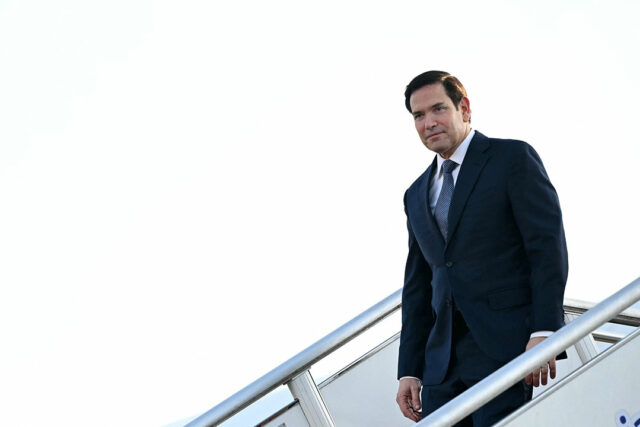
US Secretary of State Marco Rubio deplanes upon arriving at Subang Air Base, near Kuala Lumpur, Malaysia on July 10. — MANDEL NGAN/POOL VIA REUTERS

KUALA LUMPUR — US Secretary of State Marco Rubio will meet with Southeast Asian counterparts on Thursday in his first visit to Asia since taking office and will try to reassure them the region is a priority for Washington, even as President Donald J. Trump targets it in his global tariff offensive.

Washington’s top diplomat will meet foreign ministers of the 10-member Association of Southeast Asian Nations (ASEAN) gathered in Kuala Lumpur and also hold talks with Russian Foreign Minister Sergei Lavrov who is in the Malaysian capital, according to the US State department.

Rubio’s trip is part of an effort to renew US focus on the Indo-Pacific and look beyond the conflicts in the Middle East and Europe that have consumed much of the Trump administration’s attention, with Mr. Rubio balancing dual responsibilities as secretary of state and national security adviser.

However, Mr. Trump’s global tariff strategy is likely to cast a shadow over the trip, after the president announced steep tariffs to take effect on Aug. 1 on six ASEAN members, including Malaysia, as well as on close Northeast Asian allies Japan and South Korea.

Mr. Rubio will nevertheless seek to firm up US relationships with partners and allies, who have been unnerved by the tariffs, and is likely to press the case that the United States remains a better partner than China, Washington’s main strategic rival, experts said.

“This is significant, and it’s an effort to try to counter that Chinese diplomatic and economic offensive,” said Victor Cha, president of the geopolitics and foreign policy department at Washington’s Center for Strategic and International Studies.

Mr. Rubio will also meet with Mr. Lavrov later on Thursday, according to the US State department schedule. It would be the second in-person meeting between Mr. Rubio and Mr. Lavrov and comes at a time when Mr. Trump has grown increasingly frustrated with Russian President Vladimir Putin as the war in Ukraine drags on.

China’s Foreign Minister Wang Yi is also expected to join talks from Thursday, but it was unclear if Mr. Rubio would meet with him.

‘BETTER LATE THAN NEVER’
A senior US State department official told reporters on Monday that among Mr. Rubio’s priorities on the trip was reaffirming Washington’s commitment to the region, not just for its sake but because it promotes American prosperity and security.

“It’s kind of late, because we’re seven months into the administration,” Mr. Cha said of Mr. Rubio’s trip. “Usually, these happen much sooner. But then again, it is an extraordinary circumstance. But I guess better late than never.”

Security cooperation is a top priority, including the strategic South China Sea, and combating transnational crime, narcotics, scam centers, and trafficking in persons, said the State department official, speaking on the condition of anonymity.

As well as their unease about Mr. Trump’s tariff policies, many in the Indo-Pacific have doubts about the willingness of his “America First” administration to fully engage diplomatically and economically with the region.

Mr. Trump said this week he would impose a 25% tariff on Japan and South Korea and took aim at ASEAN nations, announcing a 25% levy on Malaysia, 32% on Indonesia, 36% on Cambodia and Thailand, and 40% on Laos and Myanmar.

Mr. Trump has also upset another key Indo-Pacific ally, Australia, which said on Wednesday it was “urgently seeking more detail” on his threat to raise tariffs to 200% on pharmaceutical imports.

According to a draft joint communique seen by Reuters, ASEAN foreign ministers will express “concern over rising global trade tensions and growing uncertainties in the international economic landscape, particularly the unilateral actions relating to tariffs.”

The draft, dated Monday, before the latest US tariff rates were announced, did not mention the United States and used language similar to an ASEAN leaders’ statement in May. Both said tariffs were “counterproductive and risk exacerbating global economic fragmentation.”

The State department official said Mr. Rubio would be prepared to discuss trade and reiterate that the need to rebalance US trade relationships is significant.

The export-reliant ASEAN is collectively the world’s fifth-biggest economy, with some members beneficiaries of supply chain realignments from China. Only Vietnam has secured a deal with Mr. Trump, which lowers the levy to 20% from 46% initially. — Reuters

Taiwan shows off new US tanks as annual war games intensify

A soldier salutes Taiwan president Lai Ching-te in front of US-made M1A2T Abrams tanks after taking part in live-fire exercises in Hsinchu, Taiwan on July 10. — REUTERS/ANN WANG

TAIPEI/HSINCHU — Taiwan’s army on Thursday displayed the fire power of its first US-sourced M1A2T Abrams tanks — a traditional weapon that analysts say will need to be increasingly protected against drones in any future battle given lessons from the Ukraine war.

Four Abrams tanks were shown maneuvering across a mud-choked army training ground in Hsinchu county, firing at moving and static targets, on the second day of Taiwan’s annual military exercises that are designed to test the island’s resilience in a conflict with China.

Wearing a combat helmet, President Lai Ching-te observed the firing, saying later that with “every increase in the military’s combat power, the nation and its people gain an extra layer of security.”

“Whether in terms of strike capability or mobility, it was extremely powerful — undoubtedly the strongest tank on the battlefield,” Mr. Lai said.

Senior military officials in Mr. Lai’s government say they intend the comprehensive 10-day drills to show both China and the international community, including its key weapons supplier the US, that Taiwan is determined to defend itself against any China attack or invasion.

China views the democratically governed island as its own and has intensified military pressure around Taiwan over the last five years.

Mr. Lai’s comments also come ahead of a recall parliamentary election on July 26 that could see his ruling Democratic Progressive Party (DPP) take back control of the legislature.

The tanks are among the first batch of 38 Abrams main battle tanks delivered in December, with the rest of the 108 ordered by Taiwan due to be delivered later this year and next year.

They marked Taiwan’s first new tanks for 24 years.

Analysts and regional military attaches say that while the Abrams remains a potent and highly adaptable weapon that would help Taiwan defend its cities and coasts in an invasion scenario, Taiwan will have to leverage its counter-drone technology to protect them.

Both Russian and Ukrainian tanks, including US Abrams supplied to Kyiv, have reportedly proven vulnerable to drones and advanced anti-tank weapons.

The tanks have yet to be fully commissioned, and Wednesday’s test firing was not a formal part of the drills, which are designed to replicate full battle conditions at sea, on land and in the skies, military officials said.

Singapore-based military scholar Thomas Lim said he expected Taiwan would attempt in a war scenario to cover their “prized assets” with counter drone elements or also deploy them from high positions for extra protection.

“This isn’t straightforward… but it isn’t a problem unique to Abrams,” said Lim, of Singapore’s S. Rajaratnam School of International Studies.

President Lai said that he believed that through “realistic combat training,” the M1A2T tank will “be able to integrate with drones and innovative tactics to more effectively fulfill the nation’s strategic objectives.”

China’s Defense Ministry on Tuesday said that Taiwan’s drills were “nothing but a bluff.” — Reuters

Integrating sustainability in the entire value chain

“Epson’s headquarters develops products with sustainability features such as low power consumption and paper-saving functions, says Masako Kusama, president and director of Epson Philippines Corporation.

Its manufacturing facility in Batangas, Philippines, meanwhile, operates on 100% renewable energy. The company is also on track to reducing its total emissions in line with the 1.5-degree Celsius scenario by 2030, Ms. Kusama told BusinessWorld.

In this interview, she shares how Epson embeds sustainability in its value chain. She also talks about the heightened awareness Filipino c-suite executives have in combatting climate change.

Interview by Patricia Mirasol
Video editing by Jayson Mariñas

Data, dialogue, and direction: FEU Public Policy Center joins women leaders in shaping a more inclusive future

What does it take to shape a future where leadership is equitable, inclusive, and sustainable in our social and institutional systems?

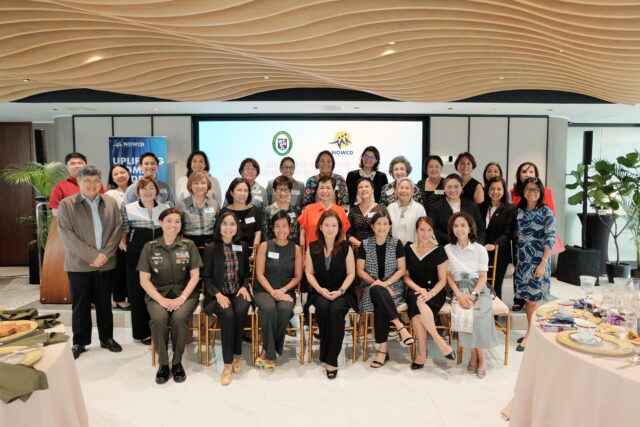
That was the central question at “Breaking Barriers: Women Leading in Business and Beyond,” a forum organized by the Nextgen Organization of Women Corporate Directors (NOWCD) on June 23 at the BPI Wealth Lounge in Makati City. The event brought together leaders from business, government, and academia to reflect on the progress of women’s leadership and the structural changes needed to support it.

At the forefront of the conversation was the Far Eastern University (FEU) Public Policy Center, whose participation affirmed the University’s long-standing commitment to research, inclusion, and future-ready leadership.

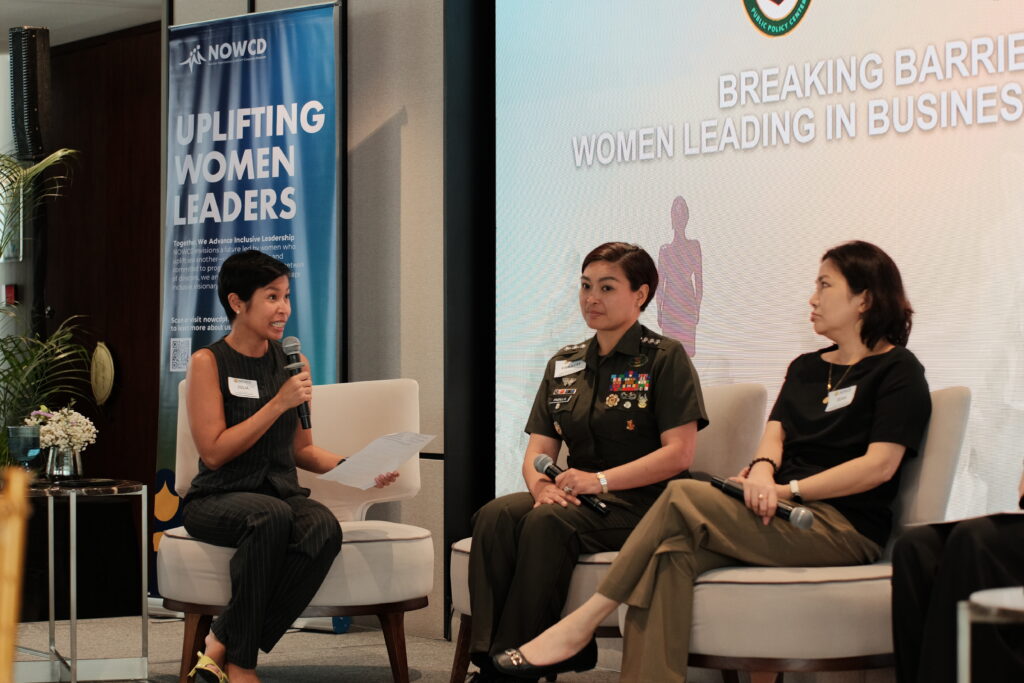
Julia Andrea Abad, executive director of the FEU Public Policy Center, moderated a dynamic panel discussion with Mariana Zobel de Ayala of Ayala Land, Robina Gokongwei-Pe of Robinsons Retail, Col. Francel Margareth Padilla of the Armed Forces of the Philippines, and Political Science Professor Dr. Jean Franco of UP Diliman. Together, they explored the lived realities of women in leadership, the role of mentorship, and how institutions can evolve to foster greater diversity at the top.
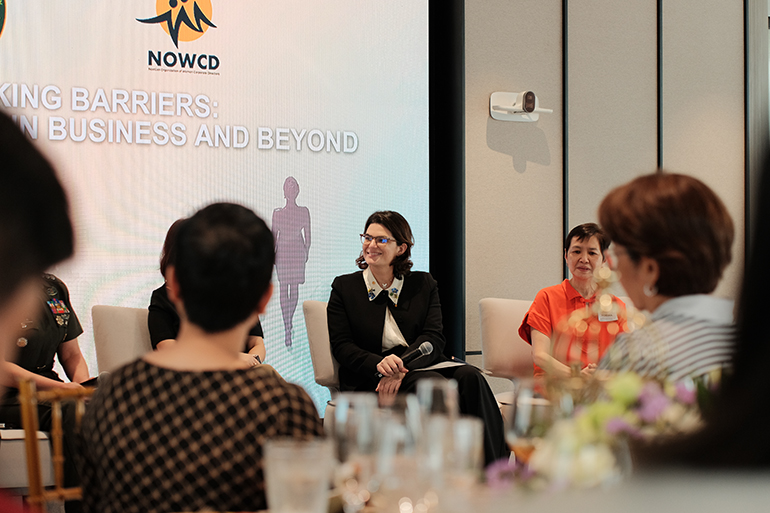
“Sustainability includes building systems that empower people equitably and evolve with the times,” Ms. Abad noted. “True progress requires dismantling the barriers that keep leadership from reflecting the diversity of our society.”

A key moment in the forum was the research presentation delivered by Patricia Thea Basilio, data analyst at the FEU Public Policy Center. Drawing from their 2024 College Experience Survey, Basilio shared findings on gender attitudes among Filipino college students. The study revealed that sexist views remain prevalent among young people, especially males, and are often linked to higher interest in leadership roles. These raise important concerns for the country’s future leadership landscape.

“We found that many of those aspiring to lead still hold beliefs that could limit the very inclusivity they are meant to champion,” Ms. Basilio said. “This calls for deeper reflection on how we cultivate both skills and values in our future leaders.”

Representing FEU’s senior leadership at the event was Gianna Montinola, consultant for external affairs, who introduced keynote speaker Mariana Zobel de Ayala. Ms. Montinola’s involvement highlighted FEU’s broader institutional advocacy for diversity, equity, and inclusion across sectors.

“Inclusive leadership doesn’t happen by accident. It requires intention, investment, and collaboration,” Ms. Montinola said. “As an academic institution, FEU takes this responsibility seriously, both in what we teach and in the research we pursue.”

Bringing the lone academic research voice to the table, FEU contributed a unique perspective that blended empirical insights with practical recommendations for cultivating inclusive leadership in a changing world. The event closed with a call to continue building networks that support women not only in reaching leadership roles, but in thriving within them.


As for the university, the work continues: generating data that matters, fostering dialogues that challenge norms, and preparing students to lead with both competence and values.


Spotlight is BusinessWorld’s sponsored section that allows advertisers to amplify their brand and connect with BusinessWorld’s audience by publishing their stories on the BusinessWorld Web site. For more information, send an email to online@bworldonline.com.

Join us on Viber at https://bit.ly/3hv6bLA to get more updates and subscribe to BusinessWorld’s titles and get exclusive content through www.bworld-x.com.

UK scheme to help exploited migrant carers is failing, charity says

STOCK PHOTO | Image by 🆓 Use at your Ease 👌🏼 from Pixabay

 – A multi-million-pound British government scheme to help exploited migrant care workers find new work has largely failed due to barriers including high visa costs, research showed on Thursday.

The research by the London-based Work Rights Center comes after the charity found last month that only 3.4% of the more than 27,000 carers who were contacted through the so-called rematching scheme had found work.

Nearly a third of carers in England – workers who support the elderly and other vulnerable people – are migrants. Many have faced abuse or exploitation since arriving to fill severe labor shortages following Britain’s exit from the EU.

Charities have called on the government to reform work visas, which are tied to employers or “sponsors”, which they say creates a power imbalance that leads to exploitation, including fraudulent fees being charged, debt bondage and modern slavery.

The government launched the 16 million pounds ($22 million) scheme last year to support migrant care workers who found themselves out of a job after sponsorship licenses were revoked from care firms amid a crackdown on exploitation. The government had no specific target set for how many workers would be helped.

The Work Rights Centre said that exploited migrant workers, often facing financial constraints, were unable to afford the high visa costs required to move into a new job through the scheme, or meet the expectation from employers that they have access to a car in order to visit private homes.

“A slim chance at obtaining a new job cannot be the only thing this government offers in compensation for the exploitation and debt victims have suffered due to ministers’ refusal to reform this flawed visa scheme,” said Work Rights Centre Policy Manager Adis Sehic.

Other barriers to finding jobs through the scheme included a lack of awareness of its existence, the inability of workers to get references from employers with revoked licenses and strict English-language requirements from employers, the charity said. – Reuters

Cyber crime and real-world crime are converging in a dangerous new way – here’s how to stay safe

STOCK PHOTO | Image from Freepik

THE CONVERSATION

Disclaimer: This asset – including all text, audio and imagery – is provided by The Conversation. Reuters Connect has not verified or endorsed the material, which is being made available to professional media customers to facilitate the free flow of global news and information.

By Jongkil Jay Jeong, Senior Fellow, School of Computing and Information System, The University of Melbourne, Ashish Nanda, Research Fellow, Deakin Cyber Research and Innovation Centre, Deakin University, and Peter Thomas, Director, Centre for Future Skills and Workforce Transformation, RMIT University


It starts with a call from someone claiming to be your bank. They know your name. They know your bank. They even know your credit card number. There’s been “unusual activity” on your account, they say – and they just sent you a one-time passcode to verify your identity so they can assist.

You read out the code and feel reassured. Moments later, your funds are gone and the bank refuses reimbursement, citing a breach of terms because you voluntarily shared your passcode.

This is not a niche or isolated scam. It’s part of a growing pattern we’re seeing across Australia and beyond: cyber criminals are merging digital and real-world tactics in ways that make these frauds more convincing, harder to stop, and far more damaging.


It starts with stolen data

These scams don’t begin with a phishing email or fake app. They begin with data – your data – stolen in one of countless breaches, such as the latest Qantas incident that exposed the details of up to 5.7 million customers.

Sometimes the personal data has been sold through third-party data brokers. Names, phone numbers, emails, even card details are routinely leaked and traded online.

Once they have this information, scammers get to work. The phone call mimics a real interaction with a bank, perhaps with a spoofed caller ID. Victims are pressured in urgent language to “verify” their identity, often by reading out a one-time passcode that, unbeknownst to them, is authorizing a transaction using their own card details.

We refer to this as a “convergence scam” – where online data leaks, psychological manipulation and weak enforcement come together. It’s a sophisticated hybrid of digital theft and physical-world exploitation, and it’s on the rise.


Devastating and personal

These scams are deeply personal and can be financially devastating. But what makes them even more alarming is the system-wide failure surrounding them.

For starters, many credit card fraud insurance policies contain clauses that exclude coverage when the customer “voluntarily” provides account credentials – including one-time passcodes – even if they did so under duress or deception.

One victim we spoke to lost nearly A$6,000 after a scammer posing as their bank prompted them to read out a passcode over the phone. The transaction was verified using that code, and the bank later refused to reimburse the loss.

In a formal response, the bank stated that by voluntarily sharing the one-time passcode, the customer had breached the e-payments code, even though they were manipulated into doing so. As a result, the customer was held liable and ineligible for a chargeback.


Law enforcement may not help

Even when the criminals leave a physical trail, follow-up is rare. Law enforcement rarely investigates. In the cases we’ve seen, reports are acknowledged but not pursued. Officers don’t explicitly say the case is too small or not worth the effort, but their inaction suggests it, especially given how resource-intensive most cyber-crime investigations tend to be.

In many instances, particularly when the total loss isn’t deemed significant, victims are simply told to follow up with their bank, based on the assumption they’ll be reimbursed.

In one case we reviewed, stolen card details were used in-store at major Australian retailers such as Woolworths and Coles – indicating that a cloned card had been physically used. These purchases could, in theory, be tracked back to in-store CCTV footage. But no investigation was launched.

This reluctance to act, even when the evidence is tangible, sends a dangerous message: that scammers can operate with near-impunity.

Meanwhile, banks and regulators are slow to update verification systems. One-time passcodes are still widely used, even though scammers now exploit them routinely. There’s little recourse for victims, and minimal accountability for data brokers whose records fuel these scams.


What can we do to protect ourselves?

For individuals, the first line of defense is simple but vital:

  • never share a one-time passcode or security code over the phone, even if the caller seems legitimate
  • if in doubt, hang up and call the bank directly using the number on your card
  • be cautious about where and how you share your personal information, especially online through websites or social media. Only disclose what personally identifiable information you have to.


The true answer is systemic change

Banks and other institutions need to put into place stronger identity verification systems that don’t rely solely on SMS codes. We need greater transparency and regulation of data brokers.

Crucially, we also need active enforcement of cyber-enabled fraud, especially when there’s physical evidence, such as in-store purchases and CCTV footage.

Banks should also reassess their policies and procedures on how they communicate with customers. If scam calls closely mimic real ones, it’s time to change the script. More proactive education, clearer warnings, and redesigned verification processes can all help prevent harm.

The real danger of these convergence scams isn’t just financial loss. It’s the erosion of trust: in our banks, in our security systems, and in the institutions meant to protect us. – Reuters


Rubio makes first visit to Asia as Trump tariffs loom

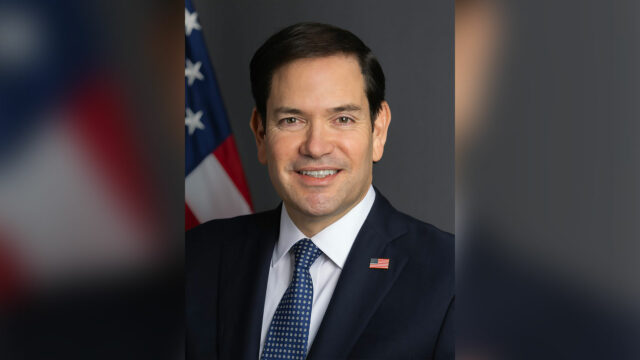
Photo By U.S. Department of State - https://www.flickr.com/photos/statephotos/54295399868/, Public Domain, https://commons.wikimedia.org/w/index.php?curid=160957686
Photo By U.S. Department of State – https://www.flickr.com/photos/statephotos/54295399868/, Public Domain, https://commons.wikimedia.org/w/index.php?curid=160957686

 – U.S. Secretary of State Marco Rubio will meet with Southeast Asian counterparts on Thursday in his first visit to Asia since taking office, and will try to reassure them the region is a priority for Washington, even as President Donald Trump targets it in his global tariff offensive.

Washington’s top diplomat will meet foreign ministers of the 10-member Association of Southeast Asian Nations gathered in Kuala Lumpur, and also hold talks with Russian Foreign Minister Sergei Lavrov who is in the Malaysian capital, according to the U.S. State Department.

Mr. Rubio’s trip is part of an effort to renew U.S. focus on the Indo-Pacific and look beyond the conflicts in the Middle East and Europe that have consumed much of the Trump administration’s attention, with Mr. Rubio balancing dual responsibilities as secretary of state and national security adviser.

However, Mr. Trump’s global tariff strategy is likely to cast a shadow over the trip, after the president announced steep tariffs to take effect on August 1 on six ASEAN members, including Malaysia, as well as on close Northeast Asian allies Japan and South Korea.

Mr. Rubio will nevertheless seek to firm up U.S. relationships with partners and allies, who have been unnerved by the tariffs, and is likely to press the case that the United States remains a better partner than China, Washington’s main strategic rival, experts said.

“This is significant, and it’s an effort to try to counter that Chinese diplomatic and economic offensive,” said Victor Cha, president of the geopolitics and foreign policy department at Washington’s Center for Strategic and International Studies.

Mr. Rubio will also meet with Mr. Lavrov later on Thursday, according to the U.S. State Department schedule. It would be the second in-person meeting between Mr. Rubio and Mr. Lavrov, and comes at a time when Mr. Trump has grown increasingly frustrated with Russian President Vladimir Putin as the war in Ukraine drags on.

China’s Foreign Minister Wang Yi is also expected to join talks from Thursday, but it was unclear if Rubio would meet with him.


‘BETTER LATE THAN NEVER’

A senior U.S. State Department official told reporters on Monday that among Mr. Rubio’s priorities on the trip was reaffirming Washington’s commitment to the region, not just for its sake but because it promotes American prosperity and security.

“It’s kind of late, because we’re seven months into the administration,” Mr. Cha said of Mr. Rubio’s trip. “Usually, these happen much sooner. But then again, it is extraordinary circumstances. But I guess better late than never.”

Security cooperation is a top priority, including the strategic South China Sea, and combating transnational crime, narcotics, scam centers, and trafficking in persons, said the State Department official, speaking on the condition of anonymity.

As well as their unease about Mr. Trump’s tariff policies, many in the Indo-Pacific have doubts about the willingness of his “America First” administration to fully engage diplomatically and economically with the region.

Mr. Trump said this week he would impose a 25% tariff on Japan and South Korea and also took aim at ASEAN nations, announcing a 25% levy on Malaysia, 32% on Indonesia, 36% on Cambodia and Thailand, and 40% on Laos and Myanmar.

Mr. Trump has also upset another key Indo-Pacific ally, Australia, which said on Wednesday it was “urgently seeking more detail” on his threat to raise tariffs to 200% on pharmaceutical imports.

According to a draft joint communique seen by Reuters, ASEAN foreign ministers will express “concern over rising global trade tensions and growing uncertainties in the international economic landscape, particularly the unilateral actions relating to tariffs.”

The draft, dated Monday, before the latest U.S. tariff rates were announced, did not mention the United States and used language similar to an ASEAN leaders’ statement in May. Both said tariffs were “counterproductive and risk exacerbating global economic fragmentation.”

The State Department official said Rubio would be prepared to discuss trade and reiterate that the need to rebalance U.S. trade relationships is significant.

The export-reliant ASEAN is collectively the world’s fifth-biggest economy, with some members beneficiaries of supply chain realignments from China. Only Vietnam has secured a deal with Mr. Trump, which lowers the levy to 20% from 46% initially. – Reuters