Home Blog Page 838

Shutdown could cost US economy $15 billion a week, Treasury says

REUTERS

Washington – The two-week-old federal government shutdown may cost the US economy as much as $15 billion a week in lost output, a Treasury official said late on Wednesday, correcting an earlier statement from Treasury Secretary Scott Bessent that put the cost at up to $15 billion per day.

Bessent used the incorrect estimate in two separate appearances earlier on Wednesday, while urging Democrats to “be heroes” and side with Republicans to end it.

A Treasury official said the cost estimate was based on a report by the White House Council of Economic Advisers.

Bessent told a news conference that the shutdown was starting to “cut into muscle” of the US economy.

The wave of investment into the US economy, including into artificial intelligence, is sustainable and is only getting started, but the federal government shutdown is increasingly an impediment, Bessent said.

“There is pent-up demand, but then President (Donald) Trump has unleashed this boom with his policies,” Bessent said at a CNBC event held on the sidelines of the International Monetary Fund and World Bank annual meetings in Washington.

“The only thing slowing us down here is this government shutdown,” Bessent said.
He said that incentives in the Republican tax law and Trump’s tariffs would keep the investment boom going and fuel continued growth.

“I think we can be in a period like the late 1800s when railroads came in, like the 1990s when we got the internet and office tech boom,” Bessent said.

US DEFICIT HAS SHRUNK, BESSENT SAYS
Bessent also said that the US deficit for the 2025 fiscal year ended September 30 was smaller than the $1.833 trillion deficit posted in the prior fiscal year. He did not provide a figure, but said that the deficit-to-GDP ratio could come down to the 3% range in coming years.

The Treasury Department has not yet reported the annual deficit figure.

The Congressional Budget Office estimated last week that the US fiscal 2025 deficit fell only slightly to $1.817 trillion despite a $118 billion jump in customs revenue from Trump’s tariffs.

“The deficit-to-GDP, which is the important number, now has a five in front of it,” Bessent said at the CNBC event.

Asked if he wanted to see a three at the start of the deficit-to-GDP ratio, Bessent said, “Yes, it’s still possible.”

He added that the ratio would come down if the US could “grow more, spend less, and constrain spending.” — Reuters

Japan LDP’s Takaichi explores coalition with right-leaning party in premiership bid

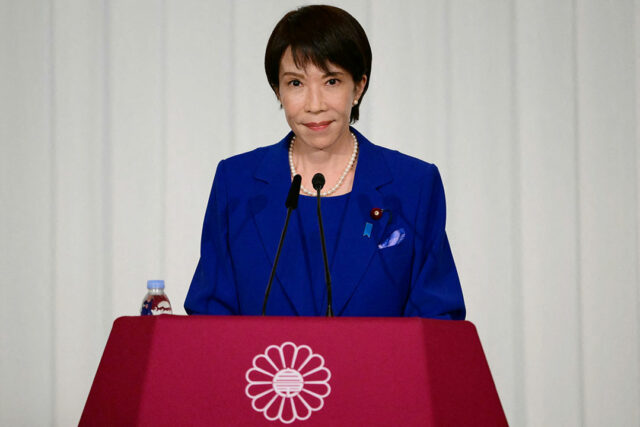
Sanae Takaichi, the newly elected leader of Japan’s ruling party, the Liberal Democratic Party (LDP), attends a press conference after the LDP presidential election in Tokyo on October 4, 2025. — YUICHI YAMAZAKI/POOL VIA REUTERS

TOKYO — Japan’s weakened Liberal Democratic Party (LDP) is set to begin policy talks on Thursday with the Japan Innovation Party (JIP) as Sanae Takaichi, the ruling party’s new leader, woos an ally to help clinch a prime ministerial vote expected next week.

The Nikkei share average rose as prospects appeared to brighten for Ms. Takaichi to become Japan’s first woman premier, stoking bets on a revival in big spending and loose monetary policy.

Ms. Takaichi’s path to succeed Prime Minister Shigeru Ishiba had seemed all but certain until the LDP’s junior partner, Komeito, quit their 26-year coalition last week, setting off a flurry of negotiations with rival parties to select the next premier.

“There were strong views (among party members) that we should win as many of the policies that we have been committed to as possible, then form a coalition and change Japanese politics,” Fumitake Fujita, co-head of the JIP, told reporters.

He was speaking after members of his right-leaning party agreed at a meeting on Thursday to leave the final decision to party executives.

Taken together, the two parties would be just two seats short of a majority in the lower house, which has the deciding vote to choose the prime minister. The government has yet to agree to a date for the parliamentary vote.

On Wednesday, after a brief meeting with Ms. Takaichi, JIP chief Hirofumi Yoshimura had said the party would back her as prime minister if both could agree on key policy proposals it would submit to the LDP.

Ms. Takaichi will meet Mr. Fujita, along with the parties’ policy chiefs, to discuss issues such as designating a second capital and social security reform.

The parties are aligned on security policy, such as higher defense spending and plans to revise Japan’s war-renouncing constitution.

But the JIP also figures in separate efforts by the main opposition Constitutional Democratic Party to draw it into a coalition with the Democratic Party For the People (DPFP) and enable a premiership bid by DPFP leader Yuichiro Tamaki. — Reuters

Landmines that sparked Thai-Cambodia clash were likely newly laid, experts say

STOCK PHOTO | Images by Aranjuezmedina from Freepik

BANGKOK/PHNOM PENH — Thai Army Second Lieutenant Baramee Sricha was on a patrol near a disputed stretch of the border between Thailand and Cambodia on July 16, when a member of his team stepped on a landmine that detonated, severing his ankle.

The incident was a catalyst to five days of hostilities between the neighbors, which ended with a US-brokered ceasefire. It also sparked a diplomatic row over PMN-2s – a Soviet-origin anti-personnel mine that litters parts of Cambodia and which Phnom Penh and Bangkok have pledged by treaty not to use.

Thailand accuses Cambodia of laying the mines along parts of their joint frontier and says PMN-2s have maimed at least six Thai soldiers since July, including the member of Baramee’s patrol.

Cambodia denies the accusations. It says that some Thai soldiers stepped on non-PMN-2 ordnance planted during a decades-long civil war that left it as one of the world’s most heavily mined countries.

Phnom Penh has since positioned itself as a global advocate against the use of landmines. It has invested some $1 billion alongside foreign donors over the past 30 years in demining operations.

Any use of anti-personnel mines by Cambodia, where tens of thousands have been killed or maimed by such ordnance since 1979, would mark a disappointing reversal in decades of public commitments, said Yeshua Moser-Puangsuwan of Landmine Monitor, which is part of the International Campaign to Ban Landmines.

It would also come as some European nations threatened by Russia pull out of the Ottawa Convention, which bans the use of anti-personnel landmines. They join major powers like Washington, Moscow and Beijing, which are not signatories to the treaty.

Thailand’s military provided Reuters with access to videos and photographs of what it said were subsequent PMN-2 demining operations carried out by its troops around the site of the July 16 incident, as well as another border-area mine blast on July 23.

During an August visit to frontline Thai military units, the news agency took photos of shrapnel that service members said they recovered from those incidents, as well as images of dozens of intact mines Thailand said were retrieved from along the border area.

Reuters examined the metadata on seven of the supplied images, which show they were taken at the same time as Thai demining operations carried along the frontier between July 18-23 that were listed in two undated military documents about landmines on the border seen by the news agency.

The metadata did not include location information, and Reuters was not able to confirm independently where the images were taken.

Four independent landmine experts, asked by Reuters to evaluate the material, said the images depicted PMN-2s that had been freshly laid. However, the analysts were not able to determine who placed the ordnance.

The Cambodia Mine Action and Victim Assistance Authority (CMAA), a governmental agency that oversees demining activities, told Reuters that a determination on the incidents could only be made after an impartial third-party investigation. Cambodia’s military does not have stockpiles of live anti-personnel mines, it added.

CMAA’s First Vice President Ly Thuch, who reports directly to Prime Minister Hun Manet, said visual appearance alone is not conclusive proof of age.

“Environmental and disturbance factors can make long-buried items appear relatively fresh,” he told Reuters.

A Thai foreign ministry spokesperson said Bangkok’s investigations had determined that the landmines that injured its soldiers were newly planted PMN-2s: “They were found in new condition, still with clearly visible markings.”

Bangkok is a longtime US ally which did not have widespread access to Soviet-origin munitions and says it has never deployed the PMN-2.

The defense ministry of Russia, which previously said it stopped manufacturing PMN-2-type mines in the late 1990s, did not respond to Reuters’ questions.

INDEPENDENT ASSESSMENT
The condition of the PMN-2s in the visuals taken by the Thai military and Reuters indicates they had been in the ground for no longer than a few months, said UK-based independent expert Andrew Vian Smith.

There are tell-tale signs on older PMN-2s, Smith said: their pliant plastic casing becomes brittle over time, and they also have a rubber disc that in most soil conditions quickly becomes dull, collecting dirt in the gaps.

“The mines I was shown had nothing in those gaps,” said Smith, who has worked on operations in Cambodia.

The mines were not covered by roots and vegetation as one would expect if they had been in the ground for a long time, said Moser-Puangsuwan.

CMAA’s Thuch said that soil erosion, flooding and shifting vegetation could lead old mines to appear newer than they are.

Moser-Puangsuwan said that flooding might explain a mine shifting position but that such factors don’t make ordnance look new.

“Ignoring the absence of other signs of ageing, it is not credible that floodwater could clean these mines and then bury them tidily again,” Smith said.

The CMAA has said in a public statement that the mine that exploded on July 16 was not a PMN-2, instead suggesting that mines of American, Chinese or Vietnamese origin might have been responsible.

Asked how it made the determination without access to the injured Thai service members, Thuch said it was a preliminary assessment of “the injury pattern reportedly observed … (based) on the limited open information available to us.”

Reuters’ images of the remnants from July 16 include an “initiation delay bellows” – a device that is compressed to trigger the mine’s firing mechanism – while photos of the July 23 shrapnel show a spring wire, both of which Smith said were characteristic of the PMN-2.

Thuch said fragment recognition from photos has inherent limits. And there was no verified evidence of local stockpiling or unsanctioned use of mines in the area, he added.

DIPLOMATIC PRESSURE
A succession of civil wars, including those involving the genocidal Khmer Rouge regime, convulsed Cambodia for some two decades from 1970.

The conflicts left behind one of the world’s most densely mine-contaminated areas: a 1,046-kilometer-long stretch along the Thai-Cambodia border.

Demining efforts began in earnest after a 1991 peace accord. More than 3,200 square kilometers of land has since been cleared of unexploded ordnance.

However, PMN-2 mines, which were among the most commonly deployed in Cambodian and contiguous territory, continue to litter the countryside. Some 1,800 PMN-2s have been found and deactivated since September 2023, CMAA said.

The Ottawa Convention requires contracting states to “destroy all stockpiles of landmines they possess within 4 years” of signing up, said Moser-Puangsuwan.

Thailand is applying diplomatic pressure through the convention and has asked United Nations chief Antonio Guterres to request that Cambodia respond to its allegations through a compliance mechanism built into the treaty.

The convention provides a clear mechanism to address compliance issues, said Farhan Haq, deputy spokesperson for Guterres, adding that the Secretary General would “continue to support efforts in that sense and hopes that Thailand and Cambodia will achieve a cooperative resolution.”

Bangkok has also repeatedly petitioned member states party to the treaty since July. It argues that Cambodia has violated the convention by stockpiling and using landmines as well as having previously declined joint demining operations along the disputed border. — Reuters


Rare earths tensions rise as US and China trade barbs

US and Chinese flags are seen in this illustration. — REUTERS

BEIJING — Chinese state media on Thursday issued a seven-point rebuttal to US calls for Beijing to wind back its rare earth controls, as both sides struggle to move beyond a volley of barbs and accusations of blindsiding the other.

US Trade Representative Jamieson Greer on Wednesday called China’s new rare earth export restrictions “a global supply-chain power grab,” and suggested Beijing could stave off President Donald J. Trump’s threat to reimpose triple-digit tariffs on Chinese goods by shelving the measures set to take effect on Nov. 8.

Beijing maintains it not only notified Washington before announcing the new licensing regime, but that the controls are also consistent with measures long in place in other major economies.

The US and China have been embroiled in a war of words since a September telephone call between Mr. Trump and Chinese leader Xi Jinping, with each accusing the other of stoking tensions weeks ahead of an expected meeting between the two men.

Beijing attributes the ramped-up rhetoric to the US Commerce Department’s surprise expansion of its “Entity List” in late September to include companies in China and elsewhere that use subsidiaries to bypass export restrictions on chipmaking equipment and other high-tech goods.

Washington pins the start to China’s critical minerals move, which Mr. Trump described as “shocking.”

“The United States has long overstated national security concerns and abused controls, adopting discriminatory practices against China,” read one of seven infographics published by People’s Daily, the official newspaper of the governing Communist Party. The poster added that Washington maintains a control list of over 3,000 items long, compared to the 900 on Beijing’s catalogue.

“Implementing such export controls is consistent with international practice,” the first poster said, reiterating Beijing’s stance on the measures since their announcement.

Washington has had similar rules since the 1950s and has been using them in recent years to stop foreign semiconductor companies selling chips to China if they are made using US technology.

“Washington should not be surprised by China’s ‘tit-for-tat’,” read an editorial in the Global Times, a People’s Daily-owned tabloid, which has often been first to report on China’s next steps in trade disagreements.

“The sudden shift in the trade atmosphere caught many by surprise, yet that’s not surprising,” the editorial continued.

“The direct trigger for this round of tension was Washington’s breach of promises – an all-too familiar pattern.” — Reuters

Filipina entrepreneurs still face funding and knowledge gaps, says expert

FoundHer Co-founder and Chief Executive Officer Niña L. Terol at the FoundHer Summit. — ALMIRA MARTINEZ

An expert said female business owners continue to face a knowledge gap and limited access to funding despite the growing presence of women-led enterprises in the country.

“When it comes to funding startups, and especially growth-stage businesses, women are getting a much smaller piece of the pie, even if a large majority of MSMEs are actually women-led,” FoundHer Co-founder and Chief Executive Officer Niña L. Terol told BusinessWorld at the sidelines of an event.

Ms. Terol noted that only 2% to 3% of women globally can get funded through venture capital. Meanwhile, about 20% of women in the Philippines get venture capital funding.

“There is a disparity between the number of businesses that are being started and owned by women and the number of businesses that are actually getting external funding and external capital to grow those businesses,” she said.

According to the Organization for Economic Cooperation and Development (OECD), more than 55% of micro, small, and medium-sized enterprises (MSMEs) in the country are women-led, which is “exceptional” by global standards.

Citing the Asian Development Bank (ADB) survey, OECD said that 58% of micro-enterprises, 50.3% of small enterprises, and 16% of medium-sized enterprises are women-owned in the country.

With the rapidly increasing number of female business owners, Ms. Terol said many lack sufficient understanding of financial opportunities that can aid in their business growth.

“Going to investors or going to banks and financial institutions is not often the first thing that they do. So when women entrepreneurs need capital, the first thing they do is go to family and friends,” she said.

Data from the Bangko Sentral ng Pilipinas (BSP) revealed that the total loans of MSMEs reached P540.92 billion as of June, 11% up from a year earlier.

However, the total loans accounted for only 4.59% of the Philippine banking industry’s P11.78-trillion lending portfolio, falling short of the prescribed ratio of 10%.

Strict bank requirements and their hesitancy to extend credit to MSMEs also lead other women to high-interest-bearing instruments, such as personal loans and credit cards, said Ms. Terol. “And those options might not always be the best, or the safest, or the most efficient use of money.”

“We just need to make sure that we bridge the knowledge gap, so that women know where to go and what options they have, and they don’t feel helpless in the face of a lack of capital,” she added. — Almira Louise S. Martinez

Photo caption: FoundHer Co-founder and Chief Executive Officer Niña L. Terol at the FoundHer Summit. — Almira Martinez

Twelve percent of Philippine firms identified as AI ‘Pacesetters’, says Cisco  

CISCO

About 12% of businesses in the Philippines are considered the most prepared for artificial intelligence (AI) adoption, outpacing their peers in integrating AI into operations and likely to reap more measurable value from it, according to a 2025 Cisco AI readiness Index.  

They are called the “Pacesetters,” representing 13% of their global counterparts, and have shown a consistent pattern of outperforming their peers across every measure of AI value. 

“They’re six times more likely to move pilots into production and 30% more likely to realize measurable value,” Zaza Soriano- Nicart, managing director of Cisco Philippines, said in a statement.  

“As organizations now move toward deploying AI agents, their success depends on their readiness, discipline, and action.” 

The findings of the index also show that Pacesetters in the Philippines demonstrate stronger readiness for AI adoption compared to other local firms.  

About 61% of organizations have a defined AI roadmap, while 27% have a change-management plan. Only 16% prioritize AI as a top investment, and 44% have both short- and long-term funding strategies.  

In terms of infrastructure, 34% are investing in new data-center capacity, while 41% expect their AI use cases to generate new revenue streams. 

On security readiness, 52% are aware of AI-specific threats, 33% integrate AI into their security and identity systems, and 50% are fully equipped to control and secure AI agents, indicating that while progress has been made, the country still has significant room for growth in overall AI readiness. 

The 2025 Cisco AI Readiness Index, now in its third year, is based on a double-blind survey of 8,000 senior information technology and business leaders in charge of AI strategy at organizations with more than 500 employees across 26 industries. 

Fourteen of the 30 countries in the Asia-Pacific region, including the Philippines, were covered in the survey, Ben Dawson, Cisco’s president of sales for Asia Pacific, Japan, and Greater China, said during a roundtable on Wednesday. 

“The index is weighted across a number of pillars of readiness, from some of the business aspects such as strategy and governance, to the technology side involving infrastructure and data, and of course, the cultural aspects,” Mr. Dawson said.  

He also added that although many firms have high ambitions to embrace AI, only 13% globally say they are fully ready for it. Edg Adrian A. Eva

Midnight launch events for iPhone 17 now ongoing, freebies announced 

APPLE NEWSROOM

Apple official retailers have announced their in-store activities and giveaways for various iPhone 17 midnight launch events happening in several venues in multiple locations. The launch events will begin at around late evening on October 16. The pre-order period for the phone began on October 9 and lasted until October 16.  

The iPhone 17 is the nineteenth generation of smartphones developed by Apple beginning with the original iPhone released in 2007. The iPhone 17 series now has four models available in its lineup: the iPhone 17, iPhone 17 Pro, iPhone 17 Pro Max, and an all-new ultra-thin model, the iPhone Air.  

For their in-store promotion, Digimap is giving away up to P37,000 worth of gifts for its midnight launch event in One Ayala Mall, Ayala Center Cebu, and Alabang Town Center. Up to P100,000 worth of Apple products (AirPods, iPad, Apple Watch) will be given away at the One Ayala Mall launch in Makati.  

Digital Walker and Beyond the Box is giving away freebies worth P100,000 which includes a MacBook Air for the first 20 people in line. Depending on their position in the line, lucky customers may get various products such as headsets, speakers, and power banks worth anywhere from P36,000 to P51,000. The launch events will be at Glorietta Activity Center, Robinson’s Ermita, and Power Plant Mall in Rockwell. Digital Walker is also raffling off a Tesla Model Y electric vehicle for customers who participated in the pre-order period 

The first in line at the iStudioPlus launch event in BGC will get up to P71,000 worth of freebies. The first 30 in line will get a total of P47,000 worth of freebies. There will be performances at the store featuring musical guests and celebrities. 

Power Mac Center will hold two launch events in Greenbelt 3 and SM Mall of Asia. The first 30 customers in Mall of Asia and the first 40 customers in Greenbelt will either get an iPhone 16E or an Apple Watch Ultra. — Ed G. Geronia Jr. 

Metro Dumaguete Water to invest P524 million to upgrade city’s water service  

MDW

Metro Dumaguete Water (MDW), a joint venture between Dumaguete City Water District and Metro Pacific Water, has pledged a P524-million investment over the next five years to enhance the city’s water supply infrastructure and service delivery. 

“The capital expenditure (CAPEX) program is a key component of the company’s long-term master plan to ensure reliable and affordable water for all residents,” MDW said in a statement.  

MDW’s chief operating officer (COO), Robert R. Cabiles, said that the more than P500 million investment will be allocated to four key areas, including service improvements, non-revenue water (NRW) management, source development, and the adoption of new technologies.  

Under the CAPEX program, Mr. Cabiles said the utility plans to develop a new pumping station to provide additional water supply to northern barangays, as well as conduct essential pipe improvements to meet population and demand growth. 

He noted that although various improvements have been made in recent years, some parts of the city still do not enjoy 24/7 water availability. 

“These zones have been identified in our first five years of operations and have been factored into our master plan,” Mr. Cabiles said in a statement.  

“The sustainable solutions for these areas have been identified and will be rolled out in the next one to three years,” he added. 

The COO also highlighted the utility’s achievements in the past year, including the establishment of two pumping stations and the addition of four kilometers of transmission pipeline. He said that MDW now covers 95% of the city, serving 135,000 residents. 

A 24/7 customer service hotline and over 1,000 new payment partners were also implemented and can be accessed by MDW’s customers.  

Mr. Cabiles assured the city council that despite substantial capital expenditures, MDW continues to offer a minimum charge of P202.50, noting that it remains one of the most affordable water rates in the province. 

MPW, one of the joint-venture partners of MDW, is the water infrastructure investment subsidiary of the Pangilinan-led conglomerate Metro Pacific Investments Corp. (MPIC). 

MPIC is one of the three key Philippine units of Hong Kong-based First Pacific Co. Ltd., the others being Philex Mining Corp. and PLDT Inc. Hastings Holdings, Inc., a unit of PLDT Beneficial Trust Fund subsidiary MediaQuest Holdings, Inc., has a majority share in BusinessWorld through the Philippine Star Group, which it controls. Edg Adrian A. Eva

PUMA releases the H-Street Premium line based on a classic design 

PUMA.COM

Fashion forward footwear maker PUMA is releasing a new line of sneakers based on a classic silhouette. In the early 2000s, the Harambe running spike became popular because of its low-profile design. The H-Street Premium continues this line where sportswear meets the best of streetwear. 

The PUMA H-Street Premium line comes in the most sought-after colors of the season. The sneakers come in three colorways: Black-Shadow Grey-Gum for a laid-back look, Brandy-Toasted Almond-Gum for a vintage-meets-modern chic, and Alpine Snow-Warm White-Gum for a minimalist appeal.  

For the shoe’s construction, PUMA has chosen premium leather and suede uppers, rounded toe, and gum soles. With its sprint shoe roots, the H-Street Premium is built with comfort and light weight in mind with its molded footbed, cushioned EVA midsole, synthetic lining, flat heel, and secure lace closure.  

For its initial drop, the PUMA H-Street Premium will be exclusively available for P6,000 at Commonwealth shops on October 17 with a wider release on PUMA.com on October 24. Ed G. Geronia Jr. 

PASIAWORLD 2025 to lead ethics and integrity program, driving best practices across procurement and supply chains

The Procurement and Supply Chain Institute of Asia (PASIA) proudly announces the return of PASIAWORLD 2025, Asia’s premier integrated conference on supply chain, procurement, and logistics, set for Nov. 13-14, 2025, at the Manila Marriott Hotel.

The two-day conference will gather the region’s most influential leaders, experts, and decision-makers to exchange insights, share best practices, and explore fast-evolving trends in the global supply chain and procurement landscape. Delegates can expect plenary sessions, panel discussions, interactive round tables, exhibits, and valuable networking opportunities that foster learning, collaboration, and innovation.

With the theme “Leading Supply Chain, Procurement & Logistics Innovations Amidst Volatility and Disruptions,” PASIAWORLD 2025 focuses on engaging more CEOs, CXOs, and professionals with the knowledge and foresight to navigate today’s complex, rapidly changing environment. It will spotlight agile, strategic, and tech-savvy leadership in supply chain management.

Key topics include strategic sourcing, category management, artificial intelligence in procurement intelligence, supplier performance, and decision-making. The program will also address global supply chain disruptions and strategies to improve visibility, resilience, and adaptability. ESG and sustainability will be highlighted as organizations face growing pressure to align with environmental, social, and governance goals.

A key highlight is the Ethics and Integrity Program Re-launch, where CEOs and procurement leaders from both public and private sectors will reaffirm their commitment to transparency, accountability, and ethical leadership.

Register now and be part of PASIAWORLD 2025 — where integrity meets innovation in shaping the future of supply chain and procurement.


Spotlight is BusinessWorld’s sponsored section that allows advertisers to amplify their brand and connect with BusinessWorld’s audience by publishing their stories on the BusinessWorld Web site. For more information, send an email to online@bworldonline.com.

Join us on Viber at https://bit.ly/3hv6bLA to get more updates and subscribe to BusinessWorld’s titles and get exclusive content through www.bworld-x.com.

No tsunami threat in PH after 6.7 magnitude quake in Indonesia

PHIVOLCS-DOST FB PAGE

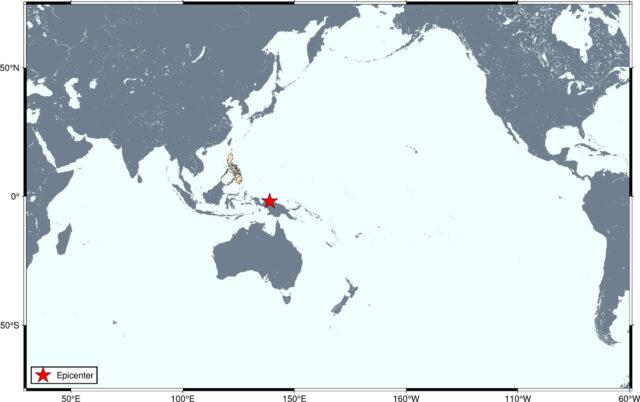
There is no tsunami threat in the Philippines following the 6.7-magnitude earthquake that struck neighboring Papua, Indonesia, on Thursday, according to the state seismology agency.

“No destructive tsunami threat exists based on available data,” the Philippine Institute of Volcanology and Seismology (PHIVOLCS) said in a 1:48 p.m. advisory.

According to the United States Geological Survey (USGS) report, the tremor’s epicenter was about 200 kilometers from the city of Abepura, which has a population of over 62,000.

The quake occurred at a depth of 70 kilometers, and no tsunami alert was issued by the US-based Pacific Tsunami Warning Center. — Edg Adrian A. Eva

Mapúa eyes more tourism and hospitality students

Mapúa University launched its School of Tourism and Hospitality Management on Wednesday. - ALMIRA S. MARTINEZ

The Mapúa University School of Tourism and Hospitality Management aims to boost its enrollees for the following academic year through its partnership with Ayala Land Hospitality (ALH).  

 “We are gearing up for a better (enrollment turnout) for 2026-2027. In fact, for the next term, we are hoping that we get even more,” Mapúa School of Tourism and Hospitality Management Dean Lora Lee F. Reboton told BusinessWorld in an interview on Wednesday. 

 Since opening its doors to students for the 2025-2026 academic year, the school currently has 20 students, divided equally between its two programs: Bachelor of Science in Hospitality Management and Bachelor of Science in Tourism Management.  

 Ms. Reboton noted that the low enrollment rates this year were due to a lack of time to promote the programs.  

“When we started marketing the programs, that was in April or May, so it was too close to the opening of the school, which was in August,” she said. “We didn’t have the luxury of time, but we were blessed to have that much.”  

To boost the number of students, the school will focus on transferees and late enrollees for this year’s second term.  

“We will be able to accommodate more students who will be transferring or late enrollees who chose to rest during the first term. We are hoping that we will get even more enrollees,” Ms. Reboton said. 

The school also aims to highlight its partnership with ALH, more specifically with one of its brands, Seda Hotels, to encourage more students to join the program.  

Located beside Seda Manila Bay, Ms. Reboton said students will have a “living and breathing laboratory” that they can use whenever needed, which makes learning more experiential.  

“Our school is a partnership with the Ayala Land Hospitality, so you can expect that instructions here will be made by professionals from Seda Hotel mostly,” she added. 

Aligned with the industry standards and practices of Seda Hotels, graduates from the new Mapúa school will also be ‘prioritized’ upon employment application in the 12 properties of the hotel brand.  

“Because we are partnered with them, we have the edge already,” Ms. Reboton said. “So when you say you came from Mapúa University School of Tourism and Hospitality, you’re prioritized, but it’s still subject to their selection process.”  

The 100-year-old Mapúa University was founded by the first registered architect in the country, Don Tomas Mapúa, in 1925. The university was placed under the top 1501+ institutions globally in the Times Higher Education (THE) World University Rankings, alongside four other Philippine universities.Almira Louise S. Martinez 

ADVERTISEMENT
ADVERTISEMENT