Home Blog Page 7607

Bogo-Medellin Milling swings to P13-M profit

BOGO-Medellin Milling Co., Inc. posted a net income of P12.78 million for the third quarter of its fiscal year that will end in September on the back of higher sales.

The listed sugar milling company turned profitable during the April-to-June period and reversed its P17.74-million net loss incurred a year ago.

“The significant increase in net income for this quarter compared to same period last year is mainly due to higher sugar sale,” Bogo-Medellin said in the regulatory filing.

Total sales during the quarter rose 20.9% to P55.29 million from P45.73 million in the same period last year.

Of the total sales for the period, P42.66 million came from raw sugar while P12.64 million came from molasses.

The company’s cost of sales for the quarter fell 33.4% to P39.86 million against P59.88 million the year earlier.

For the nine months of its fiscal year, Bogo-Medellin recorded a P15.9-million net loss, an improvement over the P86.06-million net loss it suffered a year ago.

Bogo-Medellin’s total sales for the nine-month period reached P187.67 million, 27.5% higher than the P147.14 million it posted in 2020.

Raw sugar sales contributed P161.53 million to the total, while molasses sales shared P26.14 million.

The company posted a 16.3% decline in its cost of sales to P180.30 million compared with P215.52 million a year ago.

“To the company’s knowledge, there are no trends, demands, commitments, events or uncertainties that will have a material impact on the company’s liquidity. The company’s operations are funded internally, particularly from sale of sugar and molasses,” Bogo-Medellin said.

Bogo-Medellin has business interests in the milling and manufacturing of centrifugal raw sugar, with molasses as the by-product.

According to the website of the Philippine Stock Exchange, shares of Bogo-Medellin were last traded on Aug. 18 when it closed at P68.10 per share. — Revin Mikhael D. Ochave

Arts & Culture (08/25/21)

Nat’l Library calls for story entries

AS PART of the celebration of the 31st Library and Information Services Month, the National Library of the Philippines (NLP) is accepting entries for the publication Impact Stories of Libraries in the Philippines Book III until Sept. 30. The objective for this third volume is to capture activities and services of libraries in the Philippines, be it a school, academic, special, or public library that adhere to the sustainable development goals (SDGs) established in the United Nation 2030 Agenda. Interested applicants may submit personal accounts or a write up about an activity their library has implemented in relation to the SDGs. Submit the story to http://bit.ly/ImpactStoriesIII. For reference, view Impact Stories vol. 2 at http://bit.ly/ImpactStoriesVolume2. For inquiries and clarifications, contact Chad Aren E. Diaz through e-mail at caediaz@nlp.gov.ph or visit www.nlp.gov.ph.

CCP presents Buwan ng Wika shows

IN CELEBRATION of Buwan ng Wika, the Cultural Center of the Philippines (CCP) presents AWIT AT TULA: Pagbabalik-Tanaw sa Unang Hari ng Balagtasan at the Facebook page of the CCP Office of the President (www.facebook.com/watch/live/?v=163695115876901&ref=watch_permalink). Then relive the music of the 1970s in the concert MANILA SOUNDS, Saliw sa Himig ng Maynila, featuring the Philippine Philharmonic Orchestra on Aug. 28, 6 p.m. More Buwan ng Wika programs can be found at the CCP’s Vimeo channel, https://vimeo.com/showcase/8759371.

NCCA holds Filipino culture webinar

REGISTRATION for the second leg of the webinar “Mga Durungawan sa Kulturang Filipino” (Windows to Filipino Culture) by the National Commission for Culture and the Arts (NCCA), in cooperation with Cultural Center of the Philippines (CCP), is now open. With the theme, “Culture-based Education: Enriching Instruction, Enabling Integration, and Enhancing Contextualization,” the webinar series will be held online from September to November. The three-session webinar will cover a range of topics that would enhance competency in creating a culture-based instructional plan under the new normal scheme. The event also aims to provide a platform for interested in-service and pre-service teachers, educators, and other interested participants nationwide to share further cultural practices, ideas, and resources about responses to school closures and other challenges stemming from the coronavirus disease 2019 (COVID-19) pandemic. To register, visit https://bit.ly/durungawan2021 For inquiries, contact Mark Baoanan, Project Coordinator, through durungawanwebinar@gmail.com. For more information, visit https://www.facebook.com/MgaDurungawanSaKulturangFilipino/

New online platform for selling art

THERE is a new digital platform for the sale of collectibles and art, VNT Vention, created by cryptocurrency trader Julius Santillan. The website allows anyone to create, buy, sell, or collect digital merchandize — Non-Fungible Tokens (NFTs), which are used to represent items like photos, videos, audio, and other types of digital files — with minimal platform fees. It claims to connect artists to art collectors, while ensuring “a solid and supportive atmosphere.” “This online marketplace’s objective is to urge Pinoy artists to use the blockchain technology in selling masterpieces to fans and collectors alike. By tokenizing works and selling them on a digital marketplace, they can maximize their reach for potential customers,” it said in a statement. For more information, visit the VNT Vention site at https://vention.app/

Tagum honors creative writers

“IN RECOGNITION of the literary arts’ unique contribution in achieving the full potential of this city’s creative economy by 2025,” creative writers convened in the first-ever Tagum Creative Writers Summit on Aug. 20 at the Tagumpay Theater of the Tagum City Historical and Cultural Center (TCHCC). The summit featured Mindanao writers including Tagum’s Reymond Pepito, who talked about “Celebrating Tagum and the Need to Write About It,” Palanca Award winner and playwright Karlo Antonio Galay David, who talked about the “Mindanao Narrative through Plays,” and poet Nassefh Macla who gave a talk, “Poetry and Beyond: A Memory Project.” The summit kicked off the months-long activity of the Center which will culminate with fringeTGM in November, a community arts and festival featuring various artistic groups of the city. TCHCC management also unveiled the activities lined up for the culmination of the activity in November. These include the Sayaw Tagum Dance Conference, the staging of  the play Killing the Issue, an art and design conference, and a performance art and literary concert.

Library holds book, photo exhibit on PHL script

THE FILIPINAS Heritage Library, which turned 25  this month, has launched a book and photo exhibit called “Philippine Script” which looks into the evolution of the national language, and writing systems and their survival as well as the revival of old native scripts. “Philippine Script” is on view online until Aug. 27 at instagram.com/filipinasheritagelibrary.

Videos support Silverlens exhibits

SILVERLENS gallery has a number of videos featuring artists talking about their process and exhibits, and a writer discussing her encounter with an artist. Artist Gary-Ross Pastrana discusses his works in the exhibit “Things that came to light.” Marga Ortigas talks about the “otherworldly” experience of interviewing artist Chati Coronel whose has her exhibit, “Celestial Data for Daydreaming.” There is also a video of Ms. Coronel herself, answering questions about her process, her love for cosmology, and how a painting could incite hope. The exhibition videos can be viewed until Aug. 28 at www.silverlensgalleries.com.

Online art therapy offered

THE J. AMADO Araneta Foundation (JAAF), the social development arm of the Araneta Group, is conducting a series of online art therapy sessions to select youth participants and medical frontliners in response to ill effects of the pandemic. Titled “I am Visible”: Mental Wellness Through Art Therapy, the project which was organized via a grant from the National Commission for Culture and the Arts — started with its first online session via Zoom on Aug. 7. More online art therapy sessions will be held on Sept. 11 and 18. “I am Visible” aims to acknowledge the mental health crisis happening in the country today which is being exacerbated by the ongoing pandemic. JAAF has partnered with the Makati Medical Center Foundation for “I am Visible,” with the latter providing facilitators and identified doctor-participants. Joining the Program as art coaches are veteran artists Rene Canlas and Julius Legaspi, who will introduce the medium of drawing and painting: pencil, pastel, watercolor, and acrylic paints. The program will end with an online exhibit to be launched on Oct. 10, which is designated as World Mental Health Day. It will be curated by art teacher Jonah Mari Valenzuela. The virtual exhibit will be hosted on the website of Araneta City’s art museum, the Gateway Gallery. It will open with a Curator’s Talk to be livestreamed on the JAAF and Gateway Gallery Facebook pages. The exhibit will be up until Jan. 10, 2022.

State-run bank’s online payment facility sees surge in transactions 

THE LAND BANK of the Philippines (LANDBANK) saw the number of transactions coursed through its online payment platform more than double in the seven months to July from the year-ago level as the lender recorded a surge in online banking.

The state-run bank said in a press release on Tuesday that it processed P1.307 trillion worth of transactions across all its electronic banking (e-banking) channels as of end-July, up by 65% from the same period last year. Total transactions also grew by 12% to 73.5 million year on year.

Broken down, e-payments through its Link.BizPortal reported the highest increase after doubling to 2.3 million transactions during the same seven-month period.

The combined value of e-payments also grew by 103% from a year ago to P5.57 billion under the website-based online platform that covers more than 800 partner merchants.

Meanwhile, the bank’s Electronic Modified Disbursement System, which is used by National Government agencies with its partners, recorded 1.1 million transactions worth P925.28 billion, which were 36% and 74% higher than their year-ago levels.

Usage of its mobile banking application also improved as total transactions jumped by 48% to 55.72 million, with their total value rising by 136% year on year to P89.9 billion as of July.

The lender’s weAccess for its corporate clients also saw higher transactions at 11.3 million, up 31% year on year, with total amount processed reaching P277.43 million, up 22%.

Its iAccess digital banking services for its retail clients recorded 3.1 million transactions in those seven months worth P8.86 billion, bigger by 49% from a year ago.

The bank’s digital portal in opening new accounts were also able to process 1.67 million new deposit accounts as of June 30.

“LANDBANK continues to answer the call for accessible, reliable, and safe electronic banking in the new normal, driven by the varied needs of customers due in large part to the pandemic,”said Cecilia C. Borromeo, the bank’s president and chief executive officer, in a statement.

“We are committed to collaborating with more government partners to make financial services much more accessible, towards promoting Ease of Doing Business and advancing greater digital financial inclusion in the country,” she added.

The bank waived fees for interbank fund transfers via InstaPay and PESONet for retail clients until Sept. 30. It saw its net earnings climb by 1.67% to P5.48 billion in the first quarter. — Beatrice M. Laforga

Innovations that improve and extend lives

PHILIPPINE STAR/ MICHAEL VARCAS

Aside from the nine coronavirus disease 2019 (COVID-19) vaccines that have already secured Emergency Use Authorization (EUA) from the Philippine Food and Drug Administration, there are more than 200 active projects aimed at finding a viable vaccine to combat the SARS-CoV-2 virus which causes COVID-19.  

The long track record of developing solutions to combat a range of infectious diseases — including viruses with epidemic potential such as those responsible for MERS (Middle East respiratory syndrome), SARS (severe acute respiratory syndrome), and Ebola — has allowed the biopharmaceutical industry to be ready to fast-track research and development (R&D) for a COVID-19 vaccine.  

Since the development of the first modern vaccine in the late 1700s, vaccines have earned their reputation of being one of the safest, most effective, and cost-effective medical technologies ever developed.  

It is estimated that immunization prevents two million to three million deaths each year in all age groups, according to the International Federation of Pharmaceutical Manufacturers & Associations (IFPMA).  

Thanks to previous investigative efforts, such as the elaboration of the germ theory — the identification of organisms that cause a disease — and improvements in cell culture technologies, scientists have developed vaccines against infectious diseases including smallpox, diphtheria, tetanus, anthrax, cholera, plague, typhoid, tuberculosis (TB), polio, measles, mumps, rubella, hepatitis A and B, chicken pox, pneumonia and, influenza, with many more in the pipeline.  

Between 2000 and 2017, immunization campaigns cut the number of deaths caused by measles by an estimated 80%, saving more than 21 million lives, over that period globally. Future vaccine R&D investment strategies will focus on data and technology-led advancements to better understanding of immune responses and pathogen interactions.  

Vaccines also serve as a frontline defense against antimicrobial resistance (AMR). Vaccines prevent infection, and hence reduce the need to use (and misuse) antibiotics, thus serving as a critical complementary tool to mitigate the risks of AMR. They also hold up broader gains in education and economic development.  

Vaccines are one of the most important inventions in global public health and the biopharmaceutical industry will continue to prioritize tackling public health challenges at scale.  

Beyond vaccines, R&D is also being carried out to find therapies for other infectious and non-infectious diseases. Hepatitis, for example, has accompanied humanity throughout centuries.  

Once the viruses were identified, this finding contributed to a revolution in medicine that led to the development of a vaccine for hepatitis A and B, which has dramatically reduced the mortality of the virus. Despite these advances, the hepatitis C virus (HCV), which causes both acute and chronic infection, is the leading cause of liver cancer and the main reason for liver transplantation.  

An estimated 71 million people have chronic HCV infection contributing to around 400,000 deaths each year. Step by step, scientists have improved HCV treatments to a nearly 100% success rate from 6% cure rates in 1991.  

Today, the drugs used against HCV are the first that can completely cure a chronic viral illness, allowing millions of people to regain their health and live full and productive lives. This success was possible thanks to the improved understanding of the HCV molecular structure, together with sufficient investment and aligned global cooperation.  

Direct-acting antivirals debuted in 2011 and were combined with other therapies, leading to a 12-week-long treatment course that cures without debilitating side effects.  

Much progress has also been made when it comes to treating the human immunodeficiency virus (HIV), which causes acquired immunodeficiency syndrome (AIDS). 

A major medical breakthrough in the fight against HIV/AIDS was the development of antiretroviral (ARV) therapy. With time, researchers discovered that combination therapy approaches — which work by combining drugs in different sequences — were far more effective than any single drug treatment, making these combinations the default treatment regimen.  

ARV therapies also eliminate the risk of transmission from an infected mother to her child throughout pregnancy, birth and breastfeeding. With the help of major medical discoveries, the research-based biopharmaceutical industry has developed more than 222 antiretroviral Drugs for Global HIV/AIDS Relief that are essential to controlling the epidemic and extending the lives of millions.  

R&D is also focusing on a vaccine against HIV, which would be a valuable complement to other preventive interventions, significantly contributing to the interruption of the chain of transmission of HIV.  


Teodoro B. Padilla is the executive director of the Pharmaceutical and Healthcare Association of the Philippines (PHAP), which represents the biopharmaceutical medicines and vaccines industry in the country. Its members are at the forefront of research and development efforts for COVID-19 and other diseases that affect Filipinos. 

National Government Fiscal Performance

THE NATIONAL GOVERNMENT narrowed its budget deficit to P121 billion in July as an uptick in revenues failed to offset muted government spending amid the pandemic, the Bureau of the Treasury (BTr) reported on Tuesday. Read the full story.

National Government Fiscal Performance

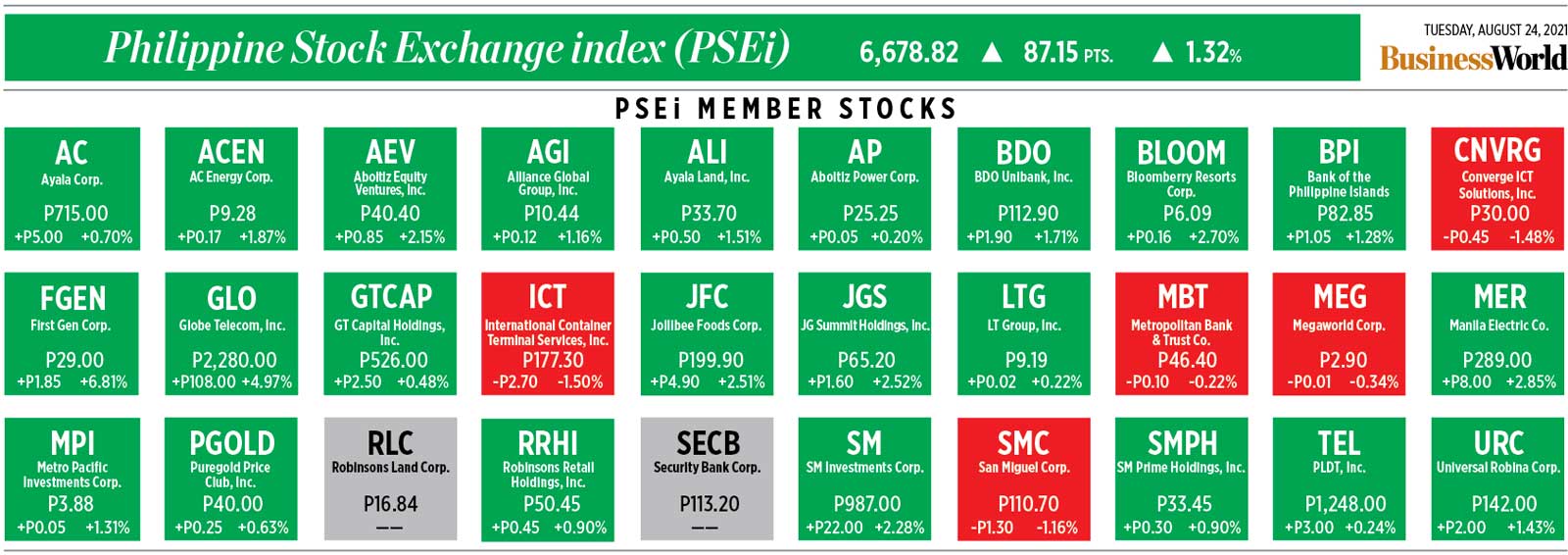
How PSEi member stocks performed — August 24, 2021

Here’s a quick glance at how PSEi stocks fared on Tuesday, August 24, 2021.


IMF’s record-high SDR allocation takes effect; Philippines gets $2.78 billion worth of funds

THE PHILIPPINES will receive $2.8-billion worth of Special Drawing Rights (SDRs) from the International Monetary Fund (IMF), as part of the latter’s efforts to help countries recover from the coronavirus pandemic. Read the full story.

IMF’s record-high SDR allocation takes effect; Philippines gets $2.78 billion worth of funds

PSEi up as investors shrug off record COVID cases

PHILIPPINE shares closed in the green on Tuesday as investor sentiment got a boost from improvements in the country’s vaccination rate and fresh data showing a narrower budget deficit in July.

The Philippine Stock Exchange index (PSEi) gained 87.15 points or 1.32% on Tuesday to close at 6,678.82, while the broader all shares index added 33.92 points or 0.82% to end at 4,144.88.

“[This is] after the latest budget deficit data narrowed to the least in three months, local COVID-19 vaccines administered [went] above the 30 million mark, and after US stock markets mostly posted new record highs on optimism on increased immunization requirements or mandates versus COVID-19, stronger US existing home sales data,” Rizal Commercial Banking Corp. Chief Economist Michael L. Ricafort said in a text message.

The Treasury reported on Tuesday that the country’s budget deficit narrowed to P121.2 billion in July, 13.57% lower than the P140.2 billion in the same month last year. Year-to-date, the budget deficit swelled to P837.3 billion, 19.5% up from a year ago.

“Market sentiment [is] also supported by Metro Manila already vaccinated 43% of the target population and targeting 50% by end-August 2021,” Mr. Ricafort added.

Overall, the country has administered over 30 million coronavirus disease 2019 (COVID-19) vaccines, but only 12.14% or 13.13 million Filipinos have been fully vaccinated.

The local stock market also appeared to have shrugged off the continued rise in COVID-19 cases. On Monday afternoon, the Health department reported a record 18,332 in daily COVID-19 infections, and admitted there was already community transmission of the more infectious Delta variant in Metro Manila.

Darren Blaine T. Pangan, trader at Timson Securities, Inc. said the US markets positive performance overnight appeared to have spilled over to the local market.

Investors cheered the news that the US Food and Drug Administration gave its full approval for the COVID-19 vaccine developed by Pfizer, Inc. and BioNTech SE, a move seen to boost vaccination rates.

“The local bourse closed higher as foreigners continue to be net buyers today. This comes after the two-day profit taking activity that happened the past few days,” Mr. Pangan said.

Net foreign buying increased to P291.11 million on Tuesday, from the P105.79 million logged in net purchases on Monday.

All sectoral indices posted gains on Tuesday. Holding firms rose by 112.85 points or 1.71% to finish at 6,678.89, while industrials went up by 138.04 points or 1.42% to close at 9,807.25.

The property index increased by 30.32 points or 0.99% to 3,073.39, while mining and oil gained 81.64 points or 0.89% to close at 9,199.61. Financials moved up by 12.70 points or 0.88% to 1,440.59; and services inched up by 6.01 points or 0.36% to end at 1,650.68.

Value turnover declined to P5.53 billion with 2.68 billion shares switching hands on Tuesday, from the P6.29 billion with 1.94 billion issues traded the previous day.

Advancers beat decliners, 106 against 83, while 54 names remained unchanged.

Timson Securities’ Mr. Pangan said he expects the market to trade within the 6,270 to 6,840 range. — K.C.G. Valmonte

Peso up on stock market gains

THE PESO strengthened versus the greenback on Tuesday due to positive market sentiment as the local stock market rallied and with preference for the local unit due to weaker-than-expected US manufacturing data report.

The local unit closed at P50.116 per dollar, gaining 15.40 centavos from its P50.27 finish on Monday, based on data from the Bankers Association of the Philippines.

The peso opened Tuesday’s session at P50.16 a dollar. Its weakest showing was at P50.24 while its intraday best was at P50.06 versus the greenback.

Dollars exchanged rose to $967 million on Tuesday from $717.65 million on Monday.

Rizal Commercial Banking Corp. Chief Economist Michael L. Ricafort said the peso’s strength was due to positive market sentiment due to gains in the local stock market.

The bellwether Philippine Stock Exchange index rose b 87.15 points or 1.32% to close trading at 6,678.82 on Tuesday. The broader all shares index also increased by 33.92 points or 0.82% to 4,144.88.

Meanwhile, a trader said the peso appreciated after the release of a weaker-than-expected US manufacturing sector report.

The IHS Markit’s US Composite Purchasing Managers Index (PMI) Output Index, which gauges the manufacturing and services sector, dropped to a reading of 55.4 in August from 59.9 in July. The index was the lowest since December, Reuters reported on Monday. It was still however above the 50-reading mark that indicates expansion in the sector.

For the flash services sector PMI, the reading stood at 55.2 from 59.9 in July. This was also weaker than the 59.5 estimate in a Reuters poll.

On the other hand, the flash manufacturing PMI was at 61.2, falling from the 63.4 in July. A Reuters poll estimated a stronger reading of 62.5 for August.

For Wednesday, both Mr. Ricafort and the trader gave a forecast range of P50 to P50.20 per dollar. — Luz Wendy T. Noble with Reuters

ASEAN growth seen rebounding after strictly enforced lockdowns

REUTERS

SOUTHEAST ASIA’S stunted growth momentum due to the severity of its lockdowns will be temporary because of its critical role in global supply chains, which will allow it to eventually close the gap with regions that remained relatively open like Latin America, Moody’s Analytics said.

Moody’s Analytics noted that strict lockdowns in Southeast Asia have hurt key growth drivers in the region such as consumer spending and exports.

“Pandemic restrictions proved largely successful in preventing mass outbreaks in export-oriented manufacturing industries, a key motor of growth for Southeast Asian economies,” Moody’s Analytics Economist Jesse Rogers said in a note Tuesday.  

“However, with restrictions on the service sector severing the traditional link between manufacturing and gains in the broader economy, trade will provide only limited support,” it added.

Mr. Rogers said Latin American countries saw a smaller hit to consumer spending, retail sales and industrial production, as most leaders pushed “to keep economies running even at the expense of adverse health outcomes.”

“Sweeping restrictions on social and business activity caused output to decline in Malaysia, the Philippines and Vietnam on a seasonally adjusted basis in the second quarter,” Mr. Rogers said.

“Thailand and Indonesia fared better, but Delta’s surge in these countries did not begin until late June, and we expect the hit from pandemic restrictions to show forcefully when July data begin to trickle in later this month,” he added.

Asian Institute of Management Economist John Paolo R. Rivera said the ASEAN strategy is more aligned with the region’s healthcare capacity.

“While this is not economically sustainable, lockdowns allow governments to buy time in creating innovative ways to manage the pandemic whilst having manageable economic repercussions,” Mr. Rivera said in a text message.

Metro Manila and some provinces reverted to the strictest lockdown settings for two weeks in March and April due to an infection surge.

Restrictions have since been eased. However, Metro Manila and some provinces were again back on lockdown from Aug. 6 to 20 to contain the Delta variant of the coronavirus.

Moody’s Analytics downgraded its growth outlook for the Philippines to 4% in August, from the previous estimate of 4.9%, citing the new lockdowns.

Gross domestic product (GDP) rose 11.8% in the second quarter, ending a 15-month recession. However, GDP dropped 1.3% quarter on quarter, reflecting the impact of the lockdown in March and April.

COVID-19 cases rose by 12,067 Tuesday, bringing total active infections to 127,703, according to the Department of Health.

Another factor that dampened Southeast Asian growth in comparison to Latin America is the late start of vaccination campaigns in ASEAN, Moody’s Analytics said.

“In most of the region, less than one-fifth of the population has received vaccine first doses — means that pandemic waves will reverberate for some time,” Mr. Rogers said. — Luz Wendy T. Noble

Pandemic delays 37 power transmission projects

THE DEPARTMENT of Energy (DoE) said the public health emergency has set back the timetables of 37 transmission projects of the National Grid Corp. of the Philippines (NGCP).

Twenty-four of the projects are being implemented in Luzon, 10 in the Visayas, and three in Mindanao.

“At the height of the nationwide community quarantine, NGCP was constrained to suspend its construction projects to ensure compliance with health and safety regulations,” the DoE said in its 2020 Power Situation Report posted on its website this week.

The Mindanao-Visayas Interconnection Project (MVIP), which links the power grids of the two island groups, is one of the 37 projects which were delayed, it said.

The MVIP, which has been certified by the DoE as an energy project of national significance, was initially scheduled for completion in December, but was set back by the pandemic, and also by damage to one of its fiber optic submarine cables.

The DoE said that the MVIP’s completion date is now December 2022, according to the transmission development plan submitted by the NGCP.

In the same report, the DoE also said power capacity in 2020 grew by around 3% to 26,286 megawatts (MW), after two large coal-fired power plants started operating — Masinloc Unit 3 on Luzon and GNPower Kauswagan Unit 4 on Mindanao.

“By the end of 2020, a total of 655 MW of installed capacity was added to the country’s power supply. The bulk of the capacity additions were supplied to the grid and equaled 643 MW, comprising coal (527 MW), solar (71 MW), oil-based (45 MW), and hydro (0.3 MW),” the DoE said.

Last year, coal accounted for 56% of the gross power generated on Luzon. Natural gas and hydro made up 26.9% and 6.2%, respectively.

“Over the past years, the power generation mix followed a similar trend, with coal and natural gas as the consistent top sources of energy in Luzon,” DoE said. — Angelica Y. Yang

Young, underbanked consumers seen as fintech’s main chance

THE FINTECH industry has room to grow in Southeast Asia, which is underbanked and has a large population of young people, Fitch Ratings said.

In a note Tuesday, the ratings agency said over half of the 580 million combined population of the Philippines, Singapore, Indonesia, Malaysia, Thailand and Vietnam are under 35 years of age.

“This presents a large pool of consumers who will underpin demand for financial services as incomes rise over the next decade,” it said.

Fitch Ratings cited a World Bank finding that over half of the region’s population remained unbanked — with the largest cohort in the Philippines and Vietnam. It noted that the lack of funds remains the major barrier for registering with a financial institution, keeping financial services penetration rates low.

“Geography poses further complications, as the archipelagic nature of Indonesia and the Philippines raises distribution and servicing costs in those markets,” Fitch said.

Fitch believes service providers will be able to overcome the region’s income and geographical issues in the region, though the technology tools most likely to be used to bridge those gaps remain vulnerable to cyberattack.

“Scalable technology can lower the marginal cost-to-serve and broaden geographic coverage, although benefits will take time to crystallize; upfront costs may be significant, network connectivity remains uneven and mis-steps will occur as innovators test uncharted waters,” it said.

Regulators are also supportive of fintech in the region, Fitch noted. The Bangko Sentral ng Pilipinas has a target of migrating 50% of payment transactions to digital by volume and value by 2023. Countries are also working to build cross-border payment mechanisms.

Fitch said credit could be the biggest opportunity for fintechs particularly in Indonesia and the Philippines.

“Limited access to formal credit stems partly from low and inconsistent incomes, identity documentation gaps and a lack of financial records,” Fitch said, can be overcome by fintechs, who have expertise in evaluating the credit of non-prime customers shunned by banks.

It said fintechs may target small consumer transactions or small businesses, where the unserved demand for financing services has been estimated at $400 billion by the International Finance Corp.

“Connectivity remains a challenge for rural communities in Indonesia and the Philippines, which could constrain fintech expansion in these areas,” it said. It however noted the national ID initiative of the Philippines alongside the construction of a secure payment system will help the market grow there. — Luz Wendy T. Noble

ADVERTISEMENT
ADVERTISEMENT