Home Blog Page 743

Biz groups call for transparency in Ombudsman rulings

OFFICE OF THE OMBUDSMAN PHILIPPINES FACEBOOK PAGE

SEVERAL business and civil society groups have urged the Ombudsman to ensure transparency after an undisclosed decision reversed a 2016 ruling against a senator over alleged Priority Development Assistance Fund (PDAF) misuse.

In a joint statement released on Wednesday, the Justice Reform Initiative (JRI), Financial Executives Institute of the Philippines (FINEX), Makati Business Club (MBC), and Management Association of the Philippines (MAP) stressed that public disclosure of all transactions involving public interest is mandated by the Constitution.

“We commend Ombudsman Jesus Crispin Remulla for disclosing the alleged secret decision to reverse the 2016 order of then Ombudsman Conchita Carpio Morales against then Congressman Joel Villanueva over his alleged misuse of the PDAF,” the statement read.

The groups warned that keeping such reversals secret could undermine public confidence in the justice system and “send a dangerous signal that decisions affecting public accountability may be quietly undone.”

Earlier, Ombudsman Jesus Crispin C. Remulla released a copy of former Ombudsman Samuel R. Martires’ 2019 decision that nullified the 2016 dismissal order against Mr. Villanueva, which had found him administratively liable for allegedly misusing P9.7 million in PDAF funds.

“We therefore respectfully urge the Ombudsman to uphold the rule of law and proceed with the investigation and prosecution of all public officials found culpable,” the groups said.

They said that jurisprudence allows revisiting prior rulings when justice may have been compromised and called for a technology-enabled public registry of decisions and resolutions involving public officers to modernize the justice system.

“The Ombudsman, by standing by its sworn duty, can stop the impunity of corruption, be a champion of justice, and deliver on the promise of a government for the people,” the statement added. — Erika Mae P. Sinaking


Gov’t told: Keep celebrations simple

PRESIDENT FERDINAND “BONGBONG” R. MARCOS, JR. — PRESIDENTIAL COMMUNICATIONS OFFICE

PRESIDENT Ferdinand R. Marcos, Jr. told government agencies to keep year-end celebrations simple amid corruption and environmental issues hounding the country.

The reminder, jointly issued with the Department of Budget and Management (DBM) led by Secretary Amenah F. Pangandaman, calls on all government agencies to exercise prudence in spending during the holiday season.

The administration’s directive follows a series of natural disasters — including earthquakes that struck parts of Visayas and Mindanao and typhoons that battered several regions in recent weeks.

“While celebrating milestones and camaraderie is important, let us not forget that many of our kababayans continue to struggle, especially those [who] are hit by recent calamities,” Ms. Pangandaman said in a separate statement.

The DBM issued a circular letter reiterating that all government entities — including government-owned and -controlled corporations, government financial institutions, state universities and colleges, and local government units — must strictly observe rules on the judicious use of public funds during Christmas and New Year activities.

The reminder cited Executive Order No. 292, Republic Act No. 6713, and Commission on Audit Circular No. 2012-003, which prohibit irregular, unnecessary, and extravagant expenditures such as luxury venue rentals, liquor purchases, or lavish parties funded by public money. — Chloe Mari A. Hufana

McDonald’s Philippines named Employer of the Year

PRESIDENT and CEO Kenneth Yang accepted the award during the PMAP Annual Conference in Cebu City, where McDonald’s was also recognized with Exemplar Status for the National Capital Region.

MCDONALD’S PHILIPPINES was named the Employer of the Year by the People’s Management Association of the Philippines (PMAP), citing its business and people management practices.

The fastfood chain was given the Exemplar Status for the National Capital Region by PMAP, the country’s premier organization for human resource practitioners and people managers.

The fastfood chain, which practices direct hiring and non-contractualization, noted that every McDonald’s store provides 80 to 100 new jobs.

At present, McDonald’s has over 800 stores nationwide with 70,000 workers.

It noted that 70% of McDonald’s employees are working students and are granted flexible work hours to help them continue their studies.

“Since opening our first store in 1981, we’ve contributed to economic growth and have provided employment and business opportunities for our franchisees, partner suppliers, and the communities we serve,” McDonald’s President and Chief Executive Officer Kenneth Yang said in a statement.

Golden Archers Development Corp. (GADC), which manages McDonald’s in the Philippines, recently secured a multi-unit franchise agreement with American fast food giant McDonald’s Corp. for a new 20-year franchise term in the Philippines.

“The new-term license also came at a time of accelerated growth, with the company opening and operating stores in virtually all provinces in the country, bringing the McDonald’s experience closer to every Filipino,” it said.

McDonald’s Philippines became a fully Filipino-owned company in 2005, with the Yang family as majority owners and tycoon Andrew L. Tan-led Alliance Global Group, Inc. is its investment partner. — Beatriz Marie D. Cruz

Chinese national nabbed for running crypto scam in Parañaque — BI

PHILSTAR FILE PHOTO

THE Bureau of Immigration (BI) has arrested a Chinese national allegedly operating a cryptocurrency investment scam in a condominium unit in Parañaque City.

In a statement on Wednesday, the BI said fugitive search unit (FSU) agents, working with the Criminal Investigation and Detection Group-National Capital Region (CIDG-NCR) and the Department of Justice Office of Cybercrime, apprehended a 41-year-old Chinese national on Monday, inside a residence along Diosdado Macapagal Blvd. in Barangay Tambo.

Authorities said the man was caught in the act of managing a computer workstation suspected of being used for online fraud. Intelligence reports earlier linked the location to another Chinese national believed to be running the operation with several accomplices.

He had also overstayed in the country, failing to extend his visa since October 2024, and was found to be working without a permit.

The Chinese national is now in custody of the CIDG for further investigation after the recovery of suspected drug paraphernalia at the scene. Deportation proceedings will be initiated, and he will be barred from re-entering the Philippines once sent back to China, the bureau added. — Erika Mae P. Sinaking
Candidates unlikely to win not nuisance, SC says

PHILSTAR FILE PHOTO

THE Supreme Court (SC) en banc has ruled that the Commission on Elections (Comelec) committed grave abuse of discretion when it declared a candidate a nuisance and canceled his certificate of candidacy (CoC) for senator in the May 2025 elections.

In a 39-page decision written by Chief Justice Alexander G. Gesmundo, the SC overturned Comelec’s cancellation of Subair Guinthum Mustapha’s CoC for the 2025 senatorial elections, after he was declared a nuisance over low past votes and limited nationwide support.

Mr. Mustapha, a labor advocate and local leader in Marawi, filed under the Workers and Peasants Party and presented evidence of his legal education, leadership roles, advocacy work, and governance platform to show his genuine intent to run.

The SC clarified that nuisance candidacy rules are meant to prevent farcical filings, but low popularity or minimal prior electoral success alone cannot justify disqualification.

“In a democratic institution such as ours, it is the people who are vested with the sole authority to decide whether a candidate wins or not, and such decision is to be passed upon only during the day of election,” the ruling read.

“The Comelec, therefore, should not deprive the people of a legitimate choice by declaring candidates as nuisance candidates simply because it perceives that said candidates have low chances of winning as purportedly shown by their previous dismal votes.”

While acknowledging Comelec’s role in maintaining credible elections, the high court urged caution, reminding the body not to rely on invalid grounds such as financial capacity or perceived unpopularity.

Senior Associate Justice Marvic M.V.F. Leonen, in a concurring opinion, stressed that nuisance candidate rules are meant to protect voters’ will, and Comelec must clearly demonstrate a lack of serious intent before disqualifying anyone. — Erika Mae P. Sinaking

Senator files measure vs power bill deposits

A SENATOR on Wednesday said that he has filed a bill seeking to scrap the collection of bill deposits by distribution utilities (DUs) and electric cooperatives (ECs) to ease costs for power consumers.

“This bill seeks to abolish the collection and reimposition of bill deposits and mandate the refund of existing deposits, together with accrued interest,” Senator Sherwin T. Gatchalian said in the explanatory note of Senate Bill No. 1470, the Anti-Bill Deposit bill.

The proposed measure orders the DUs and ECs to refund all existing bill deposits, together with accrued interest up to the date of the actual release.

“In this way, we can ensure equal and affordable access to electricity for everyone, without having to pay a deposit,” he added.

The refunds should be released in cash, check, or electronic transfer, unless consumers choose to apply them to future bills.

“This measure strengthen consumer protection, promotes equitable access to electricity, and aligns regulatory practices with the Senate’s mandate to provide reliable and affordable power service,” he said.

The bill also mandates the Energy Regulatory Commission (ERC) to conduct an independent audit of all bill-deposit accounts and to prescribe non-deposit-based credit-risk alternatives.

Mr. Gatchalian added that the ERC should prescribe non-deposit bases credit risk alternatives such as prepaid or installment-based arrangement to maintain payment discipline to consumers without imposing upfront costs. — Adrian H. Halili

PSEi plunges to three-year low on growth woes

REUTERS

PHILIPPINE STOCKS retreated on Wednesday, with the benchmark index plunging to a three-year low, amid fears over slowing economic growth that were worsened by negative sentiment from Wall Street due to concerns over the valuation of the artificial intelligence (AI) sector.

The bellwether Philippine Stock Exchange index (PSEi) fell by 0.83% or 48.98 points to close at 5,818.06, while the broader all shares index decreased by 0.68% or 24.50 points to end at 3,534.38.

This was the PSEi’s worst finish in over three years or since it closed at 5,783.15 on Oct. 3, 2022.

The main index opened Wednesday’s session at 5,891.23, higher than Tuesday’s close, but sank to an intraday low of 5,763.68. It managed to recoup some of its losses before the closing bell.

“The Philippine market closed lower amid heavy selling pressure despite inflation figures aligning with expectations. However, the upcoming release of GDP (gross domestic product) data and corporate earnings from major index constituents will likely influence market sentiment and determine the market’s next direction,” Regina Capital Development Corp. Head of Sales Luis A. Limlingan said in a Viber message.

“The local market dropped as investors traded cautiously while looking forward to the third-quarter GDP data release, which is expected to be below target,” Philstocks Financial, Inc. Research Manager Japhet Louis O. Tantiangco said in a Viber message.

The Philippine economy likely grew by 5.3% in the third quarter, according to the median forecast of 18 economists and analysts in a BusinessWorld poll. This would be slower than the 5.5% expansion in the second quarter and is below the government’s full-year GDP growth target of 5.5%-6.5%.

The Philippine Statistics Authority will release third-quarter GDP data on Friday (Nov. 7).

“Negative spillovers from Wall Street amid overvaluation concerns with the US’ artificial intelligence sector also affected the local bourse today,” Mr. Tantiangco added.

All sectoral indices closed in the red. Mining and oil sank by 3.62% or 446.88 points to 11,891; holding firms dropped by 1.3% or 61.88 points to 4,689.75; property fell by 0.99% or 21.62 points to 2,142.74; industrials went down by 0.69% or 60.24 points to 8,588.41; services decreased by 0.57% or 12.99 points to 2,255.07; and financials retreated by 0.52% or 10.20 points to 1,925.98.

“Metropolitan Bank & Trust Co. was the day’s index leader, climbing 2.26% to P68. Aboitiz Equity Ventures, Inc. was the main index laggard, falling 4.78% to P26.90,” Mr. Tantiangco said.

Decliners overwhelmed advancers, 137 to 53, while 61 names were unchanged.

Value turnover went down to P4.72 billion on Wednesday with 406.27 million shares traded from the P6.37 billion with 538.81 million issues exchanged on Tuesday.

Net foreign buying edged down to P339.58 million from P339.79 million. — A.G.C. Magno

Palay production up 12.6% in Q3 after increase in planted area

PHILIPPINE STAR/ KJ ROSALES

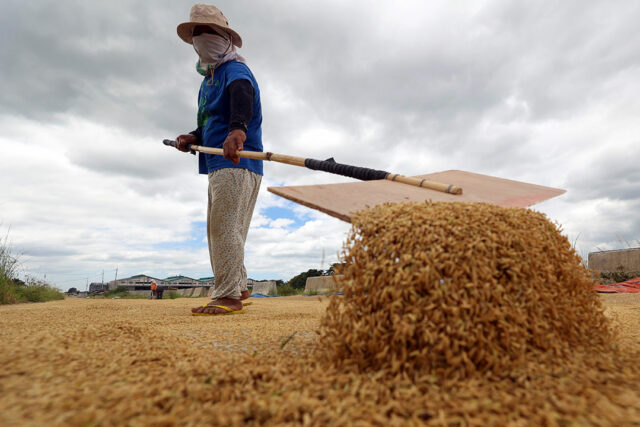
PRODUCTION of palay (unmilled rice) rose 12.6% year on year in the third quarter to 3.75 million metric tons (MT), aided by a 15.7% increase in the land planted to rice, the Philippine Statistics Authority (PSA) said.

Palay output comes in below the PSA’s adjusted estimate of 3.93 million MT issued last month.

Cagayan Valley was the top producer of palay with 499,700 MT or 13.3% of the total. The Western Visayas produced 489,640 MT (13.1%) and Central Luzon 385,100 MT (10.3%).

The three regions accounted for 36.7% of the national total during the quarter.

The harvested area in the third quarter was estimated at 916,770 hectares, up 15.7% from a year earlier.

The Western Visayas accounted for 15.8% or 145,100 hectares of the total palay harvested area, followed by Soccsksargen and the Cagayan Valley with 102,200 hectares (11.1%) and 100,080 hectares (10.9%), respectively.

The yield per hectare of palay in the third quarter declined 2.7% year on year to 4.20 MT.

Cagayan Valley was the top yielding province with 4.99 MT per hectare, followed by the Ilocos Region and Davao Region with yields of 4.95 MT and 4.92 MT, respectively.

The PSA estimates fourth-quarter palay output at 7.06 million MT, which would represent a decline of 2.3% from a year earlier. — Vonn Andrei E. Villamiel

Fisheries output drops 7.5% in Q3 on typhoon damage to aquaculture

BW FILE PHOTO

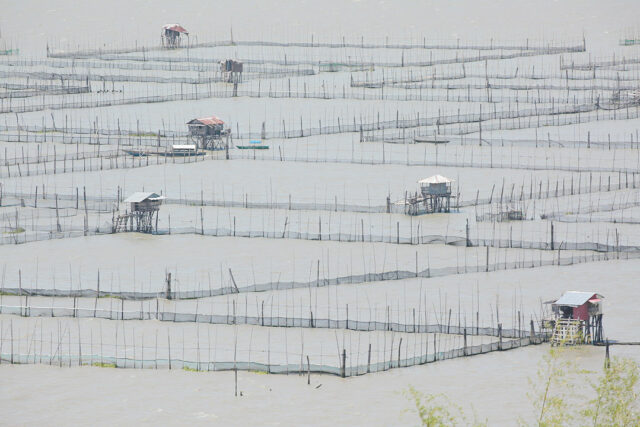
FISHERIES production fell 7.5% year on year in the third quarter to 894,320 metric tons (MT), with aquaculture leading the decline after extensive typhoon and flood damage during the period, according to the Philippine Statistics Authority (PSA).

“Decreases in production were noted in aquaculture, marine municipal fisheries, and inland municipal fisheries. Meanwhile, commercial fisheries posted production increments during the quarter,” the PSA said.

Aquaculture production fell 12.3% year on year in the third quarter, bringing the total production to 454,860 MT. The subsector accounted for 50.9% of the total fisheries production.

Commercial fisheries, which accounted for 25.1% of fisheries output, rose 4.7% to 224,560 MT.

Marine municipal fisheries production declined 9.7% in the third quarter, with production valued at 168,920 MT. The subsector accounted for 18.9% of total production.

Inland municipal fisheries production fell  0.6% to 45,990 MT, equivalent to 5.1% of overall fisheries output.

The PSA added that of the 21 major species, seaweed production fell 15.7%, bali sardinella (tamban) 13.3%, and milkfish (bangus) 9.7%.

Output grew for skipjack (gulyasan) 15.9%, squid (pusit) 22.6%, and tilapia (3.1%). — Vonn Andrei E. Villamiel

Agri output likely fell in Q3 led by fisheries; ASF concerns continue

PHILIPPINE STAR/ MICHAEL VARCAS

By Andre Christopher H. Alampay

AGRICULTURAL OUTPUT is estimated to have slowed or fallen in the third quarter after a sharp drop in fisheries volume, with analysts and industry officials also skeptical of the performance of the hog industry due to the continuing African Swine Fever (ASF) outbreak.

If borne out, their worries about the third quarter would check the momentum gained a quarter earlier, when output rose 5.7% year on year, the strongest performance in eight years.

Nevertheless, the crops subsector is expected to turn in a positive performance, despite the impact of typhoons and flooding during the period.

Former Agriculture Secretary William D. Dar said via Viber that crop output likely rose 1% despite the typhoons and two major earthquakes in Cebu and the Davao region.

“The growth would have been higher if not for these challenges and problems… farmers continue with dedication to plant rice,” he said.

He credits the Masagana Rice Industry Program and the Rice Competitiveness Enhancement Fund in supporting farmers and farm production during this quarter.

Federation of Free Farmers National Manager Raul Q. Montemayor said via Messenger that output of palay (unmilled rice) will likely rise during the period, coming off a low year-earlier base of 3.33 million metric tons (MMT).

He added that the third-quarter 2023 volume of 3.8 MMT remains out of reach “due to reduced plantings because of low palay prices.”

The Philippine Statistics Authority’s own updated estimate based on the standing crop is 3.93 MMT, which would be up 18% year on year but down 9.7% from a quarter earlier.

Corn production is expected to come in at around 2.4 MMT for the quarter, down 0.4% year on year but up 62.1% from the second quarter.

Mr. Dar also said livestock and poultry were “not growing well” or could post “minimal growth,” though he added that the poultry segment is “rebounding.”

Former Agriculture Undersecretary Fermin D. Adriano said via Viber that livestock production remains a worry due to ASF.

Mr. Adriano said official assessments of the ASF situation could be too optimistic.

The Bureau of Animal Industry (BAI) reported a drop-off in the geographic scope of ASF outbreaks this year. As of Oct. 3, the BAI said the number of barangays with active ASF cases dropped to 31 from 505.

These reports, Mr. Adriano said, do not take into account the sharp decline in the swine population.

“At a certain level of decrease, decline will plateau. This does not mean we have checked for the spread of disease… It will undoubtedly be checked if there is an increase in swine population without a setback for a period of time.”

Mr. Adriano said that if an effective vaccine against ASF is not rolled out, farmers will have to resort to drastic isolation measures as did Spain and China.

Such a strategy “will have adverse consequences to backyard raisers who cannot afford the cost of biosecurity measures,” he said.

National Fisheries Research and Development Institute Board Member Norberto Chingcuanco said via Messenger that fisheries production will fall after storms affected major aquaculture sites like Taal Lake and Pangasinan.

Fisheries production had fallen 5.1% in the third quarter of 2024, also due to typhoons. The government announced this week that fisheries production by volume in the third quarter fell 7.5% to 894.32 thousand metric tons.

Mr. Chingcuanco said the Bureau of Fisheries and Aquatic Resources and the Department of Environment and Natural Resources need to find regions to farm fish that are not along the usual typhoon track.

He named Lake Mainit in northeast Mindanao, the Pantabangan Dam reservoir in Nueva Ecija, and Naujan Lake in Oriental Mindoro as potential sites to invest in.

Agriculture output data will be released today, Nov. 6.

‘Lifeline’ subsidized-power program could expand with more consumers being classified as eligible

BW FILE PHOTO

MORE low-income electricity consumers could be admitted to the power subsidy program with the Energy Regulatory Commission (ERC) considering adjustments to the eligibility threshold for availing of “lifeline” rates.

In a statement on Wednesday, the ERC said it is conducting consultations on a proposed uniform national lifeline subsidy rate which will expand the coverage of the Lifeline Subsidy Program.

Under the proposal, qualified end-users consuming 50 kilowatt hours (kWh) per month or less will get a 100% discount on their electricity bills.

Qualified beneficiaries of the Pantawid Pamilyang Pilipino Program (4Ps) whose power consumption does not exceed the 50-kWh threshold will automatically be enrolled in the program and enjoy the lifeline rate.

According to Republic Act No. 9136 or the Electric Power Industry Reform Act, the ERC must offer subsidized electricity to qualified low-income consumers unable to pay their electricity bills at full cost.

At present, lifeline rate discounts vary depending on the prevailing rates of distribution utilities (DUs) or electric cooperatives.

Within the franchise area of Manila Electric Co. — the country’s largest private distribution utility — qualified lifeline consumers using 20 kWh per month or less are granted a 100% discount on generation, transmission, system loss, distribution, supply, metering, and other charges.

To fund the discounted rates under the enhanced program, a one-centavo per kWh lifeline subsidy rate will be collected. A lifeline subsidy fund will be created, which will be administered by state-run Power Sector Assets and Liabilities Management Corp. (PSALM).

DUs, retail electricity suppliers, and the National Grid Corp. of the Philippines will collect the subsidy rate and remit all proceeds to PSALM.

The ERC said it will conduct an annual review of the subsidy rate, consumption threshold, and sufficiency of the fund.

“We are conducting public consultation to gather valuable insights from all stakeholders. This participatory approach ensures that the proposed uniform national lifeline subsidy framework is not only aligned with the law, but is fair, transparent, and responsive to the needs of the marginalized electricity consumers,” ERC Chairman and Chief Executive Officer Francis Saturnino C. Juan said.

In a position paper dated Nov. 5, the National Association of Electricity Consumers for Reforms, Inc. (Nasecore) said the ERC should observe “equity and cost-of-service principles across all consumer classes,” instead of offering subsidies.

“Continuing to rely on the Lifeline Program to mask unfair pricing perpetuates dependence on cross-subsidies and hides inefficiencies, while punishing millions of non-lifeline households who dutifully pay but receive no protection,” Nasecore President Petronilo L. Ilagan said.

Gerry C. Arances, convenor of People for Power Coalition, said that  the expansion of the program will only provide a “fraction of the relief needed by consumers as electricity costs soar.” 

Since the program comes in the form of cross-subsidies, consumers are “pitted against each other while distribution utilities, especially those privately owned, continue to rake in billions,” he said.

“If the ERC and the Marcos administration are serious about solving the problem of energy poverty, they should have pushed through with the review of the Electric Power Industry Reform Act and its failed promise of least-cost electricity,” Mr. Arances said.

As of June 2025, around 4.5 million households have been identified by the Department of Social Welfare and Development as eligible for the Lifeline program, primarily through the 4Ps registry.

Only about 330,000 households or 7.34% of those qualified have registered with their respective DUs as of July, according to the Department of Energy. — Sheldeen Joy Talavera

Waste-to-energy auction could offer up to 200 MW in capacity to bidders

DAVAOCITY.GOV.PH

THE Department of Energy (DoE) may set an installation target of up to 200 megawatts (MW) for the special green energy auction (GEA) round focused on waste-to-energy (WTE) technology next year, with the projects scheduled for delivery in 2028.

According to the draft terms of reference, the DoE said the special auction round will be conducted exclusively for WTE projects employing thermal combustion technology, which will be eligible under Renewable Portfolio Standards.

The WTE projects will source their waste feedstock within Metro Manila and highly urbanized cities (HUCs).

The DoE is proposing to set the installation target at 170 MW, with an option to raise the total by up to 30 MW.

The installation target has initially been set at 20 MW each for Metro Manila and Davao, and 10 MW each for Bacolod, Cebu, and Cagayan de Oro.

According to 2024 estimates from the National Solid Waste Management Commission, Metro Manila and HUCs generate an estimated 6.12 million metric tons of municipal solid waste, which can be converted to 335 MW of baseload power.

WTE converts non-recyclable waste materials into usable heat, electricity, or fuel using various technologies.

Last month, the DoE announced that it will launch the special auction round in January 2026.

A succeeding auction round planned for the second quarter of 2026 will cover biomass and WTE projects.

“The integration of WTE projects into the GEA framework underscores the DoE’s commitment to ensuring energy security, environmental protection, and private sector participation in the country’s transitioning to clean and sustainable energy,” the DoE said.

The GEA program aims to promote renewable energy as a primary source of energy through competitive selection. The supply contract for winning renewable energy projects will run for 20 years, starting from the commercial operation date. 

As a flagship government initiative, the program is expected to contribute to the national target of achieving a 35% renewable energy share in the power generation mix by 2030 and 50% by 2040. — Sheldeen Joy Talavera

ADVERTISEMENT
ADVERTISEMENT