Home Blog Page 735

Quezon!

Quezon (2025)

Movie Review
Quezon
Directed by Jerrold Tarog
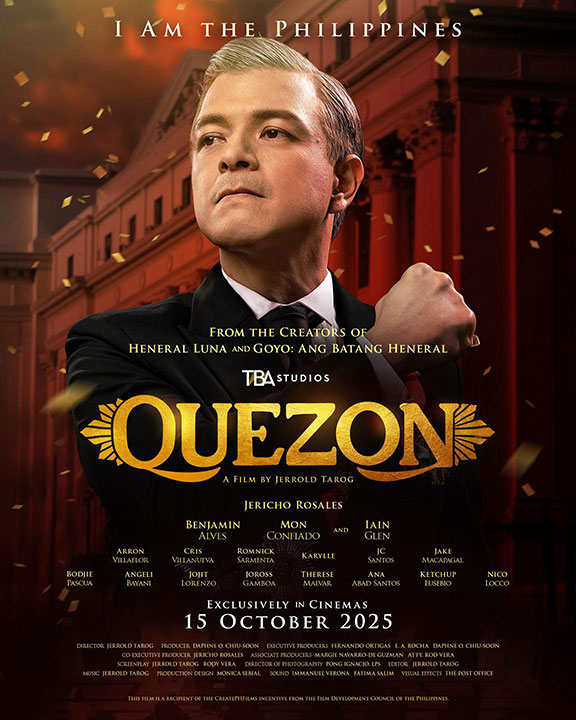
Quezon (2025)

STARTING right off with a caveat: I am not a historian, merely a student of film. I can talk of storytelling and visual style, but of historical facts about the period and details of the man himself? I can at most repeat what I’ve found through online research, perhaps hazard a few inexpert opinions based on what I’ve read.

The film itself starts in quietly spectacular fashion, taking its cue from the film that inspired many an aspiring director, Welles’ Citizen Kane: a silent short depicting the younger Quezon (Benjamin Alves) during the Philippine-American War; for the rest of the running time fictional journalist Joven Hernando (Cris Villanueva) dogs Quezon’s heels, digging into and commenting on the man’s life the way Jerry Thompson dug into and commented on Charles Foster Kane. Director Jerrold Tarog, working with cinematographer Pong Ignacio (who lensed the previous two installments of the director’s period epic, Heneral Luna and Goyo: Ang Batang Heneral) employs the kind of sweeping camera movements Welles used in his second feature, The Magnificent Ambersons, or Bertolucci in 1900 or — to name a model closer to home — Peque Gallaga in his wartime drama Oro Plata Mata (mind you, I’m not ranking Mr. Tarog as equal to Welles or even Bertolucci, just citing influences).

More inspired in my book is Tarog’s editing and music score: Quezon prances to the rhythm of the tango, a sensual dance that, when played at a brisk pace, reveals a strong sardonic streak. The film isn’t so much biopic as it is musical, with passages that entirely take their cue — emotional tone, satiric edge — from a song; isn’t just any old musical but a dance musical, with Quezon himself (Jericho Rosales) and partner-in-crime Sergio Osmeña (Romnick Sarmenta) high-stepping their way into Leonard Wood’s (Iain Glen) office for a quick game of high-stakes hijinks.

Glen underplays wonderfully against Rosales and Sarmenta, coming across as the experienced civil servant trying to curb the enthusiasm of two overcaffeinated politicos — or, to push a different metaphor, like a schoolmaster trying to educate a pair of hyperactive juveniles. Rosales for all his yelling can’t match Glen’s gravitas, and this is deliberate, I think, a case of brown skinned David needling a pale faced Goliath. Glen plays it two ways: in an intimate scene he confides to Quezon (and us) that he’d like nothing more than to retire and go home but has a job to do; at the same time he comes across as someone who thinks he knows what’s best for us — a whiff of condescension taints his most solemnly stated intentions. When Quezon does pull one over Wood (as in the case of Wood’s appointee attempting to shut down the city gambling dens) you can’t help but cheer the Filipinos for their effrontery.

The film isn’t perfect, far from it. Its mediating consciousness, reporter Joven Hernando, is a rather bland persona, and necessarily so; Tarog isn’t about to spend millions of pesos telling his story (likewise Jerry Thompson in Kane was an equally anonymous creature). More interesting is the character of Emilio Aguinaldo (Mon Confiado) — a Machiavellian figure in Heneral Luna (General Luna), an equally shadowy figure in Goyo: Ang Batang Heneral (Goyo: The Boy General). One senses that he’s Tarog’s real focus, the director’s hidden agenda while selling the project to his producers: an epic on the Philippine-American War focused on three heroes — Luna, Del Pilar, Quezon — that really tells (in three chapters) the arc of Aguinaldo’s career, from revolutionary leader to first Philippine president to shadowy ghost from the political past, rising up to fight Quezon for the presidency.

Except we don’t really get a proper narrative; the focus remains on the three heroes. Tarog needs to tell each of their stories properly – he’s spending millions of other people’s money after all — and ends up short-changing the ex-president. Aguinaldo is granted a high point: when Quezon is challenged, he responds by taking away privileges and digging up skeletons in Aguinaldo’s past; the old man’s face grows grimmer and grimmer and grimmer, and at a certain point you start to feel a bit sorry for him. A bit.

Perhaps my biggest complaint is that Tarog doesn’t listen to the whispered voices in his head and turn the film into a dance musical, complete with sung-through lyrics and an original tango score (Quezon!). I can see the project exercising the director’s full talents as composer and editor, the results stylized enough to quell any outcry; after all, it’s hard to ask critical questions when your feet are tapping to the melody.

That’s my thoughts on the film as a film — if we’re talking of Quezon as darkly comic entertainment, Tarog largely pulls it off; the feature carries you along further and faster along the tides of history than his previous efforts Heneral Luna and Goyo. If we’re talking whether or not Tarog should have adopted that specific cynical tone, well…

The biopic is generally far from being my favorite genre; most productions have to tread carefully, especially when the subject is still alive or his descendants still around, ready and willing to threaten a lawsuit or restraining order (Citizen Kane anyone?). I don’t think disrespect is fatal to a biopic; I think it’s essential if the film is to be at all interesting. Hate, love, ambivalence, any and every emotion in the dictionary should inform the feelings of the filmmaker except indifference, or (god help us) unthinking reverence.

I also question the charge that Tarog has stained Quezon’s reputation; if anything, he’s taken the cold marble statue of the man and breathed a little life into him — instead of a halo, a pair of brass balls; instead of a stentorian megaphone, an insistent almost shrill voice. Someone questioned Rosales’ vocal performance: surely it’s inappropriate for a national hero? But if you listen to sound recordings of the real Quezon, especially when he was older, it was fairly high-pitched; a bit like Lincoln, whose voice has been described as a “falsetto, almost as high-pitched as a boatswain’s whistle.” Lincoln realized his voice was a handicap, and developed his diction and rhetorical style to compensate; I assume Quezon did something similar, and Rosales decided to stay true (or as true as ability allows) to historical record.

That assertion — that a national hero must have a heroic voice — feels naive. Surely we have come to know better; if not, it’s up to filmmakers like Tarog to try show us something better, or at least something different, not necessarily for the sake of being different but for that startling detail dug up from historical record that jolts us into realization: why, this is an actual person, one who walked on everyday pavement — in a pair of shoes, like the rest of us.

There’s the question of a pro-American slant and, yes, Tarog does paint a flattering portrait of Wood (ignoring, for one, the Governor-General’s record of massacring women and children in Bud Dajo — I didn’t like that exclusion). At the same time an old aphorism pops into my head: if you want to know a man, talk to his enemies. If you want to build up a man, build up his enemies, making his eventual triumph all the more impressive. These aren’t historical but dramatic imperatives, and this, after all, is a movie.

There are cries to be “fair and balanced” and “why didn’t they consult the family?” — but a fair and balanced account is important to a history; to a film it’s… a style, at best, and one to be carefully applied lest you fairly balance all the life out of your picture. Consulting the family might turn the film into an Official Account, the equivalent of the Marcoses’ Iginuhit ng Tadhana (Written in Destiny, 1965), a mythmaking biopic that glorified that particular president’s fictional wartime record. Could Tarog have done this instead? Maybe. I don’t know all the answers, I can at best wonder.

Finally: I did see that video, of Quezon descendant Ricky Avancena confronting the actor and his director after a screening, and have this to say: I applaud Mr. Avancena for the magnanimity of his gesture, urging everyone to see the picture anyway, even if he did hate it (and he has every right to hate it, that’s his grandfather after all); I applaud the generosity of his sentiment that a work should not be suppressed but discussed and, if one ends up feeling a certain way, condemned. I also liked his style — the fiery Quezon blood does shine through. So, following his lead, I recommend: go watch, if it’s still in theaters, or go watch, if it eventually comes to streaming, and go make up your own minds.


Culinary pride or postcolonial permission? Deconstructing the Michelin moment

MAP FROM ROAD AHEAD-UNSPLASH

Nine Philippine restaurants have just earned Michelin stars — our first in history. The announcement electrified social media and dominated headlines: Filipino cuisine has finally arrived.

But through a postcolonial lens, that statement itself demands interrogation: arrived where, and according to whom? Why does our sense of arrival still depend on acknowledgment from the West?

The Michelin Guide, a 125-year-old French institution, is perhaps the most powerful arbiter of global taste. To earn a star is to be canonized into a system that has defined and refined the world’s culinary hierarchies for more than a century. It is both validation and assimilation, a moment of triumph that also mirrors our lingering colonial anxieties.

The Michelin system was born in early-20th century France, in the same cultural space that produced haute cuisine: a model of dining built on hierarchy, precision, and ritual. The star system was never neutral; it encoded an aesthetic of refinement rooted in European values of control, exclusivity, and restraint.

When Filipino restaurants such as, among others, Helm, Toyo Eatery, Gallery by Chele, or Hapag succeed within this framework, they are not only cooking; they are performing legibility to a Western system of evaluation. The degustation format, the choreography of service, the minimalist plating, the architecture of silence are signatures of an imported language of taste.

We begin to see not only the creativity and technical mastery of our chefs, but also the enduring power of colonial frameworks to define what counts as “excellent.”

This does not diminish the achievement of our chefs; on the contrary, it highlights their brilliance in navigating and subverting these codes. But it also reminds us that the Michelin model remains a gatekeeper of global culinary prestige, one that privileges form over soul, ritual over chaos, and often Western definitions of refinement over local expressions of authenticity.

THE POLITICS OF TASTE
Pierre Bourdieu wrote that taste classifies, and it classifies the classifier. Taste, in other words, is not just personal preference; it is a social construct that reflects power and reproduces privilege.

Michelin’s arrival in Manila and Cebu therefore does not simply mark a milestone for Philippine gastronomy; it marks our formal entry into a global system of permission. It tells us, once again, that excellence must be recognized elsewhere before it feels real here.

This logic of validation is familiar. It echoes our colonial conditioning: that we become beautiful when crowned by Miss Universe, artistic when exhibited in Venice, and world-class when recognized by Michelin. It is the same reflex that makes us crave global applause before we celebrate local genius.

So while the stars shine brightly, they also cast long shadows, illuminating our brilliance but exposing our insecurities.

The irony is that Filipino cuisine has never needed validation to be great. It has always been a living archive of our history: Malay roots, Chinese trade, Spanish colonization, American occupation, and a global diaspora all simmering in one pot.

Our food is messy, layered, syncretic; everything that Western culinary orthodoxy once rejected but now calls fusion. The carinderia in Pampanga that turns pork blood into poetry, the fisherman in Bohol who ferments fish with salt and sunlight, the lola in Iloilo who perfects her batchoy without ever writing down a recipe; they, too, are Michelin-class, only unacknowledged.

And yet, we rarely see them that way. Colonial conditioning has taught us that prestige lies in imported rituals, i.e., the tasting menu, the curated wine list, the architectural plating. The humble, the communal, the spontaneous are dismissed as “ordinary.”

When fine dining becomes the singular benchmark for culinary greatness, we risk erasing the everyday excellence that truly sustains our culture.

CULTURAL CAPITAL AND CULINARY PERMISSION
From Bourdieu’s cultural capital to Edward Said’s Orientalism, the logic of Western validation remains the same: it grants recognition, but always on its own terms. It decides which cuisines are worthy of admiration, and which remain curiosities to be consumed and forgotten.

Michelin’s global expansion, from Paris to Tokyo, Bangkok, and now Manila, extends not just opportunity but also oversight. It universalizes a specific aesthetic of taste and class, one historically tied to Europe’s colonial imagination.

Our participation in that system, then, is not submission; but neither is it full emancipation. It is negotiation. The Filipino chef, in this moment, becomes both artist and ambassador, innovator and interpreter, proving that our flavors can speak the language of the world while still whispering the stories of home.

Yet, as with all postcolonial negotiations, the danger lies in mistaking visibility for sovereignty.

CULINARY SOVEREIGNTY: BEYOND THE STARS
The next frontier is not more stars; it is sovereignty. Culinary sovereignty means developing our own standards of excellence, rooted in our histories, ecosystems, and ethics. It means celebrating not just who was awarded, but who was overlooked. It means recognizing that our food heritage, from kinilaw to kare-kare, pancit to pinakbet, carries wisdom that transcends the tasting menu.

It also means building institutions of our own: Philippine-led food guides, culinary awards, and research centers that document and defend the diversity of our gastronomic culture. It means investing in farmers, food historians, culinary educators, and small restaurateurs: the ecosystem that allows talent to thrive beyond the capital and beyond the gaze of foreign inspectors.

True confidence is not born of applause. It is born of authorship, i.e., the ability to write, define, and defend our own narrative of excellence.

To be fair, Michelin’s presence brings opportunity. Food is now one of our most potent forms of soft power, a diplomacy of flavor that communicates who we are without needing translation.

The stars will draw attention, tourism, and investment. But the deeper value lies in what they provoke: a national conversation about identity, pride, and cultural ownership. If we use this moment to elevate our culinary system from dependency to agency, from imitation to innovation, then Michelin’s entry becomes not an act of colonization but a catalyst for self-definition.

After all, the world is finally looking. The question is: What story will we tell when it does?

The truth is that Filipino cuisine has always been world-class, only the world is just catching up. The arrival we should celebrate is not that of Michelin to Manila, but of our own cultural consciousness: the awakening that we do not need to be discovered to know our worth.

Michelin can award stars. But only we can define taste and class on our own terms.


Dr. Ron F. Jabal, APR, is the CEO of PAGEONE Group (www.pageonegroup.ph) and founder of Advocacy Partners Asia (www.advocacy.ph).

ron.jabal@pageone.ph

rfjabal@gmail.com

Confidence before capital

The Philippine Stock Exchange index (PSEi) has declined by 17% over the past decade, even as the economy expanded and corporate profits grew and as our Asia-Pacific peers grew by around 70%. At around 6,200-6,800 in late 2025, the index remains below its 2018 peak of over 9,000 points. Meanwhile, Philippine equities trade at roughly nine times earnings, far below the historical average of fifteen and well under the regional average of thirteen to fourteen. This discount reflects weak confidence in future earnings, not weak fundamentals.

While policymakers often talk about increasing listings, enhancing infrastructure, or introducing new investment products, these supply-side measures miss the root cause: a shortage of investor demand. Companies will list only if investors are willing to buy, and investors will buy only if they believe the market is fair, liquid, and well-regulated.

Recent data underscore this imbalance. The Philippines has only about 2.8 million stock market accounts, compared with 16 million crypto users and over 40 million online gaming accounts. As Ron Acoba of Trading Edge observed, more Filipinos are comfortable with the risk and reward of gambling or crypto speculation than with long-term equity investing. This is a symptom of distrust.

Investor confidence is influenced not only by company disclosures and accounting standards but also by the broader country’s governance. In fact, foreign investors will analyze if they want to invest in the Philippines before they look at which sectors or companies they should invest in. Over the past decade, policy unpredictability, corruption scandals, and weak enforcement have consistently undermined public trust in the system. For both domestic and foreign investors, this uncertainty directly leads to higher risk premiums and lower valuations, or, worse yet, capital flight.

Other ASEAN markets have taken a different approach. Vietnam surged ahead by combining stable macroeconomic management with credible regulatory reforms. Clear tax rules, consistent monetary policy, and stronger investor protections helped Vietnam’s benchmark index rise by more than 80%t over 10 years. Indonesia has also strengthened its market by emphasizing fiscal stability and policy consistency, giving investors confidence.

In the Philippines, by contrast, governance concerns weigh heavily on sentiment. The recurring headlines on ghost projects, procurement anomalies, and misuse of public funds create an atmosphere of cynicism. This is the reason many analysts are pointing to for the market’s sluggishness. When investors see little accountability in government, they price Philippine risk higher and demand steeper discounts before investing because ultimately markets are priced based on trust.

It is not surprising that the Philippine market’s daily trading volume averages barely P5 billion, a fraction of Indonesia’s P40 billion or Thailand’s P30 billion. Liquidity has dried up because investors hesitate to commit long-term capital. This is in the context of Philippine companies continuing to innovate and expand, providing vital inputs to the growth of our economy.

Confidence must come before capital to break this cycle. The first step toward reviving the capital market lies in restoring trust in institutions. That means credible, independent enforcement of laws; consistent economic policy; transparent budgeting; and the visible punishment of corruption. Each reform that strengthens public governance sends a powerful signal to the market.

Once confidence is rebuilt, demand will follow. Investors will return. Liquidity will deepen, valuations will improve, and more firms will be encouraged to list. This, in turn, will improve Filipinos’ ability to save and Philippine companies’ ability to raise funds, contributing to further employment and investment. But this will not happen until the country confronts its governance deficit. Confidence, not capital, is our scarcest resource and restoring it requires moral leadership from both government and business. The time to act is now, to rebuild the foundations of trust on which a stronger, fairer and more prosperous market can stand.

The views expressed herein are his own and do not necessarily reflect the opinion of his office as well as FINEX.


EJ Qua Hiansen is the chief financial officer of PHINMA Corp. and the president of the Financial Executives Institute of the Philippines.

MPower powers First Cavite industrial park through retail aggregation program

(L-R) FCIEAI Vice-President Aurelio Masangkay, FCIEAI President Micaela Laila Flores, MPower First Vice-President & Head Redel M. Domingo, and MPower Senior Assistant Vice-President & Retail Sales Head Eddie John V. Adug.

MPOWER, the local retail electricity supplier of Manila Electric Co. (Meralco), has partnered with First Cavite Industrial Estate Association, Inc. to supply electricity to the latter’s 150-hectare industrial park through the retail aggregation program (RAP).

“By consolidating demand and adopting more efficient power solutions, this partnership advances sustainable progress. MPower is proud to support this vision with reliable energy that empowers industries, strengthens communities, and fuels enduring value,” MPower Head Redel Domingo said in a statement on Thursday.

Under the agreement, First Cavite consolidated its multiple accounts into a single aggregated portfolio to optimize power sourcing and improve cost efficiency.

RAP allows end-users within the same franchise area to combine their electricity demand and qualify as a single contestable customer, enabling them to participate more competitively in the retail electricity market.

First Cavite President Micaela Laila Flores said the partnership reflects the estate’s steadfast vision to be “a leading industrial estate with energy-efficient solutions and responsible practices.”

“This partnership reflects a growing momentum among industrial and commercial developments to embrace retail competition as a pathway to cost-effective, transparent, and customer-centric energy management,” MPower said.

MPower serves contestable customers, including large corporations within Meralco’s franchise area, and currently holds more than a 25% share of the Competitive Retail Electricity Market within Meralco’s coverage.

Meralco’s controlling stakeholder, Beacon Electric Asset Holdings, Inc., is partly owned by PLDT Inc. Hastings Holdings, Inc., a unit of PLDT Beneficial Trust Fund subsidiary MediaQuest Holdings, Inc., has an interest in BusinessWorld through the Philippine Star Group, which it controls. — Sheldeen Joy Talavera

A minute with: Irish pop group Westlife on 25 years, new music and tour

LONDON — Westlife celebrate 25 years with a new album and tour they say will take fans down memory lane as well as treat them to “the best show” the Irish pop group have ever done.

The boy band, formed in 1998 when its original five members were teenagers, has sold more than 55 million records and scored 14 UK No. 1 hits with songs such as “Swear It Again,” “Flying Without Wings,” and “Uptown Girl.”

A foursome since 2004, members Shane Filan, Nicky Byrne, Kian Egan, and Mark Feehily parted ways in 2012 before reuniting in 2018.

They released single “Chariot” last month, one of four new songs on upcoming album 25 – The Ultimate Collection, out in February. They also expanded their 2026 Westlife 25: The Anniversary World Tour, which marks 25 years since their first world tour.

Mr. Feehily, who in recent years has suffered health-related issues, is not joining them on tour but features on the album.

In an interview with Reuters, Messrs. Filan, Egan, and Byrne spoke about the tour, recording with Mr. Feehily and looking back on 25 years.

Below are excerpts edited for length and clarity.

Q: What can fans expect from the tour?

Filan: We want to put on our best show we’ve ever done… probably picking the setlist is always the hardest part because every fan has a different memory for that song. But it’ll be full of hits, obviously, but we’re going to elevate it from a kind of visual aspect as well.

Q: What was it like working all together on the album?

Filan: It was great to have Mark on there. Obviously, he can’t tour with us at the moment, he’s unable to, but it was very important obviously that he was on the songs and he’s singing better than ever … one of the songs coming out is some of his best vocals … We can’t wait to have him back obviously as well when he’s ready.

Q: You recently performed at the Royal Albert Hall. What was that like?

Byrne: It just felt like an event … the Oscars meets a brilliant wedding and we were on fire … And now it’s like, “Wow, did that just happen?” We’re tired today, but by next Saturday we’ll be going “Right lads, how do we do this again? Where could we go next?” And the truth is, who knows? Can it be … Madison Square Garden? Can it be the Sphere? There are no rules.

Q: How does the success you imagined in those early days compare to the reality?

Egan: I don’t think any of us would have ever been able to say to our young selves “This is what you’re going to be doing when you’re 45 … We like to think we’re normal guys … yes, we’re in this big pop act and we travel around the world … but we go home and we live quite normal lives … We’ll be back to taking the bins out tomorrow. Reuters

Reality and change

STOCK PHOTO | Image by Snowing from Freepik

What is important? The process of discovery takes time and effort. Happiness and abundance come from the values of creating, giving, and sharing.

We all have been subjected to a lifetime of social conditioning — on appearances and behavior. We have a false notion that we must live up to a certain standard to be “acceptable.” We have been saturated with images and ads that some people are practically brainwashed.

Consumerism is all about accumulating, obtaining the new, the best, and the “in” thing. The material fix from buying the latest gadget, status symbol, gem, car, is just a passing “high.” The novelty eventually wears off.

It takes depth and maturity to realize that one is not perfect and cannot have everything. People will not always love, appreciate, or approve of whatever we do. When we learn to accept certain things, it is possible to achieve a sense of serenity.

It is necessary to reassess and redefine the self and what one believes in.

We should not be influenced too much by what others say that we should believe in. They are entitled to their opinion. And we don’t have to follow or be pressured.

A sense of confidence is born of self-approval.

A process of sifting through the “doctrines” is necessary. There are old habits, notions, ways of thinking and doing that we have to unlearn or adjust. We must discard those that are no longer relevant. Only the essential values should be kept.

There is joy in giving rather than accumulating and obtaining. Contentment comes from creating and contributing.

The lesson here is gratitude for all the blessings, big and small, that millions of people do not have but wish they could have. Among them — a safe home, food, clean running water, medicines, schools. Above all, we have peace and freedom of choice and the opportunity to pursue our dreams.

Loving and caring of the self means avoiding self-destructive behavior and dysfunctional relationships. A balanced lifestyle, a nutritious diet with plenty of water, regular exercise. Fatigue drains the body and spirit. Laughter is healthy and invigorating. After working hard and solving stressful situations, one needs time off — to play and relax and dream.

Over the years, we learn how to love and how much to give. And when to stop giving and when to walk away.

Then, we must control the ego. Avoid trying to control everything and others.

We should acknowledge and diffuse destructive negative emotions such as anger, jealousy, envy, and resentment. We should cultivate humility. We should be able to say “I was wrong. I am sorry.”

We must forgive people, build bridges, and remove walls.

We should see people as they are and not project qualities that are nonexistent. Individuals grow, change, and evolve. Real love is one that is given freely without conditions or limitations.

One should stop looking for guarantees. Change happens slowly or suddenly. One must conquer fear and deal with the unexpected. Solitude does not mean being lonely. It is a joyful discovery — to spend time with oneself. It leads to a deepening spirituality, healing, and growth.


Maria Victoria Rufino is an artist, writer and businesswoman. She is president and executive producer of Maverick Productions.

mavrufino@gmail.com

GoTyme Bank customer base hits 7.8 million at end-October

GOTYME BANK’S customer base reached over 7.8 million as of end-October as it marked its third anniversary, driven by its partnerships and expanding touchpoints.

“Three years ago, we set out to make banking inclusive, secure, and truly made for people. We wanted to create a bank that fits into everyday life — one our customers could rely on. Today, over 7.8 million Filipinos have trusted GoTyme Bank, making us the fastest-growing bank in the country,” GoTyme Bank President and Chief Executive Officer Nathaniel D. Clarke said in a statement on Thursday.

It said its customer growth was driven by its network of retail and merchant partners, including Robinsons Retail Holdings, Inc. and SM Retail Inc., as well as foodpanda, PayMongo Philippines, Inc., and TikTok Shop Philippines.

GoTyme Bank added that it expanded its touchpoints to 600 self-service kiosks and automated teller machines and over 1,000 banking ambassadors nationwide.

Clients can also avail of the digital bank’s services at over 1,450 retail partner locations, including Robinsons Supermarket, Robinsons Easymart, The Marketplace, Shopwise, No Brand, Handyman, and Southstar Drug.

In September, the GoTyme Bank announced that it is offering 20 free InstaPay transfers monthly to users.

The digital bank also expanded its buy now, pay later feature MoreTyme to include a Pay-in-12 installment option with fee cashback.

Officials said in June that GoTyme Bank expects to hit nine million users by end-2025 and remains on track to be profitable by 2026.

The digital bank booked a net loss of P3.44 billion in 2024, widening from the P2.47-billion loss in 2023 amid higher operating expenses, its latest annual report showed.

GoTyme Bank began commercial operations in October 2022 and is one of the six digital banks licensed by the Bangko Sentral ng Pilipinas. It is a partnership between the Gokongwei group and Singapore-based Tyme Group. — A.M.C. Sy

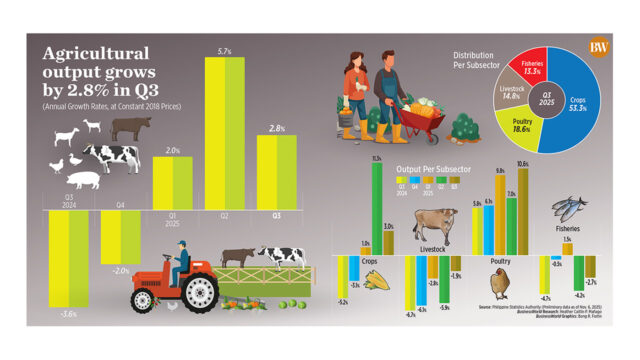
Agricultural output grows by 2.8% in Q3

THE PHILIPPINES’ agricultural production grew by 2.8% in the third quarter, as strong crops and poultry output offset the decline in livestock and fisheries, the Philippine Statistics Authority (PSA) said. Read the full story.

Agricultural output grows by 2.8% in Q3

Clark Water earmarks P17.3B for upgrades

CLARK WATER CORP., a subsidiary of east zone concessionaire Manila Water Co., Inc., plans to invest P17.3 billion through 2040 to enhance its services.

In a statement on Thursday, the company said the investment will be directed toward planned infrastructure upgrades and system enhancements.

“By upgrading our facilities and introducing innovative solutions, we ensure that locators and communities have access to reliable, high-quality, and sustainable services. These improvements not only support economic development but also reinforce our commitment to environmental stewardship and long-term resilience,” Clark Water General Manager Lyn Zamora said.

Clark Water is a subsidiary of Manila Water Philippine Venture, itself a wholly owned subsidiary of Manila Water.

Since 2011, the company has invested roughly P6.6 billion in upgrading water and wastewater systems across the Clark Freeport Zone, which currently has 1,894 total water service connections.

The company said it has delivered “100% coverage of water and wastewater services, continuous service, full regulatory compliance, and industry-leading performance.”

“As we celebrate 25 years of service, we reaffirm our commitment to world-class water and wastewater solutions for the Clark Freeport Zone,” Manila Water Non-East Zone Operations Chief Operating Officer Melvin John M. Tan said.

“With the investment, we will continue supporting growth while protecting our environment and communities. Thank you to our partners and stakeholders for your trust as we build a stronger, more resilient Clark,” he added.

Manila Water serves the east zone of Metro Manila, covering parts of Marikina, Pasig, Makati, Taguig, Pateros, Mandaluyong, San Juan, portions of Quezon City and Manila, as well as several towns in Rizal province. — Sheldeen Joy Talavera

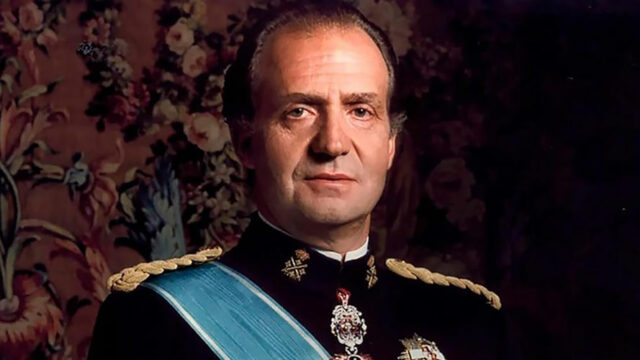
Spain’s exiled former king feels abandoned by son, according to memoir

PARIS/MADRID — Spain’s disgraced former king, Juan Carlos, feels abandoned and misunderstood, including by his son and heir, King Felipe VI, and by other close family members, according to his memoir that went on sale in France on Wednesday.

In Reconciliation, Juan Carlos, 87, said he understood why Felipe needed to be “firm as king” in public, keeping his father at a distance, but said it was painful that “as a son he should be insensitive.”

Juan Carlos, who played a key role in Spain’s transition to democracy after the death of dictator Francisco Franco, said he bitterly regretted an affair with Danish-German socialite Corinna zu Sayn-Wittgenstein-Sayn, saying it had harmed his reputation among his compatriots and led to his downfall and self-imposed exile in Abu Dhabi.

“I gave freedom to the Spanish people by establishing democracy but I was never able to enjoy that freedom for myself,” he wrote.

“Now that my son has turned his back on me out of duty, now that those who call themselves my friends have turned their backs on me, I realize that I have never been free.”

Juan Carlos said he wanted to return to Spain, enjoy a quiet retirement and a harmonious relationship with Felipe, and be buried with state honors.

The 512-page memoir, written in collaboration with French journalist and author Laurence Debray, is an attempt to reclaim his legacy after decades of scandal, Juan Carlos said.

“My father always advised me not to write my memoirs,” he wrote. “(Kings’) secrets remain buried in the shadows of their palaces. Why am I disobeying him today? I feel as though my story is being stolen from me.”

EX-KING SAYS HE GREATLY RESPECTED FRANCO
Born in exile in Italy in 1938 during the Spanish Civil War, he was separated from his parents at the age of 10 after being summoned to Spain by Franco, who groomed him to be his successor.

Juan Carlos said he grew to admire Franco, who ruled Spain for 36 years.

“I respected him enormously, appreciated his intelligence and political sense,” wrote Juan Carlos, who was crowned king two days after Franco’s death in 1975.

He also wrote about the death in 1956 of his 14-year-old brother Alfonso in Portugal as the pair cleaned a pistol — the first time he said he had spoken of the traumatic episode.

“I lost a friend, a confidant. He left a huge void,” Juan Carlos wrote. “Without his death, my life would have been less bleak, less unhappy.”

As king, Juan Carlos quickly implemented reforms that led to democratic elections in 1977. For much of his reign he was a popular figure because of the role he played in steering Spain’s transition to democracy.

However, public opinion turned against him at the height of Spain’s financial crisis in 2012, when many Spaniards lost their jobs, after details emerged of a lavish elephant-hunting trip in Botswana with Ms. Sayn-Wittgenstein-Sayn.

He abdicated in 2014 and moved to the United Arab Emirates in 2020. Felipe canceled his stipend when it became known that he was the subject of money-laundering investigations in Spain and Switzerland. Both cases were eventually dropped.

“I am accused of numerous offences, of having enriched myself through alleged commissions, without any proof or basis,” he wrote.

He said the extra-marital relations ascribed to him by the media, including an alleged tryst with the late Princess Diana, were “mostly entirely fictitious.”

He found Diana “cold, taciturn, distant, except in the presence of the paparazzi,” he wrote.

Reconciliation was published in France on Wednesday by Editions Stock and will be published in Spain on Dec. 3 by Planeta. Reuters

How narcissism ruins teamwork — and why it matters in the workplace

STOCK PHOTO | Image from Freepik

Teamwork can bring out both the best and the worst in people. Working together means sharing ideas and coordinating actions. But sometimes, it can also involve swallowing pride, particularly when people with strong personalities, such as those with narcissism, take charge.

In our new study, we explored how grandiose narcissism — the inflated belief that you’re brighter, bolder, and more capable than everyone else — affects cooperation in a team.

Instead of running surveys in a lab, we took narcissism into the wild: with more than 100 people locked in commercial escape rooms, racing the clock to solve puzzles together.

Personality psychologists distinguish between two sides of grandiose narcissism. Narcissistic admiration is the charming, confident, magnetic side that wins people over. Narcissistic rivalry, by contrast, is the defensive, combative side — quick to take offence when its status feels threatened.

Both protect a grandiose self-image, but in different ways: admiration draws people in, rivalry pushes them away. We wanted to see which side helps or harms teamwork when the pressure’s on.

THE ESCAPE-ROOM EXPERIMENT
Participants were split into small teams of four or five, most meeting for the first time. After a quick icebreaker, they entered a jungle-themed escape room with 60 minutes to find clues and escape. Success depended on communication, trust, and problem-solving: exactly what makes real-world teams thrive.

Before and after the escape-room challenge, players rated themselves and one another on traits like likeability, empathy, and confidence. This let us see how first impressions held up when the pressure kicked in.

We also measured the two sides of narcissism — admiration (charm, confidence, leadership) and rivalry (defensiveness, competitiveness). Finally, we tracked how well the teams gelled together, how much conflict emerged and how successful they were — not just how successful they felt, but how many rooms they actually escaped.

This was what’s called a round-robin design: every team member rated both themselves and each of their teammates. This let us capture not just how narcissistic people see themselves, but how they’re actually seen by others — giving a rare glimpse into real-time reputation and perception within teams.

RIVALRY WRECKS PERFORMANCE
The findings were striking. Teams high in narcissistic rivalry performed worse than others, making around one-third less progress in the escape challenge. They solved fewer puzzles, reported less unity, and generally found the experience more frustrating.

Why? Rivalry undermined team cohesion: the sense of unity that keeps people working towards a shared goal. Under pressure, rivalrous people tended to withdraw, dismiss others’ suggestions or hold back information. They didn’t always start arguments, but their defensiveness quietly slowed the group down.

The takeaway is simple: ego doesn’t just make teammates annoying, it breaks the collective bond that gets the job done.

The admiration side of narcissism told a more seductive story. Those high in admiration looked confident, likeable, and ready to lead. Early on, they seemed to boost morale. But by the end of the task, teammates saw them as more arrogant and less empathic.

In other words, the charisma that first impressed others soon wore thin once teamwork required genuine give and take. It’s the office classic: the confident self-promoter who dazzles in the meeting, but frustrates everyone by the project’s end.

Modern workplaces run on collaboration: hybrid meetings, agile teams, constant “visibility.” Yet confidence and self-promotion are still too often mistaken for competence.

Our research shows that the wrong kind of confidence can quietly undermine trust, creativity and performance. As organizations rethink leadership and teamwork in the wake of the pandemic and remote work, it’s worth asking: are we rewarding charisma over collaboration? Are our “team players” actually playing for themselves?

The fix isn’t to sideline confident people. But it’s to value good listeners as much as good talkers. Leaders who prize only assertiveness risk breeding rivalry instead of cooperation.

Building psychologically safe teams, where members can speak up without fear of ridicule, helps counteract the corrosive effects of ego.

Even team-building games reveal this dynamic. Escape rooms, often sold as fun bonding exercises, also expose who dominates, who supports and who quietly gives up when they’re not center stage. Those moments tell you far more about teamwork than any personality test.

The escape-room setting gave us a rare window into narcissism in motion. Participants couldn’t hide behind screens or polish their image: every decision, glance and interruption played out in real time.

What we saw was clear: rivalry isolates, admiration impresses but fades. The most successful teams weren’t the loudest, but the ones that stayed cohesive, communicative, and generous — even when the clock was ticking.

THE CONVERSATION VIA REUTERS CONNECT


Claire Hart is an associate professor of Psychology at the University of Southampton. Reece Bush-Evans is a senior lecturer in Psychology at Bournemouth University.

Dearth of teacher expertise seen hindering push for media literacy

PHILSTAR FILE PHOTO

THE Department of Education (DepEd) said the revamped basic education curriculum that includes courses in media and information literacy (MIL) is running into obstacles due to the shortage of trained teachers.

“One of the hard things of integrating topics into various learning areas is that you have a much larger group of teachers who need to be trained on particular skills,” DepEd Director for the Bureau of Learning Delivery Gerson Marvin M. Abesamis said in a panel discussion at the Philippine Media and Information Literacy Conference 2025 (MILCon 2025) this week.

“There used to be a small number of teachers who would only deliver media and information literacy, and you’d have a small number of teachers to train to build their capacity,” he added.

For the March 2025 Licensure Examination for Professional Teachers, 16,282 elementary teachers and 38,747 secondary teachers passed. As more professionals join the education industry, teacher training in MIL is emerging as a challenge, he said.

“On the other hand, it does create an opportunity to ensure that MIL is not just treated as a subject for compliance,” Mr. Abesamis said.

In the revised K to 10 and strengthened senior high school (SHS) curriculum, MIL has evolved from a core subject in SHS to an integral topic discussed across various subjects.

The realignment of the DepEd curriculum also tracks the UNESCO Media and Information Literacy Framework recommendation, which highlights it as an “emerging framework” that should not be isolated in SHS alone.

“Media and information literacy as a separate subject in senior high school is still possible. There are ways that school can still propose it as an elective, so it’s not necessarily gone,” Mr. Abesamis said.

Philippine Association for Media and Information Literacy President Carlo T. Concepcion noted that teacher education must include MIL-related skills across specializations. “We’re not only selecting if it’s English, if it’s only the languages, we also want to have this to be integrated regardless whether you are taking physical education or social sciences.”

Finnish Ambassador Saija Nurminen underscored the importance of teacher training fostering trust between the student and educator.

“The evidence shows that when the teachers are trusted, students learn to trust themselves, and trust is the basis for critical thinking,” she said.

Teaching MIL at an early age is as essential as teaching age-appropriate topics that foster critical thinking skills, the Ambassador said.

“The way we inject MIL is different from four-year-olds, seven-year-olds, and when the abstract thinking develops in junior high, it’s already different,” Ms. Nurminen said.

“Every age group needs to start learning in order to become active citizens when the 15 years of schooling is at the end,” she added.

In the Philippines, MIL is included in the curriculum for students at Grade 3.  “Even Grade 3 in the Makabansa course, there are certain competencies there that talk about the role of technology in society,” Mr. Abesamis said.

“Media and information literacy is the perfect spot or entry point for learners, as early as Grade 3, to understand the ecosystem that they’re currently in, the real world that they have,” he added.

The Makabansa subject, under the Matatag curriculum, was rolled out in Grades 1 to 3 to develop “healthy, resilient and patriotic” students. Makabansa covers competencies in Araling Panlipunan, and Music, Arts, Physical Education, and Health. — Almira Louise S. Martinez

ADVERTISEMENT
ADVERTISEMENT