Home Blog Page 731

A stronger cybersecurity agenda for the nation

First panel discussion (from left): BusinessWorld Corporate Editor Arjay Balinbin (moderator) Mel Migriño of Gogolook and Women in Security Alliance Philippines, Paul Jackson of Theos Cyber Solution, Napoleon Castillo of Fortinet Philippines, and Jocel De Guzman of Scam Watch Pilipinas

Public, private sectors confer on enhancing PHL’s cybersecurity policies and actions in second leg of BusinessWorld Insights Cybersecurity Series

By Jomarc Angelo M. Corpuz, Special Features and Content Writer

Along with the rise of e-commerce, digitalization, and connectivity, there is the emergence of new threats and challenges. Recent reports suggest that the Philippines is an “attractive target” for global threat actors due to its shift to digital payments and heavy social media use. In response to these growing vulnerabilities, key stakeholders from both the public and private sectors have been working to strengthen the country’s digital defenses through dialogue and collaboration.

Taking the lead in advancing the national discussion on cybersecurity, BusinessWorld conducted the second installment of its three-part BusinessWorld Insights Cybersecurity Series on Oct. 22 at Dusti Thani Manila.

Themed “Legislative Frontlines: The Philippines’ Policy Space For Cybersecurity”, the forum tackled policy gaps, regulatory challenges, and the need for stronger public-private collaboration surrounding the country’s cybersecurity landscape.
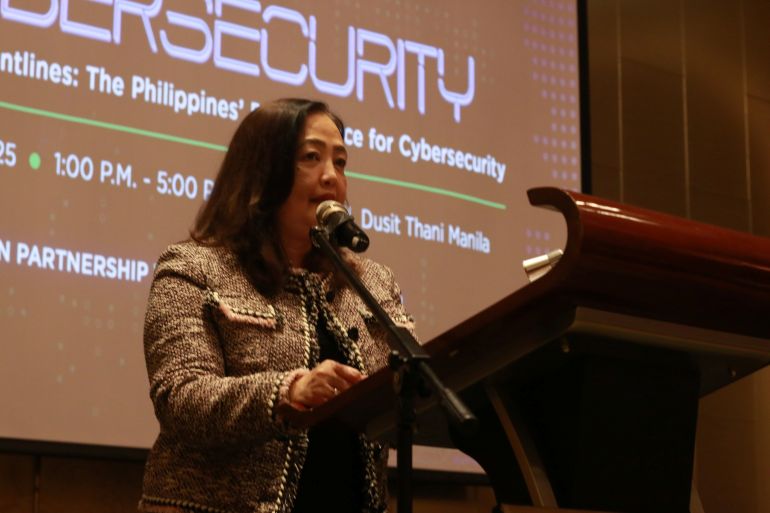
BusinessWorld Vice-President for Sales & Marketing Jay R. Sarmiento delivered the welcome remarks.

In her opening remarks, BusinessWorld Vice-President for Sales and Marketing Jay R. Sarmiento raised the call for a nation empowered to defend itself against cyberattacks and other digital threats.

“Let us aim to identify immediate gaps, friction points, or contradictions in existing frameworks and propose harmonization paths to explore how private sector members can meaningfully partner with government in both rule setting and execution,” she encouraged.

Ms. Sarmiento also acknowledged the government’s commitment to advancing the country’s digital security agenda.
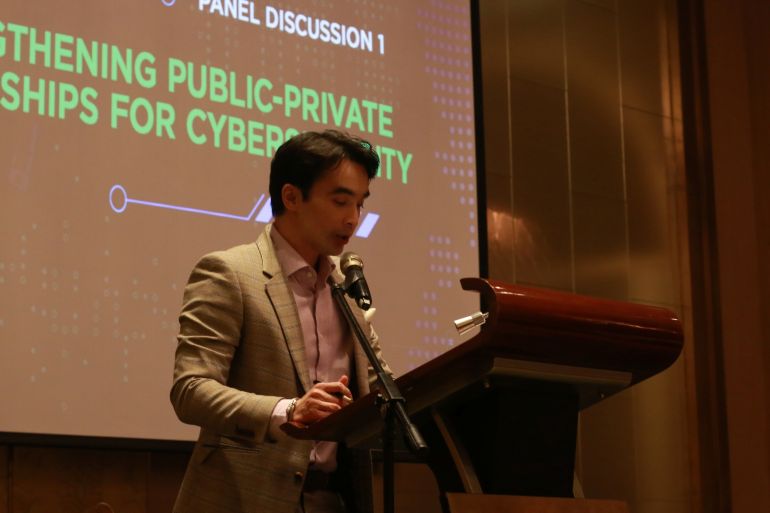
Jester Delos Santos of TV5 hosted the forum.

“​​We recognize how much the government takes cybersecurity seriously with the adoption of the National Cybersecurity Plan 2023–2028 (NCSP) as the country’s integrated blueprint for digital defense. Like any ambitious plan, the NCSP, along with our existing cybersecurity policies, faces the test of execution,” she said.

PPP for cybersecurity

Gogolook Country Head and General Mel Migrino, Theos Cyber Solution CEO Paul Jackson, Fortinet Philippines System Engineering Manager Napoleon S. Castillo, and Scam Watch Philippines Co-founder & Co-lead Convenor Jocel De Guzman composed the expert panel for the first discussion of the Insights forum themed “Strengthening Public-Private Partnerships for Cybersecurity.”

Moderated by BusinessWorld Corporate Editor Arjay L. Balinbin, the panel discussion delved into various issues that need government and private sector collaboration, including threat intelligence and collaboration, artificial intelligence (AI) in cybersecurity, policy and governance, as well as consumer protection and advocacy.

Opening the discussion, Mr. Castillo emphasized that closer coordination between the government and private organizations is essential to improving the country’s overall cyber resilience. He pointed out that better mechanisms for sharing data and insights would allow faster and more effective responses to threats.

“One interesting thing that I’ve seen in the NCSP is the mandate for the DICT (Department of Information and Communications Technology) to put up a national security operations center. If this happens, this will be a very good thing for threat intelligence sharing,” he said.

Meanwhile, Ms. Migriño of Gogolook noted that while AI has given rise to more sophisticated scams, it has also enabled organizations to detect and prevent threats with greater precision. She stressed that harnessing AI responsibly is key to building trust and keeping digital users safe.

“On the good side of things, all of the anti-scam solutions that we have are actually powered by AI. That’s the reason why we can do better in terms of prediction,” she shared.

For Mr. Jackson, strengthening cybersecurity in the Philippines requires ensuring that these frameworks are effectively implemented at all levels. He observed that while the national strategies are sound, there is still a gap between planning and execution, particularly among frontline practitioners.

“At the strategic level, I think we are doing well. Getting it to trickle down to those doing the hands-on work [is where we need improvement],” he remarked.

Concluding the discussion, Mr. De Guzman underscored the importance of sincerity and empathy in cybersecurity advocacy. He reminded both government agencies and private institutions that protecting consumers should be rooted in genuine concern.

“If you have an advocacy to protect your customers, don’t do it for your KPIs (key performance indicators). You have to have a sincere reason to help them,” he said.

The next big cyberattack

Second panel discussion (from left): TV5 News Anchor Jester Delos Santos (moderator), Atty. Elias Omar Sana of Huawei Philippines, Miguel Geronilla of GCash, Aileen Jade K. Gamboa of Meralco, and Arnold Gundaran of Cybercrime Investigation and Coordinating Center

Themed “Threat Intelligence and Incident Response: Are We Ready for the Next Big Cyberattack?”, the second panel discussion gathered insights from Huawei Philippines Head of Public Policy Atty. Elias Omar Sana, GCash Chief Information Security Officer Miguel Geronilla, Meralco Privacy Incident Management Head Aileen Jade K. Gamboa, and Cybercrime Investigation And Coordinating Center Investigation Agent IV Arnold C. Gundran.

Conversations on this panel focused on regulations and readiness, protecting critical infrastructure, balancing innovation and data privacy, and strengthening enforcement and policy, with TV5 News Anchor Jester C. Delos Santos as the moderator.

Kicking off the discussion, Atty. Sana emphasized the importance of balancing regulation with accountability among service providers. While laws are essential in guiding cybersecurity frameworks, he noted that it is equally important for companies to take proactive measures in safeguarding their systems and customers.

“Why is there a sense that we need to regulate each and every app, each and every system? Wouldn’t it be more realistic to consider that it’s in the interest of service providers to protect their customers?” he said.

From the financial technology sector, Mr. Geronilla warned that the scale and reach of future cyberattacks could extend beyond isolated incidents, potentially disrupting critical services nationwide.

“When we think about the ‘Big One,’ [threat in our cybersecurity,] it’s going to be a bit more broad, but the effects will be on a national level, rather than just hitting Manila,” he said.

Ms. Gamboa shared how Meralco leverages automation and AI to improve efficiency, but with careful consideration to ensure that technology serves both operational and ethical goals.

“In Meralco, we invest in these tools, AI and automation, but we add a series of evaluations on how these tools can work for us so that the tools will really work for us and vice versa,” she explained.

Wrapping up the discussion, Mr. Gundran emphasized the need to update and strengthen the enforcement of existing cybersecurity laws. He noted that while the Philippines already has sufficient legislation in place, some policies are outdated and must evolve alongside emerging digital threats.

“Honestly speaking, there are enough laws, but some laws are already outdated. So, one thing that we are advocating is the updating of some laws,” he said.

Further discussions

Globe Business Senior Business Consultant for Cybersecurity Joseph Tan delivered a presentation.

In between these discussions was a presentation by Joseph Tan, Senior Business Consultant for Cybersecurity, Business Solutions Consulting for Globe Business. Mr. Tan’s presentation highlighted the benefits of having cyber threat intel as well as the need for new technologies for his speech with the theme “The Inevitable Security Breach and Beyond: Respond with Precision, Anticipate with Intelligence.”

“At Globe, it is our moral obligation to keep pushing for new technologies. And what we are looking at right now, we are actually introducing silent network authentication,” he said.

To conclude the forum, DITO CME Ventures, Inc., Head of Technical Consulting and Data Privacy and Protection Officer Julian Louie Singson shared possible resolutions to make cyberspace safer for Filipinos.

Cybersecurity Council of the Philippines Co-Founder and Executive Director Julian Louie Singson shared takeaways from the forum in his endnote message.

The task ahead is very complex, but it is also clear: to build a digital Philippines that is open to innovation, grounded in trust and resilient against threats.

This BusinessWorld Insights forum was presented by BusinessWorld Publishing Corp., in partnership with the Cybersecurity Council of the Philippines, together with GCash and Globe Business, and is sponsored by Huawei, with the support of  Asian Consulting Group, American Chamber of Commerce of the Philippines, British Chamber of Commerce of the Philippines, Bank Marketing Association of the Philippines, CCI France Philippines, The Information Security Officers Group, Management Association of the Philippines, Philippine Chamber of Commerce and Industry, Philippine Franchise Association, Philippine Retailers Association, and official media partner The Philippine STAR.
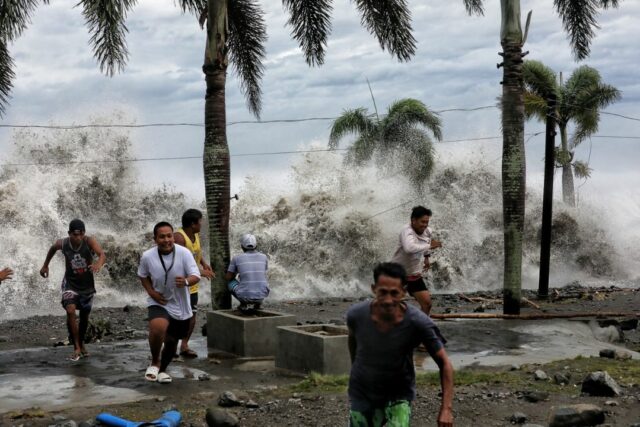
Two dead, one million evacuated as Typhoon Fung-wong slams into the Philippines

Residents from Dingalan, Aurora flee from high waves brought by a storm surge from Typhoon Uwan on Nov.9. — PHILIPPINE STAR/WALTER BOLLOZOS

ISABELA, Philippines — Typhoon Fung-wong ravaged the northern Philippines overnight, killing at least two people and cutting off some towns as residents emerged on Monday morning after a sleepless night to start assessing the damage.

More than one million people were evacuated before Fung-wong made landfall as a super typhoon in the eastern town of Dinalungan in Aurora province on Sunday night. It pounded parts of the country’s main island of Luzon with fierce winds, heavy rain and storm swells through the night.

The typhoon, locally named “Uwan”, damaged houses in the northern city of Santiago in Isabela province. Tree branches and electric posts were also felled by the typhoon.

“We could not sleep last night because of the winds hitting our metal sheets and the tree branches falling,” said Romeo Mariano, who was sheltering with his grandmother in their home.

“Almost all of the tree branches nearby fell, and when we got out to check our home, we saw the damage,” he added.

At least two people were killed by the typhoon, according to an early report from the Civil Defense office, with two others injured.

Aurora vice-governor Patrick Alexis Angara said at least three towns were inaccessible due to landslides and broken roads.

“Assessment and clearing operations are underway,” Mr. Angara told broadcaster DZMM.

The state weather agency said the typhoon was now moving over the South China Sea, and is forecast to shift northeast towards Taiwan. It warned that a large portion of the country still faced heavy rains and severe winds, along with storm swells in coastal areas.

Over 400 flights have been cancelled since Sunday, the civil aviation regulator said.

Fung-wong was the 21st storm to hit the Philippines this year and came immediately after Typhoon Kalmaegi, which last week killed 224 in the country and another five in Vietnam. — Reuters

Severe-life threatening winds persist in Luzon as Signal No. 4 remains up for Uwan

DOST-PAGASA FB PAGE

Severe life-threatening winds are still expected in many areas of Luzon as Tropical Cyclone Wind Signal No. 4 remains hoisted amid the effects of Typhoon Fung-Wong, locally known as Uwan, according to the state weather bureau.

The areas affected include the western portion of Nueva Vizcaya, the western portion of Mountain Province, the southern portion of Abra, the western portion of Ifugao, Benguet, and the central and southern portions of Ilocos Sur, the Philippine Atmospheric, Geophysical and Astronomical Services Administration (PAGASA) said in its 8:00 a.m. advisory.

Signal No. 3, where moderate to significant life-threatening winds are expected, is raised over more areas, including the western portion of Isabela, the southern portion of Apayao, Kalinga, the rest of Ifugao, the rest of Abra, the rest of Mountain Province, the northwestern portion of Quirino, the southern portion of Ilocos Norte, and the rest of Ilocos Sur.

It is likewise in effect over the rest of Pangasinan, the rest of Nueva Vizcaya, the northern portion of Nueva Ecija, the northern and central portions of Tarlac, and the northern portion of Zambales.

Meanwhile, minor to moderate life-threatening winds are expected in more than a dozen areas as Signal No. 2 is also hoisted, including Cagayan (including the Babuyan Islands), the rest of Isabela, the rest of Quirino, the rest of Apayao, the rest of Ilocos Norte, Aurora, the rest of Nueva Ecija, the rest of Tarlac, and the rest of Zambales.

The same wind signal is also in effect over Pampanga, Bulacan, Bataan, the northern and central portions of Quezon including the Polillo Islands, Metro Manila, Rizal, Laguna, Cavite, Batangas, the northern portion of Marinduque, the northern portion of Oriental Mindoro, the northern portion of Occidental Mindoro (including the Lubang Islands), and the western portion of Camarines Norte.

Signal No. 1, where minimal to minor life-threatening winds are expected, is raised over parts of Luzon, including Batanes, the northern portion of Palawan including the Calamian and Cuyo Islands, the rest of Camarines Norte, Camarines Sur, Catanduanes, Albay, Sorsogon, the western and central portions of Masbate including Ticao and Burias Islands, Romblon, the rest of Oriental Mindoro, the rest of Occidental Mindoro, the rest of Quezon, and the rest of Marinduque.

In the Visayas, Signal No. 1 is also in effect over the northwestern portion of Northern Samar, the northern portion of Iloilo, Capiz, Aklan, and the northern and central portions of Antique including the Caluya Islands. — Edg Adrian A. Eva

Hamilo Coast reaps recognition at two prestigious real estate award-giving bodies

The award-winning Pico Terraces is an expansive resort-style, series of condominium buildings located in Hamilo Coast’s Pico De Loro Cove in Nasugbu, Batangas.

Hamilo Coast’s leisure residential properties Pico Terraces and M Village at Marina Estates recently scored major wins at the 13th PropertyGuru Philippines Property Awards, the region’s biggest and most respected real estate awards program.

In the milestone event held on Aug. 15, 2025 at the Shangri-La The Fort, Manila, Pico Terraces was named the Best Condominium Development in Luzon while M Village at Marina Estates garnered commendation in the Best Subdivision Development category.

Pico Terraces also received the award for Best Resort Condominium Development at the 2025 DOT Property Awards, an event that celebrates developers, projects, and agencies that stand out in the region’s property landscape. Hosted by the Dot Property Group, the 2025 DOT Property Awards was held on Sept. 11, 2025 at Okada Manila Hotel.

Pico Terraces awarded as Winner for Best Condominium Development (Luzon): (L-R) Mabe De Goitia, SM Leisure Resort Residences (SMLRR) SAVP-Head of Marketing; Arch. Sol Prado, SMLRR SAVP-Head of Planning & Design; Wolf Ko, SMLRR SAVP-Head of Market Research; Kaye Frio, SMLRR SAVP-Head of Project Development; Imee Francisco, Costa del Hamilo, Inc. (CDHI) SVP-Head; Gem De Vera, CDHI Brand Marketing Manager; Carl Espiritu, Pico Terraces, CDHI Project Development Manager; Engr. Andrei Castillo, SMLRR AVP-Construction

Shirley Ong, EVP and Business Unit head of SM Leisure Resort Residences, accepted the DOT Property Awards at the ceremony. “Pico Terraces is where life unfolds — a community that brings the comfort of home together with the ease of a resort leisure lifestyle,” she said in her acceptance speech. “This recognition reinforces Hamilo Coast’s place as the benchmark for premium, sustainable coastal developments in the country.”

Developed by Costa del Hamilo, Inc., a duly recognized company under SM Prime, the multi-awarded Pico Terraces inspires awe with its play of heights in its condominium buildings that sprawl across 2.1 hectares of sumptuous greenery. Set against a vista of picturesque terrain, Pico Terraces boasts 80% open spaces highlighted only by expansive outdoor amenities that include cascading pools, cabanas, a clubhouse, a children’s play area, and an outdoor fitness area. True to Hamilo Coast’s vision, Pico Terraces offers all residents bountiful opportunities for a holistic and well-rounded living experience.

Left to Right: Mabe De Goitia, SM Leisure Resort Residences SAVP and Head of Marketing; Frank Bolalin, Costa del Hamilo, Inc. AVP and Head of Site Operations; Zenia Sy, SM Leisure Resort Residences VP and Head of Sales; Shirley Ong, SM Leisure Resort Residences EVP and Business Unit Head; an official DOT Property Awards media partner; Carmelyne Bolus, SM Leisure Resort Residences VP and Head of Sales Admin and Operations; AC Alejandro, Sales Director; Rian Papilla, Sales Director; and Carl Espiritu, Pico Terraces, Costa del Hamilo, Inc. Project Manager, accepting an award at the 2025 DOT Property Awards at Okada Manila on Sept. 11, 2025

Those looking to savor the serenity and enthralling backdrop that nature provides at Pico Terraces can also look forward to the completion of condominium buildings Ardea Suites and Balea Suites in 2027.

The highly commended M Village at Marina Estates located in Papaya Cove is Hamilo Coast’s newest residential development. M Village spans over 200 hectares of an integrated lifestyle anchored around a world-class marina that offers upscale eco-resort communities, vibrant residential spaces, and a preserved 30-hectare mangrove forest. M Village is strategically located at the gateway of Marina Estates, and just minutes away from the Hamilo Coast main entrance, providing easy access to an exclusive residential community surrounded by lush forests and natural attractions.

The awards and citations for Pico Terraces and M Village at Marina Estates show that Costa del Hamilo, Inc. has earned recognition as one of the finest real estate developers in Southeast Asia. Costa del Hamilo, Inc. remains at the top of its game as a premier leisure resort developer creating world class property destinations.

ABOUT HAMILO COAST

Hamilo Coast is a master-planned seaside residential community in Nasugbu, Batangas. Developed and managed by Costa del Hamilo, Inc., a subsidiary of SM Prime. It is approximately 90 minutes from Manila via Cavitex and the Ternate-Nasugbu Road. For inquiries, call (632) 7-945-8000 or visit www.hamilocoast.com.


Spotlight is BusinessWorld’s sponsored section that allows advertisers to amplify their brand and connect with BusinessWorld’s audience by publishing their stories on the BusinessWorld Web site. For more information, send an email to online@bworldonline.com.

Join us on Viber at https://bit.ly/3hv6bLA to get more updates and subscribe to BusinessWorld’s titles and get exclusive content through www.bworld-x.com.

GSIS extends emergency loan payment period amid typhoons

DEBRIS from damage caused by Typhoon Kalmaegi, locally called Tino, covers the ground in Talisay, Cebu. — REUTERS/ELOISA LOPEZ

THE GOVERNMENT Service Insurance System has given a three-month grace period on emergency loan payments for members and pensioners in areas affected by Typhoons Tino and Uwan.

“This grace period is more than just a financial reprieve—it is a lifeline. We know that many of our members and pensioners are struggling to recover from the back-to-back typhoons. By deferring their loan payments, we are giving them the time and space to heal, rebuild, and move forward without the immediate pressure of financial obligations,” GSIS President and General Manager Jose Arnulfo “Wick” A. Veloso said in a statement.

The state pension fund opened the emergency loan program on Nov. 7 and will remain available until Feb. 7, 2026. This means no loan payments will be due until next year.

Under the program, members with no existing emergency loan can borrow up to P20,000, while those with an existing balance can borrow up. To P40,000.

The loan has a 6% interest rate and a three-year payment term.

GSIS said loans granted in November 2025 will begin amortization in March 2026, with the first payment due on or before April 10, 2026.

Loans released in December 2025 will start in April 2026, payable on or before May 10, 2026.

Meanwhile, loans released in January 2026 will begin in June 2026, payable by July 10, 2026; while loans released in February 2026 will start in July 2026, with payments due by August 10, 2026. — Aaron Michael C. Sy

US flight delays, cancellations accelerate as air traffic controller shortages surge during shutdown 

YASSINE KHALFALLI-UNSPLASH

WASHINGTON — Airlines canceled more than 2,200 US flights on Sunday and Transportation Secretary Sean Duffy warned air travel will fall to a “trickle” in the run-up to the Thanksgiving holiday as air traffic control staffing shortages surge during the federal shutdown.

Major airlines were dealing with a third day of government-mandated flight cuts after thousands of delays and cancellations snarled traffic on Saturday. The shutdown, which has reached a record 40 days, has led to shortages of air traffic controllers who, like other federal employees, have not been paid for weeks.

“It’s only going to get worse… the two weeks before Thanksgiving, you’re going to see air travel be reduced to a trickle,” Mr. Duffy said on CNN’s “State of the Union” program.

Millions of people usually travel in the run-up to Thanksgiving, one of the most important US holidays, which this year falls on November 27.

“Many of them are not going to be able to get on an airplane, because there are not going to be that many flights that fly if this thing doesn’t open back up,” Mr. Duffy said.

Sunday’s cancellations were the single worst day for flight cancellations since the shutdown began on October 1.

DAILY FLIGHTS CUT

The Federal Aviation Administration instructed airlines to cut 4% of daily flights starting on Friday at 40 major airports because of air traffic control safety concerns. Reductions in flights are mandated to reach 6% on Tuesday and then hit 10% by November 14.

Many airlines have already planned their cancellations for the coming days. United Airlines, for example, will cut 190 flights on Monday and 269 on Tuesday, the company said.

As of 4:20 p.m. ET (2120 GMT) on Sunday, data from flight tracking site FlightAware indicated there had already been 2,215 US flight cancellations and more than 7,200 delays as conditions looked to be worsening. The Federal Aviation Administration earlier in the day said it had staffing issues at 12 towers.

A growing number of air traffic controllers have retired since the federal shutdown started on October 1, Mr. Duffy said. The FAA is 1,000 to 2,000 controllers short of full staffing, he told CNN.

“I paid experienced controllers to stay on the job and not retire,” Mr. Duffy said. “I used to have about four controllers retire a day before the shutdown, …now up to 15 to 20 a day are retiring.”

Some 1,550 flights were canceled and 6,700 were delayed on Saturday, up from 1,025 cancellations and 7,000 delayed flights on Friday.

Airline officials privately said the number of delay programs made it nearly impossible to schedule and plan many flights and expressed alarm about how the system would function if staffing issues worsen.

The impact on air travel could hit US economic growth, White House economic adviser Kevin Hassett said in an interview that aired on Sunday.

“Thanksgiving time is one of the hottest times of the year for the economy… and if people aren’t traveling at that moment, then we really could be looking at a negative quarter for the fourth quarter,” he told the CBS show “Face the Nation”.

Airlines for America, which represents major carriers, said staffing issues had disrupted more than 4 million passengers’ travel plans since October 1, when the shutdown began.

By next Friday, it estimated a daily US economic impact of $285 million to $580 million.

The cuts, which began on Friday morning, include about 700 flights from the four largest carriers: American Airlines, Delta Air Lines, Southwest Airlines, and United Airlines.

During the shutdown, 13,000 air traffic controllers and 50,000 security screeners have been forced to work without pay.

Mr. Duffy had earlier said he could require 20% cuts in air traffic if more controllers stop showing up for work.

Republican US Senator Ted Cruz of Texas said he was told by the FAA that since the shutdown started pilots have filed more than 500 safety reports about mistakes made by air traffic controllers because of fatigue. — Reuters

Turkey seeks safe passage for 200 civilians trapped in Gaza tunnels, official says

A VIEW of the Gaza Strip from Kobe’s Hill in Sderot, southern Israel on Aug. 12. — NORMAN P. AQUINO

ISTANBUL — Turkey is working to ensure the safe passage of some 200 civilians trapped in tunnels in Gaza, after having facilitated the return of a deceased Israeli soldier killed there more than a decade ago, a senior Turkish official said late on Sunday.

Palestinian militant group Hamas earlier said that fighters holed up in the Israeli-held Rafah area will not surrender to Israel and it urged mediators to find a solution to a crisis that threatens the month-old ceasefire.

Separately on Sunday, Israel said it received the remains of Hadar Goldin, a military officer killed in an ambush in Gaza during the 2014 Israel-Hamas war, after a handover by the Red Cross.

Turkey, the senior official said, “successfully facilitated the return of Hadar Goldin’s remains to Israel after 11 years” after “intensive efforts (reflecting) Hamas’ clear commitment to the ceasefire.”

“At the same time, we are working to ensure the safe passage of some 200 Gazan civilians currently trapped in the tunnels,” the official told Reuters.

Turkey was a signatory to last month’s Israel-Hamas ceasefire deal, backed by US President Donald Trump. It has close ties with the Palestinian group and has fiercely criticized Israel’s military campaign in Gaza. — Reuters

BBC boss and head of news quit after criticism of Trump documentary edit

The BBC logo on The Forum, Norwich. — WIKIMEDIA COMMONS/SEBASTIAN DOE, VIA CC BY-SA 4.0

LONDON — The BBC’s boss and its head of news quit on Sunday following accusations of bias at the British broadcaster, including in the way it edited a speech by US President Donald Trump.

The BBC had been under mounting pressure after an internal report by a former standards adviser was leaked to the Daily Telegraph newspaper which cited failings in its coverage of the Israel-Hamas war, transgender issues, and a speech made by Trump.

Trump welcomed the departures, criticizing the two as “very dishonest people” after the BBC’s flagship Panorama program edited two parts of one of his speeches together so he appeared to be encouraging the Capitol Hill riot of January 2021.

Tim Davie, who has led the British Broadcasting Corporation since 2020, defended the organization, saying its journalism was seen as the gold standard around the world. But he said mistakes had been made and he had to take ultimate responsibility.

Deborah Turness, the CEO of BBC News, also resigned. In an email to staff she said: “I want to be absolutely clear recent allegations that BBC News is institutionally biased are wrong.”

RESPECTED OVERSEAS, QUESTIONED OVER NEWS JUDGEMENT

Widely respected around the world, the BBC still tops polls in Britain on the most trusted news brand and has huge reach in the country, providing news, entertainment, and sport.

But the corporation, which is funded by a license fee paid by all television-watching households, comes under intense scrutiny from some national newspapers and critics on social media, which object to its funding model and perceived liberal stance.

It has in recent years been accused of failing to maintain its commitment to impartial news by critics on both sides of the political divide, struggling to navigate the fractious political and cultural environment.

The leaked internal report said BBC Arabic had shown anti-Israel bias in its reporting of the war in Gaza and that an effort to cover a group campaigning for single-sex spaces had been suppressed by a small group of staff who saw it as hostile to the transgender community.

In recent years it had struggled to contain multiple scandals. In one, Gary Lineker, at the time its most highly paid sports presenter, was suspended for criticizing the government’s immigration policy. That briefly led to many sports staff walking off the job in opposition.

It was condemned for showing punk-rap duo Bob Vylan chanting against the Israeli military at Glastonbury, and it pulled a documentary about Gaza earlier this year because it featured the son of a deputy minister in the Hamas-run government.

In the Panorama documentary broadcast last year, Trump was shown telling his supporters that “we’re going to walk down to the Capitol” and that they would “fight like hell”, a comment he made in a different part of his speech.

He had actually said his supporters would “cheer on our brave senators and congressmen and women”.

Trump, in a social media post on Sunday, accused the two executives of having tried to influence a US presidential election.

“On top of everything else, they are from a Foreign Country, one that many consider our Number One Ally. What a terrible thing for Democracy!” he said.

DAVIE DEFENDS BBC, NEWS BOSS DENIES BIAS CLAIMS

British culture minister Lisa Nandy thanked Davie for his work as director general, saying he had led the broadcaster through a period of significant change.

A person familiar with the situation said Davie’s decision had left the BBC board stunned and he would stay on for the next few months while a replacement was found.

Davie defended the corporation, saying it should be championed not weaponized due to its role in helping to build a healthy society and thriving creative sector.

But he said it was not perfect and he had made his decision after “reflecting on the very intense personal and professional demands of managing this role over many years in these febrile times”.

The BBC, which has to negotiate a new charter with the government in 2027 to guarantee its finances, had appeared to struggle to respond to the recent run of negative headlines.

The chairman, Samir Shah, had been expected to apologize to lawmakers for the furor on Monday. — Reuters

DepEd targets 105,000 classrooms, digitalization via PPP

The Department of Education hosts a session on new opportunities for funding and innovation in basic education through public-private partnerships. — ALMIRA S. MARTINEZ

The Department of Education (DepEd) said on Friday that it aims to produce 105,000 classrooms and address digital gaps through the Public-Private Partnership (PPP) for School Infrastructure Project (PSIP).

“It will test the core of our governance to deliver these classrooms and the core of our commitment, as a nation, to do right by our learners,” DepEd Undersecretary for Strategic Management Ronald U. Mendoza said in a media event in Makati.

“I’m just trying to emphasize here that we will be proving something as a nation if we are able to get this down, and the best vehicle that we can use is PPPs,” he added.

The PPP framework was adopted by DepEd in 2010 to address the classroom backlog. “We did not change their names anymore, and we’re trying to stick to the old model, which has already been approved almost 12 years ago,” said Mr. Mendoza.

The first phase of PSIP was completed in 2016 and has constructed 9,296 classrooms in regions I, III, and IV-A worth P16.43 billion.

The PSIP Phase 2, on the other hand, costs P3.86 billion and involves the designing, financing, and construction of 4,370 one-storey, two-storey, three-storey, and four-storey classrooms, including furniture, fixtures, and toilets in 1,735 public schools in regions I, II, III, X, CAR, and CARAGA.

“It managed to build 13,391 classrooms, these two tranches,” Mr. Mendoza said.

Following the same framework, the new generation of PSIP targets the construction of 105,000 classrooms from 2026 to 2031.

“This country has never produced 105,000 classrooms in such a short period of time,” the DepEd official said.

The third phase of PSIP aims to construct 15,000 classrooms in regions I, II, III, IV-A, IV-B, V, CAR, and NCR. For PSIP IV, the department targets 40,000 classroom constructions in regions VI, VII, NIR, VIII, and selected areas in Luzon.

Meanwhile, regions IX, X, XI, XII, XIII, BARMM, and other sites not covered by the first two waves are included in the 50,000 target for PSIP V.

“What we tried to do is to first go with the fastest batch of classrooms that can be produced,” Mr. Mendoza said. “And then go through these same regions two more times in order to zero out the deficit in these different provinces.”

Apart from classroom construction, the PSIP also aims to address the digital gap in the sector through PSIP Connect, which aims to disseminate devices, internet connectivity, and power to public schools nationwide.

“The PPPs for classrooms are very important, and we should build them, but it is really digital connectivity that will change the trajectory of our learners,” he said.

The latest classroom backlog in the country, logged at 165,000, is from 2022 data, according to Mr. Mendoza. “We have built some classrooms since 2022, we have also lost many classrooms since 2022, and we have also welcomed new learners since 2022.”

Data from DepEd revealed that Region 4A has the highest classroom shortage at 31,002, while Cordillera Administrative Region (CAR) has the lowest at 2,301.

Mr. Mendoza noted that 54% or 89,050 of the classroom deficit is in Luzon, followed by Mindanao at 31% or 51,445, and Visayas at 15% or 24,948.

“In order for us to reduce that deficit, according to economic math, we must build faster than 11,000 at least,” Mr. Mendoza said.

“We must build faster than 11,000 plus (due to) the classrooms damaged by earthquakes, volcanic eruptions, and typhoons,” he added. — Almira Louise S. Martinez

Philips new smart door lock with palm vein scanning coming in 11.11 sale

Philips highlights the PalmVerify feature of their online-exclusive smart lock. — PHILIPS EVENT PHOTO

Philips Home Access unveiled its latest and most advanced smart door lock on Friday, offering a range of unlocking features tailored for all kinds of users. The new model is set to hit the market during the 11.11 November sale.  

Called the DDL902-MFVP-11HWS smart door lock, it is priced at ₱88,000 and will be available on Philip Home Access’s flagship store on Lazada, with 10 units for pre-sale and more limited units available during the actual sale. 

If purchased during the 11.11 sale, the smart lock model comes with a free video doorbell, free installation, and a three-year extended warranty, totaling P25,000 worth of freebies, Avelyn B. Lim, vice president of Larx Trading, said.  

Lazada may also offer vouchers for additional discounts, she added. 

The new smart lock model is equipped with palm vein and 3D face recognition, along with six other unlocking methods, making it an all-in-one solution to the common pain points of other smart locks, the vice president said. 

“So the palm vein is not only precise and secure but also offers touch-free benefits,” Ms. Lim said during the launch event.  

“It overcomes issues usually encountered by older people when using fingerprints, which can be difficult for scanners to read when the skin is (too) dry. So, this smart lock is definitely ideal for the whole family,” she also said.  

The smart door lock is also equipped with three cameras capable of night vision and panoramic view, and a wireless charging feature for easier recharging when the device runs low on battery. 

Its lithium polymer battery can last up to three months and can still be opened manually if the battery runs out. 

With the new model’s jam-packed features, its use will be highly favorable for big families, as is common in many households in the country, since the smart lock also has an app feature, Richard C. Ang, president of Larx Trading, said. 

“In the Philippines, the average household usually has around four to five people,” Mr. Ang said during the event in both English and Filipino. 

“Even if only one person has the key and you’re a family of five, you can simply give access to everyone. That’s the convenience. And there’s no need to create duplicate keys anymore,” he added. 

Mr. Ang said that more Filipino residents are already considering switching to smart door locks, not only for security but also for their convenience.  

At Philip Home Access alone, the company sells over a thousand units across all models each month, he said.Edg Adrian A. Eva 

Philippines likely to miss 2025 growth goal

A man walks along a muddy street where cars piled up after being swept away in floods brought by Typhoon Kalmaegi at a subdivision in Bacayan, Cebu City, Philippines, Nov. 5. — REUTERS/ELOISA LOPEZ

By Aubrey Rose A. Inosante, Reporter

THE PHILIPPINE ECONOMY is unlikely to get the boost it needs in the fourth quarter to reach the low end of its full-year growth target, as public spending and investments are expected to remain subdued amid a widening corruption scandal, analysts said.

Analysts also said it is time for economic managers to revise their 5.5% to 6.5% gross domestic product (GDP) growth goal for 2025.

Jonathan L. Ravelas, a senior adviser at Reyes Tacandong & Co., said Philippine GDP is unlikely to grow by 6.9% in the fourth quarter to register at least 5.5% growth for the full year.

“The government’s economic team flagged slower public spending as a key drag on momentum. In response, I’ve adjusted my GDP targets for 2025 to 5.3% (from 5.7%), and for 2026 to 5.6% (from 5.8%),” he told BusinessWorld in a Viber message over the weekend.

Philippine GDP expanded by 4% in the third quarter, sharply slowing from the 5.5% in the second quarter and 5.2% a year ago, as public construction was hit by a corruption scandal involving infrastructure projects that has dampened consumer and investor sentiment.

This was the slowest pace since the 3.8% contraction at the height of the pandemic in the first quarter of 2021. Excluding the pandemic, this growth was the weakest since the third quarter of 2011.

This brought the nine-month average to 5%, slower than 5.9% in the same period last year.

Reinielle Matt M. Erece of Oikonomia Advisory and Research, Inc. said the economy is not likely to expand by 7% in the fourth quarter.

“We may expect it to grow by at most 5.2% given the momentum of the economy. Persistent pessimism, add to that the disappointing third-quarter GDP growth, would drag investments on a downward trend,” he said in a Viber message over the weekend.

Mr. Erece said that strong corporate earnings won’t be enough to counter the drag from transparency issues and economic disruptions from recent calamities.

Economy Secretary Arsenio M. Balisacan on Friday said hitting even the low end of the government’s 5.5% to 6.5% growth target will be “very challenging,” especially with more storms expected this quarter.

ING Bank Regional Head of Research, Asia Pacific Deepali Bhargava warned that sluggish government spending could become a longer-term drag on the economy, dampening both fiscal outlays, business and private sector sentiment.

Government spending rose by 5.8% in the third quarter, slowing from the 8.7% pace in the previous quarter, but faster than the 5% growth in the same period in 2024.

“While agriculture and private consumption are likely to rebound in the fourth quarter, investment and public spending may remain muted, keeping the overall GDP growth numbers subdued,” Ms. Bhargava said in a report on Nov. 7.

Citing the Business Outlook Survey, Ms. Bhargava noted the 12-month all-industry confidence index fell to its lowest since 2022 in the third quarter, with respondents most pessimistic about construction and real estate.

“Externally, export strength in Q3 provided some support, but this resilience may fade in 2026 as the full impact of higher tariffs takes hold, eroding competitiveness,” she said.

ING now sees 2025 GDP growth at 4.7%, down from its earlier 5.2% forecast.

‘UGLY ALL AROUND’
Pantheon Macroeconomics Chief Emerging Asia Economist Miguel Chanco described the Philippines’ third-quarter GDP print as “ugly all around” and warned that the worst has yet to come.

“Looking ahead, things are likely to get worse before they get any better, as the anti-corruption drive in public infrastructure projects that has stymied activity only really started in the final month of the third quarter,” he said in a report on Nov. 7.

Mr. Chanco flagged deepening cracks in domestic demand, with sales data showing no signs of “light at the end of the tunnel” but more likely than not to bleed into the fourth quarter.

For Mr. Chanco, the only real bright spot was the export of services, which rebounded by 2.4% quarter on quarter.

“We’ve been downbeat on the economy’s growth prospects for some time, but it’s clear today that we’ll still have to downgrade our already soft 5.3% and 5.4% projections for this year and next, respectively,” he said.

Union Bank of the Philippines Chief Economist Ruben Carlo O. Asuncion said in an e-mail that 4% growth in the third quarter reflected impact of tighter financial conditions, slower government spending, and lingering external headwinds.

“While household consumption remained resilient, the drag from weak capital formation and subdued exports underscores the need for stronger public investment execution and targeted support for trade-sensitive sectors,” he said in a Viber message.

In the third quarter, household final consumption expenditure, which accounts for over 70% of the economy, grew by a slower 4.1% from 5.3% in the second quarter and 5.2% a year ago.

Gross capital formation, the investment component of the economy, contracted by 2.8% versus the 12.8% growth a year ago and the 1.2% expansion in the second quarter.

Capital Economics noted that the Philippines’ third-quarter performance contrasted sharply with most of the region — including Taiwan, South Korea, and Vietnam, where growth accelerated during the period.

“Heightened uncertainty and fears of exposure may deter firms from committing to new investment projects, while delays in public procurement will weigh further on demand,” it said, saying that weakness in activity is likely to persist through 2026.

Despite the absence of widespread political unrest, Ms. Bhargava said the expansion of the anti-corruption campaign risks prolonging the economic slowdown.

“It’s sad that neighboring ASEAN (Association of Southeast Asian Nations) countries such as Vietnam are growing at such a robust pace compared to us. We lack competitive industrial policy, inclusive opportunities, and most importantly, good governance,” Mr. Erece said.

Finance Secretary Ralph G. Recto earlier said the economic fallout from the corruption scandal is “temporary,” adding that he projects an economic rebound in 2026.

Mr. Ravelas said that for investments to rebound in the fourth quarter, the government has to “fix the corruption issue and restore public trust.”

“For now, monitor fiscal policy execution closely. If spending remains subdued, private sector resilience and investment will be critical to sustaining growth,” Mr. Ravelas said.

MORE ROOM FOR BSP CUT
Meanwhile, weak economic prospects and the easing inflation outlook would give the Bangko Sentral ng Pilipinas (BSP) ample room to continue its easing cycle, analysts said.

Capital Economics said in a report that the recent GDP result “confirmed” the chances of the BSP cutting rates at its Dec. 11 meeting.

“We continue to expect two more 25-basis-point (bp) rate cuts this cycle (one before yearend and another in early 2026) but the risks are skewed towards more easing than we currently anticipate,” it added.

ING’s Ms. Bhargava said the slower third-quarter print strengthens their call for a 25-bp rate cut in December.

Since it began its easing cycle in August 2024, the Monetary Board has cut its key policy rate by 175 bps to a three-year low of 4.75%. 

BSP Governor Eli M. Remolona, Jr. has signaled further easing until next year to help support domestic demand as the corruption mess dampened investor sentiment and economic prospects.

“With inflation easing and the BSP likely to pivot to a more accommodative stance in early 2026, apart from the 25-bp cut in December,” Mr. Asuncion said.

In the 10-month period, inflation averaged 1.7%, matching the BSP full-year forecast and still within its 2-4% target.

“Nevertheless, we expect growth to regain momentum, though risks from global demand and fiscal constraints remain,” Mr. Asuncion said.

Banks’ NPL ratio eases to six-month low in September

BW FILE PHOTO

By Katherine K. Chan

THE PHILIPPINE BANKING sector’s gross nonperforming loan (NPL) ratio eased to a six-month low in September, preliminary data from the Bangko Sentral ng Pilipinas (BSP) showed.

The banking industry’s gross NPL ratio slid to 3.31% in September from 3.5% in August and 3.47% in the same month last year.

This was the lowest bad loan ratio in six months or since the 3.3% logged in March.

Loans are considered nonperforming once they remain unpaid for at least 90 days after the due date. These are deemed risk assets since borrowers are unlikely to pay.

Based on preliminary BSP data, banks’ soured loans slipped by 2.1% to P538.661 billion in September from P550.095 billion in August.

Year on year, it increased by 4.1% from P517.453 billion.

The total loan portfolio of Philippine banks reached P16.263 trillion in September, climbing by 3.5% from P15.709 trillion in August and by 9.1% from P14.904 trillion last year.

Rizal Commercial Banking Corp. Chief Economist Michael L. Ricafort said Philippine banks’ bad loans declined as September had less weather disruptions.

“This is largely due to better weather conditions in September 2025 versus in August 2025, when storms and flooding reduced the number of business days that also disrupted loan collection activities,” he said in a Viber message.

He noted that individuals and businesses had more capacity to settle their debts due for payment considering they had more working days during the month.

BSP data also showed that past due loans fell by 2.4% to P676.778 billion in September from P693.085 billion a month ago. Year on year, it grew by 6.9% from P632.868 billion.

This brought the past due loan ratio to 4.16% in September, easing from 4.41% in August and 4.25% a year prior.

Restructured loans increased by nearly 1% to P332.084 billion in September from P328.917 billion the previous month. It likewise went up by 12.8% from P294.526 billion in September 2024.

This accounted for 2.04% of the industry’s total loan portfolio, down from 2.09% in August but up from 1.98% seen last year.

Meanwhile, banks’ loan loss reserves dropped by 2.8% to P504.927 billion in September from P519.293 billion in August.

Year on year, it edged up by 4.6% from P482.837 billion previously.

The loan loss reserve ratio inched down to 3.1% in September from 3.31% in August and 3.24% a year ago.

On the other hand, lenders’ NPL coverage ratio, which gauges the allowance for potential losses due to bad loans, stood at 93.74%, slipping from 94.4% in August but climbing from 93.31% in September 2024.

Mr. Ricafort said increased economic activity during the holiday season may lead to a further easing of lenders’ NPL ratio. However, he noted that natural calamities such as typhoons and earthquakes could affect borrowers’ repayment capacity.

“For the coming months, better weather (and) business or economic conditions in some parts of the country towards the Christmas holiday season would help more borrowers to improve their ability to service their loans as they fell due, but offset by the strong typhoon or storms, earthquakes, and other natural calamities in some parts of the country,” he said.

Super Typhoon Fung-Wong approached the Philippines on Sunday, just a few days after Typhoon Kalmaegi battered the country.

The Philippine Atmospheric, Geophysical and Astronomical Services Administration in its 8 a.m. bulletin, placed Polillo Islands, the northern portion of Camarines Norte and eastern portion of Camarines Sur under Signal No. 5.

Albay, Quezon, and parts of Bicol were under Signal No. 4, while Metro Manila, Central Luzon, and large swaths of Northern Luzon are under Signal No. 3.

ADVERTISEMENT
ADVERTISEMENT