Home Blog Page 717

Philippine variety wins silver at World’s Best Rice Award

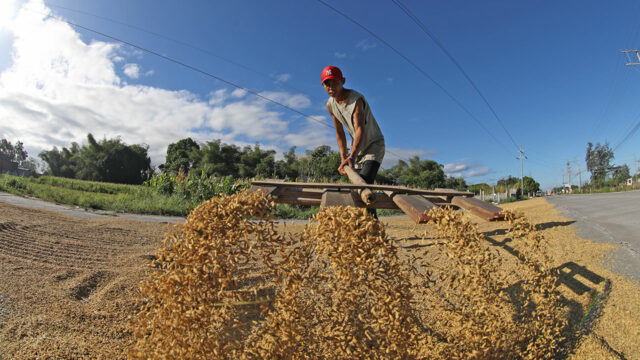
PHILIPPINE STAR/WALTER BOLLOZOS

THE Philippines’ homegrown rice variety NSIC Rc218, popularly known as Mabango and sold locally as Dinorado, has won silver at the 2025 World’s Best Rice Award in Phnom Penh, Cambodia.

Chosen from 30 entries representing rice giants such as Thailand, India, and Australia, Mabango was chosen for its distinctive fragrance, tenderness, and flavor. Vietnam’s ST25 and Cambodia’s Phka Rumdoul varieties tied for gold.

Developed in 2009 by the Department of Agriculture-Philippine Rice Research Institute, Mabango also won third place in the same competition last year.

Rowena Sadicon, founder of the Philippine Rice Industry Stakeholders Movement, which submitted the entry, said the victory highlights the growing competitiveness of Filipino farmers.

“This win isn’t just about quality. It’s about identity — a reminder that the Philippines is not only the world’s largest rice importer, but also a nation capable of producing world-class, sustainable, and export-worthy rice,” Ms. Sadicon was quoted as saying in a statement.

Agriculture Secretary Francisco P. Tiu Laurel, Jr. said in a statement that the achievement is a “proof that our farmers and scientists can stand with the world’s best,” and expressed hope that the Philippines could once again be-come a rice exporter. — Vonn Andrei E. Villamiel

GSIS Touch app hits 2 million users

USERS of the Government Service Insurance System’s (GSIS) mobile application has reached 2 million, driven by the state pension fund’s digital transformation.

“Reaching two million users for GSIS Touch is a clear signal that we are on the right track with our digital-first approach,” GSIS President and General Manager Jose Arnulfo “Wick” A. Veloso said in a statement on Wednesday. “This is particularly relevant at this time, when our members and pensioners need immediate, quick, and convenient access to services like emergency loans. The milestone represents two million members who can now get the help they need without leaving their homes nor wait in line.”

The number of GSIS Touch users represented a significant portion of the state pension fund’s more than 2.7 million members and pensioners.

GSIS said this came as 99.6% of its services have been fully digitalized.

GSIS Touch was launched in 2020 and provides 24/7 access to GSIS services such as loan application, claims filing, and real-time status tracking.

The app also generates a GSIS Digital ID to replace physical Unified Multi-Purpose Identification (UMID) card.

By mid-2025, GSIS said the majority of its loan applications and service requests were initiated through the app.

The state pension fund’s digitalization has resulted in improved efficiencies, such as a 77% reduction in processing time online enrollment through the app. — Aaron Michael C. Sy

Senate begins plenary debates on proposed P6.793-trillion budget

PHILIPPINE STAR/PAOLO ROMERO

By Adrian H. Halili, Reporter

THE SENATE started plenary debates on the proposed P6.793-trillion national spending plan for 2026, slashing Public Works budget while significantly increasing allocation for the education, health, and social welfare sector, amid public calls for greater transparency in the budget process.

“We are determined to restore what has been lost – leadership, accountability, and transparency,” Senator Sherwin T. Gatchalian, who heads the Finance Committee, said in his sponsorship speech, Wednesday evening.

“The first step towards rebuilding the trust of our people is showing them through specific and concrete actions, that their hard-earned money will be used responsibly, and that they know exactly where it is going,” he added.

The committee conducted 35 days of hearings before the budget proposals reached the Senate floor, following its implementation of transparency measures in the budget deliberations.

The panel slashed the Department of Public Works and Highways’ budget by P55.91 billion to P568.56 billion from the P624.48 billion proposed by the House of Representatives, over “red flags” in the agency’s projects.

“During the hearings, we discovered several red flags such as roads with no station IDs, duplicate projects, projects in multiple phases, and reappearing projects from previous year’s budget,” Mr. Gatchalian said.

The government has been facing a mounting corruption scandal where billions of pesos in public funds were siphoned off by public works officials, lawmakers and contractors, triggering public outrage and drawing calls for transparency and accountability.

The panel also removed unprogrammed appropriation in its version of the 2026 budget, noting its potential to be another source of corruption.

“During the budget hearings, one of our most painful discoveries was that unprogrammed funds had turned into a magnet for corruption.” Mr. Gatchalian said.

The senator added that it cut unprogrammed funding to P174.5 billion, a P68.5-billion reduction from its counterpart bill.

“Of 11 line items in unprogrammed funds, the Senate version reduced them to seven, with only three cash items.”

The Senate earlier vowed to weed out problematic budget insertions after the 2025 spending plan was flagged for unprogrammed appropriations. The 2026 proposal includes P250 billion in such funds, most of which are pre-planned initiatives rather than emergency contingencies.

Senators hiked allocations for the Education department to P992.66 billion, P78.5 billion higher than the House proposal of P914.14 billion, mainly to fund the construction of classrooms.

“One of our most urgent priorities is addressing the nation’s long-standing classroom backlog,” he added, noting a P19.3-billion increase to P68 billion for classrooms.

Senators also allocated P376.5 billion for the Health department to fund the Universal Health Care and Zero-Balance Billing Program.

Funding for Zero-Balance Billing program was increased by P9.3 billion to P62.6 billion, aimed at benefiting about 18 million Filipinos.

“These initiatives aim to ensure that every Filipino can access quality healthcare without the burden of financial hardship when seeking medical treatment,” the senator said.

The budget panel also increased funding for programs under the social welfare department, including the social pension benefits and the Pantawid Pamilyang Pilipino Program (4Ps)

Broken down, funding for social pensions for indigent senior citizens rose by P8.2 billion, while the 4Ps program climbed to P101.8 billion.

Last month, the House of Representatives approved on final reading House bill No. 4058, the General Appropriation Act, which rechanneled funding meant for flood control to the education, food, and healthcare sector. It also removed about P35 billion for unprogrammed appropriations.

Next year’s spending plan is 7.4% higher than last year’s budget, and equivalent to 22% of the country’s gross domestic product, which grew by 4% during the third quarter.

The Senate seeks to deliberate the national spending plan until Nov. 26, according to a copy of plenary debate schedule sent to reporters. Following Senate approval, the bicameral conference committee will convene from Dec. 3 to 6.

REBUILDING TRUST

Jose Enrique A. Africa, executive director of the research group Ibon Foundation, said that eliminating unprogrammed funding would show the Senate’s commitment to fiscal integrity and democratic control.

“Unprogrammed appropriations are among the least accountable items in the budget and are, in effect, executive pork barrel funds. Their vague purposes and off-budget nature reduce effective public oversight,” he said in a Viber message.

Ederson DT. Tapia, a political science professor at the University of Makati said that cutting unprogrammed appropriations would help rebuild public trust.

“Cutting the P250-billion unprogrammed funds would signal fiscal discipline and help rebuild public trust by limiting discretion and enhancing transparency. But it should be replaced by social services for the people,” he said in a Facebook Messenger chat.

Adolfo Jose A. Montesa, an advisor for the People’s Budget Coalition, said unprogrammed funding must be removed from the budget as it is a potential source of corruption.

“Due to its lump sum and contingency nature, the projects under unprogrammed appropriations are not subject to the same scrutiny that the regular budget goes through. Because of the lack of transparency and accountability,” he said in a Viber message.

He added that Congress must reallocate “patronage-based pork” towards better government aid policies programs.

“These programs have been weaponized by politicians as a means to create a dependent relationship – aid in exchange for votes. This is a form of pork that we must eliminate.”

He said that Congress must institutionalize transparency and accountability policies in the budget process, noting that this would lower corruption cases in the government.

“The most effective antidote to corruption is transparency, openness, and accountability — if we allow citizens to participate during every stage of the budget process, we are minimizing the opportunities for politicians to misappropriate funds,” Mr. Montesa said.

According to Mr. Africa, making the budget process available to the public is a crucial anti-corruption measure.

“The 2026 budget deliberations are happening amid widespread public frustration over opaque processes and anomalous pork barrel starting with but beyond flood-control projects,” he said.

He added that Congress must also disclose all legislative district allocations and all proponents of amendments or insertions.

The Senate in August mandated that all documents relating to the 2026 budget be uploaded to online platforms. This includes all transcripts of committee hearings, briefings, and technical working group meetings.

President Ferdinand R. Marcos, Jr. said earlier that the bicameral conference committee meeting on the proposed budget will be livestreamed to the public, following calls for better transparency in government spending.


Bargain hunting lifts PHL shares after 3-day slide

PHILIPPINE STAR/KRIZ JOHN ROSALES

PHILIPPINE STOCKS rebounded on Wednesday as players picked up beaten-down issues following the market’s three-day slide that caused the main index to log fresh multi-year lows.

The Philippine Stock Exchange index (PSEi) jumped by 1.5% or 84.95 points to close at 5,714.02, while the broader all shares index climbed by 0.96% or 33.26 points to end at 3,498.87.

The PSEi finished at multi-year lows in the past three days, bottoming out at a near five-and-a-half-year trough of 5,629.07 on Tuesday.

“The PSEi rebounded today as investors engaged in bargain hunting after several days of heavy selling… Overall, sentiment improved slightly as traders looked for short-term gains amid oversold market conditions,” Regina Cap-ital Development Corp. Head of Sales Luis A. Limlingan said in a Viber message.

“The recovery came despite the peso weakening to the P59-per-dollar level again, reflecting continued external pressure.”

The peso plunged to a new all-time low of P59.17 against the greenback on Wednesday, down by 18.5 centavos from its P58.985 finish on Tuesday. This was worse than the previous record-low close of P59.13 hit on Oct. 28.

“The PSEi finally corrected higher amid some bargain hunting after declining for three consecutive trading days,” Rizal Commercial Banking Corp. Chief Economist Michael L. Ricafort said in a Viber message, adding that positive spillovers from Wall Street also helped boost market sentiment.

After Monday’s sharp rally, Wall Street had a muted start to Tuesday’s session but gathered steam as the day wore on, Reuters reported. The Dow Jones Industrial Average rose 559.33 points or 1.18% to 47,927.96, marking a record closing high. The S&P 500 rose 14.19 points or 0.21% to 6,846.62, and the Nasdaq Composite fell 58.87 points or 0.25% to 23,468.30.

The US Senate passed a deal on Monday that would restore federal funding after the record-long shutdown, which has disrupted food benefits for millions, left hundreds of thousands of federal workers unpaid, snarled air traf-fic, and delayed the release of government economic data.

Most sectoral indices closed higher on Wednesday. Services jumped by 2.66% or 61.10 points to 2,354.86; financials went up by 2.25% or 41.50 points to 1,882.56; industrials rose by 1.59% or 132.10 points to 8,395.56; mining and oil increased by 0.7% or 94.84 points to 13,544.16; and property edged up by 0.09% or 1.83 points to 2,020.62.

Holding firms slipped by 0.05% or 2.51 points to 4,524.74.

Advancers outnumbered decliners, 102 to 86, while 50 names were unchanged.

Value turnover went down to P6 billion with 1.30 billion shares traded on Wednesday from the P8.56 billion with 2.03 billion issues that changed hands on Tuesday.

Net foreign selling was at P36.3 million on Wednesday versus the P701.78 million in net buying on Tuesday. — Alexandria Grace C. Magno with Reuters

Tropical Storm Uwan re-enters PAR; Signal No. 1 up in Batanes

DOST-PAGASA FB PAGE 

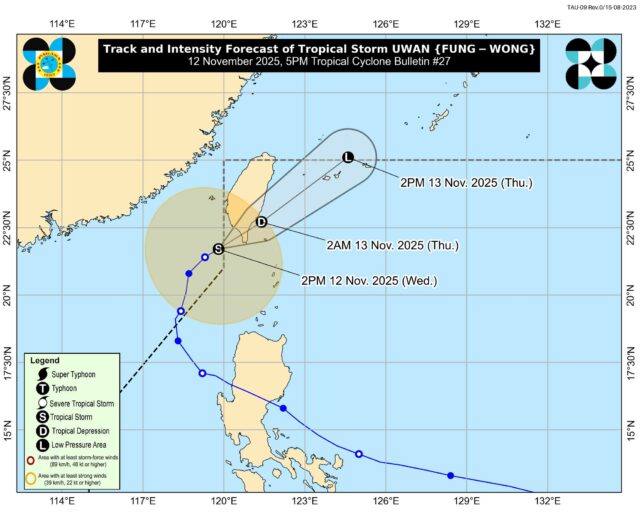
Tropical Storm Fung-wong, locally named Uwan, made its re-entry into the Philippine Area of Responsibility (PAR) on Wednesday afternoon, prompting the hoisting of Tropical Cyclone Wind Signal No. 1 in Batanes, according to the state weather bureau.

Fung-wong, packing 75 kilometers per hour (kph) of sustained winds and 90 kph of gustiness, was last located 210 kilometers northwest of Itbayat, Batanes, the Philippine Atmospheric, Geophysical and Astronomical Services Administration (PAGASA) said in its 5:00 p.m. advisory.

It re-entered the PAR as it approached southern Taiwan, where it is likely to make landfall by this evening. PAGASA said it was moving east-northeastward at 10 kph.

With Signal No. 1 in effect in Batanes, residents are expected to experience strong winds within the next 36 hours, causing minimal to minor threat to life and property.

PAGASA also raised a Gale Warning over the seaboard of extreme northern Luzon. Small seacraft are advised not to travel, as up to very rough sea conditions are expected. — Edg Adrian A. Eva

Globe and T.I.P. launch Digital Thumbprint Ambassador Program to empower students as champions of online safety

Globe and T.I.P. launch the Digital Thumbprint Ambassador Program, empowering students to champion online safety, promote digital literacy, and build a kinder, more responsible digital community.

With cyber threats on the rise and the Philippines ranking among the world’s most targeted countries for cyberattacks, Globe and the Technological Institute of the Philippines (T.I.P.) have joined forces to launch the Digital Thumbprint Ambassador Program, a new phase of Globe’s award-winning Digital Thumbprint Program (DTP) that empowers students to become advocates of responsible digital citizenship.

“Young people are at the forefront of the digital world, so they’re also among the most at risk,” said Yoly Crisanto, Globe Group Chief Sustainability and Corporate Communications Officer. “Through our partnership with T.I.P., we’re giving students the tools and confidence to protect themselves and others online. The Digital Thumbprint Ambassador Program empowers them to turn awareness into action and help build a safer, more compassionate digital community.”

Turning Knowledge into Action

Under the partnership, selected T.I.P. students will be trained by Globe as Digital Thumbprint Ambassadors and trainers to promote digital literacy, mentor peers, and represent the school in cyber wellness events. They’ll also gain access to internships, mentorship opportunities, learning tools, and support to bring their community projects to life. 

“We at T.I.P. believe in empowering our students not just to excel academically, but to contribute meaningfully to society. Through this partnership with Globe, our students are given the platform to apply their digital knowledge for social good, equipping them to protect themselves and others from online harms while becoming responsible digital citizens,” said Dr. Frank D. Alejandrino, Vice-President for Student Affairs and Services at the Technological Institute of the Philippines.

Globe’s Holistic Approach to Online Safety

The new ambassador program builds on Globe’s sustained efforts to protect Filipinos online through both technology and education. On the education front, Globe’s Digital Thumbprint Program (DTP) has reached nearly 2 million students, trained 115,000 In 2025 alone, over 21,000 students and educators have participated in DTP learning sessions nationwide.

Call to Action: Building a Kinder and Safer Digital World

Cyberbullying continues to affect many Filipino students, highlighting the need for digital empathy and accountability, values central to Globe’s Digital Thumbprint Program (DTP). “To our T.I.P. ambassadors, every click, comment, and share leaves a mark. Let those marks reflect integrity, empathy, and respect. T.I.P.’s vision is anchored on technology and inclusion and we believe that the responsible use of today’s technologies start with you”, said Yoly Crisanto.

Globe invites schools nationwide to join the cause and partner in implementing the Digital Thumbprint  Ambassadorship Program, empowering students to lead efforts in building a safer and kinder online community. Through this partnership, schools can help foster empathy, prevent cyberbullying, and promote responsible digital citizenship among Filipino youth.

For more information about DTP and the Globe Community Builders Program, visit globe.com.ph/student-program.


Spotlight is BusinessWorld’s sponsored section that allows advertisers to amplify their brand and connect with BusinessWorld’s audience by publishing their stories on the BusinessWorld Web site. For more information, send an email to online@bworldonline.com.

Join us on Viber at https://bit.ly/3hv6bLA to get more updates and subscribe to BusinessWorld’s titles and get exclusive content through www.bworld-x.com.

Asia rich lack succession plans as wealth nears $99 trillion

Visitors along the promenade in the Tsim Sha Tsui district in Hong Kong, China. Photographer: LAM YIK/BLOOMBERG

Asian private wealth is projected to reach $99 trillion by 2029, yet many of the region’s wealthiest families are unprepared for the handover of their soaring fortunes, according to a report on Tuesday.

Nearly half of the region’s first-generation wealth holders haven’t made proactive succession plans, according to research by UOB Private Bank, Boston Consulting Group and the National University of Singapore. They found that many only make plans when forced to, with 37% waiting for a health crisis and 43% acting only when business circumstances demand it.

The issue threatens more than just the family fortune, the report warns. Much of Asia’s wealth remains tied to founder-led businesses that employ millions and help anchor regional economies. Chaotic handovers have the potential to freeze assets in legal disputes, fragment family empires, and destabilize companies that have grown rapidly but lack the governance structures that many Western dynasties built over generations.

The alternative to smooth succession isn’t just family drama: It’s potential market disruption across the world’s fastest growing wealth region.

“Imagine if you split the wealth evenly amongst all the children,” said Ernest Saudjana, head of Boston Consulting Group in Southeast Asia. “Once you go through certain generations, the ownership becomes so fragmented that from a governance perspective, it’s not very clear who is making the call on certain business decisions.”

The report surveyed 228 high-net-worth individuals across seven Asian markets. While 91% of the 46 family business founders want to keep leadership within the family, 28% say their heirs aren’t interested and 24% say their chosen successors aren’t prepared. More than a third of founders still make all wealth decisions alone, and 28% haven’t disclosed their wills to anyone.

Asian private wealth has jumped from 6% of the global total 25 years ago to 21% today, according to data from BCG. Singapore pulled in $765 billion in wealth inflows between 2019 and 2024, while Hong Kong attracted $975 billion. More than 80% of that is coming from within Asia.

But the researchers warn that without better succession planning, much of that wealth could erode through disputes and poor transitions, which risks turning Asia’s wealth creation story into a cautionary tale. — Bloomberg

Thai king’s historic state visit to China signals closer ties

TOURISTS visit Wat Arun Ratchawararam Rathawaramahawihan in Bangkok in January. — BLOOMBERG

BANGKOK — When King Maha Vajiralongkorn arrives in Beijing on Thursday, he will become the first reigning Thai monarch to make a state visit to China, in what analysts say is a sign of the Asian giant’s increasing influence on his kingdom.

A constitutional monarchy since 1932, Thailand has used royal visits as foreign policy tools, including two US trips by King Vajiralongkorn’s father, King Bhumibol Adulyadej, during the height of the Cold War in the 1960s.

Beijing and Bangkok established diplomatic relations in 1975 and their bilateral ties have evolved from the post-Cold War years, with a significant expansion in two-way trade and investment.

China is the largest import market for Thailand, which shipped in Chinese goods worth $80 billion last year, as well as a top source of visitors for its vital tourism sector and a major investor in industries such as automobiles.

Migration from China to Thailand also spans centuries, and many Thai families, including captains of industry, business and politics, have Chinese ancestry.

“Thailand and China share a special bond, we see them as siblings and they see us as family,” said former Thai foreign minister Tej Bunnag, who also served as ambassador to Beijing.

In a statement announcing the visit by King Vajiralongkorn and his wife Queen Suthida, the Thai government said it was a reflection of “the deep-rooted friendship and mutual understanding shared between Thailand and China at all levels.”

In Beijing, the king is scheduled to meet with Chinese President Xi Jinping and Premier Li Qiang, although no agreements are expected to be signed between the two countries.

Since his ascension to the throne in 2016, King Vajiralongkorn has only made one official trip abroad, to Bhutan in April.

“China is the first major country which His Majesty King Maha Vajiralongkorn officially visits,” Chinese Foreign Ministry spokesperson Mao Ning said in a briefing last week.

“This fully demonstrates the great importance that the two sides attach to growing bilateral relations.”

VISIT COMES WEEKS AFTER ROYAL DEATH
Despite invitations, the late King Bhumibol – who spent seven decades on the throne – did not visit China. Instead, he sent representatives, including the current king when he was Crown Prince in 1987, said Sitthiphon Kruarattikan, an international relations scholar at Bangkok’s Thammasat University.

“Look at all the countries that China has diplomatic relations with, the heads of states of most of those countries have been to China, with Thailand an exception for a long time,” he said.

“To have a reigning Thai monarch visiting, this is what the Chinese wanted,” Mr. Sitthiphon said.

The visit comes during an official mourning period just weeks after the death of the king’s mother, signifying the importance the royal court gives to Beijing.

As in other parts of Southeast Asia, China has grown increasingly assertive in Thailand, pressing the government to intensify efforts against cross-border cyber scams and repeatedly discouraging the legalization of gambling, citing concerns about the possible impact on Chinese tourists.

In February, Beijing also succeeded in persuading the Thai government to deport 40 Uyghurs in detention in Bangkok, an issue that had been stalled for a decade.

Although a robust long-term relationship with China is vital, Thailand must also look out for its own interests, said former foreign minister Mr. Tej.

Thai officials have flagged the flare-up in trade tensions between the United States and China as a big risk to Southeast Asia’s economy.

“China is a big country and they look at things at a global level,” Mr. Tej said.

“We are a small country in Southeast Asia and we have to maintain a balance in our foreign relations.”— Reuters

Tyhpoons Fung-wong and Kalmaegi leave nearly 260 dead after hitting Philippines

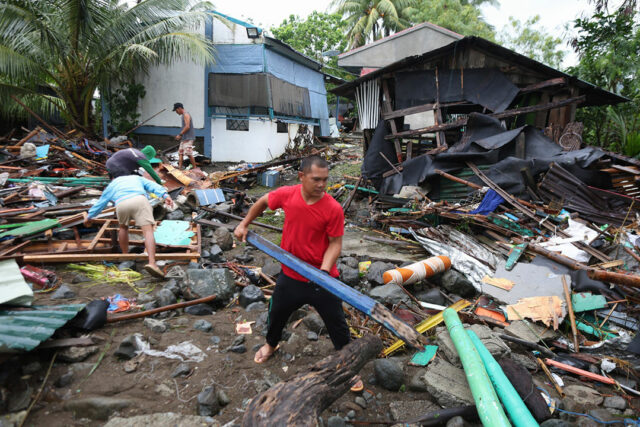
Residents of Aplaya village in Dingalan, Aurora province clear debris from their homes after Super Typhoon Uwan battered the area with strong winds and heavy rains. — PHILIPPINE STAR/WALTER BOLLOZOS

At least 259 deaths were reported following the onslaught of two tropical cyclones, Fung-wong and Kalmaegi (local names: Uwan and Tino), which battered large parts of the country in recent weeks, according to the Office of Civil Defense (OCD).

The more recent Super Typhoon Fung-wong, which lashed Luzon last weekend, was reported to have claimed 27 lives as of Wednesday morning, Diego A. Mariano, deputy spokesperson of the OCD, told reporters via Viber message.

Most fatalities were recorded in Ifugao with nine deaths, followed by Benguet with four.

Mountain Province, Kalinga, and Nueva Vizcaya each reported three fatalities.

There was also one death each in Catanduanes, Capiz, Samar, and Sulu, as well as another in an unknown province.

Fung-wong also left two individuals missing, while 36 others were injured, the OCD said.

Meanwhile, the death toll from Typhoon Kalmaegi has climbed to 232, while the number of missing and injured individuals stands at 112 and 523, respectively.

Mr. Mariano said the majority of fatalities were concentrated in Cebu, with 150 deaths, followed by Negros Occidental with 42, Negros Oriental with 21, Agusan del Sur with 6, and Capiz with 3.

There were also two deaths each in Dinagat Islands, Southern Leyte, and Leyte, and one fatality each in Antique, Iloilo, Guimaras, and Bohol.

Government recovery operations are still ongoing in affected areas where missing cases were reported due to the two storms, Mr. Mariano said.

According to the National Disaster Risk Reduction and Management Council (NDRRMC), as of 12:00 p.m., more than 2,700 teams and 2,700 assets from uniformed agencies had been deployed for search, rescue, and retrieval operations in areas affected by Fung-wong.

In areas affected by Kalmaegi, 276 teams, 143 land assets, 5 sea assets, and 2 water assets were deployed as of 6:00 a.m.

The Department of Social Welfare and Development (DSWD) said last week that it is ready to provide burial assistance to families who have lost loved ones, such as those affected by Typhoon Kalmaegi, through its Assistance to Individuals in Crisis Situations (AICS) program. — Edg Adrian A. Eva

Strong brands make a difference, says food industry CEO

Strong products need a “strong, dependable, and trusted name” to succeed, this food industry leader said.

Interview by Patricia Mirasol
Video editing by Jayson Mariñas

CICC and JuanHand partner to strengthen cybercrime prevention and promote responsible digital finance

In photo, from left to right: Alvin Navarro, director of CICC; Atty. Aboy Paraiso, undersecretary of CICC; Francisco “Coco” Mauricio, president and CEO of WeFund Lending Corp.; and Tiezheng “Tim” Li, chief executive officer, FinVolution

The Cybercrime Investigation and Coordinating Center (CICC) and leading fintech platform JuanHand, under the FinVolution Group, have officially signed a Memorandum of Agreement (MoA) to collaborate on advancing cybercrime prevention, promoting online safety, and enhancing responsible financial practices among Filipino consumers.

Held at the JuanHand office, the ceremony formalized a shared vision between the public and private sectors — ensuring that innovation in digital finance goes hand in hand with cybersecurity, consumer protection, and public education.

The partnership outlines several key areas of collaboration, including:

  • Development of cybercrime prevention policies and programs;
  • Mutual assistance and coordination with relevant agencies on investigations and reporting of online financial crimes;
  • Joint training, capacity-building, and intelligence-sharing on cyber fraud and fintech-related offenses; and
  • Public awareness campaigns promoting online safety and responsible digital financial behavior.

“This partnership is a step forward in protecting Filipino consumers in the digital space,” said Usec. Atty. Aboy Paraiso of CICC. “Together with responsible fintech players like JuanHand, we are not only combating cyber threats but also empowering citizens to use technology confidently and safely.”

JuanHand, operated by WeFund Lending Corp., is one of the Philippines’ top fintech platforms offering fast, secure, and transparent loan services. Its parent company, FinVolution Group, is among the world’s leading fintech innovators with a strong regional presence and commitment to responsible digital finance.

“At JuanHand, we believe that financial empowerment must always come with accountability and protection,” said Coco Mauricio, CEO of JuanHand. “Through this partnership with CICC, we’re doubling down on user safety, data privacy, and education — ensuring that every Ka-Juan can access financial help in a secure, transparent, and responsible way.”

“The Philippines is a key market for FinVolution,” added Tim Li, CEO of FinVolution Group. “We’re excited to support CICC’s initiatives in building a safer digital ecosystem. This partnership reflects our long-term vision of combining technology and trust to deliver inclusive financial access for all.”

Under the MoA, the CICC will maintain the Cybercrime Coordination Center (C3) to continue receiving reports of illegal online money lending, coordinating with relevant government agencies for investigation and prosecution, and helping ensure proper compliance among fintech operators.

Both the CICC and JuanHand reaffirm their commitment to shared values of innovation, trust, and public service — working hand in hand to safeguard Filipinos in the evolving digital economy.

About JuanHand
JuanHand is a trusted online lending platform in the Philippines operated by WeFund Lending Corp., under FinVolution Group, one of Asia’s most established fintech companies. The app provides fast, secure, and responsible financial access for Filipinos in need of short-term credit solutions.

About CICC
The Cybercrime Investigation and Coordinating Center (CICC), under the Department of Information and Communications Technology (DICT), is the government agency mandated with cybercrime prevention and suppression, and promoting awareness for a safer digital Philippines.


Spotlight is BusinessWorld’s sponsored section that allows advertisers to amplify their brand and connect with BusinessWorld’s audience by publishing their stories on the BusinessWorld Web site. For more information, send an email to online@bworldonline.com.

Join us on Viber at https://bit.ly/3hv6bLA to get more updates and subscribe to BusinessWorld’s titles and get exclusive content through www.bworld-x.com.

Australia spy chief says Chinese hackers probing telecommunications, critical infrastructure

REUTERS

SYDNEY — Australia’s spy chief said hackers working for the Chinese government and military had probed Australia’s telecommunications network and critical infrastructure, warning on Wednesday of the potential for disruption to the economy if a sabotage attack were carried out.

The Australian Security Intelligence Organization’s director general of security, Mike Burgess, told a business conference in Melbourne that espionage was estimated to have cost Australia A$12.5 billion ($8.1 billion) last year, including the loss of A$2 billion in trade secrets and intellectual property.

Mr. Burgess highlighted the threat of cyber sabotage, describing the activities of the Salt Typhoon and Volt Typhoon Chinese hacking groups, which he said where “hackers working for Chinese government intelligence and their military”.

China’s embassy in Australia did not immediately respond to a request for comment. China routinely denies hacking.

Salt Typhoon had not only penetrated US telecommunications systems in a strategic spying operation but also “have been probing our telecommunication networks here in Australia too,” he said.

Volt Typhoon had intention to disrupt, he said, compromising US critical infrastructure to pre-position for potential sabotage.

“We have seen Chinese hackers probing our critical infrastructure as well,” he added.

Mr. Burgess warned of the potential impact on the community of widespread telecommunications disruption, including to banks and transport, and through cut-off water supplies and power.

“I assure you; these are not hypotheticals – foreign governments have elite teams investigating these possibilities right now,” he said.

Other potential scenarios included an Australian company being crippled as a trade competitor, or causing panic during an election, he added.

Chinese officials made multiple complaints to the Australian government and private sector about ASIO whenever he spoke publicly about China, Mr. Burgess said last week during a speech at the Lowy Institute in Sydney. “It won’t stop my resolve,” he said.—Reuters

ADVERTISEMENT
ADVERTISEMENT