Home Blog Page 6926

Philippines reports 492 more Omicron infections

PHILIPPINE STAR/ MICHAEL VARCAS

THE PHILIPPINES reported 492 more coronavirus infections involving the highly mutated Omicron variant, bringing the total to 535.

In a statement, the Department of Health (DoH) said 69% of 714 samples sequenced by the Philippine Genome Center on Jan. 13 to 14, tested positive for Omicron. It added that 332 of the patients were local, while 160 were returning migrant Filipinos.

The agency said 68% of the local cases were from Metro Manila, which has been struggling to contain a fresh surge in infections.

Seventy-six patients came from the Calabarzon region, 11 from Central Luzon, five from Central Visayas, two each from Cagayan Valley, Western Visayas, Davao region, Soccsksargen and the Cordillera Administrative Region, and one each from Ilocos, Mimaropa and the Bangsamoro Autonomous Region in Muslim Mindanao.

The Health department said three of the new Omicron cases were still active, two have died, and 467 patients have recovered. The agency said it was verifying 20 other cases.

Health Undersecretary Maria Rosario S. Vergeire on Tuesday said Omicron had become the predominant variant especially in the National Capital Region.

DoH on Wednesday posted 22,958 coronavirus infections, bringing the total to 3.29 million. The death toll increased by 82 to 53,044, while recoveries rose by 36,611 to 2.97 million, it said in a bulletin.

The agency said 43.5% of 62,531 samples on Jan. 17 tested positive for COVID-19, way above the 5% threshold set by the World Health Organization (WHO).

There were 270,728 active cases, 8,335 of which did not show symptoms, 257,632 were mild, 2,970 were moderate, 1,487 severe and 304 were critical.

DoH said 94% of the latest cases occurred on Jan. 6 to 19. The top regions with new cases in the past two weeks were Metro Manila with 7,861, Calabarzon with 4,647 and Central Luzon with 2,049 infections. It added that 68% of deaths occurred in January, 10% in October and 18% in September.

Eighty-seven duplicates had been removed from the tally, 64 of which were reclassified as recoveries, while 32 recoveries were relisted as deaths. Six laboratories failed to submit data on Jan. 17.

DoH also reported 115 more Delta infections, bringing the total to 8,612. Of these, 88 were local and 27 were returning migrant Filipinos. The variant first detected in India nearly exhausted the country’s health system last year.

Of the latest Delta cases, two were still active, two have died and 107 have recovered, the DoH said.

It added that the country now had 3,170 cases of the Alpha variant after a new case of the virus type first detected in the United Kingdom was also found among the samples.

DoH said 49% of intensive care unit beds in the country had been used, while the rate for Metro Manila was 53%.

Health Secretary Francisco T. Duque III on Tuesday said daily coronavirus infections were probably decreasing, but the country remained at critical risk from the virus.

Metro Manila, Ilocos, Cagayan Valley, the Cordillera Administrative Region, Central Luzon and Calabarzon were still under critical risk, he told a taped Cabinet meeting on Monday night.

The country had an average 314 cases from Dec. 21 to 27, spiked more than eight times with 2,592 cases from Dec. 28 to Jan. 3 and rose almost eight times with 20,462 cases the following week, Mr. Duque said.

The average daily cases rose by 71% from Jan. 11 to Jan. 17, he said, adding that infections have started to plateau.

Daily infections in the country have reached a record this month amid the spread of the heavily mutated Omicron variant.

Health Undersecretary Maria Rosario Vergeire on Tuesday said coronavirus infections in various regions have been increasing.

She also cited a steep increase in hospital admissions in Metro Manila in the past week, noting that 60% of hospital beds in the capital region were occupied.

Ms. Vergeire said it was too early to say that coronavirus infections in Metro Manila were decreasing. The Health department does not look at daily changes in COVID-19 data because it could be influenced by certain variables such as laboratory submissions, she told ABS-CBN TeleRadyo.

She said cases remained high. — Kyle Aristophere T. Atienza

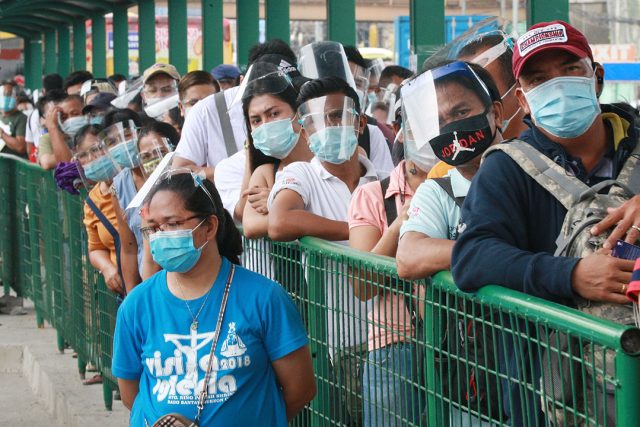
Ban on unvaccinated commuters confusing, according to senators

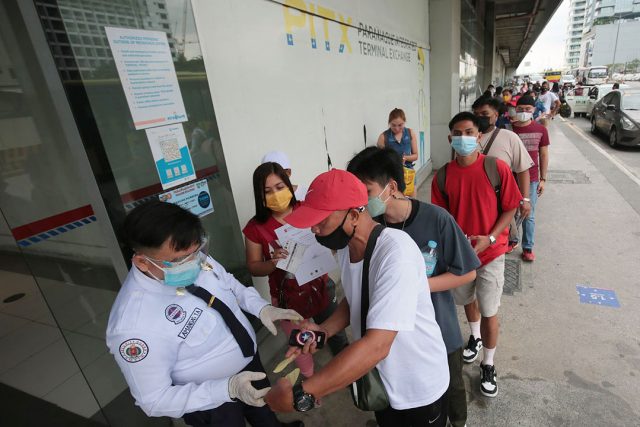
PHILIPPINE STAR/ MICHAEL VARCAS

SENATORS on Wednesday said a government ban on unvaccinated commuters in public transportation in Metro Manila is confusing, after the Transportation department exempted workers from the rule.

“Obviously, the idea did not go through contemplation,” Senate President Vicente C. Sotto III said in a Viber message. “Swashbuckling at the very least.”

Labor Secretary Silvestre H. Bello III said workers were exempted from the ban, which lawmakers said prevents Filipinos who have not been vaccinated against the coronavirus from rendering essential services.

As of Tuesday, only 56.03 million of about 108 million Filipinos have been fully vaccinated against the coronavirus.

Senator Panfilo M. Lacson, Sr. said the exemption was announced belatedly, and after many commuters had suffered from the ban.

“Since the start of the pandemic in our country in early 2020, our government’s action has always been reactive and late,” he said in a statement. “Those affected by the policy may avail of legal remedies like a class suit, but that is if they are prepared for a protracted legal battle.”

Mr. Lacson, who is running for president in tandem with Mr. Sotto, said the country needs “proactive leadership with a science-based and data-driven approach to beat this pandemic.”

Senator Sherwin T. Gatchalian said it would be better to lift the ban. “All of those taking public transportation are workers anyway,” he tweeted.

Senator Richard J. Gordon urged the government to reconsider the policy because millions of Filipinos have yet to be fully vaccinated.

“I’m not really in favor of that,” he said in a statement in mixed English and Filipino. “I’ll tell you at the outset, that is against the poor.”

He said the government should instead intensify its vaccination drive, noting that many unvaccinated Filipinos are poor.

A resolution was filed in the House of Representatives on Tuesday by a women’s party-list group calling on the chamber to investigate the legal basis of one of the transportation department’s pandemic policies. 

Transportation Secretary Arthur P. Tugade on Jan. 11 issued an order limiting public transportation access to vaccinated people in the National Capital Region (NCR) under Alert Level 3 or higher. The ban took effect on Jan. 17.

The policy applies to all public domestic travel within Metro Manila by land, sea and air. It does not apply to people who have not been vaccinated against the coronavirus for medical reasons.

Passengers must show physical or digital copies of their vaccine cards issued by their local governments or by the Department of Health.

Drivers and operators who fail to enforce the ban face fines of P1,000 to P10,000. They may also get suspended or their franchise revoked.

Violators may be punished under city ordinances that bar them from going out and other laws.

Meanwhile, the Gabriela Women’s Party filed a resolution urging the House of Representatives to probe the ban.

Party-list Rep. Arlene D. Brosas said the ban stirs up fear and discriminates against unvaccinated passengers. She also said drivers and jeepney operators would lose money because of the ban.

“The people are already tired and are having a hard time with dysfunctional transportation,” she said in a statement. “The government will make things worse for them through this no vax, no ride policy.”

Ms. Brosas said the ban is illegal and has no scientific basis.

The lawmaker said that under the COVID-19 Vaccination Act, vaccine cards should not be required for work, schools and other government transactions. “This is too much. This policy should be abolished.” — Alyssa Nicole O. Tan and Jaspearl Emerald G. Tan

Ballot printing delayed, says Comelec 

WIKIMEDIA

PRINTING of ballots for the May elections has been delayed due to “technical factors,” the Commission on Elections (Comelec) said on Wednesday. 

“The printing committee, taking into consideration various technical factors, has moved the start of printing to a date yet to be announced,” Comelec spokesman James B. Jimenez told reporters in a Viber message. 

He earlier said printing would start this week. 

The ballots were in the final stage of proofreading, Comelec Deputy Executive Director Helen C. Aguila-Flores told reporters on Tuesday, adding that printing would cost P1.3 billion. She said printing would finish between April 12 and 21. 

Comelec would print 67.4 million ballots — 65.7 million for local and 1.7 million for overseas voting, she said. 

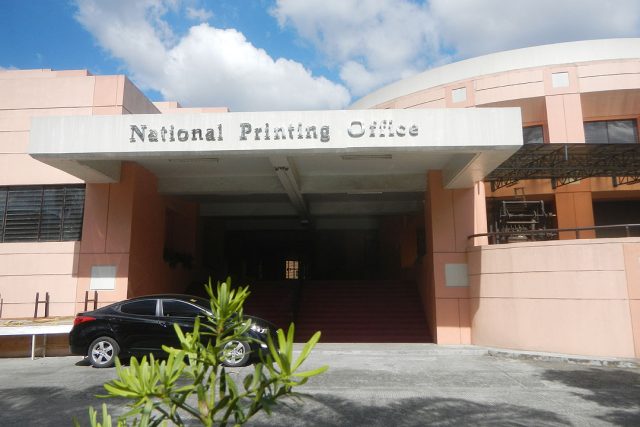
Ballots for the national and local elections would contain 178 party-list, 64 senatorial, nine vice-presidential and 10 presidential candidates, said Ms. Flores, who gave a virtual walkthrough of the National Printing Office in Quezon City. — John Victor D. Ordoñez 

Gov’t eyes streamlined travel process

The Anti-Red Tape Authority has partnered with several agencies to streamline the process for local travel amid a coronavirus pandemic. 

It signed a joint memorandum circular with the Interior and Local Government, Transportation, Science and Technology, Tourism, Health and Information and Communications Technology departments seeking to simplify domestic travel requirements. 

Under the circular, local governments must use a so-called S-Pass (Safe, Swift and Smart Passage) to facilitate travel to areas within their jurisdiction, ARTA Deputy Director-General Ernesto V. Perez told an online briefing on Wednesday. 

The pass would become a one-stop-shop for travel applications, he added. 

Local governments must process applications through the S-Pass in 24 hours, otherwise they would be deemed approved, Mr. Perez said.  

“All terminals, ports and airports are mandated to check or approve S-Pass travel permits from passengers going through other places, using the S-Pass QR scanners for authorities,” he added. — Revin Mikhael D. Ochave  

Government workers get COVID leave benefit

PHILIPPINE STAR/ MICHAEL VARCAS

GOVERNMENT employees who contract coronavirus disease or become probable cases in line with official duty can take time off from work during the quarantine, isolation and treatment period without being charged from their leave credits, the Civil Service Commission (CSC) announced Wednesday.

The new policy, which previously applied only to health workers, is contained in a memorandum issued Jan. 18. The leave period will be considered an “excused absence,” according to the commission. 

CSC said “there is a need to consider the predicament of government workers aside from PHWs (public health workers) who are repeatedly exposed to COVID-19 (coronavirus disease 2019) in performing their official duties due to face-to-face interaction with clients and co-workers, or due to community transmission.” 

Those who are probable cases or asymptomatic and undergoing the required quarantine while waiting for the result of the swab test “may be required to adopt a Work-from-Home arrangement depending on the nature of work of the employee” based on existing guidelines on remote work.

For officials and employees who go on personal travel, “only the required quarantine period may be excused, while the isolation and/or treatment period shall be charged against leave credits,” CSC said.

The memorandum enumerates the required documents to be presented upon returning to work. Human resource departments are tasked to monitor the implementation of the COVID-related leaves. 

Office heads, meanwhile, are directed “to ensure that efficiency and productivity work standards are met, and that delivery of public service is not prejudiced during the required quarantine, isolation, and/or treatment of concerned officials and employees,” the commission said. — Marifi S. Jara

Gov’t mulls incentives for vaccinators in pharmacies

PHILIPPINE STAR/ MICHAEL VARCAS

THE NATIONAL government is looking at possible incentives for vaccinators who will participate in inoculation drives in select drugstores, a pandemic official said on Wednesday. 

Vaccination against coronavirus disease 2019 (COVID-19) in designated pharmacies and clinics will start in Metro Manila on Jan. 20 and 21, and the program will later be expanded nationwide.

“We are discussing that now because pharmacies have volunteered to provide their service and we thank them for that,” Vivencio B. Dizon, deputy chief implementer of the country’s pandemic plan, told a televised news briefing in Filipino on Wednesday. 

“We are now talking with the Department of Health on the possible incentives that we could give especially to the pharmacists in drugstores,” he added. 

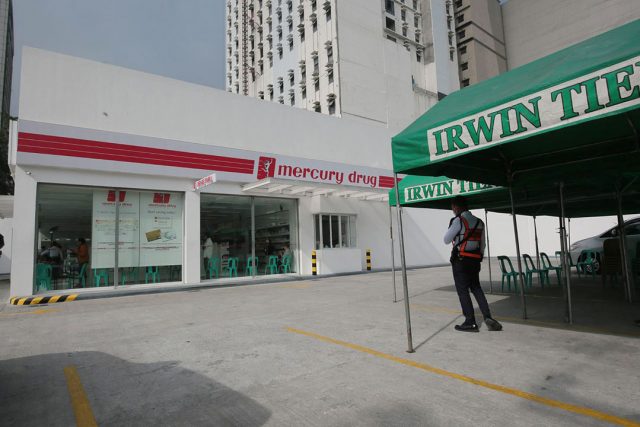
Among the drug stores and clinics tapped by the government for its so-called Resbakuna sa mga Botika program are Generika Drugstore, Healthway, Mercury Drug, QualiMed Health Network, Southstar Drug, The Generics Pharmacy, and Watsons.

Mr. Dizon said the pilot run will be held to assess the capacity of pharmacies to conduct vaccinations.

“We will assess the pilot after one week,” he said. “Then we will determine how the program can be expanded to other areas in the country.”

The presidential palace earlier said the pilot run will only cater to recipients of booster shots, noting that the initial implementation will be expanded accordingly. 

The Philippines has so far fully vaccinated more than 56 million people as of Jan. 18, while 59.26 million have received an initial dose, data from the Health department showed. About 5.36 million booster shots have been administered as of Tuesday, it added. 

ANTIGEN TEST
Meanwhile, the Department of Trade and Industry (DTI) pressed for the immediate certification of home antigen test kits amid the surge in local coronavirus cases. 

Trade Secretary Ramon M. Lopez, in a virtual session of Power Mornings on Wednesday, said the DTI wants the Food and Drug Administration (FDA) to fast-track the accreditation of home antigen test kits for COVID-19 so that the products could be officially sold across drugstores. 

According to Mr. Lopez, there have been proposals since last year for the use of self-administered antigen test kits as a means of self-regulation to help prevent transmissions. 

“This is our way really to not overwhelm the testing facilities. I believe (that) in the new normal, it is up to us to test ourselves before we go out to big crowds and attend big events or gatherings,” Mr. Lopez said. 

“I believe that the COVID-19 vaccine is to protect ourselves but home-testing/self-testing is to protect others. If we don’t feel well and then we test positive using the home antigen test kit, we should not be allowed to go out anymore,” he added.

During a recent taped meeting of President Rodrigo R. Duterte with his Cabinet, FDA Director-General Oscar G. Gutierrez, Jr. disclosed that there are nine additional applications from antigen test kit manufacturers for a special certification that will allow the home use of the products. 

Mr. Gutierrez said the nine new applications brought the overall pending applications to 11, which were forwarded to the Research Institute for Tropical Medicine (RITM) for testing. — Kyle Aristophere T. Atienza and Revin Mikhael D. Ochave 

DoTr eyeing transport terminals as vaccination sites

PHILIPPINE STAR/ MICHAEL VARCAS

THE TRANSPORTATION department on Wednesday said that it is considering using integrated transport terminals, train stations and expressways as vaccination sites.

“We are already exploring that possibility… We are mostly looking at the integrated terminals for the road transport. We are also looking at the other stations for the rail transport,” Transportation Undersecretary Artemio U. Tuazon, Jr. told ANC’s Headstart. 

He said Transportation Secretary Arthur P. Tugade had also instructed the Toll Regulatory Board to “see if we can have vaccination sites along the expressways.”

“They are now studying it whether we can implement it.” 

The department started enforcing on Monday a “no vaccination, no ride/no entry” policy across all forms of public transport in the National Capital Region (NCR).

On Jan. 11, Mr. Tugade issued Department Order No. 2022-001, limiting public transportation access to vaccinated individuals in the NCR while under Alert Level 3 or higher. 

The policy applies to all domestic travel to, from, and within the NCR via public transportation by land, sea, and air, according to the order. It also covers public transportation for individuals who reside outside the NCR “but work and/or travel to the same.” 

The department clarified on Tuesday that workers are exempted from the policy.

“An employee of an industry allowed to operate under Alert Level 3 can still board public transport, even if unvaccinated, provided that he/she can present proof that he/she is going to work,” Transportation Assistant Secretary Goddes Hope O. Libiran said in a statement. — Arjay L. Balinbin 

Senators slams DA over fish import for typhoon-hit areas

BFAR-REGION 8

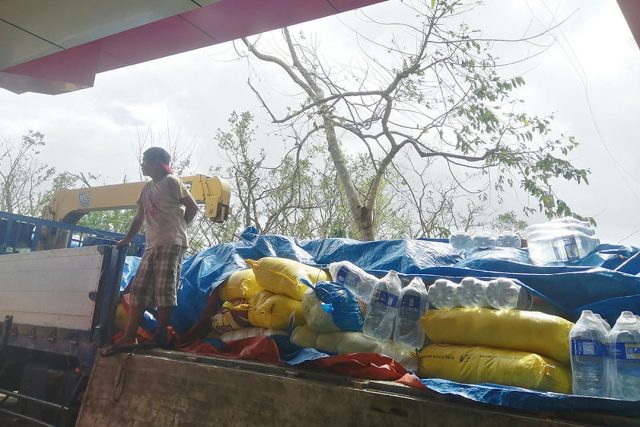
SENATORS on Wednesday slammed the Agriculture department’s approval to import 60,000 metric tons (MT) of fish for areas affected by last month’s typhoon. 

“Sure, go import more! After killing our farmers by importing vegetables and fruits, it is the turn of our fishermen to die,” Senator Panfilo M. Lacson, Sr., who is running for president in the May elections, said in a mix of English and Filipino on Twitter.

The Department of Agriculture (DA) authorized on Tuesday the imports of frozen small pelagic fish, noting the Bureau of Fisheries and Aquatic Resources’ (BFAR) projection of a fish shortfall of 119,000 MT in the first quarter of 2022.

“Stop that importation!” said Senator Maria Imelda “Imee” R. Marcos in a Viber message.

“There’s at least 35,000 MT still unsold from 2021 importation plus those still to be delivered for quarter one of 2022! You will kill local fisheries,” she said, citing data from the National Fisheries and Aquatic Resources Management Council.  

Using the same data, Asis G. Perez, former BFAR director and convenor of Tugon Kabuhayan, said he agrees with the multi-sectoral council’s position that another batch of imports is unnecessary.

“There is no need to import owing to the fact that there are still fish left in the cold storage,” Mr. Perez said in a call with BusinessWorld.

Meanwhile, Senator Emmanuel “Manny” D. Pacquiao, Sr., who is also eyeing the presidency, called the Agriculture department’s decision “unbelievable” as it will cause suffering to fisherfolk. 

“We should be the ones exporting fish, especially fishes like galunggong (Blackfin scad) and mackerel because the Philippines has a lot of those. How did it happen that we are the ones importing now even though we have so many Filipino fishermen?” he added. 

Senator Francis “Kiko” N. Pangilinan, a candidate for vice president, said in a Viber message that the department’s move is proof of the government’s neglect of the sector. He called it “unfortunate” that the country remains “seafood insecure.” — Alyssa Nicole O. Tan

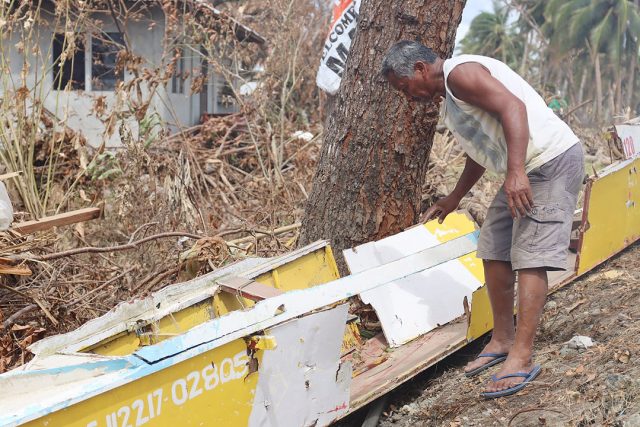
12 towns in Southern Leyte found to have contaminated water post-typhoon Odette

@PROVINCIALGOVERNMENTOFSOUTHERNLEYTE

A DOZEN of the 18 towns and one city in Southern Leyte have been found to have contaminated water supply with bacteria levels that make it unsafe for drinking, according to the regional health office.

The office, in a statement issued Tuesday night, said the findings are based on water analysis conducted after typhoon Odette, internationally known as Rai, struck on Dec. 16. 

“The Department of Health’s Eastern Visayas Center for Health Development conducted water assessment to determine the status of household drinking water and water refilling stations after the onslaught of Typhoon Odette,” it said. 

The health office appealed to “national, provincial, regional, municipal” authorities to help provide interim supply for affected communities as well as assist in fixing the distribution facilities. 

The 12 towns, which the office did not immediately disclose, all have a Level III water system, which means a piped distribution network with individual household connections and a treatment facility.

Typhoon Odette swept through central and southern parts of the Philippines, leaving widespread infrastructure damage, including utility facilities such as for water distribution. — MSJ 

1Sambayan coalition endorses 7 senatorial bets of Robredo camp

OPPOSITION coalition 1Sambayan on Wednesday endorsed seven of the 12 senatorial candidates of presidential aspirant Vice President Maria Leonor “Leni” G. Robredo, excluding in the list personalities who have been considered as enablers of the current administration. 

Howard M. Calleja, one of the group’s convenors, said in a virtual forum that the pro-democracy coalition would endorse lawyer and author Alex L. Lacson, labor leader Jose Sonny G. Matula, human rights lawyer Jose Manuel “Chel” I. Diokno,  Senators Leila M. de Lima and Risa Hontiveros-Baraquel, ex-senator Antonio F. Trillanes IV, and former House representative Teodoro “Teddy” B. Baguilat, Jr.

Mr. Calleja, a lawyer, said the group would announce its full senatorial slate at a political event on Jan. 28. “The lineup is still open to accommodate more candidates.” 

1Sambayan, formed by former government officials and members of groups from across the Philippine political spectrum, has yet to endorse the senatorial candidacy of lawyer and activist Neri J. Colmenares, who was among the group’s convenors before he filed his candidacy papers in October.

Mr. Colmenares, who has been calling for a united opposition to defeat administration bets in the May elections, was not included in Ms. Robredo’s Senate list. 

The other senatorial bets under Ms. Robredo’s Senate slate are former vice president Jejomar C. Binay, Sr., Sorsogon Governor Francis Joseph “Chiz” G. Escudero, and Senators Richard J. Gordon, Emmanuel Joel Villanueva, and Juan Miguel “Migz” F. Zubiri. 

Mr. Colmenares is a former Bayan Muna Party-list lawmaker. Bayan Muna is part of the progressive House bloc Makabayan, which has been endorsing presidential candidates based on platforms and common advocacies.

Some members of the opposition movement earlier alleged that Makabayan had refused to publicly support the presidential candidacy of Ms. Robredo.

The left-wing political bloc, however, said it has yet to endorse any presidential candidate because it was still in the process of consulting candidates on platforms and programs “while pushing for the broadest possible unity to defeat Duterte and Marcos.”

Meanwhile, Ms. Robredo said in a press release on Tuesday night that she has asked the Commission on Elections to allow her office “to continue with its COVID-19 pandemic response even during the official campaign period,” which begins on Feb. 8. — Kyle Aristophere T. Atienza

Solons welcome return of in-person classes but want DepEd to take further steps

PHILIPPINE STAR/ MICHAEL VARCAS

MEMBERS of the House of Representatives welcomed the Education department’s move allowing limited face-to-face classes in areas that are under the two lowest alert levels for coronavirus, but at the same time called on the agency to include more measures to make learning more accessible and safer for students. 

Kabataan Rep. Sarah Jane I. Elago called on the Department of Education (DepEd) to allocate more subsidies for schools to ensure implementation of safety protocols.

Under the Philippine COVID-19 alert level system, 5 is the strictest while 1 is the most relaxed and only minimal safety health protocols need to be followed. 

Under the most recent DepEd guideline, areas under Alert 1 and 2 are allowed to resume in-person classes. 

DepEd had a test run of limited physical classes last year from Nov. 15 to Dec. 22. Around 287 schools joined the simulation. 

“There must be additional subsidies available for schools to implement all the necessary COVID-19 mitigation and prevention strategies including free testing and WASH (water, sanitation, hygiene) facilities to allow and encourage the safe and voluntary return of students, teachers and staff in their campuses,” she said in a statement. 

Albay Rep. Jose Ma. Clemente “Joey” S. Salceda, meanwhile, suggested an expanded access to the Alternative Learning System (ALS). 

“…We need to increase access to the Alternative Learning System. This has been one of the most effective anti-poverty measures of the DepEd,” he said in a statement. 

“The ALS has been a very attractive path for learners who cannot afford to go to conventional school but want to attain diplomas. That source of demand has increased during the pandemic.” 

Mr. Salceda noted that there is around P599 million allocated in the national budget that could be used for supporting alternative learning programs and P14.7 billion set aside in the DepEd budget for flexible learning materials. 

He also recommended that the DepEd create a catch-up plan for the learning gaps caused by the pandemic, similar to the National Recovery Plan for economic growth and job recovery. 

ACT-Teachers Rep. France L. Castro, for her part, suggested several health measures such as the mass hiring of school nurses and providing weekly free COVID-19 testing for teachers and school staff. 

“Government should ramp up its plans and prepare our schools for the safe reopening of classes to also boost the nation’s confidence and allow the safe reopening of face-to-face classes,” Ms. Castro said in a statement.

“Use scientific measures and not non-sense policies to ensure that our schools are indeed safe for in-class learning. Let us not waste any more resources with barriers and never-ending lockdowns of schools,” she added.

Ms. Castro also said that DepEd should provide more support to teachers. — Jaspearl Emerald G. Tan 

Search for meaning and purpose

As expected, Australian Immigration and Health authorities sought the truth, discovered it, gave it proper value over the status of a tennis Wonder Boy, and cancelled the visa of the number one male tennis player in the world, Novak Djokovic. Victory for the truth over immoral and untruthful hype.

REFLECTING ON ONE’S PURPOSE
Companies and individuals set aside time for periodic strategic planning sessions that will invariably include the obligatory formulation or revisiting of mission and vision statements. Such exercises force organizations to go back to the basics, so to speak. Participants in such exercises are extricated from the organization’s day-to-day concerns, so that these corporate leaders will literally have moments of silence and lock out all the noise of daily concerns.

It is during these moments of reflection that questions like these are asked: What is our purpose? Why are we here? What is our objective? What is our business? What service are we offering? What problems does our product solve? Put it another way, in these organizations we are actually engaged in a profound and systematic way to define purpose and meaning.

In the context of our personal lives, we do, from time to time, pause and reflect and ask: Why we are doing what we are doing? As we advance in years, we are constantly reminded of our mortality and start reflecting on the need, for instance, for holographic wills. We start to consult relatives, close associates, confidants, lawyers and peers who are most likely contemplating similar acts.

Reflecting about purpose leads one further into meditating about one’s destiny and, ultimately, searching for meaning in one’s life, especially, among super seniors, in the few years ahead. The search for purpose, mission, and meaning becomes more intense and relevant in times of great physical difficulty, deep longing for loved ones whose presence is denied us for a variety of reasons, and during extraordinary financial need for the materialistic, greedy, acquisitive people who have been used to taking over companies, outmaneuvering others through brute power and influence. These predators do not know when to stop fattening their wallets and egos. They don’t care who gets hurt, and have no qualms about driving competitors out of business and rendering thousands jobless.

While reflecting on the meaning of one’s life is a common occurrence, there are, of course, various personal circumstances behind this search.

NINOY AQUINO
During his incarceration for seven year and seven months, Ninoy Aquino was given by his “Creator time to think about his purpose in and meaning of life.” Before his illegal arrest in the wee hours of a Saturday morning, Sept. 23, 1972, Ninoy was the feared fiscalizer who took Marcos and his cronies to task for corrupt deals and obvious attempts to kill democracy. He was regarded as the most viable alternative to Marcos and Imelda, for whom Marcos was laying the groundwork for eventual takeover of the reins of government.

Ninoy had charisma and could hold the crowd’s attention for hours in rallies and campaign speeches. He was preparing for the 1973 presidential election and had started building his organization, even telling me in August 1971 that “I’m running for president in 1973 and I want you to join me (after you graduate from AIM).” He was bringing in the then most modern campaign technology as he mapped out the country and identified the leaders, power centers per region and major cities, and the dynamics and alliances in those areas. He had the financial backing of one of the county’s vast agribusiness empires and other sectors of the economy tired of Marcos’ illegal capture of businesses. He had tremendous mobility, going around in a helicopter that further enhanced his image of a young man on the go who had youth, experience, and brought hope.

All these ended when he was hauled off to Camp Crame by then Col. Romeo Gatan and herded together with other political leaders, media personalities, student leaders, clerics, religious leaders, peasant leaders, activists, and all others identified as anti-Marcos.

In jail, Ninoy was deprived of freedom, a platform, and ordinary conveniences like his eye glasses. His family was subjected to humiliation and close in staff were tortured to confess to trumped up charges against Ninoy. In protest against his conviction by a military tribunal that sentenced him to death by musketry, Ninoy went on a 40-day hunger strike. During his strike, for which novena Masses were held in various churches in Metro Manila, Ninoy went into deep prayer, consulted with various clergy, and reflected on the meaning of life. After the hunger strike, Ninoy spoke of his transformation. He was able to commune with the world’s greatest thinkers through books which was one of the few concessions Marcos allowed in his dark and almost airless prison cell. Ninoy had plenty of time to reflect, to pray, to realize that all his successes and the accolades he had earned as early as 17 years of age, were mere trappings of power which now he believed were excess baggage in his search of meaning and purpose.

What mattered now, Ninoy realized, was his mission which was to help restore democracy in a country that had been terrorized and militarized, which was more intolerant of expressions of freedom, was excessively extravagant and, overall, was going to the dogs. Ninoy had, by then, dedicated the remaining years of his life to the restoration of democracy even if he had to give up his life for it. He had said, “I would like to be given the honor to die for my country.” Months before he finally left Boston to embark on that fateful journey to Manila on Aug. 21, 1983, he had asked me if his returning to the Philippines would help push Marcos towards democratic reforms. It was clear that Ninoy had made up his mind: he would return to the Philippines even if he was killed doing so.

Ninoy had discerned his purpose in life, his destiny, and his death would be the final act in his search for meaning.

VIKTOR FRANKL
One reason Ninoy and his family survived the cruelty of Marcos and Martial Law could be attributed to lessons that can be learned from Viktor Frankl, a Jewish Austrian psychologist who survived the Holocaust.

Frankl who, like millions of Jews, suffered under the Nazis and their allies, survived because he adopted the attitude that, “Everything can be taken from a man but one thing: the last of the human freedoms — to choose one’s attitude in any given set of circumstances, to choose one’s own way.”

Sean Murray wrote: “Frankl was a keen observer of human behavior and thought. Frankl observed, ‘We who lived in concentration camps can remember the men who walked through the huts, comforting others, giving away their last piece of bread.” Murray said that Frankl and his fellow prisoners had everything stripped from them: their families, friends, jobs, health, possessions, even their names and the hair on their bodies, but there was one thing that remained truly their own. It is what Stoic philosophers refer to as our inner discourse or guiding principles. Namely, we get to choose how to react to any given thought, emotion, or circumstances.

Both Ninoy and Frankl chose to react to their respective situations in the way that worked for them. Ninoy considered what Marcos did to him and his family as part of the political dynamics in the Philippines. Nothing personal, and yet Ninoy believed that Marcos was the key factor in the restoration of democracy in the Philippines. That was Ninoy’s mission — to help restore democracy. In that mission, Ninoy found meaning and purpose. He had further strengthened his resolve through prayer and the rosary.

Frankl had his own mission as he tried to survive the concentration camps — to finish his book, Man’s Search for Meaning, centered around his concept of Logotherapy, a therapeutic approach that helps people find meaning in life and, because it is laser-focused on the future, it helps people endure suffering and hardship to attain a noble outcome to which people are passionately committed.

People committed to their mission will continue to do battle despite all assets ranged against them, as Ninoy and Frankl and many unknown heroes have done.


Philip Ella Juico’s areas of interest include the protection and promotion of democracy, free markets, sustainable development, social responsibility and sports as a tool for social development. He obtained his doctorate in business at De La Salle University. Dr. Juico served as secretary of Agrarian Reform during the Corazon C. Aquino administration.


ADVERTISEMENT
ADVERTISEMENT