Home Blog Page 684

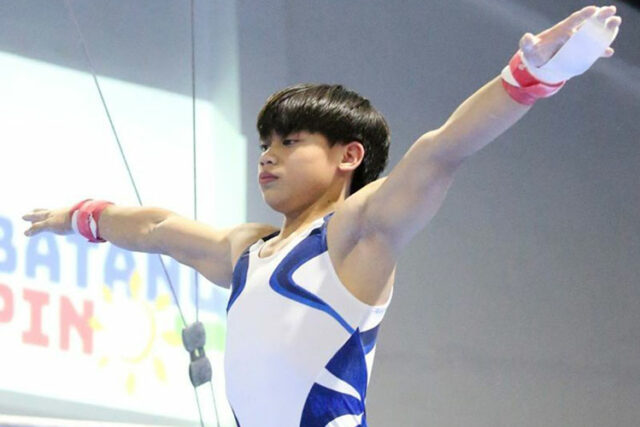
Karl Eldrew Yulo leads Team Philippines in FIG Artistic Gymnastics Junior World Championships

KARL ELDREW YULO — PHILIPPINE STAR/JUN MENDOZA

THE stage is set for Karl Eldrew Yulo, Olympic double-gold medal winner Carlos Yulo’s talented younger brother, to make a name of his own as he spearheads the country’s ambitious medal bid in the 3rd FIG Artistic Gymnastics Junior World Championships unfurling on Thursday at the Marriott Grand Ballroom of the Newport World Resorts in Pasay.

Mr. Yulo, 17, is the country’s best chance at snaring a medal, possibly a gold, after training for months in Japan under Munehiro Kugimiya, the same Japanese coach that trained and molded the elder Mr. Yulo to what he is now — an Olympic and world champion.

“He almost won in a competition in Japan and he’s doing really well,” said Gymnastics Association of the Philippines President Cynthia Carrion during yesterday’s Philippine Sportswriters Association Forum at the Rizal Memorial Sports Complex.

Ms. Carrion was referring to Mr. Yulo’s performance in the just concluded All-Japan Championships in Takasaki, Japan where he suited up for the Sohgoh Gymnastics team that Mr. Kugimiya is coaching.

There, Mr. Yulo competed in the floor exercise, vault and horizontal bars and helped his squad finish fourth in the team event.

Mr. Yulo quietly flew in on Monday and should be ready for perhaps the biggest competition in his young life thus far.

“I think Eldrew will go for gold in the floor (exercise) and he’s also good in rings, vault and p-bars (parallel bars),” said Ms. Carrion, who is organizing the event supported by Smart, PLDT and Cignal TV.

Also competing is Elizabeth Antone, who copped a vault silver and an individual all-around bronze in the Asian Junior Championships in Jecheon, South Korea last June.

Interestingly, Ms. Carrion said they were granted by the FIG the right to field in a team in both the men’s and women’s divisions with the ladies also comprising of Sabina Tayag, Maxine Bondoc and Jellian Bantilan.

“I’m praying and hoping they survive but I think it’s a good experience for them because in the future I’m sure they’ll do better,” said Ms. Carrion.

Fittingly, Journey front man Arnel Pineda will sing the five-day event’s official anthem titled “Going for Gold” in the opening ceremony that actor and model Derek Ramsey is hosting.

Ms. Carrion said all 74 countries seeing action have arrived and all-accounted for. — Joey Villar

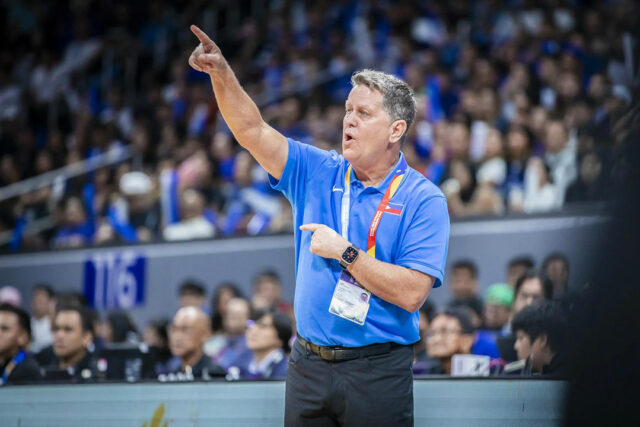
Gilas all set for the back-to-back games against Team Guam in FIBA World Cup Asian Qualifiers

COACH TIM CONE — FIBA.BASKETBALL

GILAS Pilipinas has reassembled with much excitement, laser-focused on setting the right tone in its Group A opening assignments in the FIBA World Cup Asian Qualifiers against Guam.

Coach Tim Cone said the Nationals are determined to take care of business in back-to-back games in Guam (Nov. 28) and at the Blue Eagle Gym (Dec. 1).

“We’re all chomping at the bit, ready to go,” said Mr. Cone, who has expanded the pool to 18 with the addition of big man Quentin Millora-Brown (QMB) and do-it-all guard Juan Gomez de Liaño.

“We know how important these games are in terms of the big picture, in terms of going to the World Cup. Our ultimate goal here is to make the (2028) Olympics and we can’t do that unless we get to the (2027) World Cup and we can’t do that unless we beat Guam. So that’s how important this Guam series is.”

After Guam, the Nationals will face heavyweights Australia and New Zealand in home-and-away encounters in the next two windows. The aim is to finish in the Top 3 to advance to Round 2 of the Continental Qualifiers.

Gilas opened camp at the Blue Eagle Gym on Tuesday with Messrs. Millora-Brown and Gomez de Liaño on hand to get their first feel.

They were welcomed by naturalized player Justin Brownlee, PBA stalwarts June Mar Fajardo, Scottie Thompson, Cjay Perez, Chris Newsome and Japeth Aguilar and overseas-based players Dwight Ramos and Jamie Malonzo as well as alternates RJ Abarrientos and Troy Rosario. Calvin Oftana, nursing a hamstring injury, was also present on Day 1 but didn’t participate.

A 6-foot-10 stud, Mr. Millora-Brown is expected to shore up the frontline that will continue to miss Kai Sotto, who’s still recovering from an ACL injury.

“We’re looking forward to having him,” Mr. Cone said of QMB, now on board after being reclassified by the FIBA as a local.

Mr. Gomez de Liaño, for his part, should help fill in the need for a “pure point guard.”

“That was a position that we felt we could use a little bit more of a scorer and a ball controller and a pick-and-roll guy.” Mr. Cone said.

“I was just really impressed with Juan’s defense. I thought his defense was really spectacular. And that’s what we expect from the point guard position. We want a great defender because in the international game, there’s so much initiation through the point guard and the high screens and all, they initiate so much.”

The rest of the Gilas 18 — Kevin Quiambao, Carl Tamayo, AJ Edu, backup naturalized player Ange Kouame — are expected in the next few days. Though not slated to play, Mr. Sotto is coming over to support the squad.

After the initial sessions in Metro Manila, the Nationals are set for an isolated camp at the Inspire Sports Academy from Nov. 21 to 23 before leaving for Guam on the 25th. — Olmin Leyba

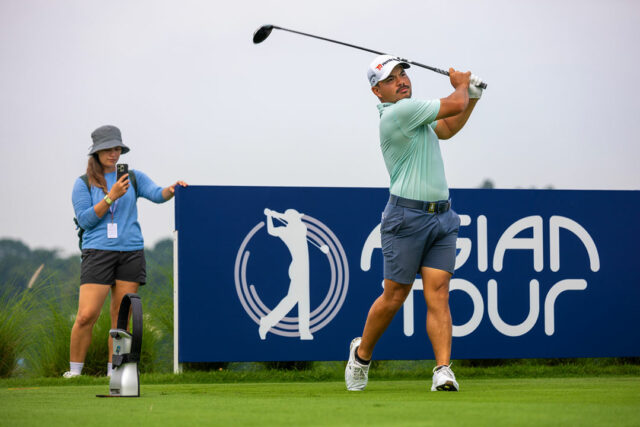
Tabuena competes in PIF Saudi International for a LIV Golf slot via International Series Rankings

MIGUEL TABUENA — ASIAN TOUR/GRAHAM UDEN

MIGUEL TABUENA makes a final push for a golden ticket to the LIV Golf when he competes in the $5-million PIF Saudi International beginning on Wednesday at the Riyadh Golf Club.

The season-ending tournament serves as the last chance for Mr. Tabuena and other hopefuls in the Asian Tour to land a gig at next year’s LIV Golf via the International Series (IS) Rankings pathway.

Only the Top 2-ranked players will secure a guaranteed promotion and entering this week, the Filipino ace runs third with 232.28 points behind pacesetter Scott Vincent of Zimbabwe (325.59) and second-running Yosuke Asaji of Japan (285.30).

Mr. Tabuena, the IS Philippines titlist, is up for a faceoff with Mr. Vincent, winner at Morocco, and Mr. Asaji, champion of the recent Singapore Open, in the first two rounds of the competition that offers elevated ranking points.

The three kick off their bids on No. 1 in an 11:40 a.m. tee off.

Also aiming for the golden tickets are Ollie Schniederjans of the US, who sits at No. 5 (197.87), IS Jakarta victor Wade Ormsby of Australia, who occupies sixth (195) and Kazuki Higa of Japan, who is at 10th (160.7).

It will be an obstacle-riddled road to the $1-million champion’s purse and 324 ranking points, though, with some of the biggest names in world golf, including Major champions Dustin Johnson, Sergio Garcia and Cameron Smith, vying for honors. — Olmin Leyba

OKC Thunder continue New Orleans Pelicans’ misery with another double-digit win

CHET HOLMGREN and Shai Gilgeous-Alexander led a balanced attack with 26 and 23 points, respectively, and Isaiah Hartenstein registered a career-high-tying four steals in a solid all-around game as the visiting Oklahoma City (OKC) Thunder handed New Orleans Pelicans interim coach James Borrego a second straight defeat, 126-109, on Monday night.

Hartenstein complemented his four steals with 16 points, seven rebounds, six assists and a block for the Thunder, who won their sixth in a row and 14th in 15 outings this season.

Each of the six victories in the current Oklahoma City winning streak have been by double-digit margins. The Thunder also had a 31-point home win over the Pelicans at the start of November.

Lu Dort (17), Isaiah Joe (14) and Ajay Mitchell (11) also scored in double figures for Oklahoma City, which ran out to a 13-2 lead in the game’s third minute and coasted home. Dort tipped off the rout with consecutive 3-pointers in the opening 50 seconds.

The Thunder exploded for 49 points in the first period, with Dort bombing in four 3-pointers and Gilgeous-Alexander going 7-for-7 at the free-throw line among 11 points.

Gilgeous-Alexander finished with a game-high eight assists and three steals.

Down by 25 points after one period and seeking to end a five-game losing streak, New Orleans rallied to within 69-56 at halftime. But Holmgren opened the third period with a 3-pointer and the Thunder never looked back.

The defending champs shot 49.4% overall and outscored the hosts 51-36 on 3-pointers, with Dort (four), Joe (four), Holmgren (three) and Gilgeous-Alexander (three) accounting for 14 of the team’s 17 successes from deep.

Holmgren shot 10-for-14 overall and also found time for a game-high nine rebounds. Hartenstein converted seven of his 10 field goal attempts.

Hitting nine of his 16 shots, rookie Jeremiah Fears paced the Pelicans with 24 points. — Reuters

Mavericks’ options

To argue that the Mavericks find themselves in a precarious situation would be to understate the obvious. True, they finally got around to firing Nico Harrison, the reviled architect of the forced departure of erstwhile foundational piece Luka Doncic. On the other hand, the move has no significance outside of arresting the continued erosion of their brand. They have serious roster issues, and are once again compelled to choose between competing now or planning for the future, and suffering the consequences regardless of their decision.

There is little to rejoice in the lay of the barren land. Anthony Davis may be a proven star, but he’s hurt, again, and slated for a rich extension. Were he to meet his potential at 32, he would still move the needle. Unfortunately, his well-documented injury history makes him a big question mark. What is his long-term value? Does he even merit the $275-million contract extension he is eligible to sign in August? At four years, the new deal nets him a whopping $75 million in 2030, by which time he will be an old 37.

This, then, brings the Mavericks to their first option. If they trade Davis, what gains can they reasonable expect? Only a fool would think they’re due to get a dollar-for-dollar return. Still moving him signals a commitment to a full-blown reset that figures to bring in more youth and flexibility. The benefits are obvious, but only after a likely downturn. The step backward consolidates their belief in Cooper Flagg, the top overall pick in the 2025 draft, by clearing the decks and assembling a better supporting cast moving forward.

On paper, the second option makes sense. The Mavericks would essentially be doubling down on the reasoning behind Davis’ arrival early this year. Assuming he comes back healthy and is joined by seven-time All-Star Kyrie Irving following a long convalescence from an anterior cruciate ligament tear, contention cannot but be far behind. Unfortunately, the premise requires a leap of faith. Can they truly make a deep run for the hardware when their biggest weapons are brittle at best?

It bears noting that the Mavericks are big taxpayers and thus constrained from making significant lineup changes.

And with no shot at sustainability, they are left to consider gambling for success in the short term or preaching prudence for the long haul. At this point, the choice is clear.


Anthony L. Cuaycong has been writing Courtside since BusinessWorld introduced a Sports section in 1994. He is a consultant on strategic planning, operations and human resources management, corporate communications, and business development.

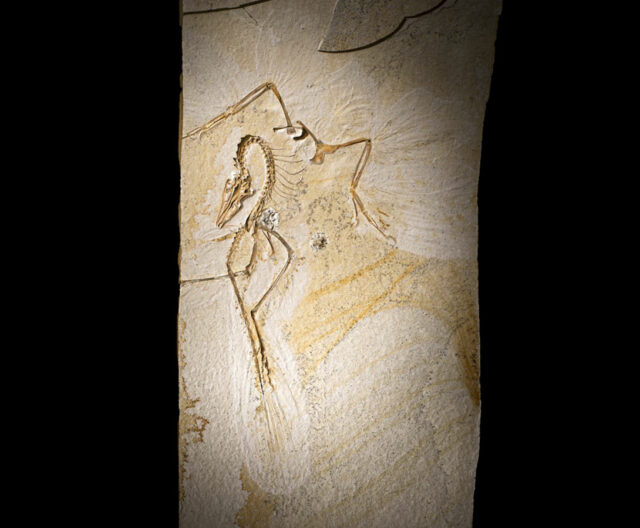
Magnetic fossils may reveal ancient creature’s internal ‘GPS system’

FIELDMUSEUM.ORG

MICROSCOPIC magnetic fossils found in North Atlantic seafloor sediments may represent components of an internal “GPS system” for an ancient marine creature that used Earth’s magnetic field to navigate long distances, according to scientists.

The researchers said the fossils – about 50 times smaller than the width of a human hair – are made of a strongly magnetic iron-bearing mineral called magnetite. They suspect these particles were once part of a marine organism, though its identity remains mysterious.

Scientists have recovered a number of these fossils dating back as far as 97 million years ago. There has been a debate as to whether or not they were biological in origin.

A new study employed three-dimensional imaging to determine the magnetic structure of one of the fossils, a magnetite particle shaped like a tiny ice cream cone that dates to 56 million years ago. The researchers identified features optimized to detect the strength and direction of Earth’s magnetic field, a dynamic force generated by the motion of molten iron in our planet’s core and extending out into space.

The fossil’s interior harbored a closed loop of magnetization resembling a vortex. The particle could have been used to create a magnetoreception sense in an animal useful for guiding navigation, the researchers said.

“We show that the large magnetization means it would be optimized to detect variations in the strength of Earth’s magnetic field from location to location, which is a key part of building a natural ‘GPS system,’ enabling an animal to actually geolocate itself, not just know, for instance, which way is north,” said Rich Harrison, a University of Cambridge professor of Earth and planetary materials and co-leader of the study published in the journal Communications Earth & Environment.

A global positioning system provides satellite-based navigation guidance.

While some migratory animals including birds, fish and insects are thought to use Earth’s magnetic field to navigate, how they manage this remains unanswered. One hypothesis is that magnetite particles inside their bodies align with Earth’s magnetic field, akin to a compass needle.

Identifying the creature to which the fossils may have belonged remains a challenge as they were not associated with any other bodily remains.

It would make sense, the researchers said, if they came from a migratory animal common enough to have left behind abundant fossil remains. Eels are a possibility, Mr. Harrison said.

“Eels are just one example of a migratory marine organism, famous for having to navigate twice across the Atlantic Ocean. Larval eels are transported by ocean currents associated with the Gulf Stream system from Sargasso Sea breeding grounds to coastal and freshwater habitats from North Africa to Scandinavia. After a decade or more, maturing adults migrate back to the Sargasso Sea, spawn and die,” Mr. Harrison said.

The organism responsible for the magnetite fossils also may have been simply a microbe of some sort. These particles closely resemble magnetite fossils called magnetosomes produced by certain bacteria, though magnetosomes are around 20 times smaller.

Certain aquatic bacteria possess a form of magnetoreception arising from chains of magnetosomes inside these unicellular organisms that enable them to line up with Earth’s magnetic field, helping them navigate to their preferred water depth.

“There is strong evidence suggesting that many other organisms – including mammals, birds, amphibians, reptiles and insects – do have magnetic-navigation capabilities. What remains unknown is how they do it,” said physicist and study co-leader Sergio Valencia of the Helmholtz-Zentrum Berlin research institute in Germany.

“One major challenge is that if magnetic particles exist in these animals, they are extremely small and sparse, making them very difficult to locate within the whole organism,” Mr. Valencia said.

So how would this biological “GPS system” work?

“If these particles were indeed part of a living organism, one intriguing possibility is that they were connected to magnetoreceptive cells, acting as magnetic sensors. As the particle reoriented itself with Earth’s magnetic field, it could have generated a mechanical or electrical signal that the organism used to detect magnetic intensity and direction,” Mr. Valencia said.

“In this way, the organism might have had a magnetic ‘sense’ – analogous to our sense of sight, which captures light distribution – allowing it to navigate its environment safely using the local strength and direction of the planet’s magnetic field as a guide,” Mr. Valencia said. — Reuters

Philippines’ Marcos rejects estranged sister’s claim of drug use

PHILIPPINE STAR/NOEL B. PABALATE

MANILA — The Philippine president’s office said on Tuesday that claims by his estranged sister that he uses illicit drugs are baseless and should not be taken seriously.

Speaking at an anti-corruption rally on Monday, Senator Imee Marcos said, without providing evidence, that her brother had struggled with drug use since their youth and that it had persisted to the present day.

“It is the reason for the flood of corruption”, she said.

In response, Presidential Communications Undersecretary Claire Castro told a press briefing on Tuesday that “it is a story without value.” She cited a drug test Mr. Marcos took in 2021, when he was campaigning for president, that yielded negative results.

President Marcos has faced accusations of illicit drug use before. His predecessor, Rodrigo Duterte, had said Mr. Marcos was included in the drug agency’s so-called ‘narco-list’ that was submitted to him when he was mayor of Davao City, a charge which the Philippine Drug Enforcement Agency has denied.

Mr. Duterte, president from 2016 to 2022, was arrested and taken to The Hague in March on a warrant linking him to killings during his “war on drugs”, in which thousands of alleged narcotics peddlers and users were killed.

Imee Marcos is an ally of Mr. Duterte and says she no longer speaks to her brother.

She was elected as an independent senator in May’s midterm elections, and ran with the backing of Vice President Sara Duterte, daughter of the former president and political rival of President Marcos.

Imee Marcos has criticized her brother’s policies, including moves to deepen security ties with the United States, which are in contrast to Mr. Duterte’s pro-China stance.

The president’s son, Congressman Ferdinand Alexander “Sandro” Marcos, issued a statement defending his father and calling his aunt’s assertions “a web of lies aimed at destabilizing this government to advance her own political ambitions.”

President Marcos has launched a sweeping investigation into irregularities in infrastructure projects, particularly flood-control works, after an internal audit showed many were substandard, poorly documented, and in some cases nonexistent.

The scandal, which has implicated officials and lawmakers, has angered a graft-weary public, with many taking to the streets to demand accountability. — Reuters

China snaps up US soybeans after pledge to Trump, but at high price, traders say

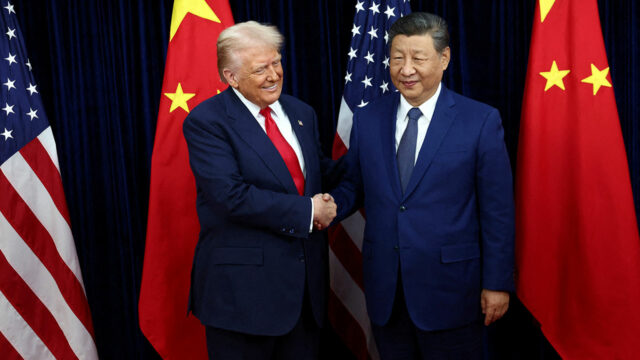
US PRESIDENT Donald J. Trump shakes hands with Chinese President Xi Jinping as they hold a bilateral meeting at Gimhae International Airport on the sidelines of the Asia-Pacific Economic Cooperation (APEC) summit in Busan, South Korea, Oct. 30, 2025. — REUTERS/EVELYN HOCKSTEIN

CHICAGO — China bought at least 14 cargoes of US soybeans on Monday, two traders with knowledge of the deals said, its largest purchase since at least January and the most significant since a summit between President Donald J. Trump and President Xi Jinping in October.

China is buying US soybeans to meet the pledges it made to Washington at the trade summit in Busan, South Korea, even though the cargoes are priced higher than rival Brazilian offers, two Asia-based traders said.

“This bigger round of US soybean buying is no longer a goodwill gesture but a manifestation of China’s commitment to the Busan terms,” said a Singapore-based trader.

China’s state-owned grain trader COFCO bought at least 840,000 metric tons for shipment in December and January, the two traders with knowledge of the deals told Reuters.

Eight of the vessels were for shipment in December and January from US Gulf Coast terminals, while the rest were for shipment in January from Pacific Northwest ports, one trader said. A second trader estimated around 75% of the sales were for Gulf shipment, with the remainder from the Pacific Northwest ports.

The sales total may ultimately be larger if more deals are finalized, traders said.

COFCO did not immediately respond to a request for comment.

All four traders declined to be named due to the market sensitivity of the issue.

The White House said China had agreed to buy 12 million metric tons of US soybeans this year, but only a small volume of sales had occurred before Monday. China imported nearly 27 million tons of US soy last year, according to US government data.

EXPENSIVE US BEANS
Asian traders estimated COFCO paid $2.35-$2.40 per bushel over the January Chicago contract SF26 for shipments from Gulf terminals and a premium of $2.15-$2.20 per bushel from Pacific Northwest ports, well above the prices for Brazilian new-crop soybeans, which are around $1.25 per bushel over the Chicago Board of Trade (CBOT) futures.

“It is a political move, as prices being paid by COFCO are much higher than Brazilian prices,” said a trader at a company which runs soybean processing plants in China. “Chinese companies are just doing it as a commitment to buy US soybeans.”

Mr. Trump said on Friday sales would be on track by the spring.

“It is good to see the hard work of our US trade negotiators and their Chinese counterparts turning into business for US soy farmers and exporters. We look forward to this continuing as trade lanes are restored,” said Jim Sutter, chief executive officer of the US Soybean Export Council.

China had largely shunned US soybeans this season due to a heated trade war with Washington, sourcing supplies from export rivals Brazil and Argentina instead.

The absence of their top customer dragged US soy prices to near multi-year lows this summer and heaped strain on a farm economy already struggling from rising costs for inputs like fuel, fertilizer and seeds.

Farmers and trade groups have been working to open new markets for US soy, but those efforts to replace Chinese demand have been difficult.

US soybean futures Sv1 on CBOT rallied nearly 3% on Monday to a 17-month high on the China trade optimism.

Cash premiums for soybeans delivered to Gulf Coast and Pacific Northwest terminals in the coming months and loaded for export jumped by 10 cents a bushel or more, traders said. — Reuters

Taiwan to further tighten export controls for dual-use technology

STOCK PHOTO | Image by Clint Bustrillos from Unsplash

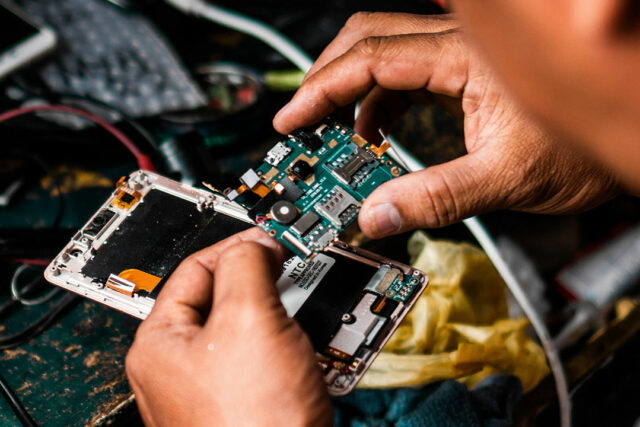
TAIPEI — Taiwan will tighten its export controls for potential dual-use civilian-military technology to include quantum computers and advanced semiconductor equipment to fulfill its obligations to stop weapons proliferation, its economy ministry said.

Since Russia invaded Ukraine in 2022, Taiwan has announced successive updates to its export control regime to prevent Taiwanese high-tech goods from being illicitly used for military purposes.

On Monday, the economy ministry’s International Trade Administration issued a 60-day review period for planned revisions to its export control list for dual-use items and technology, and another list that covers military items.

The review period is to elicit feedback from interested parties before the final rules are implemented, the ministry added.

Taiwan was making the revisions to comply with the Wassenaar Arrangement, the ministry said, referring to an international agreement to prevent weapons proliferation, though diplomatically isolated Taiwan is not a signatory.

The rules, when they go into force, mean Taiwanese companies would need government approval for such exports.

It did not say when exactly the rules would go into effect.

Taiwan, which China claims as its own territory despite the strong objections of Taipei’s government, already has separate tight chip export controls when it comes to Taiwanese companies either manufacturing in China or supplying Chinese firms.

In June, Taiwan added China’s Huawei Technologies and Semiconductor Manufacturing International Corp (SMIC) to its export control list, which includes other proscribed organizations like the Taliban and al Qaeda.

Taiwan is home to TSMC, the world’s largest contract chipmaker and a major supplier of chips to artificial intelligence darling Nvidia. — Reuters

Japan warns citizens in China about safety as diplomatic crisis deepens

STOCK PHOTO | Image from Freepik

BEIJING/TOKYO — Japan has warned its citizens in China to step up safety precautions and avoid crowded places amid a deepening dispute between Asia’s two largest economies over Japanese Prime Minister Sanae Takaichi’s comments on Taiwan.

The advisory issued by Japan’s embassy in China came as a senior Japanese foreign ministry official traveled to Beijing to hold talks on Tuesday with his Chinese counterpart to try and tamp down tensions.

China has urged its citizens not to travel to Japan, in what could deal a sizeable blow to Japan’s economy given Chinese currently make up nearly a quarter of all tourists there, according to official data. Tourism-related stocks in Japan have plunged.

MOST SERIOUS DIPLOMATIC CLASH IN YEARS
Ms. Takaichi sparked the most serious diplomatic clash in years when she told Japanese lawmakers this month that a Chinese attack on Taiwan threatening Japan’s survival could trigger a military response.

In response, a Chinese diplomat in Japan posted a threatening comment aimed at Ms. Takaichi on social media. That drew a strong rebuke from Tokyo but has failed to stem a wave of vitriolic commentaries aimed at her in Chinese state media.

“We have made judgments based on comprehensive consideration of the security situation in the country or region, as well as its political and social conditions,” Chief Cabinet Secretary Minoru Kihara said on Tuesday about the safety notice.

Noting the media coverage in China, the Japanese embassy there had on Monday reminded citizens to respect local customs and be careful in their interactions with Chinese people. It asked citizens to be aware of their surroundings when outside, advising them to not travel alone and urging extra caution when traveling with children.

“If you see a person or group that looks even slightly suspicious, do not approach them and leave the area immediately,” the embassy notice said.

Film distributors have also suspended the screening of at least two Japanese films in China amid the deepening dispute between Tokyo and Beijing, in what Chinese state broadcaster CCTV said late on Monday was a “prudent decision” that took into account souring domestic audience sentiment.

Some Japanese films including the animated Crayon Shin-chan the Movie: Super Hot! Scorching Kasukabe Dancers and manga-turned-movie Cells at Work!, originally slated for release in the coming weeks, will not begin screening in mainland China as scheduled, CCTV said, citing checks with film importers and distributors.

EFFORTS TO EASE TENSIONS
Beijing claims democratically governed Taiwan as its own and has not ruled out using force to take control of the island. Taiwan’s government rejects Beijing’s claims and says only its people can decide the island’s future.

Taiwan sits just over 110 km (68 miles) from Japanese territory and the waters around the island provide a vital sea route for trade that Tokyo depends on. Japan also hosts the largest contingent of US military overseas.

On Sunday, Chinese coast guard ships sailed through waters around a group of East China Sea islands controlled by Japan but claimed by China. Japan’s coast guard said it drove the Chinese ships away.

The US does not formally recognize the islands, known as Senkaku in Tokyo and the Diaoyu in Beijing, as Japanese sovereign territory but since 2014 has said it would be obliged to defend them if attacked under the Japan-US security treaty.

“In case anyone was in doubt, the United States is fully committed to the defense of Japan, which includes the Senkaku Islands. And formations of Chinese coast guard ships won’t change that,” US ambassador to Japan George Glass said on X.

This week’s Group of 20 (G20) summit in South Africa provided a potential forum to help ease tensions but China said its premier has no plans to meet Ms. Takaichi on the sidelines of the gathering.

Mr. Kihara said nothing has been decided about bilateral meetings during G20, but that Japan remains open to conducting “various dialogues” with China.

‘ON A KNIFE’S EDGE’
As well as tourism, Japan is heavily dependent on China for supply of critical minerals for everything from electronics to cars.

“If we rely too heavily on a country that resorts to economic coercion the moment something displeases it, that creates risks not only for supply chains but also for tourism,” Japan’s economic security minister Kimi Onoda told a press conference on Tuesday.

“We need to recognize that it’s dangerous to be economically dependent on somewhere that poses such risks,” she added, responding to a question about China’s calls for its citizens to avoid travel to Japan.

Japan’s Trade Minister Ryosei Akazawa said on Tuesday there had been no particular changes in China’s export control measures on rare earths and other materials as of yet.

The heads of Japan’s three business federations met with Ms. Takaichi late on Monday and urged dialogue to resolve the diplomatic tensions.

“Political stability is a prerequisite for economic exchange,” Yoshinobu Tsutsui, chairman of Japan’s biggest business lobby Keidanren, told reporters after the meeting, according to media reports.

Japan’s refusal to retract its statements meant its de-escalatory efforts had failed to mollify Beijing, Cornell University’s China foreign policy expert Allen Carlson said.

“As a result, the two countries now stand on a knife’s edge.” — Reuters

Vietnam to prosecute journalist for anti-state activities

MATT W NEWMAN-UNSPLASH

HANOI — Police in Vietnam are prosecuting a Berlin-based journalist and news website editor known for critical reports about the leaders of the Southeast Asian nation, accusing him of anti-state activities, authorities said.

Despite sweeping economic reform and increasing openness to social change, Vietnam’s ruling Communist Party retains tight media censorship and tolerates little criticism, particularly in the run-up to its five-year congress, next set for January.

The journalist, Le Trung Khoa, 54, was accused of “making, storing, spreading information, materials, items for the purpose of opposing the state,” Vietnam’s public security ministry said in a statement on Monday.

Authorities have approved the decision to prosecute Khoa and an order to arrest him, it added.

Mr. Khoa, editor in chief of the news site Thoibao.de, said on Tuesday the effort to prosecute him was a government “farce” and part of its strategy against the news site, which cannot be accessed from Vietnam and is not subject to its censorship.

The ministry said Mr. Khoa holds a Vietnamese passport. On his social media account, Mr. Khoa said he was also a German.

The German embassy in Hanoi did not immediately respond to a Reuters request for comment.

At the Communist Party’s next congress from January 19 to 25, its leaders will set out their main strategies and policies. — Reuters

ASEAN 2026 Philippine Chairship: Navigating our Future, Together


Spotlight is BusinessWorld’s sponsored section that allows advertisers to amplify their brand and connect with BusinessWorld’s audience by publishing their stories on the BusinessWorld Web site. For more information, send an email to online@bworldonline.com.

Join us on Viber at https://bit.ly/3hv6bLA to get more updates and subscribe to BusinessWorld’s titles and get exclusive content through www.bworld-x.com.

ADVERTISEMENT
ADVERTISEMENT