Home Blog Page 683

Soldier held by BARMM cops for cigarette smuggling

COTABATO CITY — Police anti-smuggling operatives on Saturday foiled an attempt by an Army technical sergeant to transport P194,680 worth of Indonesian-made cigarettes from Zamboanga City to Carmen town in Cotabato.

Officials of the Police Regional Office-Bangsamoro Autonomous Region (PRO-BAR) and the Maguindanao del Norte Provincial Police Office told reporters on Tuesday that the now detained 46-year-old Vergelio L. Marapao, Jr. belongs to the Army’s 1st Scout Ranger Battalion (SRB) based in Carmen, one of 17 towns in Cotabato province.

The 1st SRB is deployed in Carmen but is not an organic unit of the Army’s 601st Infantry Brigade based in the municipality, only supporting the anti-terror operations of the brigade and the 6th Infantry Division in the area.

Brig. Gen. Jaysen C. De Guzman, director of PRO-BAR, said operatives from different police units stopped Mr. Marapao’s car, just for a routine inspection at a checkpoint in Barangay Macasandag in Parang, but detained him immediately when they found out it was loaded with cigarettes from Indonesia.

Investigators from the Parang Municipal Police Station had found out that Mr. Marapao was on his way to their battalion headquarters in Carmen, from Zamboanga City, where his family reportedly resides, when he was intercepted by policemen at a stretch of the Secretary Narciso Ramos Highway in Parang, a seaside town in Maguindanao del Norte, one of the five provinces in the Bangsamoro Autonomous Region in Muslim Mindanao.

The imported cigarettes that policemen found in the trunk and backseat of Mr. Marapao’s car, costing P194,680, are now in the custody of PRO-BAR, to be turned over to the Bureau of Customs for its disposition.

Mr. Marapao is now detained in a police detention facility in Parang, where Camp SK Pendatun, the command center of PRO-BAR, is located. — John Felix M. Unson

Hydropower developers seek higher tariff for run-of-river

STOCK PHOTO | Image by Wirestock from Freepik

HYDROPOWER developers are seeking a higher, more “reasonable” tariff for run-of-river (RoR) hydropower projects to attract further investment, an industry official said.

On the sidelines of the Third Philippine Hydro Summit on Tuesday, Gertrude V. Roque, president of PhilHydro Association, Inc., said that increasing the tariff would attract more developers.

“The reality is that we’re not just producing water or power, but we are also taking care of the watershed and the infrastructure that we contribute to the countryside,” Ms. Roque said.

Hydropower facilities generate electricity from the natural flow of moving water. The types of such projects active in the Philippines are impounding hydro, run-of-river hydro, and pumped storage hydro, which qualify for subsidized rates under the government’s feed-in tariff (FIT) program.

Launched in 2011, FIT offers fixed payments per kilowatt hour to developers. This is also a uniform charge billed to all on-grid electricity consumers to support the development and promotion of renewable energy.

Since the installation target for RoR under FIT is about to be fully subscribed, the Department of Energy (DoE) has set a new target of 100 megawatts (MW) this year.

During the previous FIT rounds, the rate for RoR ranged from P5.90 per kilowatt-hour (kWh) to P6.0804 per kWh, depending on the scheduled completion date of each project.

Once the quota is taken up fully, RoR will adopt the incentive structure of the green energy auction, another program to encourage renewable energy development.

PhilHydro proposed the use of “actual average capacity factor” as the basis for setting the tariff. This sets the rate based on how much electricity a power plant actually generates over a period of time, compared to how much it could generate if it ran at full power continuously.

“Actual and historical capacity factors of operational plants best represent the true conditions and challenges of operating RoR hydro,” the group said in a position paper.

PhilHydro is also asking for run-of-river hydro to be shielded from contingency costs, citing “constant exposure to weather, climate change and natural disasters.”

As of October, the government has awarded 404 hydropower project service contracts with a potential capacity of more than 14,000 MW.

According to a speech by Energy Secretary Sharon S. Garin delivered by Ruby B. de Guzman, director of the Renewable Energy Management Bureau, hydropower’s role in the system is to provide firming capacity and deliver power reserves crucial to keep the grid stable.

“Hydropower is more than just a part of our energy mix — it is a National Imperative that underpins a successful energy transition and is crucial to achieving our renewable energy targets of 35% by 2030 and 50% by 2040,” Ms. Garin said.

The DoE is partnering with foreign partners and technical experts to map potential large-scale hydropower sites across the Philippines, supporting the goal of boosting hydro capacity, she said.

“The energy transition is not a distant goal — it is the reality we are living today. And for the Philippines, water is not just life; it is power, resilience, and opportunity,” she added. — Sheldeen Joy Talavera

BSP says cash withdrawal cap was agreed to after consultation with banks

PHILSTAR FILE PHOTO

THE Bangko Sentral ng Pilipinas (BSP) said its P500,000 cap on cash withdrawals to make large kickbacks from infrastructure projects more traceable was arrived at following due study and consultation with the banking industry.

“It wasn’t a knee-jerk reaction,” BSP Deputy Governor Zeno Ronald R. Abenoja told BusinessWorld on the sidelines of a Senate hearing on Thursday. “It was well-considered. We looked at other countries’ experiences. So, it was carefully thought out… and we did consult the banks, the feedback that the banks were getting from their clients and among themselves.”

Sen. Francis Pancratius N. Pangilinan had asked the Senate plenary if the regulation was a knee-jerk reaction to revelations that nearly P500 million in cash was withdrawn over two days by contractors linked to the flood control scandal.

Mr. Pangilinan also said he has received complaints from banks, depositors and small businesses about the P500,000 cap.

“A lot of banks, a lot of depositors, (and) small businesses are saying suddenly it’s so difficult to transact with the banks because there is a limit of P500,000,” he said.

In September, the BSP issued a circular imposing a P500,000 daily limit on cash withdrawals, including the total of multiple transactions.

Clients seeking to withdraw more than P500,000 will have the burden to submit documents proving that the cash withdrawals serve a legitimate business purpose.

Mr. Abenoja also noted that the BSP guidelines mirror the provisions of the Anti-Money Laundering Act (AMLA) and other central bank regulations.

 “The guidelines… iterate what is already in the AMLA,” he said. “Because under the AMLA, banks are required to do enhanced due diligence. And one form of that is to require or ask for supporting documents to make sure that legitimate transactions underlay their transactions with the banks.”

AMLA requires covered persons, including banks, to file suspicious-transaction reports to the Anti-Money Laundering Council within five working days from its occurrence.

Sen. Sherwin T. Gatchalian, who heads the Senate finance committee, said then-Finance Secretary Ralph G. Recto sees the measure as a “possible” factor behind the slowing growth in the third quarter.

“Secretary Recto was saying this is possible,” Mr. Gatchalian told the plenary. “And also moving forward, it can also create some negative effects.”

“The BSP acknowledged this, and they are now reviewing this policy,” he added.

Mr. Abenoja said the central bank’s Financial Supervision Sector and Office of the General Counsel and Legal Services are handling the review of the regulation. 

“It’s ongoing,” he said. “We don’t know yet what will be the final outcome. But the BSP is considering all these inputs.” — Katherine K. Chan

Rice, galunggong prices rise, meat down in early November

PHILIPPINE STAR/ MICHAEL VARCAS

PRICES of rice and galunggong (round scad) rose in early November, as pork and chicken prices declined slightly, according to the Philippine Statistics Authority (PSA).

During the period the PSA calls the first phase of November (Nov. 1-5), the national average retail price of well-milled rice rose to P47.55 per kilo, against P47.37 during the second phase of October (Oct. 15-17) and P47.30 a month earlier. The year-earlier price had been P55.11 per kilo.

The highest average retail price of well-milled rice in the first phase of November was recorded in the Central Visayas at P53.46 per kilo, against the P52.30 reported in the second phase of October.

The lowest retail price of well-milled rice in early November was reported in the Cagayan Valley at P39.88 per kilo, which rose from the P39.48 recorded in the second phase of October.

Galunggong prices rose to P241.71 per kilo in the first phase of November from P237.77 and P233.90 recorded in the second and first phases of October, respectively. A year earlier, the price for the staple fish had been P214.73 per kilo.

Retail prices of fresh pork (in bone-in form) averaged P315.63 per kilo, down from P320.98 and P323.58 in the second and first phases of October. Compared to a year earlier, pork prices rose from P299.93 per kilo previously.

The retail price of dressed chicken averaged P208.69 per kilo, against P210.03 and P211.14 in the second and first phases of October. Prices remained elevated compared to the year-earlier level of P202.71 per kilo. — Vonn Andrei E. Villamiel

Regulator finds possible competition law violations in flood control bid rigging

PHILIPPINE STAR/MIGUEL DE GUZMAN

THE Philippine Competition Commission (PCC) said on Tuesday that it found possible violations of the Philippine Competition Act in the course of its investigation into alleged bid rigging in flood control projects in Bulacan.

In a statement on Tuesday, the PCC said it referred, through its Competition Enforcement Office, its initial findings to the Department of Justice (DoJ) on Nov. 14.

In particular, the PCC said that it found possible bid rigging in certain flood control contracts at the Department of Public Works and Highways (DPWH) 1st District Engineering Office of Bulacan.

“Evidence gathered indicates that the contractors agreed to rig and manipulate the bidding process by having predetermined winning and losing bidders,” the PCC said.

“On the other hand, several public officers of the DPWH 1st District Engineering Office facilitated and ensured that the bid-rigging arrangement was followed,” it added.

The PCC defines bid rigging as collusion by bidders to manipulate the outcome of a public procurement exercise.

“Such conduct undermines competition, deprives the public of fair value, and wastes government resources,” it said.

The DoJ is set to “evaluate the referral and recommend either the conduct of further case build-up or proceed to preliminary investigation.”

“The PCC will continue to support the process and uphold its mandate to safeguard competitive markets and protect public interest,” the competition authority said.

The DPWH tapped the PCC to evaluate to what extent infrastructure bidding is affected by collusion. — Justine Irish D. Tabile

Canada seeking to expand PHL agri role after success of dairy, hog collaboration

REUTERS

By Vonn Andrei E. Villamiel

CANADA is seeking to expand its footprint in Philippine agriculture following the success of some of its collaborations in the Philippine hog and dairy industries, a Canadian government official said.

Diedrah Kelly, executive director of Canada’s Indo-Pacific Agriculture and Agri-Food Office, said at a food security forum late Monday that the use of Canadian technology in some Philippine farms has yielded efficiency and productivity gains.

“As a result of this technology, the yield on those cows is about a liter more (of milk) each day than what they had previously,” Ms. Kelly said.

“Canadian technology and genetic material are being provided for both pork and dairy,” she added.

The technology-sharing supports the Philippines’ drive to expand its dairy industry. The Department of Agriculture (DA) said it set a target of 5% of the Philippines’ dairy requirements to be serviced by domestic production within the next two or three years.

The Philippines currently imports about 99% of its dairy needs from Australia, New Zealand, and Canada.

Canadian Ambassador to the Philippines David Hartman said at the forum that Canada is working more closely with the Philippines to strengthen food security and support sustainable growth through stronger agricultural and trade ties.

“Food security is not just about access to food. It is about continual access to high-quality and safe food, which itself depends on the resilience of our supply chains, the sustainability of our agricultural systems and robust trading relationships,” Mr. Hartman said.

Mr. Hartman said Canada is a reliable supplier of agricultural products to the Philippines, exporting meat, grains, seafood and processed foods, while also providing expertise in climate-smart technologies, precision farming and sustainable practices.

Ms. Kelly added that Philippine experts and officials have visited Canada to observe its biosecurity practices to contain African Swine Fever (ASF) and other diseases.

According to the DA data, since ASF was first detected in the Philippines, the hog herd has fallen from 15 million head to around 8 million.

Ms. Kelly also cited the potential of plant-based proteins in addressing stunting in children, particularly the use of ingredients like peas and chickpeas, which are imported by the Philippines primarily for feed production.

“Canada produces a significant amount of peas and chickpeas, which have high levels of protein. They are very cheap, and there is the technology for pea protein extraction that can be used for the fortification of staples like noodles and rice. It is an area that Canada and the Philippines should explore more,” she said.

Canadian officials at the forum said collaboration and trade efforts between the two countries reflect the complementary nature of their agricultural industries.

In 2023, Canada was the Philippines’ 10th largest supplier of agri-food and seafood products, with imports amounting to around $460 million, according to Canada’s Agriculture department.

Top Canadian exports included frozen pork, which accounts for roughly 25% of Philippine pork imports. Canadian wheat and meslin, a mix of grains used in animal feed, also accounted for 9.2% of Philippine imports of such commodities.

The Philippines exports various high-value crops and fish products to Canada. According to the DA, agri-fishery exports to Canada grew from $109 million in 2020 to $148 million in 2024, the strongest performance in five years. 

The trade deficit in agri-food and fishery commodities remains around $340 million in Canada’s favor, according to 2023 data.

“While Canada does import fruits and vegetables from the Philippines, there is simply space to do more,” Ms. Kelly said.

At the forum, Arnel V. de Mesa, agriculture assistant secretary for special concerns and official development assistance (ODA), said the Philippines is looking to boost production and exports of high-value agricultural commodities.

“Rice is an important staple, but to make farmers profitable and bring them out of poverty, we should go beyond rice. The department has recognized the importance of high-value commercial crops,” Mr. De Mesa said.

Mr. De Mesa said the DA is focusing on boosting the production of coffee and cacao and is looking to Canada for support.

“Canada has very good innovation and technology that the Philippines can tap. By the end of December, we will be proposing several ODA projects focusing on coffee, cacao, and dairy … We are hoping that Canada and the Philippines can work together to help us bridge all those issues,” Mr. De Mesa said.

Mr. De Mesa said Canadian expertise could also be tapped for post-harvest facilities. He noted that post-harvest losses to the mango crop are around 37%, while losses to rice were 17%, much higher than Vietnam’s 8%.

Recently, the Canadian Embassy in Manila announced 12 new development projects in the Philippines worth more than P3.2 billion, covering agri-food trade, climate-resilient and adaptive food systems, water and food security, among others.

Canadian efforts in the Philippines are part of a broader pivot to Southeast Asia, amid uncertainties in North American trade.

Canada is currently negotiating a free trade agreement with the Association of Southeast Asian Nations to deepen trade and investment ties.


Gov’t urged to release remaining RCEF money in time for planting

REUTERS

A SENATOR is seeking the release of funds generated from rice import tariffs to support farmers in time for the planting season.

“The P13-billion in Rice Competitiveness Enhancement Fund (RCEF) funds that have not yet been re-released is worrisome, especially those meant for seed, because planting has already begun,” Senator Francis Pancratius N. Pangilinan said in a statement. 

He called on the departments of Finance (DoF), Agriculture (DA), and Economy, Planning, and Development (DEPDev) to focus funding on seedlings before the planting window closes.

The Rice Tariffication Law authorizes a certain amount of rice tariffs to be deposited with the RCEF for spending on items to modernize the domestic rice industry.

He added that the delayed disburdenment of funds could cause farmers to miss the planting window, resulting in lower rice yields and lost income for producers.

“The planting season runs from September to February, with peak planting in November to December in the Visayas and Mindanao, and December to January in Luzon,” Mr. Pangilinan said. 

He said delays in releasing funds have put on hold various programs involving farm mechanization, logistics, rice dryers, and training for 18,000 farmers.

“This is not a technical delay — this is a blow to productivity and food security,” he said.

Mr. Pangilinan also called for the urgent release of new tariff guidelines, which will index tariff levels using international rice prices as a basis.

“World rice prices are changing in real time. I hope tariff adjustments will also be real time, or near real-time,” he added.

Executive Order No. 105 set a 15% tariff on rice once imports resume by January, followed by flexible rice tariff adjustment system to be set by an inter-agency group. — Adrian H. Halili

EcoSolar granted environmental clearance for 20-MW Capiz battery storage project

ECOSOLAR Energy Corp., a Yuchengco group company, was granted an environmental compliance certificate (ECC) for its proposed 20-megawatt (MW) battery energy storage system (BESS) in Panitan, Capiz.

The Department of Environment and Natural Resources (DENR) has cleared the project as environmentally compliant, according to a statement.

EcoSolar is a subsidiary of PetroGreen Energy Corp., the renewable energy arm of publicly listed PetroEnergy Resources Corp.

PetroGreen Assistant Vice-President Yrel V. Ventura said the project has obtained other pre-development milestones such as local government unit endorsements, and the approval of a system impact study by the National Grid Corp. of the Philippines.

Built on a 0.6 hectare site, the BESS project is scheduled for commercial operations by the fourth quarter of 2026.

Mr. Ventura said that the storage project will support stability of the Panay sub-grid and add energy security for Panay communities.

PetroEnergy is aiming to increase its generation capacity to 500 MW by 2029. — Sheldeen Joy Talavera

Tomato, onion production rise in Q3

PHILSTAR FILE PHOTO

TOMATO and onion output posted strong gains on a seasonally adjusted basis in the third quarter, according to the Philippine Statistics Authority (PSA).

The PSA said tomato production for the three months to September was 57,320 metric tons (MT), up 43.9% from the previous quarter.

The 43.9% rise is the biggest increase in seasonally adjusted tomato output in at least nine years, according to PSA records.

Meanwhile, seasonally adjusted onion production in the third quarter rose 20.6% from a quarter earlier to 104,810 MT.

The third-quarter rise in onion output is the biggest increase in seasonally adjusted production since the fourth quarter of 2024.

Seasonally adjusted volumes, which strip out the effect of factors such as harvest season, trader demand, and lean production months, show the underlying trends in production, allowing for clearer comparisons across quarters. — Vonn Andrei E. Villamiel

PSEi dips on growth worries, weak Wall Street cues

BW FILE PHOTO

By Alexandria Grace C. Magno

PHILIPPINE shares retreated on Tuesday as investors weighed slower economic growth projections, lingering corruption issues and negative cues from US markets.

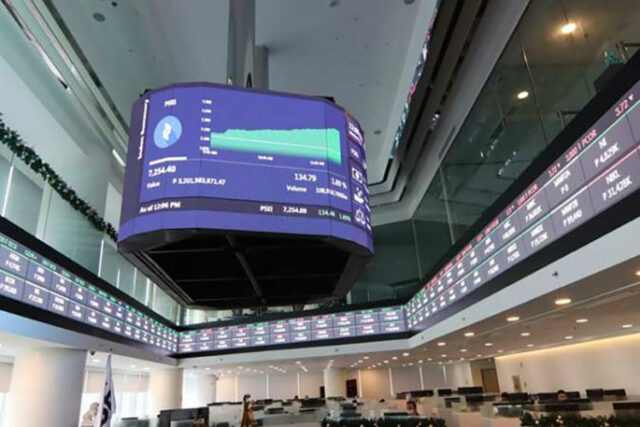
The Philippine Stock Exchange Index (PSEi) fell 0.38% or 22.46 points to 5,756.66, while the broader all-share index dropped 1.5% or 49.25 points to 3,231.55.

“The local market’s sideways movement ended in negative territory as it gave in to selling pressures,” Japhet Louis Tantiangco, research manager at Philstocks Financial, said via Viber. “Investors digested Finance Secretary-turned-Executive Secretary Ralph Recto’s projection for 2025 GDP (gross domestic product) growth of 4.7-4.8%.”

“The lingering corruption issues amid the latest developments also weighed on sentiment,” he added.

Profit taking after Monday’s sharp gains added to the decline, according to Luis Limlingan, head of sales at Regina Capital Development Corp.

“Investors turned cautious after locking in gains from the previous session’s strong run,” he said in a Viber message, noting that sentiment dropped somewhat after Mr. Recto’s growth comments.

Sector performance was mixed. Services slid 1.65% to 2,361.09, mining and oil fell 1.31% to 12,826.45 and industrials dropped 1.06% to 8,387.74.

In contrast, property rose 1.12% to 2,109.62, financials added 0.27% to 1,898.35 and holding firms inched up 0.02% to 4,483.45.

SM Prime Holdings led gainers, climbing 4.65% to P21.40, while ACEN Corp. lagged, falling 5.69% to P2.32, Mr. Tantiangco said.

The decline followed US market weakness. On Monday, the S&P 500 and Nasdaq closed below their 50-day moving averages for the first time since late April, as investors awaited corporate earnings — including Nvidia — and a delayed US job report. The Dow also slipped below its 50-day average for the first time since Oct. 10, Reuters reported.

Market breadth was negative, with losers outnumbering winners 94 to 74, while 60 stocks were unchanged.

Value turnover decreased slightly to P6.67 billion on 1.15 billion shares traded, down from P6.76 billion on 1.12 billion shares on Monday. Net foreign selling widened to P1.31 billion from P171.2 million, reflecting cautious sentiment among overseas investors.

DTI, Converge to launch AI training hub by Q1

THE Department of Trade and Industry (DTI) is partnering with Converge ICT Solutions, Inc. to launch an artificial intelligence (AI) and startup center, which is intended to help boost the global competitiveness of micro, small and medium enterprises (MSMEs).

In a briefing on Tuesday, Nylah Rizza D. Bautista, Trade assistant secretary and supervising head of the Competitiveness and Innovation Group (CIG), said that the hub will go live by the first quarter.

“This initiative aligns with our mandate under the Philippine Innovation Act, the Innovative Startup Act, and the Tatak Pinoy Act, the laws that drive productivity, competitiveness, and inclusive innovation,” she said.

“Digitalization is no longer optional for our MSMEs, and this partnership will help them future-proof for a fast-changing economy,” she added.

She said the hub will be open to all startups to co-create and network with the leaders in the industry, as well as to learn about the AI platforms that can be useful for MSMEs.

“By doing this, (we fulfill) our commitment to ensure that every entrepreneur, from small store owners to exporters, has access to the tools that drive innovation,” she added.

Converge Senior Vice-President and Head of its SME group Dindo G. Marzan said the partnership offers a platform for MSMEs to survey available solutions and train them on such technologies.

“If MSMEs can learn how to use, let’s say, ChatGPT or AI-enabled solutions, I’m pretty sure they’ll be able to save a lot on costs and make sure they become effective in what they do to grow or expand their business,” he said.

Under the partnership, Converge will support DTI programs by expanding MSME access to reliable connectivity, digital onboarding assistance, and capacity-building initiatives.

“These efforts also reinforce the DTI’s ongoing work in nurturing emerging startup communities and helping entrepreneurs explore technologies such as e-commerce automation, cloud solutions, and responsible use of AI tools to improve business efficiency,” the DTI said. — Justine Irish D. Tabile

UP eyes the twice-to-beat edge against Final 4 hopeful Ateneo

UNIVERSITY OF THE PHILIPPINES FIGHTING MAROONS — UAAP

Games on Wednesday
(SM Mall of Asian Arena)
7:30 a.m. – Ateneo vs UPIS (16U)
9:30 a.m. – ADU vs DLSZ (16U)
11:30 a.m. – ADU vs DLSU (Women)
1:30 p.m. – ADU vs DLSU (Men)
4:30 p.m. – Ateneo vs UP (Men)
7 p.m. – Ateneo vs UP (Women)

REIGNING champion University of the Philippines (UP) guns for the second and last twice-to-beat edge against Final Four hopeful Ateneo de Manila University in the Battle of Katipunan to kickstart the final week of the UAAP Season 88 men’s basketball eliminations on Wednesday at the SM Mall of Asia Arena.

Action kicks off at 4:30 p.m. for the main game of the pivotal double-header that also features De La Salle University (6-5) and Adamson University (5-7) at 1:30 p.m. in hunt for the last two seats in the semifinals after the qualification of National University (NU) (11-2) and UP (9-3).

La Salle, Adamson and Ateneo (5-6) along with Far Eastern University (5-7) figure in a logjam midway through the rankings with University of Santo Tomas (7-5) having an inside track one game up.

And the pressure is on UP not to be dragged down the mud race despite being in the Final Four already with a possible 10th victory that would ice its place in the Top Two for a win-once bonus with NU.

“Our mindset is consistency. We’re just gonna take it one game at a time,” said mentor Goldwin Monteverde as UP clinched a Final Four ticket for the fourth straight season under his watch.

As it stands, UP is already assured of at least a playoff for the No. 2 seed but could still be joined by La Salle and Santo Tomas — with only five losses — to a three-way tie at 9-5 for more complications. And the Diliman-based dribblers want none of it, here and now.

The Fighting Maroons nearly lost steam in that bid with a gritty 70-65 win over Adamson to seal a Final Four entry for the seventh straight season, the longest active streak in the UAAP since 2018.

UP wasted a 16-point first-half lead before Gerry Abadiano and Francis Nnoruka stepped up for the struggles of aces Rey Remogat and Harold Alarcon to avenge its 62-59 buzzer-beater loss in the first round.

That’s the ninth win in the last 10 games for the Fighting Maroons after a 0-2 start but for Mr. Monteverde, it only gets tougher from here if they wish to defend their title and earn a fifth straight finals appearance.

“We need to learn to try finishing off what we started every game,” ordered Mr. Monteverde as UP shoots for a repeat win over Ateneo after an 83-69 win in the first round.

Ateneo, however, who started the season at 4-0, definitely wants payback to stay afloat after a costly 69-57 defeat against Santo Tomas.

The Blue Eagles, under Tab Baldwin who has won them four titles, finished at the cellar in Season 87 with a 4-10 slate and despite a hot start fell to their sixth loss in the last seven matches to lose steam in a redemption bid at fifth spot now. — John Bryan Ulanday

ADVERTISEMENT
ADVERTISEMENT