Home Blog Page 6593

Rates of Treasury bills, bonds to rise on Fed, BSP tightening bets

BW FILE PHOTO

YIELDS on government securities on offer this week are expected to increase further in anticipation of rate hikes by the US Federal Reserve and the Bangko Sentral ng Pilipinas (BSP).

The Bureau of the Treasury (BTr) will offer P15 billion in Treasury bills (T-bills) on Monday, or P5 billion each in 91-, 182- and 364-day securities.

On Tuesday, it will auction off P35 billion in fresh three-year Treasury bonds (T-bonds).

A bond trader said in a Viber message that T-bill rates are likely to move sideways from the previous auction, while the three-year bond could fetch a rate ranging from 4% to 4.250%.

“Market players are still cautious coming in to the week in anticipation of more interest rate hikes by the US Fed and BSP,” the trader added.

“Moreover, the market will also watch this Tuesday’s domestic CPI (consumer price index) print for a lead.”

The BSP chief has said the central bank is looking to end its pandemic-driven accommodative policy by the second half. BSP Governor Benjamin E. Diokno last week signaled the key policy rate could reach up to 2.75% by next year.

The central bank has kept its key rate untouched for the 11th straight meeting last month despite warning that its inflation target might be breached this year due to surging global oil prices brought by the Russia’s invasion of Ukraine.

Analysts said headline inflation likely accelerated in March as the surge in global oil prices amid the Russia-Ukraine war caused faster increases in food and transport costs.

A BusinessWorld poll of 18 analysts yielded a median estimate of 4% for last month’s inflation, nearer the upper end of the central bank’s 3.3% to 4.1% projection.

If realized, this would be faster than the 3% in February and would match the upper end of the 2-4% target of the BSP. Still, it would be slower than the 4.5% seen a year earlier.

The Philippine Statistics Authority will release March inflation data on Tuesday.

Central banks around the world have been tightening their monetary policies to temper inflation even in the face of risks to economic growth.

The Fed hiked its policy rates for the first time since 2018 by 25 basis points (bps) last month to combat its surging inflation that reached a 40-year high. It also signaled more aggressive hikes in the coming meetings.

Rizal Commercial Banking Corp. Chief Economist Michael L. Ricafort said in a text message that the rise in rates of government debt could be tempered by lower BSP term deposit facility (TDF) auction yields for the past two weeks, the decline in global oil prices, and a stronger peso.

On Friday, global oil prices dipped ahead of a meeting of International Energy Agency member countries to discuss a release of emergency oil reserves alongside the US planned release of up to 1 million barrels of oil per day for six months, Reuters reported.

Brent crude futures were down 6 cents or 0.1% to $104.65 a barrel by 1055 GMT on April 1. US West Texas Intermediate crude futures were down 37 cents or 0.4% at $99.91.

At the secondary market on Friday, the 91- 182- and 364-day T-bills were quoted at 1.3493%, 1.5347%, and 1.7434%, respectively, based on the PHP Bloomberg Valuation Reference Rates published on the Philippine Dealing System’s website.

The government partially awarded the T-bills it offered last week as yields continued to rise amid expectations of more aggressive Fed rate hikes.

The BTr only awarded P5 billion in 91-day T-bills at its auction last week even as total tenders reached P35.804 billion, over two times as much as the P15-billion program.

The government raised P5 billion as planned via the 91-day securities as bids reached P17.802 billion. The average rate of the tenor went up by 5.1 bps to 1.587% from 1.536% last week.

Meanwhile, the government did not award 182-day T-bills even as tenders reached P9.4 billion versus the P5-billion program. Had the government made a full award, the average rate of the six-month papers would have gone up by 24.9 bps to 1.856% from the 1.607% fetched at the previous auction.

The government also rejected P8.602 billion in bids for the 364-day debt against the P5-billion plan. Had the BTr fully awarded its offer, the average rate of the one-year T-bill would have increased by 37.5 bps to 2.137% from the 1.792% quoted for the tenor previously.

Meanwhile, the last time the government offered three-year bonds was on March 1 where it rejected all bids as investors asked for higher yields amid rising inflation expectations due to the Russia-Ukraine crisis.

The BTr plans to raise P200 billion from the domestic market this month, or P60 billion via T-bills and P140 billion from T-bonds.

The government borrows from local and external sources to help fund a budget deficit capped at 7.7% of gross domestic product this year. — T.J. Tomas with Reuters

Eastern Communications entering more Vis-Min areas

By Arjay L. Balinbin, Senior Reporter

FOLLOWING its recent footprint expansion in Negros and Bicol, Eastern Communications, a broadband provider jointly owned by PLDT, Inc. and Globe Telecom, Inc., said it will expand further in Visayas and Mindanao this quarter.

Eastern Communications is also entering Panay Island (Kalibo, Boracay) and Butuan in the second quarter, the company told BusinessWorld in an e-mailed reply to questions on Saturday.

“More areas are in the pipeline such as Zamboanga and Bohol,” it added.

Eastern Communications noted that its nationwide expansion will allow the company to promote its connectivity and digital solutions in the “next normal.”

“The company continuously strives to be a one-stop-shop for telco and ICT (information and communications technology) solutions among businesses across the country.”

On Friday, Eastern Communications announced its footprint expansion in the provinces of Negros and Bicol.

“Eastern Communications introduced its Internet Direct Service (IDS), a premium and dedicated high-speed business-grade connectivity, and other borderless solutions such as Eastern Cloud, their business-grade cloud service that offers efficiency and collaboration, and Eastern Cyber Defense, a suite of premium cybersecurity solutions equipped by global partners such as Cisco, Fortinet, DOSarrest, among others,” it said in an e-mailed statement.

The telecommunications company has earmarked P3 billion for its nationwide expansion this year.

In 2021, the company allotted P2.8 billion for its expansion plans. It was able to complete the rollout of its services in Tuguegarao, Batangas, Lucena, Iloilo, Cagayan de Oro, and Davao City last year.

Hastings Holdings, Inc., a unit of PLDT Beneficial Trust Fund subsidiary MediaQuest Holdings, Inc., has a majority stake in BusinessWorld through the Philippine Star Group, which it controls.

French fashion photographer Patrick Demarchelier, 78

SCREENSHOT FROM INSTAGRAM.COM/PATRICKDEMARCHELIER

LONDON —  French fashion photographer Patrick Demarchelier, known for his front covers and portraits of famous figures including the late Princess Diana, has died at the age of 78.

Mr. Demarchelier photographed fashion house campaigns and glossy magazine shoots throughout his career, and was even referenced in the 2006 movie The Devil Wears Prada.

His photographs of Diana became some of the best known images of her, including a black and white one of her smiling while hugging her knees wearing a strapless gown and tiara.

“It is with great sadness that we announce the passing of Patrick Demarchelier on March 31st 2022,” his representatives wrote in a post on his Instagram page late on Thursday.

“He is survived by his wife Mia, his three sons Gustaf, Arthur, Victor and three grandchildren.”

No further details were given.

In 2018, Demarchelier was accused of sexual harassment, allegations he denied. At the time, Vogue publisher Conde Nast said it would stop working with him for the foreseeable future.

Fashion industry figures, including models including Bella Hadid and Cindy Crawford, paid tribute to him.

“I am grateful to have been lucky enough to be in front of your lens. Most gentle, most legendary, soft but full of life. You will be missed Patrick,” Ms. Hadid wrote on Instagram.

“Thanks for so many great memories and beautiful, timeless images,” Ms. Crawford said.

Posting her own Vogue front cover shot by Mr. Demarchelier, actress Kate Hudson wrote: “So many memories. I had the pleasure of being photographed by Patrick often and always enjoyed him and his team so much. Sending a ton of love to his family.” — Reuters

Geely Emgrand Premium: Geely crosses over to the sedan segment

The Geely Emgrand in Tagaytay — PHOTO BY KAP MACEDA AGUILA

The Emgrand is raising the subcompact stakes

LIKE THOR’s hammer (see what I did there), Geely smashed and carved a nook for itself in the highly competitive automobile industry of the Philippines. Hard to believe that the brand had just punched its time card in 2019 to mark its return — this time under Sojitz G Auto Philippines Corp. (SGAP) as its official distributor.

Driven primarily by the compelling, right-priced product that is the Coolray, Geely in the Philippines hit the ground running and quickly became one of the reasons that the term “China-made” turned into a, well, more palatable proposition for car browsers. The Coolray success here is, by no means, an aberration. In a recent press release, Geely Philippines reported that the “Coolray has been a best-selling model since its launch in China last October 2018. It quickly rose to the top three best-selling compact SUVs in the Chinese market. In September 2019, Geely Coolray officially began its worldwide trip, entering the automotive markets of over 10 countries including the Philippines, Russia, and Saudi Arabia. It quickly captured a large number of local customers. Two years after diving into the global market, the Coolray has become a sales legend with nearly 400,000 cars worldwide.”

Geely has been a juggernaut here as well. Last year, as the pandemic was (cautiously) being corralled, vehicle sales almost tripled. With but three models in its lineup, Geely Philippines moved 6,104 units — a 182% jump from the 2,158 units sold in 2020. All told, the brand kept ninth place in auto sales overall (even as it more than doubled its share of the market from 0.9% to 2.1%).

What makes this even more remarkable is that all three of the aforementioned models are SUVs. This perhaps underscores the fact (as if we need to be reminded) that Filipinos are such big crossover fans.

Nonetheless, Geely Philippines (or any brand for that matter) will not be served well by being a one-trick pony. There’s business to be had in other auto segments. With that in mind, SGAP recently launched the 2022 iteration of the Emgrand. Not only is the brand expanding its offerings, the Emgrand is going to do battle in what the distributor called “the country’s largest segment, the subcompact sedan market.”

Now, I can finally reveal that several of us motoring journalists were asked to participate in a focus group discussion last December. That was when SGAP was still examining the feasibility of actually bringing in the Emgrand or perhaps, more accurately, how the Emgrand would fare perception-wise versus the models it is slated to do battle with. Lined up shoulder to shoulder with the competition, the Emgrand looked modern and well-equipped. Save for one vehicle, it was also the biggest among the subcompacts.

Those of us present for the session agreed that the Emgrand would be a promising release for Geely if it was priced well below P1 million — the lower the better, actually. Now I will not surmise as to the importance ascribed to that opinion, but take a gander at the Emgrand’s price tags: P908,000 for the Premium variant and P798,000 for Comfort. Obviously, there’s a large gaping hole between the two price points, and I’d like to think that it’s by design so that Geely can fill in that void with more variants — depending on how warmly the Emgrand is received.

It’s a scorcher of a morning that greets us at the Geely North EDSA dealership. We’re here to get our noses swabbed (de rigueur in this pandemic era) ahead of a first-ever ride-and-drive for the Geely Emgrand (and first in the new normal for SGAP). The Azkarra and Okavango had been deprived of this activity when they were launched here.

SGAP President and CEO Yosuke Nishi is there at the showroom to talk to us and see us off. I ask him if there are enough units of the Emgrand, and he nods — adding there is adequate supply so that buyers don’t have to wait. He also intimates that it is important for SGAP to hold the activity as the company knows people are waiting for feedback from people like us before they put the car into their consideration set. SGAP General Manager for Sales and Marketing Froilan Dytianquin concurs.

An industry veteran, Mr. Dytianquin also shares that SGAP is looking at selling 12,000 total vehicles in 2022 — about 2,500 of which will be Emgrands. More good news is forthcoming for Geely fans: A new model will be unveiled this year, in addition to an “updated” one. It’s not all about bringing in nameplates, either. The executive further reveals that 27 Geely dealerships are now open, and six are in the works. By the end of the year, SGAP expects 40 facilities in total to be open. It’s pretty obvious that Geely Philippines is about doing things quickly.

Now that the economy and society in general is opening up, Geely is ready to dip its toes in an even bigger pool. “The Geely Emgrand aims to continue what we have begun from our young brand. We have heard and listened to our customers and this gave us the confidence to bring in a sedan for the Filipino market,” Mr. Nishi had said in a statement.

So, let’s get to the crux of the matter. Is the Emgrand the right-priced sedan you are looking for?

In China, the answer is obviously yes — there have been more than 3.38 million Emgrands sold cumulatively. Now, the Philippines is the first overseas market to get the model since the all-new edition’s global launch last year. SGAP said that part of the reason why we had dibs on the Emgrand has to do with the aforementioned robust sales and growth in such a short time. China is certainly looking at the Philippines with keen interest. Remember the Coolray Sport Limited? That was an example of China’s swift response to demands of the Philippine market.

The Coolray formula for success certainly comes to mind at first blush of the Emgrand. Here’s a product that punches above its price point in terms of fitments and execution. Even during the aforementioned focus group discussion, the Emgrand stood out as defying the conventions of the affordable class. It benefits from Geely’s advanced, so-called 5G smart factory in Changxing. Said to employ 100% automated welding, the Emgrand thus gets consistent gaps and flush (less than 3.5mm). “This factory also enables Geely now to adopt the longest roof laser welding instead of spot weld on the Emgrand, increasing its strength by 50%, making the vehicle safer.”

You can see this elevated level metalwork in the Emgrand, which sports not only a great finish but elegant styling — reminiscent of a certain Sweden-headquartered brand which Geely owns. Isn’t synergy great?

I don’t know about you, but “subcompact” seems like a misnomer for this model, which stretches 4,638mm and is 1,822-mm wide. The Premium variant assigned to me on this drive has all the bells and whistles — including leatherette and suede material that cover its seats. If you ask me, the blue-and-white color scheme is a little off-putting though, particularly if you happen to choose an exterior color that doesn’t match it (like the red-hued unit I’m driving).

But let’s look at the exterior first. The Emgrand Premium gets projector LED headlamps with auto headlight control. Daytime running lights are LEDs as well and are standard in the lineup. The Premium’s side mirrors fold automatically, and boasts a hands-free-opening, 500-liter trunk. Speaking of which, with the rear seatbacks folded, this capacity grows to 1,100 liters. Seventeen-inch alloy wheels with 205/50R17 tires complete the picture, along with nifty welcome and farewell lighting that showcases a lighting routine on the Emgrand when you unlock or lock it — courtesy of 190 LED bulbs in the rear which “project three unique light patterns.”

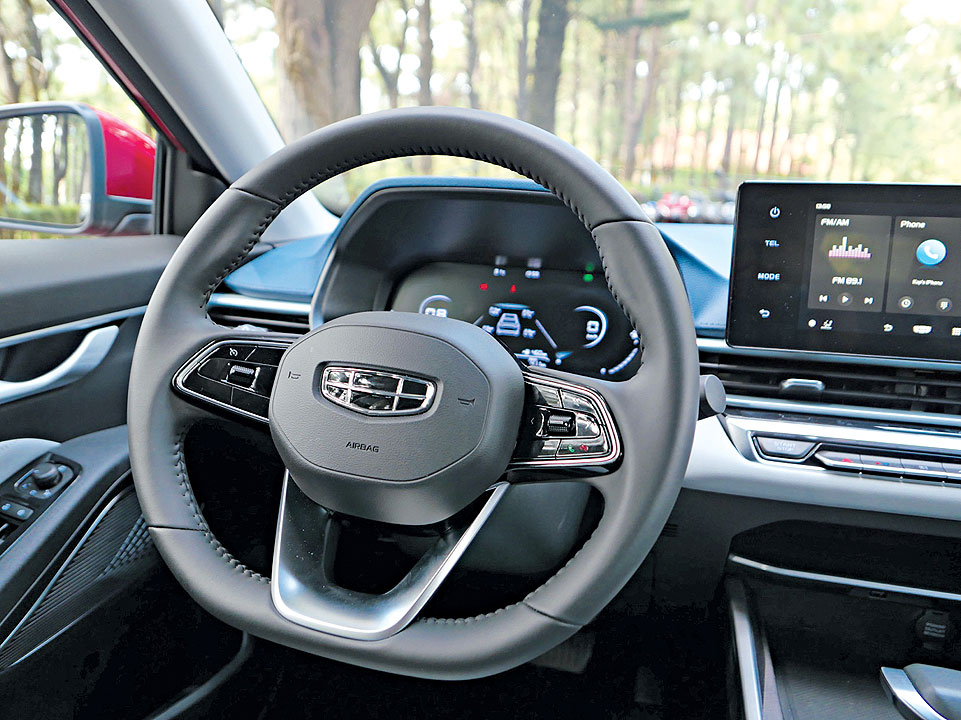
The first thing that calls your attention inside the cabin is a huge eight-inch infotainment screen with wireless screen mirroring via EasyConnection. Unfortunately, neither Apple CarPlay nor Android Auto is available, but we keep hoping an OTA update in the near future will make the Emgrand more accepting of our mobile devices. Having said that, I managed to pair my iPhone wirelessly for some hands-free calls and to listen to Spotify tunes through its six speakers. Not bad. The screen also turns into a reversing display.

“The inside is where all the magic happens,” says SGAP Product Planing Specialist Aaron Leang. Much of the magic is in the electronic air-conditioning with an “intelligent interactive system.” You can set it that when you unlock the car, the A/C can be switched on. Conversely, when you leave the car and lock it, a blower will activate after a minute. This dries the evaporator to prevent the growth of molds. The air-con also has a CN95 filter to keep the cabin free from viruses and bacteria.

“It adapts to what you do,” adds Mr. Leang. “It lowers the fan speed of the A/C when you make a Bluetooth call, when the sunroof is opened it switches to fresh air mode, and when the recirculation button is engaged, all windows will close — including the sunroof.”

The Emgrand is powered by a new 1.5-liter dual continuous variable valve timing normally aspirated engine, good for 102hp at 5,600rpm and 142Nm. Geely says the car is kept light through an all-aluminum alloy cylinder block. The driver accesses the goodness through an eight-speed continuous variable transmission (CVT).

As the output numbers would suggest, the Emgrand isn’t built for speed or agility — that would be missing the point altogether. What it does deliver in spades is what the lower variant (for now) is named after — COMFORT. NVH levels are managed, the aforementioned air-conditioning is adequate, there’s a lot of soft-touch materials within. Space is generous, as are places to stow your stuff. There’s even a USB port under the rear A/C vents. Thoughtful touches help the Emgrand elevate the category — such as an all-digital instrument cluster which even affords a real-time view of tire pressure. Other appurtenances and safety essentials include ABS with EBD, electronic stability program, traction control, hill hold control, electric parking brake with autohold, six air bags (on the Premium), and three ultra-sonic reversing radars and high definition wide angle reverse camera (Premium). There’s also a rear intelligent monitoring System that reminds you to check the rear seats before getting off the car.

If you check out the website of Geely Philippines and find your way to the Emgrand’s brochure, you’ll see a third variant, “S.” It appears to be the lowest trim, although it isn’t available just yet. Now that’s going to undercut a lot more of the competition.

But I think, for now, this is one thing Geely isn’t going to rush. It’s willing to wait on how the Emgrand will be received. If you ask me, there’s much reason to believe the reception will be as warm as the summer we’re now going through.


Southeast Asian company to enter insurance market

A NEW INSURER is expected to enter the Philippine market this month and set up both life and nonlife firms, Insurance Commissioner Dennis B. Funa said on Friday.

The conglomerate comes from Southeast Asia and will set up life and nonlife insurance firms, Mr. Funa told reporters at the sidelines of the Insurance Commission’s 73rd anniversary event in Manila on Friday.

The company will not acquire existing insurers and set up new entities, he said.

“The license is now being processed,” Mr. Funa added. “They can well afford the P1.3-billion capitalization.”

Insurance companies’ minimum capital requirement was hiked to P900 million as of end-2019 from P550 million under Republic Act No. 10607 or the amended Insurance Code. This will increase further to P1.3 billion by the end of this year.

Mr. Funa said the higher requirement will take effect this year despite calls from industry groups to scrap it as this is among the highest in the region and could bring down the number of insurance companies in the country and eventually reduce consumer choices and competition.

“There are remedies for that: get new investors, get new stockholders. There is always a way to raise capital,” he said when asked about smaller companies’ difficulty in meeting the higher requirement.

“Some companies would be willing, some might not. It would depend on the board of directors. But if it’s a policy, then I guess they have no choice but to follow,” Mr. Funa added.

The IC chief said more than half of insurance companies would be able to comply with the new rate, based preliminary data from the agency.

“Higher capitalization will always be good for any company. The higher the capitalization is, the farther it is from any financial threat,” Mr. Funa said.

Finance Secretary Carlos G. Dominguez III said the higher capital requirement would protect the public at the sidelines of the same event on Friday.

“To improve the protection for the public, the capitalization really has to go up,” Mr. Dominguez said. “It’s like a bank, you want to make sure the public is protected. The job of the Insurance Commission isn’t to protect the industry, it’s to protect the public.” — Tobias Jared Tomas

S.Korea supports Iloilo smart greenhouse program

DA

SOUTH KOREA has assisted in the construction of smart greenhouses in Iloilo, in what is being pitched as a climate-change mitigation measure, the Department of Agriculture (DA) said.

The DA and the Korea Agency of Education, Promotion and Information Service in Food, Agriculture, Forestry and Fisheries (EPIS) constructed 10 such greenhouses, which will be used to boost mushroom and tomato production and that of other high-value crops.

The greenhouses went up at the Western Visayas Integrated Agricultural Research Center in Jaro, Iloilo.

“Changing weather patterns resulting in unusually warmer temperatures or heavy rainfall have caused an imbalance in the production of agricultural commodities,” the DA said in a statement.

“Through time, the threat of climate change has caused alarm to the food production sector, not only in the Philippines but throughout the world. And so, innovative and smart technologies are now being adapted to address these inevitable phenomena,” it added.

Agriculture Secretary William D. Dar said that EPIS will continue to collaborate with the DA in future agricultural development and food productivity initiatives.

“This showcase manifests that new technologies are crucial in feeding the next generation. Smart technology and precision farming upgrade our productivity levels benefiting farmers and food producers,” Mr. Dar said in a statement.

“We have to have enough food, and I believe that this smart farming system is the best solution. Smart greenhouses are forward-looking, and will surely elevate the food production here in our country,” he added.

EPIS will provide assistance in agriculture digitalization, particularly in the establishment and implementation of a centralized system for the DA.

Apart from Iloilo, 11 more smart greenhouses will be built in Bukidnon for strawberries, potato seedlings, and tomatoes. — Luisa Maria Jacinta C. Jocson

Prime Infra gets nod from IPs for water supply project

RAZON-LED Prime Infrastructure Holdings Corp. (Prime Infra) announced that it secured the consent of the Dumagat-Remontado indigenous peoples (IPs) for the second phase of its bulk water supply project in Rizal.

In a media release, the company said the approval of the fourth and final memorandum of agreement (MoA) in the free, prior and informed consent (FPIC) process “is a major milestone in helping to efficiently and sustainably address the looming water shortage in Metro Manila,” mitigate flooding in the lower areas of Rizal province, Marikina City and Pasig City “and uplift the lives of the project’s host communities in Rizal province.”

Wawa Bulk Water Supply Project Phase II, Upper Wawa Dam, aims to provide at least 518 million liters per day to over 500,000 households within Metro Manila and Rizal.

The negotiations and MoA signing was supervised by the FPIC team and the National Commission on Indigenous Peoples (NCIP).

“It shows the full support from the community for the Upper Wawa Dam Project and will allow us to proceed with working to provide reliable water supply to Metro Manila’s East Zone residents while also helping support the growth and sustainable development of the IPs in Antipolo City and Rodriguez, Rizal,” WawaJVCo, Inc. President Melvin John M. Tan said.

WawaJVCo is a joint venture between Prime Infra and San Lorenzo Ruiz Builders and Developers Group, Inc.

Sinigurado sa MoA na ang mga katutubong Dumagat ng Montalban, kasama ang mga kabataan, kababaihan at matatanda ay magkakaroon ng bahagi sa pagpapaunlad ng aming lupang ninuno,” said Adolfo C. Gallanosa from the Montalaban IP.

(The MoA made sure that the Dumagat IPs from Montalban, including children, women, and the elderly, will be part of the success of this project on our ancestral land.)

WawaJVCo was formed to develop the bulk water supply project and mitigate flooding in Metro Manila’s eastern portion. Its parent firm, Prime Infra, has infrastructure assets that include renewable and sustainable energy, water, and construction.

“Prime Infra applies an integrated and comprehensive approach to the task of developing infrastructure assets, improving lives and laying a strong foundation for the future by enabling the delivery of essential services to communities in emerging markets worldwide,” the company added. — Luisa Maria Jacinta C. Jocson

Bridgerton — how period drama made audiences hate the corset

LIAM DANIEL/NETFLIX

WHEN you think of a corset, you might imagine period drama dames sucking in as they cling onto a bedpost as a feisty lady’s maid aggressively laces them in. Nextflix’s hot Regency inspired drama Bridgerton features similar such tortuous scenes.

In the run up to the show’s second season, Simone Ashley, who plays the new heroine Kate Sharma, complained to Glamour Magazine about the horrors of wearing a corset. She claimed that her corset caused her “a lot of pain” and “changed her body.”

In the first season, Prudence Featherington (played by Bessie Carter) was tight-laced into a corset. Prudence’s mother urges her daughter on: “I was able to squeeze my waist into the size of an orange-and-a-half when I was Prudence’s age.” Rather unnecessary, when regency gowns fall from an under-bust empire line, which obscures the waist. Unlike their later Victorian counterparts, Regency corsets focused on enhancing a lady’s assets, not shrinking her waist.

This scene is ubiquitous in period dramas, from Elizabeth Swan fainting in Pirates of the Caribbean, to Rose DeWitt Bukater unable to breath in Titanic, and, of course, Mammy’s iconic line, “Just hold on, and suck in!,” as Scarlet O’Hara clings to a bedpost in Gone with the Wind. It may be on screen shorthand for the restricted lives of historical women, but it stems from a fundamental misunderstanding of historical corsets and women alike.

After centuries of women (and some men) wearing corsets to support and shape the body, it was Victorian men who taught us to hate corsets. Corset-related health issues were a myth, constructed by doctors, to promote their own patriarchal perspectives. So, you might be surprised to hear that period dramas are perpetuating Victorian misogyny.

The list of medical complaints that 19th-century doctors attributed to the corset seems unending. Constipation, pregnancy complications, breast cancer, postpartum infection, and tuberculosis were all blamed on the corset. One Victorian doctor, Benjamin Orange Flower, author of the 1892 pamphlet Fashion’s Slaves, claimed that “if women will continue this destructive habit, the race must inevitably deteriorate.”

As science has developed, the medical root of these illnesses has been identified, and the corset’s culpability disproved. The corset offers an example of gender bias within medical research. The many ailments of George IV, one of the many men to wear a corset in the 19th century, were never blamed on his corset wearing.

Some corsets were even specifically designed to be healthy and supportive. Lingerie company Gossards published Corsets from a Surgical Perspective in 1909, which promoted the flexibility and supportive possibilities of the corset, which could “preserve the lines demanded by fashion, but without discomfort or injury.”

But the hourglass shape of the late 19th-century period was not what women of the Regency desired. They were only interested in their breasts, as Hilary Davidson has shown. Breasts needed to be lifted and separated into two round orbs. Regency corsets (or “stays” as they were known) were often short, always soft, and never heavily boned. Their purpose was bust support, never restriction. I wonder what regency women would have thought of modern bras with straps that pinch and underwire that rubs.

Historical corsets were ingenious, light and bendy. Whalebone (which is baleen from the mouth of a whale, and is not actual bone) is wonderfully flexible, and molds to the body beneath it — and many corsets were simply reinforced with cotton cording. Corsets reduced back pain from bad posture and had expanding portions for pregnancy.

The problem then in the depiction of corsets in period dramas is not “historical accuracy,” an idea widely debunked by historians, including Bridgerton’s own historical advisor. Bridgerton’s costumes are joyously reminiscent of designer George Halley’s highly embellished and brightly colored empire line fashion designs from the 1960s. Bridgerton’s costumes are historically inspired fantasy.

Bridgerton is to Regency England what Game of Thrones is to the Wars of the Roses, and there is nothing wrong with that. It is a fantastical reimagining, creatively inspired by the past. The idea that its costumes should be “historically accurate,” or that such an aspiration is even possible, is not what is at stake here.

This is an issue of historical fallacy. Women of the past had agency over their bodies and how they were dressed. They were clever about how they achieved the fashionable proportions, padding out the hips and bust, rather than reducing the waist. Like the show’s famed dressmaker, Madame Delacroix, many of the professionals dressing them were themselves women. We strip away that agency and ingenuity when we assume historical women were passive dolls, dressed up and cinched in by a patriarchal society.

For historical women, corsets were a support garment, which allowed them to follow the fashionable silhouette without having to diet, exercise, or have cosmetic surgery. It would be a refreshing change to see period dramas embrace this feminist history of the corset, instead of falling back on a misogynistic stereotype.


Serena Dyer is a Lecturer in History of Design and Material Culture at the De Montfort University in Leicester, UK.

Volvo wants the planet safe as well

Volvo S90 — PHOTO FROM VOLVO PHILIPPINES

The Swedish auto brand takes climate change seriously

AS FAR AS I can remember growing up in the Philippines, we’ve always recognized Scandinavian car brand Volvo as one of the strongest champions of vehicle safety. To this day, that has not changed — but did you also notice how the brand has now taken a fiercely proactive stance when it comes to climate action?

As a matter of fact — and among other achievements — Volvo has recently been cited by the global environmental non-profit CDP as one of the leaders (together with only a small number of companies) in taking real actions toward becoming a climate-neutral company.

“Receiving the prestigious A-score from the CDP shows that we are on the right track, and hopefully, we can inspire other companies to do even more,” shared Volvo Cars Head of Global Sustainability Anders Karrberg.

Furthermore, Volvo also clinched the Smart and Safer Mobility Award at the 2021 Europa Awards, for its active efforts to address several motoring concerns, primarily in the fields of accessibility and environmental impact. This, alongside the company’s customer-centric approach in delivering cleaner and data-driven solutions for our local urban mobility ecosystem.

If you will remember, Volvo Cars has already long disclosed its goal to transform into a fully electric car maker by 2030. Imagine, that’s only eight years away. This production transformation is a major component in its quest to become a climate-neutral company by the year 2040.

In alignment with this, Volvo Philippines will this year be offering a beautiful range of hybrid vehicles powered by a new B6 engine. This modern B6 engine features a state-of-the-art 2.0-liter, four-cylinder turbocharged engine connected to a 48-volt hybrid system. The new Volvo S90 and XC90 variants already feature this, and do not sacrifice performance in exchange for fuel economy, mind you. At its core is an Integrated Starter Generator (ISG) that spits out an additional wave of power to enhance its already impressive 295 horses and 310 lb-ft of torque.

And to make things more exciting and hopefully bring the vehicles closer to the people, Volvo Philippines will be showcasing its latest local fleet of hybrid vehicles at the upcoming Manila International Auto Show (MIAS) — finally back in the metal — at the World Trade Center this week after a COVID-19 hiatus since 2020.

And since we already mentioned this disastrous COVID pandemic, might I also add that Volvo Cars now also highlights an advanced kind of air purifier that keeps the cabin air quality more sterile than ever before. It is the tiny details like these that keep Volvo vehicles at the forefront of transportation technology that marry comfort and connectivity with every aspect of passenger safety.

As our country’s local charging infrastructure (or lack thereof) still implies that hybrid vehicles are our current best bet when it comes to consumer convenience in the journey to vehicle electrification, Volvo Philippines is happy to exhibit its 2022 Volvo Boost Hybrid Range, and to offer special deals and promotions alongside them, at the upcoming largest vehicle trade show in the country.

SL Agritech in P2-B social finance issuance

RICE producer SL Agritech Corp. announced that it became the country’s first private corporation issuer of a social finance instrument worth P2 billion.

“DNV made a second party opinion assuring [the] fund will enable us to raise capital for a project that has ‘social’ benefits. The funds will be drawn in one or more tranches over three years,” SL Agritech said in a statement.

The issuance is to be managed and arranged by MIB Capital Corp. and has been approved by DNV Business Assurance Pty. Ltd.

“SL Agritech currently meets the criteria established in its Eligibility Assessment Protocol [that is] aligned with the stated definition of social bonds and loans,” DNV said in a statement.

“There has been a steadily increasing demand for sustainable bonds such as SL Agritech’s social finance instrument,” said Konsintr Puongsophol, Asian Development Bank financial sector specialist.

“Global sustainable bonds doubled to $1.5 trillion in 2021 from $745.4 billion in 2020,” he added.

SL Agritech said that it is engaged in a continuing expansion every two years. Its hybrid rice plant production and seed processing sites including expansion sites are found in Talavera, Nueva Ecija; Banay Banay, Davao Oriental; Victoria, Tarlac; and Matanao, Davao del Sur.

“Through our plant expansion program, we are able to help more farmers and provide employment to those in the agricultural sector.  We are contributing to the economic growth in the target locations and nearby rural communities,” SL Agritech Vice-President for Rice Operations Christopher Brian C. Lim said.

“Both oil and food are very important for us. Right now, during this Russia war, the price of wheat and food has risen. There is a good opportunity for farmers to plant and yield more for us to be self-sufficient. In this season, we have to be self-sufficient in food,” he added.

A review and finalization of the terms of the issuance will be done from April 18 to 27, while the signing of the financing facility will be on May 2.

The social financing instrument will be made available to 19 primary institutional lenders.

SL Agritech said it recently established its social finance framework and corporate social and sustainability committee to oversee socioeconomic development projects.

The projects include a contract growing program for rice and hybrid seeds that provides farmers inputs, tools, and technology in advance. SL Agritech then buys back farmers’ harvest at prevailing price plus a premium.

The hybrid rice technology demonstration program is a nationwide farmers’ education that guides farmers on implementing farming technology using hybrid seeds from planting to harvesting.

The company is also continuing the research and development of hybrid seed varieties in terms of yield, good tasting quality, and pest resistance to ensure a sustainable food system.

It is also planning plant expansion programs aimed at generating more employment for farmers and agricultural sector, promoting economic growth in rural communities. — Luisa Maria Jacinta C. Jocson

Yields on government debt climb on expectations of faster inflation

YIELDS on government securities (GS) went up across the board last week on expectations of faster inflation and potential rate hikes by various central banks.

GS yields, which move opposite to prices, went up by an average of 5.54 basis points (bps) week on week, according to the PHP Bloomberg Valuation Service Reference Rates as of April 1 published on the Philippine Dealing System’s website.

At the short end of the curve, yields on the 91-, 182-, and 364-day Treasury bills (T-bills) on Friday picked up by 2.81 bps (to 1.3493%), 0.81 bp (1.5347%), and 0.56 bp (1.7434%), respectively, from their March 25 finish.

The belly of the curve likewise climbed as rates of the two-, three-, four-, five-, and seven-year Treasury bonds (T-bonds) increased by 3.6 bps (to 3.3857%), 7.35 bps (4.0737%), 10.2 bps (4.7063%), 6.1 bps (5.1729%), and 2.79 bps (5.6271%), respectively.

The long end of the curve also rose, with yields on the 10-, 20- and 25-year T-bonds gaining 23.94 bps (5.9587%), 1.13 bps (5.5605%), and 1.7 bps (5.5512%).

“Bond yields continued to reflect expectations for faster inflation and potential rate hikes by the BSP (Bangko Sentral ng Pilipinas),” ING Bank N.V. Manila Senior Economist Nicholas Antonio T. Mapa said in an e-mail on Friday.

“To some extent sentiment took its cue from developments related to the conflict in Eastern Europe as well as the borrowing plan for the second quarter,” Mr. Mapa added.

“The GS market sustained its defensive ways this past week as dealers and investors are still hesitant to build up major positions in anticipation of more interest rate hikes ahead, led by the US Federal Reserve,” a bond trader said in a Viber message.

“Moreover, the rise in local yields was tempered by relatively lower global oil prices this past week,” the bond trader added.

The BSP chief has said the central bank is looking to end its pandemic-driven accommodative policy by the second half. BSP Governor Benjamin E. Diokno last week signaled the key policy rate could reach up to 2.75% by next year.

The central bank has kept its key rate untouched for the 11th straight meeting last month despite warning that its inflation target might be breached this year due to surging global oil prices brought by the Russia’s invasion of Ukraine.

On Thursday, the central bank said March inflation could breach its target amid local oil price hikes and peso depreciation.

The BSP estimated that inflation for March could settle between 3.3% to 4.1%, with the midpoint at 3.7%.

If realized, this would be faster than February’s 3% but slower than March 2021’s 4.1%. The midpoint also matched November 2021’s pace and would be the quickest pickup since the 4% print in October last year.

The Philippine Statistics Authority will release March inflation data on April 5, Tuesday.

On Friday, global oil prices dipped ahead of a meeting of International Energy Agency member countries to discuss a release of emergency oil reserves alongside the US planned release of up to 1 million barrels of oil per day for six months, Reuters reported.

Brent crude futures were down 6 cents or 0.1% to $104.65 a barrel by 1055 GMT on April 1. US West Texas Intermediate crude futures were down 37 cents or 0.4% at $99.91.

Central banks around the world have been tightening their monetary policies to temper inflation even in the face of risks to economic growth.

The Fed hiked its policy rates for the first time since 2018 by 25 bps last month to combat its surging inflation that reached a 40-year high. It signaled more aggressive hikes in the coming meetings.

Meanwhile, the Bureau of the Treasury announced on Wednesday it plans to borrow P200 billion from the domestic debt market in April, smaller than the P250 billion programmed last month. Broken down, the government targets to borrow P60 billion from its weekly T-bill auctions and P140 billion via T-bonds.

For this week, ING’s Mr. Mapa said investors are likely to get direction from the upcoming March inflation report as well as international developments.

“As for particular tenors, next week features both a bills and bond auction and we could see some action on the belly of the curve,” Mr. Mapa said.

Yields will continue to trade sideways with an upward bias this week, the bond trader said.

“The local bond market will have a full plate this week as market players gear up for the release of March CPI (consumer price index) on Tuesday and the three-year FXTN (fixed rate Treasury note) auction issuance (indicative range at 4.00% to 4.25%),” the bond trader said.

The Treasury will offer P35 billion worth of fresh three-year bonds on Tuesday.

The government borrows from local and foreign sources to help fund its budget deficit seen to hit 7.7% of the country’s economic output this year. — Lourdes O. Pilar with Reuters

NGO helping develop market for organic nano-fertilizer

SHUTTERSTOCK

A SOCIAL enterprise has joined the effort to grow the market for organic fertilizer, particularly a type of nano-fertilizer which will soon be manufactured in the Philippines, as a response to the global shortage of fertilizer that is threatening to dampen global food production.

Ignite Impact Fund Founder Maria Antonia G. Arroyo said in a statement that her organization is pressing for greater adoption of organic fertilizer after the Russian invasion of Ukraine disrupted the global supply of synthetic fertilizer, of which Russia is a major manufacturer.

“We believe that BioPrime is definitely aligned with our mission to help these sectors and bring them out of extreme poverty, which is why their organic fertilizers are such a welcome development,” she said, referring to a US-made fertilizer that claims to increase yields for rice, corn, sugar, coffee, banana, cacao, tobacco, pineapple, vegetables, and tree crops.

“In trials with Philippine Rice Institute, BioPrime has been proven to reduce the need for synthetic fertilizers, which is currently at record high prices, and pesticides, lowering farming costs,” Ignite Impact Fund said.

In mid-March, BioPrime Agri Industries, Inc. announced that it is planning to develop nano-fertilizer facilities in the Philippines, which it plans to use as an export base for the region.

“The production facility will have a targeted capacity of 48 tons per year, employing more than 100 Filipinos in this high-technology agri initiative. Our product provides an avenue for the Philippines to implement an effective balanced fertilization program and planned production volumes can supply more than 3 million hectares of rice lands targeted to produce at least 22.4 million metric tons (MT) of rice per year,” BioPrime Chairman Ben Mead said in a statement.

“Farmers save money because they have less input costs, and they make more money because the yield is improved. It’s just a very exciting development for agriculture in the Philippines,” Mr. Mead said.

“Given that we’ve demonstrated that BioPrime works and it can have a highly significant impact in improving the returns to farmers, now is absolutely the time for the Philippines to embrace this technology,” he added.

BioPrime fertilizer’s components are microbial stimulators, enzymes, and mineral electrolytes that stimulate the microorganisms in the soil.

It claims to restore soil integrity, promotes microorganism activity, and reduces pest pressure. — Luisa Maria Jacinta C. Jocson

ADVERTISEMENT
ADVERTISEMENT