Home Blog Page 64

Semirara Mining and Power Corp. to hold Annual Meeting of Stockholders on May 4 via remote communication

NOTICE OF ANNUAL STOCKHOLDERS’ MEETING

Please be notified that the Annual Meeting of Stockholders of Semirara Mining and Power Corporation (“Corporation”) will be held on May 4, 2026, 1 Monday at 10:00 a.m. and will be conducted by remote communication at https://www.semirarampc.com/asm.

Agenda

  1. Call to Order and Proof of Notice of Meeting 
  2. Certification of Quorum 
  3. Chairman’s Message 
  4. Approval of Minutes of Previous Stockholders’ Meeting held on May 5, 2025 
  5. Presentation and Approval of President’s Report 
  6. Presentation and Approval of Audited Financial Statements for CY 2025
  7. Ratification of the Acts of the Board of Directors and Management from the Date of the Last Annual Stockholders’ Meeting up to the Date of this Meeting 
  8. Election of Directors for 2026-2027 
  9. Approval of Appointment of Independent External Auditor 
  10. Other Matters 
  11. Adjournment 

Record Date

Stockholders of record, as of March 17, 2026 will be entitled to notice of, and vote at the said annual meeting or any adjournment or postponement thereof.

Registration and Voting

Stockholders may attend the meeting remotely by registering here beginning April 20 to April 28, 2026. Only stockholders of record as of March 17, 2026 will be entitled to vote at the said meeting. Stockholders may vote in absentia using the online voting portal at https://www.semirarampc.com/votingor by appointing the Chairman of the meeting as their proxy. The voting portal will be accessible beginning April 20, 2026, until 12:00 noon of May 4, 2026.

The following documents are required to be transmitted by email to corporatesecretary@semirarampc.com upon registration:

CERTIFICATED SHARES:

1. Individual Stockholder
        a. Valid Government-Issued ID or passport
2. Corporate Stockholder
        b. Secretary’s Certificate designating its attorney-in-fact and proxy 

        c. Valid Government-Issued ID or passport of the representative

UNCERTIFICATED OR SCRIPLESS SHARES:

1. Individual Stockholder
         a. Broker’s Certification stating the stockholder’s name and the number of shares held
         b. Valid Government-Issued ID or passport
2. Corporate Stockholder
         a. Broker’s Certification stating the stockholder’s name and the number of shares held
         b. Secretary’s Certificate designating its attorney-in-fact and proxy
         c. Valid Government-Issued ID or passport of the representative

The requirements and procedure for electronic voting in absentia and participation by remote communication is set forth in Schedule 4 of the Definitive Information Statement published on the Company’s Website and on PSE Edge.

Stockholder Question

Questions may be sent prior to the meeting at corporatesecretary@semirarampc.com no later than April 28, 2026, which shall be limited to the items in the agenda. Some questions may be addressed while others will be replied to via email.

Proxy

Duly accomplished proxy forms must be submitted on or before 5:00 p.m. on April 24, 2026 to the Office of the Corporate Secretary at the 2nd Floor DMCI Plaza, 2281 Don Chino Roces Avenue, Makati City 1231, Philippines or by email at corporatesecretary@semirarampc.com. Validation of proxies is set on April 28, 2026, at 10:00 a.m.

Electronic copies of the Definitive Information Statement, Management Report, SEC Form 17A and other pertinent documents are available at the Company’s Website (https://www.semiraramining.com) and on the PSE Edge.

(Sgd.) JOHN R. SADULLO 

Corporate Secretary

For the Board of Directors

—————————————–

1 Should the date of the annual stockholders’ meeting (ASM) be declared a legal holiday, the ASM will be held on the next succeeding business day at 10:00 a.m. pursuant to Section 1, Article I of Corporation’s By-Laws, as amended.

Semirara Mining and Power Corporation has a dividend policy that ensures a minimum of 20% of net profit after taxes starting from the period ending December 31, 2005. However, the Board of Directors has the option to declare more than 20% if there is excess cash, and less than 20% if there is insufficient cash available. The corporation declared a regular cash dividend of P1.25/share and a special cash dividend of P.75/share on March 24, 2025, with a Record Date of April 8, payable on April 23, 2025. It also declared a special cash dividend of P1.25/share on October 20, with a Record Date of November 4 payable on November 20, 2025.


Spotlight is BusinessWorld’s sponsored section that allows advertisers to amplify their brand and connect with BusinessWorld’s audience by publishing their stories on the BusinessWorld Web site. For more information, send an email to online@bworldonline.com.

Join us on Viber at https://bit.ly/3hv6bLA to get more updates and subscribe to BusinessWorld’s titles and get exclusive content through www.bworld-x.com.
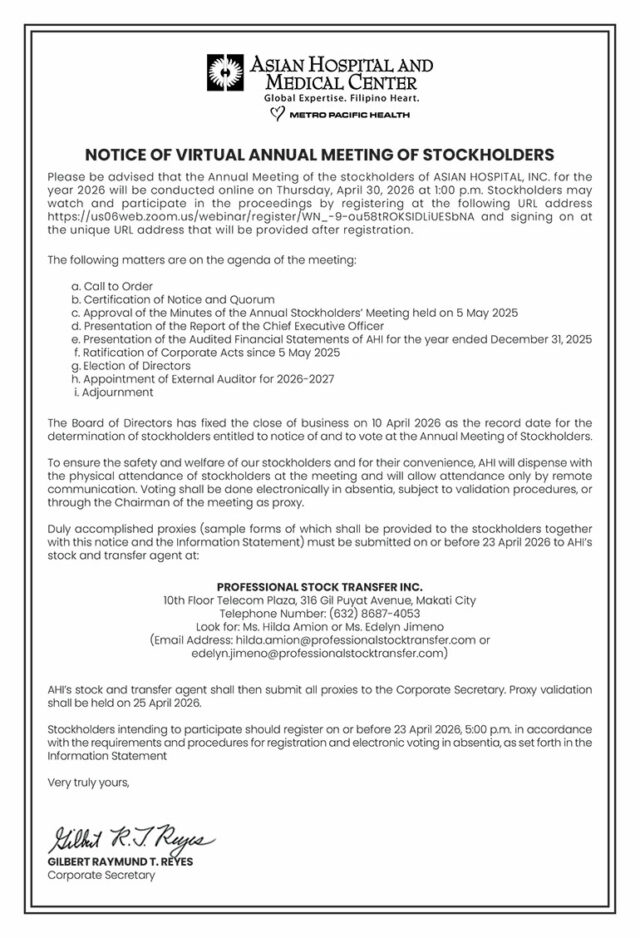
Asian Hospital, Inc. discloses virtual Annual Stockholders’ Meeting on April 30


Spotlight is BusinessWorld’s sponsored section that allows advertisers to amplify their brand and connect with BusinessWorld’s audience by publishing their stories on the BusinessWorld Web site. For more information, send an email to online@bworldonline.com.

Join us on Viber at https://bit.ly/3hv6bLA to get more updates and subscribe to BusinessWorld’s titles and get exclusive content through www.bworld-x.com.
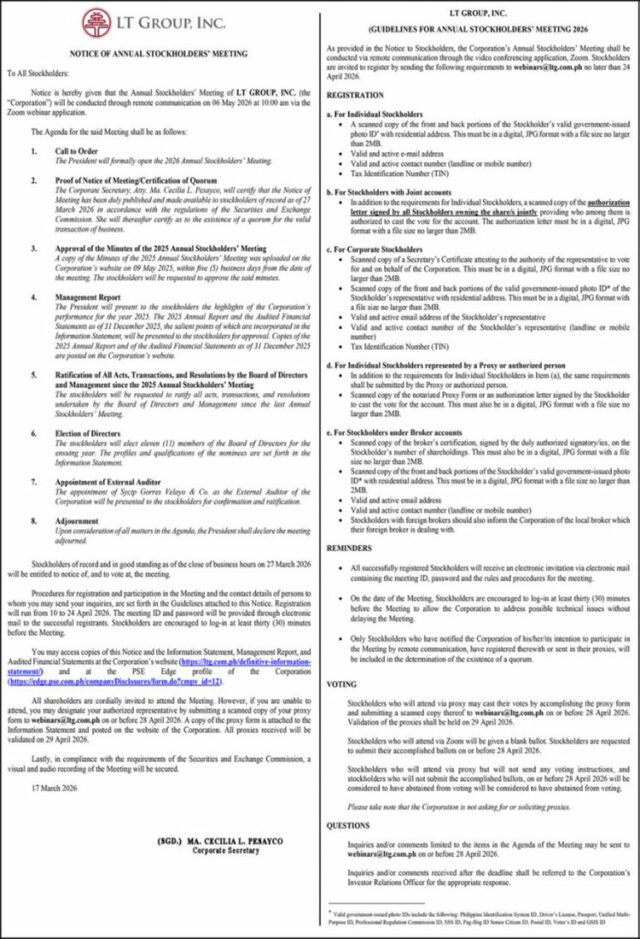
LT Group, Inc. discloses Annual Stockholders’ Meeting on May 6 via Zoom


Spotlight is BusinessWorld’s sponsored section that allows advertisers to amplify their brand and connect with BusinessWorld’s audience by publishing their stories on the BusinessWorld Web site. For more information, send an email to online@bworldonline.com.

Join us on Viber at https://bit.ly/3hv6bLA to get more updates and subscribe to BusinessWorld’s titles and get exclusive content through www.bworld-x.com.
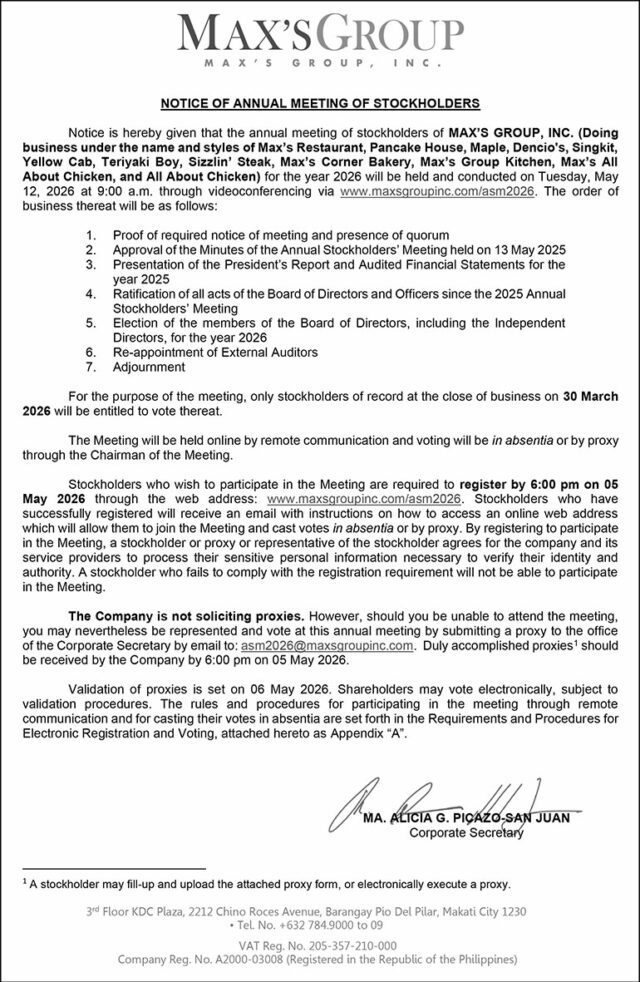
Max’s Group, Inc. to conduct Annual Stockholders’ Meeting on May 12 via videoconference


Spotlight is BusinessWorld’s sponsored section that allows advertisers to amplify their brand and connect with BusinessWorld’s audience by publishing their stories on the BusinessWorld Web site. For more information, send an email to online@bworldonline.com.

Join us on Viber at https://bit.ly/3hv6bLA to get more updates and subscribe to BusinessWorld’s titles and get exclusive content through www.bworld-x.com.

Medium Rare showcases techno and neoclassical music

IT MAY SEEM like the hypnotic, pulsating beats of underground techno music and the opulent, cinematic sounds of neoclassical music are worlds apart, but that’s not always the case.

This May, the Medium Rare immersive event will feature local and international artists practicing both forms of music to mount a multi-sensory party.

The likes of Spanish electronic music producer Pablo Bolívar and Italian composers and pianists Lorenzo Travaglini and Davide Semmarchi will headline the event, to be held on May 9 at Salon de Ning at The Peninsula Manila, Makati City.

This seventh edition of Medium Rare is titled Kaleidoscope, refers not only to the convergence of different types of music, but also of music with gastronomy and art. The one-night event aims to be “a cross-cultural experience designed to expand Manila’s cultural nightlife.”

Medium Rare began as a personal idea to merge two art forms I deeply care about: gastronomy and music,” said its founder, chef Chele Gonzalez, in a statement. “The word ‘medium’ represents the space between disciplines where they meet, while ‘rare’ reflects our desire to present something unique beyond the mainstream.”

The intimate atmosphere will be built by a lineup of local artists that have yet to be announced, made special by international guests whose presence is supported by the Embassy of Spain in the Philippines and the Philippine-Italian Association.

BLURRING BOUNDARIES
Spanish electronic music producer Pablo Bolívar, known for his blend of techno and ambient music, is the founder of labels Seven Villas Music and Avantroots Records.

Mr. Gonzalez said at a press conference on March 26 that Mr. Bolívar’s long career is proof of the longevity of electronic music.

“It is part of our daily life. Even if we don’t notice it, we find that there is always electronic music or house music in the background. It is still as present as ever,” he explained.

Despite being a Michelin-starred chef, Mr. Gonzalez emphasized that his role at the event is that of a DJ and organizer. Both he and Mr. Bolívar have music careers that date back to the 1990s in Spain.

“I’ve been into music before I was even a chef,” he told BusinessWorld. “We’ll have a special menu for Medium Rare, but I created this event to integrate my two passions, with the main focus really being the music.”

As for Italian composers and pianists Lorenzo Travaglini and Davide Semmarchi, representing the creative collective Bosco Studio, they will be bringing to Manila their signature “intersection of neoclassical composition and cinematic sound.”

Both musicians blend emotionally driven piano works with atmospheric textures and expressive minimalist structures — a combination of classical and modern.

“This will be our first trip in Asia,” said Mr. Travaglini in a video message. “We are really excited to come and meet artists in the local scene and experiment with new sounds.”

CURATED CULTURAL CROSSOVERS
Medium Rare co-organizer Samantha Nicole said at the press conference that a roster of local DJs will fill out the entire run from 7 p.m. to 4 a.m.

“It will be rooted in Manila’s underground electronic community,” she told BusinessWorld. “We have international guests, but we really want to highlight our local talents.”

The choice of Salon de Ning at The Peninsula as the venue was deliberate as it builds on the vibes created in the venues of past editions, held at Gallery by Chele, BGC; the Aire32 bar at The Westin, Ortigas; and Puesta de Sol in Bolinao, Pangasinan.

“You can expect a ‘listening bar’ atmosphere, filled with electronic music and some jazz and funk-infused house music,” said Ms. Nicole.

Tickets are limited as the venue can accommodate less than 100 guests. Salon de Ning fulfills the art side of the experience, its interiors inspired by 1930s Shanghai Art Deco, where intimate subculture and hotel grandeur intersect.

Two ticket options are available: the full experience ticket starting from 7 p.m., priced at P2,500 and inclusive of the neoclassical sets and food by Mr. Gonzalez; and the dance experience ticket starting from 10 p.m., priced at P1,500 and inclusive of the transition set all the way to the DJ-led dance night.

For more details, visit Medium Rare’s social media pages @mediumraremusik. — Brontë H. Lacsamana

Inflation concerns push up Treasury bill yields

WIKIPEDIA/JUDGE FLORO

THE GOVERNMENT made a partial award of the Treasury bills (T-bills) it offered on Monday as yields on the longer tenors went up due to expectations of faster Philippine inflation in March amid the Middle East conflict’s impact on oil trade, fueling bets of monetary tightening.

The Bureau of the Treasury (BTr) raised only P22.8 billion via the T-bills it auctioned off, below the P27-billion target, even as total tenders were at P50.203 billion or nearly twice the amount on offer. This was also higher than the P36.78 billion in bids recorded on March 23.

“Results were mixed in today’s Treasury bills auction, with the Auction Committee fully awarding bids for the 91- and 182-day T-bills while partially awarding the 364-day securities,” it said in a statement.

Broken down, for the 91-day T-bills, the government raised P9 billion as planned as demand  for the tenor reached P26.66 billion. The three-month paper fetched an average rate of 4.985%, easing by 1.9 basis points (bps) from 5.004% last week. Bids accepted had yields ranging from 4.898% to 5.025%.

The Treasury likewise borrowed the programmed P9 billion via the 182-day debt as tenders reached P16.552 billion. The average rate of the six-month T-bill was at 5.08%, rising by 4.8 bps from 5.032% previously. Tenders awarded carried rates from 5.014% to 5.199%.

Meanwhile, the BTr sold just P4.8 billion in 364-day securities, below the P9-billion plan as the offer was undersubscribed, with bids reaching only P6.991 billion. The one-year paper fetched an average yield of 5.204%, up by 3.8 bps from 5.166% last week. Accepted bids had rates from 5.148% to 5.25%.

At the secondary market before Monday’s auction, the 91-, 182-, and 364-day T-bills were quoted at 4.9897%, 5.1253%, and 5.1803%, respectively, based on PHP Bloomberg Valuation Service Reference Rates data provided by the Treasury.

T-bill rates were “mostly higher as investors demand better returns amid inflation risks,” a trader said in a text message.

Yields continued to go up on expectations that Philippine headline inflation rose last month as global crude prices continue to surge due to the Middle East war, Rizal Commercial Banking Corp. Chief Economist Michael L. Ricafort said in a Viber message.

“The sharp increase in local fuel pump prices could lead to higher prices and overall inflation that could breach the BSP’s (Bangko Sentral ng Pilipinas) inflation target range of 2%-4% in the coming months, that, in turn, could lead to rate hikes to fulfill the price stability mandate,” he said.

Higher oil prices due to fuel trade disruptions amid the Middle East war and rising rice costs may have pushed Philippine inflation to its fastest pace in nearly two years, analysts said.

A BusinessWorld poll of 18 analysts yielded a median estimate of 3.8% for the March consumer price index, faster than the 2.4% in February and 1.8% a year ago.

This is near the upper end of BSP’s 3.1%-3.9% forecast for the month and its 2%-4% annual target. The print would also be the quickest in 20 months or since the 4.4% seen in July 2024.

BSP Governor Eli M. Remolona, Jr. earlier said that future policy decisions will depend on second-round price effects from the Middle East war, adding that oil prices reaching $200 a barrel could prompt them to hike rates.

The Monetary Board last month left its benchmark rates unchanged in an off-cycle meeting as it said that current inflation pressures are supply-driven, for which policy adjustments have little impact.   

It will hold its next review on April 23.

On Tuesday, the government is looking to raise up to P40 billion from a dual-tenor Treasury bond (T-bond) offering, or P20 billion to P30 billion each via reissued seven year T-bonds with a remaining life of three years and one month and reissued 25-year securities with a remaining life of eight years and seven months.

The BTr wants to borrow P248 billion from the domestic market this month, or P140 billion via T-bills and P108 billion through T-bonds.

The government borrows from local and foreign sources to help fund its budget deficit, which is capped at P1.647 trillion or 5.3% of gross domestic product this year. — Aaron Michael C. Sy

PhilWeb inks deal with Newport for online gaming platform services

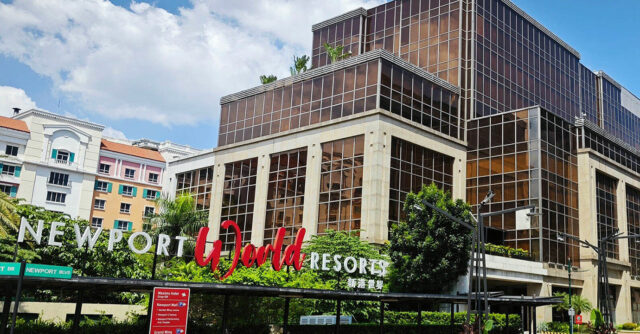
NEWPORTWORLDRESORTS.COM

PHILWEB CORP. said it has entered into an agreement with Travellers International Hotel Group, Inc., operator of Newport World Resorts, to provide platform and content services for its online gaming operations.

In a disclosure on Monday, the company said the deal covers Newport World Resorts’ online gaming platform, NWRPlay, under its role as a Philippine Amusement and Gaming Corp. (PAGCOR)-accredited gaming system administrator (GSA).

Under the agreement, PhilWeb will provide platform technology, system support, gaming content integration, and marketing and operational services, subject to regulatory requirements and approvals.

“The engagement forms part of the company’s ongoing initiatives to expand its B2B platform and content initiatives within the regulated online gaming sector,” it said.

PhilWeb recently secured accreditation from PAGCOR as a gaming affiliate and support service provider, allowing it to offer technology and operational services to licensed operators within the regulator’s ecosystem.

The company has been expanding its game content distribution and aggregation business.

Last month, it launched this initiative with PT Gaming and NUSTAR Online, two operators serving different segments of the local market. PT Gaming focuses on online users, while NUSTAR Online is linked to a resort brand catering to a more premium customer base.

Travellers International Hotel Group operates Newport World Resorts, an integrated resort in Pasay that includes a casino, hotels, retail outlets, dining, and entertainment facilities.

The complex houses Newport Mall, a performing arts theater, and a cinema, as well as several hotels such as Marriott Hotel Manila, Holiday Inn Express Manila Newport City, Marriott West Wing, Hilton Manila, Sheraton Manila Hotel, and Hotel Okura Manila.

PhilWeb shares closed unchanged at P10.50 apiece on Monday. — Alexandria Grace C. Magno

From compliance to competitive advantage: Why stress testing must be a boardroom priority

STOCK PHOTO | Image by Creativeart from Freepik

Cybersecurity issues, the negative effects of AI, the Middle East war, and the closures of the Strait of Hormuz are driving organizations to perform stress testing and execute mitigation strategies. To understand why stress testing is now a boardroom priority, it is important to review its origins in risk management and consider how its purpose has evolved over time.

Major crises such as the 1997 Asian Financial Crisis and the 2008 Global Financial Crisis exposed hidden risks and spurred the development of modern stress testing. Regulators in most countries now require banks to demonstrate resilience in adverse scenarios, ensuring adequate capital and liquidity. This built discipline but focused only on static monetary results.

Most nonbank Boards ignored stress testing until new risks forced every industry to rethink their priorities and methods.

FROM RISK MEASUREMENT TO STRATEGIC PERSPECTIVE
Stress testing now centers on risk management, not just compliance. New risks — cybersecurity, climate, geopolitical, and supply chain — rival financial ones, yet models often miss them. Analytics and judgment are crucial. In the energy sector, stress testing revealed that supplier disruption could affect regulatory compliance and customer trust. In technology firms, it uncovered vulnerabilities in cloud infrastructure, letting companies invest early in resilience. Such examples show stress testing uncovers risks traditional assessments might miss.

In addition, organizations are even more interconnected each year. Disruptions now spread quickly across all functions. Worse, historical data can’t predict current risks. Organizations must design tough, unprecedented scenarios. Leading firms use stress testing to set strategy, allocate capital, and manage operations — not just to measure risk.

And advanced stress testing alone isn’t enough. High performers combine modeling with expert judgment to assess risks across reputation, regulatory, and operational dimensions. Firms now model for shocks such as cyberattacks that affect their own supply chain or currency shocks — reflecting how crises cascade in real life.

Reverse stress testing asks, “What caused failures?” to better understand the underlying factors, and to identify hidden assumptions and weaknesses, such as liquidity or access issues.

Finally, better computing power enables wide-ranging simulations, such as stochastic methods, to produce more detailed results and a broader range of outcomes.

Stress testing extends beyond banks. Companies in consumer, energy, technology, and logistics make it part of their strategy. Corporate resilience demands that organizations understand what might lead to their demise: loss of suppliers, lack of access to cash, significant uncollected receivables, unsustainable debt levels, or a combination of these and other adverse conditions. These organizations then use stress testing to answer the question: What if a critical supplier fails? How could a cyber incident hit operations or revenue? Can our balance sheet endure prolonged shocks? Where are hidden risk concentrations? Leading firms use stress test results to drive a Board’s investment, diversification, and risk appetite decisions. This results in a “playbook” the organization can already implement or execute when a “black swan” event happens.

THE ‘BLACK SWAN’ AND WHAT TO DO ABOUT IT
Nassim Nicholas Taleb in his book The Black Swan: The Impact of the Highly Improbable popularized the term “black swan” event. Such events — rare and high impact — force a rethink of risk. Hindsight explains them, but experience can’t prevent them.

Stress testing can’t predict nor account for all “black swan” events. Rather, it tests “severe but plausible” scenarios to improve preparedness, not prediction. Effective approaches include assuming extreme hypotheticals, including shocks and knock-on effects, convening cross-functional workshops, and continuously updating scenarios. Crises show organizations fail when they ignore risks, not because risks are unknowable.

Leaders must shape decisions with stress testing. They must drive this culture shift. Here are three starting points:

1. Integrate into Strategy and Planning – Boards and executive management must make stress testing an embedded part of strategy reviews, capital decisions, and investments. Use it to check assumptions.

2. Align to Risk Appetite – Boards must define their risk appetite and apply stress-test results accordingly, supporting transparency and accountability.

3. Establish Resilience Metrics – Boards must track more than finances and instead focus on a few critical metrics that reflect resilience. For most, liquidity (their ability to meet obligations during a crisis) and recovery time (the speed of restoring operations after disruption) are vital. For example, for companies that rely on partners such as manufacturers or logistics providers, supplier diversity matters. Companies in technology or data-driven fields might focus on cybersecurity readiness. By homing in on these key industry-relevant metrics, Boards can keep oversight sharply focused.

Organizations should not limit stress testing to risk or finance teams, but rather involve operations, IT, strategy, and communications. Then base their crisis plans on stress test results. This ensures decisive action, not improvisation under pressure. Organizations that embed these practices recover more quickly, experience less disruption, and build greater partner trust.

THE ROLE OF THE BOARD
For Boards, stress testing is a governance essential, not just a technical task. Effective engagement starts with clear ownership: Risk Committees or other Board subcommittees are usually charged with oversight. Boards should make stress testing a regular agenda item to review scenarios, results, and action plans. Embedding stress testing in agendas and charters clarifies responsibilities, drives accountability, and makes resilience a core focus.

Key questions Boards should ask include:

• Are we testing the right scenarios, including those that challenge our core assumptions?

• Do we understand the organization’s breaking points — and how close we are to them?

• Are stress test results influencing strategic decisions, or are they treated as compliance outputs?

• Do we have sufficient visibility of non-financial risks?

• Is resilience embedded in our culture, or concentrated in a single function?

• What mitigation strategies are in place, and is there a ready playbook for a crisis?

Boards that ask these questions steer organizations through uncertainty.

FROM DEFENSE TO ADVANTAGE
The real shift: stress testing now drives success, not just failure avoidance. Robust stress testing leads to better strategy, capital allocation, speed, and trust. Resilience now differentiates organizations; it’s not just a cost.

Stress testing, which grew out of crises and subsequent bank regulation, became a strategic imperative for large firms. Boards must prepare for crises in advance. To strengthen stress testing, organizations must ensure access to financial, risk, and technology experts. External advisors or consultants with industry knowledge can reveal blind spots. And adding members skilled in crisis management or operational resilience enhances readiness to address evolving threats. Stress testing ensures readiness, not prediction, for the future.

When is the best time to build organizational resilience? The best time was a decade ago. The second-best time is now.


Gil B. Genio is the governor and secretary of the Management Association of the Philippines or MAP. He is a retired banker and Globe and Ayala executive, and a member of the Analytics and AI Association of the Philippines and the Institute of Corporate Directors. He is an independent director at GT Capital Holdings, Puregold Price Club, and Megawide Construction.

map@map.org.ph

iamgilgenio@gmail.com

Entertainment News (04/07/26)


Disney+ presents drama The Flowers of Evil

THE live-action adaptation of the Japanese coming-of-age manga series, The Flowers of Evil, is set to debut on Disney+ this April. Based on the hugely popular manga of the same name, the series has been adapted for the screen by Keita Meguro and Shuho Takase and stars Fuku Suzuki and Ano. It follows a teenage boy who is caught smelling his female classmate’s gym clothes and blackmailed until he spirals into guilt. The Flowers of Evil arrives on Disney+ on April 9.


Philippines to join 1st Eurovision Song Contest Asia

THE Eurovision Song Contest is launching an Asia edition for the first time, to be hosted by Bangkok, Thailand, in November. The European Broadcasting Union, Voxovation and Thailand’s S2O Productions and Channel 3 recently announced the 10 countries that are set to participate. Aside from the host, Thailand, countries confirmed to join are South Korea, Vietnam, Malaysia, Cambodia, Laos, Bangladesh, Nepal, Bhutan, and the Philippines. On April 9, ZOOP, a social media app dedicated to covering the contest, will be launched. The Philippine broadcaster for the inaugural Eurovision Song Contest Asia will be ABS-CBN. The date of the grand final is Nov. 14.


Coco Martin movies on Cinema One

FILIPINO actor Coco Martin will be taking over Cinema One this April as his box-office hits headline the Blockbuster Sundays program. Films in the lineup air every Sunday at 7 p.m. Coming up are 3pol Trobol: Huli Ka Balbon!, slated for April 12, where Mr. Martin plays a dedicated bodyguard who is framed for the murder of his boss and must go on the run. On April 19, the 2017 reboot of Ang Panday sees his take on the iconic street-smart man from Tondo who discovers he is the descendant of a legendary blacksmith. Finally, his team-up with comedienne Vice Ganda in The Super Parental Guardians sees the two actors share a roof and care for children left behind by a late best friend, airing on April 26. Cinema One is available on iWant, SKYcable, Cignal, GSat Direct TV, and other local cable service providers.


Jesuit Communications to film movie in Spain

FOLLOWING 2023’s GomBurZa, Jesuit Communications has announced its next film offering: Los Salvajes Bravos (The Brave Ones), a drama adventure about “Igorot savages” brought to the 1887 grand exposition in Spain. It stars an ensemble cast: Romnick Sarmenta, Ruru Madrid, Michael de Mesa, Christian Vazquez, Arnold Reyes, Michael Roy Jornales, Jojit Lorenzo, Paolo O’Hara, Elora Españo, JM Salvado, Miguel Vasquez, DM Boongaling, Aya Sarmiento, Kenshin Lagutan, Roven Alejandro, and Andreas Muñoz. Directing is Paolo Dy, who also co-wrote the screenplay with playwright Juan Ekis. The cast and production team of Los Salvajes Bravos will be flying to Spain to film the rest of the movie. The production is supported by the Quezon City Film Commission.


James Blake releases new record

GRAMMY-WINNING producer, songwriter, and musician James Blake has dropped a new record, Trying Times, via Good Boy Records. It features his signature blend of soul, electronica, hip-hop, and alt-R&B. Recently released singles “Death Of Love” and “I Had A Dream She Took My Hand” are part of the album. In each song, Mr. Blake “navigates the fragile space between closeness and solitude in an uncertain era, tracing the fault lines of contemporary life.” Trying Times is out now on all digital music streaming platforms.


The End of Oak Street premieres in August

STARS Anne Hathaway and Ewan McGregor are set to lead an action thriller slated for August, titled The End of Oak Street. They play members of the Platt family who are navigating the aftermath of a mysterious cosmic event which rips Oak Street from suburbia and transports the neighborhood to someplace unknown. It also stars Maisy Stella and Christian Convery. The film is written and directed by David Robert Mitchell and opens in cinemas and IMAX on Aug. 12.


AXEAN Festival 2026 heads back to Bali

SOUTHEAST ASIAN intra-regional music showcase, the AXEAN Festival, is scheduled to return for its 7th edition at Jimbaran Hub in Bali, Indonesia, from Aug. 29 to 30. Launched in 2020 by a collective of music industry professionals across the region, it aims to be “a key export platform for Southeast Asian music, as well as a prominent convergence for cross-border collaborations and partnerships between global industry stakeholders and artists.” The lineup, conference programming, and other information will be announced soon.


Paw Patrol: The Dino Movie arrives in August

THE children’s film PAW Patrol: The Dino Movie, featuring the voices of Carter Young, Mckenna Grace, Terry Crews, Jennifer Hudson, Jameela Jamil, Bill Nye, Paris Hilton and Snoop Dogg, has released its trailer which teased new music from the Backstreet Boys to be featured on the soundtrack. The movie follows the PAW Patrol pups, who crash land on an uncharted tropical island filled with dinosaurs. It opens only in cinemas in August.


Korean crime series premieres on Disney+

KOREAN stars Park Seojun and Um Taegoo star in the upcoming crime noir series, Born Guilty, set in the gritty underworld of 1980s Seoul. It follows two rival gangsters looking to forge a new criminal empire far from their troubled pasts. It is scheduled to premiere on Disney+ later this year.

Central bank securities fetch higher average rate despite oversubscription

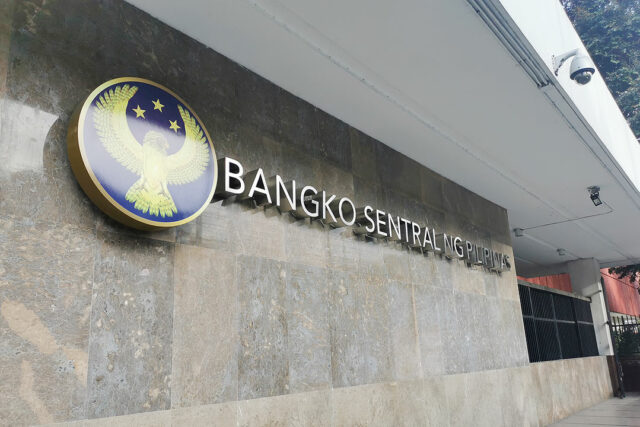
Bangko Sentral ng Pilipinas main office in Manila. — BW FILE PHOTO

THE BANGKO SENTRAL ng Pilipinas’ (BSP) short-term securities were quoted at a slightly higher average rate on Monday even as the offer was met with strong demand.

Total bids for the 28-day BSP bills reached P54.326 billion, exceeding the P40 billion placed on the auction block. This was also higher than the P50.676 billion in tenders for the P50-billion offer on March 27.

The auction was held outside of the usual Friday schedule due to non-working days in observance of Holy Week.

“The BSP reduced the offer volume from P50 billion in the previous week to P40 billion,” the central bank said in a statement. “Total tenders reached P54.3 billion, resulting in a bid-to-cover ratio of 1.36x.”

The bid-to-cover ratio climbed from the 1.0135 logged previously.

As a result, the BSP made a full P40-billion award of the one-month securities.

Accepted yields were from 4.475% to 4.58%, narrowing from the 4.43% to 4.6125% margin seen in the previous auction. This led the average accepted rate of the one-month bills to edge up by 0.74 basis point week on week to 4.5265% from 4.5191%.

The BSP has not auctioned off the 56-day bills since Nov. 3.

The central bank uses the BSP securities and its term deposit facility to mop up excess liquidity in the financial system and to help guide short-term market yields towards its policy rate.

The BSP bills also contribute to improved price discovery for debt instruments while supporting monetary policy transmission.

The central bank began auctioning off short-term securities weekly in 2020, initially offering only a 28-day tenor and adding the 56-day bill in 2023.

In its February 2026 Monetary Policy Report, the central bank said it has limited its BSP securities offerings to a single tenor to rationalize its liquidity operations and focus on tenors that would boost monetary policy transmission.

As of mid-February, the central bank’s monetary operations have siphoned off P1.2 trillion in liquidity from the market. Of this, 28.5% was absorbed through BSP securities, while 44.4% were done through overnight reverse repurchase facility, 18.2% via the overnight deposit facility and 9% from the term deposit facility. — Katherine K. Chan

New PHL-Japan shipping link seen to support prefab housing supply

ASIANTERMINALS.COM.PH

A NEW shipping link between the Philippines and Japan is expected to support the supply of prefabricated housing materials, as Dubai-based logistics firm DP World, which works with terminals in Manila and Batangas, leverages a container service operated by French shipping company CMA CGM.

The JP8 service, which began operations on March 18, is the new shipping link between the Philippines and Sendai, Japan, marking the first direct connection between the two in eight years, DP World said in a statement on Monday.

“Operated by CMA CGM on a weekly schedule, the service calls at Manila South Harbor and Batangas Integrated Port,” DP World said.

Both ports are operated by Asian Terminals, Inc. (ATI), DP World’s local partner.

“The JP8 service strengthens connectivity between Japan and the Philippines, while leveraging our terminals in Manila South Harbor and Batangas as key access points,” Glen Hilton, chief executive officer and managing director for Asia Pacific at DP World, said.

DP World said the service is expected to support demand for prefabricated housing in the Asia-Pacific region.

“The service strengthens connectivity to DP World’s terminals in Manila and Batangas, supporting the faster and more reliable movement of prefabricated housing materials,” DP World said.

The service will support Ichijo Komuten Co., Ltd., a Japanese homebuilder expanding in the Philippines, which produces prefabricated housing components for export to Japan through its local unit, House Research Development (HRD).

It will also support Nihon Sangyo, a company within the Ichijo Komuten Group that handles the procurement, logistics, and distribution of these materials and components.

JP8 is a direct container shipping service operated by CNC, an intra-Asia shortsea shipping brand of the CMA CGM Group.

DP World said the service combines direct maritime connections with its integrated logistics capabilities to facilitate cargo movement across ports, production sites, and markets.

Its partner terminals in Manila and Batangas are supported by inland and marine services aimed at easing congestion and reducing transit times, DP World added.

Philippine exports to Japan were valued at $986.44 million in February, accounting for 13.5% of total exports for the month. — Beatriz Marie D. Cruz

Regional office markets seen to recover unevenly as delayed supply enters 2026

FREEPIK/EVENING_TAO

REGIONAL OFFICE markets are expected to recover unevenly as construction delays that stalled project completions across key hubs in the second half of 2025 push new supply into 2026, according to Savills Philippines, a real estate consultancy.

Office completions across major regional hubs such as Cebu, Clark, Bacolod, and Davao City stalled in the second half of last year as construction delays and supply chain issues pushed project timelines back, Savills Philippines said in its regional outlook report released last week. Iloilo City was the only exception, delivering 24,000 square meters (sq.m.) of new office space for the year.

The slowdown reflects a more cautious stance among developers amid fluctuating interest rates, while temporarily easing vacancy pressures in select markets, according to the report.

Delayed projects are expected to come online from 2026, with Cebu and Davao City accounting for much of the incoming supply, Savills Philippines said.

These include Cebu’s 166,200 sq.m. Grade A office pipeline and 76,900 sq.m. across four Davao developments by 2027, which could push vacancy levels higher, it said.

“While the influx of space may cause a temporary uptick in vacancy rates by 2027, it positions these cities as the primary beneficiaries of the ongoing corporate decentralization away from Metro Manila,” Savills Philippines said.

In 2025, regional office markets in the Philippines remained active and resilient, posting positive net take-up in Cebu, Clark, Iloilo, and Davao, while Bacolod continued to record negative absorption, according to the report.

The business process outsourcing (BPO) sector remained the main driver of demand, pushing some submarkets close to full occupancy and supporting a pipeline of new developments expected to sustain medium-term growth, it said.

Performance varied across key cities, with Cebu leading expansion, while Davao recorded the lowest vacancy rate, Savills Philippines said.

Cebu’s office vacancy rate fell to 11% in 2025 from 16.6% in 2024, driven by strong leasing activity and demand in key areas such as IT Park and fringe locations, according to the report. Much of this demand came from BPOs and multinational firms favoring LEED-certified buildings for efficiency and workplace quality.

“Looking ahead, office supply in 2026 is projected to reach its highest level since 2023. A significant portion of this pipeline will be concentrated in fringe locations, particularly the North Reclamation Area and Lapu-Lapu City,” the report said.

The additional supply could increase vacancy in newer submarkets but may also shift demand beyond traditional hubs and expand Cebu’s overall office footprint, it added.

Davao’s prime office market remains supply-constrained, keeping Grade A buildings fully occupied, with vacancies largely confined to non-PEZA Grade B spaces in mixed-use developments, according to Savills Philippines.

“The absence of new Grade A completions in 2026, with the next wave of supply expected in 2027, positions existing prime assets to sustain high occupancy levels and potentially command firmer rental rates,” the report read.

“At the same time, this supply gap creates an opportunity for early consolidation and pre-leasing strategies ahead of upcoming developments, further underscoring Davao’s medium-term investment potential,” it added.

Clark’s office market demand shrank by 11,600 sq.m. in late 2025, but strong activity earlier in the year kept total demand positive at 15,100 sq.m., helping lower vacancy to 22.5% from 25.3%, Savills Philippines said.

Iloilo’s office market recorded about 22,600 sq.m. of transactions in 2025, but net demand rose by only 7,600 sq.m. as most activity came from tenant relocations and upgrades rather than expansion, according to the report.

Bacolod’s office market also softened in 2025, with tenant footprint reductions and negative net take-up of 9,000 sq.m. due to consolidation, limited expansion, and demand shifting to newer spaces in Bacolod East, widening the performance gap among submarkets, Savills Philippines said.

Entering 2026, rental rates in provincial hubs are forecast to hold steady rather than decline, creating a price floor despite shifting vacancy rates, according to the report.

“This resilience is underpinned by a sustained “flight to quality,” where the concentration of demand for Grade A and LEED-certified spaces allows landlords to maintain — or even modestly escalate — headline rents,” Savills Philippines said.

Rental rates in regional hubs increased through the fourth quarter of 2025 alongside higher vacancy levels, with growth largely driven by demand for Grade A office spaces, it added.

Davao recorded the highest increase, with rents rising by P11.9 per sq.m. to an average of P503.5. “This outperformed established markets like Cebu and Clark in terms of percentage growth, signaling a tightening of grade A supply in the Davao region,” the report stated. — Alexandria Grace C. Magno

ADVERTISEMENT
ADVERTISEMENT