Home Blog Page 64

Philippines still likely to be ASEAN’s second-fastest growing economy despite oil shocks
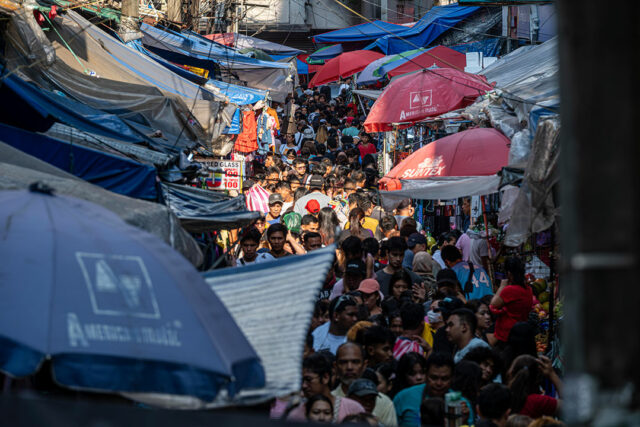
Shoppers flock to Divisoria, Manila. — PHILIPPINE STAR/RYAN BALDEMOR

By Katherine K. Chan, Reporter

The Middle East conflict threatens the Philippines’ growth prospects but a rebound in private spending and robust exports could still position the country as the second fastest growing economy in the region, the ASEAN+3 Macroeconomic Research Office (AMRO) said.

AMRO Chief Economist Dong He said they see the Philippine gross domestic product (GDP) expanding by 5.3% this year, unchanged from their forecast in January, and by 5.8% in 2027.

“This makes the Philippines one of the faster-growing economies in the region – above the ASEAN average of 4.6% and the ASEAN+3 average of 4%,” Mr. He told BusinessWorld in an e-mail interview. “The acceleration reflects an expected recovery in private consumption and stronger exports.”

If both projections hold true, the economy will surpass its 4.4% growth last year or when the flood control graft scandal slowed government spending, household consumption and investments in the country.

Household spending, which accounts for over 70% of the country’s GDP, grew by 3.8% in the fourth quarter, the weakest pace seen since the -4.8% in the first quarter of 2021. Full-year household spending growth eased to 4.6% in 2025 from 4.9% in 2024.

On the other hand, the country’s goods exports grew by 15.2% to $84.41 billion last year, exceeding the Bangko Sentral ng Pilipinas’ (BSP) projected 9% growth to $60 billion.

For this year, the BSP expects goods exports to rise modestly by 3% to $65.3 billion amid reduced front loading and elevated trade costs, before picking up by 4% to $67.9 billion in 2027.

Still, Mr. He said the Philippines will likely remain resilient against tariff and trade disruptions.

“The Philippines has been relatively less affected by tariff and trade disruptions, reflecting its more domestically driven growth and lower reliance on goods exports,” he said.

“However, vulnerabilities remain in electronics and semiconductor exports. To mitigate risks, the country should further diversify export markets, improve trade facilitation and logistics, and attract firms looking for supply chain relocation to strengthen external resilience,” he added.

The information technology and business process management (IT-BPM) and finance sectors may also help drive the country’s growth this year, Mr. He said.

However, he noted that the IT-BPM industry needs policies to support its shift toward knowledge-process outsourcing (KPO) and global capability centers (GCCs) activities.

“For the Philippines, the high value-added knowledge-based services, such as the IT-BPM and finance would continue to be the key sources of value-added creation,” Mr. He said. “However, with AI (artificial intelligence) becoming increasingly prevalent, a concerted shift is required toward higher-value segments, namely KPO, GCCs and digital trade services.”

While the country may be well positioned this year, Mr. He also noted that global trade uncertainties, financial market volatility and energy shocks amid the ongoing conflict in the Middle East could weigh on its economic growth.

“The conflict in the Middle East and the resulting disruption to the Strait of Hormuz pose the most immediate risk to the outlook – a protracted disruption to global energy supply could push inflation higher and weigh materially on growth,” he said.

“Other key risks include unpredictable US trade policy shifts, the uncertain trajectory of technology demand, and volatile global financial markets,” he added.

ENERGY RISKS
Oil trade disruptions have led to energy price shocks globally, with the Philippines facing oil price surges and looming fuel shortages as the war drags on.

For Mr. He, the oil crisis could mean faster inflation for the Philippines as its heavy reliance on imported oil from the Middle East makes it vulnerable to price and supply shocks.

“The Philippines is one of the more affected countries in the region,” he said. “As a net oil and gas importer, with 98% of its oil imports sourced from the Middle East, the Philippines is exposed to higher oil prices and potential supply disruptions.”

AMRO now sees Philippine inflation quickening to 3.9% this year if oil prices hold around $80-$90 per barrel. This is faster than its earlier projection of 3.2%.

However, Mr. He said inflation can further accelerate if price increases and supply disruptions last longer.

“Given heightened uncertainty, the authorities should remain vigilant and stand ready to recalibrate policy parameters to mitigate the impact of external shocks,” he added. “Specifically, amid rapidly evolving geopolitical tensions, volatile energy prices, and weaker growth momentum, the BSP should remain cautious in making monetary policy adjustments.”

Last month, the BSP kept its benchmark rate unchanged at 4.25% in an off-cycle meeting to calm markets worried over uncertainties arising from the US-Iran war.

BSP Governor Eli M. Remolona, Jr. said the Monetary Board arrived at the decision after noting that the current price pressures are supply-driven, and hiking rates immediately risk derailing the country’s economic recovery.

He added that future monetary policy decisions will consider second-round price effects, particularly a potential uptick in transport fares, food and fertilizer prices, electricity rates and wages.

AMRO’s Mr. He said the central bank must “respond decisively” once such second-round effects materialize.

“Meanwhile, enhanced coordination between fiscal and monetary authorities is required to cushion the impact of supply-driven inflation and prevent adverse effects on growth,” he added. “In this regard, the government could consider timely administrative measures, such as targeted subsidies to highly exposed sectors and reducing tariffs on energy imports.”

Amid current economic shocks, Mr. He said the Philippines has a “sharper mandate than usual” in tightening regional cooperation and addressing shared economic challenges as it takes the helm in the Association of Southeast Asian Nations (ASEAN) this year.

“The current moment – where trade disruptions and an energy shock are testing the region simultaneously – gives the chairmanship a sharper mandate than usual,” AMRO’s chief economist said.

Mr. He said the National Government must pursue local reforms alongside regional development efforts, especially by drawing in private investments, enhancing infrastructure delivery and strengthening capital markets.

“The current external environment raises the cost of delaying these reforms,” he added.

This year, the Philippines assumed chairship of the 11-member regional bloc, composed of Brunei, Cambodia, Indonesia, Laos, Malaysia, Myanmar, the Philippines, Singapore, Thailand, Vietnam and Timor-Leste.


China ready to cooperate with Russia to ease Middle East tension, foreign minister says

United States Ambassador to the United Nations Mike Waltz addresses a Security Council meeting to discuss 'ongoing US aggression' against Venezuela at the UN headquarters in New York City, US, Dec. 23, 2025. — REUTERS

BEIJING — China is willing to continue to cooperate with Russia at the UN Security Council and make efforts to cool down the Middle East situation, Foreign Minister Wang Yi told his Russian counterpart Sergei Lavrov in a phone call on Sunday.

Mr. Wang said the fundamental way to resolve navigation issues in the Strait of Hormuz is to achieve a ceasefire as soon as possible, adding that China has always advocated political settlement of hotspot issues through dialogue and negotiation.

The foreign ministers’ call came ahead of a UN Security Council vote next week on a Bahraini resolution to protect commercial shipping in and around the Strait of Hormuz.

As permanent UNSC members, China and Russia should “adopt an objective and balanced approach and seek to win greater understanding and support from the international community,” Mr. Wang told Mr. Lavrov, according to a statement from his ministry.

A Russian Foreign Ministry statement said the ministers discussed ways to achieve a rapid ceasefire and “launch a political-diplomatic dialogue.”

“Satisfaction was expressed at the coincidence in Russia’s and China’s approaches on most issues on the global agenda, including the situation around Iran, related to the unprovoked aggression of the US and Israel against that country,” it said.

China has repeatedly called for a ceasefire in the Gulf region and Middle East, urging an end to the fighting that has run for more than a month and largely closed the Strait of Hormuz, a critical shipping artery for oil and gas. — Reuters

US rescues airman, vows ‘hell’ for Iran if Strait stays shut

REUTERS

WASHINGTON/CAIRO — US special forces rescued an airman in a high-risk mission deep inside Iran while President Donald Trump threatened to rain “hell” on Tehran if it did not reopen the Strait of Hormuz by Tuesday for oil flows vital to the world economy.

Mr. Trump announced the rescue in the early hours of Sunday in a social media post that described the operation in a mountainous area as “one of the most daring” such missions in US history.

The airman, the weapons officer of an F-15 jet shot down on Friday, was wounded but “will be just fine”, Mr. Trump said in a message on X. The jet’s pilot was rescued later that day.

In another post laden with expletives, Mr. Trump told Iran to open the Hormuz waterway, the conduit for around a fifth of the world’s oil and natural gas supply that has been largely shut down since the war began five weeks ago.

“Tuesday will be Power Plant Day, and Bridge Day, all wrapped up in one, in Iran,” he said on his Truth Social platform, threatening strikes on energy and transport infrastructure that critics say would violate international law.

“There will be nothing like it!!! Open the Fuckin’ Strait, you crazy bastards, or you’ll be living in Hell – JUST WATCH! Praise be to Allah. President DONALD J. TRUMP”

Adding to the pressure, Washington’s ally in the war, Israel – which attacked a major petrochemicals facility in Iran on Saturday – was preparing to attack energy facilities next week and was awaiting US approval, a senior Israeli defense official said.

In the kind of mixed messaging that has baffled supporters, foes and financial markets alike, Mr. Trump told Fox News on Sunday that Iran was negotiating, with a deal possible by Monday.

After reports of explosions across Iran’s capital Tehran on Monday morning, a US-Israeli strike on a residential building killed at least five people and left several people buried under rubble in Qom, south of the city, a deputy governor told the semi-official SNN news agency.

IRAN CONDEMNS ‘RECKLESS’ US, HITS GULF
Tehran is demanding an end to hostilities and its parliamentary speaker Mohammad Baqer ‌Qalibaf condemned Mr. Trump’s threats, saying he was being misled by Israeli Prime Minister Benjamin Netanyahu.

“Your reckless moves are dragging the United States into a living HELL for every single family, and our whole region is going to burn because you insist on following Netanyahu’s commands,” he posted on X.

Showing it still had fight despite the US-Israeli pounding, Iran expanded attacks on Gulf energy infrastructure, launching drone and missile strikes on petrochemical facilities in Kuwait, Bahrain and the United Arab Emirates.

The Revolutionary Guards also said they hit an Israeli‑linked vessel at Dubai’s Jebel Ali port.

In Kuwait, drones sparked fires and caused “severe material damage” at petrochemical plants operated by affiliates of state oil firm Kuwait Petroleum Corporation, the company said.

The strikes underscored Iran’s ability to sustain cross‑border attacks and disrupt infrastructure across multiple Gulf states, exposing vulnerabilities in energy and maritime hubs.

In Israel too, media showed search-and-rescue teams combing debris in the northern city of Haifa after an Iranian missile hit a residential building. Israeli paramedics said nine people were being treated.

HOSTAGE CRISIS AVERTED
With the impact from the strait’s closure on the global economy deepening by the day, the rescue of the US airman removed the risk for Mr. Trump of a hostage crisis further souring the mood of an American public already sceptical of the war.

Under cover of darkness, US commandos slipped deep into Iran, undetected, scaled a 7,000‑foot (2,100-meter) ridge and took the ​stranded American weapons specialist to safety, moving the airman toward a secret rendezvous point before dawn on Sunday.

Two MC-130 aircraft that had ferried some of the roughly 100 special ‌operations forces into rugged terrain south of Tehran suffered a mechanical failure and could not take off, a US official told Reuters.

Their commanders made a high-risk decision, ordering additional aircraft to fly into Iran to extract the group in waves — a decision that left the elite commandos waiting for a couple of tense hours.

The rescue force was pulled out in stages, ​and US troops destroyed the disabled MC‑130s and four additional helicopters inside Iran rather than risk leaving sensitive equipment behind.

Iran said several US aircraft were destroyed during the operation, including two military transport planes and two Black Hawk helicopters. Footage posted on social media showed burned-out aircraft wreckage, which Reuters verified was in the area.

PEACE EFFORTS FRUITLESS
The war, which opened with US and Israeli air strikes across Iran on February 28, has spread to Lebanon, where Israel has resumed its campaign against the Iranian-backed Hezbollah.

Thousands have died, mainly in Iran and Lebanon, where Israeli airstrikes killed another 11 people on Sunday, according to Lebanon’s health ministry.

Efforts brokered by Pakistan to bring the two sides to an agreement have so far failed.

“What we care about are the terms of a conclusive and lasting END to the illegal war that is imposed on us,” Iran’s Foreign Minister Abbas Araqchi said on X.

Iran’s chokehold over the narrow Strait of Hormuz shipping lane off its southern coast has sent crude prices soaring, squeezing consumers and businesses worldwide. — Reuters

Oil prices rise as US-Israeli war with Iran continues to disrupt supply

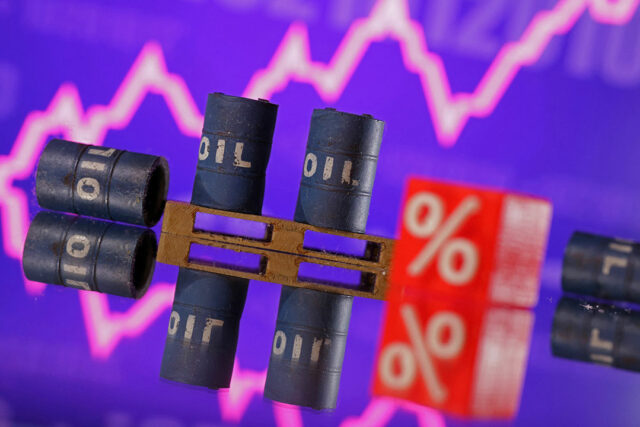
Miniatures of oil barrels and a rising stock graph are seen in this illustration. — REUTERS/DADO RUVIC/ILLUSTRATION

OIL PRICES climbed on Monday on continuing fears of supply losses because of shipping disruptions in the key Middle East producing region from the US-Israeli war with Iran.

Brent crude futures rose $1.71, or 1.6%, to $110.74 a barrel by 0057 GMT. US West Texas Intermediate crude futures gained $0.71, or 0.6%, to trade at $112.25 per barrel.

On Thursday, the last trading day before the Good Friday holiday break, WTI settled up more than 11% and Brent soared nearly 8% in volatile trading, recording their biggest absolute price increase since 2020, as US President Donald Trump promised to continue attacks on Iran.

The Strait of Hormuz, which carries oil and petroleum products from Iraq, Saudi Arabia, Qatar, Kuwait, and the United Arab Emirates, remains largely closed by Iranian attacks on shipping after the war began on February 28.

Because of the Middle East supply disruptions, refiners are seeking alternative sources for crude, particularly for physical cargoes in the US and the UK North Sea.

“Global buyers are bidding aggressively for (US) Gulf Coast barrels and Brent is rallying even faster,” the Schork Group said in a client note on Monday.

On Sunday, Mr. Trump ratcheted up pressure on Tehran, threatening in an expletive-laden Easter Sunday social media post to target Iran’s power plants and bridges on Tuesday if the strategic Strait of Hormuz is not reopened.

Still, some vessels, including an Omani-operated tanker, a French-owned container ship and a Japanese-owned gas carrier, crossed the Strait of Hormuz since Thursday, shipping data showed, reflecting Iran’s policy to allow passage for vessels from countries it deems friendly.

The war threatens to linger on as Iran has officially told mediators it is not prepared to meet with US officials in the Pakistani capital Islamabad in coming days and efforts to produce a ceasefire have reached a dead end, the Wall Street Journal reported on Friday.

On Sunday, OPEC+, consisting of some members of the Organization of the Petroleum Exporting Countries and allies such as Russia, agreedto a modest rise of 206,000 barrels per day for May.

However, that decision will largely exist on paper as several of the group’s key producers are unable to raise output due to the war.

Russian supply has been disrupted recently by Ukrainian drone attacks on its Baltic Sea export terminal. Media reports on Sunday said its Ust-Luga terminal resumed loadings on Saturday after days of disruptions. — Reuters

Puregold highlights sari-sari stores’ role in driving grassroots commerce and MSME growth

With Puregold Channel’s Sari-Sari Stories, the company honors the enduring impact of sari-sari stores as drivers of commerce and MSME growth.

In its final installment of the Sari-Sari Stories, Puregold releases “Pangalan,” a moving tribute to the sari-sari stores that continue to power daily life, grassroots enterprise, and community connection across the Philippines.

Following “Ways,” “The Sign,” and “The Witness,” Puregold broadens the conversation from nostalgia to economic relevance, highlighting how sari-sari stores continue to serve as accessible retail touchpoints, community anchors, and entry-level enterprises that support household livelihoods in the country.

The short film, “Pangalan,” showcases the resilience and relevance of sari-sari stores amid the changing retail landscape.

Sari-sari stores go beyond informal neighborhood retail. They function as last-mile commerce points that respond to everyday consumer needs with proximity, familiarity, and flexible purchasing options. Their resilience has allowed them to remain relevant even as the retail landscape continues to evolve.

That economic role is matched by social relevance. At the heart of Pangalan is the idea that sari-sari stores are more than neighborhood shops: they are trusted spaces that people turn to not only for essentials, but for connection and reliability. The film captures this dual role in distinctly Filipino terms: the store as tanungan, tambayan, and takbuhan.

The narrative is reinforced by appearances of OPM artists Jhoanna Robles of BINI, Stell Ajero of SB19, and Skusta Clee, whose personal recollections reflect the deep familiarity of sari-sari stores in Filipino life. Their participation adds cultural relevance to a message ultimately anchored in enterprise, accessibility, and community-based retail.

Through the short film series, Puregold hopes to reinforce its commitment to MSMEs by spotlighting the role that grassroots enterprises play for Filipino neighborhoods.

Puregold’s focus on this segment remains rooted in mass-market demand and the practical realities of everyday consumption. By spotlighting community-based retail, the company reinforces its relevance at the grassroots level while drawing attention to the vital contribution of MSMEs to the domestic economy.

In “Pangalan,” Puregold mentions the upcoming Tindahan Ni Aling Puring Convention, another effort to support sari-sari store owners and entrepreneurs nationwide.

The timing is equally strategic, with MSMEs already looking ahead at the upcoming Puregold Tindahan Ni Aling Puring Sari-Sari Store Convention in May. The annual event has become a key platform for sari-sari store owners, entrepreneurs, and partner suppliers, underscoring Puregold’s enduring commitment to small business development and ecosystem growth.

Watch the full video here:

Stay in the loop. Subscribe to the Puregold Channel on YouTube, like @puregold.shopping on Facebook, and follow @puregold_ph on Instagram and X, and @puregoldph on TikTok for updates and behind-the-scenes content.


Spotlight is BusinessWorld’s sponsored section that allows advertisers to amplify their brand and connect with BusinessWorld’s audience by publishing their stories on the BusinessWorld Web site. For more information, send an email to online@bworldonline.com.

Join us on Viber at https://bit.ly/3hv6bLA to get more updates and subscribe to BusinessWorld’s titles and get exclusive content through www.bworld-x.com.

Poll: Inflation likely hit 20-month high in March

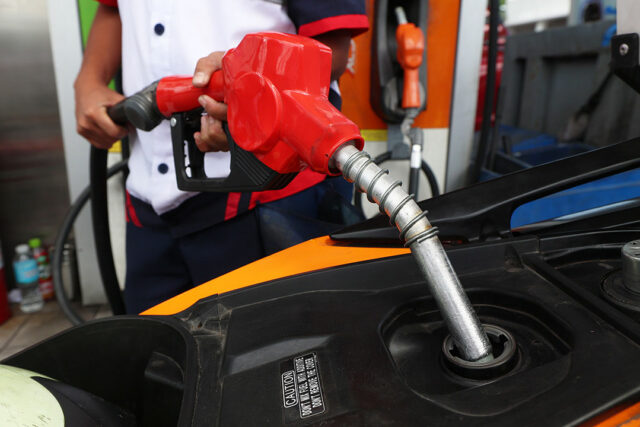
AN ATTENDANT fills a tank at a gasoline station in Quezon City, March 20, 2026. — PHILIPPINE STAR/MIGUEL DE GUZMAN

By Katherine K. Chan, Reporter

SHARP OIL PRICE increases driven by supply disruptions from the Middle East war, along with pricier rice, may have pushed Philippine inflation to its fastest pace in nearly two years, analysts said.   

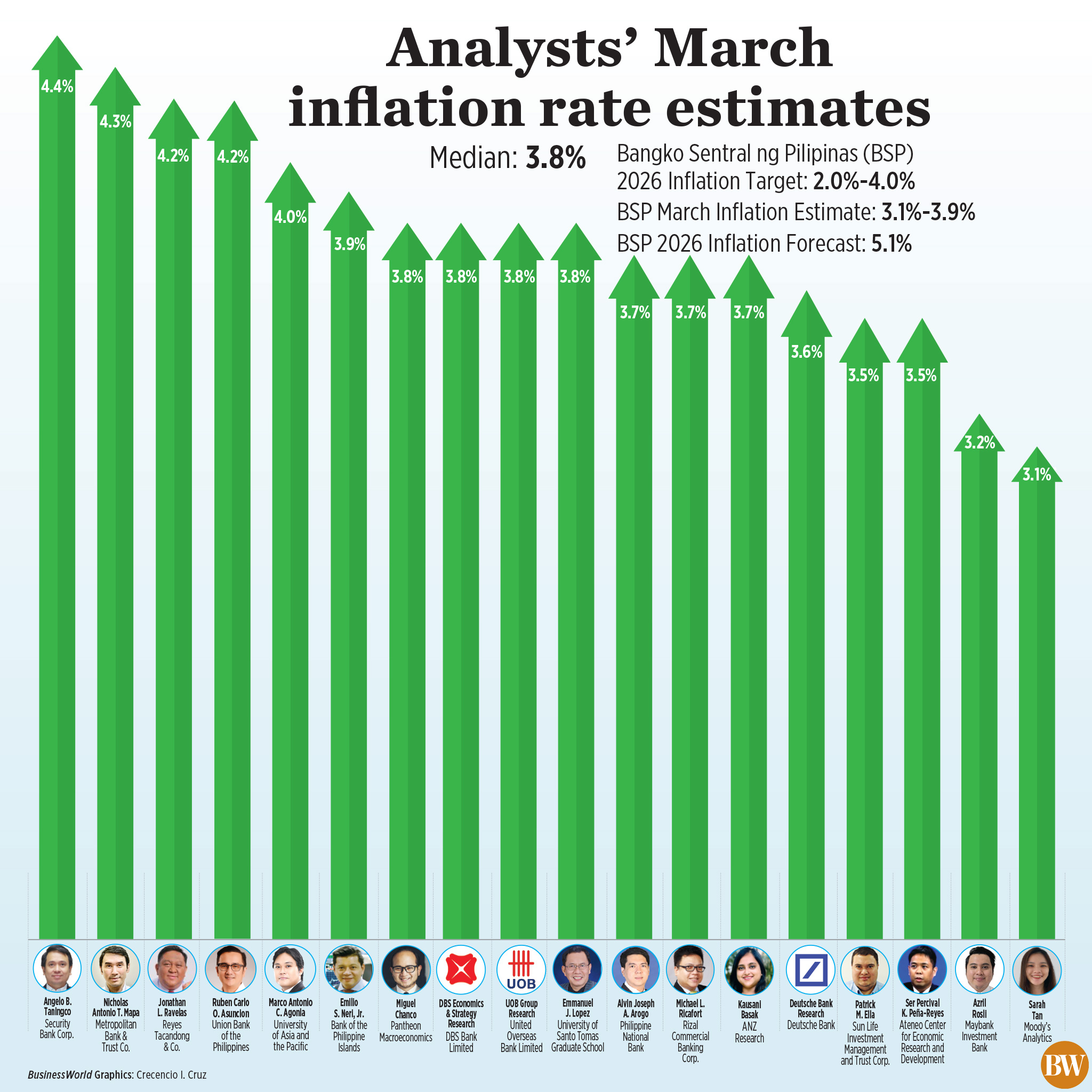
A BusinessWorld poll of 18 analysts yielded a median estimate of 3.8% for the consumer price index in March, accelerating from the 2.4% in February and 1.8% a year ago.

This is near the upper end of the Bangko Sentral ng Pilipinas’ (BSP) 3.1%-3.9% forecast for the month.

If realized, the headline print would be the fastest in 20 months or since 4.4% seen in July 2024.

This would also mark the third straight month that inflation settled within the central bank’s target.

The Philippine Statistics Authority (PSA) will release the March inflation data on Tuesday, April 7.

“I’m looking at 3.8% for the March inflation print, with most of the acceleration from 2.4% in February coming from transport deflation coming swiftly to an end on the back of the major fuel price hikes seen in recent weeks,” Miguel Chanco, chief Emerging Asia economist at Pantheon Macroeconomics, said in an e-mail.

He said transport inflation likely quickened to 8.5% last month from -0.3% in February.

“On top of this, we’re expecting a further rise in food inflation where low base effects are still doing a lot of heavy lifting,” Mr. Chanco added.

In March, local fuel retailers raised pump prices by double digits as the US-Iran war sent crude oil prices soaring. Pump price adjustments stood at a net increase of up to P43.50 a liter for gasoline, P67.35 per liter for diesel and P70.90 per liter for kerosene last month.

The Philippines is a net importer of crude oil and sources most of its crude oil as well as liquefied petroleum gas supply from the Middle East. This makes the country extremely vulnerable to global crude price swings.

Analysts also attributed the faster headline clip to higher rice prices and electricity rates during the month.

“In addition, higher rice and power prices, coupled with the continued depreciation of the peso, likely amplified imported inflation pressures, especially for fuel, food, and other essential goods,” Maybank Investment Bank economist Azril Rosli said in an e-mail.

“Some offset may have come from softer prices for vegetables, fish, and meat, but overall price pressures appear to have been dominated by energy-led cost increases and second-round effects in services and utilities,” he added.

Based on PSA data, the average cost of local regular milled rice climbed by 5.8% to P48.69 a kilo in the second half of the month from P46.02 a year earlier. The price of well-milled rice went up by 8.02% year on year to P56.68 a kilo, while the price of special rice rose by an annual 3.79% to P64.07 a kilo.

Manila Electric Co. hiked electricity rates by 64.27 centavos per kilowatt-hour (kWh) to P13.8161 per kWh for its customers in the greater Metro Manila area. This meant households consuming 200 kWh monthly paid about P129 more in their electricity bill for March.

TARGET BREACH?
Meanwhile, several analysts see inflation potentially breaching the BSP’s target in March, as base effects and elevated prices of rice and other staple foods add to the inflationary impact of oil shocks.

“We forecast March inflation at 4.2% year on year, up from 2.4% in February, mainly reflecting unfavorable base effects and higher food prices, particularly rice and other key staples, amid tighter domestic supply conditions and lingering import‑related cost pressures,” Union Bank of the Philippines Chief Economist Ruben Carlo O. Asuncion said in an e-mail.

“Transport and utility costs also likely contributed following recent movements in global oil prices, while core inflation remains relatively stable for now,” he added.

Emerging supply-side pressures could also drive second-round price effects on transport fares, electricity rates and wage-related adjustments, Mr. Asuncion noted.

The BSP wants to keep inflation within the 2%-4% range, with 3% as their point target.

However, the central bank is now expecting the headline print to overshoot the band amid price pressures from elevated oil costs and second-round inflation effects.

If the BusinessWorld poll’s median forecast materializes, headline inflation would average 2.7% as of March, still below the BSP’s revised inflation estimate of 5.1% for the entire year.

Meanwhile, Security Bank Chief Economist Angelo B. Taningco projects inflation to accelerate to 4.4% in March, citing the peso’s slump as one of the drivers.

The peso touched back-to-back record lows last month as uncertainties over the Middle East war took a toll on the local currency.

On Tuesday, the peso closed at a fresh low of P60.748 against the dollar, down 5.8 centavos from its previous record finish of P60.69 on Monday, Bankers Association of the Philippines data showed.

PAUSE OR HIKE?
Still, most analysts polled by BusinessWorld said the current macroeconomic backdrop calls for a pause at the BSP’s upcoming meeting later this month.

“Easing would risk fueling inflation expectations, while aggressive tightening would weaken growth without addressing the root cause of the shock,” Moody’s Analytics Assistant Director and Economist Sarah Tan said in an e-mail.

“In this context, we expect the BSP to adopt a wait-and-see approach, assessing whether the increase in oil prices proves temporary or sustained. For now, a prolonged pause appears the most realistic path, and we expect the BSP to hold fire at the April meeting,” she added.

However, Security Bank’s Mr. Taningco sees the BSP tightening in a move to temper inflationary pressures.

“We still expect the BSP to raise the policy rate by 25 basis points (bps) to 4.5% at its April 23 meeting,” he said via e-mail. “This is largely in response to March inflation topping the 4% upper bound of the BSP’s target range.”

On March 26, the central bank maintained the key rate at 4.25% in an off-cycle meeting as it sought to soothe markets amid uncertainties arising from the Middle East war.

The BSP last reduced its benchmark rate by 25 bps for a sixth straight meeting in February, extending its easing cycle to a year and a half. It has cut a total of 225 bps since August 2024.

BSP Governor Eli M. Remolona, Jr. said they opted to hold steady as policy adjustments will have little impact on taming supply-driven inflation pressures, adding that tightening may delay economic recovery.

Still, the central bank chief said the Monetary Board will monitor second-round price effects to guide their upcoming policy decisions, with a rate hike likely if the price of crude oil reaches $200 per barrel.

The Monetary Board will hold its second policy review this year on April 23.

Middle East war darkens outlook for Philippine economy — BMI

A clear view of the setting sun is seen above the skyline of Taguig, March 13, 2026. — PHILIPPINE STAR/RYAN BALDEMOR

THE PHILIPPINE ECONOMY is likely to expand by 4.7% this year, amid sluggish government spending and oil supply disruptions arising from the ongoing war in the Middle East, Fitch Solutions unit BMI said.

In a report dated March 31, BMI said Philippine gross domestic product (GDP) growth may have recovered in the first quarter, expanding by 3.6% due to strong exports and factory activity.

If realized, this would be faster than the post-pandemic low of 3% in the fourth quarter of 2025, but much slower than 5.4% in the first quarter of 2025.

At the same time, BMI said it cut its full-year Philippine GDP growth projection to 4.7% from 5.1%, reflecting its shift to a scenario where oil prices remain higher for longer.

“Subdued government capex (capital expenditures) continued to weigh on overall activity. Furthermore, the US-Iran conflict darkens our outlook for the rest of the year,” BMI said.

Latest data from the Bureau of the Treasury showed that government spending fell year on year for a sixth straight month in January. State spending slumped by 23.9% to P303.5 billion from the P398.8 billion logged in the same month last year.

The Fitch unit also noted that elevated energy prices amid the war will likely weaken consumers’ purchasing power, eventually taking a toll on the consumption-driven economy.

“Already, this has fed through to higher domestic energy prices, with diesel and gasoline prices rising by around 80% and 50% respectively, compared with pre-conflict levels,” BMI said.

“Higher fuel costs will erode household purchasing power and weigh on growth, while government measures to curb energy consumption — including a four-day workweek for public sector workers — will add further to this drag,” it added.

The month-long Middle East conflict sent oil prices soaring after the closure of the Strait of Hormuz disrupted crude oil shipments.

The Philippines, a net importer of oil, sources most of its supply from the Middle East, making the country vulnerable to swings in global oil prices.

Last month, President Ferdinand R. Marcos, Jr. placed the Philippines under a state of national energy emergency for a year amid concerns over the country’s energy supply.

Mr. Marcos also signed into law a measure temporarily authorizing the Executive department to suspend or reduce the excise tax on petroleum products.

Since the US and Israel began its war on Iran in late February, local pump prices have jumped up by P43.50 a liter for gasoline, P67.35 per liter for diesel and P70.90 per liter for kerosene.

However, the Department of Foreign Affairs said last week that it has secured a deal with Iran, allowing Philippine-flagged vessels shipments and seafarers safe passage through the Strait of Hormuz.

BMI sees consumer prices soaring in the coming months, raising its full-year inflation forecast to 3.6% from 3.2% previously.

“Even so, we are revising up our inflation forecast by 0.4 (percentage point) to 3.6%, with implications for monetary policy,” it said.

This also came after the Bangko Sentral ng Pilipinas (BSP) stood pat in an off-cycle meeting last month as it noted that inflation may breach its 2%-4% target at 5.1% this year.

The central bank’s benchmark rate currently stands at an over three-year low of 4.25%, following 225 basis points (bps) in total cuts since August 2024.

For BMI, the BSP’s easing cycle has now hit a dead end, with no room for any further reductions at least until yearend.

“This decision suggests that the BSP is willing to look past short-term supply-shock inflation spikes and signals the bar for a rate hike remains high,” it said. “Taken together, this meeting reinforces our revised call for no additional easing in 2026.”

The Monetary Board is scheduled to hold a policy meeting on April 23. — Katherine K. Chan

Maharlika’s top exec says investment plans on track

By Justine Irish D. Tabile, Senior Reporter

MAHARLIKA INVESTMENT Corp. (MIC) said capital deployment will remain on track and focused on its core pillars even as global uncertainty remains high amid the ongoing war involving the US, Israel, and Iran.

“We are not slowing down. The current geopolitical headwinds and volatile currency fluctuations, in fact, validate exactly what we were built to do,” MIC President and Chief Executive Officer Rafael D. Consing, Jr. told BusinessWorld.

“Rather than pulling back, we are responding with highly strategic and calibrated capital deployment,” he added.

The Philippines has been under a one‑year state of national energy emergency since March as it faces heightened risk of fuel supply disruptions due to the war in the Middle East.

Mr. Consing said the sovereign wealth fund will be anchoring its investments in energy, infrastructure, agriculture, and mineral extraction and processing to build natural hedges for the Philippine economy.

“The current market volatility presents us with unique opportunities to acquire high-value, critical assets at reasonable valuations,” he said.

Mr. Consing said the MIC views the critical mining sector as a vital sovereign hedge and has already earmarked specific investment amounts for opportunities under evaluation.

“We recognize how indispensable copper is to the global energy transition and the growth of artificial intelligence,” he said.

“We are actively evaluating a pipeline of critical mineral projects, and we will share specific project and company details once binding agreements are signed,” he added.

Meanwhile, the MIC is looking to finalize its acquisition in Synergy Grid & Development Phils., Inc. (SGP), following its acquisition of a stake in Asian Terminals, Inc. (ATI).

On March 17, MIC announced the completion of its acquisition of 101.19 million common shares in ATI, securing a stake in the port and logistics operator.

This is after the settlement of the tender offer, which resulted in the acquisition of 177.61 million shares, was completed.

“Our immediate priority is finalizing our acquisition in SGP to lock in our stake in the National Grid Corp. of the Philippines,” Mr. Consing said, citing a P19.7-billion investment deal to acquire a 20% stake in SGP.

Asked for the timeline, he said: “I have to defer to SGP’s own disclosures, since they are a publicly traded company.”

In a disclosure dated Dec. 3, 2025, SGP said that although a binding term sheet was executed between the two “the parties are in the negotiation and due diligence stage.”

SGP previously said there is no set date of closing, citing the scale and strategic nature of the investment.

Meanwhile, Mr. Consing said that the MIC is also making headway on joint initiatives in agriculture and sustainable energy “as we aggressively transition into the active capital deployment mode.”

For 2026, he said that the outlook on MIC’s financials remains optimistic.

“This year marks a pivotal shift for MIC as foundational investments like ATI begin to generate resilient cash flows,” he said.

“[The year] 2026 will be defined by robust capital deployment, risk-adjusted returns, and measurable socioeconomic impact,” he added.

BoI-approved investment pledges up 27% in Feb.

BW FILE PHOTO

By Beatriz Marie D. Cruz, Senior Reporter

THE BOARD of Investments (BoI) approved P36.5 billion worth of investment pledges in February, mainly driven by investment commitments in the renewable energy (RE) sector.

In a statement on Sunday, the BoI said February approvals were 27.2% higher than the P28.7 billion recorded in the same month last year.

The number of approved investment projects in February jumped to 21 from the six projects recorded a year earlier.

The BoI greenlit P20.4 billion worth of investment pledges in the RE sector, accounting for 55.9% of the total approved pledges.

By location, P21.5 billion worth of investments will go to Central Luzon, followed by the National Capital Region with P4.2 billion, and the Ilocos Region with P3.5 billion.

In the first two months of the year, the BoI approved 35 projects worth P47 billion, up from the eight projects approved in the same period last year.

Foreign investments during the period surged by 943.4% to P3.1 billion from P300 million recorded last year, which the BoI said signaled “growing investor interest” in the country.

Singapore was the top source of foreign investments as of end-February, accounting for P1.8 billion or 55.2% of the total. This was mainly driven by the 85% Singaporean-owned Intramuros Solar Energy Corp., which pledged P1.7 billion worth of investments.

It was followed by China at P500 million (16.8% of the total pledges), while Canada (6.5%), Australia (6.3%), and the United States (5%) each contributed around P200 million.

The energy sector, which includes RE, accounted for the largest share of approved investments at P22.4 billion or 47.7% of the total in the January-to-February period.

Accommodation and food service activities attracted P7.6 billion in investment approvals, followed by real estate activities (mass housing) with P6.4 billion, manufacturing with P5.3 billion, and transportation and port storage with P3 billion.

Central Luzon received the largest share of approved investments with P21.5 billion as of end-February. This included a P16.4-billion solar power project of Aboitiz-led Cleanergy 2 Power, Inc.

The second-largest recipient of investment pledges was Central Visayas (P8.2 billion), followed by the National Capital Region (P4.5 billion), Ilocos Region (P3.7 billion), and Mimaropa (P2.9 billion).

“The strong increase in BoI-approved projects reflects growing investor confidence in the Philippines and the continued inflow of high-value investments that support our economic priorities,” Trade Secretary and BoI Chairman Ma. Cristina A. Roque said in a statement.

She noted that the uptick in energy-related investments align with the need to boost energy security amid uncertainties in the global oil supply.

“Notably, the significant investments in renewable energy will play a crucial role in strengthening our energy security amid current challenges, while accelerating the country’s transition to a more sustainable and resilient energy future,” Ms. Roque said.

RE accounts for 25% of the country’s energy mix. The Philippines is looking to raise the share of renewables in the power generation mix to 35% by 2030 and 65% by 2050.

BoI Investments Promotion Services Executive Director Evariste M. Cagatan said the latest approvals reflect confidence in the Philippines as an investment destination.

“The increase in BoI-approved projects reflects strong investor confidence in the country’s evolving investment environment, driven by CREATE MORE (Corporate Recovery and Tax Incentives for Enterprises to Maximize Opportunities for Reinvigorating the Economy, and our efforts to build a greener and more competitive economy,” she said.

Rizal Commercial Banking Corp. Chief Economist Michael L. Ricafort said RE‑related investments are expected to account for a bigger share of the country’s investment pledges in the future.

“RE-related pledges have been among the largest foreign investments into the country over the past two years and could still continue, as there is greater imperative for more RE supply to further reduce reliance on imported petroleum products,” he said in a Viber message.

PLDT builds infrastructure to prepare Filipino youth for AI future

Blums Pineda, senior vice-president and head of Enterprise Business Group at PLDT and Smart, and PLDT Group AI Business lead

PLDT, Inc. is expanding its digital infrastructure and training programs to prepare Philippine universities and the local workforce for the integration of artificial intelligence.

During a forum for the Mendiola Consortium at Centro Escolar University in Manila, Blums Pineda, senior vice-president and head of Enterprise Business Group at PLDT and Smart, and PLDT Group AI Business lead, said universities will play a central role in preparing the workforce for an economy increasingly shaped by machine-assisted decision-making.

“Artificial intelligence is not just another technology cycle,” Mr. Pineda said. “It’s a general-purpose technology like electricity or the internet — one that changes how entire industries operate and how professionals do their work.”

The shift carries particular weight for the Philippines, whose economy is closely tied to global services and knowledge-based work. Global research show that roughly 25% to 35% of jobs may be exposed to AI at the level of individual tasks, while only 3% to 5% face a high risk of full displacement.

Instead, the more common outcome is job transformation. That is already visible in the Philippines’ IT-BPM industry, which employs nearly two million workers, where AI supports tasks such as summarizing interactions and retrieving information, allowing workers to focus on more complex and value-driven roles.

“What we’re seeing is not the disappearance of human roles,” Mr. Pineda said. “AI handles repetitive tasks, while people focus on decision-making, relationships, and solving more complex problems.”

For universities, the implications go beyond adding new technology courses. Students graduating today will enter a workforce where machines can assist with writing software, analyzing markets, and supporting medical diagnoses.

“Every technological revolution eventually walks into a classroom,” he said. “The difference with AI is that it didn’t politely wait for curriculum committees. It has already arrived.”

The shift is influencing how universities design courses, conduct research, and manage administrative operations, with AI increasingly supporting teaching and analytics. At the same time, institutions are navigating challenges around academic integrity, bias, and responsible AI.

In this space, PLDT Enterprise and ePLDT have also been working closely with universities to support early-stage adoption. One example is an ongoing engagement with De La Salle University (DLSU), where the team is exploring the ePLDT SwiftStart AI Program. Designed as an immersive introduction to generative AI, SwiftStart enables institutions to understand foundational concepts such as prompt engineering, while experiencing practical applications using tools like Google Workspace with Gemini.

For the PLDT Group, the critical enabler of AI adoption lies in infrastructure — particularly high-performance computing, connectivity, and secure data environments.

Through its corporate business arm PLDT Enterprise and subsidiaries ePLDT and VITRO, Inc., which deliver integrated digital, connectivity, and ICT solutions to public and private institutions in the Philippines and abroad, the PLDT Group has been investing in hyperscale data centers capable of supporting AI workloads.

Among them is VITRO Sta. Rosa, the country’s first hyperscale data center designed for AI applications. The facility hosts Pilipinas AI, a sovereign AI solutions stack that allows organizations to run AI workloads while keeping data within Philippine borders.

“The invisible infrastructure behind AI — fiber networks, computing power, and data centers — will determine how quickly institutions can innovate,” Mr. Pineda said.

Beyond infrastructure, PLDT and Smart are expanding access to AI through initiatives such as AI-in-a-Box, which provides literacy training, connectivity, and practical tools for institutions. “Technology only transforms society when ordinary institutions can use it,” Mr. Pineda said.

Ultimately, preparing students for an AI-driven economy will require not only technical knowledge but also skills that machines cannot easily replicate, including critical thinking, ethical judgment, and interdisciplinary problem-solving.

“The future of AI in education won’t be determined by how quickly we buy new tools,” Mr. Pineda said. “It will be determined by how carefully we build the systems behind them.”

The PLDT Group’s efforts support its commitment to inclusive innovation, quality education, and workforce development aligned with the United Nations Sustainable Development Goals.


SparkUp is BusinessWorld’s multimedia brand created to inform, inspire, and empower the Philippine startups; micro, small and medium enterprises (MSMEs); and future business leaders. This section will be published every other Monday. For pitches and releases about startups, e-mail to bmbeltran@bworldonline.com (cc: abconoza@bworldonline.com). Materials sent become BW property.

UP to hold first innovation summit, launch system research and innovation office

The University of the Philippines (UP) will bring together researchers, entrepreneurs, government officials, and industry leaders for its first Innovation Summit on May 5-6 at the SMX Convention Center Aura in Bonifacio Global City.

The summit will feature plenary sessions and panel discussions focused on how research and collaboration can address national challenges, and on ways to strengthen science, technology, and innovation to support national development goals.

Dubbed “Inoblasyon: The UP Innovation Summit,” the two-day event will also mark the formal launch of the UP System’s Office of the Vice-President for Research and Innovation, which will help coordinate the university’s systemwide technology development and partnerships aimed at supporting national priorities.

Eight innovation clusters focused on research priority sectors will also be launched. These are (a) health, biotech, and biomedical systems; (b) agri-aqua biotechnology and smart food systems; (c) functional foods and nutraceuticals; (d) climate, energy, and environmental technologies; (e) sustainable materials, circular economy, and green manufacturing; (f) creative industries and cultural enterprises; (g) digital governance and public sector innovation; and (h) education and human capital technologies.

The summit will also feature technology showcases, startup and research exhibits, and networking opportunities to foster and deepen partnerships among academia, government, industry, and investors — including the signing of collaborative agreements to accelerate the transfer, adoption, deployment, and scaling of UP-developed technologies.

The event is spearheaded by the OVPRI, the Technology Transfer and Business Development Office, and the Office of the Vice-President for Public Affairs. Seats for the summit may be limited due to venue capacity and event arrangements.

Interested parties may inquire at techtransfer@up.edu.ph or follow the summit’s official Facebook page at facebook.com/Inoblasyon.UPInnovationSummit.


SparkUp is BusinessWorld’s multimedia brand created to inform, inspire, and empower the Philippine startups; micro, small and medium enterprises (MSMEs); and future business leaders. This section will be published every other Monday. For pitches and releases about startups, e-mail to bmbeltran@bworldonline.com (cc: abconoza@bworldonline.com). Materials sent become BW property.

SEC move to end freeze on new online lending firms draws cautious support

SEC.GOV.PH

By Alexandria Grace C. Magno, Reporter

THE Securities and Exchange Commission’s (SEC) move to lift its 2021 moratorium on new online lending platforms (OLPs), alongside proposed stricter capital and compliance requirements, is drawing cautious support from industry players, amid concerns over enforcement and regulatory consistency.

Global Dominion President and Chief Executive Officer Patricia Poco-Palacios said the moratorium addressed earlier concerns about lending practices, and lifting it with stricter requirements could help strengthen industry regulation and consumer protection.

“I think the intent behind lifting the moratorium, paired with strong regulatory safeguards, reflects an advancing approach to financial regulation in the Philippines — and that is a welcome development,” she told BusinessWorld in an e-mail.

“What really matters is that the requirements are applied consistently and that new entrants are held to the same standards from day one,” she added.

The SEC imposed the moratorium in November 2021 on the registration of new online lending platforms run by financing and lending companies as it worked on rules to curb predatory lending and abusive debt collection practices.

This year, the SEC is moving to lift the moratorium and sought public feedback, which ended on March 25, on a proposed framework requiring up to P100 million in capital for the largest operations and a three-year compliance period for existing firms.

Published on March 11, the SEC’s draft circular seeks to lift the moratorium on new OLPs and introduce a “pay-to-scale” framework aimed at enhancing consumer protection and market stability.

Moritz Gastl, general manager at Tala Philippines, said stronger enforcement against unregistered lenders, copycat applications, and abusive collection practices will be needed once the moratorium is lifted.

“Social impact-driven fintech companies, like Tala, and regulators must work hand in hand to balance responsible innovation and consumer protection, so new players should be strictly screened to ensure their operations will truly improve Filipinos’ quality of life beyond access to credit,” he told BusinessWorld in a separate e-mail.

On the proposed capital threshold, Mr. Gastl said higher capital requirements indicate a maturing industry and may help filter out bad actors, but he added that stricter oversight of collection agencies and broader coordination on borrower protection will also be needed to improve trust.

He also noted that rising living costs and stagnant incomes are driving demand for reliable credit, adding that transition measures should ensure continued supply.

“Clear and predictable regulations allow us to factor them into our business and focus on providing credit to underserved Filipinos,” he added.

“As long as new rules do not impose disproportionate administrative burdens on reputable companies nor disrupt legitimate business operations, Tala will gladly satisfy capitalization requirements,” Mr. Gastl said.

“We also hope that processing times and licensing fees are in line with our Southeast Asian neighbors to ensure regional competitiveness.”

The draft circular links the right to operate digital platforms directly to a company’s paid-up capital.

For financing companies, the requirements are graduated based on the number of apps they manage: P30 million for one OLP, P60 million for two to five, and P100 million for the maximum allowable limit of 10 platforms.

Lending companies face a similar but lower-scaled requirement, topping out at P50 million for 10 platforms.

The Commission will also grant existing financing and lending companies a three-year transition period to comply with revised paid-up capital requirements and require affected entities to submit a compliance plan within 60 days of the circular’s effectivity.

Ms. Poco-Palacios said stricter requirements could help level the playing field, adding that the three-year transition period for capital increases appears manageable for operators.

“At the end of the day, those of us who have invested in compliance, in people, and in responsible lending practices should welcome a higher bar because it distinguishes us from those who are exploiting regulatory gaps,” she said.

“Ultimately, more responsible players in the online lending space mean more Filipinos gaining access to credit. And access to credit, when delivered responsibly, is transformative,” Ms. Poco-Palacios noted.

ADVERTISEMENT
ADVERTISEMENT