Home Blog Page 65

Atlanta Hawks retain NBA East No. 6 seed with win over struggling Sacramento Kings, 123-113

NICKEIL ALEXANDER-WALKER scored 27 points, Jalen Johnson added 26 points and 10 assists and the Atlanta Hawks held off the visiting Sacramento Kings for a 123-113 victory on Saturday.

CJ McCollum scored 22 points, while Jock Landale finished with 19 points and 13 rebounds for the Hawks (42-33), who won their 15th game in 17 tries. Zaccharie Risacher tallied 13 points and Mohamed Gueye chipped in 10 for Atlanta, which holds a half-game lead over Philadelphia for the East’s No. 6 seed — the last guaranteed playoff spot in each conference.

Hawks coach Quin Snyder collected his 500th career victory, becoming the sixth active NBA head coach and 41st in league history to reach the plateau.

DeMar DeRozan led Sacramento (19-56) with 22 points, followed by Maxime Raynaud’s 18 points and 10 boards. Precious Achiuwa had 16, DaQuan Jeffries scored 15 and Daeqwon Plowden had 14 for the Kings, who dropped their third straight. Malik Monk and Killian Hayes both scored 10 points.

Atlanta pushed its 12-point halftime lead to 16 on Gueye’s 3-pointer with 8:08 left in the third.

The Kings pulled within nine on DeRozan’s layup, before Atlanta extended the lead back to 13.

Sacramento closed the third on a 7-1 run — including Hayes’ buzzer-beating triple — to cut its deficit to 88-82 entering the fourth.

The Kings tied the game at 97 apiece on Plowden’s 3-pointer with 8:03 left. Johnson’s five straight points began an 11-0 run that gave the Hawks a 108-97 edge with 5:47 remaining.

The margin was pushed to 14 on Landale’s triple. After DeRozan and Plowden’s 3-pointers, McCollum’s trey sealed the Atlanta win.

Neither team took a lead larger than five in the first quarter, as Jeffries’ 3-pointer with 46 seconds left gave the Kings a 30-27 lead after 12 minutes.

Sacramento opened up a seven-point lead on Plowden’s dunk at the 9:05 mark of the second quarter.

After Monk’s hook shot put the Kings ahead by 2, Alexander-Walker’s triple and Gueye’s dunk stamped a 14-0 run to put the Hawks up 63-51.

McCollum beat the first-half buzzer with a mid-range jumper to give Atlanta a 66-54 lead. Alexander-Walker had 14 first-half points, while Achiuwa’s 12 led the Kings. — Reuters

Lakers star Luka Doncic suspended one game after 16th technical foul

LUKA DONCIC — NBA.COM

THE NBA suspended Los Angeles Lakers star Luka Doncic for one game without pay on Saturday for receiving his 16th technical foul this season, and he will miss Monday’s game against the visiting Washington Wizards.

Doncic, the league’s leading scorer, was assessed a technical along with Brooklyn forward Ziaire Williams when they jostled each other with 5:12 remaining in the third quarter of the host Lakers’ 116-99 victory on Friday.

An offensive foul was called seconds earlier on Doncic, and a video review showed him pushing Williams, with the Nets player retaliating by swiping at Doncic’s face.

The 16th technical triggered an automatic suspension, which will cost Doncic 1/174th of his annual salary, about $264,000, per ESPN. League rules stipulate that following the 16th technical, for every two additional technicals, the player will be suspended another game without pay.

The Lakers had successfully appealed Doncic’s most-recent technical for a yelling match with Orlando Magic center Goga Bitadze on March 21. The league rescinded the technicals.

Doncic, 27, is averaging 33.7 points, 8.2 assists and 7.8 rebounds for the Lakers (48-26), who are in third place in the Western Conference with eight games remaining in the regular season.

A six-time All-Star guard, Doncic has been selected All-NBA first team five times and was the 2018-19 NBA Rookie of the Year. — Reuters

Series of crafted exits

Tom Brady has long since conquered time, so now he negotiates with it. In another life, or perhaps simply another version of the one he has, he might already be preparing for yet another return to action in the National Football League. The impulse remains. Even now, he admits to having nudged at the boundary between what has been and what could still be. The answer, delivered with institutional firmness, was predictable: The league office “didn’t like that idea very much.” Ownership and participation, after all, are not meant to coexist. And so the thought experiment ended where it began: somewhere between curiosity and closure. Ever competitive, he has clearly not lost the urge; he has simply outlived its usefulness.

What lingers is not indecision but perspective. The same flag football cameo that briefly rekindled muscle memory for Brady also clarified its limits. He could still throw. He could still belong. That said, belonging at this stage is no longer about taking hits on a Sunday; it is about stewardship. Retirement is thus not an ending, but a reallocation of purpose that requires resisting the very instinct that made him great.

Across the American sporting landscape, LeBron James faces a similar negotiation with Father Time. The question is not whether he can continue (and evidence suggests he can), but where, and to what end. His stated preference to finish his career with the Lakers has, of late, carried a tone of intention rather than inevitability. If nothing else, the development is an acknowledgment that even icons must defer to the business side of the sport. Never mind that the surge of the purple and gold coincided with his complete acceptance of a redefined role. Forget that the subtle satisfaction that comes with still mattering also makes continuity a choice and not a compromise.

There is, of course, dignity in the deliberate narrowing of ambition. Once, James chased championships across geographies, calibrating legacy in rings and narratives. Now, the pursuit seems more contained, almost intimate: to end where he stands, provided the conditions remain ideal. It is the difference between proving greatness and inhabiting it.

Golf, meanwhile, offers the starkest reminder that age does not deal in good faith. The latest image is not of a leaderboard, but of an overturned vehicle on a narrow Florida road, with Tiger Woods again serving as an abject model of fragility. Authorities say he attempted to overtake a truck at speed, clipped its trailer, and rolled his SUV onto its side; he emerged without injury but was arrested on suspicion of impairment, with no alcohol detected and a refusal to undergo further testing. Significantly, the turn of events underscores an unsettling pattern: the 2021 crash that nearly cost him a leg, the earlier episode involving prescription medication, the long trail of physical and personal recoveries that have defined his later years.

In this light, Brady’s aborted comeback, James’ measured intent, and Woods’ latest ordeal are variations on the same theme. The modern athlete is no longer afforded a single ending. There are, instead, a series of crafted exits: some public, some private, all incomplete. The body may still comply, the mind may still wander, but the context inevitably concretizes. Rules intervene. Circumstances evolve. And sometimes, the margin for error is reduced to a moment.

And so the choice ultimately isn’t about whether to continue, but how to conclude: not abruptly, not indulgently, but with an awareness that even the greatest careers are, in the end, collaborative acts between player and league, between ambition and acceptance, between what is still possible and what is no longer permitted.

Brady asked the question and received an answer. James continues to shape one. Woods, once more, is forced to confront his. The circumstances unfold in between, with the final act not so much declared as understood.


Anthony L. Cuaycong has been writing Courtside since BusinessWorld introduced a Sports section in 1994. He is a consultant on strategic planning, operations and human resources management, corporate communications, and business development.

Oil-shock vulnerability blamed on deregulation

A worker prepares to fill an underground storage tank at a gas station in Quezon City, March 9, 2026. — REUTERS/LISA MARIE DAVID

By Sheldeen Joy Talavera, Reporter

THE deregulation of the Philippine fuel market made it vulnerable to the latest oil supply shock, leaving the economy at the mercy of disruptions in the Persian Gulf crude supply, analysts said.

“The Philippines was among the hardest hit precisely because it has the most deregulated oil market in Southeast Asia,” Noel M. Baga, co-convenor of think tank Center for Energy Research and Policy, told BusinessWorld.

“With no price controls, no strategic petroleum reserve, and near-total dependence on imported petroleum, every global price shock lands directly on Filipino consumers with no buffer,” he added.

Mr. Baga said state-run Philippine National Oil Co. (PNOC) must establish a strategic petroleum reserve — a government-held physical stockpile that can be deployed during future crises.

“The Philippines currently has none, which is the single most glaring structural gap exposed by this crisis,” he said.

The Philippines relies on commercial oil stockpiles held by private companies and imposes inadequate inventory requirements of 30 days of crude oil and 15 days of finished petroleum products.

As of March 20, the Philippine petroleum supply was equivalent to about 45 days.

This is higher than what is required but well below the recommended minimum by the International Energy Agency of 90 days, according to Jun Hao Ng, assistant economist for Asia Macro at global economic advisory firm Oxford Economics.

To ensure reliable fuel supply, Mr. Ng said the Philippines must expand its reserve infrastructure.

“The country could also consider diversifying import routes away from the Strait of Hormuz, potentially sourcing from exporters outside the Middle East, such as the US. But, this would increase costs and require adjustments for different crude oil grades,” he told BusinessWorld via e-mail.

The Philippines has been scrambling to find alternative suppliers of fuel as the conflict in the Middle East has disrupted exports from key oil-producing countries.

Aside from existing suppliers, Energy Secretary Sharon S. Garin has said the country is also seeing to arrange shipments from Malaysia, Brunei, and India. It is also considering sourcing from the US, Canada, Russia, or South America

Ms. Garin has said that oil companies are not being required to accumulate one year of inventory, which she said was “very expensive,” with available storage also limited.

On Friday, the Department of Energy (DoE) announced the arrival of the first shipment carrying 142,00 barrels of diesel, part of the 1.04 million barrels of diesel the government is seeking to import.

The DoE tasked the oil and gas exploration arm of PNOC to procure around two million barrels of fuel to boost reserves, giving it a budget of P20 billion.

A month into the Persian Gulf crisis, pump prices have hit historic levels, with diesel being priced as high as P140 per liter.

“While the Philippines’ initial response to the energy crisis has been swift, including cash handouts for the transport sector, the measures appear to be fiscally cautious and limited in scope,” Mr. Ng said.

Thailand, which similarly relies heavily on imported oil, has implemented a general fuel price cap that cushions citizens from rising prices, he said.

Mr. Ng said that suspending excise tax and value-added tax on fuel could help mitigate inflationary pressure.

However, both measures would reduce government revenue, effectively shifting the fiscal burden to the Philippine government, he said.

“The suspension of the fuel excise tax and the declaration of the national energy emergency are good first steps to further alleviate hardship but they hardly address the heart of the problem with our reliance on imported oil,” Gerry Arances, executive director of the Center for Energy, Ecology, and Development, told BusinessWorld.

He said the law which liberalized the downstream oil industry must be revisited, “with the long-term objective of eliminating fossil fuel reliance and ending the vulnerability of consumers to price shocks.”

Signed in 1998, Republic Act No. 8479, or the Downstream Oil Industry Deregulation Act, allows oil companies to set and adjust pump prices based on global oil price benchmarks and other market factors, instead of awaiting government approval.

Mr. Baga said the President can classify fuel as a prime commodity and impose the sort of price ceilings authorized by the Price Act.

Ms. Garin has said that the government is focused on addressing profiteering instead of imposing price caps on petroleum products.

Ang ayaw natin ay abusado ang kita. Kaya ‘yun ang binabantayan namin at ginagawan namin ng guidelines para ma-kontrol ‘yan (What we don’t want is unreasonable profits. That’s what we are monitoring and putting guidelines in place to control it),” she said in a radio interview last week.

PHL growth forecast cut to 4.5% — ING

PHILIPPINE STAR/MICHAEL VARCAS

ING BANK NV downgraded its economic growth projection for the Philippines to 4.5% in 2026 from 5.2% previously, as it expects higher oil prices to raise the country’s import bill and shave 80 basis points (bp) off growth.

In a commentary published by ING Bank’s Economic and Financial Analysis Division, Regional Head of Research for Asia-Pacific Deepali Bhargava said that crude shortages and surging pump prices are amplifying downside pressures on the economy.

“The ultimate economic impact will depend on how long the disruption persists, but the shortages are already amplifying existing weaknesses in domestic demand,” she said.

“The direct hit to gross domestic product (GDP) will come through a higher oil and gas import bill, which is currently about 4% of GDP. Indirect effects will stem from rising transportation and logistics costs, which will feed through to consumer prices,” she added.

As petroleum accounts for 46% of the country’s fuel consumption, in the base case scenario that Brent oil prices average $80-85 per barrel (bbl), the higher oil import bill alone could trim roughly 80 bp off GDP growth.

“Against this backdrop, we are revising down our 2026 GDP growth forecast to 4.5%, from 5.2% previously. The economy is entering this period of elevated energy costs from a position of vulnerability, following an already weak 2025 performance driven by a sharp contraction in government spending,” she added.

The Philippines is among the most oil-dependent countries in the Asia-Pacific, with over 95% of oil imports coming from the Persian Gulf, leaving it exposed to price swings and supply disruptions.

“The transportation sector is the largest consumer of oil products, meaning fuel costs feed directly through to logistics and household expenses,” she said.

“This vulnerability is further aggravated by limited domestic fuel reserves, with the energy secretary noting that the country has roughly 45 days of diesel supply remaining,” it added.

In response, the government has been trying to secure alternative supply sources, including a 700,000 barrel shipment from Russia.

“Yet with national consumption estimated at 450-487k barrels per day, this volume would cover only a few days of demand unless additional shipments are secured from Russia or China,” she said.

With retail fuel prices remaining fully market-linked, pump prices in the Philippines have more than doubled since the start of the Persian Gulf crisis.

As such, the government introduced targeted subsidy measures and passed a law that will permit the suspension or partial reduction of excise duties on selected petroleum products.

“While the fiscal cost is currently modest at around 0.07% of GDP, the Philippines’ relatively thin fiscal buffers mean that any significant expansion of support would increase pressure on government finances,” she said.

She said  despite having the room to extend fuel subsidies due to weaker spending in 2025, fiscal space remains limited.

“Any additional support would risk further delaying capital expenditure spending, which would in turn slow the broader growth recovery. Even if spending normalizes somewhat in 2026, the drag from tight fiscal conditions on confidence and economic activity will take time to fade,” she said.

“With consumer sentiment still weak, we expect the recovery to remain uneven. As a result, our 2026 growth forecast remains at 4.5%, with risks clearly tilted to the downside,” she added.

Meanwhile, she said that even prior to the war, labor market conditions had weakened, with the unemployment rate climbing to 5.8% in January 2026, the highest since the 6% posted in June 2022.

“Weaker government spending has now translated into softer private investment, job losses, and a slowdown in wage gains. These trends are likely to intensify as higher oil prices raise production costs, discourage hiring, and compress real incomes,” she added.

Ms. Bhargava said the weaker external balances are likely to drive the peso lower but said that the Bangko Sentral ng Pilipinas (BSP) may cut rates in April.

The BSP on Thursday said that it committed to “anchoring inflation expectations and taking a forward-looking approach amid the risk of second-round effects from rising oil prices.”

Citing precedents in 2022 and 2018, she said the BSP had hiked rates once inflation breached the upper end of its 4% target.

“With Brent crude prices up roughly 40% month on month in March, headline inflation is now likely to exceed the target band even under our base case. This implies that the consumer price index could breach 4% as early as March, raising the probability of a rate hike as early as April,” she said.

However, she said that unlike in 2022, the economy is struggling, as reduced government spending in 2025 has dragged down both business investment and household consumption.

“Given this weaker growth setting, and assuming the current conflict eases soon, our base case is that the BSP remains on hold in April. That said, if oil prices stay above $100/bbl in our longer-war scenario and with limited signs of de-escalation in the ongoing conflict, the BSP may be compelled to consider raising rates as soon as April,” she added. 

She said higher oil prices are likely to widen the Philippines’ current account deficit to 4% of GDP in the second quarter from 2.4% in the first quarter if oil prices are sustained above $100.

“The BSP’s recent guidance that it is not defending any specific exchange rate level and that intervention in the foreign exchange (FX) market remains modest suggests limited resistance to further currency weakness. While rate differentials matter, historical experience shows that FX performance is more closely driven by external balances,” she said.

“With the dollar supported by safe haven flows and the Federal Reserve unlikely to ease aggressively in the near term, domestic tightening alone is unlikely to materially shift the peso’s trajectory. A move beyond P61/dollar remains a clear risk,” she added.

On Friday, the peso hit a new record low, weakening by 32 centavos to close at P60.55, the Bankers Association of the Philippines reported.

Meanwhile, the BSP raised its inflation forecast for 2026 to 5.1% from 3.6% previously. If realized, the headline print would breach its 2%-4% target. — Justine Irish D. Tabile


Airports, ports still expecting passenger surge during Easter as travel costs rise

PHILIPPINE STAR/ MIGUEL DE GUZMAN

PASSENGER TRAFFIC is still expected to rise during the Easter travel season, with both ports and airports anticipating heavier volumes, the Philippine Ports Authority (PPA) said.

The PPA is projecting port passenger throughput of 2.46 million between Palm Sunday and Easter Sunday, up 2.07% from a year earlier.

According to the port regulator, passenger traffic is expected to increase at Batangas Port, Iloilo River Wharf, Calapan Port, Jordan Port, and Bredco Port.

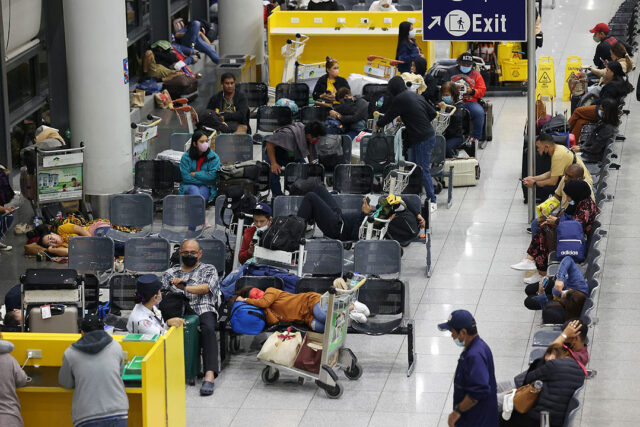
The New NAIA Infra Corp. (NNIC), operator of the Ninoy Aquino International Airport (NAIA), said it is expecting 1.35 million passengers to travel during the week, against 1.33 million over the same period last year.

“NNIC said passenger demand remains strong, although the increase is lower than earlier expected due to flight suspensions and operating restrictions affecting some Middle East services,” it said.

It said it deployed more personnel at check-in counters, immigration and security screening areas to help manage the expected passenger influx.

NNIC’s new terminal assignments took effect on March 29. Terminals 1 and 3 will serve international flights. Terminals 2, 4, and the proposed Terminal 5 are designated for domestic operations.

NNIC said traffic will peak during the week at 158,884 passengers, with passenger volume averaging 143,000 daily.

It said Terminal 3 is expected to handle 712,932 passengers during the period, followed by Terminal 2 with 346,342 and Terminal 1 with 293,990.

The Land Transportation Franchising and Regulatory Board (LTFRB) said it ordered all regional directors to conduct roadworthiness inspections at bus and other public utility vehicle terminals.

“This is a yearly exodus and we expect more people and motor vehicles again to be on the road on their way to the provinces for religious observances, vacations and other activities,” LTFRB Chairman Vigor D. Mendoza said in a statement.

Meanwhile, Metro Pacific Tollways Corp. (MPTC) said it is deploying additional personnel and providing round‑the‑clock basic mechanical services at all North Luzon Expressway (NLEX) and Subic‑Clark‑Tarlac Expressway (SCTEX) rest and refuel stations.

MPTC, the tollway arm of the Metro Pacific Investments Corp. (MPIC),  also said that roadworks, lane closures and maintenance activities are also suspended during the Holy Week.

MPTC, the country’s largest toll road developer and operator, manages major expressways including the NLEX, SCTEX, Manila-Cavite Expressway, Cavite-Laguna Expressway, Cebu-Cordova Link Expressway, and the NLEX Connector Road.

MPIC is one of three key Philippine units of Hong Kong-based First Pacific Co. Ltd., alongside Philex Mining Corp. and PLDT, Inc.

Hastings Holdings, Inc., a unit of PLDT Beneficial Trust Fund subsidiary MediaQuest Holdings, Inc., holds a majority stake in BusinessWorld through the Philippine Star Group, which it controls. — Ashley Erika O. Jose

GOCC subsidy bill falls 22.9% in 2025 as fiscal consolidation ramps up

President Ferdinand R. Marcos, Jr. led the inspection of the solar-powered irrigation project at Barangay Viejo, Minalabac, Camarines Sur, March 23, 2026.

By Justine Irish D. Tabile, Senior Reporter

SUBSIDIES provided to government-owned and -controlled corporations (GOCCs) fell 22.9% in 2025, the Bureau of the Treasury (BTr) said.

Budgetary support provided to state-run firms amounted to P106.92 billion in 2025, down from P138.763 billion a year earlier.

State-owned firms receive monthly subsidies from the national government to support their daily operations if their revenue is insufficient.

Social Watch Philippines Senior Budget Analyst Alce C. Quitalig said the lower subsidies released in 2025 reflect the government’s fiscal consolidation efforts.

“The current administration is clearly pursuing fiscal consolidation, reducing reliance on national government subsidies to GOCCs and signaling an expectation to the GOCCs to become more self-reliant in terms of generating their own revenue,” Mr. Quitalig said via Viber.

He said the subsidies released last year were the lowest since the P103 billion released in 2016.

Michael L. Ricafort, chief economist at Rizal Commercial Banking Corp. (RCBC), said the government in 2025 shifted its focus to profitable GOCCs to reduce the budget deficit and national government borrowings.

In 2025, the National Irrigation Administration (NIA) topped the subsidy list with P47.239 billion or 44.2% of the total.

This was followed by the National Food Authority (NFA), which received P14.404 billion, and the Power Sector Assets and Liabilities Management Corp., with P8 billion.

Other GOCCs on the subsidy list were the Philippine Crop Insurance Corp. (P5.85 billion), the Philippine Retirement Authority (P4.433 billion), the Philippine Food and Drug Administration (P3.765 billion), the Philippine Heart Center (P2.409 billion), and the Philippine Rubber Research Institute (P2.112 billion).

Government financial institutions (GFIs) received the fewest subsidies, with the Land Bank of the Philippines receiving P7 million for 2025.

According to LANDBANK, the P6.784 million it received from the BTr last year “was not an operational subsidy but a fund to cover the requirement for the payment of landowners’ compensation under the Comprehensive Agrarian Reform Program (CARP).”

“Under Republic Act No. 6657, or the Comprehensive Agrarian Reform Law, LANDBANK is mandated to serve as the financial intermediary for land acquisition and compensation, and the amount cited was solely intended to support this statutory function,” it said in a statement.

LANDBANK was among the top remitters to the National Government. It declared P32.35 billion in cash dividends from its 2025 earnings, which it said underscores its strong financial position and sustained contribution to national development.

Mr. Quitalig said the lower subsidies to GFIs could be a by-product of GOCC reclassification.

“The government reclassified certain GOCCs, shifting some from the category of GFIs to other GOCCs, and vice versa,” he said, citing the reclassification of the Philippine Crop Insurance Corp. from the GFI category to the other GOCC category in 2024.

“Indeed, Social Housing Finance Corp., Credit Information Corp., Philippine Deposit Insurance Corp., and National Home Mortgage Finance Corp. received no subsidies in 2025, highlighting uneven treatment across institutions,” he added, noting that the four agencies are GFIs.

The other agencies that received minimal subsidies were the Tourism Infrastructure and Enterprise Zone Authority, which received P22 million, and the Philippine Health Insurance Corp. (PhilHealth), which received P27 million.

According to Mr. Quitalig, subsidies for PhilHealth have been on the decline since 2023 from over P80 billion annually.

In 2023, subsidies to PhilHealth totaled P50.7 billion. This fell to P9.6 billion in 2024.

The other GOCCs that received less than P100 million in subsidies in 2025 were the Zamboanga City Special Economic Zone Authority (P47 million), the Philippine Center for Economic Development (P59 million), the Philippine Tax Academy (P60 million), and the Southern Philippines Development Authority (P84 million).

Mr. Quitalig said steep cuts were made in the housing and irrigation GOCCs, with the National Housing Authority (NHA) receiving P1.4 billion in 2025, down from P5 billion in 2024, the NIA receiving P47 billion against P71 billion previously, and the Pampansang Pabahay Para sa Pilipino Program, which received P758 million, down from P1.1 billion.

“These reductions raise a critical question: What does this shift mean for nonfinancial GOCCs tasked with essential services and for citizens who depend on them?” he said.

“These nonfinancial GOCCs with social functions face operational strain and tighter budgets, which may constrain their ability to deliver essential services,” he added.

At first glance, he said that the 2025 subsidy report shows a smoothed-out monthly distribution.

“Some subsidy releases remain uneven, notably for NIA, NHA, and PhilHealth,” he said.

“In contract, smaller allocations to Philippine National Railways, Light Rail Transit Authority, and NFA were released more regularly in 2025, suggesting improved predictability for transport and food security services,” he added.

RCBC’s Mr. Ricafort said he expects subsidies this year to increase in view of the assistance that the government will release for the most vulnerable members of society, such as transport, fisherfolk, agriculture, and the poor.

“Other subsidies such as on healthcare and other social services for the poorest of the poor could lead to higher subsidy bills, on top of non-monetary measures to prevent higher prices from passing through to the general public,” he added.

AI to disrupt workforces before benefits show — study

WANGXINA-FREEPIK

A NEW STUDY by the International Labour Organization (ILO) and the World Bank concluded that developing countries are likely to experience upheaval in the workforce before they reap economic benefits from generative artificial intelligence (AI).

In a study, “Disruption without dividend? How the digital divide and task differences split GenAI’s global impact,” the ILO said that differences in digital infrastructure and task composition shape how the risks and benefits of GenAI are distributed across countries.

“Exposure to GenAI is higher in advanced economies, particularly in clerical and professional occupations. Developing countries, while less exposed overall, face structural constraints that limit their ability to benefit from the technology,” the ILO said after a review of 135 countries.

The report highlighted the role of the digital divide, noting that many workers in vulnerable jobs are already online even in lower-income settings, which could accelerate job losses.

“These jobs often represent relatively higher-quality jobs in lower-income countries, including clerical and administrative positions that have historically offered a pathway to decent work, particularly for women and young workers. The concern is that AI-driven automation could close off these pathways,” the ILO said.

According to ILO, the study also noted that “many workers in roles with potential for productivity gains lack reliable internet access in lower-income settings, limiting their ability to benefit from GenAI.” 

“The paper shows that workers in lower-income economies tend to perform fewer non-routine analytical tasks, rely less on computers at work and have more routine or manual work, reducing the scope for productivity gains from GenAI implementation,” it added. — Erika Mae P. Sinaking

NCR retail price growth steadies in February

A vendor sits in a stall selling products in sachet packaging at a public market in Manila, Philippines, Aug. 1, 2019. — REUTERS

RETAIL price growth of general goods in Metro Manila steadied in February, the Philippine Statistics Authority (PSA) reported on Friday, noting price acceleration in crude materials, inedible except fuels and manufactured goods classified chiefly by materials.

Citing preliminary data, the PSA reported that the general retail price index (GRPI) in the National Capital Region (NCR) grew 2.1% year on year in February, unchanged from January.  A year earlier, price growth had been 1.2% growth.

The February reading is the strongest since the 2.5% posted in January 2024.

In the year to date, GRPI growth averaged 2.1%, up from 1.3% a year earlier.

Ateneo Center for Economic Research and Development Senior Research Fellow Ser Percival K. Peña-Reyes said the year-on-year growth in retail prices in the NCR was down to “selective price increases in certain commodity groups (beverages and tobacco, crude materials except fuels); steady price trends in many retail goods (manufactured goods, chemicals like oils and fats, machinery, miscellaneous manufactured articles, food); and a dampening effect from weaker or declining prices of mineral fuels and lubricants,” he said via Viber.

The PSA noted a pickup in the indices of crude materials, inedible except fuels (3% in February from 2.8% in January) and manufactured goods classified chiefly by materials (1.6% from 1.5%).

“The February acceleration was largely a cost-push effect due to rising prices of key raw materials (especially chemicals and oils), which meant increased costs for producers and higher prices for manufactured goods and related retail items,” Mr. Peña-Reyes said.

Year-on-year growth in the mineral fuels, lubricants, and related materials index was 1%, a turnaround from the 0.4% decline in the previous month.

Meanwhile, slower yearly growth was seen in the indices of food at 3.4% in February, down from 3.6% in January, and machinery and transport equipment at 0.5%, against 0.7% previously.

The indices of other commodity groups steadied in February from their respective levels in January.

The GRPI is based on 2012 constant prices.

Rizal Commercial Banking Corp. Chief Economist Michael L. Ricafort said price gauges could climb further in the coming months due to oil price hikes and the weaker peso.

“Both of which would lead to higher prices of imports, and overall inflation, with risk of second-round inflation effects or higher prices of other affected goods and services,” he said in a text message.

He also cautioned about rate hikes by the central bank to keep inflation within the 2%-4% target range.

Meanwhile, Mr. Peña-Reyes expects GRPI growth to remain stable in the short term.

“By mid-year onward, there could be a gradual upward bias, driven by fuel, food, and demand-side pressures. Overall, we can expect controlled, moderate growth, but not a surge,” he said.

The PSA uses the GRPI as a deflator in the National Accounts, particularly in the retail trade sector, and serves as a basis for forecasting. — Isa Jane D. Acabal

The SGV journey toward inclusive leadership and empowerment

IN BRIEF:

• SGV & Co. advances women leaders through a strong meritocratic culture, resulting in a leadership bench where women have actively helped shape the Firm’s direction.

• The firm’s efforts highlight that inclusiveness is vital for a thriving future, demonstrated through impactful initiatives empowering women and girls in historically underrepresented areas.

• Equally vital to the ongoing journey towards equity are the male allies and supporters whose shared goals and mutual respect strengthen and amplify these efforts.

In an industry where leadership development and career pathing have traditionally been narrow, SGV & Co. has built something more enduring and increasingly relevant. The firm has long treated meritocracy as an operating principle. The result is a leadership bench where women have advanced and actively help shape its direction.

On International Women’s Month, we celebrate the women honored as leaders and changemakers, exemplifying power that nurtures, uplifts, and transforms lives with grace and purpose. Their leadership guards legacies and guides future generations with courage and compassion, built on a foundation of meritocracy that SGV has always upheld.

WOMEN SETTING THE PACE
SGV’s record on women leadership was built over decades by individuals who navigated, and often remodeled, the structural barriers of their time.

Erlinda T. Villanueva’s appointment as SGV’s first female partner in 1961 signaled a shift that would resonate for decades. It demonstrated that advancement within the firm was anchored in performance, not precedent.

The rise of Gloria L. Tan-Climaco to become the firm’s first woman Chair and Managing Partner marked a defining moment. Her recognition as both a Young Lady Achiever in Public Accounting and an Outstanding CPA in Public Accounting from the Philippine Institute of Certified Public Accountants reflected a career grounded in technical excellence and credibility. Her subsequent role advising former President Gloria Macapagal Arroyo on strategic initiatives underscored the broader influence SGV leaders would wield.

SGV Senior Consultant Delia Domingo Albert followed a similarly expansive path. As former Secretary of Foreign Affairs and Philippine Ambassador, she brought institutional discipline to the global stage. Her tenure included serving as chair of the United Nations Security Council in 2004, where she championed the role of women in peace-building. Her career has since become a template for leadership that crosses sectors while consistently advocating gender equity.

These women leaders did more than succeed individually. They embodied the values of integrity and excellence that the firm’s founder, Washington SyCip, built the firm upon. Today, women make up the majority of SGV’s workforce and more than half of its partners and principals.

MERITOCRACY BY DESIGN
At SGV, meritocracy is part of the organizational infrastructure. From recruitment to promotion, the firm has relied on performance metrics, technical proficiency, and leadership potential as its primary filters. Advancement is neither automatic nor arbitrary.

This philosophy is reinforced through deliberate investment in mentorship and professional development. Programs ensure that high-potential employees, regardless of gender, gain access to sponsors, stretch assignments, and leadership exposure. Over time, this has produced a steady influx of women leaders who are not only qualified but also well-suited for the positions.

The result is an organizational culture that is both competitive and collaborative. Individuals are encouraged to excel and contribute to the firm’s collective strength. For women professionals steering through a historically male-dominated industry, this environment has been significantly influential.

IMPACTFUL INITIATIVES TO EMPOWER AND UPLIFT
The firm takes pride in the progress it has made in its ongoing journey toward equity. Its efforts serve to underscore that inclusiveness is essential to shaping a future where everyone can thrive. These efforts include a range of impactful initiatives designed to empower and uplift women and girls, particularly in areas where they have been historically underrepresented.

One such initiative is the EY STEM Program, which equips girls aged 13 to 18 with future-ready STEM skills through a free, gamified app. This innovative approach builds confidence and curiosity in science and technology, engaging 600 students during its launch at one high school. The program has inspired many young Filipinas to explore STEM fields and is set to expand its reach in 2026 through a new memorandum of agreement with the school’s LGU. This expansion aims to bring STEM opportunities to more public schools, empowering even more young women to pursue careers in science and technology.

Complementing this is the EY Women in Tech (WiT) program, which SGV participates in as a member firm of EY. This global initiative was established by EY in 2020 to empower girls and women to enter, remain, and lead in the technology sector. Serving as an umbrella network of over 40 regional and competency-based WiT communities across the EY network, the program connects members, shares best practices, and fosters a strong sense of community. Open to everyone regardless of gender, rank, or professional background, WiT encourages participation in both global and local events that promote learning, inclusiveness, and career growth within the technology space.

Further strengthening SGV’s commitment to gender equality is the Gender Equality Assessment, Results, and Strategies (GEARS) Program. Building on the firm’s distinction as the first professional services firm in the Philippines and Southeast Asia to receive the EDGE Assess-level certification, GEARS enables the firm to measure its progress and continuously enhance gender equality in the workplace. This program reflects the firm’s dedication to creating an equitable environment where all employees can thrive.

Together, these initiatives highlight the firm’s holistic approach to inclusiveness, ensuring that equity is not just an aspiration but a lived reality for women and girls across all levels and sectors.

A PRAGMATIC BLUEPRINT FOR LEADERS
The SGV model offers a pragmatic blueprint for business leaders. While essential, meritocracy is not sufficient on its own. Without conscious efforts to eliminate systemic barriers, organizations risk underutilizing significant portions of their talent pool.

Embedding inclusiveness into leadership training is a critical first step. Bias, often subtle and unintentional, can accumulate into structural disadvantage if unchecked. Equally important is cultivating mentorship and sponsorship networks. At SGV, these have been instrumental in bridging the gap between potential and opportunity, especially for younger professionals. Transparency plays a pivotal role as well. Setting clear diversity targets and holding leadership accountable ensures that progress is visible and sustained.

Finally, flexibility should be viewed as part of the policy, and not just a perk. In a global talent market, accommodating diverse needs can be a decisive differentiator.

COLLABORATION ACROSS ALL GENDERS
As SGV celebrates its 80th anniversary, it is important to see the bigger picture: SGV’s story is ultimately one of continuity. The firm’s early commitment to meritocracy laid the foundation for a leadership culture that could evolve without losing its identity.

Today, SGV is extending that legacy into a more complex and demanding era, shaping it in its own image. For the women leaders who have risen through the firm’s ranks, and for those who will follow, the message is clear: capability remains the currency of advancement. In a system that increasingly values inclusiveness, that currency now circulates more freely.

In celebrating International Women’s Month, it is important to recognize that true progress toward equity and empowerment is achieved through collaboration across all genders. Equally vital to this journey are the male allies and supporters whose shared goals and mutual respect strengthen and amplify these efforts. Together, women and men stand united, building a brighter, more inclusive future. This collective commitment ensures that the impact made today will inspire lasting positive change for generations to come.

This article is for general information only and is not a substitute for professional advice where the facts and circumstances warrant. The views and opinions expressed above are those of the author and do not necessarily represent the views of SGV & Co.


Rossana A. Fajardo is the chairman and country managing partner of SGV & Co.

Yemen’s Houthis enter Iran war with attacks on Israel, while US Marines arrive in region

AN IRANIAN MISSILE flies toward Israel, amid the US-Israel conflict with Iran, as seen from Jerusalem, March 11, 2026. — REUTERS/JAMAL AWAD TPX IMAGES OF THE DAY

CAIRO/DUBAI — The risk of an expanded Iran war grew as Yemen’s Iran-aligned Houthis on Saturday launched their first attacks on Israel since the start of the conflict, as additional US forces reached the Middle East.

Washington has dispatched thousands of marines to the Middle East in the month-old war. The first of two contingents arrived on Friday on an amphibious assault ship, the US military said on Saturday.

The Washington Post reported on Saturday that US officials said the Pentagon was preparing for weeks of ground operations in Iran, possibly involving raids by Special Operations and conventional infantry troops. Whether President Donald J. Trump would approve plans for deploying ground troops remained uncertain, the Post reported.

Reuters has reported the Pentagon was considering military operations that could include deploying ground troops in Iran.

LEBANESE JOURNALISTS, RESCUE WORKERS HIT
The war, launched on Feb. 28 with US and Israeli strikes on Iran, has spread across the Middle East, killing thousands and hitting the world economy with the biggest-ever disruption to global energy supplies.

Secretary of State Marco Rubio said on Friday the US could achieve its aims without ground troops but that it was deploying some to the region so Mr. Trump would have “maximum” flexibility to adjust strategy.

The Pentagon was also expected to deploy thousands of soldiers from the US Army’s 82nd Airborne Division.

Iranian President Masoud Pezeshkian spoke to Prime Minister Shehbaz Sharif of Pakistan, which hosts talks from Sunday with the Turkish and Saudi foreign ministers on ways to ease regional tensions.

Israel carried out a wave of attacks on Tehran on Saturday, targeting what Israel’s military said was Iranian government infrastructure.

It also hit targets in Lebanon, resuming its war against Iran-backed Hezbollah, killing three Lebanese journalists in a strike on a media vehicle, Lebanon’s Al Manar TV reported, as well as a Lebanese soldier. A follow‑up strike on the rescue workers sent to assist them also caused fatalities.

Israel’s military said it had targeted one of the journalists, accusing him of being part of a Hezbollah intelligence unit and saying he had reported on locations of Israeli soldiers.

Iran kept up attacks on Israel and several Gulf states after hitting an air base in Saudi Arabia on Friday and wounding 12 US military personnel, two of them seriously, in one of the most serious breaches of US air defenses so far.

Air defenses shot down a drone near the residence of the leader of the Iraqi Kurdish ruling party, Masoud Barzani, in Erbil, security sources told Reuters early on Sunday. Security sources said on Saturday that another drone attack had targeted the home of the president of Iraq’s Kurdistan region.

Israel, which regularly faced missile attacks from the Houthis before the war, confirmed a missile had been fired at it from Yemen. There were no reports of casualties or damage.

HOUTHI STRIKES MAY MEAN NEW THREAT TO SHIPPING
The attack pointed to a potential new threat to global shipping, already hit by the effective closure of the Strait of Hormuz, previously a conduit for about a fifth of global oil and liquefied natural gas supplies.

The group carried out a second strike on Israel, said Houthi military spokesperson Yahya Saree, vowing more strikes to come.

The Houthis have shown an ability to strike targets far beyond Yemen and disrupt shipping lanes around the Arabian Peninsula and the Red Sea, as they did in support of Hamas in the Gaza war.

With US midterm elections due in November, the increasingly unpopular war has weighed on Mr. Trump’s Republican Party. He has appeared eager to end it soon, while also threatening escalation.

Demonstrators took to city streets across the US on Saturday in anti-Trump rallies described by organizers as a call to action against the war on Iran.

Mr. Trump has threatened to hit Iranian power stations and other energy infrastructure if Iran does not open the Strait of Hormuz. But he extended a deadline he had imposed for this week, giving Iran another 10 days to respond.

Iranian threats to attack ships in the Strait have kept most oil tankers from attempting the waterway. Iran has agreed to let an additional 20 Pakistani-flagged vessels pass through the Strait, with two ships permitted to transit daily, said Pakistani Foreign Minister Ishaq Dar.

Israel has targeted Iran’s nuclear infrastructure. The head of Russia’s state nuclear corporation Rosatom, which has evacuated staff from the Bushehr nuclear power plant on the Gulf coast, said the attacks threatened nuclear safety.

Mr. Pezeshkian said Iran would “retaliate strongly if our infrastructure or economic centers are targeted.”

Iranian attacks were reported in multiple areas across the Gulf, including Kuwait, the United Arab Emirates and Oman.

An Iranian airstrike hit the Israeli village of Eshtaol, near Jerusalem. Seven people were hospitalized, Israel’s ambulance service said. Aluminium Bahrain said its facilities were targeted in an Iranian attack on Saturday, Bahrain’s state news agency reported.

In Iran, media said at least five people were killed in a US-Israeli attack on a residential unit in the northwestern city of Zanjan, and in Tehran, the Iran University of Science and Technology was struck. Reuters

WTO talks stalled going into final day amid U.S.-India e-commerce deadlock

WORLD TRADE ORGANIZATION

YAOUNDE — Talks to reform the World Trade Organization (WTO) and extend a moratorium to not impose customs duties on electronic transmissions such as digital downloads entered their final day on Sunday with no breakthrough yet in sight, diplomats said.

Trade ministers are working at a WTO meeting in Cameroon to close the gap between the United States and India over extending the e-commerce moratorium due to expire this month, three diplomats told Reuters.

Extending the moratorium is seen as a test for the WTO’s relevance, following a year of tariff-fueled trade turmoil and major disruptions due to the Middle East conflict.

India indicated it would accept an extension of two years, three diplomats said. US Trade Representative Jamieson Greer, however, has said Washington was not interested in a temporary extension to the ban, only a permanent one.

Business leaders say an extension is critical to guarantee predictability, fearing duties could otherwise be introduced.

There are suggestions the US could accept a “pathway to permanence” with a 10-year extension, a Western diplomat said. A second said a five- to 10-year extension was being explored, while a third indicated it was unlikely all WTO members would agree to go beyond two years.

A new draft document seen by Reuters on Saturday evening proposes support for developing country members, as well as a review clause.

Extending the moratorium permanently would give the US confidence to remain “fully engaged” in the trade body, the US Ambassador to the WTO, Joseph Barloon, told Reuters ahead of the talks.

“If the moratorium does not get extended, the US will use it as an excuse to beat the WTO on the head,” a fourth senior diplomat said.

REFORMS
The debate comes amid efforts to rework WTO rules to render subsidy use more transparent, make decision taking easier and potentially rethink the so-called Most-Favored-Nation principle that ensures members extend all trade benefits equally to one another.

The US and the European Union argue China in particular has taken advantage of current rules to their detriment.

Meanwhile, decision making under the consensus-based system has often been stymied by individual countries’ objections.

A handful of countries are opposing a detailed work plan on reforms, while most members support it, two senior diplomats said.

“We are frustrated that we are spending a lot of time talking about process, when we want to get on with the real work, reforming the WTO,” a Western diplomat said.

Including into WTO rules an agreement reached by a subset of members aimed at boosting investment in developing countries also remains blocked by India, which said plurilateral accords risk eroding the body’s founding principles. — Reuters