Home Blog Page 6250

New dance company to go toe-to-toe with Ballet Philippines

NATIONAL Artist for Dance Alice G. Reyes — PHOTO BY KAI HUANG/BUSINESSWORLD

By Sam L. Marcelo, Multimedia Editor

NATIONAL Artist for Dance Alice G. Reyes has made her next move: she has formed another dance company to go toe-to-toe with Ballet Philippines (BP), the 53-year-old company that she founded and fell out of love with after multiple contretemps between her and the BP board — each one worse than the last, the most recent being a copyright claim on one of her pieces by BP. (See: “Copyright fight: Ballet Philippines risks losing ‘treasure trove’ of dance”)

Alice Reyes Dance Philippines, Inc. (ARDP) has broad ambitions, among them to “establish and maintain an artistic company or companies for the performance of dance: folk, ballet, classical, modern, as any forms, variations or development thereof; … [and] to serve as the venue for the dance development apperception programs and projects of the Cultural Center of the Philippines,” according to the company’s Articles of Incorporation filed with the Securities and Exchange Commission on May 17.

Sitting on ARDP’s board are: Christopher R. Upton, president of John Robert Powers International and Ms. Reyes’s son; Liliane “Tats” Rejante Manahan, a restoration expert who also chairs the Heritage Conservation Society; Gregory H. Banzon, chief operating officer and executive vice-president of Century Pacific Food, Inc.; Ricky Toledo, co-founder of design and fashion boutique AC+632; and Cristina S. Keppler, an arts-and-culture patron.

Ms. Reyes declined to be interviewed for this story.

PHOENIX RISING?
It is unclear whether ARDP will be a resident company of the Cultural Center of the Philippines (CCP), although its informal predecessor — a group of dancers who were retrenched over the pandemic and subsequently mentored by Ms. Reyes — has already been working with the CCP to mount shows and conduct regional workshops through the CCP’s Professional Artists Support Program (PASP), an initiative formerly known as Professional Dance Support Program backed by CCP Chair Margarita “Margie” Moran Floirendo and CCP President and National Commission for Culture and the Arts (NCCA) Chair Arsenio “Nick” Lizaso.

The CCP has four resident dance companies:

BP, founded in 1969 by Ms. Reyes “to successfully synthesize diverse dance and movement forms” (its status as a resident company is on hold until the legal issue between the board and CCP is resolved);

Bayanihan Dance Company, founded in 1956 “to research on and preserve indigenous Philippine art forms in music, dance, costumes and folklore”;

• The Ramon Obusan Folkloric Group, founded in 1972 for the “preservation and perpetuation Philippine traditions with special emphasis on music and dance”;

• And, Philippine Ballet Theatre (PBT), founded in 1987 “as the pre-eminent classical ballet company in the Philippines.”

“To be a resident company of the CCP means that you are the flagship company in relation to excellence in artistic production. You are the flagship in terms of developing original Filipino work in your area,” said Chris B. Millado, then CCP artistic director and vice-president, in a previous interview with BusinessWorld.

With BP’s relationship with the CCP on shaky ground, its alumni thinking twice about having its new Russian artistic director stage their masterpieces, and its founder calling it “Ballet Russe” in scathing rebuke, the question is: how long can the company hold on to its reputation as the “leading professional classical and contemporary dance institution.”

And while ARDP is “new,” it will be composed of familiar faces. Ronelson P. Yadao, who was passed over as artistic director at BP despite Ms. Reyes’ recommendation, will serve in that capacity at ARDP. Forming the corps are dancers who used to be with BP, PBT, Ballet Manila, and Steps Dance Center. And behind all of them: Ms. Reyes herself.

ARDP will make its grand entrance with Pulso Filipinas, with regional dance students performing with the artists of the CCP PASP, which is slated for late September at the CCP’s Main Theater; and Alay nina Alice at Agnes (tentatively scheduled this September), a program that celebrates the work of two National Artists for Dance: Ms. Reyes and Agnes D. Locsin, a pioneering neoethnic choreographer who was conferred the title this June and who previously said that the BP board was “destroying the name [of Ballet Philippines].”

“If BP collapses, let it. And then let it rise like the phoenix,” she said in the vernacular in a previous interview with BusinessWorld. — with Mark T. Amoguis

SES satellites with ‘fiber-like speeds’ will be in PHL next year

SES S.A., a Luxembourg-based satellite communications services provider, said on Wednesday that it will bring more advanced satellite technology to the Philippines next year to aid the country’s digitalization efforts.

The company’s “Second-Generation Medium Earth Orbit Satellites,” or O3b mPOWER, will be “available in the Philippines in 2023,” Rob Marabut, business development director at SES, said during a virtual press briefing.

He said this technology will support a variety of requirements from major sectors such as mobile network operators, government, maritime, and mining, among others.

In Southeast Asia, the Philippines has the second-highest number of internet users at 79 million next to Indonesia’s 171.2 million, Jose del Rosario, research director at Northern Sky Research, said during his presentation.

The Philippines is “quite good” in terms of internet penetration at 72.1%, but requirements per user are increasing, Mr. Del Rosario said.

“Why satellites? It’s part of everyday life and there are tremendous benefits to mankind.”

Among these benefits are “instant infrastructure, robust and reliable infrastructure, and it is the only viable solution in underserved and remote locations,” he added.

According to SES, its O3b mPOWER has “fiber-like speeds,” which will “enable the delivery of cloud computing applications and services to power digital inclusion, while connecting communities and industries regardless of the remoteness of their location.”

“When its services become available in early 2023, O3b mPOWER’s reliable and fiber-like connectivity will play a key role in driving commercial and economic developments throughout the Philippines,” it added.

Mr. Del Rosario expects that the Philippines will create a robust and thriving space industry to support the country’s space program through private sector involvement and cooperation.

According to its website, SES, which supplies video and data connectivity worldwide, has over 70 satellites in two different orbits. It is serving one billion television viewers, seven out of the top 10 global telecom companies, four out of the world’s six major cruise liners, and 58 government organizations. — Arjay L. Balinbin

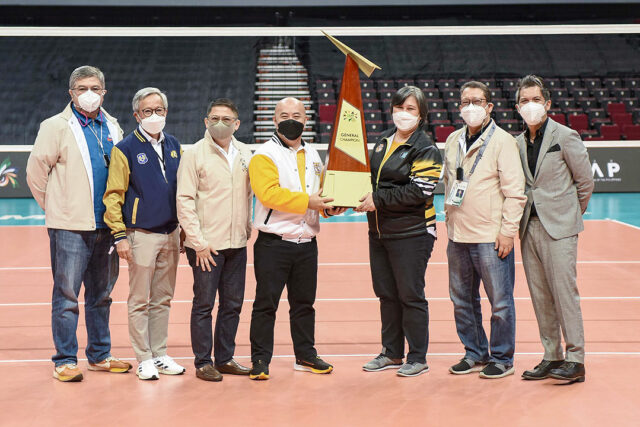
UST captures fifth straight UAAP general championship

FIFTH straight UAAP general championship for Santo Tomas — THE UAAP

UNIVERSITY of Santo Tomas (UST) continued to be the bastion of overall collegiate excellence even under a compressed format after claiming the University Athletic Association of the Philippines (UAAP) general championship once again amid the pandemic.

With the premier collegiate league staging only eight events for Season 84 in its return from a two-year hiatus, the Tigers still flaunted their pedigree by ruling four tournaments to capture their fifth straight UAAP general title.

Overall, it’s the 45th seniors division title for Santo Tomas as the winningest general champion in the UAAP. In the juniors play that was not held this year, the school also has 21 crowns marked by six consecutive titles.

Santo Tomas harvested 84 points built on championships in poomsae, men’s 3×3 basketball, men’s beach volleyball and men’s chess as UAAP settled for a shortened calendar from more than 30 titles up for grabs in the previous seasons.

The Tigers also finished at the podium in women’s 3×3 basketball (silver) while making the women’s volleyball Final Four.

National University finished at second with 81 points after gold medals in women’s chess, women’s 3×3 basketball and especially, women’s volleyball.

The Lady Bulldogs ruled the women’s volleyball in sweeping fashion, capping off a 16-0 season behind Rookie of the Year and Most Valuable Player Mhicaela Belen to end a 65-year title drought.

Season 84 host La Salle (76) completed the podium at third place with University of the Philippines rising to fourth place laced with a historic championship in men’s 5-on-5 basketball after 36 years.

Ateneo de Manila University (58), Adamson University (42), Far Eastern University (39), and University of the East (3) completed the rankings in order. — John Bryan Ulanday

SariSuki launches speedy grocery delivery service Supah 

SOCIAL commerce startup SariSuki has introduced a new rapid grocery delivery service called Supah that delivers groceries across select parts of Metro Manila.

During a media round table in Pasig City on Wednesday, SariSuki Co-Founder and Chief Executive Officer Brian P. Cu said that Supah offers a delivery service for grocery items such as snacks, condiments, beverages, fresh produce, and dry and frozen goods within 15 minutes.

Supah’s delivery services are currently available in Makati City, Bonifacio Global City in Taguig, Pasig City, Mandaluyong City, San Juan City, Binondo district in City of Manila, and both New Manila and Timog areas of Quezon City.

“Our business puts tremendous value on our customers’ time and needs. We see doing the grocery as effortless, time-saving and economical, while still making it possible to attend to other things. Thanks to our efficient ecosystem of suppliers, vendors and riders, we are able to fulfill this commitment without a delivery fee,” Mr. Cu said.

Supah currently has eight “dark stores” where the goods are stored, and over 100 riders that cater close to 5 million people, and categorizes under quick commerce.

Mr. Cu, a former president of Grab Philippines, said that Supah has been “quietly tested” since March over certain areas and has garnered a positive response, adding that the company raised around $11 million last year to fund the new venture.

“When we first started it, no one thinks they need 15 groceries until they get groceries in 15 minutes, sometimes even a little bit less. The goal of Supah is [to] help reduce the time used up by today’s busy consumers in going to the supermarket, and in spending time away from the other activities that they can use with the time that they have,” Mr. Cu said.

Lance Y. Gokongwei, JG Summit Holdings, Inc. president and chief executive, said that the company can help Supah by making products from its Universal Robina Corp. (URC) more accessible.

JG Summit’s corporate venture capital, JG Digital Equity Ventures (JGDEV), is an investor in SariSuki. Mr. Gokongwei is also a board director of SariSuki.

“I think my role really is to advise and provide some experience that I can share. As far as the JG Summit resource, of course, our ecosystem, we want to help as much as possible in terms of making products, for instance, from URC as accessible as possible to the company,” Mr. Gokongwei said.

“Supah offers great potential as it tries to address the consumers’ evolving needs in grocery shopping by finding the optimal balance among several critical factors like speed, assortment, value, and convenience. This innovative technology will help shape the future of grocery shopping in the country,” he added.

Moving forward, Mr. Cu said that the company seeks to expand, saying that 40 dark stores is enough to cover the entirety of Metro Manila.

“We’re looking at expansion. But we want to prove (there’s) enough demand in the existing stores that we have now before we start investing in expansion,” Mr. Cu said.

“To cover the entire Metro Manila in 15 minutes, we need to have 40 dark stores. But we’re not saying that we’re going to go to 40 next year,” he added. — Revin Mikhael D. Ochave

Alanis Morrissette cancels Manila concert, again

THE THIRD time was not the charm for Canadian-American singer Alanis Morissette as she announced the cancellation of the Manila stop of her Jagged Little Pill tour. The concert had been originally scheduled for 2020, and then again for 2021, and was cancelled both times because of the coronavirus pandemic.

This last time, the Jagged Little Pill concert was scheduled for Nov. 18 and 19 at the SM Mall of Asia Arena in Pasay City.

“To my friends in Philippines, I am crestfallen to announce that the upcoming Jagged Little Pill Anniversary tour dates have been cancelled (I am framing it to myself that I am postponing for another time),” Ms. Morrisette posted on her Facebook page. “I love you all and will be back as soon as we can. Until then, big hug.”

The local concert promoter Ovation Productions gave as reasons for the cancellation “scheduling issues and to the unprecedented logistical challenges of global touring in 2022.”

“[I]n consultation with her management, Ovation Productions feels it’s best to refund the ticket holders now and [we] have all committed to rescheduling these dates at the earliest possible time,” said a post on the promoter’s Facebook page.

All the purchased tickets will receive a full refund, said the promoter, noting that the refunds will be “processed at point of purchase to the original payment method used for purchase.”

Details on how to get refunds for both cash and online ticket purchases can be found on the Facebook page of Ovation Productions. —  MAPS

Tim Cone will assist the coaching staff of Miami Heat in Summer League

TIM CONE — PBA IMAGES

THE prime jobs kept coming for Barangay Ginebra coach Tim Cone.

As he makes another tour of duty with Gilas Pilipinas’ think tank, the multi-titled Mr. Cone got a call up from Miami’s Erik Spoelstra to serve as part of the Heat’s coaching staff in the coming National Basketball Association (NBA) Summer League.

Mr. Cone will assist Malik Allen in the pre-season competition set July 7 to 15 in San Francisco and Las Vegas, the PBA’s winningest coach himself announced on One Sports on Wednesday.

The Miami Heat gig will keep Mr. Cone out of the Gin Kings’ bench in four of their Philippine Basketball Association (PBA) Philippine Cup assignments against Converge, Terrafirma, TnT and Meralco. Ginebra assistant Richard del Rosario will take over momentarily.

“I’m going to try to go in there (Heat’s Summer League campaign) with an incredibly humble idea and just try to soak up anything there is,” said Mr. Cone, following in the footsteps of PBA great Jimmy Alapag, who served in a similar capacity with Sacramento last year.

Mr. Cone revealed his Summer League stint a day after Gilas program director/head coach Chot Reyes named him to the national team’s powerhouse coaching staff that includes Nenad Vučinić, UAAP winner Goldwin Monteverde of UP, Jong Uichico and Josh Reyes.

“I’m here to form the best team possible, not only the players but also the coaching staff for the 2023 FIBA World Cup,” said Mr. Reyes as he announced Mr. Cone’s appointment on Tuesday night while receiving his sixth Coach of the Year award from the PBA Press Corps.

“He wants to help and I think he’ll bring great value to the coaching staff,” Mr. Reyes said of Mr. Cone.

The 24-time PBA champion readily welcomed his reunion with Mr. Reyes, his assistant in the Philippine Centennial Team that took bronze in the Asian Games and won the Jones Cup in 1998.

“I’m happy and honored to have the chance to help coach Chot and the Gilas program in any capacity. It can’t get any more exciting than hosting the World Championships at home,” Mr. Cone told The STAR.

“What a thrill for the country and an honor. I’m looking forward to being a part of the team that puts our best foot forward.” — Olmin Leyba

Toyota PHL eyes carbon neutrality for Santa Rosa plant by 2035 

REUTERS

CAR MANUFACTURER Toyota Motor Philippines Corp. (TMP) is aiming to make its Santa Rosa production plant in Laguna carbon-neutral by 2035.

TMP said in a statement on Wednesday that it has accelerated its plant carbon neutrality target by 15 years from the originally planned 2050, aligning with the new aim of the global Toyota group to cut carbon dioxide (CO2) emissions in all of its manufacturing plants.

“For TMP, I am confident to say that plant carbon neutrality by 2035 is possible. We have 13 years left before our deadline, and we are working continuously to achieve 100% renewable energy (RE) by also exploring offsite power sources,” TMP President Atsuhiro Okamoto said.

As part of the initiative, the local car manufacturer on Wednesday inaugurated a 1.46-megawatt (MW) solar facility worth P94 million to power its Santa Rosa manufacturing plant and head office. With this, the company boosted its minimum RE ratio to 18%.

“With as much as 2 million kilowatt-hours of derivable clean energy per year, TMP’s onsite RE will contribute to 7-10% of the total energy requirement for manufacturing and non-manufacturing operations,” TMP said.

“As a result, the company will reduce its emissions by as much as 1,400 tons of CO2 per year, equivalent to 2.9 million trees planted over 20 years,” it added.

In 2021, TMP created a plant carbon neutrality (PCN) road map that sets clear targets under the two pillars of RE utilization and energy efficiency, after Toyota Motor Corp. in Japan pulled forward its zero CO2 emissions goal under the Toyota Environmental Challenge (TEC) 2050.

“These pillars anchor how TMP will achieve its PCN target by using 100% RE from onsite and offsite power sources, applying smart technologies and operational efficiencies in manufacturing, as well as using modern machineries that lean on alternative fuel or energy sources,” TMP said.

TMP began its RE investment in 2018 with the first phase installation of 1-MW TMP solar array, which seeks to achieve the commitments to TEC 2050, particularly the “Challenge 3: Plant Zero CO2 emissions.” It was a registered joint crediting mechanism (JCM) model project, which received a subsidy from the Japanese government.

“The JCM, a program that funds the diffusion of low carbon infrastructure in developing countries, provided the agreement to use the carbon credits in Japan’s emission reduction target,” TMP said.

The second phase is the addition of a 0.46-MW capacity, which began in March 2022. Manila Electric Co. subsidiary MSpectrum, Inc. installed 3,486 panels for the full rooftop solar power system on TMP’s main building in Santa Rosa City.

“Through TEC 2050, TMP also aims at reducing indirect emissions that occur in its value chain. TMP implements process improvement activities in logistics operations — from the transportation of parts to the delivery of vehicles to the dealerships,” the company said.

“To date, there are eight suppliers and 26 Toyota dealers that have also invested in RE facilities or entered into RE purchase agreements. Moreover, TMP has the widest lineup of hybrid electric vehicle (HEV) models which provide eco-friendly mobility options to customers,” it added. — Revin Mikhael D. Ochave

How to maintain a balance between luxury and sustainability

CITY of Dreams Manila Property President Geoff Andres with locally sourced fresh produce from hydroponics farms.

THE CLOCK is ticking for City of Dreams’ plans to be a carbon-neutral and zero-waste resort by 2030.

The resort recently laid out its sustainability goals, namely: focusing on renewable energy, energy efficiency, zero waste initiatives, reduction in water consumption, recycling, digitalization of processes, sustainable gardening or organic urban farming, and support to local SMEs (small-medium enterprises). “[These will] enable us to help conserve natural resources and the environment for future generations; and provide opportunities for local communities to thrive and be part of inclusive socio-economic progress,” City of Dreams Manila Property President Geoff Andres said in an e-mail to BusinessWorld.

“We are faced with various social and environmental challenges and as an innovative integrated resort whose core values revolve on service for colleagues, guests, community, and the environment, we endeavored to be a force of good and make a contribution to the universal call to action to protect the planet,” he continued.

City of Dreams is known for its luxury properties, namely Nuwa Manila, The Nobu Hotel, and the Hyatt Regency Manila; along with its casino and the many luxury restaurants that dot the space.

GOING LOCAL
Going green usually means reducing some measure of consumption, so how will the luxury property maintain a balance between luxury and sustainability? Mr. Andres said that their efforts enhance guest experiences with the installation of an onsite water filtration and bottling system, the elimination of single-use plastic, sourcing sustainable products through local supply chains, providing eco-friendly amenities, and infusing local produce and using sustainable packaging alternatives. According to a statement, up to 86% of its procurement consists of local products in support of local SMEs in the country.

For example, it partners with local coffee farmers through the Philippine Coffee Board, Inc.; procures rice that is 100% chemical-free and 100% traceable — from grain sourcing to planting and processing — from Alangalang, Leyte through its partnership with Chen Yi Agventures. Fresh vegetables and produce are grown in hydroponics come from Aba Pardes Agritech Corp.; and its seafood comes responsibly sourced from local fisheries and farms through sustainable seafood companies such as Meliomar and SeaTraceability, Inc. Recently, City of Dreams also switched to using cage-free eggs across all its restaurants.

“What we want to put out there is that it is possible to offer an elevated dining experience in a sustainable manner,” said Mr. Andres. “As our guests become more aware of our sustainability initiatives and socially responsible practices, it elevates their luxurious experience with us. They immerse [themselves] in sustainable luxury knowing that while they avail [themselves] of exceptional accommodation, dining, and entertainment, they minimize their impact on the environment and help in our conservation efforts.”

SUPPORTING EMPLOYEES
Closer to home, The Forbes Travel Guide has given City of Dreams Manila the first Work Here, Work Happy award earlier this year. “This new award recognizes a property or brand that has implemented creative ways to attract and retain staff,” said The Forbes Travel Guide on its website. These are due to programs like the President’s Award, which annually recognizes and rewards the most outstanding colleagues; encouraging volunteerism in weekly CSR initiatives; working in partnership with Ugnayan, an employee-management council; offering 24/7 buffet and unlimited meals in a modern employee dining room; providing sleeping lounges and bathroom facilities, and providing free shuttle bus service at pick-up and drop-off points; and granting generous employee discounts in its hotels and restaurants.

In an e-mail, Mr. Andres said, “The unrelenting efforts of our Human Resources team drives the resort’s Employee Love initiatives, that create an environment that fosters colleagues’ professional growth and work-life balance.”

Attention to sustainability and creating a good working environment are relatively new concepts for businesses, in light of changing attitudes towards work and the planet. Why does City of Dreams find it important to highlight both? “We believe that championing both people and planet through our positive work culture and environment… help build a sustainable future.” — Joseph L. Garcia

Learning about Cavite cuisine through the Tres Marias

CLOCKWISE from left Kilawing Papaya, Kare-Kare, Adobo Seca

CULINARY historian and writer Ige Ramos, along with local Cavite restaurateur Agnes Bautista-Poblete of Cantina de Tita A shared a bit about their hometown via a cooking demonstration last week. This is part of the ongoing Philippine Food Tour series of The Maya Kitchen, streamed monthly on Facebook.

For this particular demo, Ms. Poblete made a Caviteño triple-treat called the Tres Marias (Three Marias). This consists of Kare-kare (a tripe stew with a peanut-based sauce), Adobo Seca (a dry adobo which is usually meat cooked in vinegar), and Kilawing Papaya. Of the combination’s unusual name, Ms. Poblete said: “Hindi naman talaga malinaw ang paliwanag sa akin. Ang sabi lang nila, kasi noong panahon ng Kastila, ang mga tumutulong sa kusina ay mga Pilipina (It wasn’t clearly explained to me. What they said was that during the Spanish Occupation, the kitchen helpers were the Filipinas).” So, according to her, those Filipinas were ordered to do this and that, perhaps being addressed by their names.

Anyway, she says that these dishes are usually served during special Sunday luncheons, cooked at the same time so they’d be ready to serve at tables.

THE FIRST MARIA: KARE-KARE
The kare-kare was made first, featuring tripe and beef cheeks. Mr. Ramos pointed out that in Cavite, tripe is called mindongo (as opposed to other regions calling it tuwalya, due to its resemblance to terrycloth towels). The rest of the ingredients included garlic, onions, string beans, banana hearts, pechay (Chinese cabbage), annatto (locally known as atsuete), ground peanuts, and ground rice.

Normally, Mr. Ramos says, kare-kare is cooked over six hours, but because of TV magic (namely, that they had simmered the tripe and the cheeks beforehand), they managed to cut the cooking time to under an hour. He advised viewers to throw out the initial stock (due to it being tainted by smells and scum), then to keep the water from the second boiling to use as stock. Ms. Poblete, meanwhile, chopped the banana hearts thinly: it’s less regional but more personal history: she used to do this so her children would find it easier to eat.

She said that normally, this would be cooked in a big kawali (a big native pan, a bit like a wok), over a wood fire. Garlic and onion were sauteed, to which the meats were added. In another pan, the vegetables were sauteed simultaneously, with Mr. Ramos pointing out that the banana hearts had to be added to the pan first, due to the presence of cellulose fiber that makes the vegetable hard. In another pan, the annatto water was added to the meats. Mr. Ramos said that he sometimes uses lye to brighten the color of the annatto, to make it a deeper red. Once the meats were boiling, that was when they added the ground peanut, suspended in water. He said to make sure to mix the peanut well: the proteins present in peanuts make them impossible to completely dissolve, and they tend to stick to the bottom of the pan. To flavor and to thicken the sauce, toasted ground rice was added.

In some other households, the vegetables aren’t sauteed, but are added to the peanut soup to stew alongside the meat. In Cavite, according to them, the sauteed vegetables are served separately. Mr. Ramos notes that kare-kare is a difficult dish to make, due to it having to be cooked in two different pans.

He also noted that when looked at through different lenses, it would appear that our cooking overcooks its vegetables. He explained, “In reality, the reason why we overcook our vegetables is because our vegetables are very hard.” Jumping to another region, he said that in Ilocos, pinakbet (a dish made with assorted vegetables in fish paste or sauce), is cooked until the vegetables are wrinkly (which is the source of its name, from another Ilocano word describing that appearance). This, he says, is when those vegetables release their flavor. 

THE SECOND MARIA: ADOBO SECA
Next, they jumped over to Adobo Seca, which is taken from a Spanish word meaning dry (seca). This was made with your normal adobo ingredients (pork, garlic, bay leaves, and vinegar), but omitting the soy sauce (a fairly recent, but mainstream addition), and adding annatto to the mix. The annatto, Mr. Ramos pointed out, was an import to the Philippines from Mexico via the galleon trade.

The pork was browned in oil, and its fat was allowed to render, after which garlic was added. As the oil sizzled, Mr. Ramos said, “Ito iyong sound na gustong-gusto ko (this is the sound that I really like).”

Both cooks had opinions on why Cavite cuisine is so. Ms. Poblete said, “Siguro iyong panlasa na meron ang mga Caviteño (Maybe it’s the taste that Caviteños have).” Mr. Ramos agrees, noting that Cavite cuisine isn’t known for extremes, like dishes being too sweet, too rich, or too spicy.

On a funnier note, as the fumes of the garlic reached his nose, Mr. Ramos said, “Kaya walang aswang sa Cavite. Grabe kami gumamit ng bawang (This is why we don’t have monsters in Cavite. We use too much garlic),” alluding to the old legend that garlic repels monsters like vampires and other ghouls. Speaking of old wives’ tales, Mr. Ramos addressed one about adobo. As they were cooking, vinegar was one of the last ingredients to be added, and tradition says that one shouldn’t stir adobo until after the vinegar has been thoroughly cooked. “Wait for it to simmer,” he said, giving this old wives’ admonition a new stamp of approval.

THE THIRD MARIA: KILAWING PAPAYA
Finally, the dish ended with a kilawing papaya. Normally, kinilaw is raw fish cooked in vinegar, but in Cavite, this is a dish made with grated green papaya, garlic, miso, vinegar, and a little-used ingredient: beef pancreas. This was cooked in a pan, over a fire.

Ito, favorite ko ito (This is my favorite). Every time I go home to Cavite, I always crave for kinilaw. That’s why I always visit Tita A’s Cantina. She makes a really good kinilaw. This is like a childhood memory for me,” said Mr. Ramos.

“When you talk about Cavite food, [it’s like], ‘What? Is there such a thing as Cavite food?’”

Mr. Ramos has been known to promote Cavite cuisine as an especially historical one, noting the region’s long history, particularly as the food of the birthplace of modern Filipino democracy. In jest, he noted that the region is better known for its amulets, the action films of actor and politician Ramon Revilla, and criminals like Nardong Putik. “Very notorious kami,” he said.    Joseph L. Garcia

Japanese men’s team turns back Argentina in four sets

FILIPINO fans went in droves to the Smart Araneta Coliseum to satisfy their curiosity as to why this intriguing Japanese men’s volleyball team generates this much buzz.

They didn’t go home disappointed.

Pumped up by one of the best crowds the league drew in its Philippine sojourn at the Big Dome, a gritty and tenacious Japan came back from a huge opening set deficit in turning back Argentina, 27-25, 25-18, 17-25, 25-16, in Week 2 Volleyball Nations League (VNL) action on Tuesday night.

The win propelled the Ryujin Nippon straight to the top with 13 points on four victories in five matches while endearing themselves more to the local spectators — around 3,000 — who cheered wildly for the team from the Land of the Rising Sun.

Japan overtook Tokyo Olympics gold medalist France and powerhouse United States, which were at second and third with 12 and 11 points, respectively, on identical four wins against a loss.

The World No. 10 also avenged its four-set defeat to the Argentines in last year’s VNL edition in a game where the former took the opening set only to implode in the end.

And the Ryujin Nippon had to overcome an 11-5 opening-set deficit in carving out the emphatic win.

Yuji Nishida elicited the most applause as he unleashed a masterful 25-point effort in a game where he came through on both ends.

It was also the energetic Mr. Nishida who scored the most crucial points in the extended first set.

“This match is a very tough game. It’s a very different game. We’re very, very happy with the win,” said the Italian club Vibo Valentia stalwart.

Mr. Nishida also admitted they were electrified by the Filipinos’ support.

“Yes, it’s true,” he said.

Although Argentina came in the higher ranked country between the two, it, however, couldn’t live up to billing as it was unnerved and was never the same after painful first-set meltdown.

The Argentines couldn’t help but cry after the loss that sent it down in the gutter at 14th of the 16 teams with only four points and a win in five outings to show.

PLDT is a presenting partner while The STAR, Quezon City headed by Mayor Joy Belmonte, Maynilad, Philippine Sports Commission and the Philippine Olympic Committee are among those backing this ultra-competitive 16-country event. — Olmin Leyba

AllHome launches four new PetBuddy stores

ALLHOME Corp. on Wednesday announced that it opened four new stores for its specialty brand Pet Buddy as part of its expansion into the pet care industry.

The new PetBuddy stores are in Sta. Rosa, Bacoor, Antipolo and Taguig. Its maiden location opened in Las Piñas last year.

“There is a natural synergy between the building and maintaining of a home and the care of pets, and we are excited to build further on the convenience and value of the AllHome retail experience with PetBuddy,” AllHome Chairman Manuel B. Villar, Jr. said in a statement.

“We are confident that we can apply the same elevated and upgraded product and experience offering that we banner with each AllHome store to a growing pet care market in the Philippines,” he added.

PetBuddy carries a line of pet care products and imported pet products. It also provides grooming and daycare services in all its branches.

The pet store chain is classified as a small specialty format. The addition of the four new PetBuddy stores brings AllHome’s small specialty network to 21 and the group’s overall store network to 62.

“Pets carry a special place in our hearts, and with the rising middle class of the Philippines, we are observing Filipinos putting more importance in sourcing the right kinds of products and services for these ‘members of the family,’” AllHome Chairman Camille A. Villar said.

She also said that by providing elevated experiences to its customers, the firm is confident in its ability to delight pet owners with the newest concept, one that carries the “signature elevated experience of the AllValue group.”

At the stock exchange on Wednesday, AllHome shares declined by 1.53% or seven centavos to finish at P4.51. — Luisa Maria Jacinta C. Jocson

Dining In/Out (06/23/22)

Robinsons Hotels gets own mobile app

ROBINSONS Hotels & Resorts (RHR) has just come out with a mobile app which guests can download and book their stay. The mobile app is outfitted with features that will give visitors access to RHR’s suite of hotels and resorts. After an initial sign-in process, users need only to input their trip details into the app, search for their travel dates, and they can book multiple rooms in any of RHR’s 25 properties with a click. Browse through the app to see what each of the properties has to offer. Options are also available for add-ons within the app, such as breakfast, extra beds, and more. Users can even input promo codes to take advantage of the best deals. Users also have the option to either pay for their stay through the app or settle their bill at the hotel. For added safety and convenience, users may opt for a contactless check-in through uniquely generated QR codes at select self-check-in kiosks situated within the hotel lobby. The app, https://uqr.to/RobinsonsHotelsApp, is also available on the App Store and Google Play.

Wrap & Roll at Kenny Rogers Roasters

KENNY Rogers Roasters new Wrap & Roll is a complete meal in itself. It starts off with a flat tortilla bread packed with one’s choice of meat, vegetables, then drizzled with dressing in every roll for a healthy and handy meal. Now available in all Kenny Rogers Roasters nationwide, the new Wrap & Roll is available in three variants: Wrap & Roll Steak, containing premium steak rolled with mushrooms, tomato, lettuce, carrots, and special dressing in tortilla bread; Wrap & Roll Chicken, with classic roast chicken, fresh lettuce, tomato, white onions, carrots, and dressing in a tortilla; and, Wrap & Roll Fish, with a fish fillet, carrots, lettuce, tomatoes, and dressing in a tortilla wrap. The wraps cost around P220. Add potato chips and soda, with prices starting at P255. They are available for dine-in, takeout, or delivery through www.kennyrogersdelivery.com.ph, the hotline 8-555-9000, or via Grab Food, Food Panda, and Pickaroo.

Eden comes out with cream cheese

EDEN has just come out with a new Cream Cheese, made from high-quality farm-fresh milk, for a creamy taste and smooth texture that is perfect for baking, cooking, or as a spread. Available in a 225 gm block at P140 SRP (suggested retail price), and a 140 gm spreadable tub at P95 SRP. Visit www.cheeseanything.com for recipes that can be made at home with Eden Cream Cheese.

ADVERTISEMENT
ADVERTISEMENT