Home Blog Page 6185

Arts & Culture (07/08/22)

Ace Banzuelo’s “Muli”

Music video features ABS-CBN stars

ABS-CBN stars Francine Diaz and Seth Fedelin appear in the music video of Ace Banzuelo’s chart-topping electronic ballad “Muli,” which has been the most streamed OPM song on Spotify and Apple Music for more than a month now. It continues to make an impact on several music charts worldwide, reaching No. 1 on Apple Music Viral Hits — Philippines, No. 2 on Spotify Top 50 — Philippines and Spotify Viral 50 — Philippines, No. 3 on Apple Music Top 100: Philippines, and No. 6 on Spotify Viral 50 — Global. “Muli” has also landed on Spotify Viral 50 charts in four other territories: UAE, Singapore, Canada, and New Zealand.

GMA Network tops Facebook, TikTok

ON FACEBOOK, GMA Network is the top Philippine media organization with 22,126,213 likes as of June 2022. According to Sprout Social, for the first half of 2022, GMA Network’s Facebook page similarly leads in terms of Public Engagements by 72% against its closest media competitor. GMA Network also has 1.1 million followers on Tik Tok. Some of its top posts are from the daily showbiz news updates Kapuso Showbiz News and the #GMAPaNoticeChallenge, an acting challenge where fans can make their own versions of scenes from GMA shows with the best ones getting featured on the GMA Network account. GMA Network is @gmanetwork on Facebook, Twitter, Instagram, YouTube, and TikTok.

Kenneth Cobonpue in Smart Infinity documentary

FURNITURE designer Kenneth Cobonpue will headline the next episode of Smart Infinity’s Infinite Legacies documentary series on July 10, 7 p.m., on Cignal, Cignal Play, or Smart GigaPlay. Mr. Cobonpue will also speak about his advocacies at an Infinity Exclusives event happening on July 8 at the Interior Crafts of the Islands, Inc., in Cebu City. Replays are available on Smart’s GigaPlay App. For more details, follow Smart Infinity’s Instagram account @smartinfinity or visit smart.com.ph/infinity.

Alfamart on track to have 1,400 stores in Luzon

BW FILE PHOTO

ALFAMART, the minimart chain of SM Markets, aims to expand its stores to a total of 1,400 by the end of 2022 as it actively looks for sites in terminals and residential communities.

“Our dream for every Alfamart store is to help the local community through employment and also creating opportunities for the local MSMEs,” said Alfamart Chief Operating Officer Harvey T. Ong.

Alfamart has opened more than 500 new stores during the past two years since the pandemic started in 2020 as it kept its doors open and continued its expansion saying that the crisis has reinforced its role and responsibilities to the communities.

“As a result, we created income opportunities for the landlords that own space and contractors that build the stores. In this manner, Alfamart’s expansion has created over 4,000 jobs over the last two years,” Mr. Ong said.

Through partnerships with property owners, Alfamart hopes to open more Super Minimarts in communities across Luzon.

One of these property owners is Ms. Cecilia P. Ventura who was an overseas worker for two decades before deciding to come home and invest in a plot of land in Sta. Rita, Guiguinto, Bulacan that later turned into a successful venture with Alfamart.

Ms. Ventura said that “Alfamart continues to save the community time and fuel, especially at this time when oil prices are spiking, as customers could purchase what they needed close by.”

Alfamart is the minimart chain of SM Markets, the food retail brand of SM Retail, Inc.

SM Retail is one of the core businesses of SM Investments Corp., which serves as the holding company of the SM group with interests in retail, property, and banking.

On Thursday, SM Investments ended higher by P5 or 0.6% to P844 apiece. — Justine Irish DP. Tabile

IM chess match with cerebral palsy

SEAN Mervic Tiu and National Master Jojo Legaspi

ALL Sean Mervic Tiu, a 30-year-old who has cerebral palsy, wants in life is to continue play the game he loves — chess — and play some of the country’s top masters.

This weekend, Mr. Tiu will get his chance. Mr. Tiu will play five standard games against seasoned International Master (IM) Cris Ramayrat — two on Saturday and three on Sunday at the Sta. Rosa Barangay Hall in Pasig City.

National Master Jojo Legaspi has teamed up with Circa and Legacy Chess Clubs and the National Chess Federation of the Philippines (NCFP) to make Mr. Tiu’s dream come true.

Mr. Tiu actually made a good account of himself early this month when he scored three points out of a possible five in a FIDE-rated tournament the NCFP organized at the PACE in Quezon City.

And there is hope he could pull off a miracle or two against Mr. Ramayrat, who was once one of the country’s fastest players in his younger days.

“We just want to give Sean a chance in life through chess and also encourage all differently able players to express themselves through chess,” said Mr. Legaspi. — Joey Villar

Workers ignore call for annual medical exam

We have a low participation rate of 40% on average for our annual medical exam over the past three years. People tell us they’re too busy to leave their jobs as the exam takes about three hours to complete. Our chief executive officer (CEO) is worried that some employees may be taking illegal drugs. He’s also thinking of withholding the health benefits to those who are non-compliant, or even charge them with insubordination. What do you suggest? — Pearly Shell.

My top-of-the-mind diagnosis of your company’s low participation rate centers on how you manage the buildup to your annual medical exam. I suspect it is being treated as a routine event, with no creative flair and style injected into your announcements. That is my best guess for what is happening in your organization.

Many companies do the same thing over and over, with the result being low participation rates, which the human resource (HR) department does almost nothing to address.

Take diabetes as a common health issue. An organization can do something by using a simple practical approach. So, what’s my “simple practical approach”? I know of some companies allowing their workers to have an unlimited supply of rice for lunch in their cafeteria. 

Another organization gives unlimited coffee to their workers as part of their benefits. How does this contribute to health issues among the workers that may ultimately lead to absenteeism or prolonged absences? 

Of course, these examples are benevolent acts of management. However, the missing context is that these organizations issue regular medical bulletins to warn employees that they should take good care of their health by giving them reliable information from medical authorities. 

VALUE-ADDING INTERVENTIONS
You don’t have to spend big money to make your employees take the medical exam seriously. The answer to your predicament lies in value-adding interventions that would make the examination process easier, faster, interesting, and enjoyable. Here are some things I would recommend:

One, issue regular bulletins about health issues. Have a baseline of actual data collected by your medical service provider and use this to convince people to take the medical exam. If diabetes and high cholesterol levels are prominent in your workforce, educate your workers on how to avoid these conditions and actively monitoring their health.

Two, make it easy for the workers to participate in medical check-ups. If you have space, allow your service provider to bring its medical team and laboratory equipment to the workplace. Major clinics can bring their mobile x-ray units and other equipment inside the premises or even the car park area.

Three, require line leaders to encourage the workers to take the exam. The idea is to give employees no reason to delay taking the exam, not even busy workloads. Make the team leaders, supervisors and managers arrange a work schedule that would rule out workload as an excuse.

Four, make employees take the exam by birth month. Birthdays are a good occasion to plant the idea in the workers’ minds that they should take care of their health. Offer healthy snack treats as they await their turn if the exam is performed in the workplace. Invite pharma companies to distribute free samples of vitamins and donate prizes like coffee mugs or t-shirts for people celebrating birthdays.   

Five, offer a ‘wellness bonus’ for workers not taking sick leave. This “bonus” does not have to mean cash. Multi-vitamins or supplements are a possibility. Whatever “bonus” you may decide on, take into consideration the savings a company may realize from reduced premiums if the health plan is not used much.

Six, organize a ‘biggest loser’ contest. This recognizes workers who have adopted diet and exercise routines with prizes suited to your budget. The more attractive the prize is, the higher the medical exam participation rate will be. Such contests are also fun and foster camaraderie.

Last, get monthly feedback from those who have undergone the medical exam. You can always improve the management of the exam process by getting feedback. Imagine the data you can generate every month. While it’s true that you can’t act on all ideas, especially those involving additional costs, it’s important to hear that the workers care about their well-being.

LAST RESORT
Management can always wield an iron fist, especially when medical costs are rising every year. However, I would advise against issuing threats like withholding medical coverage or insubordination proceedings, which should be a last resort.

It can be extremely frustrating and emotionally draining to find yourself constantly confronted with employee complaints, even if you don’t have a labor union. Sometimes, complaints are unavoidable, but do something to minimize them.

The best approach is persuasion and making the medical exam attractive in some way.


Consult with Rey Elbo on Facebook, LinkedIn or Twitter or send your questions to elbonomics@gmail.com or via https://reyelbo.consulting


Deep purpose

THE first face-to-face meeting of the Filipina CEO Circle was hosted al fresco at the Manila Polo where John Clements CEO Carol Dominguez gave us a copy of the book Deep Purpose by Harvard Business School Professor Ranjay Gulati.  Carol was so intrigued by the book’s research that she bought 500 copies.

Purpose is defined as “the firm’s very reason for being.” Professor Gulati comments that instead of just simply pursuing a purpose, deep purpose leaders project it faithfully out into the world. Thus, in these leaders’ hands, purpose serves as an organizing principle that shapes decision-making and binds stakeholders to one another. He also talked about companies with a “convenient purpose,” or those with idealistic purpose statements yet may sell harmful products (junk food, weapons, etc.) and gave variations of it.

The book discusses several organizations Professor Gulati interviewed to “understand the secrets to their success.” He explores how leaders can pursue purpose more deeply:

• by navigating the inevitable trade-offs more deliberately and effectively to balance between short and long-term value;

• updating organizations to foster more autonomy and collaboration to allow employees to work more purposely;

• even using powerful storytelling to communicate and build a community of inspired stakeholders; and

• building cultures to allow employees to link the corporate purpose to their own personal reasons for being, among other things.

Carol co-organized the “Deep Purpose” session with DBS CEO Piyush Gupta. Carol said Mr. Gupta’s transformation of DBS serves as a model for how to be centered in deep purpose, get your employees highly engaged in executing that purpose, radically elevate your company’s contribution to the communities it serves, and, at the same time, achieve impressive financial results.

With a deep purpose to excel in serving customers and with an appreciation for the power of digital technologies to either threaten or catapult financial institutions, Mr. Gupta set about radically transforming DBS. He reorganized the bank to make it not just customer-centric but customer-obsessed, drove the bank to be digital to the core, created a culture of continual innovation, and turned banking on its head with a strategic focus on “Making Banking Joyful” and with the DBS tagline of “Bank Less, Live More.” DBS was named “world’s best bank” by Euromoney.

To further study “deep purpose,” John Clements organized a “Renewal and Rejuvenation” Conference in Colorado Springs last June. The sessions discussed several case studies (Ikea, Danone, JetBlue etc.) and their deep purpose and sustainability initiatives. Carol shares some of her key takeaways:

1. Some companies (Ikea) have made conscientious efforts to address sustainability issues. These efforts have included identifying the most significant ways in which their respective companies are having a negative impact on the environment and making concerted efforts to redress those situations.

2. Despite these concerted efforts to address sustainability issues, the net impact appears to be modest at best.

3. Deep purpose is a nice concept, but needs financial performance to go with it or could be fired from job (as Emmanuel Faber of Danone found out).

4. It is easier for companies to have deep purpose as their founding principle (ex. JetBlue and Whole Foods) than it is for long-established companies to overlay deep purpose on established enterprises (Danone).

5. You can be a great CEO with high purpose, energy, and intelligence, but need to communicate effectively with your board of directors ( David Neeleman of JetBlue ).

Mr. Gulati argues that a deeper engagement with purpose is important not only to the company’s wellbeing but also to  humanity’s future. He says that purpose can serve as a radically new operating system for the enterprise to enhance performance while benefiting society. It is indeed challenging to save the earth and generate profits, but profit without purpose is no longer  sustainable. Does your company have a deep purpose or a convenient purpose?

*****

The views expressed herein do not necessarily reflect the opinion of these institutions.


Ms. Flor G. Tarriela was the first chairwoman of the Philippine National Bank. She is a former undersecretary of Finance and the first Filipina vice-president of Citibank N.A.  She is a trustee of FINEX and an Institute of Corporate Directors fellow. A gardener and an environmentalist, she established Flor’s Garden in Antipolo, an ATI Accredited National Extension Service Provider and a DoT Accredited Agri Tourism Site.

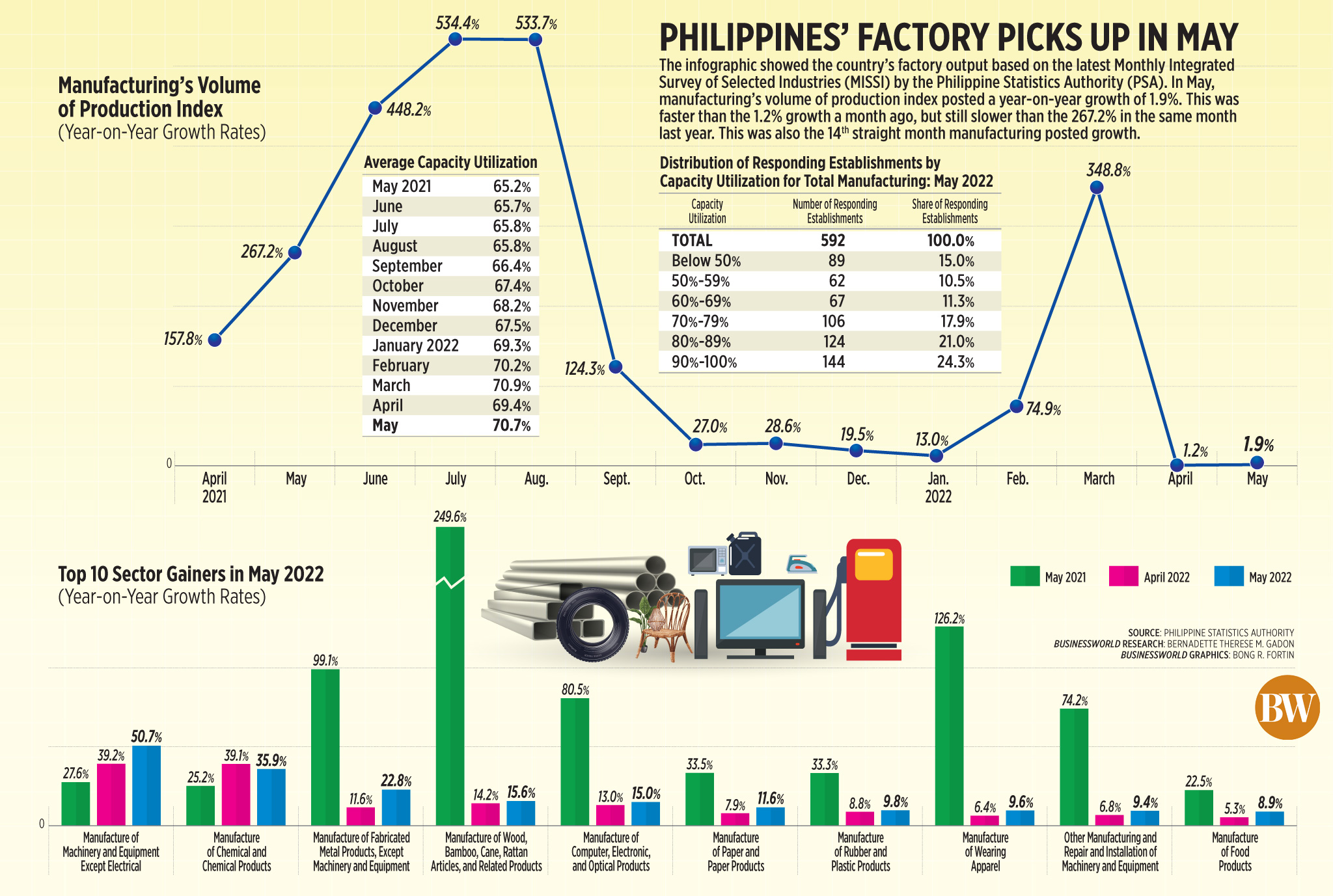
Philippines’ factory picks up in May

MANUFACTURING ACTIVITY in the Philippines grew for a 14th straight month, buoyed by the further reopening of the economy as the number of coronavirus cases declined. Read the full story.

Philippines’ factory picks up in May

How PSEi member stocks performed — July 7, 2022

Here’s a quick glance at how PSEi stocks fared on Thursday, July 7, 2022.


PSEi down on profit taking after three-day climb

BW FILE PHOTO

PHILIPPINE STOCKS fell on Thursday on profit taking and data showing more Filipinos were unemployed in May, with the quality of jobs worsening.

The benchmark Philippine Stock Exchange index (PSEi) slid by 92.69 points or 1.43% to close at 6,352.32 on Thursday, while the broader all shares index went down by 37.51 points or 1.08% to 3,405.39.

“The PSEi retreated today and retraced much of yesterday’s rally as investors likely took profit following gains in the first half of the week… Nevertheless, the market’s move remains in line with a healthy pullback,” China Bank Securities Corp. Research Head Rastine Mackie D. Mercado said in a Viber message.

“Shares on the Philippine Stock Exchange retreated, snapping a four-day winning streak, as more Filipinos found themselves unemployed or out of business in May while the quality of available jobs worsened, in what could be a sign that the economy, while growing again, is struggling to heal the pandemic-battered labor market,” Globalinks Securities and Stocks, Inc. Head of Sales Trading Toby Arlan C. Arce said in a Viber message.

“Sentiment may have also been soured after the government tempered its growth target for this year. The Marcos administration is now looking at a 6.5% to 7.5% economic growth in its first year in office, lower than the target set by the previous government,” Mr. Arce said.

Preliminary data from the Philippine Statistics Authority released on Thursday showed this was higher than the jobless rate of 5.7% in April, but remained lower than 7.7% in May last year.

May’s unemployment rate was equivalent to 2.927 million jobless Filipinos in May, up 165,000 from 2.762 million in April.

Job quality also deteriorated as the underemployment rate — the proportion of those already working but still looking for more work or longer working hours to the total employed population — rose to 14.5% in May from 14% in April.

In absolute terms, this translated to 6.668 million underemployed Filipinos in May, 269,000 more than the 6.399 million the previous month.

All sectoral indices posted losses. Industrials fell by 217.61 points or 2.30% to 9,216.24; services lost 33.46 points or 1.97% to end at 1,665.01; mining and oil went down by 200.45 points or 1.79% to 10,942.96; financials dropped by 24.45 points or 1.61% to 1,486.51; property decreased by 44.15 points or 1.49% to 2,903.76; and holding firms declined by 15.68 points or 0.25% to 6,056.71.

Value turnover went down to P4.69 billion on Thursday with 708.51 million shares from the P5.32 billion with 915.72 million issues seen the previous day.

Decliners outnumbered advancers, 103 versus 68, while 51 names closed unchanged.

Foreigners turned sellers anew with net sales worth P662.86 million on Thursday from the P93.22 million in net purchases seen the previous trading day.

China Bank Securities’ Mr. Mercado placed the PSEi’s support at 6,200 and resistance at 6,500, while Globalinks Securities and Stocks’ Mr. Arce placed support between 6,200 and 6,150 and resistance from 6,450 to 6,500. — J.I.DP. Tabile

Marcos orders DPWH to focus on infra projects aiding agriculture

BONGBONG MARCOS FB PAGE

PRESIDENT Ferdinand R. Marcos, Jr., who is also his own Agriculture Secretary, has called on the Department of Public Works and Highways (DPWH) to focus on infrastructure projects that benefit food security, Public Works Secretary Manuel M. Bonoan said.

“The President has instructed the prioritization of infrastructure that would aid in the food security program of the government amid rising inflation, as well as the interconnectivity of regions and convergence programs with other agencies,” the DPWH said in a statement on Thursday, citing Mr. Bonoan.

Being his own agriculture secretary allows “things (to) move quickly” in response to global developments, Mr. Marcos said in a statement, noting that the agriculture industry has been facing “severe” problems. 

The “infrastructure projects under DPWH that would help farmers are farm-to-market roads in convergence with the Department of Agriculture (DA),” the DPWH said.

In June, the DPWH reported that it completed farm-to-market road projects in Cabanatuan City and Gabaldon and General Tinio, all in Nueva Ecija.

“The concreting of the local roads required a combined amount of P12.6 million funded through the General Appropriations Act (GAA) of 2022,” the department said in a statement.

The paving project “was made possible through the convergence program of the DPWH and the Department of Agriculture with funding sourced from the 2021 (General Appropriations Act),” it added.

Mr. Bonoan said he will continue to pursue the big-ticket projects under the Build, Build, Build Program of the former administration “as instructed” by Mr. Marcos.

The DPWH hopes to “continue to tap the private sector for the country’s road network improvement through Public-Private Partnership program.”

In April, DPWH officials from the previous administration said they had completed 12 out 119 flagship projects.

The department had projected the completion of seven more big projects by June 30 and 12 more by December, including the P45.29-billion Southeast Metro Manila Expressway Project and the P75-billion MRT-7 of San Miguel Corp. (SMC).

Mr. Bonoan was SMC Tollways’ president and chief executive officer when he was tapped by Mr. Marcos to head the DPWH. — Arjay L. Balinbin

DPWH requests additional P500M for Albay-Sorsogon connector

DPWH

THE Department of Public Works and Highways (DPWH) said on Thursday that it is seeking an additional P500 million for the remaining civil works of the Albay-Sorsogon Connector Road project, which is expected to benefit up to 5,000 motorists daily once completed.

“The project has so far received an allocation of P2.21 billion,” the department said in a statement.

The remaining works are “civil works covering the installation of active and passive slope protection systems, metal beam guardrails and continuation of the concreting of the unpaved areas,” the department said.

The 15.87-kilometer connector road is a priority project for the Bicol Region, according to DPWH Region 5 Director Virgilio C. Eduarte.

“Locals and visitors will be able to utilize this all-weather road very soon. We are targeting completion of ongoing sections before the end of this year,” Mr. Eduarte said.

Once completed, the road is expected to reduce travel time by one hour.

The project will “eventually (improve) the economic condition of areas along its route,” Mr. Eduarte said. — Arjay L. Balinbin

WB says only 60% of 4Ps recipients in 2020 were among the poorest

PHILIPPINE STAR/EDD GUMBAN

THE World Bank (WB) said the Philippines’ cash transfer program, designed to aid the poorest 40% of the population, has seen beneficiaries from outside that category creep in gradually, to the point where only 60% of recipients in 2020 would have qualified under the original eligibility criteria.

“In 2009, almost 92% of (the Pantawid Pamilyang Pilipino Program) beneficiaries belonged to the bottom 40% of income distribution. However, this share has declined over time and, by 2020, during the pandemic, only slightly over 60% of… household (beneficiaries) are from the bottom 40%,” World Bank Senior Economist for Social Protection and Jobs Global Practice Yoonyoung Cho said in a presentation with the Philippine Institute for Development Studies (PIDS) on Thursday.

She was referring to the government’s cash transfer program, which is also known as the 4Ps.

Ms. Cho called for a cleanup of the Philippines’ beneficiary list to ensure that payments intended for the most vulnerable members of the population do not leak to unauthorized recipients.

“There should be a clean beneficiary and citizens database which facilitates better targeting (or) identification of beneficiaries in the time of crisis,” she said, calling the distribution of aid in the Philippines “quite inefficient.”

She added that “prioritizing those in the greatest need enhances fiscal efficiency, meaning greater impact for peso spent.”

When beneficiaries are effectively targeted, she backed the use of multiple financial service providers for disbursements to “further enhance greater access and convenience for beneficiaries.”

“(These) delivery systems can be enhanced using digital tools,” Ms. Cho said.

“This does not mean that poor beneficiaries have to become internet experts. Rather, wherever feasible, the implementers (should) use these tools and platforms for swifter response so they have sufficient time and energy to care for beneficiaries.”

Ms. Cho also recommended the streamlining of contingency financing mechanisms ahead of calamities and “simpler bureaucratic processes for activating and using the calamity funds.”

“Utilizing the rapidly developing and growing finance ecosystem for government transfers will greatly help,” Ms. Cho said.

She called for the Philippine Identification System (PhilSys) ID and the PhilSys Number rollout to be expedited.

“The PhilSys holds a key to many of these recommendations and it has made a huge progress during the pandemic,” Ms. Cho said. — Diego Gabriel C. Robles

Diokno signals Finance dep’t studying carbon tax feasibility

Finance Secretary Benjamin E. Diokno — PHILIPPINE STAR/KRIZ JOHN ROSALES

FINANCE Secretary Benjamin E. Diokno said his department is considering a carbon tax, and is currently working out whether such a measure is practicable.

“Carbon tax too, if feasible,” Mr. Diokno told reporters in a Viber message after being queried on fund-raising initiatives under consideration by the new government.

Asked to elaborate on the carbon tax, Mr. Diokno did not respond.

A tax on carbon emissions was contemplated in the third package of former Finance Secretary Carlos G. Dominguez III’s fiscal consolidation plan.

If approved, the third package is set to be implemented in 2025. The impact on government revenue has yet to be determined.

A carbon tax is levied on businesses that emit carbon dioxide, with the proceeds helping support greenhouse gas mitigation projects while forcing companies to address their own emissions to minimize their tax exposure.

Mr. Diokno also signaled the possibility of imposing a tax on single-use plastics in an interview with the ABS-CBN News Channel on Wednesday.

“The Philippines is probably one of the most vulnerable with respect to climate change, and so it is in our own interest that the movement towards climate change should be supported,” he said. “I think we on our part, on the tax side, should think of some measures that we can do to reduce pollution. For example, a tax on single-use plastic is worth considering.”

A P20 excise tax per kilogram of single-use plastics was also part of the previous government’s fiscal consolidation plan, although it had been targeted for rollout in 2023.

The previous government estimated that the tax can raise P249 billion or more every year, with the revenue going towards paying down the P3.2 trillion in additional debt incurred during the pandemic.

At the end of May, National Government debt stood at P12.5 trillion.

Mr. Diokno formerly served as co-chair of the previous administration’s so-called “Green Force,” an Inter-Agency Task Force for Sustainable Finance.

The task force supported the Sustainable Finance Roadmap that hopes to unlock financing for green initiatives.

In April 2021, President Rodrigo R. Duterte approved the Philippines’ first Nationally Determined Contribution, which set a target of reducing greenhouse gas emissions by 75% by 2030. — Diego Gabriel C. Robles

ADVERTISEMENT
ADVERTISEMENT