Home Blog Page 613

A call to restore trust, pursue clarity

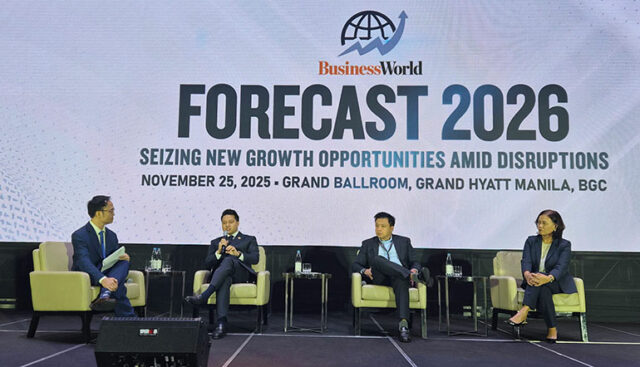
BusinessWorld Forecast 2026 Forum once again gathered the Philippine business community last Nov. 25 at the Grand Ballroom of the Grand Hyatt Manila in Bonifacio Global City, Taguig. — Photo by Jao Malapo

BusinessWorld Forecast 2026 highlights critical need for rebuilding investor confidence in response to heightened institutional distrust

By Bjorn Biel M. Beltran, Special Features and Content Assistant Editor

Trust is more than sentimentality. In business and finance, trust is capital; and in matters of capital, losses do not mirror gains. When you lose 50% of a P1,000 investment, you don’t recover completely when you gain 50% of your remaining P500 back. You would need 100%.

The base shrinks, and everything that follows grows from a weaker foundation. More critically, losses choke off future potential. They make growth harder, costlier, and slower than any ordinary business disruption. Which is why systems built on trust, be it financial or political, treat losses as existential risks. A single breach changes the entire trajectory, demanding repairs far costlier than the damage itself.

“For the past many years, we have been talking about disruption in the context of technology and innovation — how breakthroughs are forcing our businesses to evolve and adapt,” Miguel G. Belmonte, president and chief executive officer (CEO) of BusinessWorld, began BusinessWorld Forecast 2026, which discussed the Philippines’ economic prospects in the coming year.
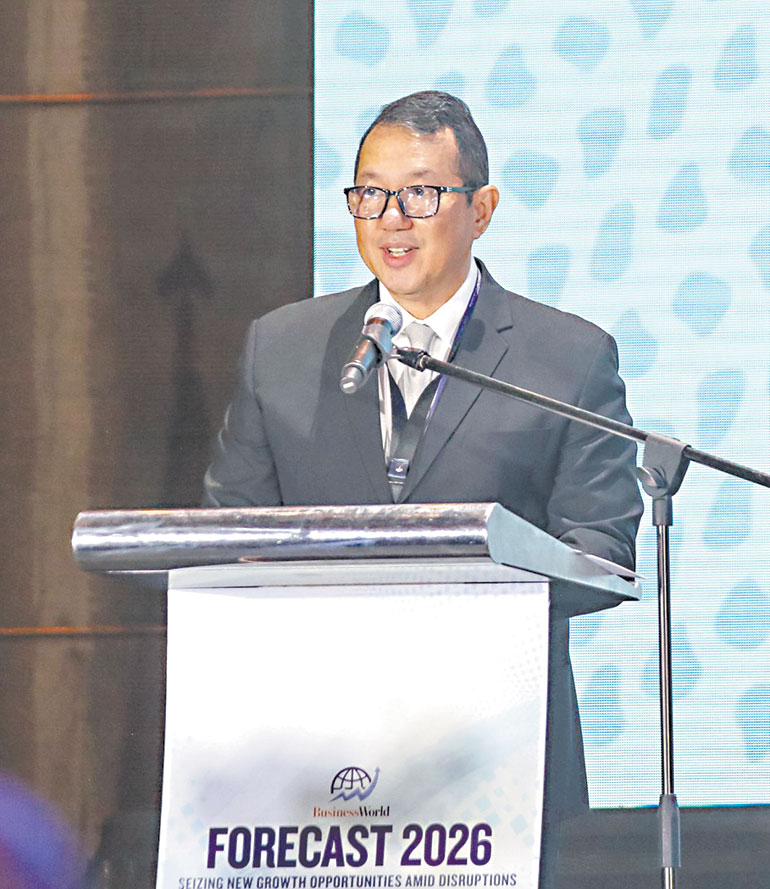
BusinessWorld President and CEO Miguel G. Belmonte — Photo by J. Legaspi Computer Graphics

“This time, however, we grapple with a more sinister form of disruption: that is, a corruption crisis, which — combined with political volatility — is weakening the peso, dampening the country’s growth prospects, dragging the stock market, and pulling down business confidence in general.”

Citing official data from the Asian Development Bank and the Bangko Sentral ng Pilipinas (BSP), Mr. Belmonte argued that the Philippines is starting 2026 from a worse position than the year prior. This is because the country is never an isolated case, but one that struggles and thrives amid a global backdrop that is increasingly volatile due to geopolitics, climate change, and technological shifts like artificial intelligence.

“At times like this, what matters most for markets and businesses is not the noise around us, but the strength of our institutions and the steadiness of our long-term fundamentals,” former BSP Governor and currently the Chairman and Independent Director of the Board at SM Investments Corp. Amando M. Tetangco, Jr. said during his keynote address.
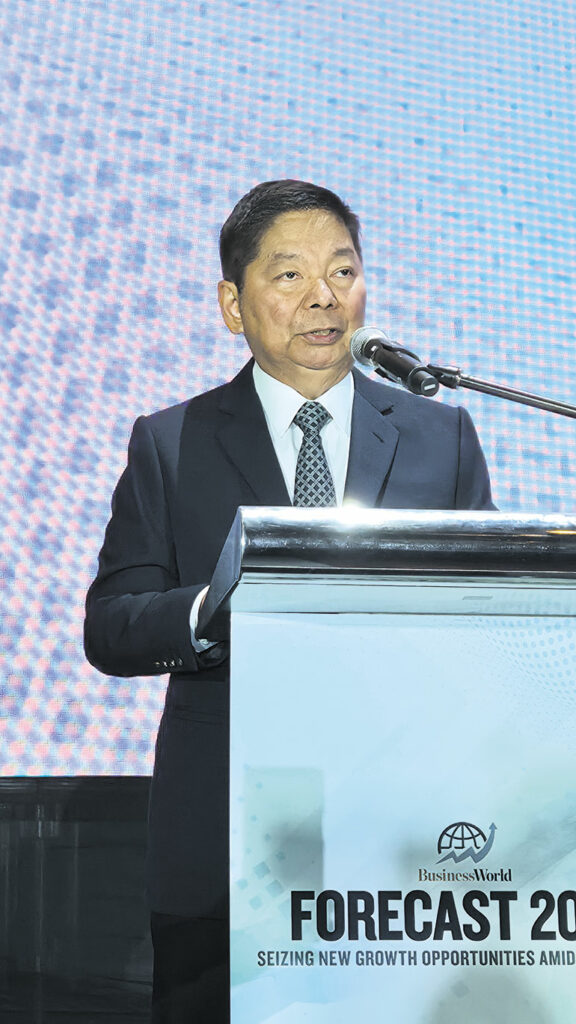
SM Investments Corp. Chairman and Independent Director of the Board Amando M. Tetangco, Jr. — Photo by J. Legaspi Computer Graphics

“Across the private sector, there is shared understanding that governance concerns must be addressed with firmness and transparency. In this environment, investors and consumers look for clarity — clarity of direction, policy consistency, and discipline execution,” he stressed.

Navigating directions for growth

BusinessWorld Forecast 2026 also attempted to provide clarity in other areas. From diagnosing the Philippines’ current problems and challenges, the forum explored where growth can still come from and where businesses should direct their attention.

The forum’s first panel, “The Macro-Economic Compass: Charting the Path amid Global Headwinds,” brought together Neil Adrian S. Cabiles, assistant secretary of the Department of Finance; Andrew Jeffries, country director for the Asian Development Bank; Nicholas Antonio T. Mapa, chief economist and markets strategist at Metropolitan Bank & Trust Co.; and Eduardo V. Francisco, president of BDO Capital & Investment Corp. Moderated by BusinessWorld Editor-in-Chief Cathy Rose A. Garcia, the discussion examined geopolitical tensions, supply-chain vulnerabilities, climate risk, and slowing global demand.
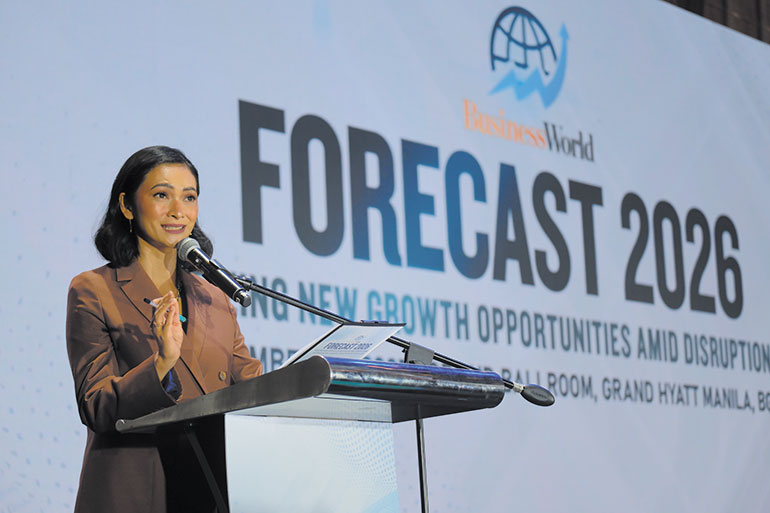
Journalist and academic Dr. Danie Laurel hosted the BusinessWorld Forecast 2026 forum. — The Philippine Star/Jesse Bustos

Next, the second panel addressed the technological revolution at the forefront of many business leaders’ minds. The discussion on “AI Unleashed: Moving from Adoption to Integration,” featured Congressman Brian Poe Llamanzares, chairman of the Global AI Council; Marco de la Rosa, senior partner and Philippines country head at A.T. Kearney; and Ambe C. Tierro, country managing director of Accenture Philippines. Moderated by BusinessWorld Corporate Editor Arjay L. Balinbin, the session explored how businesses are moving beyond pilot-stage AI adoption toward full operational integration.

A fireside chat on legal reforms followed, led by Atty. Nilo T. Divina, founder and managing partner of DivinaLaw, and moderated by BusinessWorld reporter Chloe Mari A. Hufana. The conversation reviewed major reforms such as TRAIN and CREATE laws, noting their potential to enhance tax efficiency, investment attractiveness, and regulatory predictability.

The afternoon resumed with a session on sustainability, “The Green Transition: Sustainability as a Catalyst for Growth,” featuring Jocot de Dios, CEO of Manila Water, and moderated by journalist and academic Dr. Danie Laurel, who also hosted the entire Forecast 2026. The session highlighted accelerating investments in renewable energy (RE), the Philippines’ strong performance in global RE attractiveness rankings, and the rising importance of climate-aligned policies.

This was followed by an exclusive presentation from Pauline Fermin, president and CEO of Acumen Strategy Consultants about their ongoing “Project Alphabet: Decoding Filipinos Across Generations.” Ms. Fermin outlined generational behaviors and social trends influencing consumption, workplace expectations, and broader socioeconomic shifts. These patterns, she noted, will play a significant role in shaping demand and labor dynamics next year.
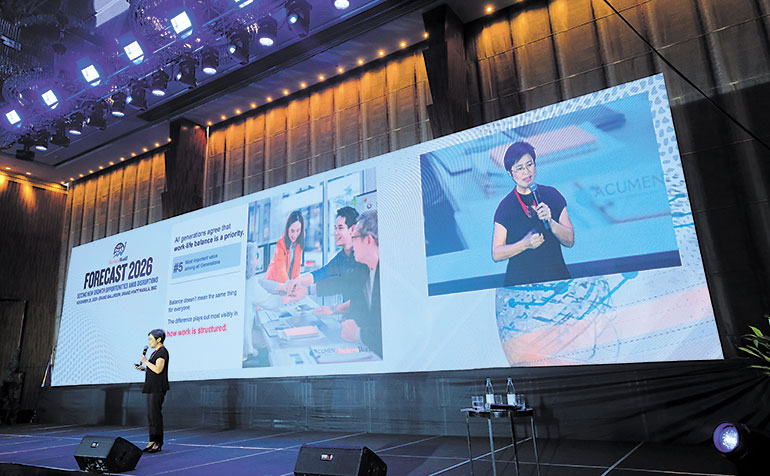
A highlight of Forecast 2026 was the exclusive presentation from Pauline Fermin, president and CEO of Acumen Strategy Consultants, about their ongoing “Project Alphabet,” which outlined generational behaviors and social trends influencing workplace expectations. — The Philippine Star/Jesse Bustos

Expanding on that thread, the third panel, “The Future of Work: Managing a Multigenerational Workforce,” featured Enrique Antonio Reyes, vice-president and head of Strategic Business Partnering at Converge ICT Solutions, Inc.; Steph Naval, founder and CEO of Empath; and Miguel Lim Lanuza, head of Leadership and Culture at Mynt. Moderated by BusinessWorld reporter Beatriz Marie D. Cruz, the conversation explored communication gaps, digital adoption, mental health concerns, and succession planning across five generations now coexisting in the workplace.

Finally, the panel on “Navigating the New Normal in Trade: How the Philippines is Faring in the New Global Trade Order,” convened Danilo “Dan” C. Lachica, president of the Semiconductor and Electronics Industries in the Philippines Foundation, Inc. (SEIPI); Victor Andres “Dindo” C. Manhit, president of the Stratbase Institute; and John Reinier H. Dizon, president of the Federation of Philippine Industries. Moderated by former BusinessWorld reporter Luisa Maria Jacinta C. Jocson, the session tackled import dependence, tariff pressures, regional competition, and opportunities from the Regional Comprehensive Economic Partnership and digital-trade reforms.

Lessons for the nation

In his keynote address, Mr. Tetangco reflected on his experiences and the lessons he had learned from his career, commenting on how it currently applies to the Philippines’ economic landscape. 

“Credibility is the foundation of trust, and trust is the foundation of confidence,” he said. “At the BSP, I saw that stability is built not on the inflation of exchange rates, but on credible signals and steady follow-through.”

He said that in the private sector, the principle is the same. Leaders and investors can act when direction is clear and institutions are reliable.

Global conditions remain complex, but they continue to reshape opportunities, he also stressed. Supply chains are being rebalanced as producers distribute production and risk. More broadly, jurisdictions that offer predictability and strong institutions are benefiting. Technology is lowering barriers, with tools most limited to large companies now available to micro, small, and medium enterprises. Sustainability is becoming essential for long-term competitiveness as global regulations tighten and investors incorporate climate exposure into their decision-making.

“We operate in a world achieved by shifting geopolitics, climate pressures, and tighter fiscal space. These conditions require focus, clarity, and steady discipline. Countries and companies that keep direction clear, uphold sound governance, and follow through on commitments tend to move forward even in the field of uncertainty,” he said.

“This discipline, rooted in credible institutions, consistent policies, and purposeful execution, remains one of any economy’s or any company’s key strengths,” he concluded.

This edition of BusinessWorld Forecast 2026 was presented by BusinessWorld Publishing Corp., Ford Motor Company Philippines, and Megaworld Corp.; together with gold sponsors Ayala Corp., BDO Capital and Investment Corp., Federal Land NRE Global, Inc. (FNG), JuanHand, San Miguel Corp., and SM Investments Corp.; silver sponsors Citicore Renewable Energy Corp., DATEM, Inc., GCash, Globe Telecom, Inc., GT Capital Holdings, Inc., PLDT, Inc., and Smart Communications, Inc.; bronze sponsors Development Bank of the Philippines, Ovialand, Inc., Philippine Amusement and Gaming Corp., SM Supermalls, and National Grid Corporation of the Philippines; partner organizations Asian Consulting Group, American Chamber of Commerce of the Philippines, Bank Marketing Association of the Philippines, British Chamber of Commerce of the Philippines, CCI France Philippines, European Chamber of Commerce of the Philippines, Financial Executives Institute of the Philippines, J. Legaspi Computer Graphics, Management Association of the Philippines, Team Executive Decisions, Philippine Chamber of Commerce and Industry, Philippine Franchise Association, Philippine Retailers Association, and Isla Lipana & Co. (PwC Philippines); and media partners One News and The Philippine STAR.


Government agencies, freelancer community, GCash join forces to boost global competitiveness of Filipino borderless workers

From left: G-Xchange Inc. President and CEO Ren-ren Reyes; Bangko Sentral ng Pilipinas Bank Officer IV Ailyn Lau; Freelancer Louise Jen Manalo; Mynt President and CEO Martha Sazon; Freelancer Dana Krystelle Novales; DTI Philippine Creative Industries Development Council Secretariat Deputy Executive Director Paolo Federico Ramos; DICT Undersecretary for Policy and Communications Sarah Sison; and GCash International General Manager Paul Albano Industry leaders and government officials join the industry launch of GCash Virtual US Account, with the theme “Shaping the Future of Borderless Work: Enabling a Globally Competitive Filipino Gig Economy.”

Filipino freelancers need financial tools that not only make it easy to receive payments but also lower transaction fees and offer competitive foreign exchange rates, empowering them to fully tap global opportunities.

This was highlighted in a round-table discussion with the freelancer community, the Department of Information and Communications Technology (DICT), Bangko Sentral ng Pilipinas (BSP), the Department of Trade and Industry (DTI), and GCash, the country’s leading finance super app.

The industry launch, titled “Shaping the Future of Borderless Work: Enabling a Globally Competitive Filipino Gig Economy,” discussed how fintech players like GCash can work with the government to support freelancers, help Filipino talent thrive even more in the global market, and strengthen the country’s shift toward truly borderless work.

Addressing the pain points

Freelancers Louise Jen Manalo and Dana Krystelle Novales shared their pride in how Filipino talents are equipped with world-class skill sets — capabilities that empower them to confidently attract and work with clients from around the world.

However, the online remote workers pointed out that many Filipinos still struggle to navigate the freelance work setup because they lack access to the right digital financial tools. Such platforms can help them easily receive payments and settle transactions, especially from clients abroad.

“Hopefully, in the future, more technology innovations [will be available] for us freelancers so it would be easier to pay your taxes, to get your service payments from your client, and know where to put your money,” Manalo said.

“It would be nice in the future of freelancing, borderless work to have a one-stop finance shop,” Novales added.

BSP Bank Officer IV Ailyn Lau, in response, shared that the government and private sector can leverage each other’s strengths to develop innovative financial tools that address the users’ pain points. “Our responsibility is to ensure that all of these products and services have guardrails to ensure that they’re safe and efficient,” she stressed.

One of the initiatives shared by Lau was Project Nexus, which aims to connect the domestic instant payment systems of different countries to a cross-border payment platform, allowing instant sending of funds overseas.

“Someday, hopefully, when you open your bank account or e-wallet, you just need to choose from a drop-down list of countries, and you will instantly be able to send money to another country,” Lau said.

But beyond the payment solutions, the government is focusing on upskilling Filipino freelancers. Doing so will equip them with the skills they need to stay competitive, access higher-value projects, and thrive in the global digital economy.

“We are opening doors of opportunity for every Filipino, whether in rural communities or right here in Manila, through training, mentorship, and job-matching programs that prepare them for real participation in digital transformation,” DICT Undersecretary Sarah Sison said.

“The DICT remains firmly at the forefront, ensuring our freelancers and digital workers have the skills and support they need to seize the opportunities of the digital economy,” Sison vowed.

To help freelancers better understand these opportunities, the DTI has created roadmaps in line with the government’s goal of making the Philippines as the Asia’s premier creative hub.

“It is the government’s duty to make sure that every sector is supported either financially or through capacity-building and mentoring,” said Paolo Federico Ramos, Deputy Executive Director of DTI Philippine Creative Industries Development Council Secretariat.

Supporting the gig economy

GCash strongly supports the growing cross-border freelance economy, where millions of Filipinos are participating. With the government aiming to create 8 million digital jobs by 2028, the country’s leading finance super app contributes by providing a financial tool that helps freelancers access global opportunities.

In response, GCash has recently launched the Virtual US Account, allowing Filipino freelancers servicing clients from the United States (US) to receive payments straight to their e-wallet accounts without hidden charges.

Powered by global payments network Meridian Payments US1, the GCash Virtual US Account is the response of the country’s leading finance super app to the usual pain points of freelancers: costly transaction fees and foreign exchange (forex) losses.

The breakthrough product offers lower platform fees2 and competitive foreign exchange costs, enabling remote workers to take home a larger share of their earnings. It also removes high withdrawal fees and hidden charges for a more transparent and rewarding payment experience.

“Through our partnership with Meridian Payments US, we’re empowering Filipino freelancers with faster, more affordable, and more transparent ways to receive payments from the US. The GCash Virtual US Account bridges borders and brings greater financial freedom to millions of Filipinos working in the global digital economy,” GCash General Manager for International Paul Albano said.

Meridian Payments US is an instant payments network that connects wallets, merchants, and financial institutions directly with global banking systems.

Fully verified GCash users are eligible for account opening. To qualify, freelancers must have completed GCash profile information, maintain good account standing, and possess at least one valid Philippine government-issued ID.

Users can transfer funds from different payment platforms, payroll platforms, and marketplaces such as PayPal, Payoneer, Wise, Gusto, Deel, Upwork, Freelancer.com, Fiverr, and Onlinejobs.ph.

This feature is expected to increase the flow of US dollars into the Philippines, with the United States remaining the country’s largest source of remittances. Data from the Bangko Sentral ng Pilipinas show that around 40% of total cash remittances from January to August this year originated from the US.

“With the GCash Virtual US Account, we’re enabling Filipino freelancers to take full control of their hard-earned income, allowing them to maximize every peso they earn,” Albano concluded.

For more information, visit gcash.com.

1GCash Virtual US Accounts are issued and maintained by Meridian Payments US under a “for benefit of” arrangement. These are not bank accounts and do not qualify as deposits; hence, they are not covered by any deposit insurance schemes.
2Dependent on sending institution


Spotlight is BusinessWorld’s sponsored section that allows advertisers to amplify their brand and connect with BusinessWorld’s audience by publishing their stories on the BusinessWorld Web site. For more information, send an email to online@bworldonline.com.

Join us on Viber at https://bit.ly/3hv6bLA to get more updates and subscribe to BusinessWorld’s titles and get exclusive content through www.bworld-x.com.

Globe of good: Amplifying care, empowering communities

Globe executives, led by President and CEO Carl Cruz (3rd from left), gathered at the BluePrint event where Globe of Good was highlighted as a key initiative supporting community recovery and resilience.

As the nation recovers from a series of powerful typhoons and earthquakes, Globe is shining a light on how technology, guided by purpose, can help rebuild lives and strengthen communities.

At Globe’s recent BluePrint event, themed “Lighting Up the Season with Purposeful Connectivity & Meaningful Connections,” the company showcased how its platforms and partnerships transform digital connections into acts of compassion and collective recovery.

Rebuilding Communities Through Connectivity and Compassion

From July to November, the Philippines was hit by multiple natural disasters, including Super-Typhoon Nando, Typhoon Opong, Typhoon Tino, and most recently, Super-Typhoon Uwan. Globe responded through its Globe of Good initiative, deploying Libreng Tawag and Libreng Charging stations in 29 sites and providing relief assistance to over 9,000 families.

Beyond emergency relief, Globe continues to drive long-term recovery through its digital giving platforms such as Globe Rewards, GoGIVE, G-Gantic Goals, and the Hapag Movement, enabling customers to turn everyday actions into meaningful support for affected communities.

Turning Everyday Connections into Collective Action

For 2025, over 309,000 Globe customers have donated through Globe Rewards, raising over P5 million for NGO partners. Meanwhile, GoGIVE has engaged over 43,000 contributors, generating 2.9 billion hearts to support advocacies in disaster relief, child protection, women empowerment, environmental conservation, medical assistance, and many more.

Through G-Gantic Goals earlier this year, more than 150,000 participants came together to raise P1.5 million for the Pawssion Project. In addition, Globe was able to donate tablets to five public schools nationwide, in partnership with Ayala Foundation, Inc. and Khan Academy Philippines. These efforts show that even small gestures can create a lasting impact when shared at scale.

Through the Essentials button of the GlobeOne app, students, parents, and teachers can now access Khan Academy, which offers lessons in STEM, digital literacy, online safety, and essential life skills, available anytime, anywhere. In addition, the Kaagapay Donations Portal is also available in the Essentials platform of the app, where donors can contribute to nonstock, nonprofit organizations that deliver essential services to vulnerable groups.

Lighting Up the Holidays with Hope and Purpose

This Christmas, Globe invites customers to continue being a force for good by donating Rewards points via the GlobeOne app, joining GoGIVE, or supporting G-Gantic Goals to help fund recovery and rehabilitation efforts. “At Globe, we believe that technology should serve a higher purpose, one that uplifts lives and brings people together, especially in times of need,” said Yoly Crisanto, Chief Sustainability and Corporate Communications Officer at Globe. “Through Globe of Good, we are showing that every connection, every click, and every customer action can light the way toward recovery and resilience.”

Globe also paid tribute to its partner NGOs, who serve as on-the-ground champions delivering critical aid, education, and nourishment to communities nationwide.

A Season of Shared Light

By combining connectivity with compassion, Globe, through its GlobeOne app continues to enable its customers for Social Good, empowering Filipinos to connect with purpose and help each other rise stronger. This holiday season, Globe celebrates the power of shared humanity, proving that when technology is driven by empathy, every connection becomes a light that helps rebuild the nation.

For more information about Globe, visit www.globe.com.ph.


Spotlight is BusinessWorld’s sponsored section that allows advertisers to amplify their brand and connect with BusinessWorld’s audience by publishing their stories on the BusinessWorld Web site. For more information, send an email to online@bworldonline.com.

Join us on Viber at https://bit.ly/3hv6bLA to get more updates and subscribe to BusinessWorld’s titles and get exclusive content through www.bworld-x.com.

Wellness on the Move: St. Joseph Drug’s celebrated fun run returns stronger

What began as a milestone celebration for St. Joseph Drug’s 65th anniversary in 2023 has grown into one of North Luzon’s most anticipated fitness events. The Wellness on the Move Fun Run has become a biannual tradition, drawing families, friends, and fitness enthusiasts to scenic routes in Baguio City and Lingayen, Pangasinan.

This year’s Lingayen leg, held on Nov. 29, 2025, was not only the sixth in the series but also its most meaningful yet. The run was originally set for Nov. 8, but with the threat of Super-Typhoon Uwan looming over Pangasinan that same weekend — and the province bracing for what would become one of the worst storms to hit the area — the organizers made the prudent choice to reschedule.

For St. Joseph Drug, the decision was clear: safety had to come first.

By the time the run pushed through on Nov. 29, the Lingayen Baywalk — its iconic venue — was still undergoing rehabilitation. The storm had left visible scars, with parts of the Baywalk damaged. Yet the sight of more than 1,800 participants filling the Baywalk with energy and color sent a powerful message: wellness and community spirit endure even in the face of adversity.

A Legacy of Care

St. Joseph Drug, the leading regional pharmacy chain in North Luzon with more than 120 stores, has long been a trusted partner in health. For decades, it has provided accessible and affordable medicines and essentials to communities across the region. The Fun Run extends this mission by encouraging people to embrace a get-well, stay-well lifestyle through shared fitness activities.

From its debut in Baguio City in May 2023 with 500 runners, the event has steadily grown. The Lingayen leg’s turnout of more than 1,800 participants marked its biggest yet, underscoring the appetite for wellness activities and the strength of community ties. Each leg builds upon the last, creating anticipation among families and friends who now look forward to the biannual gathering as a fixture in their calendars.

The Fun Run is designed for inclusivity, offering 3-kilometer, 5-kilometer, and 8-kilometer distances. The Lingayen leg highlighted this diversity: the youngest participant was just three years old, while the oldest was 73. Families ran together, friends cheered each other on, and communities bonded over the shared goal of healthier living.

This wide age range reflects the event’s philosophy: wellness is not exclusive to athletes or the young. It is a journey that can be embraced at any stage of life, and the Fun Run provides a welcoming space for everyone to take part.

Bubbles, Colors, and Sunset

Despite the recent typhoon, the atmosphere was festive. Branded as a “bubbles, colors, and sunset” fun run, the event transformed the Baywalk into a vibrant celebration. The bubbles added another layer of fun, while bursts of color powder enveloped the participants. As the run unfolded, the setting sun cast warm hues across the sky, complementing the joyful mood.

Trade partners contributed by setting up booths where runners could take home health essentials, reinforcing the advocacy that wellness is not only about exercise, but also about access to the tools that support healthier living.

A Celebration of Community Resilience

Even as the Baywalk was being rehabilitated, the community gathered to prove that wellness and unity can thrive amid recovery. This success would not have been possible without the unwavering support of the Provincial Government of Pangasinan and the Local Government Unit of Lingayen, along with their attached agencies, who worked to ensure that the event ran smoothly and safely, without any incident. Their coordination and commitment — from security and traffic management to health and emergency services — provided the foundation for a worry-free and enjoyable experience for all participants.

One of the most anticipated parts of the Lingayen leg was the after-run party. For 10 minutes, participants became part of a wholesome, colorful celebration — dancing, singing along, laughing, and reveling in the joy of accomplishment. This unique feature has become a hallmark of the Fun Run, reminding everyone that wellness is not just about discipline and effort — it is also about fun, community, and celebration.

For St. Joseph Drug, the Fun Run’s success reinforced its mission: to be more than a pharmacy chain, but a partner in building healthier, stronger communities. By offering not just medicine but also opportunities for active living, the brand strengthens its bond with the people it serves.

Looking Ahead

The Wellness on the Move Fun Run continues to grow in scale and significance. With each leg, it builds momentum, attracting more participants and deepening its impact. Looking ahead, St. Joseph Drug envisions expanding the event’s reach, introducing new wellness activities, and strengthening partnerships with local governments and organizations.

The success of the Lingayen run sets a precedent for future events. It shows that anniversaries can be more than commemorations — they can be catalysts for meaningful change. By aligning celebrations with advocacy, businesses can leave legacies that extend far beyond their milestones.

Ultimately, the Wellness on the Move Fun Run is more than an event that reminds us that wellness is not confined to clinics or pharmacies — it is lived out in the choices we make, the activities we join, and the communities we build.


Spotlight is BusinessWorld’s sponsored section that allows advertisers to amplify their brand and connect with BusinessWorld’s audience by publishing their stories on the BusinessWorld Web site. For more information, send an email to online@bworldonline.com.

Join us on Viber at https://bit.ly/3hv6bLA to get more updates and subscribe to BusinessWorld’s titles and get exclusive content through www.bworld-x.com.

The Philippines’ economic path in the midst of emerging challenges

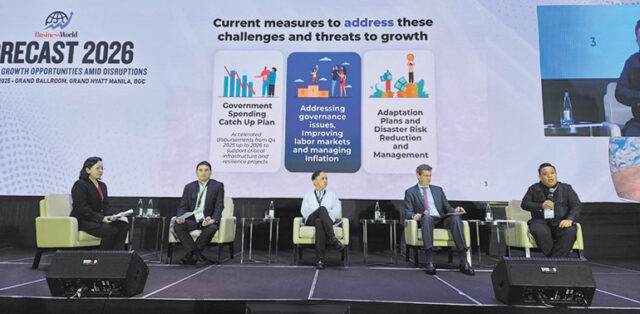
Panel Discussion 1 (L-R): BusinessWorld Editor-in-Chief Cathy Rose A. Garcia (moderator), Nicholas Antonio T. Mapa of Metrobank, Eduardo V. Francisco of BDO Capital, Andrew Jeffries of Asian Development Bank, and Assistant Secretary Neil Adrian S. Cabiles of the Department of Finance — Photos by J. Legaspi Computer Graphics

By Mhicole A. Moral, Special Features and Content Writer

The Philippines is set to enter 2026 with a measured outlook as economists and policy makers track signs of stable movement in key indicators. The ASEAN+3 Macroeconomic Research Office reported that the country’s domestic structure and access to varied export markets supported performance throughout 2025, even as trade tensions overseas created pressure across Asia. Gross domestic product for 2026 stands at 5.3%.

Macroeconomic prospects were among the discussions at the BusinessWorld Forecast 2026 forum held on Nov. 25 with the theme “Seizing New Growth Opportunities Amid Disruptions.” Government and private-sector panelists examined how the country can manage volatility while preparing for emerging challenges in the coming year.

Finance Assistant Secretary  said the government expects both positive and negative outcomes as it adjusts spending plans and works to boost economic confidence.

“We were able to address issues with a long-staged process of increasing funds and projects. [We have] a well-developed consumption. [However,] we have seen lower investment funds, so there is a slightly lower level of investment. What is concerning is that this is happening,” he said.

Department of Finance Assistant Secretary Neil Adrian S. Cabiles

Mr. Cabiles added that the government is taking steps to strengthen investor confidence by improving project selection, public spending performance, and policy stability. To keep projects on track, the Department of Finance revised its cash spending plan and accelerated public spending.

“We have revised the government spending cash plan. We have accelerated this [spending] from June 4, 2025, up to 2026, concentrating more on specific infrastructure. We are making sure that these are really good projects and that there is proper implementation for them,” he explained.

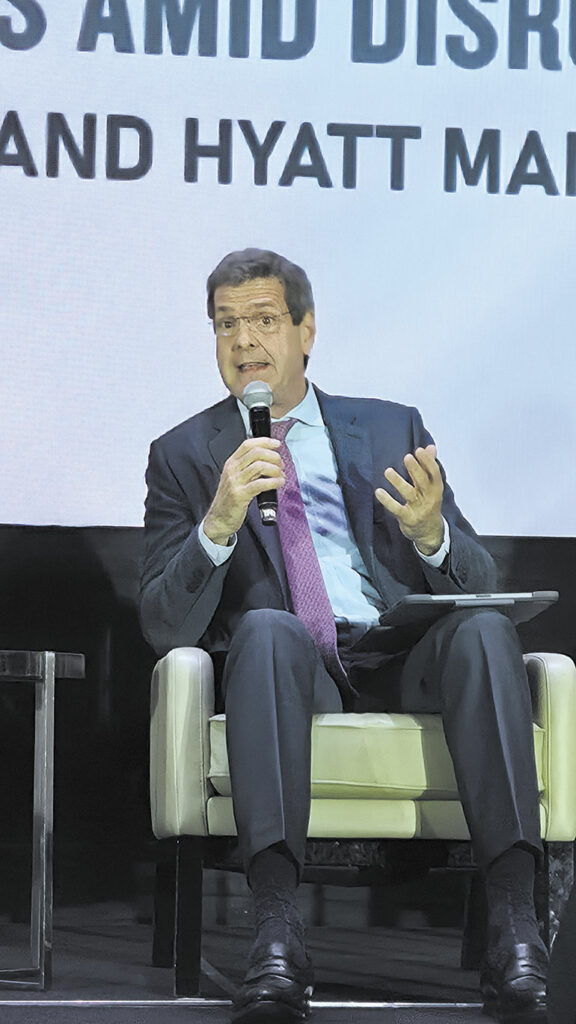
Andrew Jeffries, country director of the Asian Development Bank (ADB), said the Philippines started the decade as one of Southeast Asia’s fastest-growing markets. However, momentum slowed following recent controversies in flood control projects that delayed public works. The resulting drop in government spending affected overall economic growth, since public investment plays a major role in creating jobs and supporting supply chains.

Asian Development Bank Country Director for the Philippines Andrew Jeffries

“[Gross domestic product] growth was dragged down as a result of public investment, which has a big multiplier effect on the economy, both in the short term and long term. It has significantly slowed. So, where are we now? There are still a lot of tailwinds in this economy,” he said.

Despite these setbacks, household consumption, which accounts for roughly 70% of gross domestic product, remains strong. Low unemployment and steady remittances help families manage rising costs.

Mr. Jeffries also said the financial sector remains stable. Nonperforming loans, for instance, dropped from 3.3% in 2024 to 3.1% in 2025. Banks maintain capital levels above the 10% benchmark set by regulators. The country’s credit rating outlook remains intact, and fiscal consolidation is progressing as planned.

Similarly, Eduardo V. Francisco, president of BDO Capital & Investment Corp. (BDO Capital), noted that while overall growth is weaker than previous years, it remains workable. He described the economy as “gloomy,” influenced by foreign capital leaving the market and questions about long-term economic confidence.

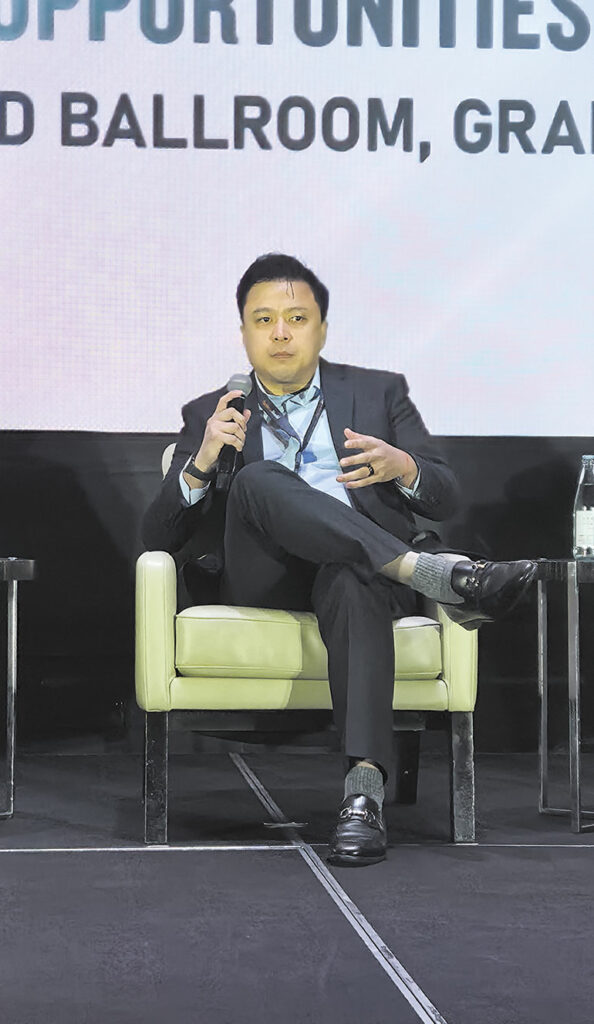
BDO Capital President Eduardo V. Francisco

“We see growth slowing, but it is manageable. At least, we are trying to adjust a bit because of seasonal differences. On the personnel side, I guess it is pretty depressing. With what is happening in the market, it is depressing for investors,” he shared.

Mr. Francisco explained that investors watch consumer spending closely because it shapes how the government responds with infrastructure and public investment. When households spend and companies invest, it creates pressure on the government to support activity with new projects.

“When people continue to invest and spend, the government will see that it needs to build infrastructure to support it,” he added.

Meanwhile, Nicholas Antonio T. Mapa, chief economist and markets strategist at Metropolitan Bank & Trust Co. (Metrobank), highlighted the need for stable prices as a foundation for economic growth. He said the Philippines remains highly dependent on household spending, and keeping prices in check is essential to sustaining the economy.

“Given that the Philippines is still heavily reliant on household consumption, price validity and keeping a check on price pressures will go a long way in ensuring that we can have at least a stable base for growth [moving forward]. So, once again, hopefully [the] government can double its efforts to keep prices stable on the supply side,” he explained.

He urged the government to strengthen efforts on the supply side to manage inflation. Proper price management, he noted, supports the Banko Sentral ng Pilipinas (BSP) toward appropriate monetary policy.

“If we do have price validity, this would give the central bank some room to provide support to the economy. And I think the BSP has done just that, implementing several rate cuts to try to support moderating growth momentum,” he added.

Metrobank Chief Economist and Markets Strategist Nicholas Antonio T. Mapa

Addressing tailwinds in economy

Fiscal multiplier, which economists refer to the additional economic activity, is viewed important as the government funds move through the economy.

Mr. Mapa explained that government projects support the fiscal multiplier as funds move through local businesses. Recent infrastructure spending, however, had limited impact because some projects were delayed or only partially executed.

“[A fiscal multiplier] has been sort of missing in the last few years, [allegedly] because these projects were never happening,” he said. “So, if we do figure this out, it will generate a fiscal multiplier, and then we can have more economic activity.”

Mr. Cabiles noted that the government is monitoring the multiplier effects of public projects and making strategic adjustments to ensure long-term benefits.

“Part of improving investment confidenceis the [oversight] that we have. We see that there has been some growth. We have improved more strategic measures in terms of this step, and the process of improving projects has also become more strategic, whether these projects have [significant] multiplier effects, and whether they are truly effective,” he added.

Consequently, Mr. Francisco emphasized that government spending could have a greater effect if funds are allocated more efficiently. He said accountability matters for market stability and expressed hope for stronger action from authorities.

“I want to see the government deliver that they are serious about addressing [corruption],” he emphasized.

Mr. Jeffries added that the government is adjusting its priorities across sectors while staying focused on long-term projects. Rules for public-private partnerships have been relaxed to encourage more investment from the private sector.

BusinessWorld Editor-in-Chief Cathy Rose A. Garcia moderated the panel discussion.

On the other hand, Mr. Francisco explained that local banks can finance long-term infrastructure projects with support from organizations like the International Finance Corp. and ADB, which have experience in guiding large privatizations.

“We have the liquidity and capacity,” Mr. Francisco said. “The challenge is getting more projects out into the economy.”

Labor concerns remain significant in the economy, according to Mr. Jeffries. While unemployment stays low, underemployment is high, hovering near 12%. Many of the jobs created are in the service sector and tend to be lower-skilled. Meanwhile, about a third of Filipino workers are employed in agriculture, which continues to face logistical difficulties and high transport costs.

The pandemic has also left lingering effects on the education system, which in turn affects workforce readiness.

“The pandemic left a scarred education system. There is a need for technical and vocational education, and reskilling will require businesses to take the lead because the training and skills that need to be developed [must meet the purpose of industry and workforce needs,” he explained.

The panelists added that climate risks, geopolitical tensions, and technological disruption all pose threats. Therefore, building a resilient economy requires integrating long-term planning and structural reforms.

Maharlika weighs IPO investments

PHILIPPINE STAR/KRIZ JOHN ROSALES

MAHARLIKA Investment Corp. (MIC), manager of the country’s sovereign wealth fund, is assessing possible investments in companies preparing to go public, although initial public offerings (IPOs) are not its immediate priority.

“We’ve looked at some IPOs. [It’s] a bit difficult because management teams are busy talking to all investors, so it’s hard for us to get the level of diligence we need before investing,” MIC Vice-President for Investments Kheed Ng told reporters on Tuesday.

“If I just buy stocks in the public markets, what impact do I make? If it’s primary capital to support a new facility or new road, then maybe we can consider it, even if it’s a public offering,” he added.

The Philippine stock market recorded only two IPOs this year: the P732.6-million listing of Cebu-based Top Line Business Development Corp. in April and the P34.3-billion debut of Maynilad Water Services, Inc. in November. These fell short of the Philippine Stock Exchange’s target of six IPOs for 2024.

China Bank Capital Corp. Managing Director Juan Paolo E. Colet said MIC’s possible participation in IPOs could help energize the local market.

“Given its limited capital, Maharlika should explore ways to magnify its impact,” he said, adding that MIC could invite other sovereign wealth funds and foreign institutions to co-invest in a separate, MIC-managed vehicle targeting “socioeconomically impactful IPOs and other equity transactions.”

He stressed the importance of strict selection criteria, including long-term prospects, good governance, and alignment with national development priorities.

MIC, created under Republic Act No. 11954, is tasked with managing the Maharlika Investment Fund and establishing its governance frameworks.

One of MIC’s latest initiatives is a partnership with the National Electrification Administration (NEA), the provincial government of Palawan, and Palawan Electric Cooperative, Inc. (Paleco) to help improve the province’s power distribution network.

The parties recently signed a memorandum of agreement to share technical expertise and pursue modernization of Palawan’s aging electrical infrastructure.

“Often hailed as the jewel of the Philippines, Palawan’s booming tourism has boosted both the local economy and our country’s global image. However, the island’s aged infrastructure has struggled to keep up,” NEA Administrator Antonio Mariano C. Almeda said during the signing.

Under the agreement, MIC will assess Paleco’s infrastructure and recommend cost-efficient upgrades, with potential investments depending on the results of the study. NEA will oversee technical requirements and implementation, while the provincial government will facilitate coordination and regulatory processes.

“We are here to diagnose the grid’s ailments with precision so that Maharlika can finance the modernization required to cure them,” MIC Chief Legal Officer Paul T. Salanga said.

MIC has previously invested in Synergy Grid & Development Philippines, Inc., a shareholder of the country’s sole grid operator, and Makilala Mining Co., Inc., a mineral exploration firm.

In its 2024 annual report, the fund said it is prioritizing projects in energy transition and security, physical infrastructure and innovation, food and agriculture, social infrastructure, sustainable resource development, and climate adaptation.

“We’ve got a pipeline that I think is quite robust,” Mr. Ng said. “In the next six months, you can expect some deals that the public will be quite happy with.” — Sheldeen Joy Talavera

MPTC raises P20B in bond sale to manage debt, fund projects

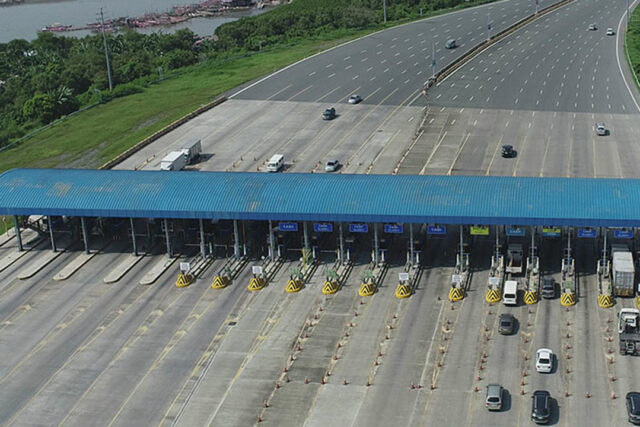
CAVITEX.PH

By Ashley Erika O. Jose, Reporter

METRO PACIFIC Tollways Corp. (MPTC) raised P20 billion from a fixed-rate bond sale to finance infrastructure projects and manage its ballooning debt.

“These bonds carry the credit rating [of PRS Aaa with a stable outlook] by PhilRatings (Philippine Rating Services Corp.), underscoring our commitment for consistent financial discipline… We remain committed to supporting the country’s economic growth,” MPTC President and Chief Executive Officer Gilbert F. Santa Maria said during the bond listing ceremony on Tuesday.

MPTC’s P15-billion fixed-rate bonds were oversubscribed by P5 billion. The offering was led by BPI Capital Corp. and First Metro Investment Corp. as joint issue managers, with BDO Capital & Investment Corp., China Bank Capital Corp., PNB Capital and Investment Corp., and Security Bank Capital Investment Corp. acting as joint lead underwriters and bookrunners.

The offer period ran from Nov. 17 to 21, with the bonds issued and listed on the Philippine Dealing and Exchange Corp. (PDEx) on Tuesday, Dec. 2.

MPTC, the tollways arm of Metro Pacific Investments Corp. (MPIC), is working to reduce its P200-billion net debt, the company said.

It also said that it intends to allocate net proceeds from the offering to partially finance investments in the construction and maintenance of the Manila-Cavite Expressway, Cavite-Laguna Expressway (CALAX), and Lapu-Lapu Expressway (LLEX), as well as to refinance bridge facilities and support other corporate purposes.

“When we acquired toll roads in Indonesia, we took loans. This one is supposed to extend the maturity of [MPTC’s] loans. This is part of the debt management program; [MPTC’s] net debt is around P200 billion,” MPIC Chief Finance, Risk, and Sustainability Officer Chaye Cabal-Revilla told reporters on the sidelines of the event.

She added that MPTC took loans for its $1-billion investment cooperation to acquire a 35% stake in PT Jasamarga Transjawa Tol (JTT), a major toll road operator in Indonesia.

“This bond deal was a way of reintroducing MPTC to the public capital markets, and the success of the offering bodes well for a future IPO,” China Bank Capital Corp. Managing Director Juan Paolo E. Colet said in a Viber message.

The bond sale is also expected to improve the company’s debt maturity profile and business prospects, he noted, saying this would support any merger plans or potential initial public offering (IPO) discussions.

“Many investors who bought the bonds appreciate the defensive nature of the tollways business, and we think the same narrative will drive positive sentiment toward the IPO,” Mr. Colet added.

For Globalinks Securities and Stocks, Inc. Head of Sales Trading Toby Allan C. Arce, MPTC’s P20-billion fixed-rate bond issuance strengthens the company’s balance sheet and is strategic as it paves the way for a potential merger with San Miguel Corp.’s toll road business.

“By refinancing short-term or bridge debt with long-tenor fixed-rate bonds, MPTC reduces refinancing risk, extends its maturity profile, and projects a cleaner, more stable financial position — all of which are essential for any large-scale corporate combination,” he said.

For Mr. Santa Maria, the company’s top priority is reducing debt while raising funds to complete ongoing projects.

“The plan to merge with San Miguel is far in the future. It is not immediately forthcoming… The debt is what we need to deal with. We have to raise money to pay down debt, extend maturities, finish CALAX, and get Lapu-Lapu Expressway started,” he said.

Last month, MPIC said it was revisiting plans to divest up to a 30% stake in MPTC to help reduce net debt.

The company previously said it aims to complete CALAX by 2026, while phase 1 of the Lapu-Lapu Expressway is expected to be finished by the fourth quarter of 2027.

MPTC is the tollways unit of MPIC, one of three key Philippine subsidiaries of Hong Kong-based First Pacific Co. Ltd., along with Philex Mining Corp. and PLDT Inc.

Hastings Holdings, Inc., a unit of the PLDT Beneficial Trust Fund’s MediaQuest Holdings, Inc., holds a majority stake in BusinessWorld through the Philippine Star Group, which it controls.

Beyond automation: Building AI-ready businesses and workforces

Panel Discussion 2 (L-R): BusinessWorld Corporate Editor Arjay L. Balinbin (moderator), Cong. Brian Poe Llamanzares of Global AI Council Philippines, Marco de la Rosa of Kearney, and Ambe C. Tierro of Accenture Philippines — Photos by J. Legaspi Computer Graphics

By Krystal Anjela H. Gamboa

The conversation about artificial intelligence (AI) is no longer for technologists; it’s a boardroom, a small-business, and a government conversation.

For the Philippines, a country with a strong services sector, a fast-growing digital economy, and millions of micro, small, and medium-sized enterprises (MSMEs), integrating AI into business operations offers an opportunity to boost productivity, improve customer experience, and create new revenue streams.

Such opportunities were explored in the second panel discussion of BusinessWorld Forecast 2026, which gathered a policy maker, a global management consultancy executive, and a professional services head to tackle the topic “AI Unleashed: Moving from Adoption to Integration.”

Congressman Brian Poe Llamanzares, who is also the chairman of Global AI Council Philippines, highlighted the need to bridge MSMEs closer to tapping the potentials of AI.

“AI is making it much easier for people to manage their businesses,” Mr. Llamanzares said. “But if you look at our MSMEs, which is 90% of our economy, how many of them have already been able to adapt AI and have we been helping them take advantage of what AI is available?”

For Philippine businesses, AI tools are found to translate into tangible benefits. Automating repetitive administrative tasks eases employee to focus on higher-value work. In labor-intensive industries, even modest productivity improvements can have large economic effects.

Also, AI-driven personalization and 24/7 conversational interfaces can raise customer satisfaction for e-commerce, finance, travel, and business process outsourcing services — sectors where Filipino companies often compete on speed and service quality.

Chairman of the Global AI Council Philippines Cong. Brian Poe Llamanzares

Furthermore, data-driven forecasting for inventory, demand, and finance helps reduce waste and increase margins — vital for retail, logistics, and agriculture. AI also enables services such as risk-based lending, personalized health advice, predictive maintenance, and targeted marketing.

These combined benefits position AI as a transformative force capable of reshaping industries across the country.

“If we can improve the adoption rate of MSMEs to AI technologies and upskill small business owners, then we’re taking a step in the right direction,” Mr. Llamanzares stated.

However, seizing AI’s potential requires bridging capability gaps in data, talent, connectivity, and governance.

“Corporations are already putting in place for the regulation internally, but the government should be able to support,” Mr. Llamanzares noted.

AI integration roadmap

Philippine companies can adopt AI through structured and incremental planning, the panel agreed. A business should begin by clarifying objectives, identifying specific problems that AI can solve.

After the goals are set, the organization must assess data readiness, ensuring that information relevant to the chosen problem is available, accessible, and of reliable quality. Next would be a launch of a small AI pilot project rather than deploying a full-scale system immediately. Pilots reduce risk and help determine whether the solution genuinely produces measurable returns.

Kearney Senior Partner and Philippines Country Head Marco
de la Rosa

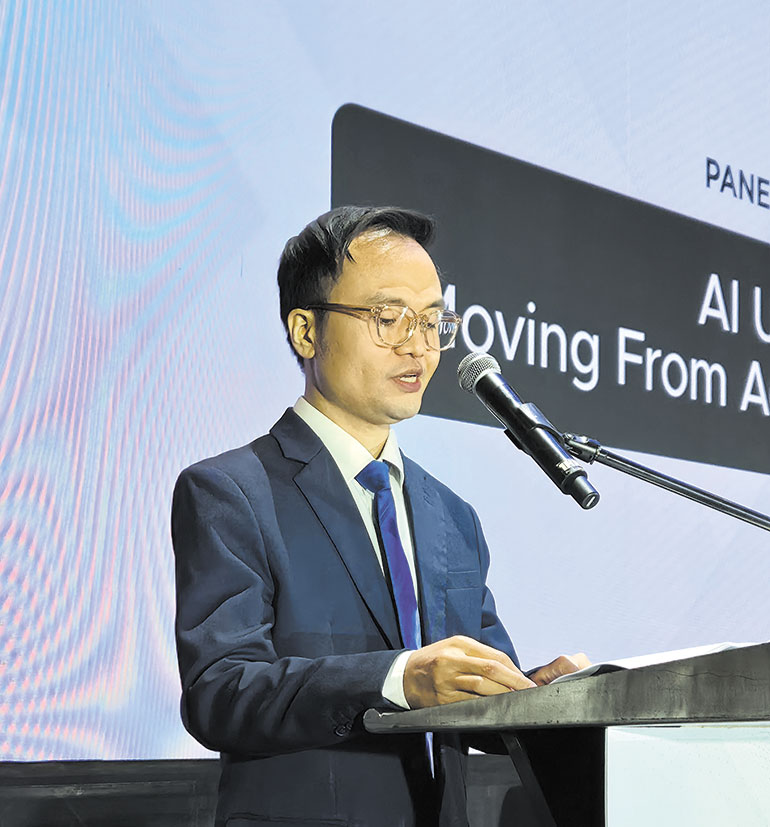
Kearney Senior Partner and Philippines Country Head Marco de la Rosa addresses the hurdle: “The challenge is that the short-term piece works from an adoption standpoint; but from a creation standpoint, that’s a longer term-play. We can’t be seen as being left behind.”

Adoption must follow a cycle of measurement and improvement. Such act is not a one-time installation but an ongoing organizational capability.

Reskilling for inclusion

The panel also noted that AI adoption will not replace workers but instead will create new roles, such as data engineers and AI product managers, while transforming existing ones. For the Philippines, where many workers are in services and MSMEs, the policy and corporate response should highlight the need for education.

“It’s a matter of educating the MSMEs of not just the availability, but the business viability of these,” Mr. de la Rosa said. “I think part of the adoption trick is having the conversation to say, ‘How do you run your business today?’”

Such education is suggested to be focused on AI-in-business literacy, AI tools usage, and domain-specific model applications. Furthermore, on-the-job training programs with industry partners and universities will enable employees through real-life application. Additionally, inclusive reskilling for frontline workers in human-centered skills, such as communication and complex problem solving, that complement AI shall ease the burden.

Equally important is ensuring that AI adoption does not result in workforce alienation or fear of replacement. Companies should proactively communicate the benefits of AI, emphasizing augmentation rather than automation-driven redundancy.

When paired with reskilling opportunities, AI can create pathways for employees to transition into analytical or supervisory roles rather than be displaced.

Companies that plan for reskilling will preserve institutional knowledge and reduce social friction from automation.

“We can scale training fast. In some ways, it’s cheap, it’s free,” Country Managing Director for Accenture Philippines Ambe C. Tierro noted.

Accenture Philippines Country Managing Director Ambe C. Tierro

Data, ethics, and regulation

With new ideas entail worries; in the context of AI, security risks arise.

“[Companies should have] a responsible AI framework outside policies, even if the country doesn’t have a policy yet,” Ms. Tierro highlighted.

As Philippine businesses adopt AI, they also must uphold ethical standards and legal responsibilities. Compliance with Data Privacy Act is non-negotiable, as businesses must obtain clear consent from users, protect personally identifiable information, and adopt security measures appropriate to the data they handle.

Explainability is another pillar of responsible AI use. In sectors such as finance, healthcare, hiring, and education, decisions must be understandable and renewable rather than treated as checklists. Additionally, business must recognize cybersecurity threats unique to AI, such as data-poisoning attacks and model theft.

AI security should therefore be incorporated into a company’s overall cybersecurity framework rather than as a separate concern.

Common risks not only include data breaches, it also involves unrealistic expectations, model failures, vendor lock-in, and social pushback.

“You can’t really stop people from using AI,” Mr. de la Rosa reminded. “So, make the capabilities available first, and then put the guardrails around it.”

BusinessWorld Corporate Editor Arjay L. Balinbin moderated the panel discussion.

Cultural and organizational change

In Filipino workplaces, where hierarchy and personal relationships matter, adoption succeeds when leaders visibly champion AI and when teams feel supported.

“Tech, talent, and trust. These are the fundamentals and the foundations of a scalable AI. Always lead with value,” Ms. Tierro advised.

Employees should be trained early on how AI tools will alter workflows, and management should create a supportive environment where questions, mistakes, and experimentation are welcomed.

Moreover, organizations should promote cross-functional collaboration by forming teams that include both technical specialists and frontline workers to ensure AI serves real needs and is not imposed from top down.

If implemented at scale, AI-driven productivity could boost economic growth, expand digital employment opportunities, and strengthen the Philippines’ global relevance — but only if done with realistic goals, proper investments in data and talent, ethical guardrails, and inclusive policies.

The challenge for leaders is to translate technical possibility into practical business value while ensuring growth is responsible and shared.

For Mr. Llamanzares, the stakes are high: “In the coming years, if we see a high adoption rate and an environment that’s conducive to the growth of AI, I’d say we’re in the right track.”

With pragmatic pilots, steady investment in people and governance, and a policy environment that supports innovation and protection, Filipino businesses can harness AI not just as a tool, but as a catalyst for sustainable, inclusive growth.

Reissued seven-, 10-year bonds fetch lower rates

BW FILE PHOTO

THE GOVERNMENT made a full award of the dual-tranche Treasury bonds (T-bonds) it auctioned off on Tuesday at lower rates amid strong demand amid improved market sentiment after S&P Global Ratings affirmed the Philippines’ investment-grade rating.

The Bureau of the Treasury (BTr) raised a combined P35 billion as planned via its dual-tenor offering of bonds as total demand reached P125.623 billion or over three times the amount placed on the auction block.

The government fully awarded both tranches as the bonds fetched average yields that were below those quoted for the papers when they were last reissued and prevailing secondary market rates, the Treasury said in a statement.

Broken down, the Treasury borrowed the programmed P20 billion via the reissued seven-year bonds with a remaining life of two years and four months, with total bids reaching P59.776 billion or nearly thrice the amount offered.

This brought the total outstanding volume for the bond series to P396.4 billion, the BTr said.

The seven-year bonds were awarded at an average rate of 5.256%, with accepted yields ranging from 5.25% to 5.259%. This was 44.2 basis points (bps) lower than the 5.698% fetched for the series’ last award on Oct. 7 but was 163.1 bps above the 3.625% coupon for the issue.

The average yield was also 8.4 bps lower than the 5.34% quoted for the three-year bond, or the benchmark tenor closest to the remaining life of the papers on offer, and 1.9 bps below the 5.275% fetched for the same bond series at the secondary market before Tuesday’s auction, based on PHP Bloomberg Valuation Service (BVAL) Reference Rates data provided by the BTr.

Meanwhile, the government also raised P15 billion as planned via reissued 10-year bonds that have a remaining life of nine years and four months as the tenor attracted P65.847 billion in tenders or more than four times the amount auctioned off.

This brought the outstanding volume for the bond series to P492.6 billion, the Treasury said.

The 10-year debt papers were awarded at an average yield of 5.876%, with accepted bids carrying rates of 5.855% to 5.88%. This was 1.8 bps below the 5.894% average quoted for the same bond series when they were last sold on Nov. 4 and 49.9 bps lower than the 6.375% coupon for the issuance.

The average yield was also 7.1 bps lower than the 5.947% seen for the 10-year debt and 1.2 bps below the 5.888% fetched for the same bond issue at the secondary market before the auction, PHP BVAL Reference Rates data showed.

Rizal Commercial Banking Corp. Chief Economist Michael L. Ricafort said the government fully awarded its T-bond offer as rates for both tenors went down amid strong demand, with S&P’s latest rating action boosting market sentiment as this could potentially lead to lower borrowing costs.

S&P last week affirmed its long-term “BBB+” and short-term “A-2” credit ratings for the Philippines as well as its “positive” outlook as it sees the country’s long-term growth remaining strong despite the ongoing flood control graft scandal.

Appetite for the offer was strong as this was the BTr’s last bond offer for the year, with no more large borrowings expected before the yearend, he said, adding that volatility in the stock and foreign exchange markets may have caused investors to flock to safer assets like government debt.

Mr. Ricafort said that prospects of further policy easing from both the Bangko Sentral ng Pilipinas (BSP) and the US Federal Reserve also helped bring yields down.

BSP Governor Eli M. Remolona, Jr. has said that a fifth straight 25-bp cut is possible at the Monetary Board’s Dec. 11 policy meeting, with further reductions until next year also on the table, as they want to support the Philippine economy amid weakening growth prospects as a graft scandal involving state flood control and infrastructure projects has dented investor confidence.

The Philippine central bank has lowered benchmark interest rates by 175 bps since it began its easing cycle in August 2024, with the policy rate now at 4.75%.

Meanwhile, markets widely expect a second straight reduction at the Fed’s Dec. 9-10 meeting, but the policy outlook for next year as the state of the US economy remains fragile.

The BTr wants to raise P101 billion from the domestic market this month, or P66 billion in Treasury bills and P35 billion in T-bonds.

The government borrows from local and foreign sources to help fund its budget deficit, which is capped at P1.56 trillion or 5.5% of gross domestic product this year. — Katherine K. Chan

Integrity, digital skills key for future business leaders — GESG

RAY SILVESTRE N. CANILAO

By Sheldeen Joy Talavera, Reporter

THE NEW GENERATION of business leaders must be technology-savvy, values-driven, and possess integrity to help steer the country toward progress and prepare for future challenges, according to top executive recruiter Global Executive Solutions Group (GESG).

“They have to be technology-driven. That’s the skills side. Half of it consists of skills that can be learned. You can study; you can do it on the job. But leaders, in the next 20 years, have to uphold the same values,” GESG President and Chief Executive Officer Ray Silvestre N. Canilao said in an interview with BusinessWorld.

With the evolving industry landscape, he said today’s leaders should guide organizations through digital transformation while addressing sustainability pressures.

“If there’s a strong leader, he will bring about competition in that industry. And competitors will look at the company as a model, and they will start to innovate themselves,” Mr. Canilao said.

He added that strong corporate leadership is essential for national economic progress, as it fosters stability, growth, and job creation.

“Whenever there’s competition, there’ll be growth… If we are led by strong leaders, different industries will prosper, because strong leaders bring about positive effect… It affects the industry, and finally, it affects the economy,” he said.

While technical skills are crucial, the chief headhunter emphasized that the foundation of leadership lies in compassion, empathy, and integrity.

“What’s the secret? It’s really integrity. Of course, at any given time, there’s always [a need] for hard work. There has to be a positive attitude. But what will seal everything will be integrity,” he said.

Founded in 2005, GESG is a Philippine-based executive search firm specializing in recruitment across various industries, particularly fast-moving consumer goods, transportation, logistics, and supply chain management.

“Maybe the confidence, the trust was built over the last many years. But at the same time, we’ve delivered good candidates. We’ve filled up positions not only for the short term, but for the medium and long term,” Mr. Canilao said.

He noted that GESG’s two decades of experience are grounded in deep industry knowledge and long-term relationships. Beyond recruitment, the company takes time to understand various organizational aspects — from culture to career trajectories.

Unlike most headhunters, the firm goes beyond resumes, focusing on personality, motivation, and leadership chemistry, he said. It uses a five-point model to identify candidates who can deliver on clients’ visions and match leaders with companies aligned to their values and preferences.

The firm’s executive search process is guided by five key dimensions: culture fit, career path strategies, leadership style, financial stability, and work-life balance, he noted.

“There has to be enough chemistry. There has to be enough respect,” Mr. Canilao said. “Because at the end of the day, you will be successful if you believe in your leader. You will be successful if the leader believes in your capability and skill.”

Matching leaders with suitable organizations is never easy, as filling senior-level positions can take anywhere from three months to a year.

“At the end of the day, it is very important for us that the candidates that we placed… sustain, grow the business, and generate profitability. So then this company can expand, employ people, be competitive, and drive innovation,” Mr. Canilao said.

Looking ahead, he said industries such as infrastructure, financial technology, and e-commerce are expected to drive demand for top executive roles.

Batang Poz sequel highlights how teens face HIV

THE LATEST release by author Segundo Matias, Jr., titled Stigma: Mga Batang Poz 2, offers a glimpse into the lives of young Filipinos living with HIV/AIDS (human immunodeficiency virus/acquired immunodeficiency syndrome).

As a sequel to his 2018 novel Mga Batang Poz, it enters territory regarding the sensitive issue that hasn’t been explored before — such as available treatments and stories of women living with HIV.

In the sequel, the four “poz” (HIV-positive) teens from the first book are joined by a new character, 15-year-old Melody, as they try to navigate their health condition in a conservative Philippines.

Mayroon akong na-encounter na 15-year-old na magpapa-test ng baby niya kasi may HIV siya (I had encountered a 15-year-old who was going to have her baby tested because she had HIV), so that inspired me to write about her,” he said at the book launch on Nov. 28.

This led to the character of Melody, who serves as the “thread” connecting the stories of the four teens from book one to her own. Though she was already in early drafts of the first book, Mr. Matias opted to shelve the character for the moment given that over 90% of HIV cases in the Philippines were male.

“I think it is very timely as well that the female character is included in book two. Compared to males, there are fewer women getting HIV, but the number is increasing — and that translates to newborns who are infected with the virus,” said Dr. Rosanna Ditangco, HIV research program head of the Research Institute for Tropical Medicine, at the panel discussion at the book launch.

“In the past, it was rarely seen, but now it’s not uncommon. If you look at statistics, there are newborn babies who are reportedly getting HIV every month, so this is very relevant not only for teenage pregnancy, but for women in general,” she added.

As a follow-up to Mga Batang Poz, which tackled the anxiety and fear of possibly having HIV, the narrative in Stigma differs by zeroing in on how these teenagers face their reality and the judgment of society. It begins with Melody joining a group chat that serves as a digital refuge for young people like her, where she meets Luis, Enzo, Gab, and Chuchay.

A RISE IN CASES
As of this year, the Philippines has reported having the fastest-growing number of HIV cases in the Asia-Pacific region. It went up by 550%, from just 4,400 in 2010 to 29,600 in 2024, which also speaks to increased awareness with more people getting tested.

In line with this situation, Stigma: Mga Batang Poz 2 aims to “challenge prejudice and call for compassion in the age of social media and digital connection.”

The first Batang Poz novel inspired a 2019 iWant miniseries starring Paolo Gumabao, Mark Neumann, and Awra Briguela. Mr. Matias said that he’s open to seeing the sequel adapted as well, be it on TV or even theater.

He explained that, for the first book, what drove him to write was the fact that he knew nothing about the reality at first, citing a memory of walking into a Department of Health facility and seeing the poz teens wear masks or hoodies to conceal their identities.

Kaya siguro mas nasulat ko pa ito lalo ay dahil wala akong nalalaman. (I guess I was really able to write about this because I didn’t know anything),” he said. “It pushed me to study the issue and handle it with sensitivity.”

The sequel’s completion and release was also delayed by the coronavirus pandemic. He had consulted with Dr. Ditangco and concluded that people were still preoccupied with another virus and would not be ready to hear more about HIV/AIDS.

After polishing the manuscript, Mr. Matias ensured that it would have “deeper and more technical discussions” compared to the first book.

“In Stigma, I made it a point to provide clear guidance on staying safe. I want to highlight the importance of PrEP (pre-exposure prophylaxis) as treatment and consistently advocating condom use for protection,” he said. “While the first book conveyed the horrors surrounding HIV, the second installment focuses on empowerment and dismantling stigma.”

THE POWER OF STORYTELLING
Danvic Rosadiño, head of programs and innovations for nonprofit organization LoveYourself, stressed the need for factual information regarding HIV/AIDS. (LoveYourself offers care, testing, and treatment for people living with HIV or PLHIV.)

“Social media has the great power to change the flow of information, but with great power comes great responsibility,” he said. “We have to be careful about what we post. It’s a major factor in destroying stigma in this day and age.”

He added that dismantling stigma will also encourage the approximate 40% of people who have not been tested for HIV. “Mas marami pa tayong matututunan at matutulungan doon sa pwede pang magpa-test (We still have a lot to learn and to help from those people who have yet to be tested).

Award-winning screenwriter and National Artist for Film Ricky Lee graced the launch and shared how fiction like Stigma fosters empathy, compared to social media where people tend to judge quickly.

Sa nobela, sa pelikula, dahil mahaba ‘yong tinatakbo ng kwento, natututo tayo na ‘wag mag-judge agad. Natututo tayong makipamuhay sa mga karakter at maintindihan sila. (In novels and films, because of the length of the narrative, we learn how not to judge right away. We learn how to live with the characters and understand them),” he said.

Matuto tayong magkaroon ng empathy at makilala sila bilang mga tao kagaya natin (Let us learn to have empathy and get to know them as people like us).”

Segundo Matias, Jr.’s Stigma: Mga Batang Poz 2 will be available soon. It is published by Lampara Books. — Brontë H. Lacsamana

FinTech Alliance PH plans data-sharing initiative to curb online lending risks

STOCK PHOTO | Image by terimakasih0 from Pixabay

FINTECH ALLIANCE PH is planning to launch a data-sharing initiative next year among industry players that focuses on monitoring borrowing behavior and possible fraudulent activity in real time as online lending platforms (OLPs) continue to gain traction.

“There is no intelligence sharing yet. In fact, we are now in serious discussions about that in the industry. Of course, we want to start with the big players, especially GCash or Maya, because they’re also into lending, and then eventually, the banks,” FinTech Alliance.PH Chairman and Rizal Commercial Banking Corp. Executive Vice-President and Chief Innovation and Inclusion Officer Angelito “Lito” M. Villanueva told reporters on the sidelines of an event last week.

“Until now, there’s no such mechanism. That’s why, as an industry,… it has to have industry-led fraud intelligence sharing and also being able to detect real time. ‘Is this the same person who applied to me? At this very second, he’s applying with us.’”

The group is looking to pilot the initiative with five players and is eyeing to come up with a final framework by 2028.

This will help protect both online lenders and the borrowing public as it will help manage risks faced by the industry such as high default rates, he said.

“We’ve been telling SEC (Securities and Exchange Commission) that there’s still no mechanism by which we can detect, for example, a Juan dela Cruz applying with 10 mobile apps or 10 online lending apps simultaneously,” Mr. Villanueva said.

“There’s no way to detect whether who is applying with the 10 online lending apps and what if out of the 10, six approve you? So, the problem starts now when the borrower is overextended or overleveraged and can no longer repay the amortization… So, that’s where the problem is. I will now default on my payments. So, that’s why we have to protect the industry.”

With these high-risk borrowers being made up of many new-to-credit individuals, existing credit information sharing rules may not be enough to monitor potentially risky borrowing behavior, he said.

“You just see your credit score, but you don’t know who is applying to you, because the credit information comes after the fact… But in real time, you won’t see who is applying.”

Mr. Villanueva said establishing an intelligence-sharing framework is essential, especially rules on data access and reciprocity, so that companies will be encouraged to join. “You don’t want to share your good customers, but you want to share with your bad customers… Of course, there’s competition, right? You don’t want to share the information because what if they pay back their loans on time?”

This can also improve fraud monitoring, he added.

“There are quite a few countries doing this. But it has to be proactive… There are a lot of these emerging technologies that could be used for good, but the thing is, the bad actors can utilize it much faster than industry. So, the ultimate loser would be the customers. Even in this regime of deepfakes and social engineering, the poor customer wouldn’t be able to have that knowledge or that expertise to even distinguish what is true and what is not.”

This will go hand in hand with ongoing efforts to protect consumers from predatory lending practices, Mr. Villanueva said, citing the SEC’s draft circular proposing to cap the interest rates and fees charged by OLPs.

“The whole idea is how to protect our consumers. And in fact, for FinTech Alliance, we already expelled at least four online lending companies for unethical collection practices.” — A.M.C. Sy

ADVERTISEMENT
ADVERTISEMENT