Home Blog Page 591

Sun Life Philippines targets to stay as top life insurer as it invests in growth
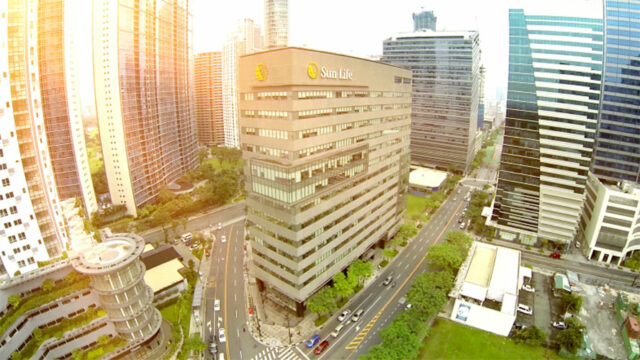
SUNLIFE.COM.PH

SUN LIFE of Canada (Philippines), Inc. (Sun Life Philippines) targets to keep its spot as the top life insurer in the country despite weakening economic prospects.

“We’ve been through all the market volatility and geopolitical risks. It’s just how we manage, how we navigate through those challenges… No one ever expected that there would be a flood control issue, right? But it happens. So, you just have to be ready,” Sun Life Philippines Chief Executive Officer and Country Head Benedict C. Sison told BusinessWorld.

Asked if he expects the company to stay on top of the sector, he said: “Definitely, I think with the way it’s looking. The first nine months results have been out.”

Sun Life Philippines booked a premium income of P44.73 billion in the first nine months of 2025, ranking first in the industry. The company said this was driven by its improved services and expanded offerings.

“We will really work hard to keep it. But for us, it’s not really the competition, it’s the clients. My belief is so long as you focus on your clients, you give them the best service, et cetera, they’ll choose you. And when they choose you, they’ll choose you over the competition. And when they choose you over the competition, you’ll sustain your number one position. So, we’re not here to fight the competition — we’re here to take good care of our client positioning,” Mr. Sison said.

He said they expect to book double-digit growth between 10% and 20% in premium income next year by building on their gains and ramping up their investments in digitalization and their advisors.

He added that the life insurance sector remains “optimistic” on growth prospects for the coming year.

“As you know, the competition is moving quickly into the digital space, so we’re also moving quickly in implementing our digital capabilities, not only to be at par with the competition, but also to lead the digital space in the life insurance industry. That’s the thing that we’re investing in this year, so we’ll continue what we’ve done,” Mr. Sison said.

The company has also tweaked its offerings to include more traditional products than variable universal life insurance (VUL) products amid changing market demand.

“I would say pre-pandemic, we were 90% VUL. Now, we’re about 50-50 traditional and VUL. It has moved really gradually, and that’s all because of the underlying fund performance of VUL products. Clients have shifted towards traditional products and we cater to that need… We’ve developed a lot of new products this year, so we will continue that,” Mr. Sison said.

He added that they expect sustained demand for both kinds of products next year as well as their global fund offerings, especially amid the volatility in domestic markets due to corruption concerns.

“We’re not only focused on the Philippine market, we’re focused on the global market. We do have global funds. And if you’ll compare it, it’s more stable. It has better returns. So we offer both.”

The life insurance industry posted a combined premium income of P299.45 billion in the first nine months of 2025, up 13.77% from P263.21 billion in the comparable year-ago period, data from the Insurance Commission showed.

Variable life premiums rose 15.96% to P198.36 billion, while traditional life premiums went up by 9.71% to P101.09 billion. New business annual premium equivalent climbed by 11.49% to P55.13 billion.

The sector’s combined net income also increased by 7.65% year on year to P30.95 billion in the period. — Aaron Michael C. Sy

2025: The year Filipinos crashed out

STOCK PHOTO | Image from Freepik

For many Filipinos, 2025 has proven to be one of the most memorable and consequential years in modern Philippine history — mostly in a bad way. The arrest and incarceration of former President Rodrigo R. Duterte in March was a huge step forward toward accountability and transitional justice in the country. However, much of this year was still characterized by uncertainty and instability. The 2025 national budget was flagged for irregularities and blank items, leading to questions regarding “pork barrel” allocations and a demand for answers surrounding cuts to critical sectors such as education and healthcare.

Meanwhile, another chapter in the Marcos-Duterte feud was written through the impeachment of Vice-President Sara Duterte in February. However, the expected trial suffered a series of legal and political setbacks ultimately leading to the barring of impeachment proceedings until February of next year. The 2025 midterm elections, viewed by many as a battleground between the two political camps, reaffirmed the dominance of political dynasties and patronage politics in the Philippine political system despite reformist victories and notable upsets (for example, Cynthia Villar and Gwendolyn Garcia).

The rather lackluster midterm results for the sitting administration led to the reshuffling of the entire Marcos Cabinet given it was a referendum for the incumbent government. Although President Ferdinand R. Marcos, Jr. retained much of his Cabinet, particularly the economic team, several officials were dismissed due to “underperformance,” while some were reassigned to new posts (for example, Vince Dizon and Raphael Lotilla). Not long after Marcos delivered his State of the Nation Address, he held a press conference ordering an investigation into the country’s flood control projects.

Since “opening the floodgates,” several government officials, including congressmen, senators, Cabinet members, as well as rank-and-file officials have been implicated in the controversy due to conflict of interest or for allegedly having received kickbacks. In addition, many contractors and firms have been heavily scrutinized and blacklisted for their involvement in substandard and “ghost” infrastructure projects. These were met by intense public backlash, with a series of mass demonstrations organized by civil society coalitions across the country, notably on Sept. 21 and Nov. 30, calling for substantial political reform as well as the resignation of Marcos and Duterte. Amidst the protests, rumors of plans for a civilian-military junta surfaced, although these were quickly shut down by the administration as well as by the military leadership.

At present, implicated officials continue to be summoned by the Independent Commission for Infrastructure (ICI) for their alleged involvement. In connection with this, many are calling for increased transparency from the ICI regarding their sessions with these individuals, while some are calling for the ICI to be given prosecutorial powers. Protest organizers have also warned that they would stage future demonstrations should there still be no meaningful accountability for the masterminds of the flood control controversy. Finally, with the year coming to a close, Malacañang has promised stronger oversight over the 2026 budget, with the palace urging lawmakers to hasten its passage to avoid the scenario of a re-enacted budget for next year.

Given this series of events, it can be argued that 2025 has been an annus horribilis (horrible year) for the Philippines. Continued mudslinging and finger-pointing among officials, fighting between the Marcos and Duterte camps, and the ongoing flood control fiasco — arguably the largest and most wide-reaching corruption scandal in Philippine history that seemingly has yielded few results — have further fractured public trust in our institutions. Unlike previous corruption scandals, the flood control saga has significantly resonated more with Filipinos on a personal level. Public interest in the matter peaked during the usually devastating typhoon season in one of the world’s most vulnerable countries to climate change. It is also tangible, seen and felt, be it in the casualties of countless typhoons, the loss of property during flooding and landslides, as well as the unconstructed, unfinished or substandard infrastructure projects. Essentially, the momentum with this year’s sociopolitical developments has brewed up a perfect storm for dissent and mobilization.

Widely held popular sentiments of political betrayal and mass economic frustration are not unique to the Philippines this year. Across Southeast Asia and beyond, citizens have conveyed renewed contempt for political systems that historically have favored elite interests over the public welfare, contributing to the growing tide of anti-establishment sentiment that has gripped the international community in the wake of the COVID-19 pandemic. Our Indonesian, Thai and Timorese neighbors have expressed similar outrage, be it over excessive monthly housing allowances for Indonesian lawmakers, a leaked phone call between Thai Prime Minister Paetongtarn Shinawatra and Cambodian Senate President Hun Sen regarding the Thai-Cambodian border crisis, to backlash over a controversial proposal to purchase 65 new vehicles for members of Timor-Leste’s National Parliament. Beyond our region, Nepal was successful with its youth-led anti-corruption protests that led to the ouster of Prime Minister K. P. Sharma Oli and his government. All of these show that citizens no longer tolerate “business as usual” arrangements that have only served to push them further down into the economic dustbin in favor of enriching the political and economic elite.

The Philippines stands at a crossroads as it enters 2026. With the Marcos administration well into its second and crucial half, no doubt it will try its hardest to declare the end of the country’s annus horribilis with the goal of preventing a Sara Duterte victory in the long term. However, public distrust has never been greater. In addition to current events, the cost of living continues to soar, compounded by stagnant wages. Flood control will continue to be a lingering talking point into the next year, while Filipinos anxiously wait for the next set of political calculus to be laid out for VP Sara’s impending impeachment trial. The “canon events” of the roller coaster that is 2025 offer us a glimpse into the next year. Unless societal issues are meaningfully addressed and the masterminds of our crises are fully held accountable, 2026 may very well become a continuation of the rollercoaster of events — that is, a never-ending cycle of crisis and survival that keeps Filipino society in a constant state of crashing out.


Vincent Carlo L. Legara is a lecturer at the European Studies Program and the Department of Political Science of the Ateneo de Manila University. He is also a junior political risk and security analyst at Polysentry.

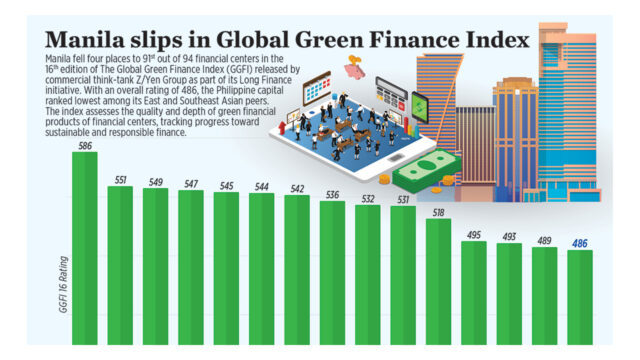
Manila slips in Global Green Finance Index

Manila fell four places to 91st out of 94 financial centers in the 16th edition of The Global Green Finance Index (GGFI) released by commercial think-tank Z/Yen Group as part of its Long Finance initiative. With an overall rating of 486, the Philippine capital ranked lowest among its East and Southeast Asian peers. The index assesses the quality and depth of green financial products of financial centers, tracking progress toward sustainable and responsible finance.

Manila slips in Global Green Finance Index

Volatility to continue before Fed, BSP decisions

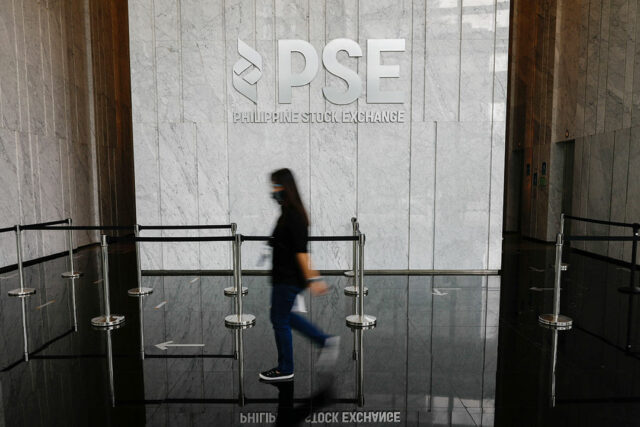
The lobby of the Philippine Stock Exchange in Taguig City, Sept. 30, 2020. — REUTERS

PHILIPPINE SHARES may see continued volatility this week before the policy meetings of the US Federal Reserve and the Bangko Sentral ng Pilipinas (BSP), which investors will monitor for potential forward-looking statements.

On Friday, the Philippine Stock Exchange index (PSEi) climbed by 1.04% or 61.64 points to end at 5,949.22, while the broader all shares index rose 0.55% or 19.03 points to close at 3,477.68.

Week on week, however, the PSEi decreased by 73.02 points from its 6,022.24 close on Nov. 28.

Analysts said Friday’s rebound was driven by the slower-than-expected November Philippine inflation print, which bolstered BSP rate cut hopes.

However, Philstocks Financial, Inc. Research Manager Japhet Louis O. Tantiangco noted that the PSEi failed to return above the 6,000 mark.

“Seemingly, the market is not yet prepared to take the said level as worries over the local economy hinder investors’ confidence from building up further,” he said in a Viber message.

For this week, the focus will be on the Fed’s policy meeting on Dec. 9-10 and the BSP’s own review on Dec. 11, he said.

“Hopes of easing by both central banks may help the market bounce back. However, investors are also expected to monitor the movements of the peso. A further decline against the US dollar may weigh on the local bourse,” Mr. Tantiangco said.

A BusinessWorld poll showed that 17 of 18 analysts expect the Philippine central bank to deliver a fifth straight 25-basis-point (bp) reduction at the Monetary Board’s meeting on Thursday (Dec. 11) to bring the policy rate to 4.5%, its lowest since September 2022.

The BSP has cut benchmark borrowing costs by a total of 175 bps since it kicked off its easing cycle in August 2024. BSP Governor Eli M. Remolona, Jr. earlier said that weakening growth prospects raise the chances of an easing move this week.

Meanwhile, an interest rate cut is all but priced in at the Fed’s meeting this week, but a divided committee makes for a wild card, Reuters reported. Analysts expect a “hawkish cut,” where the language of the statement, median forecasts and Chair Jerome H. Powell’s press conference point to a higher bar on further rate reduction.

Mr. Tantiangco added that the market will wait for the release of the latest foreign direct investments data and labor force survey that could give more clues on the state of the Philippine economy.

He put the PSEi’s trading range this week from 5,800 to 6,000.

Meanwhile, Rizal Commercial Banking Corp. Chief Economist Michael L. Ricafort put the PSEi’s immediate resistance at the 6,000 psychological mark and immediate major support at 5,785-5,850.

For its part, online brokerage 2TradeAsia.com said holiday liquidity and window dressing could boost market activity. “[Ultimately], we reiterate that this is a season of volatile and directionless spirits,” it said.

It placed the PSEi’s immediate support at 5,800 and resistance at 6,000, with secondary resistance at 6,100. — A.G.C. Magno with Reuters

House bill eyes higher tax exemption for Filipino workers amid rising prices

PEOPLE SHOP for food items inside a supermarket in Quezon City on Jan. 16, 2023. — PHILIPPINE STAR/MIGUEL DE GUZMAN

By Kenneth Christiane L. Basilio, Reporter

A BILL that seeks to raise the income tax exemption for workers has been filed at the House of Representatives, a move meant to ease the burden of rising living costs and make the tax system more “equitable.”

Filed on Nov. 17, House Bill No. 6036 proposes to amend the Tax Code by lifting the personal exemption ceiling to incomes below P40,000 a month, or P480,000 a year, from P250,000.

“It aims to restore the real value of the exemption, provide meaningful relief to working individuals and help ensure that the tax system remains equitable and responsive to current economic conditions,” Party-list Rep. Iris Marie D. Montes said in the bill’s explanatory note.

The Philippines raised the exemption to P250,000 under a 2017 tax reform law, which at the time covered wage earners making about P20,000 a month.

“While this adjustment was intended to align tax rates with income levels at the time, the real value of the exemption has since been eroded by inflation,” Ms. Montes said.

“The rising cost of living, driven by increases in food, fuel, utilities and transportation expenses has significantly reduced the purchasing power of ordinary Filipino workers,” she added.

She said many low- and middle-income workers are losing a significant share of their take-home pay to taxes.

“Raising the exemption threshold will allow workers to retain more of their income, stimulate household consumption and support inclusive economic growth,” she added.

Under the bill, those earning more than P480,000 but not over P650,000 annually will be taxed 15% on income above the lower threshold. Workers earning as much as P1.3 million a year will face a levy of P37,500 plus 25% of the excess over P650,000.

People with yearly incomes of as much as P3.2 million will be taxed P167,000 plus 25% of the amount above P1.3 million. Those earning as much as P12.8 million a year will pay P642,500 plus 30% of income exceeding P3.2 million.

Workers making more than P12.8 million will be taxed P3.5 million plus 35% of income exceeding that threshold.

“Increasing the tax exemption will reduce the government’s tax base,” Reinielle Matt M. Erece, an economist at Oikonomia Advisory & Research, Inc., said in a Viber message. He said the government might raise other taxes to offset lost revenue, which could limit public programs and projects.

“The economic impact ultimately depends on how the measure is designed,” John Paolo R. Rivera, a senior research fellow at the Philippine Institute for Development Studies, said in a Viber message.

“If it is well-targeted and paired with reforms that improve collection efficiency and broaden the tax base, it can lift purchasing power without endangering fiscal sustainability,” he added.

He said the measure could boost household spending and support economic growth. But Mr. Erece cautioned it could also stoke inflation if demand grows faster than supply.

“Higher spending power can only do so much if the supply side is not addressed,” he said. “Strong demand without matching supply may result in higher prices.”

Budget ‘urgency’ powers could weaken Congress

BW FILE PHOTO

By Chloe Mari A. Hufana and Adrian H. Halili, Reporters

ROUTINE use of presidential “urgent” certifications in the budget process risks weakening Congress’ institutional power and turning it into a “concurring office” rather than a co-equal branch, analysts said, as lawmakers rush to finish the record-high 2026 national budget.

The urgency label, which lets the Senate and House skip the constitutional rule requiring bills to pass readings on separate days, has become a powerful tool for compressing debate, rushing bicameral talks and shielding late insertions from scrutiny, they added.

“If we treat ‘urgent’ certifications as routine for every General Appropriations Act, five to 10 years from now, Congress will look more like a concurring office than a co-equal branch,” Ederson DT. Tapia, a political science professor at the University of Makati, said in a Facebook Messenger chat.

Congress is finalizing the 2026 spending plan, which President Ferdinand R. Marcos, Jr. wants enacted by Dec. 29. The bicameral conference committee meets from Dec. 11 to 13, with leaders targeting to approve its report by Dec. 16.

The pressure reflects rising concerns about Executive influence over the process, especially after the palace urged lawmakers to speed up deliberations to avoid a reenacted budget.

The annual budget is a key check on presidential power, shaping the flow of public funds and determining which projects move to implementation.

Past practice shows how broad the urgency power has become. Mr. Marcos issued urgent certifications for both the 2024 and 2025 budgets, citing the need for continuous government operations. He has not yet done so for next year’s plan.

Mr. Tapia said presidents could simply time such certifications to force approval of pork-laden items, turning transparency into an option instead of a requirement. “Once this hardens into practice, it will be very difficult to reverse,” he said.

Gian Paolo S. Ines, founding chairman of San Beda University’s political science department, said overuse of urgent certifications could undermine constitutional checks and “gives rise to accountability and impeachment issues under any administration.”

He added that a legal challenge remains possible, especially with heightened scrutiny over this year’s budget after the flood control controversy.

“All stakeholders in the legislative process may want to strictly abide by constitutional parameters and avoid any form of circumvention,” he said via Viber. “The Constitution or any law should never be bent.”

Mr. Tapia said lawmakers should use Supreme Court Senior Associate Justice Marvic M.V.F. Leonen’s recent opinion as a “practical checklist.” That includes observing the three-reading rule, avoiding same-day bicameral approval and plenary ratification and releasing real-time disclosures of all bicameral changes — including which legislators pushed infrastructure items.

Both analysts said Congress should also require any future urgent certification to undergo explicit constitutional review, with written justifications released publicly.

“If Congress can show that it disciplined its own process, the next budget will not only be more defensible before the courts,” Mr. Tapia said. “It will also be more legitimate in the eyes of citizens, who are already skeptical because of the flood control controversy.”

The unfolding public works scandal has exposed weaknesses in fiscal oversight, reinforcing long-standing questions about whether the budget process still acts as a meaningful check on executive power.

Meanwhile, greater transparency in the country’s budget process might not guarantee stronger public demand for accountability, analysts said, citing the country’s strong patronage-driven politics.

Anthony Lawrence A. Borja, an associate political science professor at De La Salle University, said transparency carries limited weight in a political culture where clientelist habits often dull public outrage.

“What is more important is to increase the demand for accountability among ordinary citizens,” he said in a Messenger chat, noting that increased transparency would only lead to better access and exposure to information.

“It is a different issue whether that information will matter to citizens who have tribal or clientelist tendencies that push them to ignore, dismiss or excuse the faults of their leaders,” he added.

Adolfo Jose A. Montesa, an adviser for the People’s Budget Coalition, said Congress could benefit from wider public participation in the budget process.

“The House and Senate can always benefit from more eyes and minds, especially from civil society, academe and media, who are trained to spot red flags,” he said via Messenger. He added that the public could help verify whether budget items actually meet people’s needs.

Mr. Borja said delays in transparency reforms could be used as political ammunition by the administration’s critics. “Will it affect ordinary voters? That will depend on how their leaders shape the narrative.”

Mr. Montesa said Congress’ transparency efforts might also be used to conceal insertions or existing red flags. “If the bicam doesn’t have genuine participatory measures, then we risk using band-aids on the deeper illness of our patronage-driven budget system,” he said.

He added that public outrage over the 2025 budget could have been avoided if citizens had been allowed real participation earlier.

Public scrutiny has intensified after fresh insertions were uncovered in the 2025 spending plan, prompting calls for stronger oversight.

These demands have pushed the Senate to order all 2026 budget documents — including transcripts, hearings and briefings — to be posted online. Malacañang also said bicameral conference committee meetings would be livestreamed.

“Participation goes beyond transparency,” Mr. Montesa said. “A verbal promise to livestream is not as meaningful as a formal resolution opening the bicam to the public.”

VP Duterte flags ‘budget-driven’ ouster maneuver as 2026 spending talks loom

VICE-PRESIDENT SARA DUTERTE-CARPIO — FACEBOOK.COM/MAYORINDAYSARADUTERTEOFFICIAL

VICE-PRESIDENT (VP) Sara Duterte-Carpio on Monday said she is ready to respond to allegations in a potential impeachment complaint, but described any move to remove her as a “budget-driven” maneuver, coming as lawmakers prepare to finalize the proposed P6.793-trillion national budget for 2026.

In a statement, she accused legislators of using the budget as leverage to secure support for her impeachment, recalling last year’s process in which she alleged a pay-for-sign scheme influenced votes during the 2025 budget’s finalization.

“The impeachment complaint against me was never really driven by principle but by price,” she said. “I have always stood ready to answer any allegation grounded in fact and truth.”

The vice-president’s conflict with President Ferdinand R. Marcos, Jr. — once a close ally — escalated into a political feud last year, culminating in her impeachment by the House of Representatives, where most members are aligned with the Marcos administration.

Ms. Duterte is the first Vice-President in Philippine history to be impeached. Her Senate trial, which would have determined whether she could be removed from office and barred from public service for life, was aborted after the Supreme Court voided the proceedings.

She faced multiple allegations, ranging from budget anomalies to plotting the assassination of Mr. Marcos, his wife and his cousin, a former Speaker. Ms. Duterte has denied all wrongdoing.

The high court barred any impeachment filings against her until Feb. 6, 2026, but groups seeking her removal have indicated plans to lodge complaints once the restriction is lifted.

“Its timing reveals a pattern that has become all too familiar,” Ms. Duterte said, asserting that the constitutional mechanism is being “dangled once again as a bargaining chip” just before approval of the 2026 national budget.

Lawmakers are expected to finalize discussions on the spending plan in the coming days, with a joint congressional conference likely later this week to reconcile House and Senate versions before sending it to the President for review and signature.

Ms. Duterte said some legislators had already disclosed attempts to solicit impeachment endorsements in exchange for budget allocations. “I cannot remain silent while the impeachment process is being twisted into a budget-driven racket.”

The Vice-President was impeached after 215 lawmakers endorsed the complaint, surpassing the one-third legal threshold to transmit charges directly to the Senate without hearings.

Ms. Duterte criticized the lack of follow-up on alleged misuse of public funds, saying: “Despite such revelations, no inquiry or investigation was conducted to hold anyone accountable for the billions of pesos squandered on political warfare.”

Historically, few Philippine officials have faced impeachment. Former President Joseph Estrada in 2000, Ombudsman Merceditas Gutierrez in 2011, Chief Justice Renato Corona in 2011 and Election commissioner Juan Andres Bautista in 2017 were among them.

Mr. Estrada’s trial was aborted amid political turmoil, Mr. Corona was convicted, and Ms. Gutierrez and Mr. Bautista resigned before proceedings concluded. — Kenneth Christiane L. Basilio

Dawlah Islamiya chief killed

COTABATO CITY — Soldiers killed Mohammad Usman Sulaiman, the top leader of the now-defunct Dawlah Islamiya, in a brief clash in the village of Satan, in Shariff Aguak, Maguindanao del Sur on Sunday, local officials said on Monday.

Mr. Sulaiman, who authorities said masterminded at least a dozen deadly bombings across Central Mindanao since 2015, was wanted for 37 high-profile criminal cases. Dubbed the group’s emir or chieftain, he was also linked to the May abduction and execution of three livestock dealers in Shariff Saydona Mustapha.

Army units from the 601st Infantry Brigade were dispatched after villagers reported sightings of Mr. Sulaiman and his followers. Officials said the soldiers were ordered to arrest him peacefully, but a firefight broke out when Mr. Sulaiman’s group opened fire. His companions fled after he was killed.

Mr. Sulaiman reportedly trained in bomb-making under Indonesian terrorist Zulkifli Bin Hir, killed by police in 2015, and was implicated in bomb attacks in Maguindanao del Norte, Tacurong, Koronadal and Sultan Kudarat from 2022 to 2023.

Brigadier General Edgar Catu and Police Brigadier General Jaysen De Guzman confirmed the operation successfully neutralized the high-profile terror figure. — John Felix M. Unson

Institutional cleansing urged

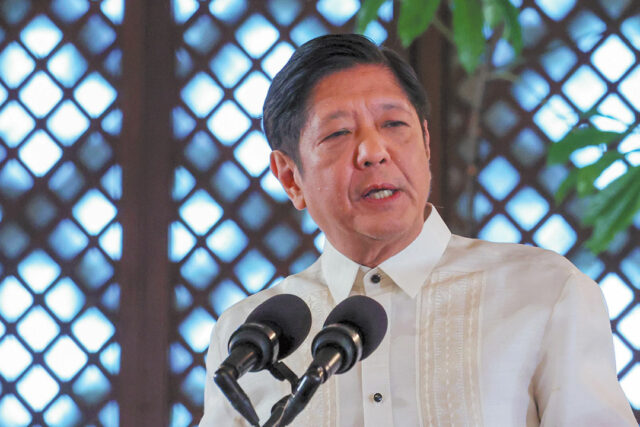
PRESIDENT FERDINAND R. MARCOS, JR. — PHILIPPINE STAR/KJ ROSALES

PHILIPPINE President Ferdinand R. Marcos, Jr. urged officials on Monday to pursue deeper institutional cleansing and anchor governance on integrity, wisdom and discernment as the bureaucracy faces mounting public pressure over the flood control corruption scandal.

In a statement marking the Feast of the Immaculate Conception in the predominantly Catholic nation, Mr. Marcos said the celebration offers an opportunity for reflection on the life and example of the Virgin Mary.

He said her “purity, devotion and unwavering faith” should inspire public leaders to ground their decisions in principle and purpose.

The President said the feast underscores the importance of beginning any mission with sound intentions and ethical grounding.

“Our intentions shape our outcomes,” he said. “If we sow pride, we reap division; if we sow deceit, we reap distrust.”

He said a nation built on “truth, humility and compassion for the least among us” could advance the administration’s Bagong Pilipinas vision — one that prioritizes integrity, service and the common good. — Chloe Mari A. Hufana

1,000 ‘ghost’ patients in CAR probed

PHILSTAR FILE PHOTO

BAGUIO CITY — The Philippine Health Insurance Corp. (PhilHealth) is investigating roughly 1,000 “ghost” patient claims, involving benefits already paid to healthcare providers for treatments never received in the Cordillera Administrative Region (CAR), the agency said on Monday.

The cases, spanning 2022 to 2024, include patients who died before the claimed services, and instances of double billing, such as one person undergoing dialysis at two facilities on the same day. Similar irregularities were detected under the Yaman ng Kalusugan Program.

PhilHealth-Cordillera lawyer Eric Mandiit said about P680,000 in benefits were disbursed for questionable claims, some uncovered when members received text alerts for services they did not use.

PhilHealth has ramped up monitoring, including surprise facility inspections, claim validation via home visits, and real-time text notifications. Facilities found guilty after due process face fines or suspension of accreditation, officials said. — Artemio A. Dumlao

Support for PWD students sought

PHILIPPINE STAR/EDD GUMBAN

A SENATOR has called for stronger support for students with disabilities and special needs in public schools, saying the government must ensure that these learners receive proper assistance.

In a statement, Senator Paolo Benigno “Bam” Aquino IV, who heads the Senate education committee, said public schools continue to lack the facilities, funding and resources required to adequately support these students.

“The facilities provided by the government are not enough,” he said on Monday, adding that funding for special needs education remains insufficient.

Mr. Aquino pushed a review of existing systems and the creation of targeted solutions to ensure that persons with disabilities (PWD) can access essential services and quality education.

He noted that many families rely on government support because they can’t afford private care, while those who can pay often find that suitable programs are unavailable.

One of five Filipino students has a disability or special concern that requires proper attention, he said, citing data from the Second Congressional Commission on Education. — Adrian H. Halili

Ports servicing offshore wind farms seen ready by 2027

DPWH.GOV.PH

THE first ports dedicated to servicing offshore wind farms are expected to be operational by 2027, according to the Department of Energy (DoE).

Energy Undersecretary Giovanni Carlo J. Bacordo told BusinessWorld that the Philippine Ports Authority (PPA) is set to auction the development contract this month for repurposing Pambujan Port in Camarines Norte.

“I understand that the opening of the bids will be this December. There’s no specific date yet,” Mr. Bacordo said.

He said redeveloping Pambujan port will cost around P4.8 billion and involve expanding the site from an initial 40 hectares to about 160 hectares.

Pambujan is one of the two ports identified by the PPA as suited for offshore wind services, along with Sta. Clara Port in Batangas.

“They’re looking at a public-private partnership scheme of development for the Sta. Clara Port,” Mr. Bacordo said.

The Philippines is hoping to generate the first kilowatts of offshore wind power by 2028 as it bids to diversify its energy mix and reduce dependence on fossil fuels.

According to the World Bank’s 2022 Offshore Wind Roadmap for the Philippines, Philippine offshore wind resources have the potential to generate over 178 gigawatts (GW).

To tap this potential, the government has awarded 92 offshore wind energy service contracts to date, with 68 GW of potential capacity.

Mr. Bacordo said Pambujan Port can cater to about 11 contracts while Sta. Clara Port can service up to 22 contracts.

“I’m really confident that these two ports… will be ready by the first quarter of 2027,” he said.

The DoE is set to conduct bidding for the fifth green energy auction round (GEA-5) next year.

GEA-5 focuses on fixed-bottom offshore wind technology, with an installation target of 3.3 GW and delivery set for 2028-2030. — Sheldeen Joy Talavera

ADVERTISEMENT
ADVERTISEMENT