Home Blog Page 5769

PSE index inches up ahead of US inflation data

LOCAL STOCKS closed nearly flat on Wednesday as investors stayed on the sidelines ahead of the release of September US inflation data, which could provide clues on the US Federal Reserve’s next move.

The benchmark Philippine Stock Exchange index (PSEi) went up by 6.26 points or 0.1% to close at 5,853.63, while the broader all shares gained 3.14 points or 0.1% to finish at 3,155.58.

AP Securities, Inc. Equity Research Analyst Carlos Angelo O. Temporal said Philippine shares barely moved on Wednesday ahead of the release of US inflation data.

“The PSEi was up incrementally after trading within a narrow band, coupled with low value turnover, as investors stayed on the sidelines, wary of US inflation data due out on Thursday,” Mr. Temporal said.

“Rising bond yields abroad following BoE’s (Bank of England) announcement that it will be concluding its bond-buying program within the week has also tempered sentiment further,” he added.

Regina Capital Development Corp. Head of Sales Luis A. Limlingan said shares traded “quietly” ahead of the release of US consumer price index report on Oct. 13 and the minutes of Federal Open Market Committee’s (FOMC) September meeting and US producer price index (PPI) data overnight.

“US stocks fell off their highs and bond yields ticked up when the BoE said its market intervention would be over soon and pension funds have just three days to rebalance positions,” Mr. Limlingan said.

“Many are looking forward to the September PPI, a gauge of final-demand wholesale prices, and the FOMC minutes due Wednesday. While Fed Chair Jerome H. Powell has acknowledged that aggressive interest rate increases could be painful, the central bank will continue to charge forward in its fight to lower inflation,” he added.

Back home, sectoral indices ended mixed. Holding firms went up by 14.07 points or 0.25% to 5,618.21; property gained 3.98 points or 0.16% to end at 2,484.81; and industrials rose by 12.10 points or 0.14% to 8,658.39. 

Meanwhile, mining and oil declined by 46.08 points or 0.44% to 10,413.83; financials dropped by 2.86 points or 0.19% to 1,498.23; and services shed 1.58 points or 0.1% to close at 1,522.95. 

Value turnover declined to P3.7 billion on Wednesday with 1.27 billion shares changing hands from the P4.22 billion with 906.40 million issues traded on Tuesday.

Decliners narrowly outnumbered advancers, 87 versus 82, while 55 names closed unchanged at the end of trading on Wednesday.

Net foreign selling went up to P327.60 million on Wednesday from the P226.27 million recorded on Tuesday.

AP Securities’ Mr. Temporal placed the PSEi’s support at 5,700 and resistance at 6,000. — A.E.O. Jose

At least 1 dead, 1 missing in Cagayan as storm Maymay dumps rain over northern PHL 

EMERGENCY response teams evacuate residents in some villages in the town of Lal-lo in Cagayan on Oct. 12 before flooding worsens due to rain from tropical depression Maymay. — CAGAYAN PIO

AT least one person was reported dead and another missing in Cagayan province in northern Philippines as tropical depression Maymay brought continuous rains despite staying almost stationary over the Philippine Sea and away from land, local authorities reported on Wednesday.

The Cagayan provincial information office, in a statement on its Facebook page, said the fatality was from the town of Buguey. Search operations, meanwhile, are ongoing for a missing fisherman from Sta. Ana.

The Provincial Disaster Risk Reduction and Management Office reported 1,210 families affected by flooding in six towns.

Several bridges and road sections were impassable while some parts of Allacapan town lost power supply, the provincial government said.

Cagayan Gov. Manuel N. Mamba issued a reminder to local officials, particularly mayors, that their physical presence in their areas is necessary as disaster preparedness and response measures are rolled out.

“Our problems are localized, that is why mayors should be in their areas, these disaster months are threatening,” he said in mixed English and Filipino, referring to the last months of the year.

Emergency response teams were on full alert for more potential flooding as the National Irrigation Administration (NIA) announced it will release water from the dam in Magat River, a major tributary of the Cagayan River.

In an advisory on Wednesday morning, NIA said it will start releasing water by 4:30 p.m. at an initial “volume of 200 cubic meters per second that may be increased based on the volume of rainfall at the Magat Watershed” due to tropical depression Maymay.

A low pressure area that could intensify into a storm before the end of the week was trailing tropical depression Maymay, the 13th typhoon to enter the country this year, according to state weather bureau PAGASA.

As of 5 p.m. Wednesday, PAGASA said Maymay had started moving westward, maintaining its maximum sustained winds of 45 kilometers per hour (km/h) with gusts of up to 55 km/h.

It was 180 km east of Casiguran, Aurora and expected “to deteriorate into a remnant low within the next 12 hours,” the weather agency said.

PAGASA warned of moderate to heavy with at times intense rains until Thursday morning in Cagayan, the northern portion of Isabela, Apayao, Kalinga, Mountain Province, and Ifugao.

Light to moderate with at times heavy rains were also expected over Ilocos Region, and the rest of Cagayan Valley and Cordillera Administrative Region.

Meanwhile, the incoming low pressure area was about 1,980 km east of northern Luzon as of Wednesday morning. — MSJ

Senator proposes full nursing scholarship to help address mass migration 

PHILIPPINE STAR/EDD GUMBAN

A SENATOR has proposed the grant of full nursing scholarships to help address the mass migration of Filipino nurses.

Senator Raffy T. Tulfo suggested that the beneficiaries could be required to serve in government hospitals for about five years after graduation to ensure an adequate number of nurses in public health facilities.

The Health department earlier said the country has a shortage of about 106,000 nurses.

Mr. Tulfo cited that the ideal nurse-to-patient ratio is 1:4 while the current proportion in the country is about five times that level, which leaves nurses exhausted and compromises the level of service.

The senator said this problem is compounded by lower pay rates compared to other countries, among other issues such as the timely release of benefits.

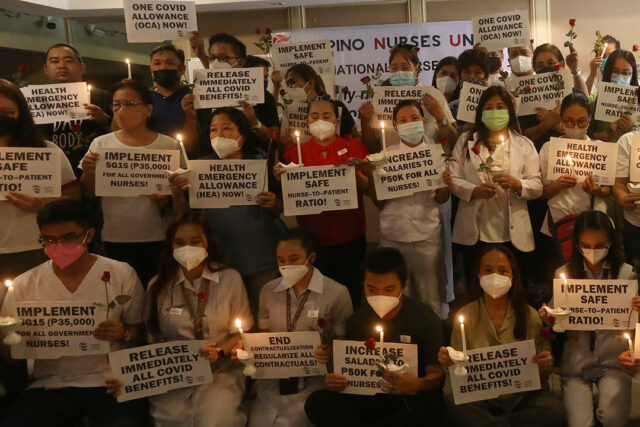
Healthcare workers, including nurses, have repeatedly held protests demanding the immediate release of their delayed hazard pay and special risk allowance in 2021.

Mr. Tulfo said he will support a bill on this proposal. — Alyssa Nicole O. Tan

House targets to pass 3 priority bills on health by yearend 

CONGRESS.GOV.PH

THE HOUSE of Representatives will start deliberating on three of the President’s priority measures relating to health by Nov. 9, with a target to have it passed at the lower chamber before the end of the year, a congressman said on Wednesday.

These measures cover the establishment of a Virology Institute, Center for Disease Control, and Medical Reserve Corps.

“We will be having our first bill deliberation this November, particularly on November 9th,” Batanes Rep. Ciriaco B. Gato, Jr., chair of the Committee on Health, said via phone call.

He cited that the schedule will only be adjusted if there is a supervening event.

“We intend to, at least, (finish the bill deliberations) in the House of Representatives this year,” Mr. Gato said.

“The committee level will be by November, and hopefully by third reading in the House of Representatives by December.”

He noted that these bills were already approved in the House during the previous Congress, but the Senate counterpart measures only reached committee level.

“We are still in the midst of the pandemic, and there is still a need to create a Philippine Virology institute to capacitate our country against public health emergencies,” he said.

Recently, the Bases Conversion and Development Authority said that it has allocated five hectares at the New Clark City in Tarlac province for the Virology Science and Technology Institute of the Philippines.

House Bill 2 seeks to create a medical reserve corps, while HB 9 seeks to establish a Philippine Center for Disease Control, and HB 10 seeks to build a Virology Institute. — Kyanna Angela Bulan

SC acquits ex-Binmaley mayor, businessman of corruption 

PHILSTAR FILE PHOTO

THE SUPREME Court (SC) has acquitted a former mayor of Binmaley, Pangasinan and a businessman of graft charges over the approval of a P2-million contract for construction equipment without public bidding.

In a 20-page decision on Oct. 10 and made public on Oct. 11, the SC First Division said government prosecutors failed to prove former Binmaley mayor Lorenzo M. Cerezo and Edwin G. Castillo caused undue injury to the government.

“In the absence of any evidence that will tend to prove any malicious motive or fraudulent intent against Cerezo, it cannot be said he gave any unwarranted benefits, advantage and preference to Castillo,” Associate Justice Samuel H. Gaerlan said in the ruling.

Mr. Castillo was the owner and operator of MTAC’S Merchandising, a construction equipment supply firm.

The case stemmed from a leasing contract between the former mayor and Mr. Castillo that involved using dump trucks and other heavy equipment to haul debris in the aftermath of typhoons.

The tribunal noted the prosecution failed to prove a conspiracy between the two.

The Sandiganbayan previously found them guilty of violating the Anti-Graft and Corrupt Practices Act.

The anti-graft court ruled Mr. Cereza showed gross negligence when he gave unwarranted benefits to Mr. Castillo.

Upon reviewing the case, the High Court said the prosecutors failed to prove “beyond a reasonable doubt” that the charges against the accused had merit.

“In every criminal prosecution, the state must prove beyond a reasonable doubt all the elements of the crime charges,” it said. — John Victor D. Ordoñez

AGRI Party-list rep files bill on national mariculture program 

PHILIPPINE STAR/ MICHAEL VARCAS

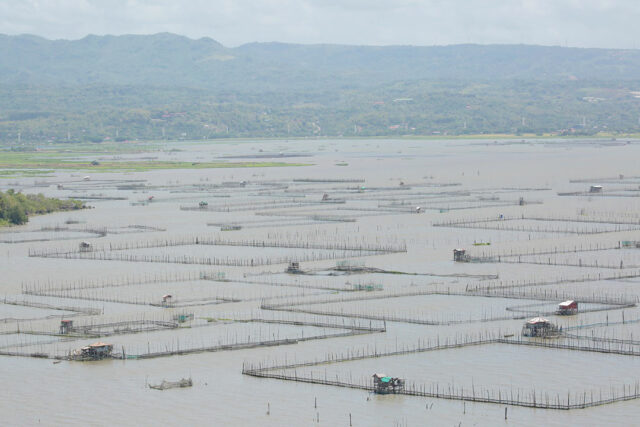
A SOLON on Wednesday filed a bill seeking to create a national mariculture program in the country as part of ensuring the countrys food security. 

House Bill 5531 or the proposed National Mariculture Program Act, filed by AGRI Party-list Rep. Wilbert T. Lee, aims to establish a sustainable mariculture industry that would provide a stable supply of aquatic commodities. 

“Our country is one of the world’s top producers of fish and aquatic plants,” Mr. Lee said in a press release. “Given our distinct advantage in natural resources, we must exert greater effort to (ensure) that we can use these amid the dangers of the climate crisis and increasing food insecurity.” 

Bangus, siganid, seaweeds, oysters, mussels, red snappers, and groupers can be grown in this method,he said, referring to the use of marine farming structures. 

He said mariculture could provide food supply as well as a steady source of livelihood for fishing communities. 

If the bill is enacted, the government would be mandated to improve mariculture viability through technical skill development among fisherfolk, from the production process to value chain transportation. 

The government will also provide equipment for post-harvest and ensure easy access to financing.

There is a need for the government to find ways to expand its food production capabilities as it can be vulnerable to climate change, Mr. Lee said.

If we do not find solutions to improve our food production, hunger will strike in the country,he added. Mariculture is a good solution to this problem, if implemented accurately, all people will benefit.Kyanna Angela Bulan 

Singaporean investor eyeing 25-ha land in Davao City for durian export 

BW FILE PHOTO/

A SINGAPOREAN investor is looking for a 25-hectare land in Davao City for durian that will be exported to his country, a city official said on Tuesday.

April Marie C. Dayap, head of the Davao City Investment and Promotion Center, said they have proposed the upland area of Paquibato, a former stronghold of communist armed rebels that had been a focus of peace efforts through socio-economic programs.

“He expressed a positive response with regards to the said area… He has no problems with that and is happy in the area,” Ms. Dayap said in mixed English and Visayan over the city-run radio channel.

She said the potential investor aims to work with local farmers on the durian varieties that would be ideal for the Singapore market.

“He said Singaporeans love durian and they only get their durian from Malaysia and Thailand,” she said. “It’s a good start and it will also encourage more farmers to plant high-value crops to market internationally.”

Ms. Dayap said there are other investment prospects for Paquibato, including two companies that are interested in setting up a corn plantation and a processing plant. — Maya M. Padillo

Toyota PHL to adopt forest, mangrove sites in Laguna and Batangas  

TOYOTA.COM.PH

CAR manufacturer Toyota Motor Philippines Corp. (TMP) will adopt two planting sites located in the provinces of Laguna and Batangas in a bid to improve its climate mitigation and biodiversity protection efforts.  

TMP said in a statement on Wednesday that it is set to sign two separate agreements with the Department of Environment and Natural Resources (DENR) Region IV-A this month to formalize the adoption of the areas under the National Greening Program. 

The site in Laguna is an upland forest block in Siniloan, while the one in Batangas is a mangrove forest in Calatagan. 

These projectscommitment is to plant 41,000 trees and mangroves in a span of five years, aiming at 80% survival rate,the TMP said. 

The company will plant native and fruit-bearing tree species in a 50-hectare area on the tail-end of Sierra Madre in Siniloan, while 16,000 mangrove propagules will be set in an eight-hectare area along the coast of Calatagan. 

Toyota shares the responsibility in protecting the planet Earth and in fighting climate change in line with United Nations Sustainable Development Goals. Global Toyota implements the Toyota Environmental Challenge 2050 to achieve zero carbon dioxide (CO2) emissions and net positive environmental impact by year 2050,TMP President Atsuhiro Okamoto said. Revin Mikhael D. Ochave  

Lawmaker slams Remulla over red-tagging justification 

PHILIPPINE STAR/ MICHAEL VARCAS

A LAWMAKER on Wednesday slammed Justice Secretary Jesus Crispin C. Remulla for justifying red-tagging by government representatives, saying the practice is nothing but a baseless accusation intended to silence those who make legitimate demands from the administration.

“Saying that red-tagging is part of democracy by no less than the justice secretary is a dangerous sign for the Filipino people who have been continuously attacked by state forces for opposing anti-people policies,” ACT-Teachers Party-list Rep. France L. Castro said in a statement.

On Monday, Mr. Remulla, who was speaking during the 136th session of the United Nations Human Rights Committee, defended the government against accusations of labeling individuals and organizations as communists without basis.

He said that the administration should be able to criticize its detractors.

Ms. Castro said making such accusations are a waste of government funds, adding that “the billions of pesos under the National Task Force to End Local Communist Armed Conflict and confidential and intelligence funds of government could have been used to provide better health, education, and transport services to the people.”

“We reiterate our demands for an end to red-tagging,” Ms. Castro said. — Matthew Carl L. Montecillo

Valuation system changed for power generators’ coal imports

FREEPIK

THE Department of Energy (DoE) said a new valuation system for thermal coal imports, which the Bureau of Customs (BoC) has agreed to implement, will more clearly reflect the true cost of coal, which many power plants in the Philippines rely on to generate electricity.

In a briefing on Wednesday, Energy Undersecretary Sharon S. Garin said the BoC has agreed to use transactional value for coal imports, instead of reference value. She expects no immediate impact on the power costs, saying only that the shift will better reflect the true price of coal when power companies pass on costs to consumers.

The BoC said reference values for imports are taken from a list of standard prices, while the transactional value reflects actual prices paid.

“The problem with coal imports is the valuation of coal. The higher it is valued, the higher the taxes and duties to be paid which in return affect the country’s electricity prices,” Ms. Garin said.

“Together with the Bureau of Customs, we have re-assess that instead of having a reference value, it should be the transactional value, so the collectors have been informed to use transactional value. The DoE (hopes this move will be to) the advantage of consumers,” Ms. Garin added.  

Energy Secretary Raphael P.M. Lotilla has said that 45% of power plants in the Philippines use coal for fuel, with 80% of that coal imported. Coal-fired plants accounted for the largest share of the Philippine power with 45%. — Ashley Erika O. Jose

Gov’t urged to create single regulator to oversee supply chain

By Arjay L. Balinbin, Senior Reporter

THE government needs to create a single regulator to oversee the supply chain industries, a procurement executive said.

The regulator needs to be a “high-level body that will facilitate stronger collaboration between the public and the private sector in setting policies, initiatives, and programs that are required to address constraints and improve supply chain performance,” according to Jesus Carlos “Charlie” P. Villaseñor, chairman of the Procurement and Supply Institute of Asia (PASIA), speaking at the BusinessWorld Insights online forum.

There should be a “national supply chain control tower to monitor demand and supply conditions, gain visibility on supply market analysis as it impacts health, livelihood, trade and the economy,” he added.

Mr. Villaseñor, who is also the chief executive officer of TransProcure Corp. and PASIA Shared Services Corp., described supply chain issues as complex, fragmented, and under pressure.

There is a “lack of integrated supply chain management focus at the national level,” he noted.

“No focal point for national end-to-end supply chain undertakings. No strategic drive,” he added.

He said strong leadership and experience, as well as government and private-sector partnerships, are necessary to deliver results.

He said a degree of uncertainty clouds the industry’s prospects during the next large-scale emergency, due to the absence of reliable data on demand and supply which the industry relies on to manage capacity constraints and exploit supply opportunities.

“Micro-, small-, and medium-sized enterprises (MSMEs) are closing with idle or no advance warning. They will not open again easily,” Mr. Villaseñor said.

Financial or capital issues also persist, while professionals are not well-trained in global supply chain standards, he said.

This means that “non-traditional financial access is needed, and (we should) push large enterprises to allocate a certain percentage of their spend to MSMEs,” Mr. Villaseñor said.

He cited the need for “human resource development programs and recognition,” as well as “professional certification in the conduct of practice.”

Marjorey M. Rubio, president and founder of BEXCS Logistics Solutions, Inc., said large companies are beginning to help MSMEs in building a sustainable supply chain.

“One of the biggest trends that we are looking at right now is that larger entities will be the ones to support the MSMEs in order to sustain (the) supply chain,” she said.

“The collaboration between large and small enterprises is going to be crucial in building a resilient supply chain.”

She said that MSMEs are not well-placed to service the e-commerce industry and have limited access to suppliers.

“The consumers are dictating the demand — or which items they would buy from the sellers — and most of our sellers source separately and on their own, so the reason there is not a fast way of sourcing their items is that they consider two types of suppliers, local and foreign. But I think a large percentage of the supplies that are being sold in the market are coming from foreign suppliers, and there is a small percentage coming from our local suppliers,” Ms. Rubio said.

Green industries promoted as ‘pandemic-proof’ job generators

BW FILE PHOTO

By Alyssa Nicole O. Tan, Reporter

“GREEN” employers like solar power farms, as well as content generators within the creative industries, are expected to drive employment in the next few years, making it crucial to address mismatched skills that prevent graduates from taking on these jobs seamlessly, according to Philippine Business for Education (PBEd).

“From our experience in YouthWorks PH, especially during the pandemic, we need to look more into pandemic and climate-resilient industries, so what we found were green industries, for example… the workforce of the solar energy industry,” PBEd Executive Director Lovelaine B. Basillote told reporters on the sidelines of the PBEd Skills Partnership Summit on Wednesday.

“We’re also looking at cloud technologies because… whether there’s a pandemic or a calamity, as long as infrastructure is there, we can actually work in the cloud,” she added. “We’re also looking at… social media content creation. We see a lot of opportunities there.”

The YouthWorks program, which seeks to tap the potential of the young workforce by investing in skills development, began in 2018. It has 77 private company partners, including McDonald’s Corp., Amazon Web Services, Inc., and BDO Unibank, Inc.

The US Agency for International Development has increased its original grant of $4.48 million for the program, which was initially meant to end in 2023, with an additional $3.86 million to extend the project until 2026. The partnership agreement for the extension was also signed during the event on Wednesday.

The private sector, Ms. Basillote said, places a premium on workers who can deliver on productivity goals while working with technology. This includes skills that promote teamwork and communication without being in the same space.

The main issue, she said, is the disconnect between business and education, especially for those who plan to work right after graduating from the K to 12 program.

“There are many existing preconceptions, biases against senior high school graduates,” she said. “If the private sector is just exposed to them, to the senior high school graduates, they will really change their minds and we were able to prove that.”

She cited a pilot program earlier performed which lasted a year and resulted in a commitment from the private sector to open over 20,000 employment positions up to K to 12 graduates. The employers involved agreed to waive the college degree requirement in their job advertisements.

“We went to the DepEd (Department of Education) and looked at the curriculum, and then matched that with the qualifications required in the job advertisements. What we found was 93% were matched, theoretically,” she said.

“The we asked the senior high school coordinators of schools and brought them together with the HR (human resources) of the companies,” she added. “This is a matter of also bringing people together because the private sector (doesn’t) know, so you need someone to advocate for the youth.”

Job fairs were also organized, she said, which led to about 40% of the 3,000 participants being invited to proceed to the next level of the recruitment process.

The PBEd has pitched government agencies to work with senior high school coordinators to broaden the pathway to internships.

“We’re hoping that we can partner with the DepEd so that we can train as many of their senior high school coordinators as possible, so that’s something we in the private sector can do to help scale these kinds of initiatives,” she said.

She also suggested decongesting the competencies in senior high school to make the curriculum more responsive to the needs of employers.

Philippine Institute for Development Studies Senior Research Fellow Jose Ramon G. Albert, speaking at the event, noted the need to ensure quality of learning and training over a broad base.

“Our policies are (geared towards getting) children to school to the neglect of quality; even interventions focus on quantity — more training programs, more trainees — than on quality assurance,” he said.

The Philippines must ensure quality basic education while increasing work-integrated learning in technical-vocational education and systems thinking in higher education, he said. It must also work on building digital skills and soft skills in the workforce.

Incentives, he added, should be provided for enterprise-based training, while industry must begin to value training certificates.

According to PIDS, about one in five Filipinos aged 15 to 24 are neither in employment, education or training (NEET), the third-highest such proportion in the Association of Southeast Asian Nations.

“NEET, nearly double for women than men, is highest in BARMM (Bangsamoro Autonomous Region in Muslim Mindanao)… is higher among the poor (23%) than the non-poor, and is higher among the rural population (19%) than the urban,” Mr. Albert said.

He noted that school attendance drops from ages 17 to 21, with more males than females leaving to start working. Many females also leave school to become economically inactive in fields like home care.

ADVERTISEMENT
ADVERTISEMENT