Home Blog Page 555

First anti-tobacco film fest showcases youth-led short films

THE TobacOFF NOW! Film Festival, organized by Amber Studios and the Metro Manila Development Authority (MMDA), was launched on Dec. 13. This inaugural edition boasts films by 25 young Filipino filmmakers who are challenging tobacco and vape culture.

All the festival films “offer powerful, eye-opening stories on youth culture, identity, and the powerful tobacco control narratives.” It is part of this year’s Metro Manila Film Festival (MMFF), and is supported by health advocacy groups like HealthJustice Philippines, Parents Against Vape, Action for Economic Reforms, Social Watch, Philippine Smoke-Free Movement, and the Philippine Legislators’ Committee on Population and Development.

Jacque Manabat, journalist and co-founder of Amber Studios, said at the media launch on Dec. 10 that the festival “gives young people the platform to tell their own stories — raw, authentic, and unfiltered.”

“We’ve seen how tobacco and vape products increasingly target the youth through appealing designs, flavors, and online strategies. These films help make sense of the realities behind those tactics and the impact they leave on young lives,” said Ms. Manabat.

“Compared to other more pressing issues in our society today, this one is more of a slow burn, and we have to convince people we have to act on it now. This is what we challenged the young filmmakers and the six advocacy groups to do,” she added.

YOUTH-DRIVEN NARRATIVES
The film festival is part of a national movement to empower the next generation to use storytelling and creativity as a tool for social change. This year’s cohort of creators underwent an intensive film and storytelling boot camp led by Ms. Manabat, journalist Chiara Zambrano, filmmaker Tops Brugada, and video editor Jobert Monteras.

“We’re trying to spark conversations that our peers are often too afraid to start,” said Jia Santorias of the Philippine Smoke-Free Movement and one of the young filmmakers this year. “Our goal is not to villainize smokers, because they are victims too, but to share the information that it is not safe.”

Mentoring sessions, hands-on workshops, and collaborative ideation helped the participants develop their short film concepts. Each explores the evolving landscape of youth culture, shedding light on the struggles, influences, and transformation shaped by tobacco and other nicotine products.

Throughout the bootcamp, mentors guided participants in developing their narrative voice, strengthening their visual style, and exploring the deeper emotional truths behind their stories.

Rochelle Ona, MMFF executive director, said in a statement that it was the youth creators’ “honesty” that moved her the most.

“These films don’t preach; they reveal. And when young people reveal their own truths, it becomes impossible to ignore,” she said.

Beyond showcasing cinematic talent, the TobaccOFF NOW! Film Festival forms part of a broader campaign advocating stronger protections for minors, according to Ms. Santorias. Their movement pushes for “a shift to healthier, more empowered lifestyle choices.”

Ms. Manabat, who spoke on the intersection of art, dialogue, and community mobilization, expressed pride in this new cultural momentum.

“What we basically provided through this program was mentorship in storytelling and filmmaking. After that, we let the kids express using their own creative voices,” she said. “This is a good mix of advocacy and creative expression.”

Details about future screenings will be announced online via TobacOFF NOW!, MMDA, and MMFF’s pages. The films are set to be shown in different schools and provinces across the Philippines. — Brontë H. Lacsamana
Quantifying the economic fallout of the corruption scandal

The ongoing Philippines corruption scandal revolving around flood control and other projects in the Department of Public Works and Highways (DPWH) surfaced last July when prolonged habagat or southwest monsoon rains poured for over two weeks and flooded many provinces and cities in the country.

This resulted in a quick negative economic impact. GDP growth in 2025 quickly declined from 5.5% in the first two quarters (Q1-Q2) to 4% in Q3. The Bangko Sentral has projected Q4 growth of only 3.8%. If this comes true, then the Philippines’ full year growth would be 4.7%, lower than 2024’s growth of 5.7%.

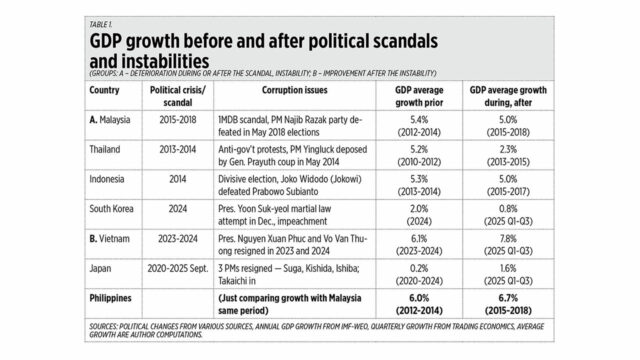
I want to estimate the Philippines’ short-term growth slowdown for 2026, and possibly 2027, based on the trends and experiences of our East Asian neighbors that also had political scandals and instability recently (see Table 1). This piece is bordering on political analysis, which is not my field, so I will limit my political commentary and focus on economic growth trends.

Malaysia experienced a three-year-long political crisis with the 1Malaysia Development Berhad (1MDB) scandal, a case of massive multi-billion dollar corruption where former Prime Minister Najib Razak was accused of channeling approximately $700 million from 1MDB into his personal bank accounts. The impact was historic — the 2018 general election ended 61 years of single-coalition rule.

Thailand experienced another military coup in 2014, and the coup leader, General Prayut Chan-o-cha, led the country for almost nine years, during which time there was a steep growth slowdown.

In 2014, Indonesia changed leadership via election and it was a highly divisive one. Its growth slowdown was mild. In 2015 President Joko Widodo faced pressure from the chairperson of his own party (PDI-P) and former President Megawati Sukarnoputri.

South Korea President Yoon Suk Yeol declared martial law in December 2024 — the second time since 1980 that martial law was imposed in the country (although, counting 2024, South Korea had been under martial law 17 times since the foundation of the republic in 1948). The 2024 martial law was very shortlived, ending after a few hours. The political backlash was severe and the growth slowdown was also severe.

Vietnam recently had internal squabbles, with two presidents resigning in the last two years.

And Japan has welcomed its very first female prime minister, Sanae Takaichi, just last October.

The numbers in Table 1 show that when instability is resolved or addressed within a year, economic recovery follows. When instability drags on for two to three years or more, an economic slowdown follows.

In the Philippines, two possible scenarios can emerge from the current situation: a.) a quick resolution of the current corruption scandal, say in 12 months (July 2025-June 2026); and, b.) a 1MDB type of scandal taking roughly three years to be resolved.

If  it is (a), then it will be like Vietnam and Japan’s economic recovery from political instability, and GDP growth can recover from 2025’s possible 4.7% and rise again to around 5.7% in 2026.

If it is (b), then it will be like Malaysia’s 1MDB scandal, dragging the instability on and further pulling growth down in 2026 to around 4.5%. So far the fiscal deficit has been muted because spending has slowed down while revenues have shown improvement (see Table 2).

I hope and wish that it will be scenario (a). So the challenge now is for the mandated agencies — like the Independent Commission on Infrastructure or its successor body (to be created by legislation), the Ombudsman, and other constitutional bodies — to come up with strong proof and cases against some of the “big fish” that have been named and implicated, leading to jailtime. Then let it serve as a lesson so that corruption at this level will not occur again.

The rest of the population — both public and private sectors — should continue doing their hard productive work. Keep producing more goods and services the honest way — that will create more jobs and further industrialize the country.

Meanwhile, notice the media’s silence on the deep work behind the scenes as the new Executive Secretary monitors the various departments. Then note the fast action on red tape and corruption in audits and letters of authority from the Finance department. And the consistent Presidential communication of new projects and policy reforms.

The three high-level secretaries, plus the other secretaries and officials, are doing quick confidence-building work in the economy. These lead to renewed business confidence, governance reforms, non-wasteful spending, and non-tax increase revenue expansion and public debt reduction.


Bienvenido S. Oplas, Jr. is the president of Bienvenido S. Oplas, Jr. Research Consultancy Services, and Minimal Government Thinkers. He is an international fellow of the Tholos Foundation.

minimalgovernment@gmail.com

PHL office market seen sustaining growth in 2026

STOCK PHOTO | Image by Pooja Singh from Unsplash

THE PHILIPPINE office market is expected to maintain gradual growth next year, driven by rising demand from information technology-business process management (IT-BPM) tenants and renewed take-up from traditional sectors, according to property consultancy Leechiu Property Consultants (LPC).

“While challenges persist, the Philippine office sector has repeatedly proven its resilience, and all signs suggest that momentum will continue into the coming year,” said Mikko Barranda, LPC director for commercial leasing, in a statement on Monday.

Year to date, office take-up rose 10% to 1.22 million square meters (sq.m.), the consultancy said in its Fourth-Quarter Property Market Report.

Of the total, the IT-BPM sector accounted for 32% (549,000 sq.m.), while other tenants — including traditional corporates, government agencies, and Philippine inland gaming operators — took up 68% (671,000 sq.m.) of space.

“This performance underscores the sector’s enduring relevance despite ongoing global headwinds, geopolitical uncertainty, and economic volatility,” Mr. Barranda added.

Among submarkets, Bonifacio Global City (BGC) led with 218,000 sq.m., a 73% increase in transactions, followed by Quezon City (169,000 sq.m.) and the Ortigas-Mandaluyong area (155,000 sq.m.). In the provinces, Cebu topped with 150,000 sq.m., or 55% of provincial take-up.

Net take-up rose 13% to 476,000 sq.m. in 2025, up from 422,000 sq.m. a year earlier. LPC noted that steady demand and fewer large-scale exits helped stabilize net absorption, despite elevated vacated space earlier in the year.

Vacated spaces fell 59% to 205,000 sq.m. in the fourth quarter, largely due to reduced downsizing and ongoing consolidation, mainly among IT-BPM firms.

LPC projects 2.3 million sq.m. of upcoming office supply nationwide over the next five years, with 1.9 million sq.m. expected to come online in Metro Manila from 2026 onwards.

Mr. Barranda said the office market is likely to sustain demand as companies continue to prioritize onsite work, while developers remain flexible to meet tenants’ evolving requirements.

“Occupiers are embracing flexible strategies, consolidations, flight-to-value opportunities, and long-term growth planning, while landlords are responding with improved terms, more efficient spaces, and investments in sustainability and smart-building features,” LPC said.

Over the next three years, lower interest rates and a tighter supply pipeline are expected to support transaction activity.

“However, the country’s success in attracting long-term investment flows will depend on its ability to enhance competitiveness through manufacturing revival, office space reimagination, and workforce upskilling,” LPC added, highlighting the need for key sectors such as real estate, tourism, manufacturing, and retail to address pricing gaps, infrastructure bottlenecks, and global competition. — Beatriz Marie D. Cruz

Philippines improves in the anti-money laundering index

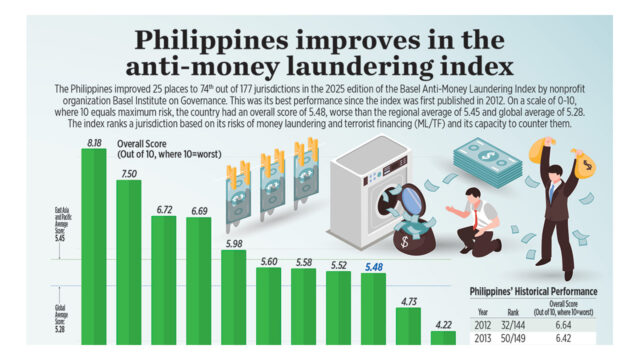
The Philippines improved 25 places to 74th out of 177 jurisdictions in the 2025 edition of the Basel Anti-Money Laundering Index by nonprofit organization Basel Institute on Governance. This was its best performance since the index was first published in 2012. On a scale of 0-10, where 10 equals maximum risk, the country had an overall score of 5.48, worse than the regional average of 5.45 and global average of 5.28. The index ranks a jurisdiction based on its risks of money laundering and terrorist financing (ML/TF) and its capacity to counter them.

NEO Office PH eyes full occupancy next year

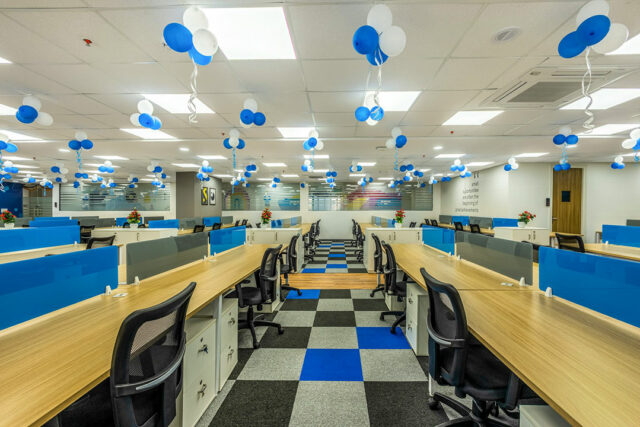
TWO/NEO in BGC. — BW FILE PHOTO

By Beatriz Marie D. Cruz, Reporter

OFFICE developer NEO Office PH expects to achieve full occupancy next year as leasing demand from business process outsourcing (BPO) companies and small and medium enterprises (SMEs) remains strong, company officials said.

“So far, the challenge right now is we don’t have any space for the tenants because we are already 97% occupied,” NEO Co-Managing Director and Chief Sustainability Officer Gie L. Garcia told BusinessWorld on the sidelines of a briefing last week.

She said the company is in discussions with prospective BPO and SME tenants and expects some lease agreements to be finalized by the first quarter of next year.

NEO owns and operates Grade A, Philippine Economic Zone Authority-accredited office buildings in Bonifacio Global City (BGC). Its portfolio totals about 289,000 square meters (sq.m.) of office space across seven towers — One/NEO, Two/NEO, Three/NEO, Four/NEO, Five/NEO, Six/NEO, and Seven/NEO.

Despite elevated vacancy levels in the broader Metro Manila office market, Ms. Garcia said NEO continues to see steady demand for space, particularly from companies seeking high-quality and sustainable office developments.

She added that the company’s certifications from both local and international green building and sustainability organizations have helped attract tenants amid tighter competition.

“While there is a challenge in the real estate industry right now in terms of filling office spaces, we have been fortunate,” Ms. Garcia said.

BGC remains the only major office district in Metro Manila with a single-digit vacancy rate, at about 9%, according to data from property consultancy firm Leechiu Property Consultants (LPC).

“Luckily for NEO, this has not been a major issue because we are increasingly becoming the preferred choice of tenants, especially among regional companies,” Ms. Garcia said.

All NEO towers hold multiple sustainability certifications, including the International Finance Corp.’s Excellence in Design for Greater Efficiencies  certification, the International WELL Building Institute’s WELL Health-Safety Rating, the 5-Star Building for Ecologically Responsive Design Excellence, and Advancing Net Zero Philippines certification.

NEO Group Chief Executive Officer Raymond D. Rufino said the company has long planned to expand outside BGC, but market conditions have made it cautious.

“There is a lot of supply in the market, and with that as a backdrop, it’s hard to be too aggressive,” he said at the same briefing.

Metro Manila currently has about 2.7 million sq.m. of available office space, based on LPC data.

Ms. Garcia earlier told BusinessWorld that NEO plans to focus next year on reducing indirect emissions and waste across its buildings. The company recently partnered with HMR Envirocycle Philippines, Inc. to allow tenants to drop off old electronic equipment for recycling.

The electronic waste will be processed into materials such as cement, which NEO plans to use in future construction activities, she said.

However, Mr. Rufino noted that traffic congestion and limited public transportation options in BGC remain challenges to tenant productivity and employee well-being.

“You can make a nice building and provide all these amenities, but the number one enemy of productivity in the office is really our transportation problem,” he said.

Deutsche Bank sees 25-bp cut in Feb.

BW FILE PHOTO

THE BANGKO SENTRAL ng Pilipinas (BSP) might deliver a sixth straight rate cut at its first policy meeting next year as weak domestic and external economic prospects could drag growth, Deutsche Bank Research said.

It said in its latest Asia Week Ahead report released on Monday that the Monetary Board (MB)could go for another 25-basis-point (bp) cut as early as its February review on expectations of a prolonged economic slowdown.

“[The] weakened — or still weakening — domestic economic outlook on the back of governance issues and the possible dampening of external trade activity as tariffs bite could justify further rate cuts to support growth, especially as fiscal policy remains constrained,” it said. “We maintain our view that BSP would cut 25 bps again in its next MB meeting.”

“Governor Remolona’s shift of views between hawkish (end of easing) and slightly dovish (maybe one more rate cut) during the Monetary Board press briefing and subsequent media interviews suggests the still-high degree of uncertainty on the economy, in our view.”

Last week, the Monetary Board lowered benchmark borrowing costs by 25 bps for a fifth meeting in a row to bring the policy rate to 4.5%, the lowest in over three years.

It has now reduced rates by a cumulative 200 bps since its easing cycle began in August 2024.

BSP Governor Eli M. Remolona, Jr. said at a briefing after Thursday’s policy meeting that benign inflation gives them room to help support weak domestic demand amid lingering governance concerns that have affected investor confidence, but stressed that they are nearing the end of their current easing cycle, with further cuts — if any — likely to be limited and dependent on data.

On Friday, he left the door open to one last 25-bp reduction, with the economy’s recovery likely to take longer than expected.

He said gross domestic product (GDP) growth could slow further to 3.8% this quarter from the over four-year low of 4% in the July-September period. This would bring the full-year average below 5% versus the government’s 5.5-6.5% goal.

The BSP chief said that they expect the economy to recover by the second half of 2026, with growth seen moving closer to the government’s 6-7% target only by 2027.

Deutsche Bank Research said this view of a prolonged economic slowdown is in line with their own. It earlier trimmed its GDP growth forecast for the fourth quarter to 4.1% from 5.4%.

Meanwhile, Ronilo M. Balbieran, an economist at the University of Asia and the Pacific, said the BSP should have delivered a 50-bp cut given its outlook for slower fourth-quarter growth.

“They should have cut 50 bps last week right off the bat,” he told Money Talks with Cathy Yang on One News on Monday. “If you were more pessimistic, why didn’t you cut it by 50 bps and then arrest it toward April? But 50 bps now is better than 25 today and 25 (in) February.”

He added that the BSP’s 3.8% forecast for fourth-quarter GDP growth “might be too low” as the peso’s weakness against the dollar in November would boost the value of migrant Filipinos’ remittances to help drive economic activity, along with the increase in consumer spending amid the holidays, and potentially bring expansion to 4.5%-5% in the period.

“That might actually rescue the multiplier of the OFW (overseas Filipino workers) remittances to their families here in the Philippines and some last-minute foreign tourists coming here in the Philippines,” he said. “So, we’re hoping that will actually catch the slack.”

Full-year GDP growth could be between 4.9% to 5.1%, Mr. Balbieran added.

Economic managers have conceded that the 5.5%-6.5% target for the year is now unattainable after the third-quarter GDP print slumped to a four-year low of 4% amid the ongoing flood control controversy, which dampened government and household spending. — Katherine K. Chan

Christmas light attractions around Metro Manila

GATEWAY 2

THE COLORS of Christmas are now filling the streets of Metro Manila, in commercial areas, school and government parks, and business districts. Amid the chaos of the holiday rush, many attractions with Christmas lights have sprung up to celebrate the festive season.

Those who are on their way home, or who are letting the rush hour traffic pass before going on their way, or who are looking for places to spend time with family and friends can choose from one of these picture-worthy Christmas light shows (arranged from north of the metropolis to south).

UP DILIMAN’S TANGLAWAS ART INSTALLATION
Those near the University of the Philippines (UP) in Diliman, Quezon City, can drop by the famed Oblation statue at night to see it lit up by an art installation by Toym Imao, a work featuring figures of people in boats atop the plaza’s pool titled Tanglawas. His work draws connections between the parol, the traditional lantern representing the Star of Bethlehem in the West Bank, to the struggles of fishermen in the West Philippine Sea and Tausug seafarers in Sulu.

A great time to visit will be on Dec. 17 at 4 p.m., when the annual UP Lantern Parade sets forth a procession of mesmerizing giant lanterns around campus.

ARANETA CITY’S GIANT BELEN AND GATEWAY’S GIANT CHRISTMAS TREES
Because all roads lead to Cubao, according to the commuters of Metro Manila, those who have the misfortune to end up in this area during rush hour can instead take in the many sights found in Araneta City. One of these is the giant belen or nativity scene located at the center aisle of Gen. MacArthur Ave. between Farmers Market and Farmers Garden. By day it is already a welcome sight amid the city’s hustle and bustle, but its beauty doubles when lit up at night.

Those passing to and from the LRT and MRT stations via Gateway can visit the Activity Area on the upper ground floor of Gateway Mall 1 and/or the Quantum Skyview on the upper ground level of Gateway Mall 2, to see bright and colorful giant indoor Christmas trees.

EASTWOOD CITY’S HOLIDAY ART WALK
The recently revitalized open park of Eastwood City in Quezon City now welcomes visitors to a luminous art walk at night. Until Dec. 30, the mall complex spotlights three artists, each presenting an installation in a different area.

Olivia d’Aboville’s plastic bottle-made Giant Dandelions and Mikayla Teodoro’s sculptural scenes in Between the Stars light up the park from 6 to 10 p.m., while Teddy Manuel’s floral adornments in Bigger Than Life decorate the mall atrium from above.

On weekends, Eastwood City’s grand fireworks displays are set to illuminate the skies.

SHANGRI-LA PLAZA’S SUSPENDED CHRISTMAS TREE
The Shangri-La Plaza mall’s holiday display evokes a sense of magic for mallgoers this year. At the mall’s Grand Atrium, the massive Christmas tree centerpiece is suspended from the ceiling, giving the illusion that it is floating in midair.

With the central escalators that sometimes skip a floor or two, netizens have joked that the tree adds to the mall’s “Hogwarts-like” quality. Choral ensembles are also set to perform, with the St. Theresa’s College Quezon City singing on Dec. 20, and the Mandaluyong Children’s Choir on Dec. 21.

AYALA TRIANGLE’S VIBRANT PARK LIGHTS
This year, the Ayala Triangle Gardens in Makati has scaled back its usual exuberant light show to reimagine its festive display as a steady illumination of patterns. Adorning the trees in the park are sun-shaped parols and colorful projections.

This year, the gardens draw inspiration from the legendary bird of the Maranao, the sarimanok, and the leaves of the fan palm, the anahaw. The Green Wall has art projections featuring Filipino weaves and patterns. Friends and families visiting the area’s restaurants can also watch out for live music performances by various artists and buskers.

SM MALL OF ASIA’S CHRISTMAS CENTERPIECE
The Mall of Asia (MOA) in Pasay City has multiple displays around its vast complex to ring in the holiday season. The centerpiece, located in the central atrium, contains Christmas trees and gift-themed displays that wish mallgoers happy holidays. Visitors are welcome to come and take pictures.

For fireworks displays, go to MOA’s Central Park on any Saturday. Set to music, dazzling pyrotechnics will light up the skies from 7 p.m. onwards.

AYALA MALLS NUVALI’S OUTDOOR LIGHTS
Though Nuvali’s famed Fountain of Lights in Laguna won’t be taking place this year, Ayala Malls Nuvali has made the holidays special with bright Christmas trees and glowing displays decorating the outdoor area.

Aside from trees, giant frames and ribbons allow visitors to take pictures with the displays. Looking across the landscape of the open-space mall area offers a festive view of golden lights fitting for Christmas. — Brontë H. Lacsamana

Dick Van Dyke credits his longevity to his positive outlook — and research says optimists live longer

DICK VAN DYKE speaking with attendees at the 2024 Phoenix Fan Fusion at the Phoenix Convention Center in Phoenix, Arizona. — GAGE SKIDMORE/COMMONS.WIKIMEDIA.ORG

Dick Van Dyke, the legendary American actor and comedian who starred in classics such as Mary Poppins and Chitty Chitty Bang Bang, turned 100 on Dec. 13. The beloved actor credits his remarkable longevity to his positive outlook and never getting angry.

While longevity of course comes down to many factors — including genetics and lifestyle — there is some truth to Van Dyke’s claims. Numerous studies have shown that keeping stress levels low and maintaining a positive, optimistic outlook are correlated with longevity.

For instance, in the early 1930s researchers asked a group of 678 novice nuns — most of whom were around 22 years of age — to write an autobiography when they joined a convent.

Six decades later, researchers analyzed their works. They also compared their analyses with the women’s long-term health outcomes.

The researchers found that women who expressed more positive emotion early in life (such as saying they felt grateful, instead of resentful) lived an average of 10 years longer than those whose writing tended to be more negative.

A UK study also found that people who were more optimistic lived between 11% and 15% longer than their pessimistic counterparts.

And, in 2022, a study which looked at around 160,000 women from a range of ethnic backgrounds found that those who reported being more optimistic were more likely to live into their ’90s compared to pessimists.

One potential explanation for these outcomes is related to the effects anger has on our heart.

People who tend to have a more positive or optimistic outlook on life appear to be better at managing or controlling their anger. This is important, as anger can have a number of significant effects on the body.

Anger triggers the release of adrenaline and cortisol, the body’s primary stress hormones — particularly in men. Even brief angry outbursts can lead to a decline in cardiovascular health.

The added strain that chronic stress and anger put on the cardiovascular system has been linked to increased risk of developing conditions such as heart disease, stroke, and type 2 diabetes. These diseases account for roughly 75% of early deaths. While stress and anger aren’t the only causes of these diseases, they contribute to them significantly.

So when Dick Van Dyke says he doesn’t get angry, it may well be one of the reasons for his longevity.

There’s also a deeper, cellular explanation behind stress’s influence on longevity, which relates to our telomeres. These are protective caps found on the ends of our chromosomes (the packages of DNA information found in our cells).

In young, healthy cells, telomeres remain long and sturdy. But as we age, telomeres gradually shorten and fray. Once they become too worn, cells struggle to divide and repair themselves. This is one reason ageing accelerates over time.

Stress has been linked to faster telomere shortening, which makes it harder for cells to communicate and renew. In other words, stress-inducing emotions such as uncontrolled anger may speed up the ageing process.

One study also found that meditation, which can help reduce stress, is positively associated with telomere length. So better anger management might just help support a longer life.

Added to this is the fact optimists appear to be more likely to engage in healthy habits, such as regular exercise or healthy eating, which can further support health and longevity by lowering risk of cardiovascular disease. Even Dick Van Dyke himself still tries to exercise at least three times a week.

IMPROVING LONGEVITY
If you want to live as long as Dick Van Dyke, there are things you can do to manage your stress and anger levels.

Contrary to popular belief, trying to “let out” anger by punching a bag, shouting into a pillow, or running until the feeling passes doesn’t actually help. These actions keep the body in a heightened state which impacts the cardiovascular system and can prolong the stress response.

A calmer approach works better. Slowing down your breath, counting them, or using other relaxation techniques (such as yoga) can help calm the cardiovascular system rather than overstimulate it. Over time, this reduces strain on the heart, which can help you live longer. It’s important you aim to do this anytime you’re feeling particularly stressed or angry.

You can also boost positive emotions by trying to be more present in your daily life. By staying present, you become more aware of what’s happening around you and within you.

For instance, if you’re planning to go out for dinner with your partner, try to be more intentional in how you go about it. This could include booking a restaurant you both truly like, or asking to eat in a quieter spot in the restaurant, so you have more time to catch up. Slow down and try to pay attention to the moment, taking in all the senses you’re experiencing as much as you can.

You can also boost positive emotions by making time for play. For adults, play means doing something simply because it’s enjoyable — not because it has any specific purpose. Play will give you a boost of positive emotions, which may in turn benefit your health.

Dick Van Dyke’s advice may be correct. While we can’t control everything that has an impact on our health, learning to manage anger and make room for a more positive outlook in life can help support both wellbeing and longevity.


Jolanta Burke is an associate professor, Centre for Positive Health Sciences, RCSI University of Medicine and Health Sciences.

Aboitiz Renewables acquires Bohol solar project

STOCK PHOTO | Image by Mariana Proença from Unsplash

ABOITIZ Renewables, Inc., a subsidiary of Aboitiz Power Corp. (AboitizPower), has acquired shares in a company developing a large-scale solar farm in Bohol for $8.55 million (P505 million).

The unit bought 100% equity interest in Ubay Solar Corp., the developer of the 137-megawatt (MW) solar project, from Ignis Philippines Development, Inc., the energy company said in a regulatory filing on Monday.

The acquisition followed Aboitiz Renewables’ exercise of its call option to acquire all of Ignis’ shares, totaling 55,000 shares, and the signing of a deed of assignment of shares of stock.

“This acquisition accelerates AboitizPower’s strategic goal to increase its clean energy capacity and solidify its market position as a leader committed to supporting the Philippines’ sustainable energy transition,” the company said.

The Ubay solar project is targeted to reach financial close next year and commence commercial operations in 2027.

In November, Aboitiz Renewables energized its 92.55-MW solar farm in San Manuel, Pangasinan, marking its third solar plant in the province.

At present, the company’s solar portfolio totals 533 MW, with facilities located in Negros Occidental, Pangasinan, Ilocos Norte, and Tarlac.

Aboitiz Renewables aims to help the group reach its renewable energy target of 4,600 MW by 2030.

Overall, AboitizPower plans to expand its total attributable net sellable capacity to 9,200 MW by 2030, maintaining a 50:50 balance between renewable and thermal energy sources. — Sheldeen Joy Talavera

ALI targets young professionals with second CityFlats property in Cebu

AYALA LAND, INC.

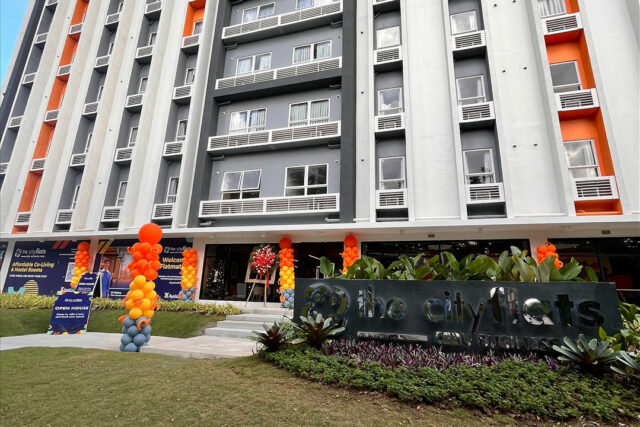
LISTED property developer Ayala Land, Inc. (ALI) has opened its second CityFlats co-living development in Cebu, aiming to capture demand from young professionals for affordable housing near major business hubs.

“Our goal is to make our estates more livable by providing practical, well-located homes for the city’s workforce. Young professionals shouldn’t have to sacrifice time, mobility, and community just to live in the city,” ALI Deputy Head of VisMin Estates Jay S. Teodoro, Jr. said in a statement on Monday.

Co-living developments have gained traction nationwide, particularly among millennials and Generation Z workers seeking curated living spaces with flexible lease terms.

The new CityFlats property has 392 rooms, each equipped with a workstation, bed, storage space, air-conditioning, a mini-kitchen, and an in-room toilet and bath.

About 80% of the development is allocated to long-stay co-living units, while the remaining rooms are intended for short-term guests such as business travelers, tourists, and employees on temporary assignments.

The property also features persons with disability-friendly units, retail spaces housing a convenience store and laundromat, and shared amenities, including a social hall designed for wellness activities and community events.

Daily rates start at P1,800 per night for short-term stays, while monthly co-living rates begin at P6,100, targeting employees, young professionals, students, and digital freelancers.

The development is located along Leyte Loop within Cebu Business Park, ALI’s 50-hectare information technology economic zone registered with the Philippine Economic Zone Authority.

“As more professionals seek to reduce commute times and manage living costs, co-living models such as The CityFlats are expected to play a growing role in urban housing,” ALI said.

ALI also operates CityFlats co-living properties in Cebu IT Park, Makati City, and Bonifacio Global City.

For the nine-month period, ALI posted a 0.9% year-on-year increase in attributable net income to P21.4 billion.

ALI shares rose by 3.92% or 85 centavos to close at P22.55 apiece on Monday. — Beatriz Marie D. Cruz

Entertainment News (12/16/25)


Taylor Swift docuseries goes to Disney+

TAYLOR SWIFT hosted a special screening in New York for the first two episodes of The End of an Era, a six-episode docuseries which is now available on Disney+. It talks about the goings on behind-the-scenes of Taylor Swift The Eras Tour. Two episodes will debut each week on Fridays. Disney+ will also premiere Taylor Swift | The Eras Tour | The Final Show, the full concert film captured in Vancouver, Canada.


Ben&Ben premieres concert film online

ONE YEAR after mounting a sold-out concert at the SM Mall of Asia Arena, Ben&Ben is inviting fans into the universe of Liwanag through The Traveller Across Dimensions: The Concert Film. The special full-length film, created in collaboration with LunchBox Productions, is now on YouTube, giving audiences the opportunity to relive the concert experience in full, free of charge.


Side A reunites for a two-day concert

SIDE A is returning with a special musical homecoming that reunites the founding and current members of the iconic Filipino pop band. Produced by Minsan Studio, the two-night concert will take place at the Metropolitan Theater in Manila on Feb. 21 and 22, and will feature orchestral arrangements by musical director Ria Villena-Osorio. Described as a big family reunion, Now & Then marks the union of two generations of Side A musicians, their catalog reimagined with a 30-piece orchestra. Tickets to the concert are available via minsan.studio.


IV OF SPADES releases Andalucia album on vinyl

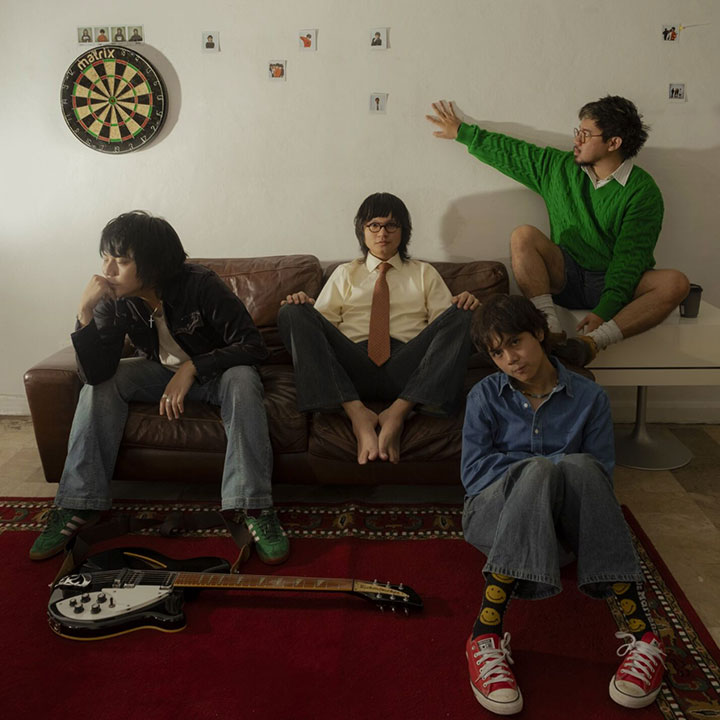
AWARD-WINNING Filipino pop-rock band IV OF SPADES is having an exclusive vinyl release of its latest album, Andalucia. A thousand copies of its first vinyl pressing (through Backspacer Records via their official website) are now available. The 12-track album is also out on all digital music platforms worldwide via Sony Music Entertainment.


Lionsgate Play offers unconventional Christmas movies

FOR THOSE who want something a bit different this holiday season, Lionsgate Play is offering action, mysteries, and dark thrills. One of these movies is Silent Night, about a grieving father who loses his son in a violent crossfire and vows revenge in a nearly wordless action thriller from legendary director John Woo. Another is P2, set during Christmas Eve, when an office worker staying late finds herself locked inside the building’s eerie underground parking level with a deranged security guard.


MTRCB head meets Disney+, Warner Bros., HBO execs

THE Movie and Television Review and Classification Board (MTRCB), under the leadership of Chairperson and Chief Executive Officer Lala Sotto, recently met with representatives from the Walt Disney Co. (Southeast Asia) Pte. Limited (Disney+), Warner Bros., and HBO, at the sidelines of its AVIA conference participation in Singapore. These Subscription Video On Demand (SVOD) services expressed interest in exploring partnerships with the Philippines’ television and film regulatory body to strengthen responsible viewing initiatives in the country. Ms. Sotto said they offered to the MTRCB the use of iconic characters and themes from popular franchises such as Harry Potter, DC, and Looney Tunes for use in strengthening media literacy initiatives across the Philippines. Disney+ also showed readiness to collaborate on a potential public service infomercial using iconic IP such as Marvel, Pixar, and classic Disney characters, the MTRCB said in a statement.


Sparkle GMA Artist Center welcomes new talents

THE Sparkle GMA Artist Center is ending the year with fresh collaborations with new artists. Some of the many artists it has signed are: multi-awarded actor Miggs Cuaderno, rising star Jess Martinez, actress-dancer-host Regine Tolentino, comeback actress Gwen Zamora, Mr. Chinatown Philippines 2025 Tyronne Tan, and Ms. Chinatown Philippines 2025 Yza Thalia Uy.

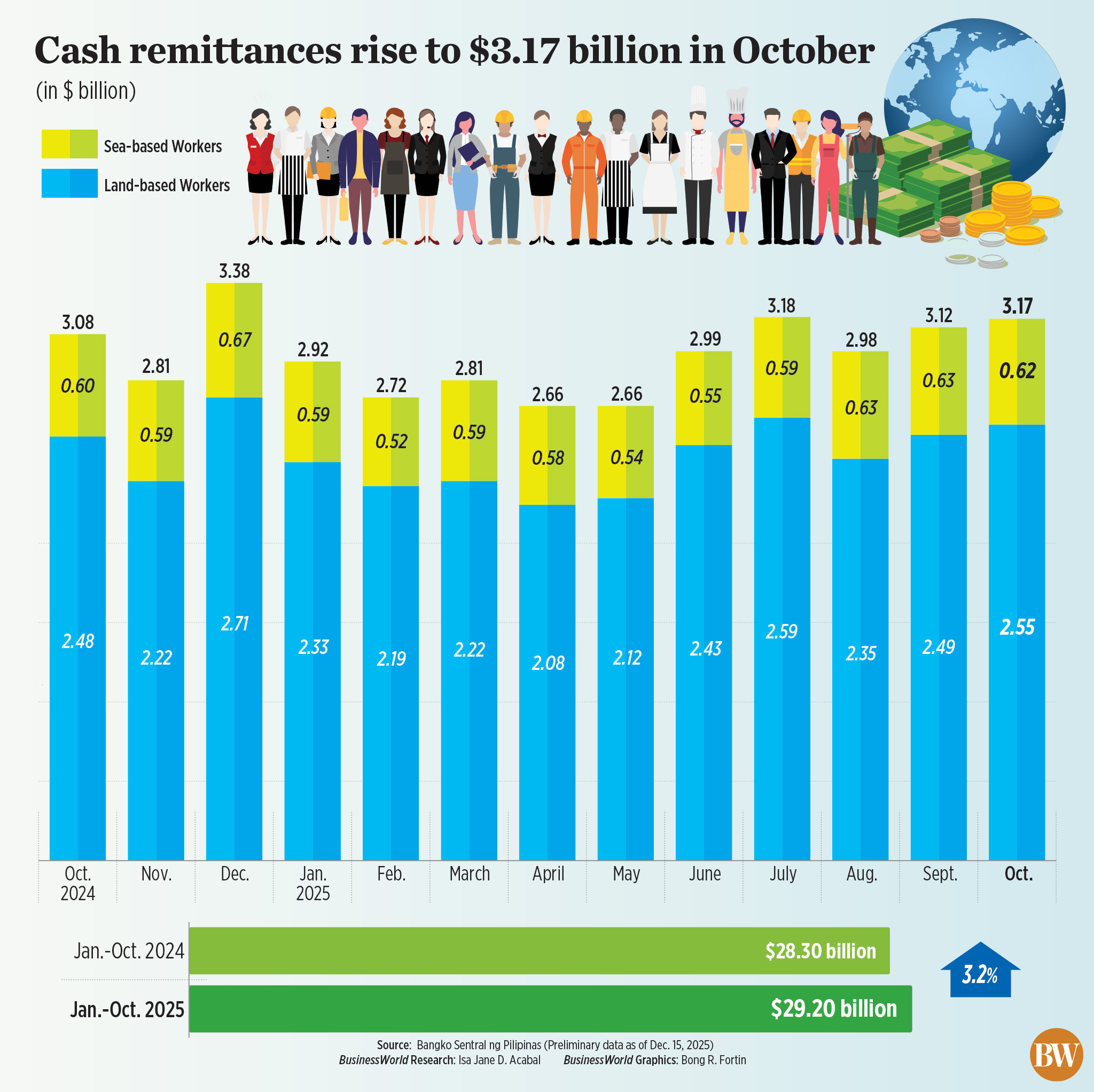
Cash remittances rise to $3.17 billion in October

MONEY SENT HOME by Filipinos abroad grew by 3% year on year in October, the slowest pace in five months, the Bangko Sentral ng Pilipinas (BSP) said on Monday. Read the full story.

ADVERTISEMENT
ADVERTISEMENT