Home Blog Page 5444

FIRB working on uniform procedure for suspending fiscal incentives

THE Fiscal Incentives Review Board (FIRB) said it expects to complete soon uniform rules to govern the suspension or withdrawal of tax incentives from registered enterprises that do not comply with the conditions of the grant, the Department of Finance (DoF) said on Thursday.

“The guidelines are meant to provide uniform rules for imposing penalties on non-compliant registered business enterprises (RBEs). FIRB’s power to suspend or withdraw tax incentives, or cancel business registration was granted under the Corporate Recovery and Tax Incentives for Enterprises (CREATE) Act,” the DoF said in a statement.

The DoF said a public consultation has been scheduled for the end of the month once the guidelines are approved by an FIRB Technical Committee.

The FIRB is also working on guidelines for dealing with the cancellation of a project or activity for which RBEs are sought incentives, the DoF said.

“The guidelines will clarify the procedure for RBEs when responding to a show cause order issued by their respective investment promotion agencies (IPAs) or the FIRB, or when filing an appeal from an adverse finding,” it added.

The FIRB also said it approved applications for tax incentives for new domestic enterprises operating tourist accommodation facilities and building common-tower telecommunications infrastructure. It gave no further details about the successful applications.

It said that the approved investment applications will “accelerate the present administration’s ongoing economic recovery efforts, specifically in areas of tourism and digitalization.”

“As we attract all types of big-ticket local and foreign investment, we also strive to be inclusive and not industry-specific in our grant of fiscal incentives. Largely, what we want to ensure is for these projects to result in a win-win situation for both the RBEs and the economy,” Finance Secretary and FIRB Chairman Benjamin E. Diokno added. — Luisa Maria Jacinta C. Jocson

New SRP bulletin still due for release this month 

A supermarket is seen in Quezon City, March 4 2022. — PHILIPPINE STAR/MICHAEL VARCAS

AN updated list of suggested retail prices (SRP) for manufactured goods remains due for release later this month, Trade Secretary Alfredo E. Pascual said. 

Mr. Pascual said his department’s Consumer Protection Group (CPG) is still reviewing the proposed price hikes of basic necessities and prime commodities (BNPCs) and the updates to be made to the SRP bulletin.

“Around January (we will issue the SRP bulletin) … That’s what we said last time… we will seriously look at the requests. The work is ongoing with the team of CPG,” Mr. Pascual told reporters recently.

Mr. Pascual said he expects the new SRP bulletin to be finalized once he returns from the World Economic Forum conference in the Swiss resort town of Davos, which runs between Jan. 16 and 20 in Davos.

Products that have pending price hike applications include canned goods, milk, coffee, and bread.

“Hopefully, by that time, the outlook for commodity prices will be clearer,” Mr. Pascual said.

According to Mr. Pascual, the review is experiencing snags because of price volatility.

“It’s difficult. You rely on the old high prices and then the prices suddenly fall. Another thing happening now is that the manufacturers are reviewing their products. They will decide what product they will include in the SRP list,” Mr. Pascual said.

“Other manufacturers are thinking of including even high-end products… technically, it is not necessary to include everything. Our interest is products that are usually consumed by the mass base of our consumers,” he added.

The latest SRP bulletin was issued by the department in August. The bulletin authorized price hikes for 67 out of 218 stock keeping units following surging production costs. The price increases ranged from 3.29% to 10%.

Some of the BNPCs authorized to raise prices were canned sardines, coffee, noodles, bottled water, processed milk, detergent soap, candles, and condiments. — Revin Mikhael D. Ochave    

PHL urged to diversify markets after achieving scale in services

THE Philippine service industry has achieved sufficient scale to start exploring diversification into new markets even during the looming global recession, economists said.

“The goal is to be able to expand our investments and trade in services, such as in food, business activities and health, beyond our borders since economies of scale in the service sector can now be feasible given new technology. Through research and development, we can create niches in agricultural and industrial markets through an expanded service sector,” Ateneo de Manila Economist Leonardo A. Lanzona, Jr., said in an e-mail.

China Banking Corp. Chief Economist Domini S. Velasquez added in an e-mail that the Philippines “is in a good place to take advantage of the growth momentum from 2022. Given the fiscal constraints brought about by the pandemic, the government has limited budget for investment-led spending. It needs to be able to prioritize investments that create quality jobs and that are climate resilient.”

In its recently released Global Economic Prospects report, the World Bank said the effects of the pandemic and the war in Ukraine are expected to extend the prolonged and broad-based slowdown in investment growth seen in the 2010s.

“Compared to the years following the global financial crisis, the investment recovery following the COVID-19 pandemic is proceeding more slowly. The slow recovery partly reflects the widespread impact of the pandemic on investment, which shrank in nearly three-quarters of emerging markets and developing economies (EMDEs) during the pandemic,” the World Bank said.

It also noted that both private and public investment growth were more sluggish during the 2010s than in the previous decade.

“For all EMDEs, projected investment growth through 2024 will be insufficient to return investment to the level suggested by the pre-pandemic trend. Investment weakness dampens long-term output growth and productivity, is associated with weak global trade growth, and makes meeting the development and climate goals more challenging,” it added.

According to the report, commodity-exporting EMDEs were projected to have lower investment growth rates than tourism-reliant EMDEs.

“It is not hard to imagine that export-dependent EMDEs will be facing limited investment growth in the next few years because this had been happening even before the pandemic.  This can be attributed to the huge market share that China has in the export market,” Mr. Lanzona said.

“The Philippines is somewhat different from the region in that it is not a heavy resource exporter nor is it particularly reliant on tourism compared to our neighbors like Thailand. Nonetheless, the Philippines should still benefit from increased investment outlays to bolster productive capacity on both fronts in particular by improving infrastructure quality and quantity,” ING Bank N.V. Manila Senior Economist Nicholas Antonio T. Mapa said in a Viber message.

Terry L. Ridon, a public investment analyst, said tourism can be a growth driver but will require enhancements to infrastructure.

“In the same manner that the BPO (business process outsourcing) and semiconductor sectors are pillars of economic growth, the tourism sector generates growth due to the inflow of foreign spending… However, it will be difficult to grow the tourism sector without adequate infrastructure supporting tourism areas and facilities, as the country will be competing with world-class infrastructure and tourism facilities in other countries, particularly our ASEAN counterparts,” Mr. Ridon said in an e-mail.

Mr. Ridon said that the government should identify where it intends to improve tourism infrastructure.

“This includes improving our international airports, such as the Ninoy Aquino International Airport, and expediting the construction of new ones, such as the New Manila International Airport in Bulacan. The government should also determine whether adequate transport options are available for tourists, to bring them to both well-known tourist hubs and developing areas,” he added.

The World Bank recommended that resources be allocated away from subsidies to fund investment growth in EMDEs.

“Macroeconomic policy can support investment in EMDEs in a variety of ways, including through preserving macroeconomic stability.  Even with constrained fiscal space, spending on public investment can be boosted by reallocating expenditures, freeing resources by moving away from distorting subsidies, improving the effectiveness of public investment, and strengthening revenue collection,” the bank said.

“Structural policies also play a key role in creating conditions conducive to attracting investment. Institutional reforms could address a range of impediments and inefficiencies, such as high business startup costs, weak property rights, inefficient labor and product market policies, weak corporate governance, costly trade regulation, and shallow financial sectors,” it added.

Setting appropriate, predictable rules governing investment, including for public-private partnerships (PPPs), is also important, the World Bank said.

“The government’s plan to use PPP should be able to augment infrastructure needs. In the next few years at least, the private sector would need to step up to spur economic growth. But at the same time the government should exert efforts to boost competitiveness and ease the cost of doing business to pave the way for private investment,” Ms. Velasquez said.

“PPPs can help, but a more accommodative policy environment may also help boost investment outlays in the medium term,” Mr. Mapa added.

Mr. Lanzona cited the need to invest in human capital.

“While infrastructure may seem to be important, investments in human capital would be more vital if we are to maximize our potential in digital technology. In fact, we have been frontrunners in this area through our business processing outsourcing (BPO) companies, and it is just a matter of expanding this sector further,” he added. — Luisa Maria Jacinta C. Jocson

ASEAN sugar seen generating most savings if PHL imports

BUREAU OF CUSTOMS FACEBOOK PAGE

SUGAR imports from within the Association of Southeast Asian Nations (ASEAN) are expected to yield the Philippines savings of $480.82 per metric ton, the United States Department of Agriculture (USDA) said.

Imports from ASEAN are subject to more favorable trade terms than goods from trade partners enjoying Most Favored Nation (MFN) status, for which savings are estimated at $128.02 per metric ton, the USDA said in a report.

“If the Philippines were to honor its commitments under the (World Trade Organization) and ASEAN… sugar prices are estimated to decline by $480/MT from ASEAN and $128/MT, at 50% tariff… if outside ASEAN,” the USDA said.

Last year, the Philippine Department of Agriculture (DA) said it is expediting the import of 64,050 MT of refined sugar to stabilize prices of the sweetener.

The DA said it is convening the minimum access volume (MAV) advisory council to facilitate imports via the MAV mechanism.

MAV governs the volumes of agricultural import commodities that a WTO signatory must admit from trading partners, essentially a commitment by members not to completely close off their markets to foreign products.

“Through its membership in the WTO, the Philippines bound itself to the implementation of a tariff-rate quota on sugar, wherein MFN trading partners are entitled to export 64,050 MT each year at an in-quota tariff of 50%,” the USDA said in its report. — Ashley Erika O. Jose

China still keen on exploration talks with Philippines — envoy

BW FILE PHOTO

By Kyle Aristophere T. Atienza, Reporter

CHINA is still committed to pursue joint oil exploration activities in the South China Sea with the Philippines and other claimant states, a Chinese envoy said on Thursday, after the Philippine Supreme Court voided a similar deal inked in 2005.

“China remains committed to properly handle maritime disputes in the South China Sea with countries directly concerned, including the Philippines, through dialogue and consultation,” Wang Wenbin, spokesman of China’s Ministry of Foreign Affairs, said in a statement.

It would “actively explore ways for practical maritime cooperation including joint exploration,” he added.

The Supreme Court voided a 2005 government deal with China and Vietnam for joint gas and oil exploration in the South China Sea.

The tribunal had ruled the agreement violated the Constitution for allowing foreigners to explore the country’s natural resources covering 142,886 square kilometers without full state supervision, it said in a statement on Tuesday.

But Mr. Wang said the exploration deal is an “important step” for the three countries to enforce a 2002 declaration signed by Southeast Asian nations and China on the conduct of parties in the South China Sea, adding that it is  a “useful experiment” for maritime cooperation among South China Sea claimants.

“It played an important role in promoting stability, cooperation and development in the region.”

The declaration promotes freedom of navigation, peaceful settlement of disputes, and self-restraint in the South China Sea.

The Philippines under former President Gloria Macapagal-Arroyo entered into the joint exploration deal with China and Vietnam through their state-owned oil companies in 2005. These were the state-run Philippine National Oil Co., China National Offshore Oil Corp. and Vietnam Oil and Gas Corp.

The constitution reserves the exploration, development and use of natural resources to Filipino citizens, or corporations or associations that are at least majority owned by Filipinos, the court said.

The ruling came more than 14 years after the plaintiffs filed the lawsuit.

In a statement, the Philippine’s Foreign Affairs department said its policy recommendations are, “at all times” anchored on the Philippine Constitution and laws.

“Cases decided by the Supreme Court form part of our legal system, and the department is duty-bound to take applicable cases into consideration in any future discussion with China on oil and gas,” it added.

But the agency said it was premature to discuss the legal implications of the case on future agreements with China “as substantive discussions have yet to commence.” “We are still in the process of setting the parameters that will guide any future oil and gas talks.”

The ruling is seen as another obstacle to Chinese efforts to revive oil and gas exploration talks with the Philippines.

The latest attempt was made in 2018, when the Philippines under former President Rodrigo R. Duterte signed a memorandum of understanding with China to conduct a joint oil and gas exploration in the disputed waterway.

The Duterte government ended the deal in June, citing constitutional and sovereignty issues.

“It doesn’t really matter what the Ministry of Foreign Affairs says now because our government will have no choice but to follow the Supreme Court decision,” Michael Henry Ll. Yusingco, a policy analyst, said in a Facebook Messenger chat.

“It will be utterly foolish of this administration to proceed with this initiative in any other way or manner other than what the Supreme Court has laid out in this decision,” he added.

‘BOUND’
In the statement, Mr. Wang noted that during President Ferdinand R. Marcos’ visit to Beijing last week, both sides agreed to “bear in mind the spirit” of the 2018 memo and “resume discussions on oil and gas development at an early date, building upon the outcomes of the previous talks.”

Terry L. Ridon, a lawyer and investment analyst, said any exploration talks with China would now be bound by the tribunal’s decision, which he said “limits exploration, development and use of natural resources to Filipino citizens or companies with at least 60% Filipino equity.”

“With the new ruling, bilateral talks with Beijing will now center on whether China will accede to a minority stake in exploration firms seeking to find oil and gas in disputed waters,” he said in a Messenger chat.

China claims more than 80% of the South China Sea, which is believed to contain massive oil and gas deposits and through which billions of dollars in trade passes each year. It has ignored a 2016 ruling by a United Nations-backed arbitration court that voided its claim based on a 1940s map.

The Philippines has been unable to enforce the ruling and has since filed hundreds of protests over what it calls encroachment and harassment by China’s coast guard and its vast fishing fleet.

China’s aggression had compelled the Philippines to look for foreign partners for its oil and gas exploration activities despite the 2016 international ruling that clarified its territories at sea.

Mr. Yusingco said the high court had shown the Marcos government how to proceed with any gas and oil talks with China, “so it’s only natural to expect the government to follow this consistently and faithfully.”

Meanwhile, research firm GlobalSource Partners in a report said the Marcos government has been managing well the difficult balancing act of reestablishing close ties with the US, while reassuring China about their relations that both have said go beyond maritime issues.

“Playing the ‘friend to all’ card could bring not only direct economic gains in the short term but, through higher level communication lines, avoid more untoward incidents in the disputed waters and in time, bring discussions on joint oil and gas development projects in the [South China Sea] beyond the drawing board,” GlobalSource analyst Romeo L. Bernardo said in the report.

The Philippines also stands to benefit from an expected resurgence in Chinese tourists, improved supply chains and a likely revival of both public and private projects after China’s reopening and exit from its Zero-COVID policy, he said.


Rights abuses continue under Marcos, says HRW

PHILIPPINE STAR/MICHAEL VARCAS

HUMAN rights abuses continued in the first six months of Philippine President Ferdinand R. Marcos, Jr.’s rule, according to Human Rights Watch (HRW).

In a global report released on Thursday, the global watchdog said drug war killings, communist tagging and attacks against journalists continue to damage the country’s democratic institutions.

“President Marcos has sought to reassure the international community that he is committed to human rights,” it said. “Human rights and civil society groups, however, debunked these claims with reports to the United Nations Human Rights Council of continuing human rights violations.”

Law enforcers killed more than 6,000 drug suspects in police raids on July 1 to May 31 last year, HRW said, citing government data.

“After Marcos took office, the government stopped releasing these statistics,” it said. “The official death toll does not include those killed by unidentified gunmen whom Human Rights Watch and other rights monitors have credible evidence to believe operate in cooperation with local police and officials.”

The authorities have seriously investigated very few drug war killings, Human Rights Watch said in the report. “Only a handful of cases — 12 out of thousands — are in varying stages of investigation by police or active review by prosecutors.”

There is only one case — the video-recorded murder of 17-year-old student Kian delos Santos in August 2017 — that resulted in the conviction of police officers, it added.

Journalist killings and harassment also persisted in the past year, HRW said. In July, the government sought to silence journalists critical of the administration by shutting down the websites of Bulatlat and Pinoy Weekly, two alternative press publications.

The National Security Council sought to close these two outlets because of alleged links to communist insurgency, a charge the editors and journalists denied.

“During the year, the government used the Cyber-libel law several times against journalists, columnists, critics of the government and ordinary social media users,” HRW said. “In August, police arrested activist and former member of parliament Walden Bello after a staff member in the office of Vice-President Sara Duterte-Carpio, the daughter of Mr. Duterte, made allegations against him.

The Justice department’s Office of Cybercrime reported that 3,700 cyber-libel cases had been filed as of May 2022. Of that number, 1,317 were filed in court while 1,131 were dismissed.

Twelve cases ended in a conviction. Among those who have been convicted of cyber-libel was Maria Ressa, chief executive officer of news website Rappler, it said.

HRW cited the detention of former Senator Leila M. de Lima, who has been in jail since 2017 on drug trafficking charges. It urged the government to drop what it called were trumped-up charges against her.

At least four witnesses have taken back their allegations of her involvement in the illegal drug trade.

Ms. De Lima, one of ex-President Rodrigo R. Duterte’s fiercest critics, has asserted her innocence, saying she was being tried for criticizing the government’s deadly drug war.

“The reality is nothing has changed but only a change in tone and a greater effort in public relations,” Human Rights Watch Deputy Asia Director Phil Robertson told a separate briefing streamed live on Facebook. “There has to be accountability on the ground, not just talking about an investigation.” — Norman P. Aquino and JVDO

Philippines’ DFA calls out Ukraine envoy for bad diplomatic practice

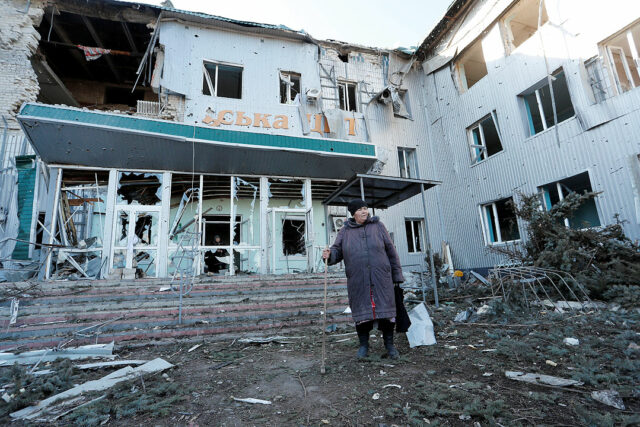
A WOMAN stands outside a local hospital, which was destroyed during Ukraine-Russia conflict in the separatist-controlled town of Volnovakha in the Donetsk region, Ukraine, March 12, 2022. — REUTERS

THE PHILIPPINES on Thursday called out a Ukraine envoy for telling Filipino journalists that Manila had not responded to Kyiv’s request for a phone call between President Volodymyr Zelensky and Philippine President Ferdinand R. Marcos, Jr.

What Denys Mykhailiuk, counselor of the Ukraine Embassy in Malaysia, did recently was “not good diplomatic practice,” Philippines’ Foreign Affairs (DFA)Undersecretary Carlos D. Sorreta told a news briefing.

“We don’t really appreciate when these things are done,” he said. “Ukraine is a country we have a good relationship with, but when matters like this are vented by representatives of another government through the press, it’s not something that we appreciate.”

“If he wants this to happen, we have to discuss it,” the Philippine envoy said. “These things are arranged, talking points are discussed in the pre-discussion. It’s not good diplomatic practice to be doing it that way.”

Mr. Sorreta was the Philippines’ envoy to Russia before his current post. He also served as assistant secretary for American affairs in 2012 to 2014.

On Wednesday, Mr. Mykhailiuk said Kyiv had been trying to arrange a phone call between Mr. Zelensky and Mr. Marcos to discuss Russia’s invasion of Ukraine.

He said the Ukraine government had been seeking the call since Mr. Marcos took office in June. “We haven’t gotten a reply from the presidential office yet.”

Government officials might have been busy with local administration and in trying to connect with China and the United States, the envoy said.

The counsellor thinks the Philippines could support Ukraine in many areas, including sending ammunition or medical equipment to help displaced civilians.

In a separate statement, the Department of Foreign Affairs (DFA) said the Philippines supports calls for a peaceful resolution of the conflict between Ukraine and Russia. “The Philippines and Ukraine have held high level-interactions as recently as November 2022, when DFA Secretary Enrique A. Manalo met with Ukrainian Foreign Minister Dmytro Kuleba on the sidelines of the 40th and 41st ASEAN Summits held in Cambodia,” it said.

“During the ASEAN Summits in Cambodia, the Philippines expressed strong support for Ukraine’s accession to the Treaty of Amity and Cooperation of Southeast Asia,” it added.

“We have supported efforts in the United Nations not only to seek a peaceful end to this conflict, but also to address the pressing and urgent humanitarian issue of displaced civilians.”

As of Jan. 2, almost 7,000 civilians have been killed during Russia’s invasion of Ukraine including 429 children, according to the Office of the United Nations High Commissioner for Human Rights. The number could be higher, it said.

DFA said the Philippines has a long tradition of providing refuge to civilians fleeing from conflict as well as protecting civilians in conflict “through our many decades of involvement in peacekeeping.”

It said it has “strongly supported” the European Union’s (EU) 10-point plan for stronger European coordination on welcoming people fleeing the war from Ukraine and the United Nations’ resolutions on the Russia-Ukraine war.

“The same support to Ukraine was reflected in the Joint Statement of the ASEAN and EU leaders in Brussels in December last year, to which the Philippines was country coordinator,” it added. — Kyle Aristophere T. Atienza

Solons file bill on airline passengers’ rights; CAAP takes full blame on Jan. 1 airport hassle

PHILIPPINE STAR/ MIGUEL DE GUZMAN

A GROUP of lawmakers filed a bill on the rights of airline passengers which, if passed into law, will replace what they called the ineffective2012 order containing the countrys Air Passenger Bill of Rights and Carrier Obligations.   

We need a law that would truly protect airline passengers and also serve as a deterrent to sloppy and inefficient work practice in the airline industry that caused the shutdown in NAIA (Ninoy Aquino International Airport) last New Year’s Day,said House Deputy Minority Leader France L. Castro, who led the filing of House Bill 6738 on Jan. 9.  

The existing Philippine bill of rights for air travelers is contained in a joint administrative order issued by the Department of Transportation and Communication, now the Department of Transportation, and the Department of Trade and Industry in Dec. 2012.   

This bill if enacted will replace the ineffective DOTC-DTI Joint Administrative Orderand will also be useful in cases to be filed against negligent or incompetent aeronautic government agencies or GOCCs (government-owned and controlled corporations),said Ms. Castro, also the ACT Teachers Party-list representative.  

Providing safe, efficient, and convenient service to its customers is a strictly construed obligation of an airline company,the bills explanatory note read.  

The measure includes obligations of the Civil Aviation Authority of the Philippines (CAAP), airport operators, and airlines in case of flight delays and cancellations similar to the technical glitch that affected all airports on Jan. 1.  

Under HB 6738, a passenger must be compensated promptly and expeditiouslyin case of flight delays or cancellations, death or injury, and loss or deterioration of a passengers baggage and property.  

Passengers must be informed of the reason for its delay via public announcement; be provided minimum level of care immediately; be offered sufficient free meals and refreshments, free phone calls, texts, fax, emails, internet access, or other means of communications, and free first aid.   

A passenger can also cancel their reservation and ask for refund or rebooking, or ask for endorsement to another airline.  

Gabriela Party-list Rep. Arlene D. Brosas and Kabataan Party-list Raoul Danniel A. Manuel also signed the bill.   

FULL RESPONSIBILITY
CAAP, meanwhile, has taken full responsibility for the air traffic management glitch that hit the Philippines on New Years Day.  

During a Senate Committee on Public Service hearing on Thursday, CAAP Director General Manuel Antonio L. Tamayo took the blame for the glitch that disrupted air operations nationwide and affected more than 65,000 passengers.   

We again extend our sincerest apologies to all those who were inconvenienced and greatly affected by this circumstance which is something we are not proud of,he said.  

The Senate hearing comes after a similar probe at the House of Representatives on Tuesday.    

We take this as a lesson, and we manifest to this honorable committee and fellow Filipinos that we take full responsibility and accountability for what happened,Mr. Tamayo said. 

We commit to see through this ordeal and remain transparent in all our dealings and of service to the Filipinos in ensuring that our skies are safe,he added.  

Senator Ramon BongB. Revilla Jr., vice chairperson of the committee, said the glitch was unacceptable especially because of the massive inconvenience it has caused the people.  

This is not the introduction we want for the new year and in our expected recovery of the economy and tourism,he said in Filipino.  

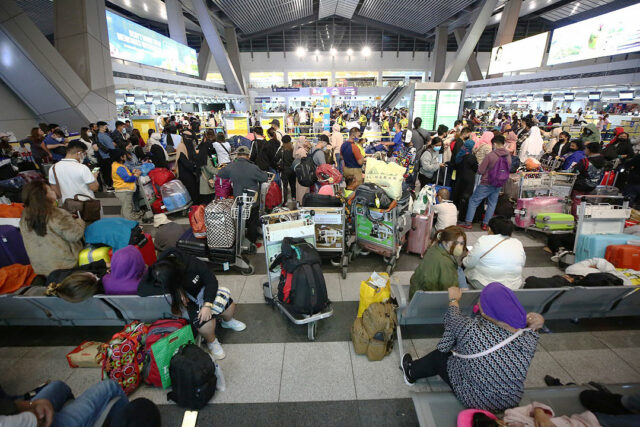
The fiasco resulted in operational shutdown not only of the Ninoy Aquino International Airport (NAIA), the countrys main gateway, but all airports in the country, causing flight cancellations and delays.  

As reported by CAAP, the disruption happened when an automatic voltage regulator malfunctioned, affecting the uninterruptible power supply and de-energized the communications, navigation and surveillance systems for air traffic management equipment.  

We seek for the truth behind the recent system glitch,said Mr. Revilla who, on the same day, filed a measure seeking to strengthen CAAP and amend the countrys 2008 aviation law.  

The bill seeks to increase the term of CAAP Director-General to seven years, exempt CAAP from the Salary Standardization Law, and enhance their fiscal autonomy. Beatriz Marie D. Cruz and Kyle Aristophere T. Atienza 

Gov’t has P1.3-B budget for free bus rides this year — DBM

PHILIPPINE STAR/ MIGUEL DE GUZMAN

THE GOVERNMENT has allocated P1.285 billion in this years budget for the continuation of free bus services nationwide, including the EDSA Busway system in Metro Manila, the Department of Budget and Management (DBM) said on Thursday.  

We understand the plight of our commuting public. The service contracting program, which funds Libreng Sakayis a big help. This will be a big help for everyday commuters,Budget Secretary Amenah F. Pangandaman said in a statement. 

Buses serving the EDSA route started charging fares on Jan. 1 as the governments free ride program ended on Dec. 31. Contracts for free rides elsewhere in the country ended earlier last year.   

Whatever amount they save daily, they can reallocate to equally or more important needs such as budget for food, electricity, tuition fee, among others, she said.   

The bus service contracting program under the Department of Transportation (DoTr) and the Land Transportation Franchising and Regulatory Board (LTFRB) was initially launched in late 2020 as part of response measures for the coronavirus pandemic.  

As of Dec. 27, the LTFRB recorded a total of around 165 million passengers who have availed of the Libreng Sakay program along EDSA in the preceding year.   

This number does not include beneficiaries in other parts of the country, mostly main urban areas, where the program was also rolled out.  

DBM Undersecretary Goddes Hope O. Libiran said the DoTr will be in charge of deciding how this years budget will be utilized.  

Since the DoTr is the implementing agency, it is up to them to identify the scope or coverage of the program. They have the option to spread or limit its coverage, based on the result of their study,she said in a Viber message. Luisa Maria Jacinta C. Jocson 


Aboitiz group to help Davao City gov’t in project for ease of doing business 

BW FILE PHOTO

THE ABOITIZ Group of Companies signed an agreement with the Davao City government on Wednesday for a project that aims to make public service procedures more efficient through digitalization.   

Project Bilis Davao, targeted for completion within the year, will cover the issuance of building and business permits, tax mapping, and the use of online payment channels.  

The Aboitiz groups ventures in Davao City include power generation and distribution, and bulk water supply.  

The rise of the digital age has transformed us allIt has since created the need for a more flexible way of doing things, including the integration of online processes in our day-to-day business, Anton Mari G. Perdices, senior vice president and chief operating officer of Aboitiz Power Corp., said during the signing ceremony.   

Mr. Perdices said the project will help improve the ease of doing business in the city, attract more investments and promote economic growth.   

Rodger S. Velasco, president and chief operating officer of Davao Light and Power Company (DLPC), said a technical working group will be formed composed of representatives from Aboitiz, the city government, and the business sector.  

Davao City Mayor Sebastian BasteZ. Duterte, for his part, said the project will encourage further innovation in public service as the local government works towards adopting digital technology in other processes.   

Online transaction and payment systems provide a world of convenience for everyone compared to manual systems,he said. 

Meanwhile, the continuing underground cabling project of DLPC in the city has been benchmarked by the Department of Public Works and Highways (DPWH) for replication in other parts of the country, according to Mr. Velasco. 

The Aboitiz group has also renewed its partnership with the city government and the Department of Environment and Natural Resources for the protection of the critically endangered Hawksbill Sea Turtle through the Aboitiz Cleanergy Park.  

DLPC is also in the process of converting the citys streetlights to LED in line with a 2018 local ordinance on sustainability.   

We look forward to more partnerships and projects with the city government of Davao,Mr. Perdices said. Maya M. Padillo

SC upholds plebiscite results on Cotabato City’s inclusion in Bangsamoro 

CITY GOVT OF COTABATO FACEBOOK PAGE

THE SUPREME Court (SC) has upheld the results of the 2019 plebiscite that included Cotabato City in the Bangsamoro Autonomous Region in Muslim Mindanao (BARMM).  

The High Court unanimously dismissed a petition that alleged fraud during the electoral exercise due to lack of evidence, it said in a statement on Thursday.  

“The mere allegation that the inclusion of Cotabato City in the newly-formed Bangsamoro Autonomous Region in Muslim Mindanao was not the true intention of the voters of Cotabato City will not persuade this Court to overturn the actions of the Commission on Elections (Comelec),” it said in the ruling.  

The tribunal has yet to upload a copy of the decision on its website.  

Comelec had complied with the requirements of the Bangsamoro Organic Law in conducting the plebiscite and did not abuse its discretion, the tribunal said.  

The petition was filed by members of the National Plebiscite Board of Canvassers in Cotabato City, which sought an injunction on the results.  

In 2019, a total of 38,682 residentscomprising a majority voted in favor of the Bangsamoro Organic Law, which included Cotabato City in the new Bangsamoro region.  

The city, although geographically within Maguindanao province that was already part of the now defunct Autonomous Region in Muslim Mindanao (ARMM), was previously under the SOCCSKSARGEN region.  

The ARMMs headquarters, now the Bangsamoro Government Center, is within Cotabato City.   

The new BARMM, borne out of a peace agreement between the government and the Moro Islamic Liberation Front (MILF), has expanded political and financial autonomy.  

In the May 2022 national and local elections, members of the United Bangsamoro Justice Party, the MILFs political party, won the top seats and a majority of the council in Cotabato City. John Victor D. Ordoñez

Paleng-QR payment system launched in Bohol’s Tagbilaran market 

MAYA PHOTO HANDOUT

THE GOVERNMENTS Paleng-QR program, which aims to expand the countrys digital payment system, has been launched in Bohol, the first stop for the Central Visayas region.  

In a statement on Thursday, digital banking and money app company Maya, the first financial services platform to adopt QR Ph, said cashless transactions are now available at the public market in Tagbilaran City, the capital of Bohol.     

Small merchants and Filipino consumers are not only enjoying a hassle-free payment experience for their everyday transactions with Maya QR but also creating a financial footprint that allows them to access more advanced banking services offered by Maya,said Maya Head of Enterprise Business Mar Lazaro.   

Apart from vendors at the public market, tricycle drivers as well as other micro, small and medium enterprises are also encouraged to adopt the cashless payment system.   

The Paleng-QR Ph initiative, led by the Banko Sentral ng Pilipinas and the Department of Interior and Local Government, was initially rolled out last year in Baguio City in northern Philippines and in Davao City in the south.