Philippines’ 3-term school shift sparks worry over workload, learning gaps
By Justine Irish D. Tabile, Senior Reporter
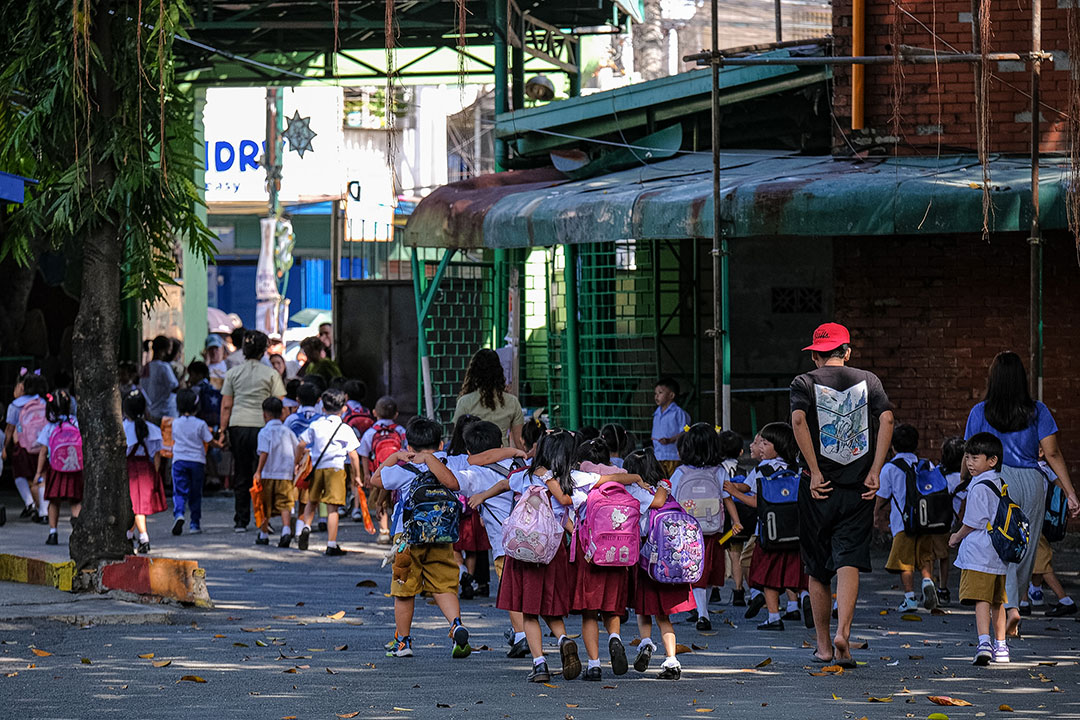
KAYLA JOY T. AGANA had already mapped out the coming school year in her head — drop-offs before work, a steady weekly rhythm and a predictable calendar she could build her routine around.
But that plan began to unravel when she heard about the government’s proposal to shift to a three-term school calendar.
 “It feels like an added burden for the parents because this is not just about the school schedule; it will directly affect us too,” said Ms. Agana, a 26-year-old government employee preparing to enroll her child in Grade 1 for the 2026-2027 academic year.
Like many working parents, she relies on consistency to manage both her job and childcare.
The prospect of longer breaks between terms, and the uncertainty of how these will be structured, has raised questions. “If it happens, I will have to figure out who will take care of my child during the breaks,” she said.
Her concerns come as the government moves forward with a major shift in the basic education calendar.
Last month, the Economy and Development Council approved the Department of Education’s (DepEd) proposal to adopt a trimester system beginning in the 2026-2027 school year.
The system will divide the academic year into three terms instead of the four-quarter system, with built-in breaks meant for assessment, remediation, and teacher training.
Under the setup, the first term will begin in June and run for 69 days, followed by a mix of instructional time and end-of-term activities. Subsequent terms will follow similar patterns, with dedicated periods for academic recovery and co-curricular work. The reform is meant to address persistent disruptions — particularly from typhoons — that have repeatedly cut into classroom time.
But for parents like Ms. Agana, the shift is less about pedagogy and more about daily life. “The plan was simple, it is to follow a stable and predictable school schedule,” she said. “Now, with the shift to a trimester system, it feels like we have to adjust all over again.”
Her skepticism is also shaped by experience. As part of the first batch to undergo the K-12 program, she recalls a system that felt rushed and, in her view, poorly implemented.
“It feels like I spent additional years but I did not really get to apply what I learned,” she said. “So, hearing about another big change makes me worried.”
Education stakeholders acknowledge that the reform carries both promise and risk.
Christopher “Happy” A. Tan, country head of PHINMA Education Philippines, said the trimester system could help preserve learning continuity in a country frequently hit by disruptions.
However, he stressed that success would depend heavily on how the system is implemented on the ground.
“DepEd’s new trimester calendar seeks to improve learning continuity amid repeated class disruptions,” he said in an e-mailed reply to questions. “But to make this work for all students — especially those from low-income backgrounds — we suggest close attention to how learning time is actually experienced on the ground.”
He noted that while the calendar includes enrichment or recovery periods, these could reduce total instructional time if not used effectively.
This makes real-time interventions during the term even more critical, particularly for students who may fall behind due to absences or other challenges.
‘NOT A SYSTEM REFORM’
The Philippine Business for Education (PBEd) said the reform is a step in the right direction — but not a complete solution.
“The move to a three-term school year is a practical step to better protect instructional time and allow for more structured learning and remediation,” PBEd Executive Director Hanibal E. Camua said via Viber. “However, it remains a calendar reform — not a system reform.”
He said improvements in curriculum delivery, assessment systems, and school-level execution should accompany the change.
Without these, the trimester calendar risks becoming a structural adjustment with limited impact on actual learning outcomes.
Teachers, meanwhile, are bracing for the transition.
Jessica P. Paz, a Grade 5 teacher with more than three decades of experience in a public school in Quezon province, said educators are concerned about the additional workload the system might bring.
“Teachers are worried because we think more work will be added to our responsibilities,” she said in Filipino.
She also expressed concern about how students — particularly those in lower-performing sections — would cope with a potentially more compressed pace of lessons under the trimester system.
“We fear that students will have an even harder time understanding lessons because the trimester system may compress the teaching pace, especially for those in lower sections,” she added.
Ms. Paz wants the government to provide sufficient training and reduce nonteaching tasks to help educators adapt.
“I hope that they will reduce our paperwork and give us more time to adjust,” she said, pointing to existing reporting requirements that already consume significant time.
Despite these concerns, some sectors see potential long-term benefits.
The IT and Business Process Association of the Philippines said the shift reflects efforts to strengthen learning continuity and improve workforce readiness.
“Talent development remains a priority for the IT-BPM (Information Technology and Business Process Management) industry, and more consistent instructional time can help strengthen the foundational and digital skills needed for the workforce,” it said in an e-mailed reply to questions.
Still, the consensus among educators and analysts is clear: the success of the trimester system will hinge not on the calendar itself, but on execution.
Clear learning targets, timely monitoring of student progress and effective remediation mechanisms are needed to ensure that no student is left behind, Mr. Camua said.
For Ms. Agana, however, those broader goals feel distant compared with the immediate realities she faces as a parent.
“All we want is something stable,” she said. “Everything else in our lives depends on that.”