Home Blog Page 5443

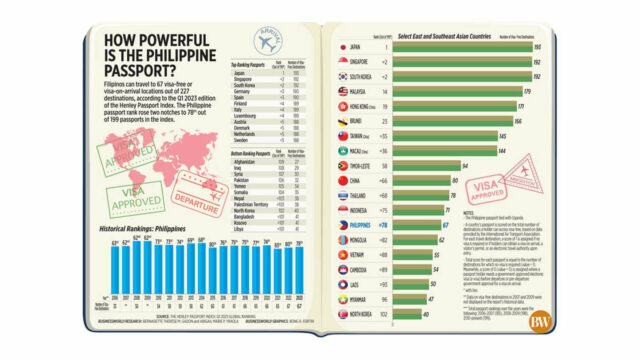
How powerful is the Philippine passport?

Filipinos can travel to 67 visa-free or visa-on-arrival locations out of 227 destinations, according to the Q1 2023 edition of the Henley Passport Index. The Philippine passport rank rose two notches to 78th out of 199 passports in the index.

How powerful is the Philippine passport?

What To See This Week (01/13/23)

GERARD BUTLER and Mike Colter in Plane (2023)

Plane

COMMERCIAL pilot Brodie Torrance saves his passengers during a horrible storm by making a risky landing on a war-torn island. But it turns out that is just the beginning of their problems. When most of the passengers are taken hostage by rebels, Torrance and an accused murderer must try to rescue them. Directed by Jean-François Richet, the film stars Gerard Bulter, Mike Colter, and Yoson An. Barry Hertz of the Globe and Mail writes: “It is all such gloriously smart stupidity that you cannot help but applaud everyone involved for sticking the landing.” The film gets a score of 68% “Fresh” from review aggregate site Rotten Tomatoes’ TomatoMeter.

MTRCB Rating: PG

Group presses DTI action on Shopee delivery delays

LOCAL advocacy group Digital Pinoys has called on the Department of Trade and Industry (DTI) to take action against the alleged delayed delivery of parcels by e-commerce platform Shopee.

In a statement on Thursday, the group said that many orders bought during Shopee’s 12.12 sale (Dec. 12 sale) and even earlier have not arrived and were tagged missing, adding that many parcels went missing in Shopee’s sorting hubs.

“The DTI should look into this as it is causing great deal of inconvenience for customers, the sellers in their platform and the delivery riders. There are already numerous complaints and it is high time to act on it,” Digital Pinoys National Campaigner Ronald Gustilo said.

The group said that sellers on the platform are also facing issues, claiming that items were reportedly missing in Shopee’s custody. It added that the sellers were charged fees but the items were missing or were returned to them.

“Many sellers are now disgruntled because they are paying for a platform fee, commission fee, packaging and delivery, among many other fees to use the platform but Shopee can’t even get the sorting done right. Sellers are losing their earnings and are still being charged despite the platform’s inefficiencies,” Mr. Gustilo said.

“Shopee should pay for all charges incurred by the sellers with undelivered parcels due to its inefficiency. It is unfair to make the sellers shoulder the return delivery fee after Shopee messed up big time. Even the packaging cost should be refunded by Shopee. They should also issue refunds immediately for all affected customers with paid parcels, no ifs and buts and no condition,” he added.

Sought for comment, Trade Undersecretary Ruth B. Castelo said in a Viber message that the DTI has been receiving numerous complaints about delayed deliveries since late last year.

“If a consumer files a complaint with DTI on delayed deliveries against a particular platform, the case is immediately resolved through mediation,” Ms. Castelo said.

“However, if the consumer impleads the logistics provider as an additional respondent, we have no choice but to endorse the complaint to DICT (Department of Information and Communications Technology) because they are the ones that have jurisdiction over courier service providers,” she added.

BusinessWorld sought the side of Shopee on the allegations but it has yet to respond as of deadline time. — Revin Mikhael D. Ochave

Prediction vs forecast

AT the start of each year, we always read and hear about predictions and forecasts from pundits and analysts, such as “The 10 Marketing Predictions for 2023” or “Economic Forecasts for 2023” or “Top Technology Predictions for 2023.” In fact, there are several pubic fora where business and political leaders converge for an annual bout of crystal-ball gazing.

Many use the terms “prediction” and “forecast” interchangeably and loosely to mean any statement about the future. It’s also common misconception that prediction is the same as forecast. This perception isn’t entirely incorrect, but a bold prediction may be subject to misinterpretation when taken out of context and may lead to dire consequences.

For example, in the field of seismology, earthquakes cannot be predicted but can be forecasted. An expert “predicting” an earthquake to occur this year may cause panic among people. Similarly, an authority who “predicts” the stock market will reach unprecedented levels may prod amateur and unknowing investors to pour in their savings into the market only to lose them later.

Still, a good many perceive predictions as definitive and absolute, like a fortune teller who can magically predict your true love story with only a quick glimpse of your palm. That’s why it’s important to distinguish between predictions and forecasts in the way we communicate and perceive anything about the future.

This is aptly done by author and statistician, Nate Silver, in his book The Signal and the Noise: Why So Many Predictions Fail-but Some Don’t, where he etymologically described prediction as “associating it with fatalism, fortune-telling, and superstition…that we might interpret these signs so as to gain an advantage from them.” On the other hand, the term forecast “came from English’s Germanic roots, unlike predict, which is from Latin. Forecasting reflected the new Protestant worldliness rather than the otherworldliness of the Holy Roman Empire. Making a forecast typically implied planning under conditions of uncertainty. It suggested having prudence, wisdom, and industriousness…”

A more technical distinction is that a prediction is a specific statement or estimate about the future, usually a specific point in time, like predicting who will win in the boxing match of Pacquiao. Analysts, marketing people, and others issue bold prediction statements to catch people’s attention and draw them to their ideas, such as “marketing or technology predictions.” When we see such kinds of predictions, most likely these are mere trends, that is, general direction of what is already happening, developing or changing. An example of a “prediction” statement I came across which is actually a trend is “cloud computing adoption will continue to rise.” We should be wary in using business predictions in our decision-making and planning.

On the other hand, a forecast is a probability statement or estimate about an occurrence in the future, usually covering a longer time scale. When communicating to our shareholders, customers, and other stakeholders, we often use forecasts to mean an estimate of occurrences, may it be stock price, economic growth rates, market share, etc. over a more generalized time points such as next six months, next five years, or next decade. This is to level-set expectations on the outcome, that is, it is an estimate over a time period.

Forecasts are more useful in strategic discussions and decision-making about what the useful variables and factors are and what potential outcomes may exist. But we should consider and evaluate multiple forecasts, blend it with our experience and insight, to come up with our own. For example, when estimating the inflation rate for this year, we can evaluate multiple forecasts from analysts and economists.

Forecasts and predictions follow the principles of probability in “hits” and “misses.” No one have openly predicted the fall of FTX. But as reported by nymag.com, “a small, loosely connected group of investors and researchers saw the broader economic carnage in crypto markets in the first half of 2022 and asked the difficult, if retrospectively obvious, question: How did this one guy have so much money when everyone else in his industry was going broke?” Majority missed and made huge losses in crypto, while some got their “hit” and avoided the losses.

Forecasts or predictions, the key is still evaluating both with prudence, and using them as aids in decision-making with prudence, coupled with your insight, experience, and wisdom.


Reynaldo C. Lugtu, Jr. is the founder and CEO of Hungry Workhorse Consulting, a digital and culture transformation consulting firm. He is a fellow at the US-based Institute for Digital Transformation. He teaches strategic management in the MBA Program of De La Salle University. The author may be e-mailed at rey.lugtu@hungryworkhorse.com


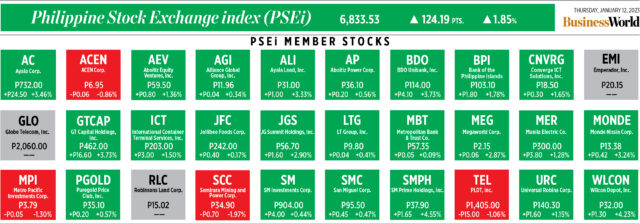
How PSEi member stocks performed — January 12, 2023

Here’s a quick glance at how PSEi stocks fared on Thursday, January 12, 2023.


PSEi climbs on rate hike bets ahead of US CPI

STOCKS climbed on Thursday ahead of the release of the December US consumer price index (CPI) report overnight, which investors expect to be a key consideration at the US Federal Reserve’s policy meeting later this month, and following comments from the Bangko Sentral ng Pilipinas (BSP) chief.

The bellwether Philippine Stock Exchange index (PSEi) rose by 124.19 points or 1.85% to close at 6,833.53 on Thursday, while the broader all shares index went up by 48.58 points or 1.37% to end at 3,588.04.

Regina Capital Development Corp. Head of Sales Luis A. Limlingan said shares rallied on Thursday on bets that the US central bank could deliver smaller rate hikes amid expectations of easing inflation.

“All eyes are on December’s CPI reading, to be released Thursday, with the consensus forecast calling for a slight easing in price pressures,” Mr. Limlingan added.

“Back home, investors digested recent signals from the BSP for a possible interest rate adjustment of up to 50 basis points (bps) and sustained hawkish commentaries from the Fed,” he said.

Unicapital Securities, Inc. Equity Research Analyst Neil Andrew L. Maderaje said in a Viber message that the PSEi rose to the 6,800 resistance level amid “a healthy P7.8-billion value turnover as the BSP noted that the pressure to match the Fed’s increases will be much lower.”

The Fed will hold its first policy meeting for the year on Jan. 31 to Feb. 1, while the BSP will hold its own review on Feb. 16.

US central bank officials recently said they could consider a smaller rate increase at their meeting if data confirm that the world’s largest economy is slowing.

Meanwhile, BSP Governor Felipe M. Medalla this week said they could consider a 25- or 50-bp rate hike at their meeting next month as inflation expectations need to be anchored.

Last year, the Fed hiked rates by 425 bps, while the BSP raised borrowing costs by 350 bps.

Most sectoral indices ended higher on Thursday, except for mining and oil, which lost 131.05 points or 1.13% to close at 11,445.48.

Meanwhile, property surged by 107.34 points or 3.64% to 3,048.99; financials added 36.61 points or 2.18% to close at 1,715.14; holding firms increased by 99.80 points or 1.51% to 6,676.06; industrials went up by 97.73 points or 1.01% to 9,704.61; and services rose by 16.60 points or 0.98% to end at 1,705.96.

Value turnover went down to P7.68 billion on Thursday with 1.42 billion shares changing hands from the P7.87 billion with 1.55 billion issues traded on Wednesday.

Advancers outnumbered decliners, 115 versus 67, while 48 names closed unchanged. Foreigners turned buyers on Thursday with P182.46 million in net purchases, versus the P1.06 billion in net selling seen the previous trading day.

“The PSEi would likely test the break of 6,800 level tomorrow, following the scheduled release of US December 2022 inflation rate tonight,” Unicapital Securities’ Mr. Maderaje said on Thursday.

“We see the 6,600 level as a healthy support level of the index amid current market developments,” he added. — Justine Irish D. Tabile

Peso weakens vs dollar ahead of US inflation data

BW FILE PHOTO

THE PESO weakened against the dollar ahead of the release of December US consumer price index (CPI) data and after the Bangko Sentral ng Pilipinas (BSP) chief said they could cut banks’ reserve requirement ratio (RRR) this year.

The local currency closed at P55.29 versus the greenback on Thursday, dropping by 49 centavos from Wednesday’s P54.80 close, data from the Bankers Association of the Philippines showed.

The peso opened Thursday’s trading session weaker at P54.95 per dollar, which was already its intraday best. It dropped to as low as P55.42 against the greenback during the session.

Dollars traded climbed to $1.458 billion from $1.005 billion on Wednesday.

“The peso weakened significantly due to some caution ahead of the US consumer inflation report overnight. The local currency will be expected to react [on Friday] to this data,” a trader said in an e-mail.

The hope is that falling inflation reduces the need for interest rate hikes, and markets have priced better-than-even odds that the Federal Reserve slows its cracking pace and hikes by 25 basis points (bps), rather than 50, at their first meeting for this year, Reuters reported.

The Fed will hold its first policy meeting for 2023 on Jan. 31 to Feb. 1. It hiked borrowing costs by 425 bps in 2022, bringing the federal funds rate to a 4.25%-4.5% range.

Meanwhile, Rizal Commercial Banking Corp. Chief Economist Michael L. Ricafort said in a Viber message that the peso corrected lower after BSP Governor Felipe M. Medalla on Thursday said they could cut in banks’ RRR in the first half of 2023 or if they no longer need to raise benchmark interest rates.

The BSP earlier committed to bringing down the RRR of big banks to single digits by 2023.

The reserve ratio for big banks is currently at 12%, one of the highest in the region. Reserve requirements for thrift and rural lenders are at 3% and 2%, respectively.

The peso also weakened after oil prices rose on Wednesday, Mr. Ricafort added.

Brent futures climbed $2.57 or 3.2% to settle at $82.67 a barrel on Wednesday, while US West Texas Intermediate crude rose $2.29 or 3.1% to settle at $77.41.

For Friday, the trader and Mr. Ricafort expect the peso to move between P55.20 and P55.40 against the dollar. — A.M.C. Sy with Reuters

Marcos plans Maharlika fund ‘soft launch’ at Davos meeting

REUTERS

PRESIDENT Ferdinand R. Marcos, Jr. will invite potential investors to provide capital to his proposed sovereign wealth fund at the World Economic Forum meeting next week, according to the Department of Foreign Affairs.

The forum, gathering world leaders at the Swiss resort of Davos, is a “great venue” to introduce the administration’s sovereign wealth fund proposal, Foreign Affairs Undersecretary Carlos D. Sorreta said at a briefing on Thursday, following a meeting with Mr. Marcos earlier in the day.

“The World Economic Forum is a great venue to do a sort of soft launch for our sovereign wealth fund, given the prominence of the forum itself, which global and business leaders (will attend),” he said.

Mr. Sorreta said the President intends to highlight the country’s economic fundamentals and the rationale behind the decision to establish the fund.

“It’s really more of a soft launch to introduce it,” he said.

The House of Representatives has approved the bill creating the wealth fund. The Senate, which has yet to discuss the measure, has included the bill in its list of legislative priorities for 2023.

The sovereign wealth fund, if approved, is expected to finance big government projects such as power grids and dams. Its main funders are currently government banks, after a backlash against an earlier proposal to tap pension funds.

The Maharlika Investment Corp., the government company that will manage the fund, will be chaired by the Secretary of Finance.

“I understand it is evolving, we have the fullest respect for the Congressional process, and the open hearings that they’re having, and how to work out the details but the broad strokes (indicate that) the President has a very, very good grasp of what he wants to achieve, whatever form the sovereign wealth fund finally takes,” Mr. Sorreta said.

“What’s very important is it’s an investment in the future, and there’s great confidence the President has in the ability of Filipino entrepreneurs and local investors,” he added.

Mr. Marcos will be in Davos between Jan. 16 and 20. He will be joined by a delegation of economic managers and business leaders.

At Davos, Mr. Marcos is scheduled to meet with leaders from South Africa, Belgium, and the European Commission, Mr. Sorreta said.

Mr. Marcos will highlight priority areas like food, nutrition, and energy security, Mr. Sorreto added.

The Philippines has lowered its economic growth target for 2023 to 6.0%-7.0% from 6.5%-7.5%. Inflation came in at 8.1% in December, the highest level since November 2008. — Kyle Aristophere T. Atienza

Onion sales suspended at DA’s Kadiwa outlets

DA.GOV.PH

THE Department of Agriculture (DA) said it will stop selling low-cost onions at its Kadiwa stores starting today, Friday, following the expiry of its deal with suppliers.

The DA said the supply deal ended on Dec. 31.

“We are working on a supplemental (memorandum of agreement). We also took into consideration the current low prices of onions,” Kristine Y. Evangelista, DA spokesperson, told reporters on Thursday.

Ms. Evangelista said that starting Jan. 13, Kadiwa onion sales will be suspended pending the signing of a new supply deal for low-cost onions.

Onions currently sell for P170 per kilogram at government-run Kadiwa stores, well below their commercial price of P340-P550, according to the DA’s price watch data from Jan. 12.  

Ms. Evangelista added that the DA is working with Food Terminal, Inc. (FTI), a government-owned corporation tasked with stabilizing food prices, on the supply of onions.

“We are now in talks with FTI to start the cycle, because they are the ones that procure the supply. This second cycle is something that we have to study; we have to consider the price because the cost structure will definitely be different this time,” she added.

Ms. Evangelista also added that the FTI “has a free hand to buy onions.” She noted that the ongoing harvest ensures the availability of domestic supply.

She said that the decision to halt Kadiwa onion sales is not connected with the investigation being conducted by the Office of the Ombudsman into the FTI’s onion purchases.

“Basically, you have to go through (procurement) procedures for this matter and… we also have to understand (FTI’s) procedures as well,” Ms. Evangelista said.

The DA and FTI are under investigation for price manipulation after an FTI had to pay high prices for an onion order, potentially setting a price benchmark for the rest of the market. — Ashley Erika O. Jose

Fare hike for LRT-1 and 2 still subject to public consultation

THE Light Rail Transit Authority (LRTA) said on Thursday that proposed fare hikes for LRT-1 and 2 must still undergo public consultation before being approved.

“The Light Rail Transit Authority would like to clarify that the matter of the fare increase will go through proper process,” it said in a statement.

It said that the recent approval by the Land Transportation Franchising and Regulatory Board (LTFRB) of the proposed fare increase is “in the nature of the agency being a member of the LRTA board of directors and not in the nature of a regulatory body.”

The other LRTA board members are the Departments of Transportation (DoTr), Finance, Budget and Management, the National Economic and Development Authority, the Department of Public Works and Highways, the Metro Manila Development Authority, and two other members of the board.

“The fare increase must be approved by the LRTA board of directors and must likewise pass through the required regulatory process, which includes public consultation/hearing,” the LRTA said.

The LRTA, which is primarily responsible for the construction, operation, maintenance and/or lease of light rail transit systems, has proposed to adjust the fares of LRT-1 and 2 by P2.29, representing the so-called boarding fare, plus P0.21 per kilometer, known as the distance fare.  

“The current boarding fare of P11 and distance fare of P1 per kilometer has been the rate since 2015,” it noted.

Light Rail Manila Corp. (LRMC), the private operator of LRT-1, sought arbitration against the Transportation department and the LRTA over fare increases.

LRMC hopes to recover around P2.67 billion in compensation claims and costs resulting from delays in the implementation of fare adjustments for 2016, 2018, and 2020.

In a memorandum dated Dec. 21, 2022, the LRTA said Transport Secretary Jaime J. Bautista at a special meeting of the LRTA board on Aug. 30, inquired into the possibility of settlement outside of arbitration proceedings.

“The representatives from the DoTr legal affairs department and the LRTA legal department explained that both parties can discuss and avail of this possibility at any given time,” the LRTA noted.

The LRMC, according to the LRTA, sent a letter dated Sept. 28 expressing its willingness to suspend the arbitration case for six months “provided that there would be amicable negotiations on LRMC’s longstanding claims, among them the matter of the fare adjustment.”

The LRTA board has agreed to regular meetings with the LRMC “as a show of good faith and to show that the government is serious in resolving the pertinent issues and concerns,” according to the memorandum.

The LTFRB has said that it has “no objections to the proposed fare adjustments” for LRT-1 and 2. — Arjay L. Balinbin

Still no agreement on Ilijan gas supply — DoE

SMCGLOBALPOWER.COM.PH

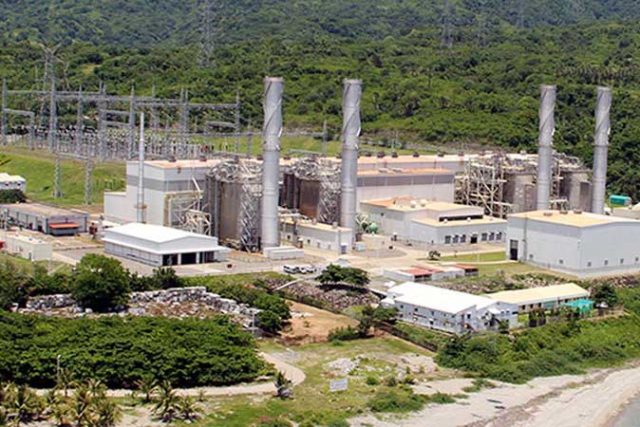
A PLAN to get power generators to share their gas with the Ilijan power plant in Batangas has not yet produced an agreement, the Department of Energy (DoE) said.

The so-called “gas-swapping” arrangement will require power plants controlled by First Gen Corp. to run on liquid fuel while turning over some of their Malampaya gas allocation to Ilijan, operated by San Miguel group company South Premiere Power Corp.

“At this time, the possible arrangements cannot yet be confirmed. The DoE continues to call on everyone concerned to cooperate in the common effort to assist the consuming public,” the DoE said in a statement. 

The DoE has warned that the absence of Ilijan’s output from the grid will bring power supply to critical levels by March, exposing consumers to the risk of higher electricity bills.

On Monday, the DoE said that the Luzon power grid is likely to experience 12 yellow alerts this year due to inadequate reserves. The Visayas grid is also expected to experience five yellow alerts by the second half of the year, while the Mindanao power supply is deemed adequate.

Ilijan is a 1,200-megawatt (MW) plant belonging to the SMC Global Holdings Corp. group. It had a gas contract with Malampaya that expired in June 2022. Its output is deemed critical if the Luzon grid is to be adequately supplied during the dry season.

The DoE has designated May as a critical period due to the surge in demand for power during the high temperatures.

Malampaya gas is fully allocated to the power plants of First Gen.

On Monday, Ilijan customer Manila Electric Co. (Meralco) said no deal has been reached with First Gen for the reallocation of Malampaya gas to Ilijan.

Meralco received last year an offer from SMC Global Power to take up the 1,200 MW capacity of Ilijan.

Meralco has said that it is considering SMC Global Power’s offer, which will help it avoid tapping power from the Wholesale Electricity Spot Market (WESM), which typically costs more.

Sourcing power from WESM resulted in higher Meralco power bills in January, as the power distributor sourced 9% of its power from WESM, up from 7% previously. — Ashley Erika O. Jose

DMW seeking to deploy more caregivers to HK

PHILIPPINE STAR/EDD GUMBAN

THE Department of Migrant Workers (DMW) said on Thursday that it is planning to hold bilateral talks with Hong Kong (HK) labor officials to deploy more caregivers to the city this year.

In a statement, the DMW said a delegation will hold exploratory talks in Hong Kong next month to discuss caregiver jobs and the city’s ongoing review of wages for migrant workers.

“This would provide additional job opportunities for our caregivers, under conditions that value their skills and are cognizant of their rights and welfare,” Migrant Workers Secretary Maria Susana V. Ople said.

She noted that Undersecretary for Policy and International Cooperation Patricia Yvonne Caunan will lead the DMW team to Hong Kong.

The Hong Kong Executive Council on Dec. 13 passed a resolution that approved the direct hiring of foreign caregivers and fast-tracking the application process to two months from four months.

In October, the Hong Kong government set a new minimum wage for foreign domestic workers of 4,730 Hong Kong dollars, equivalent to about P35,475 a month.

There were 211,514 migrant Filipino workers in Hong Kong last year, mostly employed as domestics, according to data compiled by the Hong Kong Immigration Authority as of the first half of 2022.

Only about 6% of domestic workers worldwide have access to comprehensive protections including medical care and unemployment benefits, the International Labor Organization said last year.

About 80% of the 1.4 million domestic workers in the Philippines are not covered by social security benefits, the Department of Labor and Employment and the Philippine Statistics Authority said in a joint report in 2019. — John Victor D. Ordoñez