Despite the challenging financial markets amidst the ongoing COVID-19 pandemic and soaring inflation, the Philippines is seeing a resurgence in capital raising by the country’s corporations as the economy primes itself for recovery.
The Philippine Stock Exchange (PSE) reported that companies raised a record P234.48 billion at the stock exchange in 2021, surpassing the previous high of P228.33 billion in 2012. The PSE ended the year with eight initial public offerings (IPOs), 11 follow-on offerings, four stock rights offerings and eight private placements.
In a July interview, PSE President and Chief Executive Officer Ramon S. Monzon said the PSE is again looking forward to a record number of IPOs in 2022. The eight IPOs in the first semester have already matched the same number of offerings for the entire 2021. To support this increasing trend of public issues, the Philippine Stock Exchange has organized the business forum entitled, “Road to IPO 2022,” with the participation of the Securities and Exchange Commission and the Department of Trade & Industry.
The forum is scheduled today, Sept. 15, 2022, from 10:00 a.m. to 5:00 p.m. Prominent speakers include PSE President Ramon S. Monzon and SEC Chairman Emil S. Aquino. One of the investment houses selected to participate in the forum is Investment & Capital Corporation of the Philippines (ICCP), among the oldest Investment houses in the country that offers a full range of investment services from debt capital and equity markets to financial advisory services including mergers & acquisitions. ICCP Managing Director Mariano Ocampo shares IPO readiness tips during the forum entitled, “Road to IPO 2022.”
ICCP has joined the call for more Philippine companies to tap the capital markets to finance and achieve sustainable growth. As one of the most trusted independent investment houses in the country, ICCP has successfully mentored companies in their foray into the local bourse.
In 2021, the company was joint lead underwriter for the P14.7-billion IPO of DDMPR REIT, Inc. and the P15.3-billion stock market debut of MREIT, Inc. ICCP was also the sole underwriter and issue manager for the P1-billion FOO of Apollo Global Capital, Inc. — the first offshore iron ore mining company in the Philippines.
This year, ICCP was the sole underwriter and issue manager for the P750-million offer of Haustalk, Inc. — the country’s first IPO of 2022 and the first small-and-medium enterprise (SME) listing under the new SME Listing Rules of the PSE.
This was followed-up by the P6.4-billion IPO of Citicore Energy REIT Corp. (CREIT), the country’s first energy-focused REIT, where ICCP served as underwriter. The investment house was recently engaged as sole issue coordinator, joint lead underwriter and issue manager for the IPO of Alternergy Holdings Corp. — a renewable energy company with a diversified portfolio of wind, solar & run of river hydro.
“We are happy to be a contributor in revving up this engine of growth for the economy, particularly for renewable energy, agri supply logistics, financial inclusion and climate finance. The IPO is not just for the big corporates but could also be tapped by SMEs, project proponents,” said ICCP President & CEO Valentino S. Bagatsing. “We stand ready to guide more businesses prepare to tap the local equity and debt markets. The capital markets should be utilized as a catalyst for job generating PPPs and be a valuable instrument for funding climate adaptation. We are inspired by the SEC & the PSE for their continued effort of democratizing the capital markets while ensuring transparency & accountable disclosure,” added Mr. Bagatsing.
ICCP believes that IPOs is a viable option to raise capital to fund the expansion businesses and institutionalizing ESG initiatives. Independent investment houses like ICCP have a strong role in structuring innovative ways of assisting corporations navigate the process of tapping the Philippine capital markets.
Spotlight is BusinessWorld’s sponsored section that allows advertisers to amplify their brand and connect with BusinessWorld’s audience by enabling them to publish their stories directly on the BusinessWorld Web site. For more information, send an email to online@bworldonline.com.
BENGALURU — Harish Pullanoor spent his weekends in the late 1980s tramping around the marshes and ponds of Yemalur, an area then on the eastern edge of the Indian metropolis of Bengaluru, where his cousins would join him catching small freshwater fish.
In the 1990s, Bengaluru, once a genteel city of gardens, lakes and a cool climate, rapidly became India’s answer to Silicon Valley, attracting millions of workers and the regional headquarters of some of the world’s biggest IT (information technology) companies.
The untrammelled expansion came at a price.
Concrete replaced green spaces and construction around the edge of lakes blocked off connecting canals, limiting the city’s capacity to absorb and siphon off water.
Last week, after the city’s heaviest rains in decades, the Yemalur neighborhood was submerged under waist-deep water along with some other parts of Bengaluru, disrupting the southern metropolis’ IT industry and dealing a blow to its reputation.
Residents fed up with gridlocked traffic and water shortages during the dry season have long complained about the city’s infrastructure.
But flooding during the monsoon has raised fresh questions about the sustainability of rapid urban development, especially if weather patterns become more erratic and intense because of climate change.
“It’s very, very sad,” said Mr. Pullanoor, who was born close to Yemalur but now lives in the western city of Mumbai, parts of which also face sporadic flooding like many of India’s urban centers.
“The trees have disappeared. The parks have almost disappeared. There is chock-a-block traffic.”
Big businesses are also complaining about worsening disruptions, which they say can cost them tens of millions of dollars in a single day.
Bengaluru hosts more than 3,500 IT companies and some 79 “tech parks” — upmarket premises that house offices and entertainment areas catering to technology workers.
Wading through flooded highways last week, they struggled to reach modern glass-faced complexes in and around Yemalur where multinational firms including JP Morgan and Deloitte operate alongside large Indian start-ups.
Millionaire entrepreneurs were among those forced to escape flooded living rooms and swamped bedrooms on the back of tractors.
Insurance companies said initial estimates for loss of property ran into millions of rupees, with numbers expected to go up in the next few days.
‘GLOBAL IMPACT’ The latest chaos triggered renewed worries from the $194 billion Indian IT services industry that is concentrated around the city.
“India is a tech hub for global enterprises, so any disruption here will have a global impact. Bangalore, being the center of IT, will be no exception to this,” said K.S. Viswanathan, vice president at industry lobby group the National Association of Software and Services Companies (NASSCOM).
Bangalore was renamed Bengaluru in 2014.
NASSCOM is currently working to identify 15 new cities that could become software export hubs, said Mr. Viswanathan, who is driving the project.
“It is not a city-versus-city story,” he told Reuters. “We as a country don’t want to miss out on revenue and business opportunities because of a lack of infrastructure.”
Even before the floods, some business groups including the Outer Ring Road Companies Association (ORRCA) that is led by executives from Intel, Goldman Sachs, Microsoft and Wipro, warned inadequate infrastructure in Bengaluru could encourage companies to leave.
“We have been talking about these for years,” Krishna Kumar, general manager of ORRCA, said last week of problems related to Bengaluru’s infrastructure. “We have come to a serious point now and all companies are on the same page.”
In the early 1970s, more than 68 percent of Bengaluru was covered in vegetation.
By the late 1990s, the city’s green cover had dropped to around 45% and by 2021 to less than 3% of its total area of 741 square kilometers, according to an analysis by T.V. Ramachandra of Bengaluru’s Indian Institute of Science (IISC).
Green spaces can help absorb and temporarily store storm water, helping to protect built up areas.
“If this trend continues, by 2025, 98.5% (of the city) will be choked with concrete,” said Mr. Ramachandra, who is part of IISC’s Centre for Ecological Sciences.
CITY IN DECAY Rapid urban expansion, often featuring illegal structures built without permission, has affected Bengaluru’s nearly 200 lakes and a network of canals that once connected them, according to experts.
So when heavy rains lash the city like they did last week, drainage systems are unable to keep up, especially in low-lying areas like Yemalur.
The state government of Karnataka, where Bengaluru is located, said last week it would spent 3 billion Indian rupees ($37.8 million) to help manage the flood situation, including removing unauthorized developments, improving drainage systems and controlling water levels in lakes.
“All the encroachments will be removed without any mercy,” Karnataka Chief Minister Basavaraj Bommai told reporters. “I will personally go and inspect.”
Authorities have identified around 50 areas in Bengaluru that have been illegally developed. Those included high-end villas and apartments, according to Tushar Girinath, Chief Commissioner of Bengaluru’s civic authority.
Last week, the state government also announced it would set up a body to manage Bengaluru’s traffic and start discussions on a new storm water drainage project along a major highway.
Critics called the initiatives a knee-jerk reaction that could peter out.
“Every time it floods, only then we discuss,” said IISC’s Mr. Ramachandra. “Bengaluru is decaying. It will die.” ($1 = 79.4130 Indian rupees) — Reuters
WASHINGTON — Central bankers must be persistent in fighting broad-based inflation, International Monetary Fund (IMF) chief Kristalina Georgieva said on Wednesday, conceding that many economists were wrong when they predicted last year that inflation would ease.
“Inflation is stubborn, it is more broad-based than we thought it would be,” she said. “And what it means is … we need central bankers to be as stubborn in fighting it as inflation has demonstrably been.”
If fiscal policy and monetary policy worked well, next year might prove less painful, she said at an event with French European Central Bank policy maker Francois Villeroy de Galhau. But if fiscal policy was not targeted sufficiently, it could become the “enemy of monetary policy, fueling inflation,” she said.
Ms. Georgieva’s comments came a day after the US reported an unexpected rise in August consumer prices, with rent and food costs continuing to climb.
US Treasury Secretary Janet Yellen, in an interview with CBS News, said she believed inflation “will come down over time” due to the actions of the Federal Reserve. Ms. Yellen said the Biden administration is trying to complement the Fed’s moves.
Ms. Georgieva said the surprising rise in inflation was “just one snippet of the uncertainty and difficulties” the global economy faced. Both the coronavirus disease 2019 (COVID-19) pandemic and Russia’s invasion of Ukraine contributed to surging prices and a cost-of-living crisis.
In a blog, the IMF warned that higher oil prices were driving up all consumer prices, which could result in a wage-price spiral if these second-order effects were sustained. Central bankers should respond “firmly,” it said.
When overall inflation is already high, as it is now, wages tend to increase by more in response to an oil-price shock, the IMF said, citing a study of 39 European countries. That showed people were more likely to react to price increases when high inflation was visibly eroding living standards, it said, noting that the larger the second-round effects, the greater the risk of a sustained wage-price spiral.
“If large and sustained, oil price shocks could fuel persistent rises in inflation and inflation expectations, which should be countered by a monetary policy response,” the IMF said, noting that people tended to seek higher compensation for oil price rises.
However, even in a high-inflation environment, wages stabilized after a year rather than continuing to rise at a steady clip, it said.
“To the extent that central banks remain adequately vigilant, current high inflation could still cause higher compensation for the cost of living than usual but need not morph into a sustained increase in inflation,” the IMF said. — Reuters
DETROIT/LOS ANGELES — Biden administration officials hosted labor contract talks late on Wednesday to avert a potential rail shutdown that could disrupt cargo shipments and impede food and fuel supplies, but one small union rejected a deal and Amtrak canceled all long-distance passenger trips.
Railroads including Union Pacific, Berkshire Hathaway’s BNSF and Norfolk Southern have until a minute after midnight on Friday to reach deals with three holdout unions representing about 60,000 workers before a work stoppage affecting freight and Amtrak could begin.
Talks between labor unions and railroads, which started at 9 a.m., were still underway more than 12 hours later after 9 p.m. ET on Wednesday at the US Labor Department’s headquarters in Washington.
The talks are being overseen by Labor Secretary Marty Walsh, with input from other US officials. The parties ordered in Italian food for dinner Wednesday in order to continue discussions.
“Everybody is going to have to move a little in order to get a deal done,” Transportation Secretary Pete Buttigieg told reporters on the sidelines of the Detroit auto show.
A union representing about 4,900 machinists, mechanics, and maintenance personnel said on Wednesday its members voted to reject a tentative deal.
Rail workers have gone three years without a raise amid a contract dispute, while rail companies have recorded robust profits.
In the current talks, the industry has offered annual wage increases from 2020 to 2024, equal to a 24% compounded hike. Three of 12 unions, representing about half of the 115,000 workers affected by the negotiations, are asking for better working conditions.
Two of those 12 unions, representing more than 11,000 workers, have ratified deals, the National Carriers’ Conference Committee (NCCC), which is bargaining on behalf of railroads, said on Wednesday.
Unions are enjoying a surge of public and worker support in the wake of the pandemic, when “essential” employees risked coronavirus disease 2019 (COVID-19) exposure to keep goods moving and employers reaped hefty profits, labor and corporate experts say.
A shutdown could freeze almost 30% of US cargo shipments by weight, stoke inflation, cost the US economy as much as $2 billion per day and unleash a cascade of transportation woes affecting the U.S. energy, agriculture, manufacturing and retail sectors.
White House spokeswoman Karine Jean-Pierre told reporters aboard Air Force One that a shutdown of the freight rail system would be an “unacceptable outcome for our economy and the American people and all parties must work to avoid just that.”
HIGH STAKES FOR BIDEN
President Joseph R. Biden, Jr.’s administration has begun making contingency plans to ensure deliveries of critical goods in the event of a shutdown.
The stakes are high for Mr. Biden, who has vowed to rein in soaring consumer costs ahead of November elections that will determine whether his fellow Democrats maintain control of Congress.
“Unless they reach a breakthrough soon, rail workers will go on strike this Friday. If you don’t think that will have a negative impact on our economy … think again,” said US Senator John Cornyn, a Republican and Biden critic.
Senator Bernie Sanders late on Wednesday objected to a Republican bid to unanimously approve legislation to prevent a rail strike, noting the profits the rail industry has made.
If agreements are not reached, employers could also lock out workers. Railroads and unions may agree to stay at the bargaining table, or the Democratic-led US Congress could intervene by extending talks or establishing settlement terms.
House of Representatives Speaker Nancy Pelosi said it was not clear whether Congress would step in, noting that the main issue is a lack of sick leave for workers.
Amtrak, which uses tracks maintained by freight railways, said it would cancel all long-distance trips on Thursday and some additional state-supported trains.
Rail hubs in Chicago and Dallas were already clogged and suffering from equipment shortages before the contract showdown. Those bottlenecks are backing up cargo at US seaports by as much as a month. And, once cargo gets to rail hubs in locations such as Chicago, Dallas, Kansas City and Memphis, Tennessee, it can sit another month or longer.
Package delivery company United Parcel Service, one of the largest US rail customers, and US seaports said they are working on contingency plans.
Meanwhile, factory owners are fretting about idling machinery while automakers worry that a shutdown could extend vehicle buyer wait times. Elsewhere, food and energy companies warn that additional service disruptions could create even sharper price hikes. — Reuters
The world has never been in a better position to end the coronavirus disease 2019 (COVID-19) pandemic, the head of the World Health Organization (WHO) said on Wednesday, his most optimistic outlook yet on the years-long health crisis which has killed over six million people.
“We are not there yet. But the end is in sight,” WHO Director-General Tedros Adhanom Ghebreyesus told reporters at a virtual press conference.
That was the most upbeat assessment from the United Nations (UN) agency since it declared an international emergency in January 2020 and started describing COVID-19 as a pandemic three months later.
The virus, which emerged in China in late 2019, has killed nearly 6.5 million people and infected 606 million, roiling global economies and overwhelming healthcare systems.
The rollout of vaccines and therapies have helped to stem deaths and hospitalizations, and the Omicron variant which emerged late last year causes less severe disease. Deaths from COVID-19 last week were the lowest since March 2020, the UN agency reported.
Still on Wednesday, he again urged nations to maintain their vigilance and likened the pandemic to a marathon race.
“Now is the time to run harder and make sure we cross the line and reap the rewards of all our hard work.”
Countries need to take a hard look at their policies and strengthen them for COVID-19 and future viruses, Mr. Tedros said. He also urged nations to vaccinate 100% of their high-risk groups and keep testing for the virus.
The WHO said countries need to maintain adequate supplies of medical equipment and healthcare workers.
“We expect there to be future waves of infections, potentially at different time points throughout the world caused by different subvariants of Omicron or even different variants of concern,” said WHO’s senior epidemiologist Maria Van Kerkhove.
With over 1 million deaths this year alone, the pandemic remains an emergency globally and within most countries.
“The COVID-19 summer wave, driven by Omicron BA.4 and BA.5, showed that the pandemic is not yet over as the virus continues to circulate in Europe and beyond,” a European Commission spokesperson said.
WHO’s next meeting of experts to decide whether the pandemic still represents a public health emergency of international concern is due in October, a WHO spokesperson said.
GLOBAL EMERGENCY
“It’s probably fair to say most of the world is moving beyond the emergency phase of the pandemic response,” said Dr. Michael Head, senior research fellow in global health at Southampton University.
Governments are now looking at how best to manage COVID as part of their routine healthcare and surveillance, he said.
Europe, the United Kingdom and the United States have approved vaccines that target the Omicron variant as well as the original virus as countries prepare to launch winter booster campaigns.
In the United States, COVID-19 was initially declared a public health emergency in January 2020, and that status has been renewed quarterly ever since.
The US health department is set to renew it again in mid-October for what policy experts expect is the last time before it expires in January 2023.
US health officials have said that the pandemic is not over, but that new bivalent vaccines mark an important shift in the fight against the virus. They predict that a single annual vaccine akin to the flu shot should provide a high degree of protection and return the country closer to normalcy. — Reuters
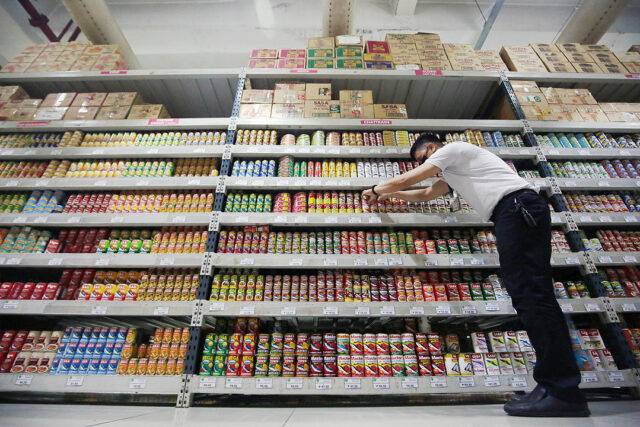
A supermarket is seen in Quezon City, March 4 2022. — PHILIPPINE STAR/MICHAEL VARCAS
NEW YORK — Slowing economic growth is pushing up global debt levels, especially in emerging markets, the Institute of International Finance (IIF) said on Wednesday, warning of a significant rise in corporate bankruptcies ahead.
The global debt-to-GDP ratio — a widely used measure to gauge a borrower’s ability to pay back debt — rose to 350% in the first increase in five quarters, the IIF found. In emerging markets, that ratio climbed by nearly 3.5 percentage points to 252% of gross domestic product, reflecting the “hit from a sharp slowdown” in economic growth.
“Inflationary pressures have not been high enough to bring debt ratios down,” the IIF’s Emre Tiftik wrote in the note.
The rise comes despite an overall decline in world debt, which shrank $5.5 trillion to $300 trillion in the three months to end-June in US dollar terms — the first quarterly drop since 2018.
Debt in mature markets declined $4.9 trillion to just over $201 trillion, while a proportionally much smaller $0.6 trillion decrease in emerging markets put the total across developing economies at $99 trillion.
The decline in the overall amount of debt was driven by the dollar near 20-year highs against other main currencies as well as a slowdown in issuance.
A toxic mix of rising inflation fueled by soaring energy and food prices has pushed interest rates higher globally in recent months, in turn amplifying global recession risks. Meanwhile governments have ramped up spending to shore up economies from the energy shock.
“Concerns over a rapid slowdown in growth and rising social tensions due to higher energy and food prices will likely prompt more borrowing by governments,” IIF economists said in the report, forecasting global debt-to-GDP to rise by another 2 percentage points by year-end.
The data show that through August, year-to-date issuance of government bonds came in 20% below the same period in 2021.
Government debt ticked down to $85.8 trillion but is up 21% from the $70.7 trillion in the first quarter of 2020, the data show, highlighting the fiscal stimulus ramp-up triggered by the coronavirus pandemic.
Upward pressure on borrowing costs is set to continue with the U.S. Federal Reserve forecast to raise its benchmark rate by at least 75 basis points next week.
“A significant increase in (corporate) bankruptcies may well be on the cards as borrowing costs rise, which will make it quite challenging for central banks to engineer a soft landing without adverse implications for job markets,” the IIF said.
Sovereign investment-grade issuers saw yields rise much less than riskier countries. The IIF data show 16 of the 35 countries with a major food crisis are already in or at high risk of debt distress.
The International Monetary Fund board could approve a new “food shock window” that would allow the fund to provide expanded emergency financing to countries in need, IMF Managing Director Kristalina Georgieva said on Tuesday. — Reuters
Top executives of Pag-IBIG Fund urged employers with unremitted contributions for their employees to avail of the agency’s penalty condonation program and settle their obligations – both prior and during the pandemic – free from any monthly penalty charge on delayed remittances.
“We at Pag-IBIG Fund recognize the significant role that the business community plays in allowing Filipino workers to gain Pag-IBIG membership, and in helping our nation continue to recover from the pandemic. That is why we are providing the means for employers to settle the unremitted Pag-IBIG contributions of their employees free from penalty charges. With this program, we expect more Filipino workers to enjoy the benefits of being a Pag-IBIG member in line with the call of President Ferdinand R. Marcos, Jr. to provide a better life for all Filipinos,” said Secretary Jose Rizalino L. Acuzar of the Department of Human Settlements and Urban Development and Chairperson of the 11-member Pag-IBIG Fund Board of Trustees.
Under the agency’s charter, employers are responsible for the registration and remittance of its employees’ mandatory monthly Pag-IBIG contributions, which consist of the employee’s contributions and the employer’s counterpart share. With its penalty condonation program, eligible employers can now settle their employees’ unremitted Pag-IBIG contributions without penalty charges.
Pag-IBIG Fund Chief Executive Officer Acmad Rizaldy P. Moti, meanwhile, stated that the program is purposely broad in scope to aid in boosting economic activity. The program covers not only all unremitted Pag-IBIG contributions by employers during the pandemic, but also all unremitted contributions even prior to the pandemic. He further said that aside from having the penalty charges on their delayed remittances 100% condoned, employers who would be unable to settle their obligations in full may also opt for a payment plan that has a low monthly interest charge of 0.5%. Moti further emphasized that if the unremitted contributions being settled are those during the pandemic, or those from March 2020 onwards, the interest charge on payment plans shall be waived.
“The Pag-IBIG Penalty Condonation Program we are offering is more extensive in coverage compared to the previous programs we implemented. As we seek to provide utmost assistance to the business community, the program covers not only the unremitted contributions during the Covid-19 pandemic, but also those prior to the health crisis. With the program’s favorable terms, employers are provided the means to update the monthly contributions of their employees, while maintaining a healthy cash flow to sustain their operations. This is our way of helping the business community – whose support has been instrumental in allowing Pag-IBIG Fund to post record-highs in our membership savings collections over the past many years – continue with their recovery from the effects of the pandemic,” said Moti.
Spotlight is BusinessWorld’s sponsored section that allows advertisers to amplify their brand and connect with BusinessWorld’s audience by enabling them to publish their stories directly on the BusinessWorld Web site. For more information, send an email to online@bworldonline.com.
The Asia CEO Awards proudly announces the Circle of Excellence (COE) awardees for 2022.
In a statement, Asia CEO Awards Chairman Richard Mills said that more than 400 nominations were received from the nation’s most important organizations and leaders.
“The Circle of Excellence awardees are an impressive group who are making gigantic contributions to the nation’s development,” added Mills.
For over a decade, the ASIA CEO Awards has been bringing senior leaders from across Philippines and the world for this celebration of success and contribution.
With this year’s theme “The Real Deal”, this one of the grandest business awards in the region have as Title Sponsor: PLDT Enterprise. Major sponsors are: Airspeed, Arthur Nowak CX, Insular Life, Kyani, LBC Business Solutions, Paraiso Village Farms, Reed Elsevier, Regus, Smart Enterprise, United Neon.
Be Part of the Asia CEO Awards
Rebecca Bustamante, Asia CEO Awards President, shared that Asia CEO Awards awardees are chosen for their achievements and contributions to clients, staff and the nation.
“Join us on October 11 for the awards night happening at the Manila Marriott Grand Ballroom,” said Bustamante while thanking their Official Venue Partner, Manila Marriott, Official Knowledge Partner, PwC, and Media Partners CNN Philippines, Business Mirror, BusinessWorld, Philippine Daily Inquirer, Good News Pilipinas and many more.
Asia CEO Awards Chairman Richard Mills and Asia CEO Awards President Rebecca Bustamante
Book tickets to the event through www.asia-ceo-awards.org. Fee includes luxurious multi-course food with flowing wines. Attire is formal (Gown, Barong/Tuxedo).
Circle of Excellence Awardees
Executive Leadership Team of the Year
Vitarich Philippines; VXI Philippines; NEARSOL; Lexmark Research and Development Corp.; Infosys BPM Philippines; PSG Global Solutions, Inc.; Pag-IBIG Fund; AirAsia Philippines; Airspeed Group of Companies; KMC Solutions; Megaworld Corporation
Reed Elsevier Top Employer of the Year
PSG Global Solutions, Inc.; Hewlett Packard Enterprise; Procter and Gamble Philippines; TTEC; Sitel Philippines Corp.; 24/7 Customer Philippines, Inc.; Shopee Philippines, Inc.; VXI Philippines; B&M Global Services Manila, Inc.; Ubisoft Philippines; Wipro Philippines, Inc.; Teleperformance Philippines; Unilever; HSBC Electronic Data Processing, Inc.; Concentrix; ING Business Shared Services B.V. Branch Office
InLife Young SHERO of the Year
Lou Sabrina Ongkiko, Master Teacher I, Culiat Elementary School; Shawntel Nicole Nieto, Founder, One Cainta Food Program/President, Sustainable PH; Arizza Ann Nocum, Co-founder and President, Kristyano Islam Peace Library, Inc.; Romae Chanice Marquez-Pena, Chief Operating Officer, Eduksine Co.; Stephanie Tumampos, GeoData Scientist & Science Communicator, Technical University of Munich; Dalareich Polot, Founder, Ginto Fine Chocolate/Founder, Dalareich Chocolate House; Sharon M. Vaswani, CEO, PanOphthalmics Ent./Chairwoman, Fortis Medi Pharmaceuticals, Inc.; Diana Paguirigan, Marketing and Communications Manager, Eastvantage; Cindy Rose T. Burdette, CEO, Allcare Technologies Philippines, Inc.
PLDT Enterprise Global Filipino Executive of the Year
Alvin So, ASEAN Region Head of Bayer Consumer Health; Jean Henri Lhuillier, President and CEO of PJ Lhuillier Inc./Cebuana Lhuillier; Steven T. Tan, President of SM Supermalls; Gregory H. Banzon, CEO and Executive Vice President of Century Pacific Food Inc.; Jose Teodoro K. Limcaoco, President and CEO of Bank of the Philippine Islands; Christopher Cabognason, Chief Distribution Officer of Allianz PNB Life; Henry Albert Fadullon, President of Phoenix Petroleum Philippines Inc.; Gil G. Chua, Group Chairman and CEO of DDB Group Philippines; Vanessa L. Suatengco, General Manager of Diamond Hotel Philippines; Rosemarie Rafael, Chairwoman of Airspeed Group of Companies; Eppie Titong, Senior Vice President of VXI Global Solutions, LLC; Ralph Ray Dacay Chua, Chairman of the Board and President of Shireli Manufacturing Company and Immuni Global Incorporated; Lito Villanueva, Executive Vice President of Rizal Commercial Banking Corporation, Chief Innovation & Inclusion Officer of Digital Enterprise & Innovations Group, and Head and Chief Digital Transformation Advisor – YGC; Alex Gamboa, President of AG&P Industrial
Expatriate Executive of the Year
Aseem Roy, Country Head of Wipro Philippines; Amit Jagga, Senior Vice President and Country Leader of Concentrix Philippines; Sanjiv Kumar Gupta, President and Country Head of IBM Solutions Delivery, Inc.; Alexander Grenz, President and CEO of Allianz PNB Life; Razvan Diratian, APAC Managing Director of Avon Cosmetics, Inc.; Jared Morrison, CEO of VXI Global Solutions; Angeline Tham, Founder and CEO of Angkas; Kamal Asarpota, CEO of Eastvantage; Fiona Kesby, CEO of GoTeam; Christo Georgiev, Country Manager and CEO of FinScore; Christian Eyde Moeller, CEO & President of Lionheart Farms Corp.
PJ Lhuillier Inc./Cebuana Lhuillier; Concentrix Philippines; Astra Zeneca; Lexmark Research and Development Corporation; TTEC; FinScore; Traxion Tech, Inc.; RightsLedger, Inc.; Land Bank of the Philippines; JustPayto Philippines Corp.; Advance
Young Leader of the Year
Jet Yu, Founder and CEO of Property Interactive Marketing Enterprise Realty Corp.; Avin C. Ong, President and CEO of Fredley Group of Companies; Karen Jane Salutan, Founder and CEO of EdukSine Production Corp.; Rolan Marco Garcia, CEO of Embiggen Group; Sharon M. Vaswani, CEO of Panophthalmics Enterprise, and Chairwoman of Fortis Medi Pharmaceutical, Inc.; Cindy Rose T. Burdette, CEO of ALLCARE Technologies Philippines, Inc.; Micah Pil, Founder of Ikigai Animation Studio; Stephanie Anne Kubota, CEO of Rush Technologies, Inc.; Kaiser Estrada, President and Managing Director of Streamlined Campaigns
Kristine Brown, CEO and Co-Founder of Chalkboard; Rolan Marco Garcia, CEO of Embiggen Group; Annalyn J. Cuisia, CEO and Founder of Traxion Tech, Inc.; Michael Allan S. Canlas, CEO of Kitchen 77 Food Creations, Inc. (Bang Bang Bangus); Kevin Yao, CEO of Autokid Subic Trading Corp.; Laurice A. Chiongbian, President and CEO of Qavalo, Inc.; Rolandrei Viktor “Zark” Varona, President of Zark’s Food Ventures Corporation; Felix Concepcion Veroya, Founder and CEO of Ask Lex PH Academy (ALPHA); Kim Frances Lato, CEO, President and Founder of Kimstore; Earl Martin Valencia, Co-Founder and Chief Business Owner of Plentina Lending, Inc.; Mark Sultan Gersava, CEO of BAMBUHAY
Kyani Wellness Company the Year
Datamatics CMS Philippines; Diageo APAC SSC LTD, Inc.; VXI Global Solutions; Infosys BPM Philippines; Land Bank of the Philippines; Hewlett Packard Enterprise; Quantrics Enterprises, Inc.; Concentrix Philippines; B&M Global Services Manila, Inc.; Tech Mahindra Limited Philippines
Airspeed Service Excellence Company the Year
VXI Global Solutions; Wipro; Home Credit Philippines; Angkas; Securities and Exchange Commission Philippines; Infosys BPM Philippines; Pag-IBIG Fund; TTEC; CGI Philippines, Inc.
Arthur Nowak Diversity Company the Year
IBM Philippines; 3M GSC; Chevron Holdings, Inc.; Procter and Gamble Philippines; Manulife Business Processing Services; Northern Operating Services Asia, Inc.; Genpact Services LLC – Philippine Branch; Concentrix; Lexmark Research and Development Corporation; Home Credit Consumer Finance Phils., Inc.
Paraiso Village Farm CSR Company the Year
IBM Philippines, Inc.; Alaska Milk Corp.; Maybank Philippines; PJ Lhuillier Inc./Cebuana Lhuillier; Genpact Services LLC – Philippine Branch; Innodata Knowledge Services, Inc.; Personal Collection Direct Selling, Inc.; Shopee Philippines, Inc.; Bounty Agro Ventures, Inc.; Radio Mindanao Network; Tech Mahindra Limited Philippines; Megaworld Foundation
Sustainability Company the Year
Bank of the Philippine Islands; Alaska Milk Corp; Meralco; Concentrix; Lionheart Farms Corp.; Procter and Gamble Philippines; Tech Mahindra Limited Philippines; Filinvest Reit Corp.; TDCX (PH), Inc.; Land Bank Of The Philippines
Spotlight is BusinessWorld’s sponsored section that allows advertisers to amplify their brand and connect with BusinessWorld’s audience by enabling them to publish their stories directly on the BusinessWorld Web site. For more information, send an email to online@bworldonline.com.
Kacific can provide last mile connectivity solutions for banks and cash agents as well as local communities so they can access digital finance.
One of the fundamental characteristics of any modern developed economy is near-universal financial inclusion, where all citizens have access to a formal financial system. More than ever, banking depends on internet connectivity to support modern digital solutions.
Although the number of Filipinos with access to financial accounts has rapidly grown in recent years, the Bangko Sentral ng Pilipinas found that 44% of the adult population still did not own a financial account in 2021. That represents just over 34 million people who do not have a formal account to save money and receive interest; send or receive remittances, income, and benefits; and make day-to-day payments.
Satellite Broadband can enhance financial inclusion
With over 7,000 thousand islands and jungle-covered mountains, the Philippines is a stunning nation. It’s also a nation that’s difficult to connect with traditional telecommunications technology.
Fiber cables are expensive and difficult to lay in such small communities. Another challenge: monsoon season. Every year, this natural event damages cables and tower structures, cutting communities off. Satellite broadband is the fastest and most cost-efficient means to distribute bandwidth to rural and other underserved areas.
Using satellite technology, Kacific has been able to deliver an alternative to fiber connection that is dependable, high-speed, and affordable for rural and remote areas. The first Ka-band High-throughput Satellite, Kacific1, was launched in 2019 as a geostationary satellite. Kacific has concentrated spot beams that cover all the remote areas — from Batanes to Palawan and even all the way to Sulu. These spot beams are high power, resulting in availabilities between 99.5% and 99.9%.
Kacific’s Ka-band technology provides higher output in small 1.2-m antennas or terminal kits, making it simple and fast to install. This also means higher download and upload speeds that can provide better internet performance.
Additionally, Kacific can mitigate the effects of rain fade through diverse uplink availability, having two local teleports located in Subic Bay and Clark as its backup sites to ensure that connectivity remains available even in inclement weather.
Satellite connectivity has a proven track record for data security – a vital need in the financial sector. With connecting rural areas key to improved financial inclusion, the Government and private sector can both play a part.
Working in partnership with Kacific, Internet Service Providers (ISPs) can provide last mile connectivity solutions for banks and cash agents as well as local communities so they can access digital finance.
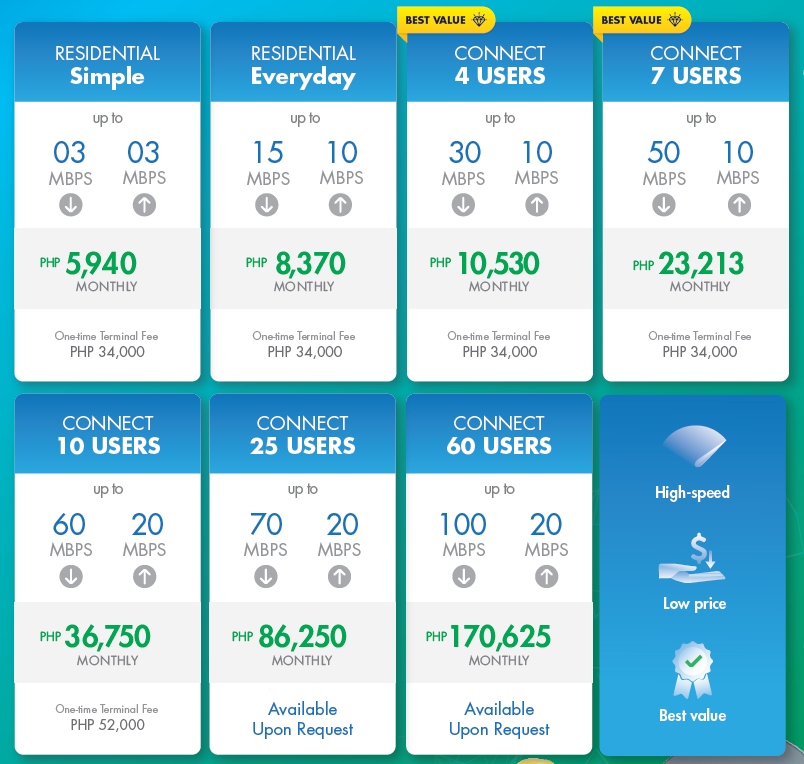
TBGI, a local ISP of Kacific, offers unlimited plans starting at ₱5,940 in the Philippines. Terminals are offered for a one-time terminal fee of ₱34,000 or ₱52,000 depending on the size of the plan. A one-time installation fee of ₱10,000 is charged by distributors to install the terminal kit in a specific area.
TBGI offers unlimited plans.
Safe banking for businesses
The Philippines is prone to natural disasters. This can cause massive disruption to communications by knocking out phone lines and cell towers and damaging fiber-optic infrastructure. But with satellite broadband access, communities can stay connected to essential banking and other services.
Kacific Enterprise Backup keeps business safe from disruptions to regular terrestrial and mobile broadband connectivity. Any financial institution can easily install Kacific’s satellite as a hot backup site in the event of fiber cuts or cable downtime, at a small fee. Acting like an insurance plan for the primary connectivity, the backup solution ensures that the bank will be fully operational 100% of the time. ATM withdrawals and POS systems should be available at least 99% of the time, especially during disaster scenarios, where preserving continuity becomes the top priority.
The Land Bank ATM of DepEd Compound in Jolo, Sulu is connected by TBGI powered by Kacific.
Satellite internet increases financial services’ reach
Kiram Irilis is a Schools Division Superintendent at DepEd Division, Sulu. Their office uses the satellite internet mainly to let Land Bank’s Automated Teller Machines communicate through a host computer en route to the bank’s nearest data center so the financial transaction will be processed. The ATM is situated inside the DepEd Compound in Jolo, Sulu.
“Before installing the internet of TBGI powered by Kacific for our ATM, we need to go to the nearest Land Bank ATM which is 8 kilometers away from our office just to withdraw our salary. In addition, the said machine is frequently in offline operation mode. Now, we don’t experience offline mode when using the ATM, we also don’t have to take long walks just to withdraw money, and we are eased from the long queue, especially during payday.”
Kacific’s Ka-band technology provides higher output in small 1.2-m antennas or terminal kits, making it simple and fast to install.
Better internet connectivity and greater financial inclusion
In March 2021, Philippines’ former President Duterte, signed an executive order EO127, allowing more entities to provide satellite broadband services to far-flung communities, with the specific goal of boosting financial inclusion. This is intended to work alongside the rollout of the country’s new National Identification system, and it has already seen over 5 million unbanked Filipinos open transaction accounts with Land Bank alone.
Meanwhile, President Ferdinand “Bongbong” Marcos Jr. noted in his first State of the Nation Address on July 27, the government’s effort to increase digital connectivity in the Philippines. Part of the plan is to connect the country’s Geographically Isolated and Disadvantaged Areas (GIDA) via his ‘Broad Band ng Masa’ project.
For isolated communities, satellite broadband bridges the gap and allows fintech to flourish. With the Government and private sector working together, it’s possible to connect rural clients and small-island economies.
To learn more about reliable, affordable, and high-speed satellite internet, contact TBGI at 0917 583 7971 or learn more on www.tbgi.net.ph.
Spotlight is BusinessWorld’s sponsored section that allows advertisers to amplify their brand and connect with BusinessWorld’s audience by enabling them to publish their stories directly on the BusinessWorld Web site. For more information, send an email to online@bworldonline.com.
CHERY Auto Philippines’ distributor, United Asia Automotive Group, Inc. (UAAGI), redefines Filipino motorists’ concept of automotive luxury, electrification, and performance, with its theme “Innovation Revolution” at the 8th Philippine International Motor Show (PIMS) at the World Trade Center in Pasay City from Sept. 15 to 18, 2022.
CHERY has started the innovation movement that brings the experience of advanced automotive technologies previously available only to a few, now to a broader Filipino motoring public. The brand focuses on the fast-growing number of buyers who want value but desire more luxury, fuel-savings performance, and technology in a crossover.
“We are thrilled to showcase our new flagship with the all-new CHERY Tiggo 8 PRO at 2022 PIMS. Our participation this year at the prestigious PIMS is yet another milestone for the brand as we celebrate the entry of CHERY into the premiere industry organization, the Chamber of Automotive Manufacturers of the Philippines, Inc. (CAMPI). With the aggressive local introduction of our crossovers, we are planting the seeds of an innovation movement that disrupts long-established customer beliefs on who can only enjoy the latest automotive technology,” says CHERY Auto Philippines/UAAGI President Erroll Dueñas.
In photo are executives from (top row) Toyota, Suzuki, Nissan, Mitsubishi, Mazda, Kia, Isuzu, (bottom row) BMW, Chery, Foton, CAMPI, Geely, Honda, and Hyundai.
“Today’s evolving automotive market is driven by several key areas, most notably connectivity and electrification. To this end, we are unveiling the third variant of our competitive flagship Tiggo 8 PRO lineup at 2022 PIMS — Tiggo 8 PRO 2.0 Turbo. Together with the luxurious Tiggo 8 PRO 1.6 Turbo, the electrified Tiggo 8 PRO Plug-in Hybrid Electric Vehicle (PHEV), and now with the powerful Tiggo 8 PRO 2.0 Turbo, we have a formidable stable of luxury, electrification, and performance,” Mr. Dueñas added.
CHERY Tiggo 8 PRO 1.6 Turbo and Tiggo 8 PRO PHEV have been receiving rave reviews, including awards from the respected C! Magazine that were bestowed during PIMS. The Tiggo 8 PRO 1.6 Turbo has been awarded the best mid-size crossover, while the Tiggo 8 PRO PHEV has been recognized as the best hybrid vehicle. This shows the brand’s commitment to bringing heightened driving experiences with memorable and worry-free customer journeys.
“We have started shifting gears by making your daily drive more memorable through the POWER of a luxurious design and advanced driver assistance technologies in the Tiggo 8 PRO 1.6T. Your journeys have become more sustainable through the POWER of electrification in the Tiggo 8 PRO PHEV. And now, we would like to introduce a new breed of POWER that will not only excite your senses but will increase your heart’s ‘BEATS per MINUTE’ even in your daily drive — the new Tiggo 8 PRO 2.0 Turbo All-Wheel Drive!,” exclaimed CHERY Auto Philippines/UAAGI Vice-President for Sales and Marketing Luigi Ignacio.
Part of the CHERY 4.0 Full-Field Power Architecture that harnesses the power of various forms of energy including fuel, hybrid, pure electric, and hydrogen, the new Tiggo 8 PRO 2.0 Turbo AWD features a state-of-the-art engine that has maximum power and torque outputs of 254 Hp and 390 Nm. It adopts CHERY’s second-generation i-HEC combustions system, the new generation thermal management system, and 350-bar ultra-high-pressure direct injection technologies.
Visit the CHERY booth at the 2022 PIMS in World Trade Center to take a closer look at the game-changing Tiggo 8 PRO lineup and test-drive activities.
For more info, follow CHERY Auto Philippines on social media: CHERY Auto Philippines (Facebook) and @cheryautophilippines (Instagram). You may also call the 24/7 CHERY Auto Philippines hotline at 0917-552-4379 or email chery@uaagi.com for more inquiries.
Spotlight is BusinessWorld’s sponsored section that allows advertisers to amplify their brand and connect with BusinessWorld’s audience by enabling them to publish their stories directly on the BusinessWorld Web site. For more information, send an email to online@bworldonline.com.
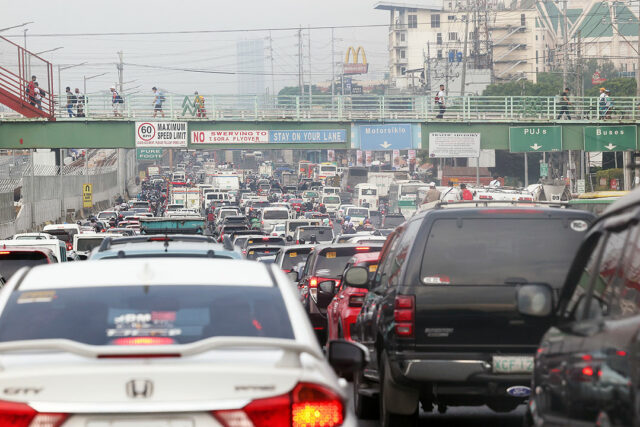
Motorists endure heavy traffic along the westbound lane of Commonwealth Avenue in Quezon City, July 28. — PHILIPPINE STAR/ MIGUEL DE GUZMAN
SALES OF VEHICLES in the Philippines nearly doubled in August, driven by strong demand for commercial vehicles as Congress considers a measure removing the excise tax exemption for pickup trucks.
According to a joint report by the Chamber of Automotive Manufacturers of the Philippines, Inc. (CAMPI) and Truck Manufacturers Association (TMA), local vehicle sales surged by 90.5% to 30,185 units in August, from 15,847 units sold in the same month last year.
Commercial vehicle sales more than doubled to 23,452 in August, accounting for 78% of the month’s sales. This was mainly due to the 106% rise in sales of light commercial vehicles to 17,973 units and 210% increase in sales of Asian utility vehicles (AUVs) to 4,589 units.
Sales of passenger cars also rose by 38% to 6,733 units, accounting for 22% of the total in August.
Month on month, total vehicle sales for August were also up by 8.5% from 27,813 units sold in July.
“The recovery of the industry is indeed on track as we reached monthly sales of above 30,000 units — a pre-pandemic monthly performance level last recorded in 2019. This year-on-year improvement of 90.5% in August brings us closer to achieving the industry sales target this year,” CAMPI President Rommel R. Gutierrez said in a separate statement.
For the first eight months of 2022, CAMPI-TMA members sold 212,872 units, up by 25% from 170,112 units during the same period last year.
Sales of commercial vehicles jumped by 39% to 160,790 units in the January to August period, which accounted for 75% of the industry’s total sales. Broken down, light commercial vehicle sales rose by 43% to 126,633 units, while AUVs went up by 31% to 27,874 units.
Passenger car sales, on the other hand, contracted by 4.3% to 52,082 units in the eight-month period but still made up 24% of total sales.
“With the return of the 8th Philippine International Motor Show this month, there are plenty of reasons to be optimistic of having a stronger year after a period of lower sales achievement because of the pandemic,” Mr. Gutierrez said.
Among CAMPI-TMA members, Toyota Motor Philippines Corp. had the highest sales in the first eight months with 108,746 units sold, equivalent to 51.09% market share.
Other top car manufacturers during the period include Mitsubishi Motors Philippines Corp. with 30,207 units sold (14.19% share), Nissan Philippines, Inc. with 14,487 (6.81% share), Ford Motor Co. Phils. Inc. with 13,348 (6.27% share), and Suzuki Phils., Inc. with 12,838 (6.03% share).
However, CAMPI earlier warned sales of commercial vehicles will take a hit if Congress approves a measure removing the excise tax exemption for pickup trucks.
In August, the House Ways and Means Committee approved the fourth package of the Comprehensive Tax Reform Program which included the elimination of the excise tax exemption for pickup trucks.
Under Republic Act No. 10963 or the Tax Reform for Acceleration and Inclusion, pickup trucks are exempted from excise tax as part of efforts to assist small business owners and professionals.
According to the Finance department, the removal of the excise tax exemption is expected to generate P52.6 billion worth of additional revenues from 2022 to 2026.
“We are concerned about the addition of the taxes. As we know, the demand for vehicles is price sensitive. This will definitely impact prices. We are still recovering. We have not yet recovered fully to pre-pandemic levels,” Mr. Gutierrez previously said. — Revin Mikhael D. Ochave
A MAN repacks sugar in packets at a public market in Taguig City, Aug. 27, 2008. — REUTERS/CHERYL RAVELO
By Luisa Maria Jacinta C. Jocson, Reporter
SUGAR PRICES may soon drop as imports of refined sugar are expected to arrive by November.
This after the Sugar Regulatory Administration (SRA) issued Sugar Order (SO) No. 2 which authorized the import of 150,000 metric tons (MT) of refined sugar for the current crop year “to ensure domestic supply and manage sugar prices.”
“The import volume of 150,000 MT of refined sugar is good for now. This will satisfy the consumers and industrials, and (also) bring down retail prices,” United Sugar Producers Federation President Manuel R. Lamata said in a Viber message.
Federation of Free Farmers National Manager Raul Q. Montemayor said in a Viber message the sugar order is a “safe” decision by the government to “ensure the availability of stocks while waiting for new harvest to come in.”
Retail prices of sugar have surged in recent months amid a supply shortage. As of Sept. 2, the average retail price of refined sugar in wet markets nearly doubled to P97.43 per kilogram from P52.71 in the same period a year ago. The price of raw sugar also rose by 60% year on year to P72.43 now.
Under SO No. 2, the 150,000 MT of refined sugar imports will be equally allocated for industrial users and consumers.
Industrial users are defined as food and beverage manufacturers that use refined sugar in products that are for sale in the local market. Consumers, on the other hand, are defined as wholesalers and traders who sell sugar in bulk to retailers.
Under the order, sugar imports are expected to arrive not later than Nov. 15. Traders are given one month from Nov. 15 to fully distribute the allocations to industrial users and consumers.
Fermin D. Adriano, former Agriculture Undersecretary for Policy, Planning, and Research, said there may be a need for additional imports in order to further bring down prices.
“If they want prices to go down or meet demand of bottling companies, they will have to import more. If not, (we) will just have to spend more to buy sugar. Our sugar prices are three times more than the world market prices,” he said in a Viber message.
Beverage manufacturers, including Coca-Cola Beverages Philippines, Inc., Pepsi-Cola Products Philippines, Inc., and ARC Refreshments Corp. earlier announced that they are facing a shortage of premium refined sugar.
Coca-Cola previously said the local food and beverage industry will require at least 450,000 MT of premium refined sugar for continued production.
However, Mr. Lamata said that the SRA must monitor the crop year’s output in order to determine if another importation order is necessary.
“We will know for sure come April to May next year. When the milling season ends, the SRA should do a private inventory of the whole industry as to how much sugar stocks are left. That’s the time we will know if we need to import or not,” he added.
Meanwhile, Kilusang Magbubukid ng Pilipinas (KMP) Chairman Rafael V. Mariano said that the import plan is ill-timed as it coincides with the start of the milling season.
“There is no need for imports. There is no need for that 150,000 MT of sugar because we have locally produced and locally milled sugar coming in. We have already started milling production,” he said in a phone call interview.
The crop year began on Sept. 1, 2022 and ends on Aug. 31, 2023.
The SRA board also issued SO No. 1, which allocates all sugar output for the crop year as class “B” or for domestic use.
“Planters themselves are saying that there is no shortage or lack of supply. We have enough. If the reason behind the import program is to lower prices, there is no need for that,” Mr. Mariano added.
Farmer-scientist group Magsasaka at Siyentipiko para sa Pag-unlad ng Agrikultura (MASIPAG) said in a statement that the government should focus on boosting local production instead of relying on importation.
“Importation is never the answer, transforming the current sugar production system and strengthening of local production anchored in genuine rural development is… Sugar importation, which is the entry point for fully liberalizing the sugar trade, would result in a 6.8% decrease in domestic output,” MASIPAG said.
MASIPAG pushed for sustainable and organic sugar farming, which can “re-localize the food system and pave the way for a pro-people sugar industry.”
Mr. Montemayor also called for the review of the Sugarcane Industry Development Act (SIDA).
“There are several billion pesos earmarked for the sugar sector under the SIDA, but only a small percentage is being spent.We need to study whether this is because of inefficiencies within the SRA or defects in the SIDA law itself,” he said.
SO No. 2 is the first sugar import plan issued under the new administration. It comes after the “illegal” release of SO No. 4, which would have allowed the import of 300,000 MT of refined sugar.














 Visit the CHERY booth at the 2022 PIMS in World Trade Center to take a closer look at the game-changing Tiggo 8 PRO lineup and test-drive activities.