Home Blog Page 5320

Republic Cement’s ecoloop targets more partners for co-processing of waste  

REPUBLIC Cement Services, Inc. through its resource recovery arm, ecoloop, targets to partner with more companies for co-processing of waste to achieve its goal of plastic neutrality, its official said last week.

“For the coming years, we are targeting more partnerships with companies with a sustainability mindset,” Angela D. Edralin-Valencia, managing director of ecoloop, told BusinessWorld on the sidelines of a Sustainability Committee meeting facilitated by the Nordic Chamber of Commerce of the Philippines last week.

Ms. Edralin-Valencia said that to date, ecoloop has partnerships with private companies and local government units (LGUs), and hopes to expand its existing partnerships.

“Our current partners are the early adopters of the EPR (Extended Producer Responsibility) law. We also targeted LGUs that have political will to achieve sustainability goals,” she said.

Data from the company’s website show that ecoloop has 12 private company partners and over 30 LGU partners. Ms. Edralin-Valencia said several partnerships are in the works.

Through the EPR law, large enterprises are mandated to recover up to 80% of their plastic packaging waste. Ecoloop’s co-processing involves the reuse or recovery of thermal and mineral properties of qualified waste materials to convert to alternative fuels, helping Republic Cement to reduce its dependence on fossil fuels like coal.

“Our goal is also to make our cement a greener and more environmental-friendly product,” Ms. Edralin-Valencia said, adding that they are also aiming to cut their fossil fuel consumption.

“Our ambition is of course to replace 50% of our fuel consumption with alternative fuel. That’s a big number and certainly, a lot of investments have to be put in place from our end to get to that number but we are still reviewing our options,” she said.

Ms. Edralin-Valencia described the EPR law as a perfect model for sustainability but said its aggressive implementation is needed. She added that existing laws are enough to attain plastic neutrality.

“We’re sitting on thousands and thousands of tons of waste every day and harnessing that waste to alternative fuel is a perfect investment. Waste to energy will eventually play a factor in the enormity of waste problems and for the benefit of the country,” she said. — Ashley Erika O. Jose

Flagship Moto ACCS store opens in San Juan

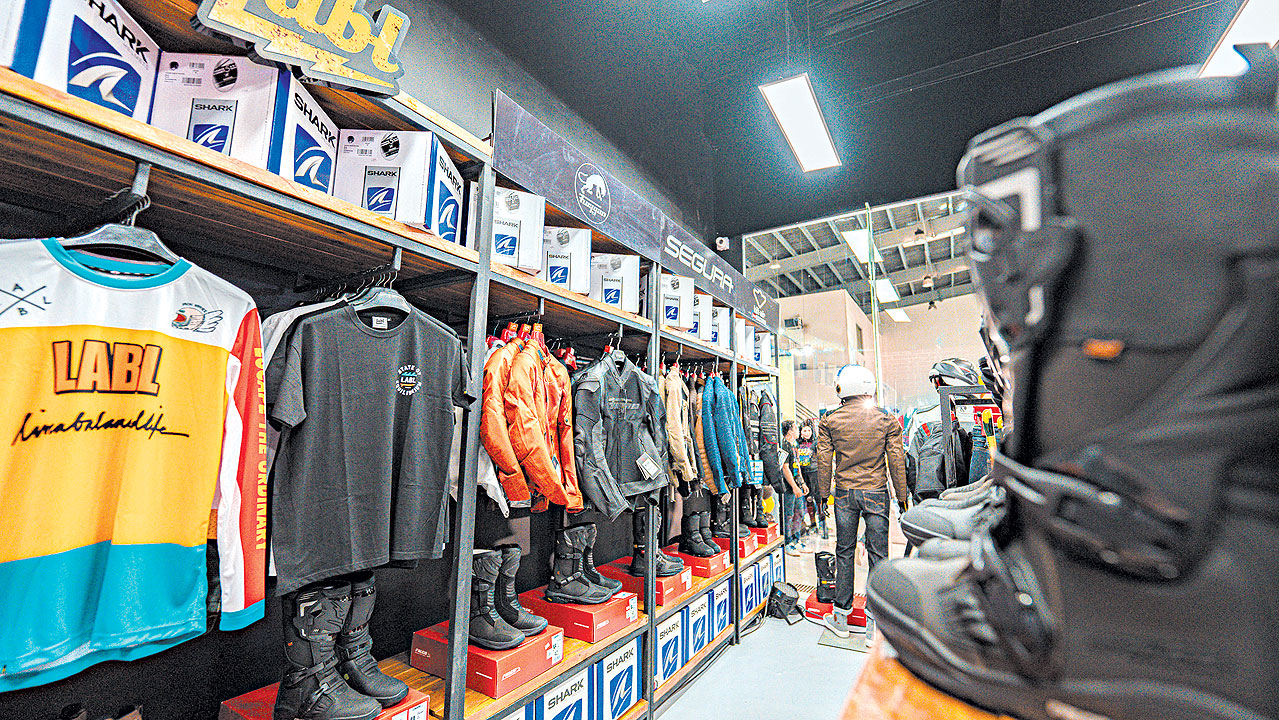
Moto ACCS Greenhills measures 61.3 square meters. — PHOTO BY KAP MACEDA AGUILA

By Kap Maceda Aguila

MOTORCYCLE ACCESSORIES and gear supplier Moto ACCS opened its flagship store last week. Located at 324 Ortigas Avenue, North Greenhills in San Juan City, the Autohub Group-owned-and-operated establishment is situated conveniently alongside Vespa and Triumph Motorcycles showrooms.

“ACCS has been known to cater to the four-wheel accessories market, but due to the high demand for motorcycles, (the brand) has now branched out to Moto ACCS — exclusively for motorcycle riders’ needs and bike accessories,” said Autohub Group President Willy Tee Ten in a release.

The inauguration of Moto ACCS Greenhills follows the opening of the first store — on the roof deck of the Mini Building on 38th Street in Bonifacio Global City, Taguig — last December.

Measuring 61.3 square meters, Moto ACCS Greenhills store features an array of quality products, including Shark helmets; motorcycle, denim, puffer jackets and gear from Segura and Furygan; Labl breathable jerserys; Falco high-cut riding shoes; Kriega heavy-duty backpacks and bags; Cardo state-of-the-art communication systems; Marco horns; Zard exhaust pipes; and Hit-Air safety shock buffering system.

The Autohub Group is looking at opening more Moto ACCS outlets in the future, revealed Autohub Group VP for Marketing, Creatives, and Fleet Owee Cruz to this writer. “These may complement our Vespa or Triumph Motorcycles shops, but we’re also considering opening them as standalone stores.”

For more information, contact Arturo Cruz at 0917-812-9608.

Ukraine’s wheat, corn crops seen shrinking again as farmers struggle

REUTERS

PARIS — Ukraine’s corn and wheat production is set to fall for a second year in 2023, with corn output not expected to exceed 18 million tons and wheat production 16 million tons as farmers reduce planting due to the war, a grain sector group said.

The projections were a best-case scenario, and production could fall more sharply depending on weather and financial difficulties of farms, Ukraine Grain Association (UGA) head Nikolay Gorbachov told Reuters on the sidelines of Argus Media’s Paris Grain Conference.

Disruption to export trade following Russia’s invasion last year has left many farmers producing at a loss, he said. “For farmers it became unprofitable to produce the grain and that’s why they cut the planted area,” he said.

Overall, Ukraine’s grain and oilseed crop output may decline to around 50 million tons from some 67 million in 2022 and about 106 million in 2021, according to UGA estimates.

Ukraine has managed to export around 30 million tons of grains and oilseeds so far in the 2022/23 season using a Black Sea grain corridor negotiated with Russia, as well as alternative routes via European Union countries, he said.

But backlogs in the Black Sea corridor and less efficient logistics in alternative routes were creating high costs that hit farmgate prices, he said, blaming Russia for slowing vessel inspections in the corridor.

Corn has been particularly affected by financial constraints as it is relatively expensive to grow, dry and transport, he said, adding about 10% of the 2022 crop remained unharvested as farmers wait for some fields to dry out.

Ukraine’s agriculture minister said last month that 2022 corn production could fall to 22 million-23 million tons from 41.9 million in 2021. Wheat production is estimated to have fallen to about 20 million tons last year.

In oilseeds, production of rapeseed and soybeans, seen as more profitable to produce and export, could hold steady this year at around 3 million tons each, Mr. Gorbachov said.

But sunflower seed output might fall due to difficulties faced by local crushing facilities that usually process the crop to export sunflower oil, he added. — Reuters

Rates of Treasury bills, bonds may decline on tightening bets

BW FILE PHOTO

RATES of government securities on offer this week could track secondary market yields’ broad decline ahead of the US central bank’s policy review and dovish hints from the Bangko Sentral ng Pilipinas (BSP) chief.

The Bureau of the Treasury (BTr) will auction off P15 billion in Treasury bills (T-bills) on Monday, made up of P5 billion each in 91-, 182-, and 364-day papers.

On Tuesday, it will offer P35 billion in reissued 25-year Treasury bonds (T-bonds) that have a remaining life of 12 years and eight months.

“The upcoming Treasury bill auction yields could continue to correct slightly lower, after the comparable short-term PHP BVAL (Bloomberg Valuation Service) yields again mostly slightly declined week on week,” Rizal Commercial Banking Corp. Chief Economist Michael L. Ricafort said in a Viber message.

“The upcoming 13-year Treasury bond auction yield could range at the 6%-6.2% levels, as the latest 12-year PHP BVAL yield stood at 6.1205% as of Jan. 27, 2023,” he added.

He said markets are expecting a 25-basis-point (bp) rate hike from the US Federal Reserve at its Jan. 31 to Feb. 1 meeting, which could be matched by the BSP in its own review on Feb. 16.

“Recent dovish signals locally, such as possible end of monetary policy tightening in the first quarter, with the possible peak in the local policy rate at 6%… would also be considered by the markets,” Mr. Ricafort said.

A trader said in a Viber message that T-bill rates could move sideways, while the reissued bonds could see slightly higher yields.

“We are seeing some upside on rates, especially for the 13-year bond reissuance, given the positive GDP (gross domestic product) print, which could mean that BSP can still hike policy rates to avoid the widening of the inflation base,” the trader said.

Meanwhile, UnionBank of the Philippines, Inc. Chief Economist Ruben Carlo O. Asuncion likewise said in a report that they see the bonds on offer on Tuesday to fetch rates of 6.05% to 6.2%.

At the secondary market on Friday, the 91-day T-bill’s rate rose by 6.37 bps week on week to 4.3757%, while the 182- and 364-day papers declined by 4.42 bps and 5.84 bps to yield 4.9535% and 5.3947%, respectively, based on the PHP BVAL Reference Rates published on the Philippine Dealing System’s website.

Meanwhile, the 25-year debt paper saw its yield drop by 9.88 bps week on week to 6.4166%, while the 10-year bond, the tenor closest to the remaining life of the issue on offer on Tuesday, fetched 6.0271%, down by 19.25 bps.

Investors widely expect the Fed to dial down its rate increases as early as its meeting this week amid easing inflation.

The US central bank raised its fed funds rate by 50 bps in December to a 4.25%-4.5% range following four straight 75-bp increases, bringing total hikes for 2022 to 425 bps.

Meanwhile, BSP Governor Felipe M. Medalla said this month that the central bank is likely to raise benchmark rates by 25 or 50 bps at its meeting on Feb. 16 to anchor inflation expectations.

Mr. Medalla also said the BSP will likely end its tightening cycle with one or two more increases this quarter, which will bring its key rate to around 6%.

The BSP hiked borrowing costs by 350 bps in 2022 to bring down elevated inflation, with its policy rate now at 5.5%.

Last week, the BTr raised P15 billion as planned from the T-bills it auctioned off as bids reached P62.013 billion, more than four times the amount on offer.

Broken down, the Treasury raised P5 billion as programmed via the 91-day T-bills with tenders reaching P22.36 billion. The average rate of the three-month papers dropped by 3.9 bps to 4.211%, with accepted rates ranging from 4.2% to 4.22%.

The government also made a full P5-billion award of the 182-day securities as bids for the papers reached P19.08 billion. The six-month tenor was quoted at an average rate of 4.912%, declining by 5.5 bps, with accepted rates at 4.89% to 4.925%%.

Lastly, the BTr borrowed P5 billion as planned from the 364-day debt papers as demand for the tenor reached P20.573 billion. The average rate of the one-year T-bill inched down by 2 bps to 5.428%. Accepted yields were from 5.393% to 5.473%.

Meanwhile, the 25-year bonds to be auctioned off on Tuesday were last offered on Oct. 25, 2022, where the government made a partial award of its offer. The Treasury raised just P26.139 billion from its offer of reissued 25-year bonds, less than the programmed P35 billion, even as total bids reached P46.988 billion.

The bonds were awarded at rates ranging from 7.625% to 8%, bringing the average to 7.887%, 3.8 bps lower than the 7.925% quoted for the bond when it was first offered on Sept. 28, 2010, and also 11.3 bps below the 8% coupon for the issue.

The Treasury wants to raise P200 billion from the domestic market this month, or P60 billion through T-bills and P140 billion via T-bonds.

The government borrows from domestic and external sources to finance its budget deficit, which is capped at P1.47 trillion this year or 6.1% of GDP. — A.M.C. Sy


Fashion figure Andre Leon Talley collections up for auction at Christie’s in New York City

ONLINEONLY.CHRISTIES.COM

PARIS — Silk caftans, exotic leather coats and monogrammed Louis Vuitton luggage sets are among items from the late American fashion journalist Andre Leon Talley set to go under the hammer at Christie’s in New York.

“He was a larger-than-life tour de force,” said Elizabeth Seigel, head of private and iconic collections at Christie’s New York, speaking at an exhibit in Paris, where some of the items are displayed.

“His work could really make or break any designers,” added Ms. Seigel.

Close to 400 lots are on sale until Feb. 16, illustrating Talley’s eccentric personal style and love of fashion, with drawings, photographs and clothing linked to his friendships with other towering industry figures, like designers Karl Lagerfeld and Diane von Furstenberg and longtime Vogue editor-in-chief Anna Wintour.

The auction house estimates the lots will fetch more than a million dollars, funds that will go to two Baptist churches that played a key role in Talley’s life.

Talley, a former US Vogue editor at large and creative director, died on Jan. 18, 2022, at age 73.

“He was Anna Wintour’s right-hand man, and he also paved the way for a new generation of those who followed him, such as (British Vogue editor-in-chief) Edward Enninful,” said Ms. Seigel, noting that he also played a role mentoring new generations of designers and writers. — Reuters

Competitive power rates sought after court move on supply deal

PHILIPPINE STAR/MICHAEL VARCAS

THE Energy Regulatory Commission (ERC) must ensure competitive rates after the Court of Appeals (CA) denied the temporary restraining order (TRO) sought by a unit of SMC Global Power Holdings Corp. that would have put on hold a lower-priced power supply contract.

“The ultimate remedy on the current supply crunch is now with the ERC, to ensure competitive rates comparable to the price proposal of the original joint SMC-Meralco (Manila Electric Co.) petition,” Terry L. Ridon, a public investment analyst and convenor of think tank InfraWatch PH, said in a message on Sunday.

On Friday, SMC Global Power, the power arm of listed San Miguel Corp. (SMC), said it would exert all legal options after the CA denied the TRO sought by its unit San Miguel Energy Corp. (SMEC).

“We remain confident that our government, through the judiciary, is one with us in promoting an environment where both consumers and industries collaborate in delivering on our country’s energy goals and providing viable and shared solutions to address the ongoing power crisis,” SMC Global Power said in a statement.

The ERC, in a statement on Thursday, said that the CA in a resolution dated Jan. 13 denied the petition for a TRO or preliminary injunction filed by SMEC. It noted that SMEC failed to prove its right to a restraining order.

SMEC sought the TRO to suspend the ERC order in September last year that denied the company’s motion jointly filed with Meralco for a price increase in their power supply contract.

“The [CA] has ruled correctly on the SMC case. It gives us hope that consumers may yet win out in this latest chapter of SMC’s legal drama to escape its contractual responsibilities,” Gerry P. Arrances, convenor of the Power for People coalition, said in a media release on Saturday.

However, the CA granted SMEC’s petition for the case to be consolidated with that of another unit of SMC Global Power — South Premiere Power Corp. (SPPC) — pending before the CA’s 13th Division.

On Jan. 25, Meralco said that its 30-day emergency power supply agreement (EPSA) with Aboitiz Power Corp. ended, prompting the power distributor to source 670 megawatts (MW) of its power supply requirement from the Wholesale Electricity Spot Market (WESM),

The Meralco-AboitizPower EPSA, which covers 300-MW, was forged on Dec. 15, 2022 to partially replace Meralco’s 670-MW contracted supply from SPPC that was suspended last year when the CA granted a TRO on its implementation sought by SPPC.

“It is the regulator’s mandate to force the best prices from market players, particularly with the real, unwelcome prospect of the spot market providing a big chunk of supply,” Mr. Ridon said.

The EPSA was priced at P5.96 per kilowatt-hour (kWh) or higher than the P4.2455-per-kWh price under Meralco’s agreement with SPPC.

Last year, SMC Global Power sought a temporary rate increase, jointly filed with Meralco, citing that SPPC and SMEC incurred a combined loss of P15 billion. The rate increase was meant to recover P5 billion of the units’ losses.

The company cited a “change in circumstance” when surging fuel costs breached the price range contemplated during the execution of the contracts with Meralco. However, the ERC denied the petition, saying it had no basis as their PSA is a fixed-rate contract.

“Filipino consumers are now on the hook for even higher power rates now that Meralco has tapped WESM. We hope that the CA can redeem itself once its TRO lapses. They should rule in favor of consumers and have SMC reimburse the higher electricity bills of Meralco subscribers,” Mr. Arrances said. — Ashley Erika O. Jose

Kia Acropolis showcases new brand identity

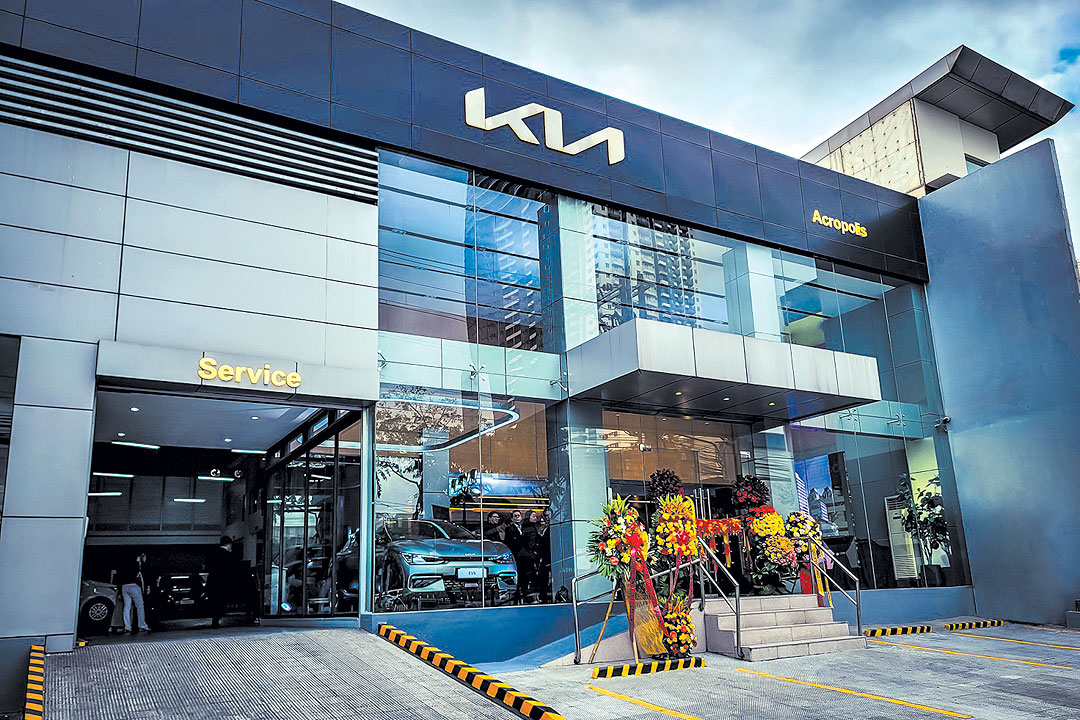
PHOTO FROM KIA PHILIPPINES

KIA PHILIPPINES recently inaugurated its newest dealership, Kia Acropolis. Kia Acropolis now wears the brand’s refreshed look, following in the footsteps of Kia Alabang in Muntinlupa, Kia Sto. Tomas in Batangas, Kia BGC (AC Motors Centrale) in Taguig, Kia Ortigas in Cainta, and Kia Kawit in Cavite.

In a release, Kia Philippines revealed that “soon, all 42 Kia dealerships nationwide will have refreshed exteriors, and by next year, all will share Kia’s revamped interior design aesthetic.” All new Kia dealers will also reflect the new corporate identity. “This is in line with Kia’s fresh new look — which is showcased by its lineup of stunning vehicles,” it continued.

Kia Acropolis is operated by Autoklassik Motors Corp., a Filipino-owned enterprise established in 2010. As an authorized Kia dealer in the Philippines, the company said it is committed to build on the strength of the brand and provide high-quality automotive services to its valued customers.

“After 13 years as a Kia dealer we have witnessed all of Kia’s innovations,” stated Kia Acropolis COO Jan Golangco. “I believe what we are really celebrating is what Kia has become through the years and I am so proud to be a Kia dealer, and owner, myself.”

Kia Acropolis provides sales, after-sales, maintenance and support services to make sure that all of its customers’ needs are taken care of in a timely and professional manner. Apart from basic servicing and repair needs, the dealership is also equipped to handle body repair and painting services.

“The industry is back to pre-pandemic levels in terms of overall sales,” joined Kia Philippines President Manny Aligada. “Everyone was hungry to go back into the business and to ride their new cars, so Kia has been riding that crest. In 2021 Kia grew by 76%. In 2022, we grew by 34%, outpacing the industry’s 26%. We have to thank Autoklassik because it is a huge part of that growth.” During the inauguration, The multi-awarded Kia EV6 — with its long-range, zero-emissions power, 800V ultra-fast charging, and distinctive SUV styling — was also on display.

The opening of Kia Acropolis espouses Kia’s tagline and its commitment to its loyal customers, and can service the areas of Libis, Katipunan, White Plains, Green Meadows, and other neighboring communities.

Kia Acropolis is located on E. Rodriguez Jr. Avenue, Barangay Bagumbayan, Libis, Quezon City. For more information, call (02) 8260-0348.

Abaca production contracts 5.7% in 2022

BW FILE PHOTO

ABACA production declined 5.7% to 63,640.61 metric tons (MT) in 2022, due to unfavorable growing conditions brought about by rain and flooding, the Philippine Fiber Development Authority (PhilFida) said.

The industry failed to meet its production target of 70,000 MT.

“The year in review was marked by lots of weather disturbances and the so-called shear line winds which caused unprecedented flooding and landslides,” PhilFida Executive Director Kennedy T. Costales said in a social media post.

PhilFida estimated that six of the 12 regions posted double-digit declines in abaca production while the rest reported increases.

Northern Mindanao output fell 21.4% to 6,483.50 MT.

Also posting declines were the Eastern Visayas, down 19.9% at 3,819.36 MT; Soccsksargen, down 19.7% at 1,586.11 MT; Zamboanga Peninsula, down 15.6% at 539.19 MT; Davao Region, down 10.3% at 13,108.47 MT; and Bicol Region down 4% at 19,040.70 MT.

On the other hand, production in Southern Tagalog rose 35.8% to 64.96 MT. That of Caraga rose 15.9% to 9,659 MT while Central Luzon output 7% to 36.60 MT. Output in the Bangsamoro Autonomous Region in Muslim Mindanao rose 2% to 3,567 MT; Central Visayas output rose 1.3% to 311.80 MT; and Western Visayas output rose 0.599% to 3,762.95 MT.

Also affecting production were poor growing practices that helped spread disease to abaca farms.

According to Mr. Costales, the spread of disease known in the industry as “umbac” or “bacbac” happens when the harvester cuts an affected abaca plant and transfers the contamination to healthy plants via his knife.

“In about six months’ time the abaca plantation is wiped out and neighboring abaca plantation within a kilometer or two also gets infected because of Pentalonia Nigronegvosa,” he said.

Meanwhile, the practice of “pojada” involves traders forcibly cutting immature abaca stalks to maximize income or profit, resulting in poor quality and reduced fiber production.

Abaca fiber is used in industrial products such as pulp and paper, cordage, fibercraft, nanocellulose, among others. — Sheldeen Joy Talavera 

Yields on gov’t debt drop ahead of Fed policy meet

YIELDS on government securities (GS) went down last week amid muted trading and bargain hunting as investors took leads from the movement of US treasuries and ahead of the US Federal Reserve’s policy meeting.

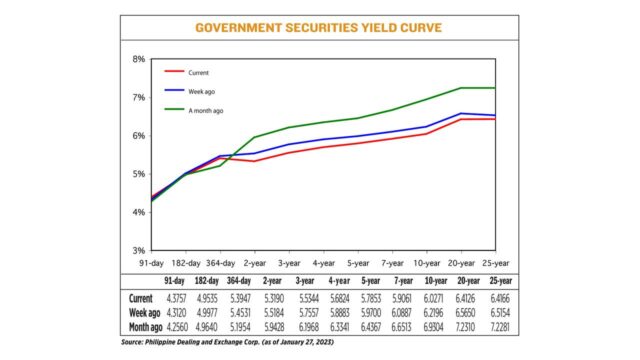
GS yields at the secondary market fell by an average of 13.42 basis points (bps) week on week, based on the PHP Bloomberg Valuation (BVAL) Service Reference Rates of Jan. 27 published on the Philippine Dealing System’s website.

Rates went down across all tenors except for 91-day Treasury bill (T-bill), which saw its yield rise by 6.37 bps to 4.3757%.

Meanwhile, the 182- and 364-day T-bills declined by 4.42 bps and 5.84 bps to yield 4.9535% and 5.3947%, respectively.

At the belly of the curve, yields on the two-, three-, four-, five-, and seven-year Treasury bonds (T-bonds) also went down by 19.94 bps (5.319%), 22.13 bps (5.5344%), 20.59 bps (5.6824%), 18.47 bps (5.7853%), and 18.26 bps (5.9061%), respectively.

At the long end, the rates of the 10-, 20-, and 25-year debt papers dropped 19.25 bps (to 6.0271%), 15.24 bps (6.4126%), and 9.88 bps (6.4166%), respectively.

Total GS volume traded amounted P8.53 billion on Friday from the P13.84 billion recorded on Jan. 20.

UnionBank of the Philippines, Inc. Chief Economist Ruben Carlo O. Asuncion said in an e-mail that trading at the secondary market was mostly muted on Friday, with most players staying on the sidelines as bargain hunting was already exhausted the past few days.

“Prices widened throughout the day as investors also await the US Federal Reserve policy rate decision and the 13-year FXTN (fixed-rate Treasury note) 25-7 auction next week. The 10-year to 13-year area was flat from the previous session, while the benchmark 20-year bond was last dealt at 7 bps higher to 6.425%. Lastly, early indications for next week’s 13-year auction are at 6.10%-6.2%,” Mr. Asuncion said on Friday.

Fed Governor Christopher J. Waller earlier said he supports a 25-bp rate increase at the Federal Open Market Committee’s (FOMC) first policy meeting for this year scheduled on Jan. 31 to Feb. 1.

The US central bank hiked its federal funds rate by 50 bps in December to a 4.25%-4.5% range following four straight 75-bp increases. This brought cumulative hikes in 2022 to 425 bps.

“Local bond yields tracked the movement of global bond yields, most notably that of US Treasuries. Expectations point to an eventual reversal in policy stance from the US Fed, which traders appear to be focusing on more than the likelihood of rate hikes in the first half of the year,” ING Bank N.V. Manila Senior Economist Nicholas Antonio T. Mapa said in an e-mail.

Mr. Mapa said the Philippine gross domestic product (GDP) data released last week did not affect yields as the market was focused on the Fed’s next policy move, which investors expect the Bangko Sentral ng Pilipinas to also take its cue from for its own review next month.

US Treasury yields rose amid economic output data beat expectations, Reuters reported. The yield on 10-year US bonds, a key global benchmark interest rate, rose over 2 bps after the data and were last seen at 3.511%. The two-year note yields, which tend to more closely reflect monetary policy expectations, rose nearly 3 bps and were last seen at about 4.18%.

This came after the US GDP rose by 2.9% year on year in the fourth quarter, slower than the 3.2% pace in the third quarter. For 2022, US economy expanded 2.1%, lower from the 5.9% recorded in 2021.

Back home, preliminary data from the Philippine Statistics Authority showed Philippine GDP expanded by 7.2% year on year in the fourth quarter of 2022, bringing the full-year expansion to 7.6%. This was better than the 7.5% estimate by economists in a BusinessWorld poll.

The country’s 2022 economic performance was above the government’s 6.5-7.5% goal and was faster than the 5.7% growth in 2021. It was also the quickest annual growth since the 8.8% seen in 1976, the government data said.

For this week, Mr. Mapa said the movement of US Treasuries will continue to affect the local market.

Mr. Asuncion said investors will take their lead from the country’s economic and inflation outlook.

“Against this backdrop of a Philippine GDP outlook cooling off, subsequent easing of local inflation, and a 10-year US Treasury rate headed south of 3.5%, investors should continue to participate in the Bureau of the Treasury’s auction of the long bonds,” he said. — L.O. Pilar with Reuters

Film academy reviewing Oscar campaigns after surprise nomination

REUTERS
REUTERS

LOS ANGELES — Hollywood’s film academy said on Friday it was reviewing this year’s campaigns for Oscar nominations, a day after a media report raised questions about the surprise nod for British actress Andrea Riseborough.

On Tuesday last week, Ms. Riseborough was nominated for best actress for playing an alcoholic single mother in little-seen film To Leslie, a shock to awards pundits who had not expected her to be in the mix.

Media newsletter Puck reported on Thursday that the unexpected nomination had sparked questions about whether an aggressive campaign for Ms. Riseborough had violated lobbying rules set by the Academy of Motion Picture Arts and Sciences.

The academy issued a statement on Friday that said the organization was “conducting a review of the campaign procedures around this year’s nominees, to ensure that no guidelines were violated.” The statement did not name Ms. Riseborough.

The review also aims “to inform us whether changes to the guidelines may be needed in a new era of social media and digital communication,” the statement said.

The academy limits how studios can reach out to voters, how often and what they can say in any communications as part of their Oscars campaigns.

Puck reported that the wife of the film director, actress Mary McCormack, and friends had “emailed and called tons of members of the Academy’s actors branch, begging them to see the little-watched alcoholic drama and post online about Riseborough’s searing performance.”

Dozens of A-list stars then “sang her praises and helped win her the coveted nomination,” Puck said.

Representatives for Ms. McCormack and Ms. Riseborough did not immediately respond to requests for comment.

To Leslie has collected $27,000 at movie box offices since its release in October, according to Box Office Mojo.

“We have confidence in the integrity of our nomination and voting procedures, and support genuine grassroots campaigns for outstanding performances,” the academy statement said.

Winners of the Academy Awards will be announced on March 12. — Reuters

Cemex shares surge after P2.1-B tender offer plan

INVESTORS loaded up on shares in Cemex Holdings, Philippines, Inc. after its parent company announced an offer to acquire more shares in the local unit to solidify its stake.

Data from the Philippine Stock Exchange (PSE) show trading of the cement manufacturer’s shares reached 421.70 million worth P473.93 million from Jan. 23 to 27.

The company’s stock price closed at P1.18 on Friday, 42.2% up from the closing price of P0.83 the week before. Its share price has nearly doubled from its 61-centavo finish on Dec. 29, 2022.

Globalinks Securities and Stocks, Inc. Head of Electronic Trading Mark Crismon V. Santarina attributed the stock’s steep price increase to news of its parent company’s tender offer.

In a disclosure on the stock exchange, Cemex said that its parent company, CEMEX Asian South East Corp. (CASEC), plans to put up a voluntary tender offer of 1.614 billion outstanding common shares at P1.30 apiece. This means CASEC intends to hike its stake in Cemex to 89.86% through a P2.1-billion tender offer of up to 11.97% of the unit’s issued and outstanding common shares.

“The tender offer is proposed to be conducted for the purpose of increasing and consolidating the bidder’s (CASEC) interests in [Cemex],” the disclosure said. It also emphasized that it does not intend to delist Cemex in the local bourse.

CASEC also plans to continue strengthening Cemex’s asset portfolio in the region, which could mean “an evaluation of strategic investments or divestments.”

Meanwhile, Philstocks Financial, Inc. Research Analyst Claire T. Alviar said traders took advantage of a chance for short-term gains.

“Following the tender offer report disclosure, [Cemex] surged immediately by almost 15% since Cemex’s parent is willing to buy shares at a premium. Many traders took this opportunity to have a short-term gain of around 15% to 28%, depending on their entry price. However, this is only a good opportunity if you bought Cemex below the tender offer price of P1.30,” Ms. Alviar said in an e-mail.

The offer of P1.30 per share by CASEC translates to about a 51.2% premium over the Jan. 23 trading price of P0.86 apiece. The disclosure added that the offer is a 68.5% premium over the one-month volume weighted average price (VWAP) of P0.772 and a 64.5% premium over the one-year VWAP of P0.791.

The tender offer is scheduled on Feb. 16 and will run until March 16. Meanwhile, the cross date for tendered shares will be on March 29 and will be settled the following day.

Mr. Santarina foresees Cemex to post a P940-million net income for 2022 and P1.002 billion for 2023.

“The high demand for construction materials, driven by government infrastructure projects and the reopening of the economy, may lead to improved earnings for the company,” Mr. Santarina said in a Viber message.

Cemex posted a net loss of P552.07 million in the third quarter last year, a reversal of the P93.55 million net profit in the same quarter in 2021. This brought its nine-month net loss to P818.77 million, reversing the P897.22 million net income in the same period in 2021.

Meanwhile, Ms. Alviar expects Cemex to stay at its current price level until the end of the tender offer period.

“After that, we may expect Cemex to decline or return around P1.00 since investors can no longer sell their shares to Cemex’s parent at P1.30 per share. Moreover, we do not expect this transaction to impact Cemex’s business operations significantly,” she added.

Ms. Alviar placed Cemex’s support and immediate resistance levels this week at P1.00 and P1.20, respectively.

For Mr. Santarina, Cemex “will keep moving in the range of P1.10 to P1.25, and we could expect to see some support at P0.90 and resistance at P1.20.” — A.O.A.Tirona

Philippines slips in human freedom ranking

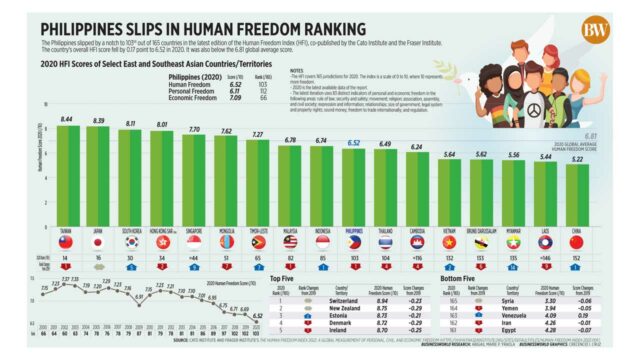
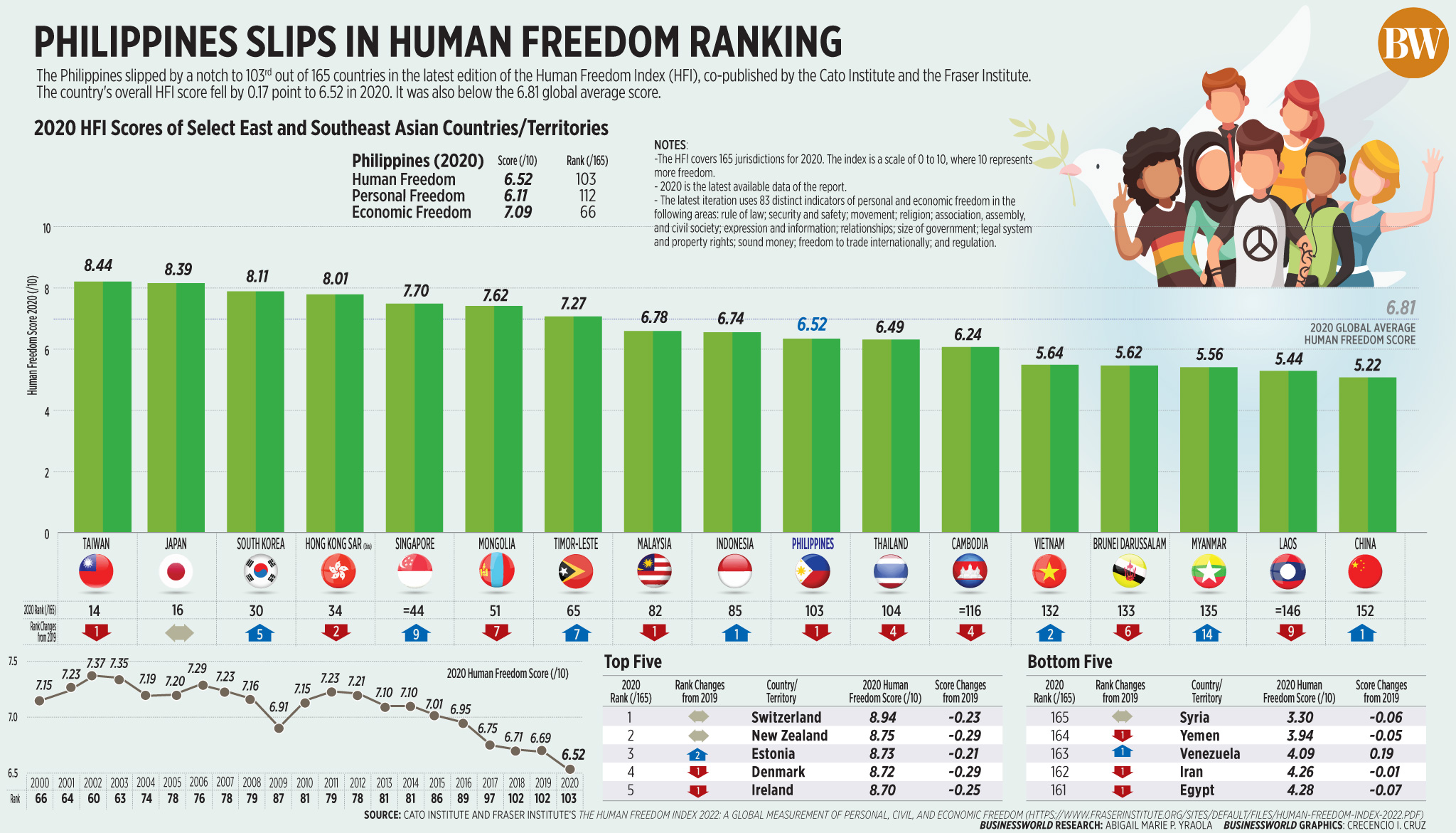
The Philippines slipped by a notch to 103rd out of 165 countries in the latest edition of the Human Freedom Index (HFI), co-published by the Cato Institute and the Fraser Institute. The country’s overall HFI score fell by 0.17 point to 6.52 in 2020. It was also below the 6.81 global average score.

Philippines slips in human freedom ranking