Home Blog Page 5191

Arellano Lady Chiefs rout LPU Lady Pirates to share NCAA S98 second place

ARELLANO University stymied Lyceum of the Philippines University on Wednesday to seize a share of second spot in NCAA Season 98 women’s volleyball. — NCAA/SYNERGY-GMA

Games Friday
(San Andres Complex)
9 a.m. — Letran vs SSC-R (M/W)
2 p.m. — San Beda vs EAC (W/M)

ARELLANO University (AU) stymied Lyceum of the Philippines University’s (LPU) attacking game and hacked out a 26-24, 25-16, 25-16, yesterday to seize a share of second spot in NCAA Season 98 women’s volleyball at the San Andres Complex.

The Lady Chiefs used their rock-solid blocking in overhauling 20-16 and 24-21 deficits in the opening set to not only snatch the set but also zap the last fight out of the dejected Lady Pirates.

It was all AU needed to come alive and dominate the rest of the way to carve out their third win in four outings, which was good enough to grab a share of No. 2 with LPU and University of Perpetual Help.

College of St. Benilde leads the way with a pristine 4-0 mark.

After blowing set point, LPU was never the same and managed to put up a token fight in the final two sets that it AU handily took.

Marrianne Padillon led her team with 12 points while Laika Tudlasan and skipper Trina Marice Abay scattered 11 hits each.

It was, however, Janice Manuntag who came through late in that heated first-set battle as she scored four of AU’s last five points in that set and finished with a solid nine-point effort.

Joan Doguna paced LPU with 13 points but none of the usual contributors stepped up that hastened their downfall. — Joey Villar

Gilas training camp for Cambodia SEA Games starts in April — Reyes

THE SEA Games, where Gilas owns the most gold medals with 18, is slated on May 5 to 17 in Phnom Penh while the World Cup is on Aug. 25 to Sept. 10 to be co-hosted by the Philippines, Indonesia and Japan. — PHILIPPINE STAR/JUN MENDOZA

GILAS Pilipinas will take a ‘first things first’ mentality with regards a long and rigid preparation for the FIBA Basketball World Cup 2023, starting with the sooner campaign in 32nd Southeast Asian Games in May.

With the World Cup still five months away, head coach Chot Reyes said that it’s concrete roadmap is yet to be finalized — save for a definite start of training camp for the Cambodia SEA Games beginning in April.

“Nothing yet. The only thing that’s on our plate right now is when to call the guys in to practice for the SEA Games set on May 5. So right now, that’s on our plate,” said Mr. Reyes, also the national program director, as Gilas seeks SEAG redemption after settling for silver behind champion Indonesia in Hanoi last year.

The SEA Games, where Gilas owns the most gold medals with 18, is slated on May 5 to 17 in Phnom Penh while the World Cup is on Aug. 25 to Sept. 10 to be co-hosted by the Philippines, Indonesia and Japan.

Like in World Cup, Mr. Reyes cleared that there are no shoo-ins in the SEA Games pending a reconvention as early as next week by his coaching staff led by deputies Tim Cone and Jong Uichico after the East Asia Super League, where Talk ‘N Text and San Miguel are representing the PBA.

“Again, there are no shoo-ins for the World Cup, the SEA Games, anywhere,” he cleared, pointing on the big picture for a series of major tournaments in terms of roster assembly and full camp details.

“Right now, the plan is in place. There are broad strokes to the plan, but the finer details are to be fleshed out as the competition comes near. So we fleshed out the details for this window and it’s over. Now, it’s time to flesh out the details for the SEA Games.”

The SEA Games, including the preparation and tournament proper, will only be a part of the grand plan for Gilas, which will include overseas training camps beginning in June for a full-swing World Cup build-up.

The only thing Gilas is waiting to cast it in stone is the official World Cup draw on April 29 here in Manila to determine the opponents it will go to war with in front of Filipino fans.

“We have to wait for the draw. It’s very difficult to plan and prepare blindly. We have to figure out who is in our group to know how we are going to prepare. It’s going to be determined by who is in our bracket, in our group. That’s No. 1,” he concluded. — John Bryan Ulanday

F2 Logistics eye share of the PVL lead with Creamline against Petro Gazz

F2 Logistics face the Petro Gazz Angels. — PVL

Games Today
(PhilSports Arena)
4 p.m. — Choco Mucho vs Cignal
6:30 p.m. — Petro Gazz vs F2 Logistics

F2 Logistics will try to reclaim a share of the lead with Creamline as it tackles an inconsistent but dangerous Petro Gazz today (March 2) in the Premier Volleyball League (PVL) All-Filipino Conference at the PhilSports Arena

The Cargo Movers were coming off a 25-23, 25-20, 25-23 win over the Cignal HD Spikers Saturday that the former hope to sustain with a victory in their 6:30 p.m. showdown with the Angels, who are in the middle of the pack with a 2-2 card.

Kianna Dy was exceptional in that win as she fired 22 points that not only lifted her team to its fourth win in five outings but also gave her confidence back after starting the season slow.

“I’m currently getting my confidence back. It’s very important,” said Ms. Dy. And that confidence is what F2 Logistics coach Regine Diego wants to build up not just with Ms. Dy but also to the rest of the team.

Petro Gazz Angels, the Reinforced Conference titlist, for its part, is out to bounce back from a heartbreaking 21-25, 31-29, 25-21, 21-25, 15-13 defeat to PLDT High Speed Hitters last week and rekindle its flickering semifinals hopes.

In the other game at 4 p.m., Choco Mucho (2-2) and Cignal (1-4) will face off with an aim of trying to bolster their respective campaign. — Joey Villar

UCI supports Philippines cycling entry at Paris Games — PhilCycling

THE PHILIPPINES will have one ally in its quest for a spot to next year’s Paris Olympics — International Cycling Union (UCI) President David Lappartient.

PhilCycling Chief Abraham Tolentino yesterday said Mr. Lappartient gave his nod to the former’s proposal for the country to be allowed to field in one entry each in road race, BMX and mountain bike qualifying races for the Paris Games.

“We talked, discussed and expounded on anything and everything about cycling that he [Mr. Lappartient] highlighted by vowing to support our program,” said Mr. Tolentino, during the Asian Cycling Confederation Congress in Bali, Indonesia.

“The support will cascade to a UCI program through the World Cycling Center Asia headquarters in South Korea,” added the Philippine Olympic Committee president.

Mr. Tolentino also presented to the ACC Congress the country’s breakthrough hosting of the Asian BMX (Racing and Freestyle) Championships at the UCI-standard Tagaytay City BMX track on July 15 and 16.

The BMX track in Tagaytay City is the sole UCI-standard track in the country and the first in Asia to have a roof.

It hosted the BMX competitions of the 30th Southeast Asian Games in 2019.

Mr. Lappartient apparently has a soft heart for the country having been in the country in 1995 as one of the commissaries in the Asian road and track championships at the Amoranto Velodrome and Subic.

And the support should go a long way for a country aiming to qualify a cyclist to Paris. — Joey Villar

Player revolts plunge Women’s World Cup into turmoil

MANCHESTER, England — Player protests and high-level resignations are dominating headlines amid a growing sense of reckoning in women’s soccer less than five months before the World Cup kicks off.

Noel Le Graet, president of France’s soccer federation (FFF), resigned on Tuesday, while Canada Soccer boss Nick Bontis stepped down a day earlier with those countries’ players embroiled in bitter disputes with their federations.

Canada’s women’s team have vowed to boycott a pre-World Cup camp next month over equal pay and support, while Mr. Le Graet faced allegations of harassment. A government ministry audit concluded the 81-year-old Mr. Le Graet did not have the “necessary legitimacy” for the position.

French women’s coach Corinne Diacre is also under fire and her future may be decided on March 9 by an FFF select committee.

Spain has also been rocked by a revolt by 15 players, who withdrew from selection consideration in protest at coach Jorge Vilda.

While the clashes could cast a cloud over the women’s global showcase, which begins on July 20th in New Zealand and Australia, players have vowed their fights are far from over, and some say the recent resignations should be just the tip of widespread changes.

“Bontis’ departure MUST trigger sweeping change,” Amy Walsh, who played for Canada at the 2008 Olympics and earned 102 caps, posted on Twitter. “It’s not enough.”

Neither Bontis nor Mr. Le Graet, however, are leaving the game. Mr. Bontis was named CONCACAF Council vice-president (North America) on Saturday, while Mr. Le Graet, who has denied all accusations, has reportedly been pegged to lead FIFA’s Paris office.

The turmoil in the two women’s programs is in stark contrast to their success on the pitch. Canada are the reigning Olympic women’s champions, while France topped their group in World Cup qualifying.

And while the governance battles rage on, female footballers have forged strong bonds — regardless of what country’s colors they wear. When the Canadian women played the recent SheBelieves Cup under protest, they found they had allies in players from around the world.

Both the Americans, who settled an equal pay lawsuit with their federation for $24 million a year ago, and Japanese wore purple tape on their wrists at the SheBelieves Cup, while the US women said in a statement: “Although we are now on the other side of this fight… our counterparts in Canada and elsewhere are experiencing the same pervasive misogyny and unequal treatment that we faced.”

Across the pond, England’s Lionesses wore purple wristbands at the Arnold Clark Cup, to “display their support (for) the Canadian WNT players and for gender equality,” the team said in a tweet.

Canada’s call for equality goes beyond equal pay. Forward Janine Beckie, who was in Qatar for last year’s men’s World Cup as part of Canada’s broadcast crew, saw the “disgusting” discrepancy between the two programs. — Reuters

Sugar: Some questions to answer

A vendor repacks sugar at Quinta Market in Quiapo, Manila, Aug. 11, 2022. — PHILIPPINE STAR/EDD GUMBAN

It looks like alleged smuggling of agricultural commodities have come front and center in news reports. For many years there was talk of smuggling of rice, pork, chicken, hamburger patties, garlic, and now onions and sugar.

One former government official remarked that “We are a strange people. We used to smuggle jewelry, Rolex watches, Italian shoes, luxury cars but now people are smuggling or attempting to smuggle onions and such kitchen items or stuff.” One can however say that smuggling becomes financially attractive when there are shortages — real or artificial.

At this time, the latest controversy is the alleged order of the Sugar Regulatory Administration (SRA) to import 440,000 metric tons of sugar before March 1. The SRA is the government agency primarily responsible “for the development of the sugar industry and to improve the working conditions of laborers.” The SRA is attached to the Department of Agriculture (DA). Unless the administrative code has changed has administrative supervision over the SRA. The SRA itself performs technical functions.

For context, during the martial law years, up to the end of the Marcos Sr.’s rule on Feb. 25, 1986, the SRA functioned independently of the DA. Marcos had given free rein to allies in the sugar industry to function as de facto governors of the SRA. Then Secretaries of Agriculture, Arturo Tanco, Jr. and Salvador Escudero, especially the former, had little to do with the operations and policy making at SRA. Given the involvement of presidential cronies in the industry, Tanco was just only too happy with the “arrangement.” He was focused on rice, corn, fisheries, livestock and poultry industries, and fertilizer availability which were already gargantuan tasks to begin with.

Context is important because the incumbent President of the Republic is also the (part time) Secretary of Agriculture. In effect, the SRA is now directly under the Department and Secretary of Agriculture. Senior Undersecretary Domingo F. Panganiban, who has been at the DA for probably at least 30 years, off and on, is in effect the Chief Operating Officer (COO) who works closely with the Office of the Executive Secretary. As we stated earlier, the DA has now come directly under the President who is also Secretary of Agriculture. He can and it seems, has “delegated” some of his powers to Mr. Panganiban and the Executive Secretary. We are not aware where the SRA Administrator and the SRA Board fit in or figure in all of these.

Given some context or background, we can perhaps go over reports of staff of legislators, investigative groups, and some media outfits to provide us a clearer perspective. Portions of such reports are found in this column.

Sugar Order (SO) No 6 was approved on Feb. 15, 2023. The Order allows the importation of 440,000 metric tons (MT) of sugar. The initial batch of imports were intended to arrive no earlier than March 1. However, there was a shipment that arrived at the Port of Batangas a week before the SRA approved SO No. 6.

The imported sugar was allegedly “connected with a draft and undated memo” supposedly issued by Senior Undersecretary Panganiban. The memo informs the SRA to “allocate the importation to three companies — All Asian Countertrade, Inc. (250,000 MT), Sucden Philippines and Edison Lee Marketing Corp. (1000,000 MT).” The order was allegedly based on the instructions of the President “through” the Executive Secretary. All this according to legislators’ staff reports.

Panganiban, an amiable civil servant throughout our association with him in the early to the mid 1970s, said (again according to reports) that there were no irregularities that attended the importation and he considered the memo issued by the Executive Secretary dated Jan. 15 a “sugar order” to proceed with the importation.

Panganiban, according to staff reports, said he picked the three companies from a list and instructed them “to proceed with the importation of sugar provided that they agree to reduce the prices of sugar.”

Panganiban also claimed that the President was aware and “properly informed” when the imported sugar arrived on Feb. 9. Study groups point out that the Anti Agricultural Smuggling Act (RA 10845) states that the entry of into the country of sugar worth at least P1 million and without a proper permit, is prohibited.

To be sure, the sugar industry, a potent political force, is up in arms over this issue unless proper answers are given to some basic questions. The sugar industry is probably the most organized agribusiness industry, mandating when to mill, where to mill, and a host of other rules and norms that have survived decades.

Expect questions like the following to be asked:

1. SO No. 6 provides that the first shipment should come in not earlier than March 1. Isn’t the early arrival of the sugar a violation of the Sugar Order?

2. What role does the Executive Secretary have in the sugar importation process? What is the role of the SRA Board in this process, if any?

3. What were the bases for choosing the three importers?

These questions need to be answered for the sake of transparency and accountability, two governance principles which have been violated for political expediency’s sake.


Philip Ella Juico’s areas of interest include the protection and promotion of democracy, free markets, sustainable development, social responsibility and sports as a tool for social development. He obtained his doctorate in business at De La Salle University. Dr. Juico served as secretary of Agrarian Reform during the Corazon C. Aquino administration.

Trying to replace China’s supply chains? Don’t bother

USERTRMK-FREEPIK

SO MUCH for the great Vietnamese supply chains that were going to replace China’s and save globalization.

Over the past few  years, analysts and consultants have eagerly pondered whether the Southeast Asian nation would edge in on its northern neighbor’s manufacturing prowess and export exuberance. Vietnam was seen as one of the biggest beneficiaries of the US-China trade conflict.

Recently, however, Vietnam’s allure as version 2.0 of the world’s factory floor has receded sharply. News trickling out of the country doesn’t bode well for companies looking to expand existing operations, or set up new ones there. Industrial production fell sharply in January, as did the number of those employed in the sector. Manufacturing activity contracted. Meanwhile, Vietnamese are turning to moonlighting and side hustles as blue-collar work slows. Wages continue to remain low and inflation is biting. Adding to the gloom, one of the largest shoemakers for Nike and Adidas, Taiwan’s Pou Chen Corp., is planning to cut 6,000 jobs at its Ho Chi Minh City plant.

A pile of niggling domestic issues are making it tougher to do business in Vietnam, too. An anti-graft campaign that led to the sudden resignation of President Nguyen Xuan Phuc spooked investors. Vietnam was supposed to be stable, and this leadership change only served to highlight the emerging market-feel of volatile politics intertwined with business decisions and processes like getting permits, approvals, licenses, and subsidies. That’s disruptive for foreign firms whose executives can quickly fall out of favor as officials in power come and go, delaying investments. Meanwhile, the country’s property sector faces a worsening debt crisis with its developers delaying repayments. For potential manufacturers, setting up with the help of domestic funding — as was the case in China — may prove challenging as it requires a lot more ongoing investment for working capital and trade finance.  Much like the rest of the world, labor is becoming a prickly issue. After at least 28 strikes in 2022, in January, 600 workers in Ho Chi Minh City protested their Japanese employer Toyo Precision Co.’s meager year-end bonus at the sewing-machine-part facility, according to local media.

For global companies, these challenges create more supply-chain complications just as they emerge from two years of struggling to smooth existing wrinkles and disruptions. After COVID-induced interruptions to production and profits, firms may have little patience to deal with more.

The appeal of moving factories to Vietnam was, in large part, driven by labor costs. The prospect of cheaper wages — relative to other production centers — has historically underpinned shifts of technology to parts of Asia (think chip manufacturing and electronics). That calculus is no longer so simple: much of the rhetoric around moving supply chains assumes that just because there are millions of working-age people in a country, they are content with low wages. It ignores their inclination toward the services sector or inflationary pressures pinching employees (much as they are hurting companies) that makes it tougher to work these jobs. Meanwhile, India and Indonesia are emerging as alternatives. Increasingly, firms need more skilled employees as digitalization and automation gain traction.

Even with the hype around Vietnam’s potential ascendancy as a vital cog in the global supply chain, it has struggled to shed the assembly-line label — as opposed to a production hub. Monthly, the country turns out over 400 million cigarette packs, more than 300 million ready-made garments, 17.2 million mobile phones, and millions of square meters of polyester. Industrial-scale equipment and machinery, or parts for them, aren’t a mainstay, yet. Meanwhile, manufacturers still depend on China for parts and components, and moving up the value chain hasn’t proved easy.

Japanese electronics firm Kyocera Corp., for instance, is expanding production of some components at its new Vietnam plant. However, the company noted last March it would only make more ceramic packages used in electronics for insulation and resistance, at this facility. The “cutting-edge small-sized packages for crystal devices are made in a highly complex way,” and it will continue to manufacture these “inside Japan for a while.”

To be sure, Vietnam’s infrastructure — from ports to highways and power supply — is well-developed around industrial parks and economic zones, where most manufacturing activity is concentrated.  Still, only 20% of roads are paved and logistics capacity hasn’t kept up with trade activity.

With one of the brightest spots looking like it’s out of the race, what’s next for globalization? For one, the world’s factory floor isn’t going to be elbowed aside any time soon. Chinese companies are effectively exporting their supply chains and facilities to Europe and Mexico in a bid to ride the nearshoring trend.

Meanwhile, it isn’t clear how much demand there actually is for a brand-new supply chain ex-China. While 30% of Japanese manufacturers use imported goods, almost 50% don’t bring in components, according to a survey by Teikoku Databank at the end of December. Meanwhile, those that do rely on imports are now shying away given the weak yen makes it expensive to bring in goods. In India, companies import electronics and other bits from China, assemble them and add some economic value by putting in a few parts like a capacitor, a device that stores electric charge. The US has kicked off its own factory-building boom, leaning on friendly trade partners.

The reality is industrial companies will manage to source the parts and components they need — some from China, others from Japan and Southeast Asia, and yet more from Mexico. Commercial ties will prevail and labor problems will abound as skilled manufacturing workers run short. Businesses will be forced to selectively decouple and certain sectors will struggle more than others. The higher the economic value of technology, the harder it’ll be to rely on others for it. There won’t be one new factory floor of the world to replace China. Just a new model of globalization to get used to.

BLOOMBERG OPINION

Is normal really what we want?

GIORGIO TROVATO/ TOMMAO WANG/UNSPLASH

“NORMAL” is a term that appeared in the English language in the 17th century as a form to standardize measurement. The Latin word, normalis, is directly referencing something made with a carpenter’s square, forming a right angle.

In the bond market, we also have a tool that defines “normal”: an upward sloping yield curve. That means that yields on longer-term bonds are higher than those on shorter-dated bank deposits, or Treasury bills and notes. Yield curves are upward sloping to compensate investors for the added risk of tying up their money for longer periods. Longer-term bonds carry greater risk of various potential losses, ranging from inflation to default. Investors therefore normally require an additional return, in the form of higher yields, to offset the risks of venturing out along the yield curve.

Today, however, most parts of the US Treasury yield curve (and many foreign government-bond market curves) are inverted,  meaning that short-dated deposits, bills and notes offer higher yields than those on longer-dated bonds.

While a recession has not followed every instance of an inverted curve, the Federal Reserve (Fed) Bank of Chicago has shown that each time the yield spread between 10-year and two-year Treasuries has inverted since 1969, a recession has followed.1

So, with today’s deeply inverted yield curve, I thought it was worth exploring three topics at the Franklin Templeton Institute: 1.) How does this inversion compare to previous episodes? 2.) What is the historical impact on equities? 3.) What is the historical impact on bonds? Based on these observations from the past, we can better evaluate if there was a pattern and whether we can discern any reasons and or lessons for the future.

CAUSE OR EFFECT?
Inverted yield curves are often the by-product of tighter monetary policies. When central banks, such as the US Fed, deem it necessary to hike interest rates to cool overheated economies, their actions cause short-dated interest rates to rise faster than yields on longer maturities.

One might ask why long-term interest rates don’t rise as much (or even more) than short rates when central banks are tightening. A key reason is that modern central banks have garnered considerable credibility in keeping inflation low. When they tighten to fight inflation, investors are quick to conclude that they will triumph, even if the cost of slaying inflation is weaker economic growth, perhaps even recession. Further along the yield curve, therefore, investors must not only discount higher short-term rates due to tighter monetary policy, but also its probable outcomes, above all lower inflation and economic weakness. As a result, when central banks tighten policies, yield curves initially flatten and then often invert, as is the case today.

Presently, the US yield curve is inverted — as measured by the gap between the 10-year Treasury note yield and the two-year Treasury note yield — by nearly three quarters of a percentage point. Relative to history, that is a big negative spread. In all previous Fed tightening episodes since 1989, the yield curve has never been as inverted as it is today. The only time in the postwar period when the gap between long and short rates was even more negative was during the early 1980s, when the Fed, under its super-hawkish chairman Paul Volcker, hiked short-term interest rates to 20%!

STOCKS AND BONDS REACT DIFFERENTLY
Accordingly, whenever the yield curve is inverted, investors ought to anticipate its normalization. Moreover, as our research shows, US Treasury yield curve normalization typically takes place in the context of falling interest rates, what Wall Street terms a “bull steepening.” In those instances, both short- and long-term interest rates fall, with the front end (shorter-dated maturities) rallying more than the long end.

Unsurprisingly, therefore, a bull steepening is bullish for fixed income markets. Prices rise along the yield curve (and across many credit markets), boosting fixed income total returns in excess of coupon rates.

One might conclude that equity investors would also be pleased with falling interest rates. All else equal, after all, lower interest rates should boost equity valuations. And US bond yields have fallen in recent months, giving stocks a lift despite slowing profits growth.

However, history gives us a more nuanced picture. During periods when the yield curve shifts from inverted back to upward sloping, stock markets typically sag. In those same episodes, total returns on bonds top those on equities in absolute and risk-adjusted terms.

That begs the question, why are equities prone to fall when the yield curve normalizes? After all, interest rates (and hence discount rates) are typically falling as the yield curve normalizes, which should be bullish for stocks.

The answer resides in the earlier discussion about the predictive power of the yield curve for recessions and, by extension, for profits. As noted, in preceding cycles dating back to 1970, an inverted yield curve always pre-dated a recession. During those downturns, as the economy weakened and inflation pressures abated, the Fed eventually relented and cut interest rates. But by then it was typically too late to engineer a “soft landing,” where inflation fell but the economy continued to grow.

For equities, the real killer is what then happened to corporate profits. Without exception, when the economy fell into recession, economy-wide corporate profits also fell. Importantly, as demand weakened, firms lost pricing power, meaning that revenues shrank even faster, especially relative to costs. The outcome was typically a nasty profits recession.

That debacle is evident, which shows US corporate profits as a percentage of US gross domestic product (GDP) — a measure of profits to total sales in the economy and a good approximation of aggregate profit margins. In each recession, except 1990, profits growth turned negative, exacerbated by a fall in profits relative to sales (i.e., relative to GDP).

So far in 2023, that is not happening. Indeed, quite the opposite is occurring. This year, despite falling S&P 500 profits at a -5% year-on-year rate for the fourth quarter 2022, equity markets have jumped higher, boosted by expectations of a pause in the Fed’s hiking cycle and hopes that a Fed “pivot” to lower rates will quickly follow.2

To an extent, this year’s rally makes sense. After all, the sooner the Fed pauses, the less damage it will do to the economy and profitability. So, equity investors are right to cheer a slowing in the rate-hiking cycle. And they are also pleased by signs that the economy is not yet buckling, as shown by solid US jobs growth and a remarkable drop in the unemployment rate to a 54-year low of 3.4%.

But equity investors should be wary of becoming overly exuberant. As Fed Chairman Jerome Powell and his Federal Open Market Committee (FOMC) colleagues have repeatedly pointed out, inflation remains too high and, in their view, is unlikely to recede to its target level without some job losses.3 The abnormalities in today’s labor market (e.g., lower labor force participation rates) therefore, are keeping the Fed tighter for longer, which only increases recession risk later this year. In short, good news about the economy, which investors are ready to celebrate, could portend even harder times ahead.

CONCLUSIONS
History strongly suggests that at this juncture in the monetary policy and economic cycles, yield curves are nearing a point of normalization. Yield curve inversion is not a lasting feature of the capital markets landscape.

History also suggests that during yield curve normalization, bonds outperform stocks in absolute as well as risk-adjusted terms. That’s our view for the next few quarters as well.

A key reason is the risks that lie ahead for corporate profits, which are already falling. They are likely to remain weak for much of 2023. The powerful start for equities in the first six weeks of 2023 has pulled forward into valuations whatever meager good news profits can offer this year, leaving valuations exposed to weaker economic conditions.

Yield curve normalization will only take place once the economy softens. That might take longer than usual, given a very tight labor market. But the risk for investors is a Fed that is “higher for longer,” with pain merely postponed. Still, equity markets might prefer a delayed normalization of the yield curve. After all, when it arrives, it is rarely good for them.

For once, therefore, equity investors might be inclined to think that when it comes to yield curves, abnormal is worth relishing. Enjoy it while it lasts.


1 Federal Reserve Bank of Chicago, 2018.

2 FactSet, as of Feb. 10, 2023.

3 US Federal Reserve.


Stephen Dover is the chief market strategist and head of the Franklin Templeton Institute.

Still life

JARED RICE-UNSPLASH

IT WAS DURING the now three years of the pandemic and the various stages of lockdown that our work routine and socializing got disrupted. Suddenly the full calendar of activities became blank, or almost so. We had to learn online shopping and banking and all sorts of virtual habits.

Stillness was forced on us, and we somehow struggled against it.

In his book, The Art of Stillness (Adventures in Going Nowhere) derived from a 2013 TED talk, Pico Iyer, a noted travel writer, extols the state of stillness or intentionally doing nothing. He talks to gurus of meditation who practice stillness and the complete elimination of activity — including chatting with your Viber group. Emptying the mind, he notes, makes us not just placid in the face of stress but also more creative.

Stillness is an art that needs to be mastered with great discipline.

Even when confined to the home in various levels of isolation, our mind wanders. We worried about how much value our stocks might have lost and whether we could get full refunds on reservations and flights for canceled trips, as well as all sorts of bills that needed to be paid online.

Our mind has always been focused on problem-solving, making judgments, and planning. The bottom line seems to be the constant stress of worrying about uncertainties which upset our routine.

Why then not go for stillness?

There is an ancient spiritual tradition of solitude, like John the Baptist stealing away for 40 days in the desert eating locusts and honey. Eastern religions like Zen Buddhism invite us to meditate by doing nothing — just sit and contemplate a “koan.” This is a riddle with no real answer like the traditional — What is the sound of one hand clapping? (Are you waving at someone?) You can make up your own koan — Does a pregnant pause need to have a father? Okay, that one needs work.

Stillness, or non-activity, is a state that requires discipline. It can mean any of three things: 1.) You don’t do anything because you want to empty your mind; 2.) Doing nothing is your natural state of being; or, 3.) You don’t really know what to do.

This third possibility can be misunderstood as a political commentary. What if you are confused and too stressed to act? Doing nothing and staying out of public view is a form of stillness. They aren’t even looking for you. (Is he on a trip again?)

Does stillness allow us to make plans in our head? The mind is supposed to be a blank. But how do you fight off stray thoughts? That’s where self-discipline comes in.

Planning is a mildly distracting mental exercise. Still, it used to be simpler. It involved evaluating capacity (financial, health, access) versus a desired goal. Let’s say you wanted to go on a trip with the family to Australia. Cost of the trip? Check. Visa needed? Check. Ability to walk long distances, including trekking up a goat trail? Next. Not too long ago, there were concerns on canceled flights, destination lockdowns, or some protocol requiring being quarantined at a hotel with no free breakfast for two weeks upon arrival. Various disruptions of this sort used to be part of making plans, or the inability to make them. Thankfully, all these restrictions have eased.

The cycle of planning needs to be shortened to a daily to-do list — What’s for dinner? (Is it milkfish in olive oil? Yummy.) As the new cases decline and flatten, there is a whole vista of making plans again without the restrictions we grew used to. Now, we can plan where to eat next week.

Stillness requires emptying the mind and unplugging it from planning as well as the pedestrian cares and worries like loan amortizations and changing car tires.

Let’s get into the still life. Are you sitting in the lotus position? Relax, loosen up. Close your eyes, put your hands on your sides, palms open and facing outward, thumbs and index fingers in closed circles. Back upright, shoulders squared.

You internalize Lao Tzu. Do you dream that you are a butterfly? You wake up. Are you now a butterfly dreaming you’re a man? When it’s time for lunch, you wonder… how much can a butterfly eat?


Tony Samson is chairman and CEO of TOUCH xda

ar.samson@yahoo.com

India leads world in internet shutdowns for 5th straight year

REUTERS

INDIA imposed by far the highest number of internet shutdowns in the world in 2022, internet advocacy watchdog Access Now said on Tuesday, as the country topped the list for the fifth successive year.

Out of 187 internet shutdowns globally recorded by Access Now, 84 took place in India, including 49 in Indian- administered Kashmir, the New York-based digital rights advocacy group said in a report published on Tuesday.

“Authorities disrupted internet access at least 49 times in Kashmir due to political instability and violence, including a string of 16 back-to-back orders for three-day-long curfew-style shutdowns in January and February 2022,” the watchdog report added.

Kashmir has long been a flashpoint between India and archrival Pakistan, which claim the region in full but rule only parts.

In August 2019, the Hindu nationalist Bharatiya Janata Party government led by Prime Minister Narendra Modi scrapped the autonomy of the Muslim-majority state of Jammu and Kashmir, splitting it into two federally administered territories.

The government has since regularly imposed communications restrictions on the region on security grounds, which rights groups have condemned and described as measures to quash dissent.

Militants have battled India’s rule in Kashmir for more than three decades. The South Asian country blames Pakistan for stoking the revolt. Islamabad denies the claims.

Although India once again led the world in internet shutdowns, 2022 marked the first time since 2017 that there were fewer than 100 shutdowns in the country, the watchdog said.

Ukraine was second on the list, with the Russian military cutting access to the internet at least 22 times after Russia invaded Ukraine on Feb. 24 of last year.

“During Russia’s full-scale invasion of Ukraine, the Russian military cut internet access at least 22 times, engaging in cyberattacks and deliberately destroying telecommunications infrastructure,” the watchdog said in its report.

Ukraine was followed on the list by Iran where authorities imposed 18 internet shutdowns in 2022 in response to demonstrations against the government.

Nationwide anti-government protests erupted in Iran last fall after the death of 22-year-old Kurdish Iranian woman Mahsa Amini in police custody on Sept. 16 last year.

Ms. Amini was arrested in Tehran by the morality police for flouting the hijab rules, which require women to entirely cover their hair and bodies. She died while in custody. — Reuters

How to get a free flight to Hong Kong in 500,000 airline ticket giveaway

BLOOMBERG

HONG KONG will begin giving away 500,000 airline tickets from Wednesday in a bid to attract visitors and boost its flagging economy, just as it finally drops its compulsory mask-wearing rule.

The tickets will be distributed by the city’s airlines — Cathay Pacific Airways Ltd. and its budget unit HK Express, as well as Hong Kong Airlines Ltd. and newcomer Greater Bay Airlines Co.

WHO GETS THEM FIRST?
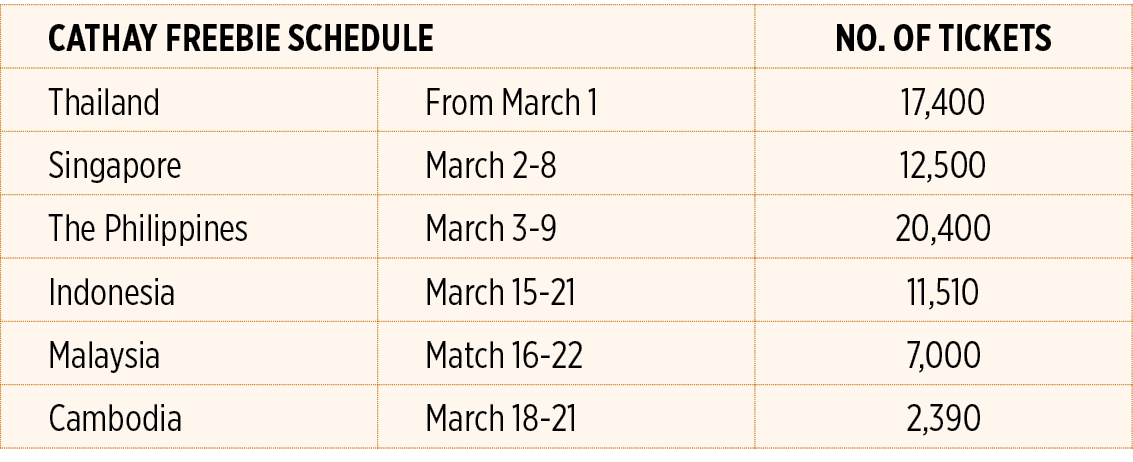
Residents in Thailand, initially. Cathay will hand out 80,000 round-trip tickets in March, starting Wednesday with 17,400 allocated to Thailand. Then it will expand the handouts to Singapore and the Philippines later this week and other nearby Asian countries in the following days.

Hong Kong Airlines will also distribute tickets from Wednesday to residents of Thailand, the Philippines and Vietnam. The carrier hasn’t disclosed how many tickets will be handed out to each country. Greater Bay Airlines will give out tickets to Taiwan in May, followed by South Korea in July. HK Express will join the campaign in April, but it hasn’t disclosed details. 

Free tickets will open for mainland Chinese residents in April. Some 80,000 tickets will become available to Hong Kong residents in July, though it is unclear what routes they will be valid for. Authorities also haven’t given a reason for the different timelines and ordering of the handouts.

HOW TO APPLY?
Cathay requires people to register on its website and take part in a quiz with three questions. The tickets will be distributed on a first-come-first-serve basis to those who get the answers right. Each applicant can submit one entry only. The winners will be announced on the campaign website on April 3 and receive a confirmation email the same day.

Hong Kong Airlines will also hand out tickets on a first-come-first-serve basis. It has released application details on its campaign page.

WHO IS ELIGIBLE AND OTHER TERMS AND CONDITIONS?
Cathay says participants must be at least 18 years old and each winner can only get one ticket. Winners still need to pay taxes and surcharges, and tickets aren’t refundable, redeemable for cash or transferable. You also can’t upgrade seats using cash or frequent-flier miles.    

DO THE TICKETS EXPIRE?
Yes, according to Cathay. Winners will receive a unique code via email once the redemption period begins. That must then be used within a month to get a ticket.

When booking a ticket, the minimum stay in Hong Kong is two days and the maximum is seven days, Cathay says. Winners are required to travel within nine months of receiving the email containing the redemption code. Rebooking charges stand at HK$1,200 ($150). 

WHY IS HONG KONG DOING THIS?
Tourism has traditionally been a major contributor to Hong Kong’s coffers, but three years of Covid restrictions kept the city largely closed off from the outside world and battered its economy, leaving it trailing rival hub Singapore. 

Hong Kong’s economy shrank 3.5% in 2022 — the third contraction in four years — and it had a whopping HK$140 billion deficit for fiscal 2022-2023, about three times higher than the government’s original estimate.

The ticket giveaway is part of a “Hello Hong Kong” campaign to promote the city as a tourism center and bring back visitors. Airport Authority Hong Kong purchased the tickets in 2020 as part of a HK$2-billion rescue package for the aviation industry. — Bloomberg

Family of late basketball star Kobe Bryant awarded nearly $29M in photos case

A mural in memory of Kobe Bryant and his daughter Gianna is painted hours after they died in a helicopter crash, on the basketball court of a housing tenement in Taguig City, Jan. 28, 2020. — REUTERS

LOS ANGELES COUNTY will pay the wife of late basketball star Kobe Bryant nearly $29 million to settle a lawsuit over allegations that sheriff officers and firefighters shared gruesome photos of the helicopter crash that killed Mr. Bryant and his 13-year-old daughter.

“Today marks the successful culmination of Mrs. Bryant’s courageous battle to hold accountable those who engaged in this grotesque conduct,” said Luis Li, attorney for Vanessa Bryant, Kobe Bryant’s wife. “She fought for her husband, her daughter, and all those in the community whose deceased family were treated with similar disrespect.”

Mr. Li confirmed that the settlement was for $28.85 million. That includes the $15 million that a jury in a federal court awarded to Vanessa Bryant in August in the case after finding that firefighters and deputies violated her privacy and caused her emotional distress.

Vanessa Bryant had sued Los Angeles County, alleging invasion of privacy, after accusing members of the Los Angeles County sheriff’s and fire departments of sharing images of the crash in unofficial settings, including to patrons in a bar.

Kobe Bryant, his daughter Gianna and seven other people died in the crash in Calabasas, Calif., on Jan. 26, 2020.

Kobe Bryant was 41 when he died. The Los Angeles Lakers great and 18-time All-Star won five NBA championships and was elected to the Hall of Fame in 2020.

Mira Hashmall, an attorney representing the county in the case, told the Los Angeles Times that the settlement was “fair and reasonable.”

She added that it resolves “all outstanding issues related to pending legal claims in state court, future claims by the Bryant children, and other costs, with each party responsible for its respective attorneys’ fees.” — Reuters

ADVERTISEMENT
ADVERTISEMENT