Home Blog Page 5168

House approves VAT refund for tourists, 2 other bills

Tourists continue to flock to Boracay, considered one of the top tourist attractions in the country. — PHILIPPINE STAR/KRIZ JOHN ROSALES

THE HOUSE of Representatives on Monday approved on third and final reading a bill seeking to grant value-added tax (VAT) refunds for foreign tourists to encourage more visitor spending, as well as the proposed e-Governance Act and reforms to the Official Development Assistance (ODA) Act.

During its Monday plenary session, 304 lawmakers voted in favor of House Bill (HB) No. 7292 that would allow nonresident tourists to obtain a VAT refund on purchases of goods worth at least P3,000. Four lawmakers voted against the measure.

Under the bill, the secretary of Finance, upon recommendation of the Internal Revenue commissioner and the Tourism secretary, is authorized to adjust the threshold based on administrative costs of processing refunds, inflation, and other market conditions.

Bob Zozobrado, president of the Tourism Congress of the Philippines, said a VAT refund scheme will finally put the Philippines at par with Southeast Asian neighbors that have been offering this to tourists for years.

“The multiplier effect of every tourist expenditure is certainly something our industry needs, especially the various micro, small and medium enterprises down the line,” he said in a Viber message.

Ser Percival K. Peña-Reyes, director of the Ateneo Center for Economic Research and Development, said in a phone call that the bill would help the country attract more foreign tourists.

Meanwhile, 304 lawmakers voted in favor of HB 7311 which seeks to leverage ODA with other funding sources, while four voted against.

HB 7311 proposes a “blended financing” framework, allowing private partners to finance the ODA. It seeks to amend the ODA Act of 1996, which is said to restrict bilateral partners, particularly from European companies, from funding ODA projects.

Michael L. Ricafort, chief economist of the Rizal Commercial Banking Corp., said greater flexibility on ODA funding would “allow the use of more government-to-government/multilateral funding sources at much lower costs and at better payment terms.”

He said this measure will also allow increased private sector participation with more capital from local and foreign investors.

Also approved on third reading was HB 7327, which seeks to institutionalize the transition of the government towards “e-governance.” There were 304 lawmakers who voted yes, while four voted against the measure.

Under the proposed measure, the Department of Information and Communications Technology (DICT) must create an E-Government Master Plan which will guide the development and enhancement of all e-government services and processes.

The bill also proposes to create the Philippine Infostructure Management System, a government-owned and -controlled corporation under the DICT to implement infrastructure programs like the National Broadband Plan, Free Wi-Fi for All, and the expansion of the National Government Data Centers and Government Cloud.

If enacted into law, it is expected to enhance the ease of doing business in the Philippines as the government transitions from the traditional person-to-person and paper-to-paper system. — Beatriz Marie D. Cruz


Petron net earnings climb 10% on high fuel demand

PETRON.COM

PETRON Corp. reported a 9.8% increase in consolidated net income to P6.7 billion in 2022 from P6.1 billion in the previous year largely due to higher fuel demand.

“We’ve been consistent in our recovery, with our profits already at pre-pandemic levels over the past two years. We continue to note an increased and growing demand for our products even as we contend with pricing challenges, heavy competition, and the lingering effects of the pandemic,” Petron President and Chief Executive Officer Ramon S. Ang said in a regulatory filing on Monday.

The oil company said that despite the volatility in the market, it was able to maintain a steady sales volume from its local and international operations.

Petron said its Philippine sales volume in 2022 stood at 68.53 million barrels, 43.1% higher than the 47.9 million barrels sold in 2021; while the company saw its international sales volume increase by 37.2% to 112.81 million barrels from 82.24 million barrels.

Petron said its service station volumes in the Philippines and Malaysia increased by 26% as gasoline and diesel products remained in demand.

Commercial sales also increased by 30% driven by sales of jet fuel, liquefied petroleum gas, and polypropylene products as the production of polypropylene resumed last year.

Crude prices continued to decline in the second semester of 2022 as the global inflation rate spiked and amid fears of recession. The price of Dubai crude dropped by 31.9% to $77 per barrel in December from $113 per barrel in June, Petron said.

Petron’s operating income rose by 11.6% to P19.21 billion from P17.21 billion, which the company attributed to the optimization of its refining assets.

“With our full recovery within our reach, we’ve returned our focus on growing the business and beefing up our operational framework to ensure our continued success and sustainability,” Mr. Ang said.

In a separate disclosure on Monday, Petron said its board of directors approved the declaration of cash dividends of 10 centavos per share for common shareholders with a record date of March 20, 2023, and a payment date of April 4, 2023.

Petron is the operator of the only refinery in the country that provides 40% of local petroleum requirements. Its refinery in Bataan produces 180,000 barrels per day.

At the local bourse on Monday, shares in the company gained 36 centavos or 13.64% to end at P3 apiece. — Ashley Erika O. Jose

ICTSI income jumps 44% on higher operating profit

RAZON-led International Container Terminal Services, Inc. (ICTSI) recorded a 44.3% increase in its attributable net income to $618.46 million in 2022 due to higher operating income.

“[The increase is] primarily due to higher operating income; partially tapered by increase in depreciation and amortization charges, interests on loans, lease liabilities and concession rights payable, provision for income taxes, and nonrecurring impairment charges,” the listed port operator said in a press release on Monday.

Revenues from operations increased by 19.8% to $2.24 billion from $1.87 billion in 2021, while its earnings before interest, taxes, depreciation, and amortization went up by 23.7% to $1.41 billion in 2022 from $1.14 billion a year earlier.

The company saw a 9% increase in the consolidated volume it handled in 2022 to 12.22 million twenty-foot equivalent units (TEUs) from 11.16 million TEUs last year.

“The increase in volume was primarily due to [the] consolidation of Manila North Harbour Port, Inc. in Manila starting September 2022, volume growth and improvement in trade activities as economies continue to recover from the impact of the coronavirus-2019 pandemic and lockdown restrictions; and new shipping lines and services at certain terminals,” ICTSI said.

For 2023, the company is earmarking a capital expenditure (capex) of approximately $400 million mainly for the ongoing constructions of ICTSI’s terminals, the second tranche of concession extension, expansions in Nigeria and Brazil, development of a terminal in Indonesia, and equipment acquisitions.

ICTSI’s capex for 2022 reached $386.35 million, which it attributed to the ongoing expansions in its Victoria International Container Terminal in Australia and Manila International Container Terminal, ICTSI D.R. Congo S.A., and Contecon Manzanillo S.A. de C.V. in Mexico.

The company has also allotted capital for the acquisitions of land at the Port of Manila and concession-extension-related expenditures at Madagascar International Container Terminal Services Ltd.

“In a year marked by geopolitical unrest and inflationary pressures, we took clear and robust actions to focus on our cost initiatives and implemented a selective and disciplined capex program which has pleasingly created value for our stakeholders,” ICTSI Chairman and President Enrique K. Razon, Jr. said in a statement.

ICTSI manages and operates container terminals in the 50,000 to 3.5 million TEUs per year range. It operates 33 terminals in 20 countries across six continents.

Its shares on Monday climbed by P7.00 or 3.5% to finish at P207 each on the stock exchange. — Justine Irish D. Tabile

AboitizPower posts 27% profit rise to P26.5B

ABOITIZ Power Corp. reported a 27.4% increase in core net income to P26.5 billion in 2022 from P20.8 billion a year earlier due to contributions from its coal-fired plants.

“We have achieved another strong year in 2022, despite the challenges posed by the ongoing pandemic. Our pursuit of delivering reliable and sustainable power to our customers and our strategic investments in renewable energy have enabled us to remain resilient and adapt to changing market conditions,” AboitizPower President and Chief Executive Officer Emmanuel V. Rubio said in a statement on Monday.

The energy company of the Aboitiz group attributed the profit increase to the contributions of GNPower Dinginin Ltd. Co. (GNPD) and the higher availability of its power plants.

AboitizPower’s GNPD is a 1,336-megawatt  coal-fired power plant in Mariveles, Bataan. To date, the power generation company has contracts with around 30 electricity distribution companies and retail electricity suppliers.

Including one-off gains, the energy company registered a net income of P27.5 billion in 2022, higher by 32.2% than the P20.8 billion recorded a year earlier.

AboitizPower also cited higher water inflows and gains from commodity hedges for its profit rise.

In the fourth quarter alone, AboitizPower recorded a consolidated net income of P8 billion, up 56% from a year ago. It booked nonrecurring losses of P167 million during the quarter, a reversal of the P71 million in nonrecurring gains recorded in the same period in 2021.

Excluding these one-off items, AboitizPower’s core net income for the fourth quarter was P8.2 billion, or higher by 61% year on year.

Its generation and retail supply business recorded an 18% increase in earnings before interest, taxes, depreciation, and amortization (EBITDA) to P51.2 billion in 2022 from P43.4 billion in 2021.

Capacity sold in 2022 went up by 7.5% to 4,034 MW versus 3,753 MW in 2021.

Energy sales also went up to 30,251 gigawatt-hours (GWh) in 2022, up by 16.2% compared with 26,031 GWh in the previous year.

AboitizPower’s power distribution businesses recorded an EBITDA of P8 billion, 6.7% higher than P7.5 billion in 2021. Energy sales stood at 5,785 GWh in 2022, 3.6% higher than the 5,583 GWh recorded a year earlier.

“As we move forward, we will continue to focus on expanding our renewable energy portfolio and leveraging digital technologies to enhance our operations and customer service. We remain optimistic about the future and are confident in delivering long-term value to all our stakeholders,” Mr. Rubio said.

AboitizPower aims to expand its portfolio to 4,600 MW of sustainably sourced energy by 2030. The company and its partners currently own a total net sellable capacity of 1,248 MW.

On Monday, its shares closed lower by P0.15 or 0.39% to P38 each. — Ashley Erika O. Jose

URC profit up 12% to P14.5B

UNIVERSAL Robina Corp. (URC) reported a 12% increase in its 2022 net income to P14.5 billion, driven by a strong topline, price increases, and cost-saving initiatives by the listed food company.

“We have closed out the year strong, turning in a record performance across all our business units, and surging well above pre-pandemic levels,” said URC President and Chief Executive Officer Erwin C. Lee in a disclosure to the stock market on Monday.

In 2022, sales rose by 28% to P149.9 billion due to the momentum of reopening economies in the region.

“The structural work we have done over the last few years has allowed us to capitalize on the growth opportunities from the reopening of the economy in 2022,” Mr. Lee said.

The company’s operating income increased by 20% to P15.2 billion compared to the previous year.

Sales of the branded consumer foods group went up by 29% to P105.9 billion, while its revenues rose by 23% to P73.6 billion.

URC’s international division registered a 17% revenue increase to P32.3 billion due to economic reopening in the region.

The agro-industrial and commodities division reported a 26% sales growth to P42.1 billion, driven by strong sales of animal and pet food.

Flour, sugar, and renewables also posted growth due to higher selling prices but saw double-digit declines in volume due to supply issues “brought about by the global wheat market volatility, more severe typhoon impacts, and lower milling outputs.”

“In the coming year, we will continue to execute our plans to keep our margin recovery on track,” Mr. Lee said.

“We remain confident that the strength of our portfolio of ‘Products and Brands that People Love’ will continue to drive growth into 2023 and beyond, as we stay true to our purpose of providing good food choices for consumers,” he added.

At the stock exchange on Monday, URC shares rose by 0.07% or 10 centavos to close at P135.10 apiece. — Adrian H. Halili

South Korean romance reality shows boom, but marriage no longer the endgame

DETAIL from the poster of the Korean reality show Single’s Inferno.

SEOUL — If South Korea’s big boom in dating and relationship reality TV shows is anything to go by, the country’s interest in romance has never been greater.

At least 20 such shows aired across the country’s cable TV networks and video streaming platforms last year, more than triple the number in 2021, according to a Reuters tally.

There’s a plethora of shows matchmaking young single people, but also, notably, a growing number highlighting South Korea’s increasing acceptance of non-traditional relationships that don’t revolve around marriage and starting a family.

Living Together without Marriage, for example, focuses on couples who have chosen not to tie the knot and His Man is one of two shows featuring LGBTQ people. Other shows throw the spotlight on divorced people searching for love again.

The trials and tribulations of dating and relationships — perennial fodder for TV content in most cultures — take on particular weight in South Korea. Here, the popularity of marriage as well as enthusiasm towards parenthood have nosedived. Sharp gender inequality and the sky-high costs of rearing children are widely blamed.

Kim Jin, chief producer of Living Together without Marriage, says the show, which premiered in January, does not intend to advocate unmarried cohabitation or discourage marriage, but spark debate.

“By showcasing these couples’ lifestyles and the reasons behind their decision, we wanted to bring the topic to the fore of society,” she told Reuters.

While official statistics on their numbers are not kept, unmarried couples living together no longer raise eyebrows in South Korea. That said, having kids outside of marriage is a step few Koreans would contemplate.

Whether to marry or not has been a source of tension for Cho Sung-ho and Lee Sang-mi, a couple of more than 10 years featured on the show.

For 32-year-old Ms. Lee, a model, the decision to live together unmarried was a deliberate choice not to be bound by tradition. She’s not eager to have children, saying it would be “impossible in reality” to be a good mother and stay true to herself.

“I am most comfortable with how it is now, and don’t quite get why I should get married and have more obligations such as visiting both sets of parents in the holiday season,” Ms. Lee said.

Mr. Cho, also 32, still hopes for marriage and children, although the former K-pop idol turned YouTuber says he understands Ms. Lee’s reluctance given that women usually bear the greater burden in child-rearing.

IMPORTANT CONVERSATIONS
South Korean disaffection with marriage and having children is underscored by grim statistics: the number of newly married couples has slid 23% in the past five years and the country has the dubious distinction of having the world’s lowest fertility rate.

And while romance reality shows may be all the rage, a substantial number of Koreans also appear prepared to eschew relationships altogether.

According to a survey of around 1,000 people last year by the Korea Population, Health and Welfare Association, about two-thirds of single people aged between 19 and 34 were not in a relationship. Of those, 61% of women and 48% of men said they had no desire to find a boyfriend or girlfriend in the future.

Shows like Living Together without Marriage illustrate how South Korea is embracing diversity in relationships in a way that is closer to Western societies, but the shows are also still very distinct from their Western counterparts.

Most have little in the way of conflict and tantrums. Although flirting, hugging, and cuddling are depicted, kissing and sex are not. Even on dating shows like Netflix’s hit Single’s Inferno which transports young people to a deserted island, most of the shows’ content revolves around long conversations between participants.

The conversations in and around dating and relationship shows are good for South Korea, says Lim Myung-ho, a professor of psychology at Dankook University.

“The government and society really need to make efforts to foster a more positive attitude towards dating and marriage and these reality programs can help with that,” he said. — Reuters

SM Investments sets 2GO tender offer price at P14.64 per share

THE board of directors of SM Investments Corp. has set the tender offer price of 2GO Group, Inc. shares at P14.64 per common share, the companies both disclosed to the stock market on Monday.

2GO’s common share price was based on the fairness valuation report issued by BPI Capital Corp.

The company also said that it is setting the tender offer period from March 15 to April 28, 2023; while its payment and settlement of the tendered shares were set from May 2 to 10, 2023.

In an earlier disclosure, SM Investments said that its board of directors approved the tender offer for 2GO shares for up to 378,817,279 common shares, which constituted 15.39% of the issued and outstanding common capital stock of the subsidiary.

The tender offer was subject to an independent third-party fairness opinion under BPI Capital as the independent third-party valuation provider. The company also tapped BDO Securities Corp. as the tender offer agent.

The offer prompted 2GO to voluntarily suspend trading activities under the approval of the Philippine Stock Exchange (PSE) on Feb. 28, 2023. The trading suspension was from March 1, 9 a.m. to the next day at 9 a.m.

Additionally, 2GO’s board of directors approved the voluntary delisting of shares from the main board of the PSE.

Meanwhile, in a separate disclosure from 2GO, the exchange approved another request from the subsidiary to suspend trading on Monday as SM Investments released its valuation for the share price.

2GO has requested for voluntary suspension of the trading of its shares at the PSE during all trading hours of March 6, 2023, “to allow the investing public equal access to and consideration of this information,” 2GO said in a disclosure to the stock market.

On the stock market on Monday shares in SM Investments rose by 1.12% or P10 to close at P886 apiece. — Adrian H. Halili

Sustained Philippine economic gains to trickle down to property

PHILIPPINE STAR/MIGUEL DE GUZMAN

By Joey Roi Bondoc

THE Philippine economy posted its fastest pace of growth in more than 40 years in 2022. This is a positive signal for the property market which, over the past decades, mirrored the boom-bust cycle of the country’s economic output. This economic expansion should support positive net take-up of office space in 2023 and continued rebound in Metro Manila’s pre-selling and secondary residential markets.

An aggressive stance taken by the National Government in attracting manufacturing investments should result in greater absorption of industrial space across the country. The personal consumption-led economic growth should also spur retail and hotel demand.

To cash in on the sustained growth, developers should line up more projects in key growth areas outside of Metro Manila. Developers of industrial parks and facilities should also prepare for greater take-up as manufacturing investments committed with investment promotion agencies take up industrial space and warehouses.

FASTEST GDP GROWTH IN 46 YEARS
In 2022, the country’s economy grew by 7.6%, exceeding the government’s target of between 6.5%-7.5% for the year and the fastest since 1976. The 2022 GDP print also surpassed most forecasts of economic analysts. The Philippines was also one of the fastest growing economies in Asia last year, only behind Vietnam’s 8% growth.

In 2023, economic output is likely to grow at a slower pace of between 6%-7% as elevated inflation and a possible global economic recession are likely to temper the country’s expansion.

OFFICE DEMAND TURNS AROUND
In 2022, office transactions in Metro Manila reached 603,800 square meters (6.5 million square feet), up 43% from the 422,400 sq.m. (4.5 million sq.ft.) recorded in 2021.

Meanwhile, provincial transactions nearly doubled to 222,800 sq.m. (2.5 million sq.ft.) from 113,100 sq.m. (1.2 million sq.ft.) a year ago. Outsourcing firms accounted for nearly 70% of total provincial deals. Cebu, Davao and Pampanga covered nearly 90% of total provincial transactions in 2022.

Colliers recorded the completion of 750,300 sq.m. (8.1 million sq.ft.) of new office space in 2022. From 2023 to 2026, we expect the annual delivery of about 555,000 sq.m. (6.0 million sq.ft.), the same level of new supply that Colliers recorded from 2013 to 2016 (450,000 to 550,000 sq.m.), prior to the entry of POGOs.

Meanwhile, vacancy as of end-2022 reached 18.8%, higher than the 15.7% recorded in 2021. In 2023, we see vacancy rising further to 20.2% on the back of completion of 641,100 sq.m. (6.9 million sq.ft.) of new supply. Net take-up in 2022 reached 110,500 sq.m. (1.2 million sq.ft.), lower than our initial forecast of 140,000 sq.m. (1.5 million sq.ft.) but still a reversal from the negative net absorption that we recorded from 2020 to 2021.

RESIDENTIAL TAKE-UP PICKS UP
Colliers recorded the completion of 9,000 condominium units in 2022, a mere 3% rise year on year. This brings Metro Manila’s condominium stock to 151,200 units as of end-2022. From 2023 to 2025, we project the annual average delivery of 6,700 units. By 2024, we expect Bay Area’s condominium stock to overtake Fort Bonifacio’s aggregate supply.

Demand in the pre-selling market rebounded as we recorded about 20,000 units sold in 2022, from a take-up of 13,300 units in 2021. Meanwhile, full-year launches reached 24,200 units, down 19% year on year.

In our view, the rising interest and mortgage rates, as well as the increasing prices of construction materials likely tempered condominium launches in 2022. New launches have yet to revert to pre-COVID levels.

In 2022, the share of the luxury and ultra-luxury market (P8 million and above per unit) to total condominium take-up reached 34%, from only 5% in 2021. Colliers believes that take-up for this segment will likely be sustained by demand from the affluent market banking on luxury and ultra luxury residential properties’ capital appreciation potential.

REVENGE TRAVEL ACROSS PHL
Data from the Department of Tourism (DoT) showed that foreign arrivals reached 2.65 million in 2022, 1,519% higher than the 163,879 arrivals in 2021. The 2022 figure exceeded the Tourism department’s initial target of 1.7 million for the year. Among the country’s top source markets in 2022 include the United States, South Korea and Australia.

With renewed optimism, the DoT now expects foreign arrivals to reach 4.8 million in 2023. However, this year’s projection remains below the record-high 8.2 million international arrivals recorded in 2019.

In 2022, Colliers recorded an average hotel occupancy of 51%, up from 44% in 2021 and 20% in 2020. We attribute the improvement in occupancy to holiday-induced spending, return of more Filipinos working abroad, and the surge in Meetings, Incentives, Conferences and Exhibitions (MICE) activities. The latter indicates that business travelers are back and in-person events are gradually returning.

In 2023, we project average hotel occupancy in Metro Manila to breach 60% due to the influx of more foreign visitors and continued growth from the local staycation market. We also see the resurgence of in-person events lifting the demand for MICE facilities and business hotels.

Colliers Philippines is optimistic that a strong economic rebound will redound to Philippine property.  Developers and investors need to be more agile as they reap gains in the market. 

The Philippine property is bound for rebound, is turning a corner, and seeing light at the end of the proverbial tunnel. All these point to the Philippine property market finally roaring back after two consecutive years of slump.


Joey Roi Bondoc is associate director and head of research at Colliers Philippines.

Filipino fans give Song Kang language lessons during meet

KOREAN actor Song Kang

KOREAN actor Song Kang certainly knows that the way to his fans hearts is through their language. Less than a minute after he stepped onstage for the Deoproce Fan Meet at the Smart Araneta Coliseum on March 5, the actor said “Mahal ko kayo” (I love you all). In between answering questions, he often said “Salamat” (thank you).

Fans interacted with their idol by teaching him a few Filipino sentences, and dialing a phone number onscreen for a chance to ask a question on the phone. Lucky fans also took home a signed Polaroid selfie and custom-painted shirt by Mr. Kang.

The 28-year-old actor first garnered international attention when he played Hwang Sun Oh in Netflix’s Love Alarm in 2019. He also starred in Netflix’s horror program Sweet Home (2020). His other popular shows include Nevertheless (2021), Navillera (2021), and Forecasting Love and Weather (2022).

He was given the title “Son of Netflix” having worked in three successful Netflix titles since 2019.

“It is fascinating, I am grateful,” Mr. Kang said about the title during a press conference at Marco Polo Ortigas prior to his fan meet. “They (Netflix) feel like family because they have been with me since the beginning of my career. I am enjoying my work with the people familiar to me.”

The actor said that he is currently shooting the second season of Sweet Home where he plays Cha Hyun-Soo, the character he says is currently closest to him. Sweet Home is an apocalyptic horror series about humans surviving attacks from monsters that are born from human desires.

Mr. Kang paused to think of responses to questions in order to avoid mentioning any spoilers for the upcoming season.

“In season one, it was the story of how the people grew and matured. Seasons 2 and 3 will be a story of who have grown,” he said.

When preparing for scenes he said, “I record the lines of other actors, and listen back to it… I look at the scene before and after the one they will shoot, so I can get a good grasp of the emotion I should be expressing at that time.”

Despite admitting that he has no intentions of becoming a K-Pop idol after his dance cover of NewJeans’ “Hype Boy” went viral, Mr. Kang stood up during the press conference to dance to the song.

In one of the question-and-answer segments with fans, Mr. Kang was asked about his advice to those who want to give up on their dreams. He said to be adventurous in the search for one’s passion.

“If you are not passionate about this thing that you are trying to do, maybe it’s not your dream. Try many different things and see where you gravitate…,” Mr. Kang said. “So, if you become more adventurous try many different things and you will eventually find the thing that you like. If you put enough time and effort into it, it can eventually become your dream. You can shine by doing that.”

THE NEW FACE OF DEOPROCE
Song Kang was in the country under the auspices of skincare brand Deoproce Philippines — he is the company’s new ambassador.

“Song Kang has a glow like no one else. He is perfect for the brand. We were enthralled by his great talent and fantastic personality. We truly enjoy working with him,” Angie Goyena, president of ZFace, Inc. — the brand’s distributor, said in a statement.

According to Mr. Kang, his simple skincare routine consists of a cleanser and a toner, which he follows up with a moisturizer and then sunscreen.

The brand’s new skincare products featuring Song Kang are the Green Caviar line (made with sea grapes) and Skin Rescue line.

Green Caviar contains vitamins A and C, as well as amino and Omega-3 fatty acids which help boost collagen production to reduce fine lines. It also has polysaccharides like Fucoidan which has antioxidant and anti-inflammatory benefits.

The Green Caviar line consists of a cleansing water (P690/150ml), a facial cleanser (P590/170ml), a toner (P790/150ml), a Vitamin C ampoule (P1,490/30ml), a water cream moisturizer (P1,490/100ml), and a skin-perfecting tint with SPF 30+ (P790/50ml).

Meanwhile, the Skin Rescue line comes with a cleansing foam (P690/170ml), a peeling gel (P790/170ml), a toner (P890/150ml), an ampoule (P1,490/30ml), a day and night moisturizer (P1,790/100ml), and a lightweight sunscreen (P890/50g).

Deoproce products are available in Watsons and SM Beauty, and online on Amorfia. — Michelle Anne P. Soliman

Atlas Mining’s income slips 17% to P3B on higher operating costs

ATLAS Consolidated Mining and Development Corp. on Monday reported a net income of P3.22 billion in 2022, down by 16.6% from P3.86 billion a year earlier, due to higher prices of fuel and energy.

In a stock exchange disclosure, the mining firm said the “unprecedented spikes” in prices resulted in higher operating and production costs. It also cited the lower production levels in company-owned Carmen Copper Corp. due to heavy rainfall.

Gross revenues were down by 4.4% to P17.68 billion from P18.5 billion.

According to Atlas Mining, the price of copper metal decreased by 6% to $4.02 per pound last year from $4.26 per pound in 2021. The price of gold per ounce rose slightly to $1,804 from $1,802 previously.

The company’s earnings before interest, tax, depreciation, and amortization decreased by 44.5% to P5.41 billion compared to P9.77 billion recorded in the previous year.

In the summary of its financial results for 2022, the listed mining company posted a cash cost of P12.40 billion, up by 38% from P8.95 billion a year earlier.

Meanwhile, Atlas Mining said its subsidiary Carmen Copper recorded a decline in gold and copper metal production and shipment last year.

Carmen Copper’s gold production was down by 11.3% to 22,339 ounces while copper output was down by 9.7% to 74.45 million pounds.

The unit’s gold shipments were 7.6% lower in volume to 21,117 ounces, while copper metal shipments declined by 5.5% to 78.34 million pounds.

“[Carmen Copper] was also able to pay its loan obligations amounting to $97.6 million coming from internally generated cash,” the company said in its press release.

At the stock exchange on Monday, Atlas Mining shares increased by eight centavos or 1.92% to close at P4.25 apiece. — Sheldeen Joy Talavera

Robinsons offers early bookings amid ‘revenge’ travel

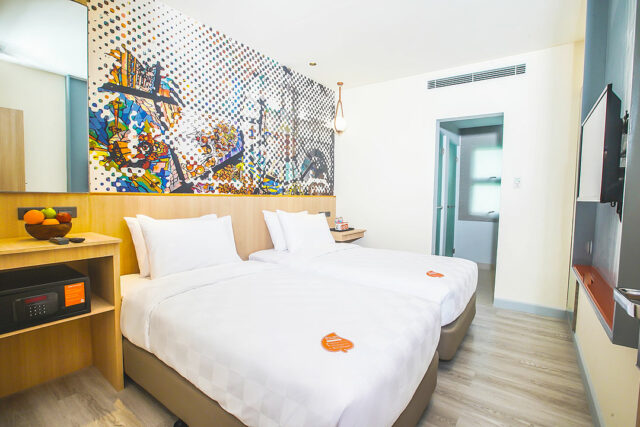
GO HOTELS recently launched new booking services — GO24/7 and GO365. — COMPANY HANDOUT

By Brontë H. Lacsamana, Reporter

ROBINSONS Hotels and Resorts (RHR) is offering flexible check-in and check-out times and year-in-advance hotel bookings in several Go Hotels, amid an anticipated rise in business and leisure trips driven by “revenge travel.”

The hospitality arm of Robinsons Land Corp. introduced GO24/7, which lets travelers choose which time to check in and out, and GO365, which allows bookings from 15 up to 365 days in advance on their website.

GO24/7, only applicable for bookings three days before the stay, will be initially available in 7 Go Hotels properties: Dumaguete, Iloilo, Lanang-Davao, Mandaluyong, Otis-Manila, Puerto Princesa, and Tacloban.

The GO365 offer will be available across Go Hotels, Go Hotels Plus, Summit Hotels, and Grand Summit.

These services are being launched in time for an anticipated increase in both business and leisure travel this 2023, said Joy de Mesa, RHR’s group director of sales and marketing, in a media briefing on Feb. 27.

“Travelers will be able to avail 10% savings on the best available rates without having to worry about not being able to book rooms and to take advantage of discounts or special offers at the time of booking,” she said.

“We thought of these offers as a good way to pair up with similar seat sale offers that airlines have,” Ms. De Mesa added. “Guests just have to pre-pay to avail of them.”

This initiative is a step towards making RHR’s booking platform more convenient and all-encompassing, with various features integrated to meet all travelers’ needs. This is why both GO24/7 and GO365 are only available via direct booking.

Meanwhile, GO Online is a chat option that RHR will be introducing on its online platform by end of March. It will allow guests to explore various packages through instant messaging.

Ms. De Mesa told BusinessWorld that they hope to fully roll out what they’ve dubbed the “GO, GO, GO” program in all their hotels before April, to take advantage of the high tourist traffic in the summer.

“We’re still ironing out GO Online so in the future we can easily integrate it with other resorts and airlines,” she said. “Our target will be both leisure and business travelers.”

Chris Rock unleashes on Will Smith and wife Jada a year after Oscars slap

WILL SMITH hits Chris Rock onstage during the 94th Academy Awards in Hollywood, Los Angeles, California, US, March 27, 2022. — REUTERS

LOS ANGELES — A year after he was slapped on stage at the Academy Awards, Chris Rock hammered Will Smith and his wife in a comedy special streamed live around the world, joking that he enjoyed seeing the actor beaten in his latest film.

Live on Netflix on Saturday from the Hippodrome Theater in Baltimore, Mr. Rock said he had been watching slavery drama Emancipation just to see Mr. Smith “get whooped,” cheering “hit him again” and “you missed a spot.”

In March 2022, Mr. Smith walked on to the Oscars stage and slapped Mr. Rock’s face after the comedian made a joke about the appearance of Mr. Smith’s wife, Jada Pinkett Smith. The King Richard star returned to his seat in the audience and later won best actor.

Mr. Rock had been mostly silent about the incident until the end of his hour-long special, when he accused Will Smith of “selective outrage,” also the name of his special.

The comedian said Ms. Pinkett Smith had stirred tension among the three, in part by calling for a boycott of the Oscars in 2016 when Mr. Rock was the host. Ms. Pinkett Smith said she was protesting the fact that Will Smith and other Black actors were not nominated.

Mr. Rock, who also is Black, joked about Ms. Pinkett Smith at the Oscars that year and again last year.

“She starts it. I finish it,” Mr. Rock said.

Mr. Rock also brought up marital problems the Smiths have publicly discussed. Ms. Pinkett Smith admitted to an affair that she called an “entanglement” in 2020.

“I didn’t have any entanglements,” Mr. Rock said. “She hurt him way more than he hurt me.”

Representatives for the Smiths did not immediately respond to requests for comment.

Will Smith issued a statement of apology to Mr. Rock and to the Academy of Motion Picture Arts & Sciences, the group that awards the Oscars, the day after slapping Rock. The academy banned Mr. Smith from attending the Oscars for 10 years.

The comedy special was the first event streamed live on Netflix, which is testing the technology as it considers expanding into other real-time programming.

Netflix agreed to pay $40 million for two Rock comedy specials under a deal reached in 2016, according to a person familiar with the matter. Saturday’s special was the second of the two.

Mr. Rock spent most of the show riffing on topics ranging from Britain’s royal family to the Kardashians, abortion, and his dating life. He concluded by saying why he did not fight back when Mr. Smith hit him.

“I got parents, and you know what my parents taught me?” he said. “Don’t fight in front of white people.” — Reuters

ADVERTISEMENT
ADVERTISEMENT