Home Blog Page 5167

ASEAN Gaming Summit: It’s a consumer market

It’s all about that (Premium) mass. This year’s edition of the ASEAN Gaming Summit, running in Manila since 2017, is dedicated to the industry’s shift from its targeted VIP legacy to a mass consumer market and what you need to engage that coveted slice of the top: Premium mass.

Join the three-day calendar event that brings the industry together in the Philippines: Bricks and Mortar, Online, PIGOs and POGOs, Regulators, Operators, Suppliers, Affiliates, and Service Providers.

Hear directly from the CEOs about how the pandemic was a catalyst for change and how they’ve adapted and thrived.

Keynote Speaker, Hann Resorts CEO Daesik Han will recount his story and share his plans for expansion in a special fireside chat format that ASEAN is debuting this year.

Panel discussions branch out beyond the home ground of the Philippines to encompass Macau, the Southeast Asia jurisdictions, as well as the much talked about upcoming potential markets: Thailand and the UAE.

Focusing on what really matters, insiders discuss localization for the online offering, traffic, affiliate marketing, and the ever-evolving cybersecurity measures.

Experts demystify Cashless Gaming and Crypto, among other in-depth sessions, separating the waters between the technology, its application, and implementation rates.

“The AGB team is thrilled about hosting another edition of the ASEAN Gaming Summit in the Philippines, where the whole spectrum of the industry, online and land-based, can come together, to engage, discuss, and showcase their offering,” Asia Gaming Brief Managing Director Luis Pereira said.

“With the industry’s support, ASEAN has become the premier gaming conference in Manila since its inception in 2017,” Luis Pereira noted, adding that “this year, in tandem with the industry’s growth across the region, we are delighted to be providing a larger capacity exhibition, as well as a stellar lineup of speakers, to provide our delegates a memorable experience.”

The premier gaming conference in the Philippines is rounded out with a 3,000-sq.m. exhibition area at Newport Resorts World, where you’ll find the relevant established brands and newcomers to the industry and the Asia markets: from manufacturers to suppliers, payments providers, and other online solutions.

From March 21st–23rd, at the Manila Marriott Hotel, attendees will find a dynamic and engaging experience featuring expert panel discussions, workshops, and an expanded exhibition showcasing the latest technology and advancements in the gaming industry.

Registration for the ASEAN Gaming Summit is now available at http://www.aseangaming.com.


Spotlight is BusinessWorld’s sponsored section that allows advertisers to amplify their brand and connect with BusinessWorld’s audience by enabling them to publish their stories directly on the BusinessWorld Web site. For more information, send an email to online@bworldonline.com.

Join us on Viber at https://bit.ly/3hv6bLA to get more updates and subscribe to BusinessWorld’s titles and get exclusive content through www.bworld-x.com.

India’s palm oil imports could jump to 4-year high on lower prices – industry official

 – India’s palm oil imports could jump 16% in 2022/23 to a four-year high of 9.17 million tons, as consumption is set to jump after two years of contraction due to COVID-led lockdowns, a senior industry official told Reuters on Tuesday.

Higher purchases by the world’s biggest importer of vegetable oils could lend further support to palm oil futures FCPOc3, which are trading near their highest level in four months.

“Consumption fell for two straight years because of the pandemic. This year, it would rebound by about 5% as restrictions have eased and prices have fallen,” said Sudhakar Desai, president of the Indian Vegetable Oil Producers’ Association.

The consumption growth would be fulfilled by higher imports of palm oil, which has been trading at a discount to rival soy oil and sunflower oil, he said.

India’s palm oil imports in the first four months of the 2022/23 marketing year that started on Nov. 1 jumped 74% from a year ago to 3.67 million tons, traders estimate.

India buys palm oil mainly from Indonesia, Malaysia and Thailand. It imports soybean and sunflower oil from Argentina, Brazil, Russia and Ukraine.

The country’s total vegetable oil imports could rise to 14.38 million tons in the current year from 14.07 million tons a year ago, Desai said.

Soybean oil imports could fall to 3.16 million tons from 4.05 million tons, while sunflower oil imports could rise to 2 million tons from 1.93 million tons, he said. – Reuters

Two Canadian firms included in US sanctions list for alleged support to Russia

 – The United States’ list of recently sanctioned entities for alleged support for Russia’s war effort in Ukraine includes two Canadian companies, US and Canadian authorities said on Monday.

The two electronics distribution companies from Montreal – Cpunto Inc. and Electronic Network Inc. – were listed for “acting contrary to the national security or foreign policy interests of the United States” and are subject to US export restrictions, according to the US Commerce Department.

The US government on Thursday called on companies to ensure they comply with Russia-related sanctions imposed after Moscow’s invasion of Ukraine, warning that a failure to do so could lead to potential prosecution or enforcement actions.

The Commerce Department recently imposed export curbs on nearly 90 Russian and third-country companies and prohibited them from buying items such as semiconductors.

The Canada Border Services Agency said the two sanctioned companies were identified as part of a “global effort” to support Russia and that it worked with the US Bureau of Industry and Security to restrict Russian access to technologies.

The Commerce Department list did not mention what the two firms shipped or attempted to ship that triggered US action.

Alexander Yermukov, a director at Cpunto, told CBC News his firm took this matter “very seriously, as we have always been acting in good faith without intention to defraud, deceive or in any way act maliciously”. He added the company intended to engage further to address the concerns but could not comment on any specifics at this point.

The two companies did not immediately respond to Reuters requests for comment. – Reuters

Philippines February CPI slows but rate hike still on the table

MANILA – Philippine annual inflation eased for the first time in six months in February owing to lower transport and food prices, but it is unlikely to budge the central bank from tightening monetary policy further.

The consumer price index (CPI) rose at a slower pace of 8.6% in February after accelerating non-stop since August, the statistics agency said on Tuesday, but core inflation quickened to 7.8% from 7.4% in January, suggesting price pressures remain.

With annual inflation still above the Bangko Sentral ng Pilipinas’ (BSP) 2% to 4% comfort range, an interest rate hike at the central bank’s March 23 meeting looks almost certain.

“The BSP remains prepared to adjust its monetary policy settings as necessary to prevent inflation expectations from becoming disanchored and safeguard the inflation target over the policy horizon,” it said in a statement.

But with the headline inflation rate slower than expected and month-on-month inflation at zero, ING economist Nicholas Mapa in a tweet said the BSP would likely opt for a quarter-point hike rather than a 50 bps increase.

Economists had forecast February inflation to quicken to 8.8%, while the central bank had 8.5% to 9.3% projection for February.
BSP has raised rates eight times for a total of 400 basis points since last year.

BSP Governor Felipe Medalla said on Friday he still expected inflation to return to within a target range by the fourth quarter of this year. — Reuters

Social media influencer admits to $1 million US pandemic loan fraud

STOCK PHOTO | Image by Gerd Altmann from Pixabay

 – A social media influencer and self-proclaimed con artist pleaded guilty on Monday to fraudulently obtaining more than $1 million in COVID-19 pandemic-related loans from the US government that she used to bankroll a lavish lifestyle that she flaunted on Instagram.

Danielle Miller, whose scams in this and other cases were chronicled in a New York Magazine profile last year, appeared before a federal judge in Boston by video from a jail cell to plead guilty to wire fraud and aggravated identify theft charges.

As a part of a plea deal with prosecutors, the 33-year-old agreed to forfeit $1.3 million and serve six years in prison, 16 months of which may overlap with a five-year sentence she received in October in a separate Florida bank fraud case. Her sentencing was set for June 27.

Prosecutors said Miller used the identities of more than 10 people to fraudulently set up bank accounts and obtain more than $1 million in pandemic-related loans intended for small businesses. She used the money for travel and luxury purchases such as a Rolex, a Louis Vuitton bag and Dior shoes, and posted photos on Instagram of herself at luxury hotels in California where she used a bank account in the name of one of her victims.

Originally from New York, Miller is the daughter of a former New York State Bar Association president and a graduate of the prestigious Horace Mann School. She was already facing charges in the separate Florida state court fraud case when she was arrested in May 2021 at a luxury apartment in Miami, where she had moved during the pandemic.

“Honestly, I more so consider myself a con artist than anything,” Miller was quoted as saying in the New York Magazine article.

The case is an example of fraud that became rampant as the federal government rushed to distribute more than $5 trillion in relief funds to help people, businesses and local governments affected by the pandemic.

More than 1,000 people have been convicted of defrauding COVID-19 relief programs, the US Government Accountability Office said last month. The White House last week said President Joe Biden plans to ask Congress to provide $1.6 billion in new funding to crack down on fraud tied to the programs. – Reuters

From Squid Game and Physical: 100 to K-pop and BTS, translation is central to tectonic shifts in global cultural consumption

Image Source: Netflix | https://www.netflix.com/ph/title/81587446

The Korean reality survival show Physical: 100 has become a global hit, topping Netflix’s non-English lineup in just a week following its premier on January 24 2023.

The name of the show says it all: 100 contestants with superb physiques participate in a variety of challenges to win 300 million Korean won, equivalent to A$335,000.

There are several reasons behind the success of the show. First, the idea of finding the fittest body through a series of grueling real-life challenges is unprecedented.

Second, the show is reminiscent of another Korean entertainment success, Squid Game. From the studio settings to the ways the challenges operate, Physical: 100 has obviously been inspired by its fictional blockbuster predecessor. Third, the sheer scale of the challenges – such as moving a 1.5-tonne ship – is just mindboggling.

There is one element that is rarely talked about, despite its pivotal contribution to the success of the show: translation.

Without translation, the show would never have been able to reach a global audience. The same goes for all the Korean dramas, movies and shows that have gained huge popularity around the world. Translation is central to tectonic shifts in global cultural consumption, which has been traditionally led by the West.

For decades, people in the East have looked to the West (mostly the United States and Europe) as a source of cultural consumption. Korea was no exception.

Local movies were once looked down upon by Korean people, who considered Western counterparts more advanced. It was not until the late 1990s that the Korean movie industry began to thrive, thanks largely to systematic government support.

Another contributor to the global popularity of Korean culture is the ascendance of Korean pop culture, better known as K-pop. This new genre of visually packed musical performance has benefited enormously from YouTube and has produced global household names such as BTS and Black Pink. As of 2021, the number of K-culture fans was estimated at more than 150 million.

The rise of Korean culture has witnessed a rapid growth of a dedicated global fandom and, interestingly, fan-led translation. Initiated by BTS fans, an enormous community also known as “Army”, fandom translation basically covers everything relating to their favorite artists. From YouTube videos and lyrics to news articles, fans from around the world who are proficient in the Korean language voluntarily translate it all into other languages and share them through social media.

Paid translation work is in demand too. Iyuno SDI, for example, provides translation services in more than 100 languages to global media companies such as Netflix, Disney and Amazon. It is, however, not always humans who translate: AI-enabled machine translation (XL8) does much of the work. Draft translation done by machines is then reviewed and edited by more than 30,000 freelance translators across the world.

Despite the growth of the translation industry, working conditions for translators are often problematic, as many translators are short of time to complete work and underpaid. Through this mass production process, cultural consideration may sometimes get lost, as happened in Physical: 100.

If you’ve watched the show, you will remember Choo Sung-Hoon, a celebrity mixed martial arts (MMA) fighter. After Choo won his first one-on-one match against another MMA fighter, Shin Dong-Kook, Shin bowed deeply before Choo, with his head touching the ground. Is this standard practice among MMA fighters? No, the answer lies in the Korean term, sunbae-nim, which Shin used consistently to refer to Choo, but was not translated in the show.

Sunbae-nim refers to a person who is older or more experienced in a workplace, school, military unit or social context. Virtually all Koreans would know several people whom they consider as sunbae-nim.

Shin clearly idolizes Choo, who is older and has been a big gun in the MMA field for almost two decades. It is therefore only natural for Shin to call Choo sunbae-nim, a term intended to deliver the amount of respect that Shin held for Choo. As there is no exact English equivalent, however, the term was often replaced in the subtitles by Choo’s given name, “Sung-Hoon”.

This might have given the wrong impression when Shin suggested to Choo that they have an MMA match, rather than playing the ball game prescribed in the show. Here is what Shin said (in the English subtitles) when he made the suggestion:

It would be rude of me to challenge a respected senior just to play with a ball.

“Respected senior” here refers to dae-sunbaenim (literally “great sunbaenim”) yet it sounds odd and unnatural. My suggestion? “It wouldn’t do justice to your distinguished MMA career if we just played with a ball.”

Titles and forms of address in Korean are always challenging to translate.

As someone who specializes in English-Korean translation, I believe it would be best to retain these original expressions. In this digital era, information is at one’s fingertips and is easy to look up. Just as “señor” or “monsieur” need no translation, Korean titles should be respected on their own terms.

When we recognize translation as a mutual process of engaging with an audience, a cultural shift from the West to the East may be achieved in a genuine sense. – Reuters

New EU-US data pact may come too late for Facebook -regulator

Stock Photo | Image by Freepik

 – A new pact to facilitate the safe transfer of EU citizens’ personal data to the United States might not come into force in time to avoid a suspension of Facebook‘s transatlantic data flows, the US firm’s lead European regulator said on Tuesday.

Facebook owner Meta, which has warned a stoppage could force it to suspend Facebook services in Europe, declined to comment on the possible timing of the regulator‘s decision or the new pact‘s entry into force.

European Union regulators led by Ireland’s Data Protection Commissioner (DPC) Helen Dixon are finalizing a ban on the legal tool used by Facebook to transfer European user data because of concerns US intelligence agencies could access them.

In an interview, Dixon said the ban could be in place by mid-May while a new EU-US data protection framework that would provide an alternative basis for the transfers might take longer.

“There is certainly a chance of that. More than a chance, I would say,” said Dixon, who is lead European regulator for US technology firms, including Apple, Google and Twitter, as their regional headquarters are in Ireland.

“They could be very close in timeline or the DPC’s suspension order could come into effect in advance,” Dixon told Reuters. “Things are coming down to the wire.”

The suspension could create a precedent for other firms. It must be signed off by other European regulators by April 13, and after that, Dixon said she would have another month to issue a ruling.

A spokesperson for Meta said the company “welcomes the progress policymakers have made towards ensuring the continued transfer of data across borders and awaits the regulator’s final decision on this matter.”


NEW FRAMEWORK

Officials have said the new EU-US framework, which aims to offer EU citizens the same level of data protection as under European law, may be ready by summer. “They are still talking about July,” Dixon said.

It is expected to face legal challenge from critics who believe it is too weak. Two previous US-EU pacts, Safe Harbour and Privacy Shield, were struck down by the European Union’s top court.

Dixon said she and her fellow regulators were positive about the new deal and that the European Commission was confident it would survive court challenge.

Critics, such as privacy campaigner Max Schrems have accused Dixon and her office of being under-resourced and too soft, a charge she rejected.

“We are really hitting our stride, working at pace,” said Dixon, whose office issued over 1 billion euros in fines last year – around two-thirds of the fines issues in the EU and Britain combined last year.

It is working on 22 large-scale international cases including against Google, Meta and Tik Tok, after concluding 17 cases last year, she said.

It plans to increase its staffing to around 250 this year from 200 last year and 27 when Dixon joined in 2014. – Reuters

Pag-IBIG Board approves postponement of 2023 contribution ike

The Pag-IBIG Fund Board of Trustees officially approved the postponement of the agency’s contribution hike in 2023, citing the continuing recovery of both workers and business owners from the pandemic, its top officials announced on March 6, 2023.

Secretary Jose Rizalino L. Acuzar, who heads the Department of Human Settlements and Urban Development and the 11-member Pag-IBIG Fund Board of Trustees, said that they unanimously approved the recommendation of the Pag-IBIG Fund Management to defer the hike in the monthly contributions of its members in 2023 – affirming pronouncements made by the agency earlier this year – and move the implementation by one year to January 2024. The deferment also applies to the share of their employers.

“We recognize that many of our members and employers are still in the midst of recovering from financial challenges arising from the effects of the pandemic on the economy.  After consulting with our stakeholders, we have officially approved the deferment of the increase of Pag-IBIG members’ monthly contributions for another year. This is in line with the call of President Ferdinand Marcos, Jr. to alleviate the financial burden of our fellow Filipinos due to the prevailing socio-economic challenges brought about by the Covid-19 pandemic,” Acuzar stated.

In 2019, agency officials approved the increase of its members’ monthly contributions after obtaining the concurrence of stakeholders to implement a planned contribution increase in 2021. During that time, the agency saw the increase necessary as it projected that the amount of loans disbursed will eventually outpace the total collections from both loan payments and members’ contributions.

However, recognizing the effects of the pandemic on its members and the request of the business community led by the Employers’ Confederation of the Philippines (ECOP) to consider their plight, Pag-IBIG Fund has deferred for the third consecutive year the increase of its contributions rates which remain unchanged since 1986.

According to Pag-IBIG Fund Chief Executive Officer Marilene C. Acosta, the agency’s robust fiscal standing and strong collections driven by members opting to save more under the agency’s Regular and MP2 Savings programs, shall allow it to address the growing loan demand of members even without a contribution rate increase this year.

“Our strong financial position shall allow us to again postpone the increase in our contribution rates for a year. We are happy to report that even without any increase in our rates, we were able to post record-highs in 2022 with our membership savings collections reaching nearly P80 billion, loan payment collections amounting to P127.42 billion, short-term loan releases at 57.69 billion and home loan takeout amounting to P117.85 billion. And, with the continued trust and support of our members, the business community and housing industry partners, we look forward to achieving another banner year for Pag-IBIG Fund in 2023 despite not increasing our contribution rates for the 37th consecutive year,” Acosta said.


Spotlight is BusinessWorld’s sponsored section that allows advertisers to amplify their brand and connect with BusinessWorld’s audience by enabling them to publish their stories directly on the BusinessWorld Web site. For more information, send an email to online@bworldonline.com.

Join us on Viber at https://bit.ly/3hv6bLA to get more updates and subscribe to BusinessWorld’s titles and get exclusive content through www.bworld-x.com.
Century Properties Group, Inc. bonds open to the public

Century Properties Group, Inc. bonds open to the public from March 6 to 10, 2023. Contact the Sole Issue Manager, Sole Lead Underwriter and Sole Bookrunner — China Bank Capital Corporation — to invest.


Spotlight is BusinessWorld’s sponsored section that allows advertisers to amplify their brand and connect with BusinessWorld’s audience by enabling them to publish their stories directly on the BusinessWorld Web site. For more information, send an email to online@bworldonline.com.

Join us on Viber at https://bit.ly/3hv6bLA to get more updates and subscribe to BusinessWorld’s titles and get exclusive content through www.bworld-x.com.

Gov’t raises PERA contribution ceiling

BW FILE PHOTO

FINANCIAL REGULATORS have doubled the maximum yearly contributions to the Personal Equity and Retirement Account (PERA) to encourage more Filipinos to prepare for retirement through the voluntary program.

In a statement on Monday, the Bangko Sentral ng Pilipinas (BSP) said the annual maximum contribution has been increased to P200,000 from P100,000 for locally employed and self-employed individuals. For overseas Filipino workers (OFW), the yearly contribution allowed was raised to P400,000 from P200,000.

“The increase in the limits provides our kababayans with greater opportunities to ensure their financial security,” BSP Governor Felipe M. Medalla said.  “It also supports the government’s broader thrusts of mobilizing individual savings for capital market development and generating funds for long-term projects.”

Upon the PERA Inter-Agency Board’s recommendation, Finance Secretary Benjamin E. Diokno approved the increase in allowable annual contributions effective immediately this year.

The BSP is the lead agency of the PERA Inter-Agency Board, with representatives from the Securities and Exchange Commission, Insurance Commission and the Bureau of Internal Revenue as members.

“Increasing the allowable PERA contribution is welcome news as it provides consumers with a higher-yielding savings vehicle while also encouraging savings behavior among Filipinos,” China Banking Corp. Chief Economist Domini S. Velasquez said in a Viber message.

The PERA also allows consumers to diversify their savings, she added.

However, Ms. Velasquez said the government should also conduct more financial literacy or education campaigns to get more Filipinos to maximize the account.

Latest central bank data showed PERA contributions climbed by 30% to P329.55 million last year from P253.35 million in 2021.

The number of PERA contributors also jumped by 16% to 5,100 in 2022 from 4,382 in 2021. About 3,600 employed individuals contributed P223.71 million to the fund last year, while OFWs (721) and self-employed individuals (785) invested P60.58 million and P45.25 million, respectively.

Unlike advanced economies, the Philippines does not have extensive social safety nets such as retirement benefits and social security,” Ms. Velasquez said. This means Filipinos will have to save more for the “rainy days.”

“At a country level, the Philippines’ savings rate lags behind our ASEAN (Association of Southeast Asian Nations) neighbors and higher PERA contributions will help,” Ms. Velasquez added. “As a country, higher savings will also result in higher funds allowed for investments, spurring economic growth.”

Recently, the BSP removed the basic security deposit for the faithful performance of a PERA administrator’s duties, which was set at 0.5% of the book value of PERA assets.   

“This is expected to lower the cost of administering PERA assets, which may impact the contributors through lower charges on PERA. This is likewise seen to encourage more BSP-supervised financial institutions to participate in the PERA ecosystem,” the central bank said.   

According to the BSP, PERA administrators included ATRAM Trust Corp., BDO Unibank, Inc. and Bank of the Philippine Islands Asset Management and Trust Corp. as of July 2021.   

Launched in 2016, the PERA is a voluntary fund meant to supplement retirement benefits from the Government Service Insurance System or Social Security System, as well as private employers.

The PERA law also offers various tax incentives to contributors such as tax exemptions on earnings from PERA investments, a 5% income tax credit on contributions that could be used to paying income tax liabilities, and a tax-free distribution on qualified withdrawal of PERA investments. 

When a contributor reaches 55 years old and an investment period of at least five years, he or she can redeem the PERA investment free of taxes. 

The central bank also launched the digital platform for PERA in September 2020 to make it more accessible to contributors. — Keisha B. Ta-asan

PHL bank executives see more rate hikes

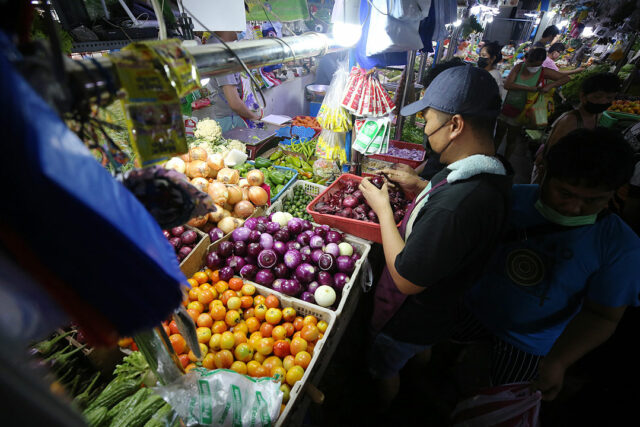
A VENDOR arranges vegetables at a public market in Manila. Stubbornly high inflation may force the Bangko Sentral ng Pilipinas to continue tightening. — PHILIPPINE STAR/ RUSSELL PALMA

By Keisha B. Ta-asan, Reporter

PHILIPPINE BANK executives expect the Bangko Sentral ng Pilipinas (BSP) to deliver two more rate hikes this year to tame inflation and to mirror the US Federal Reserve’s adjustments.

Bank of the Philippine Islands (BPI) President and Chief Executive Officer (CEO) Jose Teodoro K. Limcaoco said he sees two more 25-basis-point (bp) rate hikes by the BSP this year.

“The BSP has to act in parallel with the Fed. Otherwise, the peso will weaken. If the peso weakens then that’s a cost for inflation so they’ve got to watch that,” Mr. Limcaoco told BusinessWorld on the sidelines of the annual reception for the banking community.

“If the Fed pivots, then I see the BSP pivoting also,” he added.

The US Federal Reserve raised the target interest rate by 25 bps last month, bringing its key rate to between 4.5% and 4.75% — the highest since 2007. Its next policy review is on March 21-22.

Since March 2022, the US central bank has raised borrowing costs by 450 bps. This has caused significant volatility in foreign exchange markets, causing the peso and other currencies to weaken against the dollar.

In October 2022, the peso slumped to a record low of P59 versus the greenback. It has since rebounded, closing at P54.82 on Friday.

“Our economists are saying maybe, possibly, up to 50 (bps) more (this year) before going down,” Union Bank of the Philippines President and CEO Edwin R. Bautista said.

He said the BSP might deliver an aggressive 50-bp rate hike at its March 23 meeting before pausing its tightening cycle, or it may opt for two 25-bp rate increases at its March and May meetings. 

“It depends though. Before the last (rate hike) came out, the consensus was it was toppish, it will be 25 (bps) but it became 50 (bps)… It really depends on how the Fed will come out,” he said.

After hiking by 400 bps since May 2022, the BSP’s Monetary Board increased interest rates by 50 bps on Feb. 16, bringing the key policy rate to 6%. This is the highest benchmark rate in nearly 16 years.

Meanwhile, Robinsons Bank President and CEO Elfren Antonio S. Sarte said the Monetary Board might do another 50-bp rate hike at its next meeting, as signaled by the BSP chief.

“With the literature and the signals, I’ll say 50 (bps) as a high. Hopefully, 25 (bps but) 50 is now on the table. Personally, it depends on how the Fed will do it,” he said.

“I’m hoping that we only have one or two hikes and (then) we’ll stop already. So hopefully if inflation comes down, we’ll see a lower rate increase,” he added.

BSP Governor Felipe M. Medalla on Friday said the Monetary Board might aggressively tighten policy rates if inflation breached the 9% level in February. 

“Well, the worst-case scenario is above 9%. If that’s the case, clearly, we have to do something,” he said.

A BusinessWorld poll of 17 analysts yielded a median estimate of 8.9% for February inflation, well within the 8.5% to 9.3% forecast by the BSP.

If realized, February inflation will be faster than the 14-year high of 8.7% in January and 3% a year earlier. It would also mark the 11th consecutive month inflation surpassed the BSP’s 2-4% target.

The local statistics agency is set to release February inflation data on March 7.

Mr. Sarte said rising interest rates may slow bank lending growth this year.

“Still, we are optimistic loans will still grow this year but maybe not be as strong as the prior years. With the economy opening up, maybe some businesses will still need working capital,” he said. 

Based on the latest central bank data, credit growth expanded at its slowest pace in nine months in January, reflecting the impact of rising interest rates.

Outstanding loans by big banks, net of reverse repurchase placements with the BSP, rose by 10.4% to P10.71 trillion in January from P9.7 trillion a year earlier.

This was lower than the revised 13.7% in December. — with inputs from Aaron Michael C. Sy

Lenders face higher asset quality risks — Fitch

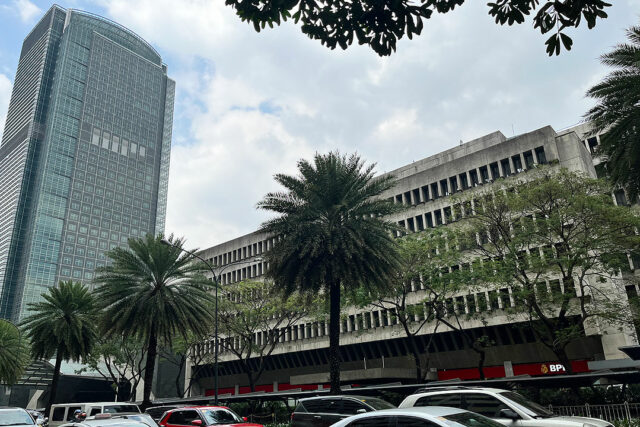
Makati central business district — CATHY ROSE A. GARCIA

PHILIPPINE BANKS are facing increasing asset quality risks amid high interest rates, but any deterioration will likely be manageable, Fitch Ratings said on Monday.

“Banks’ asset quality risks are rising due to high inflation and rising interest rates… However, Fitch Ratings expects the sector’s nonperforming loan (NPL) ratio to remain steady at around 3.5% by end-2023, as risks are largely offset by the adequate financial buffers of large corporate borrowers and a supportive economy,” it said in a commentary by its directors Tamma Febrian and Willie Tanoto.

The benchmark policy rate is at a near 16-year high of 6%, after the Bangko Sentral ng Pilipinas (BSP) raised key borrowing rates by 400 basis points (bps) since May 2022.

The banking industry’s bad loan ratio fell to 3.17% at the end of December from 3.35% a month earlier, based on preliminary BSP data. This was also lower than the NPL ratio of 3.97% at the end of 2021, and the lowest since 2.84% in August 2020.

Fitch said large corporate borrowers are in “relatively strong positions to weather higher financing costs.” Corporations make up over three-quarters of Philippine banks’ loan portfolios.

“Earnings buffers are more than sufficient to cover the expected increase in interest expenses for the vast majority of debt among listed corporates,” Fitch said.

Large-borrower concentration is high in the Philippines, which Fitch said heightens the risk of lumpy impairments, especially if there is a protracted economic slowdown.

“Banks exposed to smaller business groups with over-leveraged balance sheets are vulnerable to higher impairment risks. Nevertheless, we expect the supportive economic conditions, robust earnings buffers, and the diversified business and entrenched market positions of conglomerates to support their debt servicing capacity in the near term,” it added.

Fitch estimates the Philippines’ gross domestic product (GDP) to grow by 5.5% in 2023. This is below the government’s 6-7% growth target for this year, and slower than the 7.6% expansion in 2022.

Fitch said most asset quality deterioration is anticipated in micro, small and medium enterprises, as well as the retail sector.

“Buffers have likely eroded amid high inflation and the normalization of credit card interest rates. This is partially mitigated by an unemployment rate that fell to 4.5% by the fourth quarter 2022, which should keep any consumer-loan impairments in the near term manageable,” it added.

The BSP in January raised the monthly interest rate ceiling on credit card charges by 100 bps to 3% from 2%.

The unemployment rate stood at 4.3% in December, higher than November’s 4.2% but lower than 6.6% a year earlier.

Fitch said loan growth would likely ease to 7-9% this year due to the lagged effect of the central bank’s rate hikes.

Data from the central bank showed that bank lending grew slower in December, increasing by 13.4% year on year to P10.9 trillion. This was slower than the revised 13.9% growth in November. — K.B.Ta-asan

ADVERTISEMENT
ADVERTISEMENT