Home Blog Page 5158

PSEi up on last-minute buying, positive sentiment
THE MAIN INDEX closed in the green on Wednesday on last-minute buying and improved market sentiment as inflation eased slightly in February.

The benchmark Philippine Stock Exchange index (PSEi) increased by 6.37 points or 0.09% to close at 6,711.49 on Wednesday, while the broader all shares index declined by 4.55 points or 0.12% to end at 3,585.66.

“The local bourse dodged a downturn on last-minute buying as investors weigh further the surprising cooling of Philippine inflation in February, which improved the odds of a 25-bp (basis point) BSP (Bangko Sentral ng Pilipinas) rate hike, against growing concerns over the Federal Reserve’s monetary policy,” AP Securities, Inc. Equity Research Analyst Carlos Angelo O. Temporal said in a Viber message.

“Philippine equities managed to climb, still riding on the momentum of better-than-expected inflation print for February,” Regina Capital Development Corp. Head of Sales Luis A. Limlingan said in a Viber message.

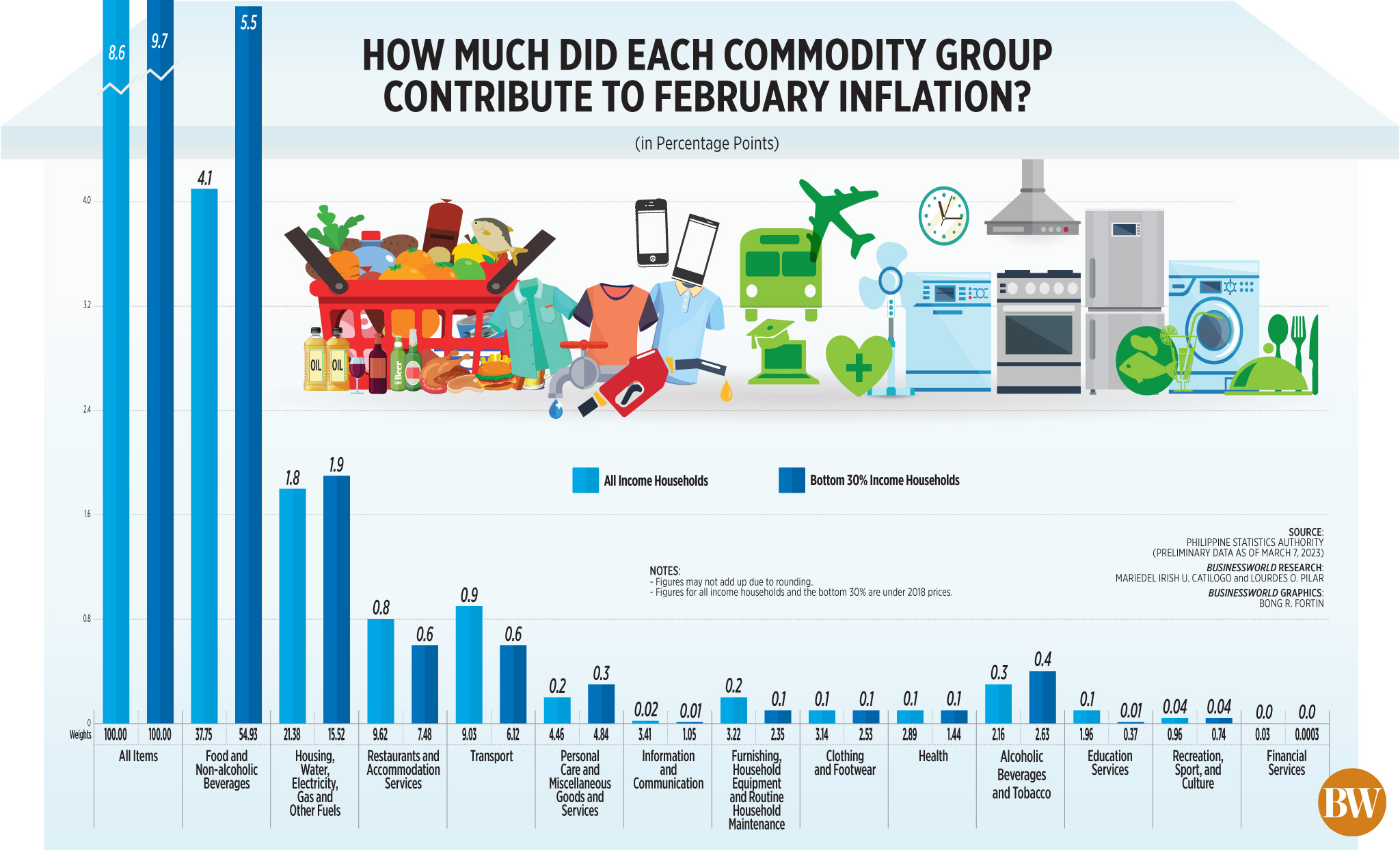
Headline inflation slowed to 8.6% in February from the 14-year high of 8.7% in January, which could lead to a smaller 25-bp hike from the BSP in its March 23 review.

“The PSEi managed to eke out gains in today’s session despite spending most of the day in the negative territory, given the surge of market-on-close buying,” China Bank Securities Corp. Research Director Rastine Mackie D. Mercado said in an e-mail on Wednesday.

Mr. Mercado said local stocks barely moved due to negative sentiment in the market following hawkish remarks from US Federal Reserve chief Jerome H. Powell.

Mr. Powell told US lawmakers on Tuesday that the Fed will likely need to raise interest rates more than expected in response to recent strong data and is prepared to move in larger steps if the “totality” of incoming information suggests tougher measures are needed to control inflation, Reuters reported.

The Fed hiked its target interest rate by 25 bps at its Jan. 31 to Feb. 1 meeting to a range between 4.5% and 4.75%.

Its next policy meeting is on March 21-22.

Back home, sectoral indices were split on Wednesday. Mining and oil declined by 318.62 points or 2.85% to 10,831.60; property went down by 27.71 points or 0.95% to 2,867.55; and industrials dropped by 27.10 points or 0.27% to 9,697.79.

Financials went up by 19.03 points or 1.02% to 1,867.80; services climbed by 3.07 points or 0.18% to 1,647.96; and holding firms rose by 4.04 points or 0.06% to 6,411.19.

Value turnover declined to P5.46 billion on Wednesday with 870.39 million shares changing hands from the P5.5 billion with 1.82 billion issues traded on Tuesday.

Decliners outnumbered advancers, 120 versus 72, while 46 names closed unchanged.

Net foreign buying declined to P12.27 million on Wednesday from P127.75 million on Tuesday.

China Bank Securities’ Mr. Mercado placed the PSEi’s support at 6,640 and resistance at 6,740, while AP Securities’ Mr. Temporal put support at 6,500 and resistance at 6,800. — A.E.O. Jose

Bottom 30% inflation rate in the Philippines

PHILIPPINE INFLATION eased for the first time in six months in February as transport and food prices rose at a slower pace, the statistics agency said. Read the full story.

Bottom 30% inflation rate in the Philippines

How much did each commodity group contribute to February inflation?

PHILIPPINE INFLATION eased for the first time in six months in February as transport and food prices rose at a slower pace, the statistics agency said. Read the full story.

How much did each commodity group contribute to February inflation?

Philippines told to stand up to increasing Chinese aggression

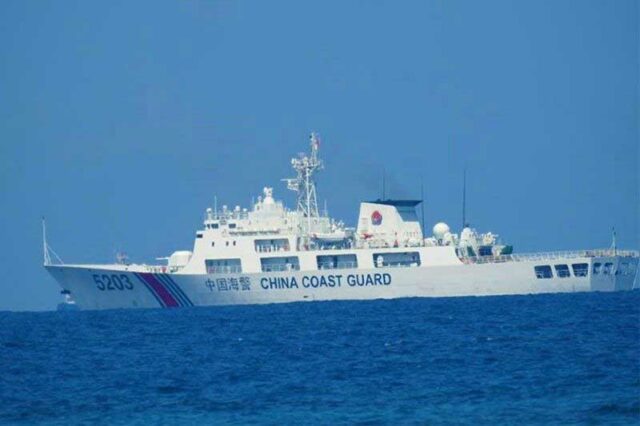
PHILIPPINE COAST GUARD FILE PHOTO

SECURITY experts on Wednesday urged the government of President Ferdinand R. Marcos, Jr. to stand up against escalating Chinese aggression in the South China Sea and engage in united response with allies.

“The best way to address Chinese gray zone activities in the West Philippine Sea is to expose it,” Philippine Coast Guard spokesman Jay T. Tarriela told a forum, referring to areas of the sea within the country’s exclusive economic zone.

He said the Philippine Coast Guard has been trying to remove the shades of gray as far as Chinese maritime activities are concerned by showing these to be either black or white.

“The Philippine Coast Guard’s persistent presence in patrolling the contested waters while at the same time documenting China’s activities allowed the international community to criticize their actions that violate international law and the international rules-based order,” said Mr. Tarriela, who advises the Coast Guard commandant on maritime security.

Chinese operations in the South China Sea have become “more and more clearly hostile and aggressive,” Jay L. Batongbacal, head of the University of the Philippines Institute for Maritime Affairs and Law of the Sea, told the forum organized by Strabase ADR Institute.

More than 40 Chinese boats were still roaming near Thitu Island, the Philippine Coast Guard said on Tuesday, weeks after it accused its Chinese counterpart of endangering the crew of a resupply ship at Second Thomas Shoal in an incident that has stoked long-running diplomatic tensions over China’s expansive claims in the waterway.

A People’s Liberation Army Navy vessel, a China Coast Guard ship and at least 42 suspected Chinese maritime militia boats were still roaming about 4.5 to 8 nautical miles from Philippine-occupied Thitu Island, which it calls Pag-asa, it said.

In his speech, Mr. Batongbacal urged the government to prepare responses to threats and activities undertaken by China against Filipinos at sea.

“We should not be afraid to consider proportional and reasonable responses,” he said. “We should not shy away every time they make threatening moves and then we retreat for fear of provocation.”

“There should be no gray area anymore. We need to begin erasing the gray zone. We need to begin acting and standing up for our lawful maritime rights,” Mr. Batongbacal said.

“This is the only way we can move that forward. Otherwise, we might as well retreat and give up everything.”

He said the government should consider working with allies and engage in a collective deterrence against Chinese aggression.

“We should not be doing everything on our own only,” he said. “We should also consider talking closely with and coordinating with allies and friends so we can engage in collective deterrence.”

“We should demonstrate to China that its gray zone activities and various other shenanigans will no longer be effective because there will be a united and collective response from all fronts wherever they may be,” he added.

‘EXPOSURE IS KEY’
Raymond Powell, Gordian Knot Center for National Security Innovation fellow urged the Marcos government to engage the public, get the help of independent analysts, storytellers and the media and use commercially available maritime data to deter so-called Chinese gray zone activities.

“Exposure is key to deterring and building resilience against them,” he told the forum. “Governments control the best gray zone information, but face barriers to release it.”

The solution is to “light up the maritime gray zone” by giving access to commercially available maritime data to credible independent analysts and media, Mr. Powell said.

Embedding media reporters in coast guard vessels to help monitor, document and disseminate all gray zone activities in the South China Sea could also work, he added.

Mr. Tarriela said the impact of publicizing Chinese activities in the waterway could be measured by the reaction of the international community.

“We can see it from how the United States, Japan and Australia express their support and willingness to develop the capability of the Philippine Coast Guard and also the Armed Forces of the Philippines,” he told reporters on the sidelines of the forum.

“Through the publication of unedited real photos and videos of the Philippine Coast Guard, we can once again reshape public opinion to weigh things objectively based on facts and not just propaganda,” he added.

Stratbase President Victor Andres C. Manhit said the Marcos government should work with like-minded states through joint patrols and maritime domain awareness.

“The Philippines and other Indo-Pacific states must engage in strategies that will ultimately change China’s behavior to be symbiotic with the internationally established rules-based order,” he said. “China’s activities within Philippine territory, driven by its expansionist ambitions and militarization, cannot be allowed.”

These activities include swarming their fishing and militia vessels in Philippine territory, blocking resupply missions, tailing scientific vessels and pointing military-grade lasers,” Mr. Manhit said. “We cannot let this aggression continue.”

The expected response to an emerging threat is to try to balance it, said Renato C. de Castro, an international studies professor at De La Salle University.

“To limit China’s ability to conduct grey zone operations against the Philippines requires Manila, Washington, Canberra and Tokyo to convey strong signals of commitment for mutual assistance through security agreements, troop deployments, arms transfers and multinational exercises, thereby reducing the Philippines’ sense of insecurity,” he told the forum.

He also said a surveillance system must be developed to monitor Chinese gray operations. “This requires the development of a region-wide surveillance network that can detect, identify and monitor Chinese vessels that are positioned for grey zone operations in the West Philippine Sea. — Alyssa Nicole O. Tan

Philippine driver strike spurs review of modernization plan

PHILIPPINE STAR/EDD GUMBAN

PHILIPPINE transport groups aborted a plan for a week-long strike after the government of President Ferdinand R. Marcos, Jr. agreed to revise its modernization plan and the phaseout of traditional public utility vehicles.

Manibela President Mar S. Valbuena and Piston President Modesto Floranda on Tuesday night met with Presidential Communications Office (PCO) chief Cheloy Velicaria-Garafil and a representative of Executive Secretary Lucas P. Bersamin to discuss their plight.

“Our group has decided to stop the transport strike alongside Piston and resume our operations starting tomorrow (Wednesday),” Mr. Valbuena said in a video posted by the presidential palace.

The palace said Mr. Marcos had ordered the Department of Transportation (DoTr) and Land Transportation Franchising and Regulatory Board (LTFRB) to use the Dec. 31 extension for franchise consolidation to study the provisions of DoTr’s 2017 modernization order and ensure the concerns of drivers and operations are taken into account.

Both agencies would consult with stakeholders to better enforce the policy, which should prioritize the welfare of transport players and commuters, it added.

Under the original modernization plan, drivers and operators must form cooperatives or get their franchises revoked.

The original deadline for the consolidation-or-lose-franchise rule was Jun. 30, but it was extended after the transport sector threatened to strike.

The LTFRB earlier said the extension was not prompted by the strike announcement. Last week, it said it would prepare the guidelines on the consolidation and modernization program. It also said it would look at whether operators could keep their franchises without joining a cooperative.

The government had downplayed the impact of the strike, which prompted schools and businesses in Metro Manila and other areas to let students and employees study and work from home.

Mr. Floranda has attributed tactical gains of the two-day strike to protesting drivers and commuters who understood their plight.

He said their call had been clearly registered after at least 80% of the capital region’s national roads were paralyzed on the second day of the strike. 

Mr. Floranda said they would continue to call for the junking of the phaseout plan. “Our worries will not go away as long as it’s there.”

Mr. Marcos said last week some jeepneys were still in good condition.

Jeepneys, which cost P150,000 to 200,000, are the cheapest and most popular mode of transportation in the Philippines, originating at the end of World War II when Filipinos recycled old jeeps left by American forces into minibuses.

The modernization program was first launched under ex-President Rodrigo R. Duterte in 2017. It sought to phase out all jeepneys by 2020 and replace them with vehicles powered by Euro-4 engines, which cost as much as P2.5 million per unit.

Mr. Marcos on Wednesday said the extension of the deadline for the franchise consolidation was enough for the state to address the transport sector’s concerns and inspect jeepneys to ensure the safety of both drivers and commuters.

“For now, we are ensuring that the vehicles are safe,” he said. “Our discussion was good. We have given the government together with the transport groups enough time — we postponed the consolidation deadline until December. I think that’s enough to fix the system.”

“We have never wavered in asking our friends from Manibela and Piston to sit down with us, to thresh out their concerns about the modernization plan,” LTFRB Chairman Teofilo E. Guadiz III said in a statement on Wednesday. “We are glad they listened to our president.”

“I will listen to their complaints, issues and we will work together so we can implement the modernization as efficiently as we can, considering what their concerns and what their recommendations are,” Transport Secretary Jaime J. Bautista told a briefing. — Kyle Aristophere T. Atienza and Justine Irish D. Tabile

Marcos: Oil spill cleanup to take less than 4 months

A PHILIPPINE Coast Guard aerial surveillance shows the oil spill off Naujan, Oriental Mindoro. — PHILIPPINE COAST GUARD

PHILIPPINE President Ferdinand R. Marcos, Jr. on Wednesday said the government aims to clean up the 800,000-liter oil spill from a tanker that sank in the waters of Oriental Mindoro last week in less than four months.

“It took four months to clean up the Guimaras oil spill,” he told reporters on the sidelines of an Agriculture department event, referring to the 2006 disaster when a motor tanker carrying more than two million liters of bunker fuel sank off the coast of Guimaras island in central Philippines.

“Maybe this time, since the amount of oil is smaller, the cleanup would be faster.”

MT Princess Empress was carrying 800,000 liters of industrial fuel oil when it sank off Naujan, Oriental Mindoro, one of the five provinces surrounding the Verde Island Passage, one of the world’s most diverse marine habitats.

Marine experts estimate that as many as 20,000 hectares of coral reefs, 9,900 hectares of mangroves and 6,000 hectares of seagrass could have been affected by the spill.

Senators and congressmen have called for separate investigations of the incident, which prompted the Oriental Mindoro province to place nearly 80 coastal villages in nine towns under a state of calamity.

Mr. Marcos said the government had tapped local fishermen who were temporarily banned from sailing to help the government in the cleanup drive.

“We are monitoring the situation closely,” he said, adding that the government is working with the private sector and Japan to address the issue.

The Bureau of Fisheries and Aquatic Resources said about 11,000 fisherfolk families were affected by the oil spill.

The bureau met with provincial officials on Monday to discuss alternative livelihood for affected fisherfolk, spokesman Nazario C. Briguera told DZBB radio.

The bureau is examining water samples to determine whether fishing is safe, Mr. Briguera said, adding that the oil spill would probably affect Oriental Mindoro’s fishery production.

The province accounts for 3.05% of fishery production of the Mimaropa region, he added. — Kyle Aristophere T. Atienza and Sheldeen Joy Talavera

Police beefing up security measures ahead of Oct. local elections after political killings 

PNP.GOV.PH

THE PHILIPPINE police force will implement tighter security measures such as setting up checkpoints in areas considered under high risk of violence, especially in the period leading up to the October village and youth council elections, a police officer told a House committee on Wednesday.  

Brigadier General Matthew P. Baccay told the House public order and safety committee that theywill implement checkpoints on points of ingress and egress of possible hotspots in view of the coming elections this coming October 30.”   

He said that checkpoints will specifically be in areas identified as hotspots of which there are threats to elected political leaders, local chief executives.”  

He added that the agency will conduct aggressiveoperations to update its list of guns-for-hire, as well as for illegal firearms.  

President Ferdinand R. Marcos, Jr. on Monday ordered police authorities to identify hotspots of political violence, days after the murder of a local official in broad daylight at his residence where eight civilians were also killed and 16 others wounded.    

Mr. Baccay said the added security measures were discussed during a meeting with governors, mayors, and the Department of Interior and Local Government on Tuesday at the police national headquarters.   

Negros Oriental Governor Roel R. Degamo and eight others died when armed men opened fire at his residential compound Saturday, where cash aid was being distributed under a social service program.   

Government prosecutors have filed murder and frustrated murder charges against four suspects.  

Antipolo Rep. Romeo M. Acop called to relieve local police officers in Negros Oriental for their alleged negligence despite the widely known political tension in the province.   

Definitely, the provincial director, the regional director, and their intelligence officer know this. But my question is what did they do in spite of the fact that they know the heated situation in Negros Oriental?Mr. Acop told the committee.  

This thing should have been prevented if only we did the proper or appropriate things therethey should be relieved, otherwise, your complacency will go on and on,he added. Beatriz Marie D. Cruz 

Senate panel recommends immediate technical capacity, system upgrade for CAAP 

PHILIPPINE STAR/ MIGUEL DE GUZMAN

THE SENATE public services committee called for an immediate improvement in the Civil Aviation Authority of the Philippines(CAAP) technical capacity and equipment, citing that the New Years Day power outage that crippled airport operations nationwide was caused by several malfunctions.  

“The January 1 systems failure was indeed a confluence of factors and errors. Experts likened it to the planets aligning albeit with an unfortunate consequence,Senator Mary Grace S. Poe-Llamanzares, chair of the committee, said in a statement on Wednesday. 

It’s rare but we know it can happen, and it will continue to happen if we don’t do anything about the problems of the air traffic system in the country,” she added. 

The panel conducted an investigation on the incident and its report, released on Wednesday, indicated that sabotage and cyberattack did not cause the glitch.  

Although there are many deficiencies in the security of our facilities such as the lack of CCTV, and the system itself such as outdated computer systems and other cybersecurity vulnerabilities, no data compromise occurred due to the incident,” Ms. Poe-Llamanzares said.  

Nonetheless, she said that a conclusive finding on this possibility can only be reached after the uninterruptible power supply data logs sent to Turkey have been fully examined.  

The senator said that upgrading critical equipment will be necessary to avert a repeat of the incident, complemented by the rollout of sufficient engineering guidelines as well as training of accredited engineers who will man the system.  

“There is a lot of work needed for a better system,she said.  

Ms. Poe also called for CAAPs immediate compliance to the International Civil Aviation Organizations recommendations as well as the amendment of the CAAP charter to improve efficiency and transparency.  

The senator said the panel does not intend to recommend penalties against CAAP officials based on their findings, stressing that public safety is their primary goal. 

Accountability will follow after weve laid down safety measures for our air passengers,she said. 

The committee also recommended that another Communications, Navigation, and Surveillance System be set up in an independent location.  

Feasibility studies on the proposed Ninoy Aquino International Airport privatization should also be fast-tracked. 

The panel also sought for the swift passage of relevant bills such as the Philippine Transportation Safety Board, Philippine Airports Authority Act, and Air Passengers Bill of Rights. Alyssa Nicole O. Tan 


Butuan Airport’s bigger passenger building completed 

CAAP

THE EXPANDED terminal building of the Butuan Airport in southern Philippines was formally opened on March 8, increasing its capacity to 616 passengers from only 248. 

This is in line with the goal to provide locals and tourists with safer journeys to the different parts of the country,” Civil Aviation Authority of the Philippines Director General Manuel Antonio L. Tamayo said during the launching ceremony.  

Butuan City is the regional center of Caraga in northeastern Mindanao, which covers the provinces of Agusan del Norte, Agusan del Sur, Surigao del Norte, Surigao del Sur, and Dinagat Island. 

The terminal expansion project cost P24.5 million.   

The airport currently caters to 12 flights daily served by Cebu Pacific and Philippine Airlines.

Test run for Commonwealth Ave. exclusive motorcycle lane starts March 9

MMDA PHOTO

A DRY run for the implementation of an exclusive motorcycle lane along Commonwealth Avenue in Quezon City starts March 9, the Metropolitan Manila Development Authority (MMDA) announced on Wednesday.  

“The dry run is meant to familiarize motorcycle riders traversing Commonwealth Avenue on the said policy. We will have a full deployment of MMDA traffic enforcers and we will be assisted by the local government of Quezon City,” MMDA Acting Chairman Romando S. Artes said in a statement.  

“No motorists will be apprehended during the duration of the dry run which will start tomorrow until next Sunday, March 19,he said.   

The dedicated lane for motorbikes is the third lane from the sidewalk, spanning between the Elliptical Road and Doña Carmen Avenue on both sides of the highway.  

Commonwealth Ave., which has been referred to as the Philippines’ “killer highway,is 12.4 kilometers long, with the number of lanes varying from six to 18.    

Mr. Artes said the motorcycle lane scheme is intended to prevent fatal road crashes and improve traffic flow along the countrys widest thoroughfare.  

There was an average of five motorcycle-related crash incidents along the avenue in 2022, according to MMDA. Of the 1,686 total, 13 were fatal, 930 resulted in non-fatal injuries, and 743 caused damage to property.   

Full implementation of the motorcycle lane policy starts March 20, and violators will have to pay a fine of P500.

Women workers raise gaps on job opportunities, minimum wage 

WOMEN police officers take the frontline as members of women’s groups hold a rally in Manila on March 8, the celebration of International Women’s Day. — PHILIPPINE STAR/EDD GUMBAN

A COALITION of women workersorganizations on Wednesday raised the lack of job opportunities and inadequate minimum wages in the Philippines as the world observed International Womens Day.   

The Women Workers United (WWU), composed of six groups, cited that 7 in 10 Filipinos mostly women are being driven into informal, precarious workwhile prices of basic goods continue to soar.   

Filipino women find themselves in a time of crisis today,WWU said in a statement.   

The group said there is a need to address gender pay gap and institute a national minimum wage commensurate to the real cost of living estimated at P1,100.  

WWU also called attention to the overall plight of women in the country, including an increase in the number of victims of violence as well as suppression of the right to unionize.    

They also pushed for the ratification of International Labour Organization Convention 190, which seeks to eliminate violence and harassment in work.  

This International Working Womens Day, we remember the historic role women have played in advancing the peoples vision for a world free from exploitation,WWU said. Alyssa Nicole O. Tan

BCDA to lease out 37 hectares in Clark for 25-MW solar facility

NEW CLARK CITY

THE Bases Conversion and Development Authority (BCDA) said it will offer 37 hectares in New Clark City for development of a P1-billion solar energy farm.

The BCDA said that it is seeking private companies to bid for the long-term lease on a site in the northern section of New Clark City and to develop a facility with at least 25 megawatts (MW) of capacity.

“In line with the renewable energy thrust of the Marcos administration, the BCDA is pushing for the development of sustainable energy sources in New Clark City. This solar farm is one of the crucial projects in New Clark City as it will supplement energy sources and lower energy costs for our locators, while also ensuring reduced carbon emissions,” BCDA President and Chief Executive Officer Aileen R. Zosa said in a statement on Wednesday.

“The BCDA is calling for private sector partners to support us in this endeavor. Your participation is important as we strive to make New Clark City into a smart, sustainable and green city,” she added.

According to the terms of reference for the auction, the initial lease period is 25 years, renewable for another 25 years.

“In line with the Philippine Development Plan 2023-2028, the Marcos government is implementing policy reforms to promote renewable energy sources, thereby lowering energy costs and supporting the revitalization of industries,” the BCDA said.

“These efforts will help achieve the goal of the Philippine government of increasing the share of renewable energy in the country’s energy mix to 35% by 2030 and 50% by 2040,” it added. 

The terms of reference were put on sale on Wednesday, with a pre-bid conference scheduled for March 24, 10 a.m. at the BCDA’s corporate office in Taguig City.

The deadline to submit bid documents, eligibility requirements, and a financial proposal will be on April 21 at noon. — Revin Mikhael D. Ochave

ADVERTISEMENT
ADVERTISEMENT