Home Blog Page 51

Stocks go down on profit taking before US data

REUTERS

PHILIPPINE STOCKS ended lower on Tuesday as investors pocketed their gains following the market’s three-day climb and awaited the release of key US data that could affect the US Federal Reserve’s policy decision this month.

The bellwether Philippine Stock Exchange index (PSEi) went down by 0.17% or 11.20 points to close at 6,408.76, while the broader all shares index slipped by 0.07% or 2.75 points to finish at 3,638.38.

“The local market retreated ever so slightly after the three-day win streak, as investors await fresh leads,” AP Securities, Inc. said in a market note.

“The local market pulled back as investors took profits following three days of rallying. The market digested the Philippines’ October foreign direct investments (FDI) data, which posted a 40% decline in net inflows,” Philstocks Financial, Inc. Research Manager Japhet Louis O. Tantiangco said in a Viber message.

FDI net inflows dropped by 39.8% to $642 million in October from $1.067 billion in the same month in 2024, the Bangko Sentral ng Pilipinas (BSP) reported late on Monday.

For the first 10 months, net inflows fell by 24.5% to $6.179 billion from $8.184 billion in the comparable year-ago period.

“Investors are also waiting for the US December consumer price index (CPI) data, which is expected to provide clues on the Federal Reserve’s policy outlook,” Mr. Tantiangco added.

US consumer prices likely accelerated in December as some of the distortions related to the government shutdown that had artificially lowered inflation in November unwound, which would cement expectations of the US Federal Reserve leaving interest rates unchanged this month, Reuters reported.

The CPI likely increased by 0.3% last month amid higher food and energy prices, mostly electricity because of data centers, a Reuters survey of economists predicted. In the 12 months through December, the CPI is forecast to have increased 2.7%, matching November’s gain.

The Fed tracks the Personal Consumption Expenditures Price indexes for its 2% inflation target. The US central bank is expected to keep its benchmark overnight interest rate in the 3.5%-3.75% range at its Jan. 27-28 meeting.

Back home, most sectoral indices closed lower on Tuesday. Industrials fell by 0.55% or 50.97 points to 9,088.80; property decreased by 0.44% or 10.44 points to 2,336.77; financials went down by 0.21% or 4.60 points to 2,174.57; and holding firms retreated by 0.16% or 8.51 points to 5,018.4.

Meanwhile, mining and oil jumped by 2.09% or 359.21 points to 17,475.64; and services increased by 0.47% or 12.26 points to 2,575.43.

Advancers outnumbered decliners, 104 to 94, while 70 names closed unchanged.

Value turnover rose to P6.75 billion on Tuesday with 1.26 billion shares traded from the P6.64 billion with 1.02 billion issues that changed hands on Monday.

Net foreign buying decreased to P506.15 million from P534.17 million. — Alexandria Grace C. Magno with Reuters
Philippines: Chinese ships harassed fishing boat near Scarborough Shoal

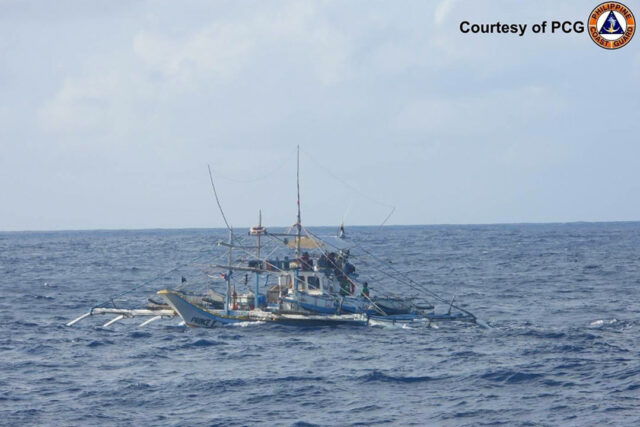
A Philippine Coast Guard photo of the fishing boat allegedly harassed by Chinese vessels. — PCG

A PHILIPPINE fishing vessel was harassed by Chinese navy and coast guard ships near the disputed Scarborough Shoal on Monday, underscoring rising tensions in the South China Sea as Beijing asserts tighter control over contested waters.

A People’s Liberation Army Navy ship with bow number 621 and a China Coast Guard vessel approached the fishing boat at close range, within 30 meters, while blaring sirens in an apparent attempt to block its route toward fishing grounds west of the shoal, the Philippine Coast Guard (PCG) said in a statement on Tuesday.

The boat’s captain diverted southeast to avoid the ships but reported being closely trailed by the China Coast Guard vessel.

The PCG dispatched the multirole vessel BRP Cape San Agustin, which supplied the fishing boat with diesel, allowing it to continue its operations and head to Scarborough Shoal.

China’s Embassy in Manila did not immediately respond to a request for comment.

Scarborough Shoal, known locally as Panatag, is claimed by both the Philippines and China. It is valued for its rich marine resources and strategic location near key shipping lanes.

China seized control of the shoal in 2012 after a standoff with Philippine forces, and has since maintained a presence through coast guard ships and fishing vessels, restricting Filipino access despite a 2016 United Nations-backed arbitral ruling that affirmed the area as traditional Philippine fishing grounds.

Rear Admiral Roy Vincent T. Trinidad, a Philippine Navy spokesman, described the incident as part of China’s “coercive and aggressive actions” meant to discourage Filipino fishermen. “These actions are designed to destroy the will to fish of our fishermen,” he said in a media briefing.

Admiral Ronnie Gil L. Gavan, PCG commandant, said the coast guard would continue safeguarding Filipino fishers. “We remain steadfast in defending the safety and maritime rights of our fishermen, in full accordance with the United Nations Convention on the Law of the Sea (UNCLOS),” he said in the statement.

Mr. Trinidad said the Philippine Navy monitored 41 Chinese vessels across four disputed features during the first week of January.

At Scarborough Shoal, the navy spotted two Chinese warships, three coast guard ships and three maritime militia boats.

At Second Thomas Shoal, six coast guard vessels and eight militia ships were observed. At Sabina Shoal, three warships, six coast guard vessels, and four militia boats were present, while at Thitu Island, there were four coast guard and two militia vessels.

He noted that while the Chinese presence is significant, it remains within the normal range monitored by Manila.

“They are not yet threatening… these are still within the normal numbers that we track,” he said. He predicted that activity in 2026 would likely increase, reflecting a trend of growing Chinese deployment near contested features.

The Philippine National Maritime Council on Monday accused China of “persistent illegal, coercive, aggressive and deceptive activities” within Philippine waters.

“Filipino fishers are civilians lawfully pursuing their livelihoods,” the council said. “Protecting them is the responsibility of the state, not an act of escalation.”

In response, Beijing accused Manila of provoking tensions. Deputy Spokesperson Wei Guo said the Philippines “has time and again provoked trouble in an attempt to change the status quo,” misrepresenting Chinese activities as illegal.

He rejected the Philippine concept of a “maritime zone,” noting that the UNCLOS recognizes only territorial seas and exclusive economic zones (EEZ).

“For a long time, the Philippines has deliberately blurred the distinction between the territorial sea and EEZ, and has distorted China’s normal activities in waters claimed as EEZ by both countries as ‘illegal patrols,’” Mr. Wei said.

He added that China acted to safeguard its sovereignty while exercising restraint and remains open to dialogue with Manila.

Brunei, Indonesia, Malaysia and Vietnam also have claims to portions of the vital waterway. Despite a 2016 UN-backed ruling voiding China’s sweeping claims, Beijing has steadily expanded its maritime presence, sometimes leading to confrontations at sea.

Manila has strengthened maritime cooperation with allies and rolled out support schemes for its fishermen, including fuel subsidies, food and equipment to encourage their presence in disputed waters.

Officials say these measures are crucial to uphold Filipino fishing rights and deter Chinese coercion while maintaining safety in the strategic waterway. — Kenneth Christiane L. Basilio and Adrian H. Halili

Philippines seeks legal paths to bring flood scam suspect back from Portugal

MISAMIS OCCIDENTAL PROVINCIAL POLICE

By Chloe Mari A. Hufana, Reporter

THE Philippines is examining all legal options to bring home one of the alleged masterminds behind a multibillion-peso flood control scandal, as a formal extradition bid is unlikely without a treaty with Portugal, Interior Secretary Juanito Victor C. Remulla said on Tuesday.

President Ferdinand R. Marcos, Jr. has ordered government agencies to study alternative avenues to repatriate former Party-list Rep. Elizaldy S. Co, Mr. Remulla said, citing approaches that could avoid the lengthy process of negotiating an extradition agreement with Lisbon.

“We are studying it because the situation is complicated,” he told reporters via teleconference in mixed English and Filipino. “We don’t have an extradition treaty with Portugal.”

Among the options being explored are coordination with international bodies such as the International Criminal Police Organization, or Interpol, and the United Nations, he said.

Negotiating an extradition treaty is not being prioritized, Mr. Remulla added, noting that such agreements typically take years to conclude and ratify.

“A treaty will take too long,” he said. “That’s why the instruction is to study other ways to do this.”

Mr. Co, who used to head the House of Representatives appropriations committee, has been linked to irregularities in government-funded flood control projects.

Investigators have flagged, among others, a P289.5-million flood control project in Oriental Mindoro implemented by the Department of Public Works and Highways.

Authorities have issued a warrant of arrest against Mr. Co for graft and malversation of public funds.

Mr. Remulla said officials are reviewing all possible mechanisms, including repatriation, while acknowledging that returning a suspect from a country without an extradition framework poses significant legal challenges.

“We will look at all avenues — and when we say all, we mean all — to make this happen,” he said.

Asked whether the case could mirror the return of former Negros Oriental Congressman Arnolfo A. Teves, Jr. from Timor-Leste, Mr. Remulla said that outcome hinged on a special accommodation by Timor-Leste’s president following direct talks with Mr. Marcos.

He said he was not aware of any comparable understanding between Manila and Lisbon.

“Extradition is almost impossible because we don’t have a treaty,” he said. “But there are other avenues we are studying so we can get him.”

The government’s focus is securing Mr. Co’s return rather than pursuing a formal extradition process, he added.

Josue Raphael J. Cortez, a diplomacy lecturer at the De La Salle-College of St. Benilde’s School of Diplomacy and Governance, said extradition requires a formal treaty and cannot rely solely on goodwill between states.

Extradition requires a treaty between countries that share common interests in combating similar crimes, he said in a Facebook Messenger chat. Acts must be criminal in both jurisdictions to qualify, while political and religious offenses are excluded under international law, he added.

Mr. Cortez said treaty negotiations typically begin with presidential approval and often take years, as governments work to balance legal standards and national interests.

“After rigorous negotiations and back-and-forth discussions on the provisions, in the case of the Philippines, we will have to secure the concurrence of the Legislature, particularly a two-thirds majority of the Senate, for such a treaty to take effect,” he said.

The case adds pressure on the Marcos administration to show progress in holding officials accountable for alleged misuse of public funds, particularly as flood control spending has come under heightened scrutiny following last year’s corruption revelations.

France, Philippines close in on visiting forces agreement

C7F.NAVY.MIL

THE Philippines and France are finalizing details of a visiting forces agreement (VFA), moving closer to a deal that would allow French troops to operate legally in the country as Manila expands its security partnerships amid tensions in the South China Sea.

The agreement could be signed within the next few months, French Ambassador to the Philippines Marie Fontanel said on Tuesday, after what she described as productive negotiations between the two sides.

“We are really optimistic that the signing could happen in the coming months, because the second round of negotiations showed that both parties, particularly the Philippines, were willing to fast-track it,” she told reporters.

President Ferdinand R. Marcos, Jr. approved talks on the agreement last year, making France the first European country poised to secure a VFA with the Philippines. Such pacts provide the legal framework governing the entry, activities and jurisdiction over foreign troops during joint exercises and military cooperation.

“If we have high-level visits, opportunities for signing, I’m sure it will happen,” Ms. Fontanel said.

Negotiations began in Paris in June and continued in Manila in December, she said, adding that discussions are now focused on finalizing the wording of the agreement.

“The second negotiation… went very well,” she said. “Let’s hope that it could have been the final negotiation.”

The Philippine Department of National Defense said last month that the two sides had concluded a “successful” round of talks aimed at deepening defense ties, improving interoperability and strengthening cooperation in support of regional peace and stability.

“There are continuous discussions on finalizing the last wording and to be sure that every party is OK with the text,” Ms. Fontanel said, without giving further details.

The push for closer defense ties comes as Manila widens its security partnerships beyond the US, seeking agreements with countries such as the UK, Canada, New Zealand and Australia, as frictions with China intensify in the South China Sea.

Ms. Fontanel said France intends to sustain and expand cooperation with the Philippines, particularly in defense and security.

“The situation calls for continuing what we have done in the past — our partnership with the Philippines, our presence, and the discussion on agreements, particularly in the field of defense and security,” she said.

France is also looking to take part in this year’s Balikatan military exercises, the Philippines’ biggest annual drills with the US and allied forces.

“Last year, we could only be observers, and the year before was our first active participation,” Ms. Fontanel said.

Asked whether France would deploy ground or air units, she said: “Both.”

Balikatan is designed to strengthen defense cooperation and improve interoperability among allied forces, as Philippine vessels and aircraft face repeated encounters with Chinese ships and planes in contested waters.

A United Nations-backed tribunal in 2016 ruled that China’s sweeping claims over most of the South China Sea have no legal basis, a decision Beijing rejects.

The waterway is a key global trade route, with more than $3 trillion worth of commerce passing through it each year. — Adrian H. Halili

Gov’t to tackle CARS funding gap

REUTERS

THE Department of Budget and Management (DBM) said it will meet with the Department of Trade and Industry (DTI) to address the funding gap for the government’s major automotive incentive programs, which could derail benefits for carmakers operating in the Philippines.

Speaking in a Palace briefing, Budget Secretary Rolando U. Toledo will address the funding shortfall for the stripped allocations for the Comprehensive Automotive Resurgence Strategy (CARS) and the Revitalizing the Automotive Industry for Competitiveness Enhancement (RACE) under the 2026 national budget.

“We’ll be having our meeting tomorrow with the DTI to look at how we can settle this account as far as our party, which is the Toyota and the Mitsubishi,” he said on Tuesday.

President Ferdinand R. Marcos, Jr. recently vetoed unprogrammed appropriations worth P92.5 billion, including P4.32 billion in fiscal support for the CARS program and P250 million for the RACE program.

The CARS program offers automakers incentives to produce 200,000 mass market units over six years in the form of tax payment certificates (TPCs), which can be applied to offset participants’ tax and duty liabilities.

Dapat ma-issue po iyong TPC na tinatawag bago sila magbayad. But at this time, it has only been earned; na-earn pa lang nila pero hindi pa naisyu iyong TPC,” he said.

(The TPC should be issued before they make payment. But at this time, it has only been earned — they’ve earned it, but the TPC has not yet been issued.)

The DBM will issue the appropriate resolutions or responses to the concerns related to the CARS program, Mr. Toledo said.

At the same time, the DBM chief said the agency plans to further reduce unprogrammed funds in 2027, after setting them at P150 billion this year. The absolute amount was the lowest since the 2019 budget.

“Most likely yes, we will look at that unprogrammed appropriation, which should probably be lower than they are now,” Mr. Toledo said, when asked if the agency would enforce the 5% cap on such allocations proposed by his predecessor, Amenah F. Pangandaman.

In the 2025 General Appropriations Act, the P363.42-billion unprogrammed funds were equivalent to 5.7% of the budget.

Mr. Toledo also defended the use of unprogrammed appropriations, saying they provide funding for foreign-assisted projects that lack perfected loans or contracts before the cutoff date.

He warned that otherwise the rollout of foreign-assisted projects could be delayed.

He also noted that while Mr. Marcos has no direct order on the share of unprogrammed funds in the budget, the economic managers and the Public Financial Management follow the cap of at least 5%.

In the same briefing, Mr. Toledo said the government has allotted nearly P40 billion for the National Disaster Risk and Reduction Management Fund in 2026.

“(Of the) P39.82-billion National Disaster Risk Reduction and Management Fund (NDRRMF) for 2026, P15.33 billion will be directly allocated for the rehabilitation and construction projects of local government units,” he said.

Comelec doubts BARMM March polls

@BANGSAMOROGOVT

THE Commission on Elections (Comelec) cast doubts on Tuesday over whether the Philippines can realistically hold the first-ever Bangsamoro parliamentary elections by March 30, citing unresolved legal questions and tightening operational timelines linked to districting rules and pending legislation.

Comelec Chairman George Erwin M. Garcia told reporters over Viber that the poll body was “confronted with strong legal and operational issues” affecting the feasibility of the scheduled elections, even as it welcomed the Bangsamoro Parliament’s recent passage of a long-delayed electoral measure.

“We are now confronted with strong legal and operational issues as to whether the conduct of the first Bangsamoro parliamentary election is still feasible by March 30,” Mr. Garcia said.

“Since there is no law yet fixing the date of the election, at this point, the same is still a question mark.”

Mr. Garcia said that Comelec had earlier fixed March 30 as the election date pursuant to existing mandates, but the newly passed Bangsamoro districting law — once signed and made effective — could collide directly with that prohibition.

“The Supreme Court clearly emphasized that there should be no redistricting 120 days before the election. Since as mandated by the decision, we fixed the date of election on March 30, 2026, this will now run contrary to the prohibition mentioned and the provision of the law,” Mr. Garcia said.

Asked directly whether the election in the Bangsamoro Autonomous Region in Muslim Mindanao (BARMM) could be postponed again, Mr. Garcia said it was too early to give a definitive answer.

“We are not yet prepared to answer that question this early,” he said. — Erika Mae P. Sinaking

P106-M illicit cigarettes seized

PHILIPPINE STAR/ROEL PAREÑO

THE Bureau of Customs (BoC) seized about P105.58 million worth of illicit cigarettes in Bataan, with shipments traced to China, Vietnam, and South Korea.

In a statement on Tuesday, the BoC announced the confiscation of P105.58 million worth of smuggled cigarettes in Barangay Santa Isabel, Dinalupihan, Bataan, following a compound inspection backed by a letter of authority.

It found 12 motor vehicles carrying 1,030 master cases of tobacco products bearing brands such as Modern, RGD, Nise Baisha, HP, Power, Carnival, Playboy, and President.

“This successful operation demonstrates our relentless drive to combat smuggling and protect government revenue,” Customs Commissioner Ariel F. Nepomuceno said.

Smuggled cigarettes deprive the government of potential import duties for Customs and excise taxes collected by the Bureau of Internal Revenue.

This comes as the BoC works to meet a higher revenue goal of P1.0138 trillion in 2026, after it fell short of its P958.7-billion target in 2025.

It collected only P934.4 billion in revenues for the full year 2025 amid a rice import ban and weak import volumes.

“Through collaboration and cooperation among government agencies, we can work together to solve this problem and ensure that those who attempt to circumvent our laws are held accountable,” he added.

The BoC said an initial investigation showed that the illicit cigarettes were intended for local distribution in Regions II (Cagayan Valley) and III (Central Luzon).

Customs added that it has stepped up its crackdown on illicit trade, apprehending suspected long-standing smuggling syndicates and posting record tobacco seizures, through its Customs Intelligence and Investigation Service and Enforcement and Security Service. — Aubrey Rose A. Inosante

Gov’t to continue asset recovery despite possible ICI closure

GOVERNMENT asset recovery efforts will remain operational despite uncertainty over the possible closure of the Independent Commission for Infrastructure (ICI), officials said on Tuesday, as the ICI-Technical Working Group (TWG) resumed its meetings.

ICI Special Adviser and lead investigator Rodolfo S. Azurin, Jr. said the TWG is expected to “survive” regardless of the future structure of the ICI, as inter-agency coordination will remain critical, particularly when cases are referred to the Office of the Ombudsman.

“I think so. Definitely. Because if you look at it, with or without the ICI, when a case is referred to the Ombudsman, it’s like a switch, like a trigger,” Mr. Azurin told a press briefing.

“For the government agencies assisting the ICI, we advise everyone to keep working so that we can deliver the results expected by the public, including the recovered assets that may form part of our investigations,” he added.

Chris Noel A. Bendijo, deputy chief of staff at the Bureau of Customs (BoC), added that the resignation of two commissioners has not affected TWG operations. He credited the systematic and well-defined framework under the chairmanship of Cybercrime Investigation and Coordinating Center Undersecretary Renato “Aboy” A. Paraiso, for ensuring asset recovery work remains “ongoing and functional.”

“Each agency clearly defines its role in asset recovery. Even in the absence of two commissioners at ICI, the work of TWG continues,” Mr. Bendijo said. He also noted that memoranda of agreement among agencies are being finalized, alongside the development of a centralized database and framework agreement to prevent duplication and resolve jurisdictional conflicts.

Mr. Bendijo said the Anti-Money Laundering Council (AMLC) has so far frozen P21.2 billion in assets — including bank accounts, e-wallets, insurance policies, motor vehicles, and air assets — linked to the personalities involved in the ongoing flood control investigation.

“To be very clear with the figures, we will create a master list of these assets, including those sold at auction and those subject to forfeiture, such as those currently held by the ICI,” he explained.

Currently, eight vehicles are in the custody of the ICI compound allegedly linked to former lawmaker Elizaldy S. Co. These seized vehicles are also part of asset recovery and ongoing investigations, according to Mr. Azurin.

“Through this detailed search, we may be able to determine whether items were misclassified, misdeclared, or if different import entries were used with varying declarations,” Mr. Bendijo added. “Again that will be determined, that’s ongoing work for now.”

The meeting on Tuesday was attended by representatives from the AMLC, Armed Forces of the Philippines, BoC, Bureau of Immigration, Bureau of Internal Revenue, Department of Justice, Department of Trade and Industry, Department of Public Works and Highways (DPWH), Office of the Ombudsman, and the Philippine National Police — Criminal Investigation and Detection Group, among others.

In a statement, the ICI said the agencies also discussed the development of the Asset Recovery Coordination and Management Dashboard System, a platform designed to consolidate information on assets subject to recovery, focusing on properties owned by individuals and entities with pending court cases, as well as those referred by the ICI and DPWH.

Agencies with regulatory or supervisory authority over monetary, real estate, and movable assets will be integrated into the dashboard to ensure alignment on frozen or recovered assets. — Erika Mae P. Sinaking

Former Bulacan district engineer denies recanting claims in flood control probe

FORMER Bulacan 1st District Engineering Office Engineer Henry C. Alcantara has categorically denied claims that he recanted prior statements made during Senate Blue Ribbon Committee hearings, his legal counsel confirmed on Tuesday.

In a statement issued by Atty. Emil Karlo L. Joven of ELJ Law Office, Mr. Alcantara’s legal counsel described recent reports circulating on social media and some news outlets as “categorically false and misleading.”

The statement, forwarded to reporters, maintained that Mr. Alcantara remains fully committed to cooperating with the Department of Justice (DoJ) as part of his participation in the Witness Protection, Security and Benefit Program. It added that his participation follows a Memorandum of Agreement with the DoJ, which serves as a prerequisite for regular admission into the program.

“In short, Engr. Alcantara is not recanting his prior statements,” Mr. Joven said. The lawyer further stressed that evaluation of Mr. Alcantara’s statements, alongside those of other parties in related cases, is a matter solely for the state prosecutors, in accordance with law and procedure.

“The general public must remain vigilant and should obtain information only from verified, identifiable, and reliable sources. Any information coming from sources other than the Department of Justice or from the undersigned should be treated with caution for potential inaccuracy,” he added.

Mr. Alcantara was also spotted at the DoJ on Tuesday for matters relating to the witness protection program, according to Justice department spokesman Raphael Niccolo L. Martinez. — Erika Mae P. Sinaking

PHL population could reach 123.96 million by 2035

PHILIPPINE STAR/RYAN BALDEMOR

THE Philippine population is projected to reach 123.96 million by 2035, the Philippine Statistics Authority (PSA) said on Tuesday.

With an average annual growth of 0.9%, the country’s total population is expected to increase by 14.76 million in 2035 from 109.20 million total population registered in 2020, according to the PSA’s 2020 Census-Based Population Projections.

The report highlights data in the 2020 Census-Based Population Projections at the regional, provincial, highly urbanized city and city/municipality levels.

These projections were prepared by the local statistics agency in partnership with the Inter-Agency Working Group on Population Projections, with technical assistance from the United Nations Population Fund Philippines.

Based on the report, the male population will be about 62.64 million by 2035, accounting for 50.5% of the total projected population.

The female population is expected to reach 61.32 million, or 49.5% of the total population.

Calabarzon is projected to be the most populous region with 19.07 million estimated population. The National Capital Region followed with 14.49 million and Central Luzon with 14.02 million.

The Cordillera Administrative Region is expected to be the least populous region with a projected population of 2.13 million.

By 2035, 12 regions are anticipated to reach the five-million mark, increasing from nine regions as of the 2020 mid-year population. — Isa Jane D. Acabal

GSIS turns over P81.34 million in fire insurance claims to Manila

GSIS FACEBOOK PAGE

THE GOVERNMENT Service Insurance System (GSIS) has paid P81.34 million in fire loss insurance claims to the City Government of Manila.

The amount will cover the damages from the Pritil Market fire in Tondo in April 2023, which destroyed around 584 market stalls and affected the livelihoods of hundreds of vendors, the state insurer said in a statement on Tuesday.

GSIS Core Business Sector Executive Vice President Jason C. Teng, representing GSIS President and General Manager Jose Arnulfo “Wick” A. Veloso, turned over the check to Manila City Mayor Francisco “Isko” M. Domagoso on Dec. 23, 2025.

The state insurer said that the Manila City Government has also renewed fire insurance for all its hospitals, public schools, and buildings to ensure financial coverage in case of emergencies.

GSIS booked a net income of P112 billion in the first nine months of 2025, it previously said. — Aaron Michael C. Sy

Bill allows gov’t employees to work from home

A WOMAN in a remote meeting via videoconference works from her living room. — REUTERS

A BILL seeking to allow government employees to work from home (WFH) and grant an allowance to remote workers was filed at the House of Representatives.

House Bill No. 6802 would expand the current telecommuting law to cover public sector employees, permitting them to work from alternative sites and provide all WFH workers a P1,000 nontaxable allowance while in such a setup.

“The current legal framework remains limited in scope and lacks provisions that address the realities of a more hybrid, technology-driven workforce,” Negros Occidental Rep. Javier Miguel L. Benitez said in the measure’s explanatory note.

The Philippines outperformed nine other AsiaPacific cities in flexible workspace demand in 2025, according to a global advisory firm The Instant Group report, underscoring the preference of Filipino workers for WFH and flexible arrangements. — Kenneth Christiane L. Basilio