Home Blog Page 509

Lucasfilm wins bid to throw out UK lawsuit over ‘resurrection’ of Star Wars character

PETER CUSHING in a scene from the 2016 film Rogue One: A Star Wars Story.

LONDON — Disney unit Lucasfilm last week won its bid to throw out a London lawsuit over the use of the likeness of a long-dead actor in a Star Wars spinoff movie.

Peter Cushing, who died in 1994, was “resurrected” as Death Star commander Grand Moff Tarkin for the 2016 film Rogue One: A Star Wars Story using visual effects and another actor.

He had appeared in the original 1977 Star Wars film, created by George Lucas, which became one of the most successful film franchises of all time.

The movies have collected more than $5 billion in global ticket sales since the release of the first installment in 1977, and spinoffs are still being produced.

Mr. Cushing had signed a deal with British company Tyburn Film Productions in 1993 to appear in a television film, an agreement Tyburn’s lawyers said gave it “the right to be the first to ‘resurrect’ Mr. Cushing by way of visual effects.”

Tyburn claimed it had lost around £250,000 ($333,725) and sued Lucasfilm and fellow Disney subsidiary Lunak Heavy Industries at London’s High Court for alleged unjust enrichment at its expense.

Lucasfilm and Lunak, however, said the case was hopeless and unsuccessfully tried to have the case thrown out twice. But the Court of Appeal ruled in their favor on Thursday.

Judge Sue Carr said that “it is impossible to identify anything at all that belonged to Tyburn which can be said to have been transferred” to Lucasfilm or Lunak, meaning the case could not continue.

Lucasfilm did not immediately respond to a request for comment. — Reuters

PDIC partners with OGCC for special legal services to boost depositor protection

THE Philippine Deposit Insurance Corp. (PDIC) has partnered with the Office of the Government Corporate Counsel (OGCC) as it looks to boost depositor protection.

PDIC and OGCC on Dec. 16 signed a memorandum of agreement (MoA) to strengthen their collaboration. Under the partnership, the OGCC will provide special legal services to PDIC.

“Under the MoA, the OGCC will assign a dedicated legal team to provide legal assistance and representation to the PDIC,” the state deposit insurer said in a statement.

“Its services will include, among others, the enforcement of the Corporation’s rights, representation in mediation and arbitration proceedings, advisory on regulatory compliance and major procurement projects, legal risks assessments, conduct of preliminary and formal investigations in administrative cases, and the preparation and filing of foreclosure petitions.”

PDIC President and Chief Executive Officer Roberto B. Tan and Government Corporate Counsel Solomon M. Hermosura both said that their partnership will help strengthen confidence in the Philippine banking system by ensuring the safety of the depositing public. — Aubrey Rose A. Inosante

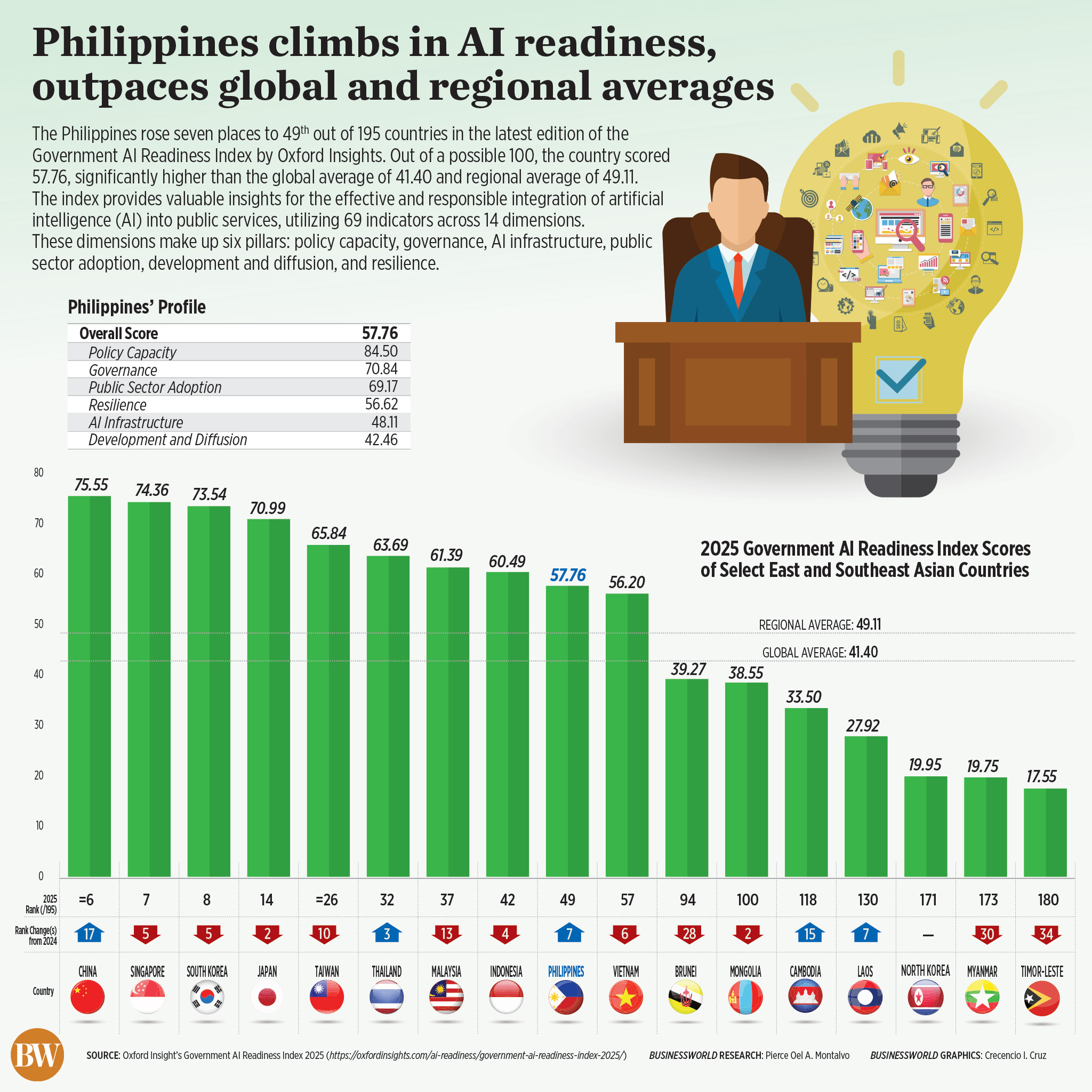
Philippines climbs in AI readiness, outpaces global and regional averages

THE PHILIPPINES climbed seven spots in the Government AI Readiness Index by Oxford Insights but scored low in securing artificial intelligence (AI) infrastructure and resilience. Read the full story.

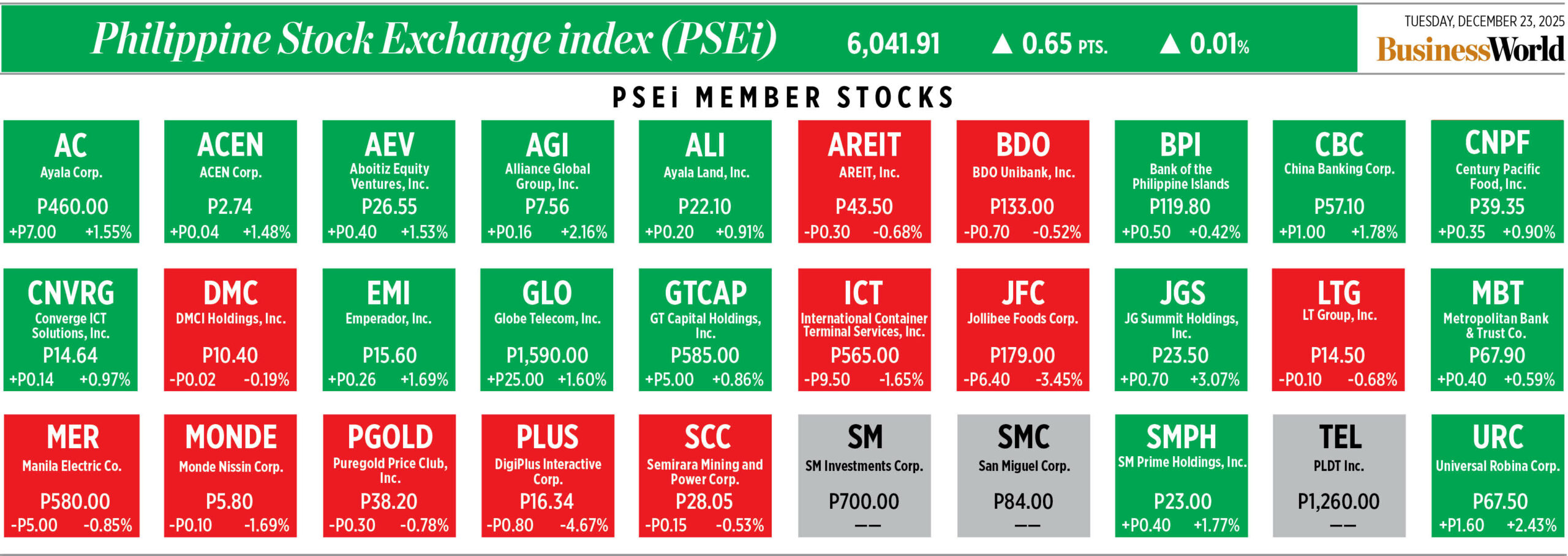
How PSEi member stocks performed — December 23, 2025

Here’s a quick glance at how PSEi stocks fared on Tuesday, December 23, 2025.


PHL stocks end flat before two-day trading break

REUTERS

PHILIPPINE STOCKS ended a tad higher on Tuesday on last-minute buying as players mostly stayed on the sidelines and took safe positions before the Christmas break.

The bellwether Philippine Stock Exchange index (PSEi) edged up by 0.01% or 0.65 point to end at 6,041.91, while the broader all shares index rose by 0.03% or 1.23 points to 3,447.53.

“The local market pocketed a last-minute uptick, barely clutching higher grounds as investors seized the opportunity to position early before the Christmas break,” AP Securities, Inc. said in a market note.

“For the most part of the day, the local market was in the negative territory as investors booked gains to shield themselves from uncertainties and possible negative developments during the holidays,” Philstocks Financial, Inc. Research Manager Japhet Louis O. Tantiangco said in a Viber message. “Still, last-minute bargain hunting allowed the market to have a flat close.”

The PSEi opened Tuesday’s session at 6,058.10, higher than Monday’s close of 6,041.26. It hit an intraday high of 6,063.82 and a low of 5,988.67.

Philippine financial markets are closed on Dec. 24-25 for the Christmas holidays.

Most sectoral indices closed higher on Tuesday. Mining and oil climbed by 1.95% or 282.58 points to 14,768.3; property rose by 0.82% or 18.67 points to 2,269.70; holding firms went up by 0.66% or 31.09 points to 4,739.75; and financials increased by 0.21% or 4.31 points to close the session at 2,055.62.

Meanwhile, services fell by 1.11% or 26.65 points to 2,368.77, and industrials went down by 0.46% or 39.96 points to 8,600.38.

“JG Summit Holdings, Inc. was the day’s top index gainer, climbing 3.07% to P23.50. DigiPlus Interactive Corp. was the main index laggard, falling 4.67% to P16.34,” Mr. Tantiangco said.

Decliners outnumbered advancers, 107 to 88, while 49 names closed unchanged.

Value turnover went down to P4.7 billion on Tuesday with 1.52 billion shares traded from the P8.28 billion with 7.16 billion issues that changed hands on Monday.

Net foreign buying was at P107.99 million, a reversal of the P975.15 million in net selling recorded on Monday.

Meanwhile, Asia shares rose alongside precious metals on Tuesday as buying momentum from investors extended ahead of the festive holidays, with an advanced reading on US gross domestic product expected later in the day, Reuters reported.

Third-quarter growth figures are forecast to show the US economy had continued to grow strongly. The market mood remained buoyant ahead of the outcome and MSCI’s broadest index of Asia-Pacific shares outside Japan rose 0.39%, while Tokyo’s Nikkei eased 0.1%, weighed down by a stronger yen.

European futures were mixed, while S&P 500 futures and Nasdaq futures were little changed. — A.G.C. Magno with Reuters

DoF could limit BIR offices authorized to issue LoAs

FREDERICK D. GO — DEPARTMENT OF FINANCE

FINANCE Secretary Frederick D. Go said the government is seeking to limit the Bureau of Internal Revenue (BIR) offices authorized to issue letters of authority (LoA) following allegations that the tax audit process is being abused.

“There are many departments that can issue an LoA. We’re looking at reducing that,” Mr. Go told reporters in a Dec. 18 briefing.

To curb potential abuse of the tax audit process, only the Commissioner, Charlito Martin R. Mendoza or the Deputy Commissioner, can approve LoAs and mission orders, the Department of Finance (DoF) said.

There are currently four offices that can issue assessments. The current plan is to consolidate the Assessment Division and VAT Audit Section’s issuing authority, the DoF said.

“If a company is being investigated, we can probably combine the VAT (value-added tax) investigation and the income tax investigation as one, rather getting them to deal with a separate group for VAT and a separate group for income tax,” Mr. Go said.

Field audits are currently suspended as the tax authorities look into the alleged abuse of the process. Audits require LoAs and mission orders before they can be initiated. Business groups and legislators had  warned that audits are being used for extortion.

On Dec. 11, the BIR said it will crack down on the issuance of LoAs for tax audits, which will be subject to clearance from Mr. Mendoza.

Mr. Go also said the government is looking to reduce the frequency of LoAs to once a year.

“There has to be a centralized digital record of LoAs being issued,” he added, noting that taxpayers will thereby gain the ability to check the documents for authenticity.

Benedicta Du-Baladad, founding partner, chair, and chief executive officer of Du-Baladad and Associates, expressed support for the BIR’s planned moves regarding tax audits.

“But in addition to that, the selection of taxpayers to be (subject to examination) must be system-generated with no manual intervention based on a certain strict, defined, clear audit criteria of auditable taxpayers during the year,” she said via Viber.

Ms. Du-Baladad also urged the BIR to remove its investigating office and field officers’ discretion in selecting taxpayers for examination.

“Only the Commissioner (and only in justifiable circumstances), should have the discretion to deviate from an issued audit plan,” she added. — Aubrey Rose A. Inosante

National Single Window deal awarded to TradeX

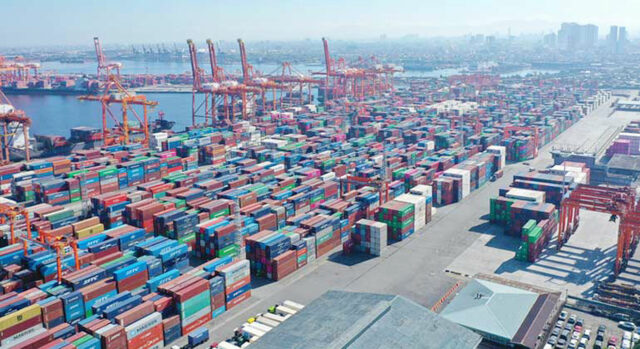
PHOTO COURTESY OF ICTSI

THE Department of Information and Communications Technology signed a contract with TradeX Network, Inc. to develop the National Single Window system, the Public-Private Partnership (PPP) Center said.

In a statement on Dec. 19, the PPP said the deal covers the Integrated Trade Facilitation Platform project, which is structured as a public-private partnership.

“The project aims to facilitate trade by streamlining and digitizing processes for import, export, and international trade-related regulatory requirements,” the PPP Center said.

The project seeks to connect businesses engaged in trade to 77 government agencies involved in the permit-issuance process.

Phase 1 will initially onboard 11 agencies from the Department of Agriculture to help traders and farmers conduct their trade digitally.

“It opens the door for our traders. The mountain of paperwork becomes a single online form. Weeks of waiting become hours, or even minutes. Grit is now rewarded with speed, not frustration,” Information and Communications Technology Secretary Henry Rhoel R. Aguda said.

Mr. Aguda and TradeX Network, Inc. President Jason Cheng signed the contract on Dec. 19, in the presence of PPP Center Executive Director Rizza Blanco‑Latorre and Information and Communications Technology Undersecretary Faye Condez‑De Sagon.

The project will help traders minimize delays in trade, with farmers shipping perishable goods expected to benefit, Mr. Cheng said.

The single window is unsolicited, structured as a build-operate-transfer project and subject to the rules outlined by the PPP Code of the Philippines.

This was the first time for a national implementing agency to complete the awarding of a project under the PPP Code framework, the PPP Center said. — Aubrey Rose A. Inosante

Clark garment firm to shut down, lay off 500

CHARTER LINK CLARK INC. FB ACCOUNT

CHARTER LINK Clark, Inc., a garment manufacturer based in the Clark Freeport Zone, has announced its closure, leaving about 500 jobless.

In a Dec. 22 letter to its employees, the company cited a “consistent decline in orders” over the past three years, compounded by the loss of its primary foreign customer, which resulted in zero projected sales for 2026. 

The letter confirmed that all workers would receive severance pay, pro-rated 13th month pay, conversion of unused leave credits to cash, and one month’s salary in lieu of notice. 

The Federation of Free Workers (FFW) described the timing and manner of the shutdown as “abusive” and “Grinch-like,” after the closure notice was delivered during a Christmas party and allegations that the workers were pressured to sign release forms in the presence of purported government officials.

“If the company’s Christmas party is turned into a meeting to hand out the ‘gift’ of being fired… that’s disrespectful and coercive,” according to Arta Maines, vice-president of FFW’s women’s network.

The company’s planned closure follows earlier legal disputes with union officials, the FFW said. Charter Link previously terminated union officials, who later won their case before the Court of Appeals.

The FFW has called on the Department of Labor and Employment and the Philippine Economic Zone Authority to investigate the closure, ensure due process, and guarantee the lawful payment of all final wages and entitlements.

It added that the abrupt closure casts a shadow over recent positive developments in the investment sphere, including the reported interest of Polish shipbuilder JPP Marine to establish operations in the country.

Jose G. Matula,  FFW president said that while foreign investment is welcome, it must be aligned with a responsible industrial policy that ensures decent work and protects workers both inside and outside economic zones.

“The Philippines cannot be ‘investment-friendly’ while being ‘worker-hostile,’” he said. — Erika Mae P. Sinaking

PHL palay output estimated at 19.6 MMT — USDA

Farmers are seen in a rice field in Bustos, Bulacan, Oct. 17, 2023. — PHILIPPINE STAR/KJ ROSALES

PHILIPPINE PRODUCTION of palay (unmilled rice) is expected to decline 0.16% to 19.6 million metric tons (MMT) in marketing year (MY) 2025-2026, the US Department of Agriculture (USDA) said.

In a report, the USDA’s Foreign Agricultural Service (FAS) in Manila said palay production during the MY, which runs between July 2025 and June 2026, is expected to decline from 19.64 MMT in the previous MY.

The USDA attributed the decrease in production to weaker-than-projected fourth-quarter output following typhoon-related losses and challenging post-harvest conditions.

Milled rice production is also projected to decline 0.16% to 12.35 MMT.

Rice consumption is projected to increase to 17.6 MMT from 17.4 MMT in the previous MY, while ending stocks are likely to fall to 2.95 MMT from 3.8 MMT previously.

“Consumption remains strong, driven by population growth and stable retail prices … Likewise, FAS Manila estimates ending stocks to decline because of lower production and reduced imports,” the USDA said.

The USDA said corn production is also projected to decline 0.73% to 8.27 MMT.

“Despite a strong harvest earlier in Q2 2025, overall output was reduced as weather disruptions offset gains from improved yields and government support,” the USDA said.

Corn consumption is projected to increase to 10.15 MMT from 9.9 MMT in the previous MY.

“FAS Manila estimates total corn consumption to increase, driven by growth in the broiler, layer, pet food, and recovering swine industries, with food, seed, and industrial (FSI) remaining robust,” the report said.

Total wheat consumption is also projected to increase 6.15% to 6.9 MMT.

“Growth in milling wheat consumption is supported by increasing demand for bread, pasta, and biscuits … Feed wheat consumption is estimated to rise as the swine, poultry, and pet food industries continue to expand, offsetting the decline in aquaculture,” the USDA said.

Meanwhile, the USDA said the Philippine food supply, or the total milled rice-equivalent volume of rice, corn and wheat, is projected to increase 1.78% to 25.8 MMT in the current MY. — Vonn Andrei E. Villamiel

Crop damage estimate after Uwan upgraded to P14 billion

RAMMB/PHILSTAR FILE PHOTO

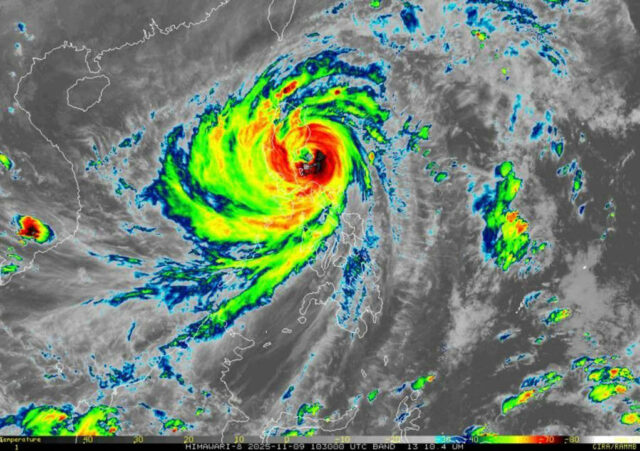
THE final estimate of damage to agriculture caused by Super Typhoon Uwan (international name: Fung-wong, has been set at P14.12 billion, according to the Department of Agriculture (DA).

The final total is more than three times the DA’s previous estimate of P4.19 billion in crop damage issued in late November.

According to the DA’s Disaster Risk Reduction Management Operations Center, damage from Uwan by volume was 455,911 metric tons (MT), including crops like rice, corn, cassava, high-value crops and livestock. It affected 254,751 farmers.

Uwan, which traversed the country in early November, affected 180,067 hectares of farmland in Luzon, Visayas, and the north of Mindanao.

The DA reported P10.26 billion worth of damage to high-value crops, including fruit and vegetables, affecting over 46,000 hectares of farmland, mostly in Luzon, the Eastern Visayas, and Negros Island.

The department also reported P2.25 billion in damage to rice, affecting over 57,000 hectares of farmland in Luzon, the Western Visayas, and the Eastern Visayas.

The damage to corn amounted to P654.11 million, affecting more than 17,000 hectares of farmland in Luzon, the Eastern and Western Visayas, and Negros Island.

The fiber industry, which includes abaca, was also severely affected, with damage inflicted by Uwan valued at P535.72 million. Over 58,000 hectares of farmland planted to fiber crops were affected, mostly in the Bicol region and Samar.

The DA said it prepared P467.1 million worth of inputs for affected farmers and stood ready to disburse quick-response funds, which can be tapped for rehabilitation and recovery in affected areas. Indemnification is also available for Philippine Crop Insurance Corp. policy holders.

Affected farmers may also apply for zero-interest loans of up to P25,000 under the Survival and Recovery Program of the Agricultural Credit Policy Council, payable over three years at zero interest. — Vonn Andrei E. Villamiel

Iloilo’s MORE Power slashes Dec. power rates

ILOILO CITY power consumers served by MORE Electric and Power Corp. (MORE Power) will pay less in the December billing cycle after the power distributor reduced rates by 4.2%.

The average electricity rate fell to P11.3477 per kilowatt-hour (kWh) in December from P11.8558 in November, the company said in a statement on Tuesday.

The rate for commercial power users, meanwhile, fell to P10.6661 per kWh from P11.1741 previously.

MORE Power attributed the downward adjustment to the wider power supply margin as demand fell on the Wholesale Electricity Spot Market.

Meanwhile, the transmission charge decreased 3.7% month on month to P1.7918 per kWh, following the decline in the cost of regulated charges and ancillary services on the reserve market.

MORE Power’s distribution charge has not been adjusted.

The company also cited a decrease in system losses to P0.4086 per kWh from P0.4512 per kWh a month earlier. — Sheldeen Joy Talavera

NCR Nov. retail price growth hits 11-month high

STOCK PHOTO | Image by Melanie Lim from Unsplash

RETAIL PRICE growth of general goods in the National Capital Region (NCR) hit an 11-month high in November with demand boosted by holiday spending, analysts said.

Citing preliminary data, the Philippine Statistics Authority (PSA) said the general retail price index (GRPI) in the NCR grew 1.4% year on year in November, against the 1.3% reading in October. The growth rate was unchanged from its year-earlier reading.

The index had come in at 1.5% in December 2024.

“The rise in prices can still be attributed to holiday demand. Higher demand for goods and services while supply plays catch-up can cause price upticks during the period,” Reinielle Matt M. Erece, economist at Oikonomia Advisory and Research, Inc., said in an e-mail.

He added that the delayed effects of rate cuts may have started showing up in the retail sector.

Ser Percival K. Peña-Reyes, director of the Ateneo Center for Economic Research and Development, attributed November’s faster GRPI growth in Metro Manila to cost pressures on retailers, early holiday price adjustments, specific goods’ price shifts despite low overall inflation, and base effects.

“These factors can cause the retail price index to rise even when national headline inflation is subdued due to slow food price growth,” he said.

In its December policy meeting, the Bangko Sentral ng Pilipinas lowered its benchmark policy rate by 25 basis points (bps) to 4.5%.

The Monetary Board cut its target reverse repurchase rate for a fifth meeting in a row, bringing the rate to its lowest since September 2022.

The central bank has so far lowered key borrowing costs by 200 bps since it began its easing cycle in August 2024.

In the first 11 months, GRPI growth averaged 1.1%, significantly lower than the year-earlier 1.8% average.

Growth in the heavily weighted food index, which accounts for 37.5% of the overall index, accelerated to 1.5% from 1.3% in October.

Faster price growth was also noted in mineral fuels, lubricants and related materials (2.8% from 1.9%), machinery and transport equipment (0.7% from 0.6%), and miscellaneous manufactured articles (0.9% from 0.8%).

“The price movements imply that the economy is experiencing selective inflation pressures rather than widespread stress,” Mr. Peña-Reyes said.

Meanwhile, price growth decelerated in beverages and tobacco (1.7% from 1.9%); crude materials, inedible except fuels (1.9% from 2.1%); and manufactured goods classified chiefly by materials (1.5% from 1.6%).

“Overall, this supports steady but cautious economic activity, with growth likely continuing at a modest pace rather than accelerating sharply,” Mr. Peña-Reyes said.

Mr. Erece said inflation remains below the central bank’s target range, so concerns about rising prices should be limited, though careful monitoring is still warranted as the first quarter approaches.

Meanwhile, Mr. Peña-Reyes said retail price growth in the following month “is expected to increase modestly from November’s level but will remain contained.”

“As for full-year 2025 retail price growth, it will likely stay moderate to low, in line with the generally low-inflation environment.”

In November, the consumer price index rose 1.5% from a year earlier, against the 1.7% reading in October. The year-to-date average was 1.6%, below the central bank’s target of 2% to 4%.

The PSA uses the GRPI as a deflator in the National Accounts, particularly in the retail trade sector, and serves as a basis for forecasting. — Heather Caitlin P. Mañago