Home Blog Page 5023

Globe Telecom, Inc. to conduct annual meeting of stockholders virtually on April 25

click to enlarge
click to enlarge

Spotlight is BusinessWorld’s sponsored section that allows advertisers to amplify their brand and connect with BusinessWorld’s audience by enabling them to publish their stories directly on the BusinessWorld Web site. For more information, send an email to online@bworldonline.com.

Join us on Viber at https://bit.ly/3hv6bLA to get more updates and subscribe to BusinessWorld’s titles and get exclusive content through www.bworld-x.com.

T-bill, bond rates to rise following Fed, BSP hikes

BW FILE PHOTO

RATES of Treasury bills (T-bills) and Treasury bonds (T-bonds) on offer this week could go up after the US Federal Reserve and the Bangko Sentral ng Pilipinas (BSP) raised borrowing costs.

The Bureau of the Treasury (BTr) will auction off P15 billion in T-bills on Monday, made up of P5 billion each in 91-, 182-, and 364-day papers.

On Tuesday, it will offer P25 billion in reissued seven-year T-bonds, which have a remaining life of six years and six months.

T-bill rates could rise this week to track secondary market levels “after the latest local policy rate hike of 25 basis points (bps) to 6.25%, the highest in nearly 16 years, matching the latest Fed rate hike of 25 bps,” Rizal Commercial Banking Corp. Chief Economist Michael L. Ricafort said in a Viber message.

At the secondary market on Friday, the 91-, 182-, and 364-day T-bills went up by 10.45 basis points (bps), 11.31 bps, and 13.89 bps week-on-week to end at 4.9666%, 5.5587%, and 5.9397%, respectively, based on the PHP Bloomberg Valuation Service (BVAL) Reference Rates data published on the Philippine Dealing System’s website.

“The upcoming seven-year Treasury bond auction results could be close to the comparable seven-year PHP BVAL yield at 6.13% as of March 24, 2023,” Mr. Ricafort added.

The seven-year bonds inched up by 3.92 bps week on week to end at 6.1251% on Friday.

The Fed last week raised interest rates by 25 bps to the 4.75%-5% range, but said it could consider a pause soon due to turmoil in the US banking system.

The US central bank has raised rates by 475 bps since March 2022.

Meanwhile, the BSP likewise decided to increase benchmark interest rates by 25 bps to anchor inflation expectations.

The latest move brought its policy rate to 6.25%, with cumulative hikes since May 2022 now at 425 bps.

Union Bank of the Philippines, Inc. Chief Economist Ruben Carlo O. Asuncion said in a report that demand for the government securities could be affected by the BSP’s hawkish outlook.

“With no imminent rate cuts in store for the BSP, we expect the market will be inclined to a buy on dips in the near term,” Mr. Asuncion said.

BSP Governor Felipe M. Medalla said after Thursday’s meeting that risks to the inflation outlook remain heavily tilted to the upside as supply shortages weigh on food prices. Price pressures may also broaden due to higher transport fares, electricity rates, and above-average wage hikes.

“Further policy tightening will also preserve the buffer against external spillovers amid heightened uncertainty and volatility emanating from financial sector distress in advanced economies,” he said.

Last week, the BTr raised just P10.636 billion from its offering of T-bills, lower than the P15-billion program, as rates climbed across the board.

Broken down, the Treasury made a partial P2.531-billion award of the 91-day T-bills versus the P5-billion program as tenders for the tenor reached only P4.041 billion. The average rate of the three-month paper rose by 28 bps to 4.911%. Accepted rates ranged from 4.74% to 4.974%. 

The government likewise borrowed just P3.7 billion via the 182-day securities, lower than the P5-billion plan, even as demand for the tenor reached P6.97 billion. The six-month T-bill was quoted at an average rate of 5.556%, climbing by 11.90 bps from the previous week, with accepted rates ranging from 5.475% to 5.6%.

Lastly, the BTr raised only P4.406 billion from the 364-day debt papers against the P5-billion program, even as bids for the tenor reached P6.795 billion. The average rate of the one-year paper went up by 14.70 bps to 5.864%. Accepted yields were from 5.775% to 5.95%.

Meanwhile, the reissued seven-year T-bonds to be auctioned off on Tuesday were last offered on Jan. 4, where the government raised the programmed P35 billion. The bonds fetched an average rate of 6.796%, with accepted rates at 6.625% to 6.895%.

The Treasury wants to raise P200 billion from the domestic market this month, or P75 billion via T-bills and P125 billion via T-bonds.

The government borrows from local and external sources to help fund its budget deficit, which is capped at 6.1% of gross domestic product this year. — Aaron Michael C. Sy

Tarlac pechay farmers sharing site with solar farm harvest 5,000 kg

Photo by Joseph Emmanuel Garcia, BusinessWorld

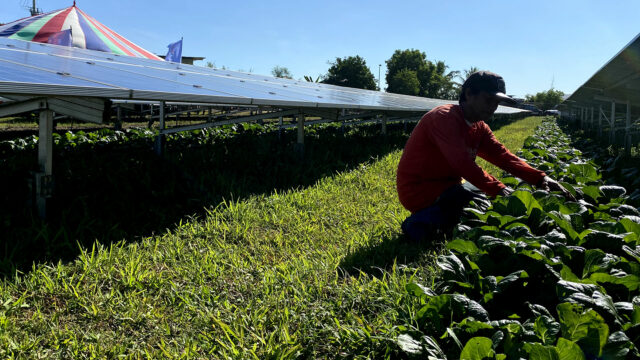
FARMERS in Tarlac cultivating Chinese cabbage, also known as pechay, were able to harvest 5,000 kilograms (kg) from a site also hosting a solar farm, Citicore Renewable Energy Corp.  said.

The 7-megawatt solar farm, known as Citicore Solar Tarlac 2, Inc., in Barangay Dalayap, Tarlac City, also provides power to area farmers, the company said, resulting in savings of 8,430 metric tons of carbon dioxide because they no longer need to fuel their equipment with diesel. The savings in diesel terms were estimated at 828,142 gallons, according to the Citicore website.

Fiona R. Nicolas, a Citicore senior manager for corporate affairs, said the project was designed “to help our host communities, especially the farmers, because we want to share our land with them so they can also profit,” she told reporters during the harvest.

Solar power projects tend to compete with agriculture for land, creating an opportunity for co-location via agrovoltaic technology.

“We have proven that agriculture and solar power generation can co-exist. So, it’s (not true) that solar power displaces agriculture,” she said.

According to Ms. Nicolas, the project tapped power from the company’s 10-hectare site, where farmers planted their crops for two cycles.

The crops were planted in between solar panels to allow access to sunlight, improving land-use efficiency and yield.

Citicore said it sold the harvested cabbage for P15-P25 per kilogram. The farmers’ profit share was 25%-40%.

The company said based on soil analysis, the site is also suitable for chili, eggplant, and tomatoes.

A trial planting at the site in 2021 yielded a harvest of 3,735 kilograms of turmeric, arugula, and French beans.

The solar farm generates 40,000 kilowatt hours (kWh) per day, the company said, equivalent to providing 5 kWh to about 8,000 households.

Ms. Nicolas cited the potential for the solar industry to co-locate with farmers for boosting food production.

“Imagine the impact we can have, especially when it comes to job creation and food security alongside clean energy generation,” she said.

The company expected gross revenues of around P1.3 million for eight harvest cycles. Its own profit will be used for other corporate social responsibility activities, she said.

Ms. Nicolas said that the company also plans to use its other solar farms for agro-solar initiatives in the Pampanga, Bulacan, and Batangas. — Sheldeen Joy Talavera

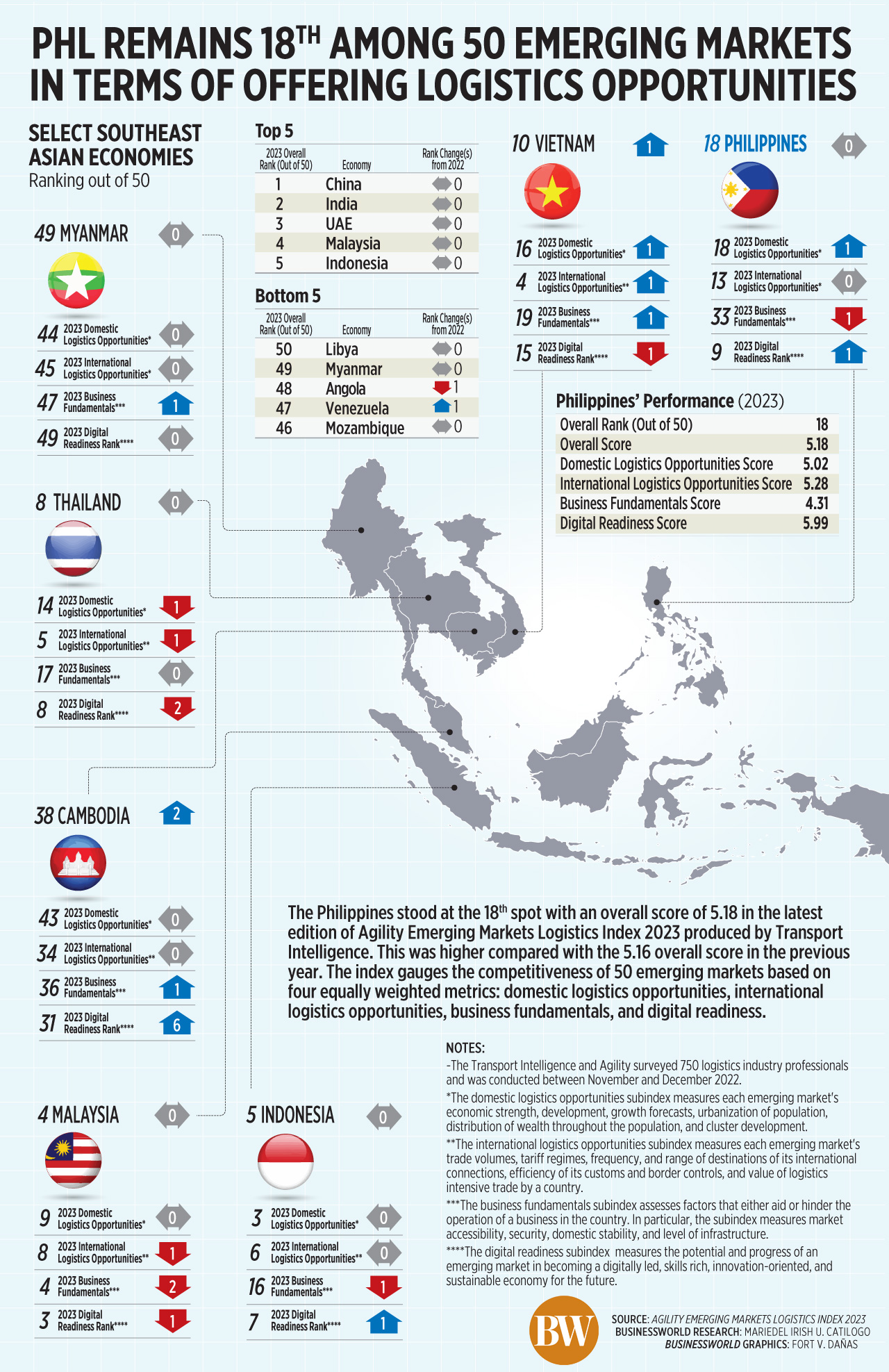
PHL remains 18th among 50 emerging markets in terms of offering logistics opportunities

The Philippines stood at the 18th spot with an overall score of 5.18 in the latest edition of Agility Emerging Markets Logistics Index 2023 produced by Transport Intelligence. This was higher compared with the 5.16 overall score in the previous year. The index gauges the competitiveness of 50 emerging markets based on four equally weighted metrics: domestic logistics opportunities, international logistics opportunities, business fundamentals, and digital readiness.

PHL remains 18<sup>th</sup> among 50 emerging markets in terms of offering logistics opportunities

Designer Ryan Chris marks 12th year by giving back to kids with cancer and indigenous students

DESIGNER Ryan Chris hosted a fashion show and charity gala called “Sketches + Stitches” to mark his 12th year in the business. However, the event was not merely a showcase of the designer’s fashion, instead, it was a celebration of his childhood dream, with every sketch and stitch dedicated to giving back to the community.

The show opened with a presentation of Joyce Peñas Pilarky’s newest collection which was followed by Ryan Chris’s latest collection of almost a hundred ensembles.

The proceeds from the evening were dedicated to two charities that are close to the designer’s heart. The MBrace Project, an organization that aims to make a difference in the lives of children with learning disabilities, cancer, and other chronic illnesses. The event also supported the Indigenous People’s Student Organization which provides resources and support to indigenous students pursuing higher education, empowering them to make a positive impact in their communities.

For more information and to see Ryan Chris’ collection, visit ryanchrisdesigner.com.

Lamborghini records best-ever year in 2022

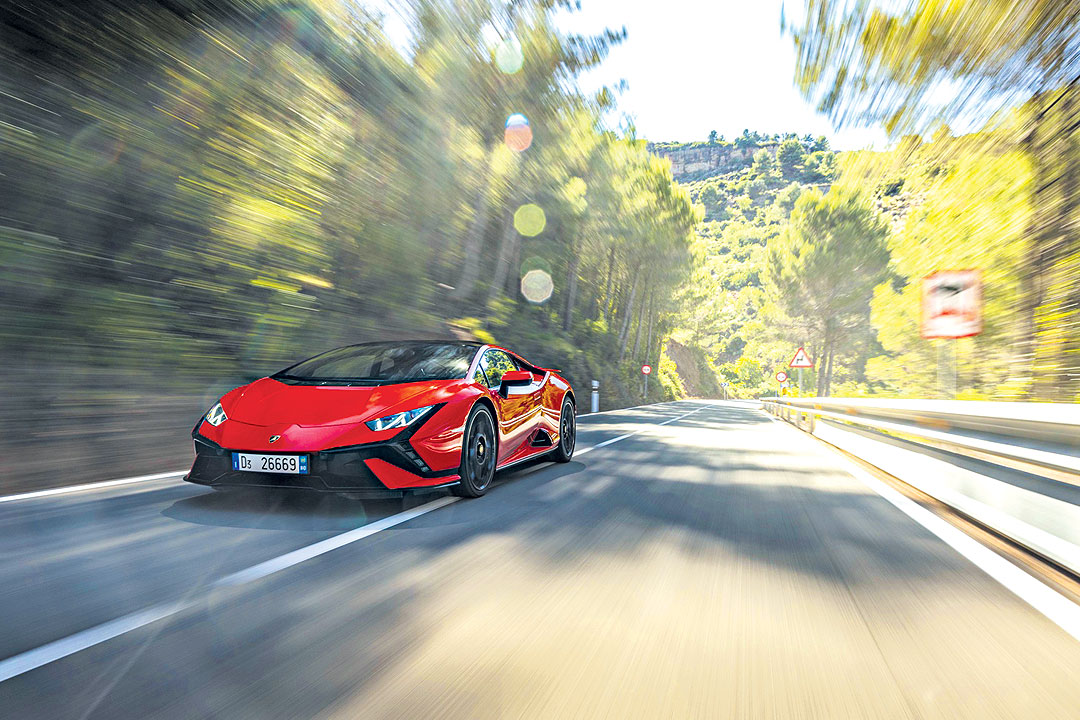
More than 5,000 units of the Lamborghini Urus were sold last year. — PHOTO FROM LAMBORGHINI

SUPERCAR MAKER Automobili Lamborghini reported that it had “another record-breaking year” in 2022. A total of 9,233 cars were delivered to customers around the globe, and the company posted turnover which breached €2 billion for the first time. Operating income also increased by 56% versus 2021 to €614 million.

Said Automobili Lamborghini Chairman and CEO Stephan Winkelmann in a release, “Our business continues to grow, and we can proudly confirm the achievement of truly remarkable targets once again in 2022. These figures come in a very important year for the company, which is marking its 60th anniversary and entering the second phase of the Direzione Cor Tauri program: An unparalleled investment plan that will guide our growth, lead to further improvements in our financial performance, and boost the value of our brand and our company. We are ready to face the many challenges and changes that await us in 2023 and we will keep pushing to the next level. We have an opportunity to really focus on our next objectives, thanks in part to our 18-month waiting list, which means we can confidently contemplate our future targets.”

Total turnover reached €2.38 billion, up by 22% versus 2021. Operating margin of 25.9% is said to be a “best-in-class result in Lamborghini’s market and (puts) it right at the top of the automotive luxury market.” Meanwhile, operating margin increased for a fifth consecutive year — another milestone for the company.

“The economic and geopolitical situation has been tough in recent years, but we’ve been able to show our resilience and our capacity to work towards excellent economic and financial results. Year 2022 was our best year ever on all financial and business fronts. It means we can take an optimistic outlook on the growth of our brand and our company,” noted Automobili Lamborghini Managing Director and CFO Paolo Poma.

Asia was at the forefront with a 14% increase, followed by America (+10%) and EMEA (+7%). The United States remained in the top spot overall (2,721 cars delivered, up 10% versus 2021); followed by the Chinese mainland, Hong Kong, and Macau (1,018 cars delivered, up 9%); Germany (808 cars delivered, up 14%); the United Kingdom (650 cars, up 15%); and Japan (546 cars delivered, up 22%).

The Lamborghini Urus led the way in sales with 5,367 units delivered (up 7%). Next in line -— and experiencing a significant increase — was the Huracán (3,113 units delivered, up 20%), and the Aventador (753 units delivered). The Aventador reached the end of its production run in September 2022.

This year, the brand turns 60, and will mark a “new era.” The launch of the new V12 super sports car — the first plug-in hybrid from Sant’Agata Bolognese — will be the first step toward the hybridization of the entire model range, to be concluded at the end of 2024. The €2.5 billion invested up to 2028 is the biggest of its kind ever for Automobili Lamborghini.

PLDT rises as capex findings soothe investors

PLDT Inc. inched up last week as worries over its budget overrun were eased while news of its Sky Cable Corp. acquisition boosted optimism amid an expected wider market share.

Data from the Philippine Stock Exchange (PSE) showed a total of 551,025 shares of the Pangilinan-led telco worth P746.3 million were traded from March 20 to 24.

PLDT shares closed at P1,350 apiece on Friday, up 3% from the P1,310 close on March 17. For the year, however, the stock was down by 25.5%.

On March 23, PLDT said it found no wrongdoing over the P48-billion capital expenditure (capex) overrun last year. It also announced this year’s capex at P80 billion to P85 billion, or below the P96.8 billion it spent last year.

Globalinks Securities and Stocks, Inc. Head of Electronic Trading Mark Crismon V. Santarina said in a Viber message that the spending report was good for investors and the announcement of a lower capex “may ease concerns” about the year’s finances.

“However, the company’s stock price [was] still affected by the overall market [performance] and investors’ feelings,” he said, referring to Thursday’s net selling of the stock by foreign investors that may also impact PLDT’s price.

Mr. Santarina said PLDT, as a member of the PSE index (PSEi), could have been affected by the current international financial situation and was not exempted from the effects of the recent collapse of Silicon Valley Bank and Signature Bank in the US.

He added that news of the US Federal Reserve’s and the Bangko Sentral ng Pilipinas’ rate hikes also influenced market players’ decisions to buy or sell.

The US Fed hiked rates by 0.25 percentage points to lower inflation.

As the market expected, the local central bank hiked rates by 25 basis points as core inflation continued to climb and to keep headline inflation on a downward trend.

Meanwhile, PLDT’s acquisition of Sky Cable is another news that gained positive sentiments from investors as this is expected to widen the telco’s market share and bring in more revenue.

“However, it’s hard to predict the exact impact of the acquisition on PLDT’s overall income given current market conditions. Investors may also be staying on the sidelines due to the uncertainties in the market that can influence market and investor sentiment,” Mr. Santarina said.

For the week, Mr. Santarina sees PLDT moving sideways as investors await another “significant event that could trigger a breakout.”

He expects PLDT’s first-quarter earnings before interest, taxes, depreciation, and amortization to reach P25.8 billion, higher than the P20.9 billion recorded in the first quarter of 2022, and a full-year net income of P30.4 billion.

He placed PLDT’s support and resistance levels at P1,290 and P1,380-P1,400, respectively.

“Despite uncertainties in the market, the company recently announced a dividend payment for its common stock, which has generated excitement among investors as it is seen as a positive indication of the company’s financial strength,” he said.

Hastings Holdings, Inc., a unit of PLDT Beneficial Trust Fund subsidiary MediaQuest Holdings, Inc., has a majority stake in BusinessWorld through the Philippine Star Group, which it controls. — Bernadette Thesere M. Gadon

Yields on gov’t debt end mixed after policy meetings

YIELDS on government securities (GS) traded in the secondary market ended mixed last week after the US Federal Reserve and the Bangko Sentral ng Pilipinas (BSP) opted for smaller rate hikes at their meetings last week.

Bond yields, which move opposite to prices, went up by 4.23 basis points (bps) on average week on week, based on PHP Bloomberg Valuation Service Reference Rates as of March 24, published on the Philippine Dealing System’s website.

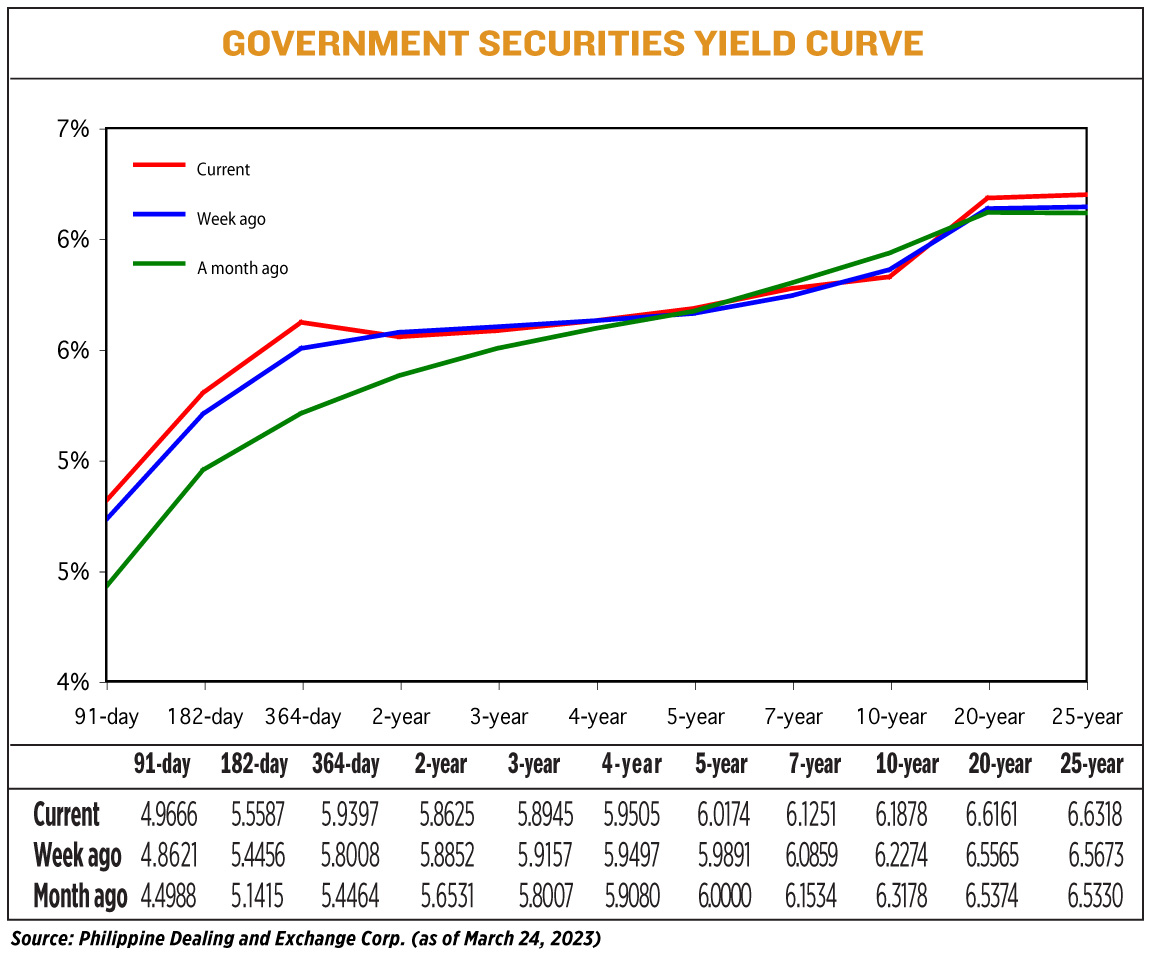
Rates at the short end of the curve went up, with the 91-, 182- and 364-day Treasury bills (T-bills) rising by 10.45 bps, 11.31 bps, and 13.89 bps to fetch 4.9666%, 5.5587%, and 5.9397%, respectively.

Meanwhile, the belly of the curve ended mixed. Yields on the two-, and three-year Treasury bonds (T-bonds) declined by 2.27 bps (to fetch 5.8625%) and 2.12 bps (5.8945%), respectively. The rates of the four-, five-, and seven-year T-bonds rose by 0.08 bp (5.9505%), 2.83 bps (6.0174%) and 3.92 bps (6.1251%), respectively.

The long end of the curve also closed mixed, with yields on the 20-, and 25-year debt papers increasing by 5.96 bps (to 6.6161%), 6.45 bps (6.6318%), respectively, while the 10-year debt paper fell by 3.96 bps to fetch 6.1878%.

Total GS volume traded reached P14.340 billion on Friday, more than doubled the P5.128 billion seen on March 17.

Analysts said the Fed and BSP’s policy decisions drove local yield movements last week.

“Domestic yields increased amid market views of policy rate hikes from the BSP and the US Federal Reserve,” a bond trader said in an e-mail.

“In line with the expectations, the local and the US central bank delivered 25-bp rate hikes, but expressed reservations on further policy rate hikes, noting dependency on incoming economic data,” the bond trader said.

The trader added that the declines in the yields on the two- and three-year bonds was due to the lack of market appetite for tenors at the belly of the curve.

Jose Miguel B. Liboro, head of fixed income at ATRAM Trust Corp., said in an e-mail that the 20-year bond auction and the policy reviews of the Fed and the BSP served as catalysts for the market last week.

“We saw healthy demand at the BTr’s (Bureau of the Treasury) 20-year auction early in the week given that market levels and expectations on central bank action had aligned by last week,” Mr. Liboro said.

He added that the 25-bp hikes delivered by the Fed and the BSP were already largely priced in at the current yield levels, with decent two-way trading activity seen last week.

The Fed on Wednesday raised interest rates by 25 bps to a range between 4.75% and 5%, but hinted at a pause due to the collapse of two US banks.

The US central bank has now raised rates by 475 bps since March 2022.

Fed Chair Jerome H. Powell sought to reassure investors about the soundness of the banking system, saying that the management of Silicon Valley Bank “failed badly,” but that the bank’s collapse did not indicate wider weaknesses in the banking system.

California regulators on March 10 closed Silicon Valley Bank. This was the largest US bank failure since the 2008 financial crisis.

Meanwhile, the BSP, in its own meeting on Thursday, also decided to hike benchmark interest rates by 25 bps to anchor inflation expectations.

The latest move brought its policy rate to 6.25%, with cumulative increases since May 2022 reaching 425 bps.

On the other hand, the BTr raised P25 billion as planned from the reissued 20-year bonds it offered on Tuesday as total bids reached P34.412 billion.

The bonds, which have a remaining life of 19 years and eight months, were awarded at an average rate of 6.631%, with accepted yields ranging from 6.5% to 6.745%.

The average rate of the 20-year bond was 10.60 bps higher than the 6.525% quoted for the same series when it was last offered on Jan. 17 but 149.40 bps below the 8.125% coupon for the issue.

Mr. Liboro expects the curve to remain flat this week, with longer tenors offering little additional yield over one- to three-year papers.

“We believe the upcoming seven-year auction could be a catalyst to cause the curve to steepen a little bit and cause an adjustment higher in the seven- to 20-year space,” he said.

“We remain constructive on Philippine fixed income and maintain the view that inflation is likely to decelerate over the coming months — making current levels attractive from a longer-term standpoint,” Mr. Liboro added.

The bond trader said local yields will likely move with a downward bias as market worries over the health of the global economy might resurface amid potentially downbeat US consumer confidence and Chinese manufacturing reports.

“Moreover, this downside might be supported due to likely weaker inflation reports from the US and Eurozone,” the bond trader added. — Abigail Marie P. Yraola


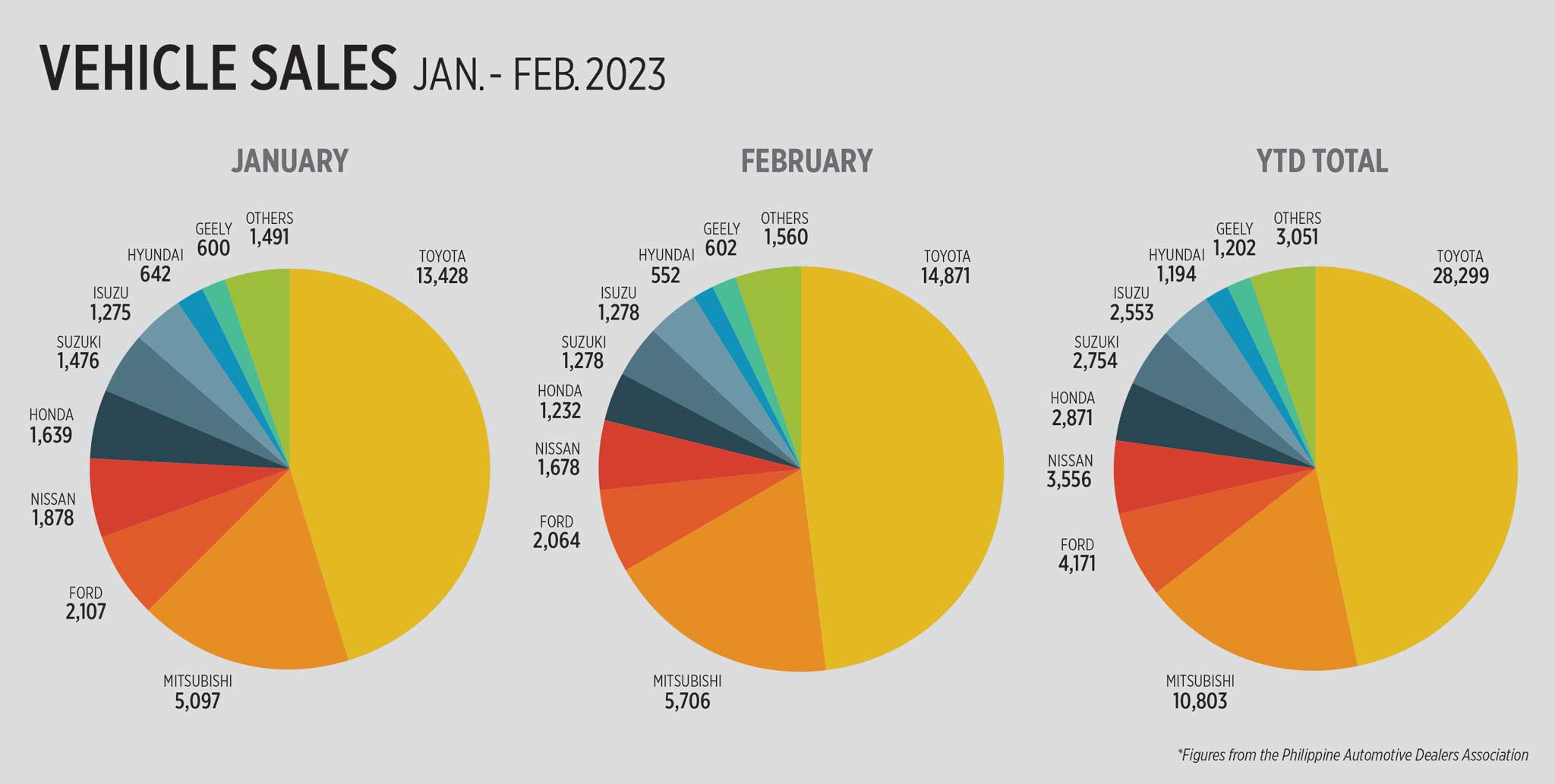
Vehicle Sales

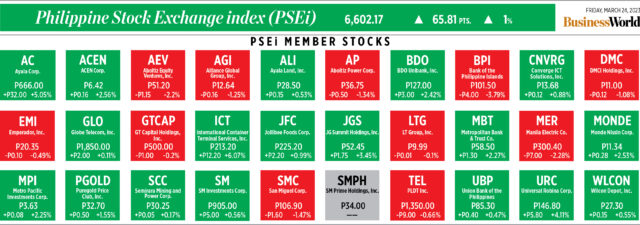
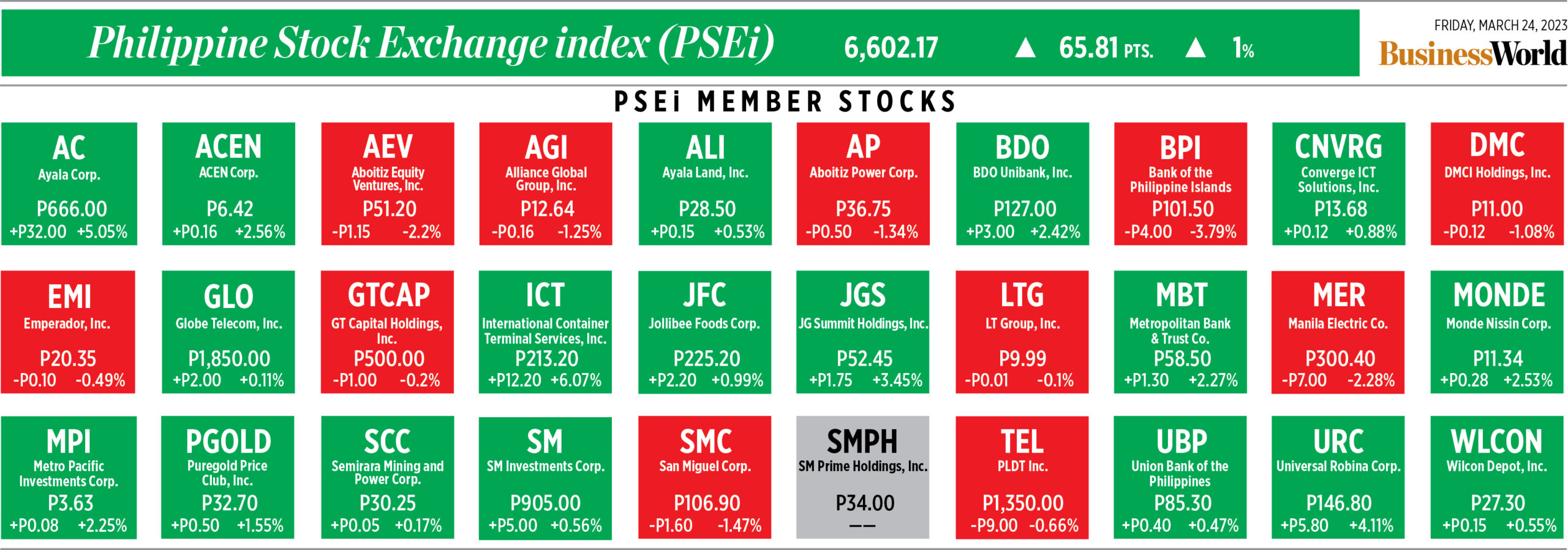
How PSEi member stocks performed — March 24, 2023

Here’s a quick glance at how PSEi stocks fared on Friday, March 24, 2023.


Peso to trade sideways on rate hike bets

BW FILE PHOTO

THE PESO could trade sideways against the dollar this week on expectations that the Bangko Sentral ng Pilipinas (BSP) would be more hawkish than the US Federal Reserve as domestic inflation remains elevated.

The local currency closed at P54.35 versus the greenback on Friday, down by eight centavos from Thursday’s P54.27 finish, Bankers Association of the Philippines data showed.

Still, week on week, the peso climbed by 36 centavos from its P54.71 finish on March 17.

The peso opened Friday’s session at P54.36 per dollar. Its worst showing was at P54.42, while its intraday best was at P54.22 versus the greenback.

Dollars traded declined to $1.036 billion on Friday from the $1.136 billion recorded on Thursday.

The peso weakened on Friday due to gains at the US stock market overnight, Rizal Commercial Banking Corp. Chief Economist Michael L. Ricafort said in a Viber message.

For this week, the peso may trade sideways against the dollar “after the BSP appeared more hawkish than the Fed in the latest round of policy rate adjustments,” Union Bank of the Philippines, Inc. Chief Economist Ruben Carlo O. Asuncion said in a report.

“Against this backdrop, our trader’s bias is to sell the dollar on rally,” Mr. Asuncion added.

The Fed last week hiked its target interest rate by 25 basis points (bps) to a range between 4.75% and 5%, with its chief signaling a pause soon following the collapse of two US banks.

The US central bank has now raised rates by 475 bps since March 2022.

Meanwhile, the BSP also raised benchmark interest rates by 25 bps as it seeks to anchor inflation expectations. The latest move brought its policy rate to 6.25%, with total increases since May 2022 now at 425 bps.

BSP Governor Felipe M. Medalla said after the Monetary Board’s meeting that risks to the inflation outlook remain tilted to the upside as supply shortages weigh on food prices, with higher transport fares, electricity rates, and above-average wage hikes expected to add to pressures.

“Further policy tightening will also preserve the buffer against external spillovers amid heightened uncertainty and volatility emanating from financial sector distress in advanced economies,” Mr. Medalla said.

Mr. Asuncion expects the peso to trade between P54.15 and P54.85 this week, while Mr. Ricafort sees it moving from P54.10 to P54.60. — A.M.C. Sy

Shares to move sideways amid banking concerns

BW FILE PHOTO

PHILIPPINE SHARES are expected to move sideways this week as investors remain cautious due to banking concerns abroad and following rate hikes by the US Federal Reserve and the Bangko Sentral ng Pilipinas (BSP).

The bellwether Philippine Stock Exchange index (PSEi) went up by 65.81 points or 1% to close at 6,602.17 on Friday, while the broader all shares index increased by 23.95 points or 0.68% to 3,516.72.

Week on week, the PSEi increased 132.45 points or 2.05% from its close of 6,602.17 on March 24.

“On the last trading day of the week, the local market jumped, as investors digested Bangko Sentral ng Pilipinas’ monetary policy decision and forecasts,” Philstocks Financial, Inc. Research Analyst Claire T. Alviar said in a Viber message.

The Fed on Wednesday raised interest rates by 25 basis points (bps) to a range between 4.75% and 5%, but hinted at a pause due to the collapse of two US banks.

The US central bank has now raised rates by 475 bps since March 2022.

California regulators on March 10 closed Silicon Valley Bank. This was the largest US bank failure since the 2008 financial crisis.

Meanwhile, the BSP, in its own meeting on Thursday, also decided to hike benchmark interest rates by 25 bps to anchor inflation expectations.

The latest move brought its policy rate to 6.25%, with cumulative increases since May 2022 reaching 425 bps.

For this week, Philstocks Financial, Inc. Senior Research Analyst Japhet Louis O. Tantiangco said investor sentiment may be influenced by lingering concerns over offshore banks.

“On a positive note, the said banking concerns and the risks they bring to both local and global economic prospects may also fuel hopes that the BSP and the US Federal Reserve will end their monetary tightening soon. This in turn may help the market,” he added.

Shares of Germany’s largest bank Deutsche Bank plunged on Friday as investors fretted that regulators and central banks have yet to contain the worst shock to the sector since the 2008 global financial crisis, Reuters reported.

In the latest effort to reassure investors, the US Treasury said the Financial Stability Oversight Council — which comprises the heads of various US regulators — agreed at a Friday meeting that the US banking system is “sound and resilient,” even after the collapse of Silicon Valley Bank and Signature Bank earlier this month.

Earlier in the day, Germany’s Deutsche Bank was thrust into the investor spotlight and slumped 8.5% alongside a sharp jump in the cost of insuring its bonds against the risk of default. The index of top European bank shares ended down 3.8%.

Mr. Tantiangco placed the PSEi’s immediate support at 6,600 and resistance at 6,800, while Rizal Commercial Banking Corp. Chief Economist Michael L. Ricafort put immediate support at 6,250 and resistance at 6,900 to 7,000. — A.H. Halili with Reuters