WASHINGTON – The US Space Force said on Monday that Elon Musk’s SpaceX was granted approval to lease a second rocket launch complex at a military base in California, setting the space company up for its fifth launch site in the United States.
Under the lease, SpaceX will launch its workhorse Falcon rockets from Space Launch Complex-6 at Vandenberg Space Force Base, a military launch site north of Los Angeles where the space company operates another launchpad. It has two others in Florida and its private Starbase site in south Texas.
A Monday night Space Force statement said a letter of support for the decision was signed on Friday by Space Launch Delta 30 commander Col. Rob Long. The statement did not mention a duration of SpaceX‘s lease.
The new launch site, vacated last year by the Boeing-Lockheed joint venture United Launch Alliance, gives SpaceX more room to handle an increasingly busy launch schedule for commercial, government and internal satellite launches.
Vandenberg Space Force Base allows for launches in a southern trajectory over the Pacific ocean, which is often used for weather-monitoring, military or spy satellites that commonly rely on polar Earth orbits.
SpaceX‘s grant of Space Launch Complex-6 comes as rocket companies prepare to compete for the Pentagon’s Phase 3 National Security Space Launch program, a watershed military launch procurement effort expected to begin in the next year or so. – Reuters
Risks of a direct military confrontation between the two nuclear powers, Russia and the United States, are steadily growing, the TASS news agency quoted a senior Russian diplomat as saying on Tuesday.
Vladimir Yermakov, the foreign ministry’s head of nuclear non-proliferation, told the Russian state news agency that Washington is escalating the risks through its conduct with Moscow.
Since the start of its invasion on Ukraine 14 months ago, Moscow has issued regular charges against the US and what it calls “the collective West” for raising the risks of a nuclear war, rhetoric intended to deter Kyiv’s allies.
“If the United States continues to follow its current course of confrontation with Russia, with the stakes constantly escalating on the verge of sliding into direct armed conflict, then the fate of START (nuclear arms treaty) may be a foregone conclusion,” Mr. Yermakov said.
The US told Russia in March that it will cease exchanging some data on its nuclear forces following Moscow’s refusal to do so, calling it a response to Russia‘s suspending participation in the New START treaty.
Mr. Yermakov did not provide details of the alleged U.S. confrontational approach in the excerpts from the TASS interview published so far.
“The most acute threat today is associated … with the danger of nuclear escalation as a result of a direct military confrontation between nuclear powers,” Mr. Yermakov said.
“And these risks, to the deepest regret, are steadily growing.”
Moscow and Beijing will assess the West’s potential involvement in the global expansion of the US anti-missile system, which “clearly undermines strategic stability,” he added. – Reuters
Coinbase Global Inc. filed a petition on Monday in an effort to compel the US Securities and Exchange Commission to create new rules for digital assets, the company said in a blog post, in the latest escalation of the cryptocurrency exchange’s tensions with the securities regulator.
Coinbase filed a petition for rulemaking with the SEC last year in which it urged the regulator to provide clarity on the circumstances under which a digital asset is a security and create a new market structure framework that is compatible with cryptocurrencies.
The SEC has not responded publicly to that petition, which led to Coinbase filing the legal challenge, said Coinbase Chief Legal Officer Paul Grewal in the blog post.
“Coinbase and other crypto companies are facing potential regulatory enforcement actions from the SEC, even though we have not been told how the SEC believes the law applies to our business,” said Grewal.
The petition will be filed in the US Court of Appeals for the Third Circuit.
The crypto industry largely believes it operates in a regulatory gray area not governed by existing US securities laws, and that new legislation is needed to regulate the sector.
SEC Chair Gary Gensler has said cryptocurrency firms should comply with existing laws and that new crypto-specific regulations are not necessary.
Coinbase disclosed in March the firm had been told that SEC staff intended to recommend enforcement action against the company. The company said in a blog post at the time that it was willing to fight any forthcoming enforcement action in court.
In July, when Coinbase also submitted its petition for rulemaking, the firm disclosed an SEC probe into its asset listing processes, staking programs and yield-generating products. – Reuters
LOS ANGELES – Jason Stark’s two young sons talked excitedly for months about seeing the “The Super Mario Bros. Movie.” When the film debuted this month, he decided to make the experience a special outing.
Mr. Stark took a day off from work and drove his boys, ages 9 and 6, about a half-hour from their Connecticut home to watch the movie at an AMC theater on a 50-foot-high IMAX screen.
“We got lunch, we went to the movies and had a fun day together,” said Mr. Stark. “They loved it. They were amazed by how big (the screen) was.”
About 35% of the movie’s $204.6 million domestic ticket sales in the first five days came from enhanced formats, including oversized screens and 3D projection, according to distributor Universal Pictures, a unit of Comcast Corp..
Film studio and theater executives say audiences returning to theaters after the COVID-19 pandemic are seeking experiences compelling enough to coax them off the couch. While overall US and Canadian ticket sales this year are 16% below 2019, moviegoers have flocked to films that deliver visual spectacles, including “Top Gun: Maverick” and “Avatar: The Way of Water.”
“Those that are the most enthusiastic about being in theaters want the biggest, best and most experiential time that they can possibly have,” said Jim Orr, president of domestic distribution for Universal Pictures.
The growing appeal of giant screens, room-pulsing audio, moving seats and simulated environmental effects, such as rain or the scent of pine forests, offer a glimpse of how theaters aim to thrive in the streaming era. Researcher Comscore predicts the formats will account for 16.7% of 2023 domestic ticket sales, up from 9.2% in 2019.
‘BUILD IT BIGGER AND BETTER’
That’s likely to be a hot topic at the annual CinemaCon convention that opens Monday in Las Vegas.
“The big conversation is going to be about, ‘If they build it, they will come,'” said Comscore senior media analyst Paul Dergarabedian. “If you build it bigger and better, even more people will go to the theater.”
And exhibitors have, indeed, been building. The total number of these premium format screens in North America reached a new high of 1,940 in 2022, an increase of 4.4% over the prior year, according to researcher Omdia. Enhanced screenings typically cost $5 to $7 more than a standard ticket, lifting revenue for studios and theaters.
Giant screen options include pioneer IMAX and various premium large formats (PLF) created by theater chains.
For Missouri-based B&B Theatres, about half of a multiplex’s grosses now come from premium formats, compared with 30% before the pandemic, said Chief Content, Programming and Development Officer Brock Bagby.
B&B operates 531 screens in 14 states and offers large format screens with heated recliners, 270-degree Screen X screens, immersive audio and MX4D seats timed to rumble with the action.
“Post-COVID, our premium screens are selling better than ever,” Mr. Bagby said.
Interest in IMAX is growing around the world, for Hollywood films and local language movies such as China’s “The Wandering Earth 2,” IMAX Corp. Chief Executive Richard Gelfond said.
IMAX has signed 62 agreements for new or upgraded screens so far in 2023, already more than all of 2022, the company told Reuters. It expects gross IMAX box office revenue to reach pre-pandemic levels this year.
Mr. Gelfond noted that Hollywood now sends more action-packed, effects-filled blockbusters to cinemas.
“For these kinds of cultural event films, people want to see them in IMAX,” Mr. Gelfond said. “These films have become more like global cultural experiences, and I think we’re benefiting from that.”
As a sign of its importance, Universal’s Orr and other studio distribution executives said they consult Mr. Gelfond about IMAX screen availability before setting movie release dates.
WATCH OUT FOR NAUSEA, WATER
This summer will test audience fervor for enhanced experiences, said Jeff Bock, analyst for Exhibitor Relations Co. Large screens will be jammed starting in May with Marvel’s “Guardians of the Galaxy Vol. 3” through director Christopher Nolan’s biopic “Oppenheimer” in late July and shark movie “The Meg 2” in August.
After that, the schedule fills with adult dramas, which do not offer the same thrill on a big screen, Mr. Bock said.
Mateo Osorio chose to see “Super Mario Bros” in different formats, including Regal’s 4DX theater in Orlando, Florida, with its rolling seats and environmental effects, and later, in IMAX.
“The sound in IMAX was great. The theater was shaking,” said Mr. Osorio.
But sometimes the immersive experiences can be a bit much.
“With ‘Avatar,’ I got really nauseous,” said Mr. Osorio of watching the movie in 4DX. “It was non-stop flying in 3D. It was water. I was soaked the entire time.” – Reuters
MANILA – Nickel Asia Corp, the Philippines’ biggest nickel ore producer, expects to bring two more mines into production in three years and will assess the feasibility of building another processing plant, its chief executive said on Monday.
In an interview with Reuters, president and CEO Martin Antonio Zamora said the miner, which partly owns the Philippines’ only two nickel ore processing plants, is also looking to ramp up investment in a renewable energy business, before undertaking an initial public offering for it, hopefully in three years.
Nickel Asia, which is partly owned by Sumitomo Metal Mining Co Ltd, is targeting annual nickel ore production of at least 4 million wet metric tonnes (WMT) from the Bulanjao mine, near its existing Rio Tuba mining site in the southwestern Palawan province, and at least 2 million WMT from Manicani mine in central Samar province.
It also aims to increase ore shipments from its Dinapigue mine in northeastern Isabela province and is looking to develop the Kepha site, near its existing Taganito mine in southern Surigao del Norte province, which will have an initial annual production of 2 million WMT.
The miner sold 15.93 million WMT of nickel ore last year from its four existing mines, down 11.2% compared with its 2021 sales volume due to unfavourable weather.
The Philippines, a major nickel ore supplier to top metals consumer China, wants to woo investment in domestic processing of the material used in making stainless steel and electric vehicle batteries, and to boost the value of its exports.
Nickel Asia is set to conduct due diligence covering two potential nickel mining sites in southern Davao Oriential province, under a recently forged deal with two domestic companies, Mr. Zamora said.
The deal includes a study to determine the economic and technical viability of a high pressure acid leaching (HPAL) plant for ore processing, which may take at least one year.
If feasible, construction of the HPAL plant could take two to three years, he said.
Nickel Asia will finance its expansion plan with internal cash or through a follow-on offering, he said.
The miner’s Emerging Power Inc (EPI) subsidiary, which has about 200 megawatts of renewable energy capacity, has entered into a joint venture with Shell Overseas Investments BV to develop up to 1 gigawatt of renewable energy capacity by 2028.
“Ideally we should have about maybe 600 plus megawatts of either installed capacity or being developed, and then we can go to the market (for EPI’s IPO) … hopefully in the next three years,” Mr. Zamora said. — Reuters
Customers purchase fresh meat products at a market. — PHILIPPINE STAR /WALTER BOLLOZOS
Customers purchase fresh meat products at a market. Economic managers said inflation is expected to settle between 5% and 7% this year. — PHILIPPINE STAR /WALTER BOLLOZOS
By Keisha B. Ta-asan, Reporter
THE DEVELOPMENT Budget Coordination Committee (DBCC) maintained its economic growth targets for this year through 2028, as robust domestic demand will likely help the economy to weather external headwinds.
At the same time, economic managers raised inflation rate assumption for this year, as prices of food and energy remain stubbornly high.
“We maintained our growth targets at 6-7% for 2023 and 6.5-8% for 2024 to 2028 in consideration of the risks posed by geopolitical and trade tensions, possible global economic slowdown, as well as weather disturbances in the country,” the DBCC said in a statement.
The 6-7% gross domestic product (GDP) projection for this year is slower than the 7.6% growth in 2022.
“We do think that there’s scope for continuing to grow robustly despite external headwinds. The economy is quite robust at this point,” National Economic and Development Authority (NEDA) Secretary Arsenio M. Balisacan said at a briefing.
Mr. Balisacan said the DBCC expects the first-quarter GDP to be “closer” to the 7.1% print in the fourth quarter. The economy grew by a revised 8.2% in the first quarter of 2022.
First-quarter GDP data is scheduled to be released on May 11.
Meanwhile, the DBCC said it expects inflation to settle between 5% and 7% this year, faster than the previous assumption of 2.5-4.5%, “given the persisting high prices of food, energy, and transport costs.”
“The revision to the inflation outlook follows the year-to-date inflation that we have of 8.3% so far… The year-to-date number is significantly above the earlier assumption of the DBCC,” Bangko Sentral ng Pilipinas (BSP) Deputy Governor Francisco G. Dakila, Jr. said at the same briefing.
He noted the DBCC’s inflation rate assumption is in line with the BSP’s full-year inflation projection of 6% this year.
The DBCC expects inflation to return to the 2-4% target range between 2024 and 2028.
“We are projecting that the inflation path will continue to decelerate and barring the occurrence of further shocks coming from the supply side, turn to within target sometime in the fourth quarter this year,” Mr. Dakila said.
Finance Secretary Benjamin E. Diokno said the DBCC still sees oil prices decreasing this year despite the planned output cut by the Organization of the Petroleum Exporting Countries and its allies (OPEC+).
The DBCC lowered its assumption for Dubai crude oil prices this year to $70-$90 per barrel from the $80-$100 range previously.
“The latest forecasts suggest that global crude oil prices will continue to decline in 2024 before stabilizing at $60 to $80 per barrel between 2025 and 2028 as the latest forecasts suggest falling global crude oil prices over the medium term,” it added.
Mr. Balisacan said the government is preparing for the anticipated return of the El Niño weather phenomenon, which may result in warmer temperatures and dry spells.
“The agencies are quite active in putting in place the measures that would mitigate the effects of the El Nino,” he said.
The DBCC also lowered the peso-dollar exchange rate assumption to P53-P57 for this year until 2028.
“This positive outturn is attributed to the BSP’s policy normalization measures, as well as expected inflows from improvements in tourism revenues and OFW (overseas Filipino worker) remittances due to the reopening of the country’s economy,” the DBCC said.
Mr. Dakila said the growth of services exports will likely support the peso over the medium term.
For this year, the DBCC kept the goods exports and imports growth targets at 3% and 4%, respectively. Goods exports and imports are expected to grow by 6% and 8%, respectively, in 2024-2028.
“Meanwhile, services exports are expected to perform better this year and next year following the recovery of the tourism sector and the continued resilience of the BPO (business process outsourcing) sector,” the DBCC said.
The DBCC raised its services exports growth assumption to 17% this year (from 12% previously), and 16% (from 6% previously) in 2024.
For services imports, the DBCC hiked its estimate to 11% (from 8%) this year and to 10% (from 8%) in 2024.
“The trade assumptions reflect the gradual normalization of economic activity both globally and domestically,” the DBCC said.
NEW TAXES The DBCC said the deficit-to-GDP ratio is still expected to decline annually from 6.1% this year to 3% in 2028.
Economic managers raised their revenue projections as they expect the proposed tax measures to take effect next year.
“Revenue projections in the medium term are expected to improve from P3.73 trillion in 2023 to P6.62 trillion in 2028, as proposed tax revenue measures under the (Medium-Term Fiscal Framework) such as the Package 4 or the Passive Income and Financial Intermediary Taxation Act (PIFITA), value-added tax (VAT) on digital service providers, and excise taxes on single-use plastics and pre-mixed alcohol are expected to be implemented starting 2024,” the DBCC said.
According to Mr. Diokno, the proposed PIFITA will generate P8.5 billion, while the VAT on digital service providers will yield P13.7 billion in revenues next year.
The House of Representatives have approved these new tax measures on final reading. However, the Senate is still deliberating on the counterpart bills.
Economic managers are still pushing for the passage of three tax reform measures to boost revenues, such as the excise tax on sweetened beverages, motor vehicle road user’s tax, and mining fiscal regime.
Mr. Diokno said the excise tax on sweetened beverages is expected to generate P53.7-billion revenues in the first year of implementation.
He said the projected revenues of the modern vehicle road user’s tax will reach P15.8 billion in the first year and up to P48.6 billion by the third year.
The proposed fiscal regime for the mining sector is expected to yield P12.4 billion in 2025, P12.9 billion in 2026, P13.4 billion in 2027, and P13.9 billion in 2028.
The House last August approved the mining fiscal regime, which would bring the country’s effective tax rate on mining (considering all taxes) to 51%, up from 38% under the current system.
The DBCC also raised its disbursements program from 2023 to 2028, “reaching P5.23 trillion in 2023 and expanding to P7.77 trillion in 2028.”
“As we strive to sustain our high-growth performance and achieve a truly inclusive and sustainable economy, the DBCC is committed to taking proactive measures to bring inflation back within the target range while developing physical, social, and digital infrastructures to gear up the Philippines for more investments and opportunities that every Filipino can enjoy,” the DBCC said.
THE ASIAN Development Bank (ADB) extended $3 billion in financial assistance to the Philippines in 2022, the fifth highest in the region.
The multilateral lender’s commitments to the Philippines, which consist of loans, grants, and co-financing programs, rose by 7.3% to $2.995 billion last year from $2.791 billion in 2021, according to the latest ADB annual report released on Monday.
Pakistan received the biggest financial assistance from the ADB with $5.58 billion, followed by Bangladesh ($3.93 billion), India ($3.12 billion) and Vietnam ($3.09 billion).
Low-interest loans approved for the Philippines reached $2.55 billion, the second highest in the region after Pakistan with $3.4 billion.
The ADB’s approved loans include the first tranche of the South Commuter Railway, support for subprogram 2 of the Capital Market-Generated Infrastructure Financing Program, support for the Philippine Technical and Vocational Education and Training System, and subprogram 1 of the Climate Change Action Program.
The Philippines received $423.9 million for co-financing projects and $9.9 million for technical assistance from the ADB last year.
The ADB said it is focusing on supporting climate action in the Philippines, which is one of the most climate-vulnerable countries in the world.
“Under the program, ADB is helping the Philippines develop, deliver, and finance a holistic approach to address climate change by transitioning to low-carbon pathways, strengthening the country’s ability to adapt to climate change, and increasing conservation of land and marine resources,” it said.
Last year, the ADB provided its first climate change policy-based loan to the Philippines.
“In 2022, ADB provided a $250-million loan, along with $171.7 million in co-financing, to support the Government of the Philippines in implementing its national climate policies, achieving its commitments under the Paris Agreement, and delivering on its broader climate ambitions,” it added.
This year, the ADB’s lending program for the Philippines is set at $4 billion, which consists of eight projects and programs.
“Our support in 2022 helped our developing member countries navigate the immediate impact of these crises while bolstering their longer-term resilience in critical areas such as climate change and food security,” ADB President Masatsugu Asakawa said in a statement. — Keisha B. Ta-asan
Philippine Ambassador to the US Jose Manuel Romualdez speaks at an event in Manila, Philippines, Aug. 6, 2022. — ANDREW HARNIK/POOL VIA REUTERS
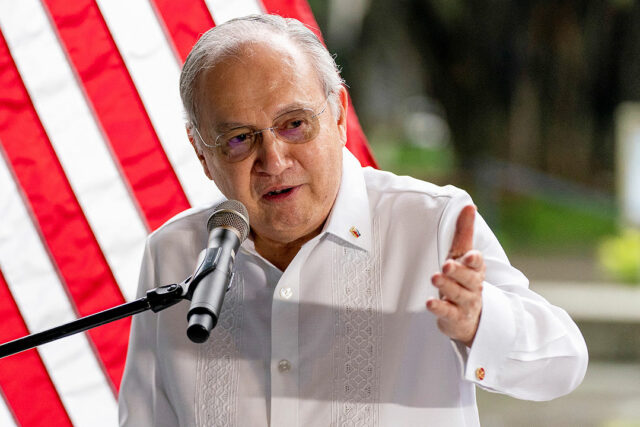
US COMPANIES are now more interested in investing in the Philippines due to its stronger-than-expected economic growth but want a more conducive business environment, Philippine Ambassador to the United States Jose Manuel D. Romualdez said.
“US companies are now more than ever looking at the Philippines… The business community here said they didn’t realize how the economy has continued to grow despite the pandemic, while most countries have a downturn trend. So that’s very significant,” Mr. Romualdez said in an April 14 interview with BusinessWorld in Washington, D.C.
The Marcos administration’s economic team touted the Philippine economy’s gains during an April 12 briefing attended by around 180 representatives from US companies and industry groups.
The economy expanded by 7.6% last year, its fastest growth rate since 1976. It exceeded the government’s 6.5-7.5% goal and was better than the 5.7% growth a year earlier. This year, the government is targeting 6-7% gross domestic product growth.
John F. Maisto, president of the US-Philippines Society and a former diplomat, said the Philippines is now sending a message that it is open for “serious” foreign investments.
“This forum has pointed out the fact that today’s reality is very positive for the Philippines in terms of attracting foreign investments. They laid out the policies, the geopolitical realities, the quality of the Philippine working population…, particularly young Filipinos who speak English and are educated well, are ready to be employed and trainable,” Mr. Maisto said on the sidelines of the April 12 Philippine economic briefing.
Asked if there are any concerns, Mr. Maisto said investors want to ensure there is the “best possible atmosphere” in the Philippines before making any commitments.
“They want the best possible legislation, the best possible guarantees, and this is the challenge for the Philippines. Happily, President (Ferdinand R.) Marcos (Jr.), from the very beginning of his administration, has emphasized publicly that the Philippines has to do much more than it has done in the past in terms of attracting foreign investments,” he said.
International Monetary Fund (IMF) Deputy Director of the Asia and Pacific Department Sanjaya Panth said in a separate interview that the Philippines should work on further easing some regulations and foreign investment limits.
“I think the Philippines has more room to go to make investment more attractive to foreign investors. [But] it seemed to me that the government was quite committed and very interested in attracting the necessary investment. I did see a pretty good reception,” Mr. Panth said.
Recent reforms include amendments to the Public Service Act, which allows full foreign ownership in telecommunications, domestic shipping, railways, subways, airlines, expressways, tollways, and airports.
For his part, Mr. Romualdez said the economic managers have vowed to make the business environment more conducive to foreign investments.
“The government is investing a lot in infrastructure, both digital and hard infrastructure… All that will translate into more interest. It’s now up to us to be able to catch that eh. This is an opportunity that happens not too very often and right now we’re right at that sweet spot,” he said.
The Philippine embassy is now looking to attract investments in key sectors such as energy, digital infrastructure and semiconductors.
Mr. Romualdez said there are also several US companies that are expanding in the Philippines.
“We’re happy to say that Moderna, for instance, they’ll start with a commercial office first in the Philippines. FedEx has moved their facilities, and they have a big facility now in Clark,” he said.
‘SAFE PLACE’ Many businesses consider the Philippines a “safe place” to invest amid tensions between the US and China, Mr. Romualdez said.
“Our relationship with the United States, it’s one of the best, obviously, because of the agreements that we’ve had on the defense side… Because of the current situation, the political situation in China. So, they will look at places where they feel it’s much safer and the Philippines is one of them,” he said.
The US and the Philippines recently expanded the Enhanced Defense Cooperation Agreement (EDCA). EDCA is a supplementary deal to the 1999 visiting forces agreement, which allows the US to rotate troops in the Philippines and build and operate facilities on agreed locations for both their military forces.
“This is another opportunity for us, because the publicity that we’ve been getting here in the United States has been positive, in terms of our defense ties, and that ties into what we want which is more economic activity,” Mr. Romualdez said.
Mr. Marcos is set to hold talks with US President Joseph “Joe” R. Biden, Jr. in Washington D.C. on May 1 to discuss areas of cooperation in defense and security, climate change and digitalization, among others. — Keisha B. Ta-asan
MANILA Electric Co. (Meralco) registered a consolidated core net income of P9.05 billion in the first quarter, up by 40.5% from P6.44 billion a year ago, on sustained energy sales and revenue growth.
“First quarter is quite good, but I think 2023 is also looking quite good so we should be able to look at double-digit growth,” Meralco Chairman Manuel V. Pangilinan said in a virtual briefing on Monday.
Betty C. Siy-Yap, Meralco’s senior vice-president and chief finance officer, said energy sales went up 2% to 11,287 gigawatt-hours (GWh) in the first quarter from the 11,069 GWh a year ago.
“The results from our power generation business continue to improve and this represented 41% of our CCNI (consolidated core net income) as of the first quarter,” she said during the briefing, adding that the business segment contributed the bulk of the rise in core profit.
Ms. Siy-Yap said there continues to be an increase in the contribution from Meralco units PacificLight Power Pte. Ltd. and San Buenaventura Power Ltd. Co., while Global Business Power Corp. is a “turnaround story.”
Meralco’s reported net income, which factors in nonrecurring items, rose by 26.5% to P8.07 billion from P6.38 billion previously. The power distributor’s customer count reached 7.67 million as of the first quarter, up 2.8% from 7.46 million in the same period last year.
First-quarter gross revenues surged 23% to P105.64 billion from P85.91 billion in the corresponding period last year on higher fuel costs and volume growth.
Total costs and expenses increased by 23.4% to P98.38 billion versus P79.74 billion previously driven by higher cost of purchased power and elevated coal and fuel power plant costs.
Purchased power cost went up by 27.4% to P78.6 billion from P61.7 billion brought about by higher Malampaya gas prices, the depreciation of the peso, and an increase in purchases from the electricity spot market. The power utility giant sourced more from the spot market after the suspension of its power supply agreement with South Premiere Power Corp.
In the first quarter, Meralco placed its capital expenditure at around P5.1 billion, with P4.5 billion spent on network projects including new connections, asset renewals, and load growth projects.
Meralco said the sales mix continued to shift towards pre-pandemic levels as business operations started to recover.
The share of the commercial segment increased to 37% during the first quarter from 34% a year ago. In contrast, the share of the residential segment was down to 33% from 35%, along with the industrial segment at 30% from 31% previously.
At the local bourse on Monday, shares in the company gained 40 centavos or 0.12% to end at P321.40 apiece.
Meralco’s controlling stakeholder, Beacon Electric Asset Holdings, Inc., is partly owned by PLDT Inc. Hastings Holdings, Inc., a unit of PLDT Beneficial Trust Fund subsidiary MediaQuest Holdings, Inc., has an interest in BusinessWorld through the Philippine Star Group, which it controls. — Ashley Erika O. Jose
Confidence in childhood vaccines has decreased by 25% in the Philippines, putting children in the country at a higher risk of vaccine-preventable diseases, according to the United Nations Children’s Fund (UNICEF).
The Philippines has the second to the highest number of zero-dose children in East Asia and the Pacific region and the fifth highest worldwide, according to UNICEF’s “The State of the World’s Children 2023: For Every Child, Vaccination” report. Most of these children are in Calabarzon, Central Luzon, and Western Visayas.
Between Jan. 1 and March 11, moreover, a total of 208 measles cases were recorded. This is a 478% increase from the same period in 2022.
Measles infections pose a high risk in all regions of the Philippines, according to the report.
“This data is a worrying warning signal. We cannot allow confidence in routine immunizations to become another victim of the pandemic. Otherwise, the next wave of deaths could be of more children with measles, diphtheria or other preventable diseases,” Catherine Russell, UNICEF executive director, said in a statement on April 19.
Vaccine hesitancy in the Philippines is attributed to cultural factors, distrust towards vaccination programs, and concerns on vaccine safety. Elsewhere, factors include uncertainty about the response to the pandemic, growing access to misleading information, declining trust in expertise, and political polarization.
The global report for 2023 also said that 67 million kids did not receive vaccinations from 2019 to 2021, with vaccination coverage levels decreasing in 112 countries. Only China, India, and Mexico showed an increase or no change in how much people valued vaccines.
In the Philippines, the prevalence of children who did not receive any vaccinations was highest among children whose mothers did not receive any education. This situation worsens the existing inequalities.
The UN agency suggested that governments should locate and provide vaccinations to all children, particularly those who missed them due to the pandemic. They should also focus on building trust in vaccines, prioritize funding for immunization and primary healthcare, and improve the resilience of healthcare systems.
It also recommended unlocking available resources, such as leftover COVID-19 funds, to implement catch-up vaccination campaigns.
“Immunizations have saved millions of lives and protected communities from deadly disease outbreaks We know all too well that diseases do not respect borders,” Ms. Russell said. “Routine immunizations and strong health systems are our best shot at preventing future pandemics, unnecessary deaths, and suffering.” — Patricia B. Mirasol
PLDT Inc. said on Monday that two of its investors filed separate motions to the court on April 7 seeking to serve as the lead plaintiff for the US class action lawsuit against the telecommunications company.
One of the investors, Sophia Olsson, who claims to have two shares in the telco, was said to have reported an alleged loss of $22.69 after the listed disclosed its budget overrun.
Meanwhile, Kevin Douglas, a PLDT investor holding 35 shares in the company, reported an alleged loss amounting to $240.23.
In a disclosure to the Philippine Stock Exchange, PLDT said that Milbank LLP, on behalf of the telco giant, has entered its appearance in the US class action. It also filed a notice of interested persons or entities along with a corporate disclosure statement as well as a memorandum of points and authorities for consideration by the court on April 17.
The two plaintiffs, represented by different law firms — Ms. Olsson by the Rosen Law Firm and Mr. Douglas by Levi & Korsinsky, LLP — are said to have failed to establish that they are appropriate lead plaintiffs.
“Under the Private Securities Litigation Reform Act, lawsuits by shareholders with a small position in the security at issue are discouraged,” PLDT said.
“Consequently, the company argued that the de minimis purported losses alleged by the Movants in this case fall far short of the basic requirement that a lead plaintiff make prima facie showing that he or she is an adequate representative who will prosecute the action vigorously on behalf of the putative class,” it added.
The company said that the two investors’ nominal losses lack sufficient financial interest in the outcome of the US class action.
“Thus, the company argued in its Memorandum that the Movants’ motions for appointment as lead plaintiff should be denied,” PLDT said.
The company is set to have a hearing for the appointment of the lead plaintiff on May 8.
“The company shall provide further updates in compliance with Philippine and US laws on disclosures related to pending litigation as they arise,” it said.
In a disclosure on Feb. 14, the company said that it had learned of a securities class action lawsuit filed on Feb. 6 by Ms. Olsson in the district court in the Central District of California.
The lawsuit named PLDT and nine of its current and former employees as defendants for allegedly violating Federal Securities Laws and a jury trial was demanded.
The individual defendants in the case include PLDT Chairman Manuel V. Pangilinan; President and Chief Executive Officer Alfredo S. Panlilio; Chief Legal Counsel, Head of Legal and Regulatory Affairs, and Corporate Secretary Marilyn A. Victorio-Aquino; and Anabelle L. Chua, who was the chief financial officer and chief risk management officer during the filing.
The case came about after the Pangilinan-led PLDT disclosed a budget overrun amounting to P48 billion.
After the company disclosed the budget overrun, it saw a 19.35% decline in the price of its shares to P1,192 apiece on Dec. 19, 2022.
On Monday, PLDT shares closed lower by P35 or 2.76% to P1,234 apiece.
Hastings Holdings, Inc., a unit of PLDT Beneficial Trust Fund subsidiary MediaQuest Holdings, Inc., has a majority stake in BusinessWorld through the Philippine Star Group, which it controls. — Justine Irish D. Tabile
AYALA-led ACEN Corp. is looking at an estimated P30 billion in new debts to fund its capital expenditures of about P50 billion to 70 billion this year, the company’s finance chief said.
“In terms of new debts, we are projecting to borrow an additional of P30 billion and we are also looking at equity offering by way of the preferred shares — not part of P30 billion,” Maria Corazon G. Dizon, treasurer, chief financial officer and compliance officer of ACEN, said in a briefing on Monday.
For 2023, ACEN has said that it has over 2,400 megawatts of projects under construction. It expects to spend up to P70 to expand its renewable energy portfolio.
Eric T. Francia, president and chief executive officer of ACEN, said during the company’s annual stockholders meeting that the amendment of article seven of the articles of incorporation to create preferred shares of 100-million unissued common shares into preferred shares had been approved.
“Issuing preferred shares allowed us to diversify our funding mix and also improved our capital structure and leverage ratios in preparation for future financing initiatives to meet our rapid growth trajectory. We’ve seen that Philippine investors both institutional and retail have an appetite for preferred shares investments so we’re tapping into this pool of liquidity to fund our growth,” Mr. Francia said.
In an earlier disclosure, ACEN announced that its board of directors had approved the reclassification of 100-million unissued common shares.
“We think now is the good time to offer preferred shares to give new investors steady, predictable and competitive returns versus other instruments in the market. These preferred shares are non-dilutive, so nonvoting,” Mr. Francia said.
At the local bourse on Monday, shares in the company gained four centavos or 0.66% to P6.10 apiece. — Ashley Erika O. Jose