
How PSEi member stocks performed — June 2, 2023
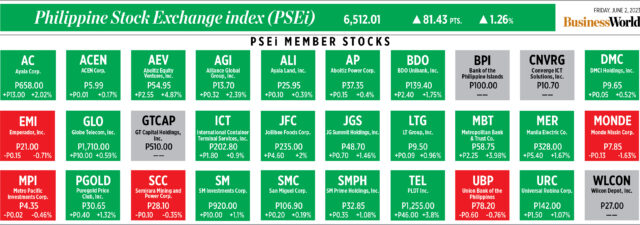
Here’s a quick glance at how PSEi stocks fared on Friday, June 2, 2023.
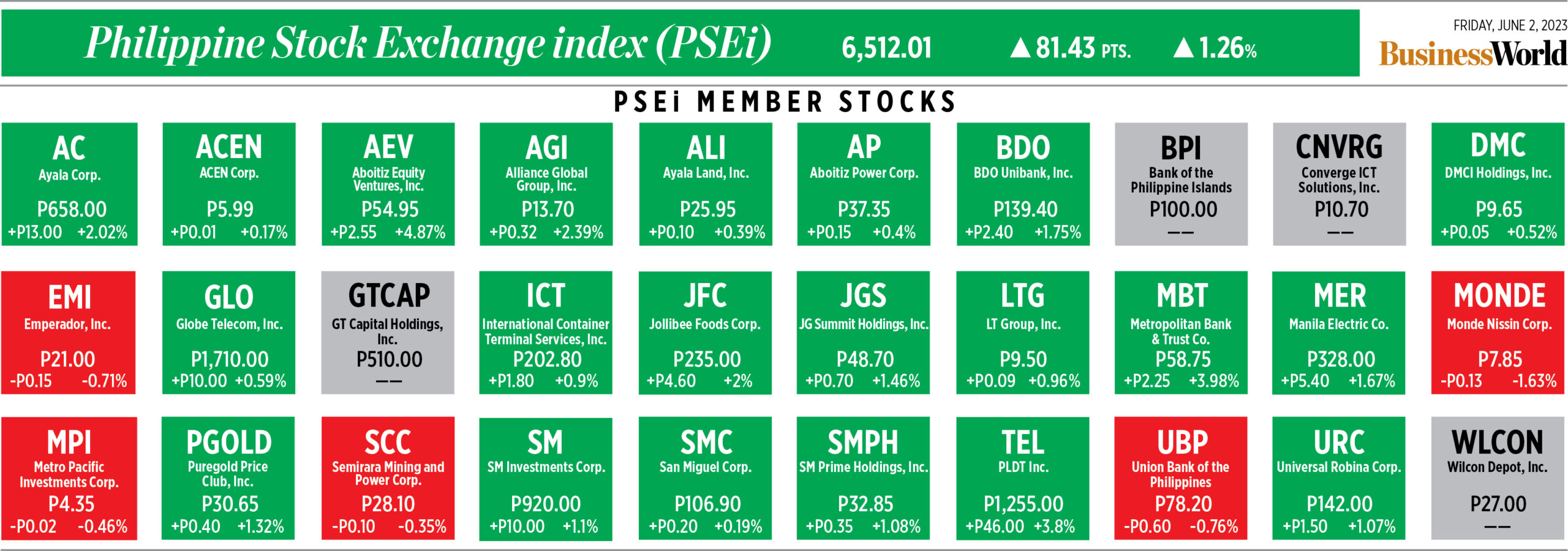

Here’s a quick glance at how PSEi stocks fared on Friday, June 2, 2023.



NEW CAR CARE products are now available from Sonax — said to be formulated to make DIY car care easy and efficient, “rendering beautiful, professional results, as well as complement one’s investment in paint protection.” Sonax takes its expertise in professional ceramic coating to the consumer level through a range of products that are designed to maintain and further the car’s exterior.
The Sonax Ceramic Series features innovative SI-Carbon Technology, which “surpasses all previous methods for long-term coating.” It works to create a “ durable, smooth, protective surface, with a beautiful, mirror-like gloss finish.” The technology leads to high hydrophobicity (i.e. surface water-beading), increased weather resistance, color enhancement, and optimal maintenance of all ceramic-sealed paint works.
The Xtreme Ceramic Active Shampoo provides gentle but thorough cleansing of all exterior car surfaces, coated or not, leaving a mild ceramic sealant that promises a long-lasting, water- and dirt-repellent layer. Xtreme Ultra Slick Detailer is a one-step multi-function detailer that can easily remove slight surface soiling and dust, while leaving an “extremely smooth and mild ceramic coat.” It’s a paint refresher that can be used on all painted surfaces.
As a direct complement to Sonax ceramic-sealed vehicles, the Xtreme Ceramic Spray Coating is a long-term DIY sealant that adds another protective layer over existing paint protection. It is designed to refresh and protect sealed paint, with an application working for up to four months.
Meanwhile, the new Intense Gloss Shampoo Concentrate comes in a more viscous form. It is gentle on all exterior surfaces and paint works, but tough on dirt, stains, tar, and insect remnants. Finally, Sonax Xtreme Leather Care Milk is designed for the careful cleaning and care of all real and artificial leather surfaces. It has jojoba oil to enrich and bring back the luster of dulled leather, without leaving a slippery feel. Leather surfaces are treated and reverted back to its original matte appearance, leaving a UV protective layer that helps to prevent further soiling and discoloration.
For more information, visit the official Sonax Philippines Facebook page (SONAX.Ph) and Instagram (@sonaxphofficial).

THE PESO may move sideways against the dollar this week ahead of the release of May inflation data, which could affect the central bank’s decision this month.
The local currency closed at P55.89 versus the dollar on Friday, strengthening by 37 centavos from Thursday’s P56.26 finish, data from the Bankers Association of the Philippines’ website showed.
Week on week, however, the peso declined by 10 centavos from its P55.79 finish on May 26.
The local unit opened Friday’s session at P56.10 per dollar, which was also its weakest showing. Meanwhile, its intraday best was at P55.89 against the greenback.
Dollars traded dropped to $898.5 million on Friday from the $990.35 million recorded on Thursday.
The peso appreciated after the US Senate passed the bill suspending the debt ceiling, Rizal Commercial Banking Corp. Chief Economist Michael L. Ricafort said in a Viber message.
US President Joseph R. Biden, Jr. on Saturday signed a bill that suspends the US government’s $31.4-trillion debt ceiling, averting what would have been a first-ever default with just two days to spare, Reuters reported.
The House of Representatives and the Senate passed the legislation this week after Mr. Biden and House of Representatives Speaker Kevin McCarthy reached an agreement following tense negotiations.
The Treasury department had warned it would be unable to pay all its bills on Monday if Congress had failed to act by then.
For this week, Mr. Ricafort said foreign exchange trading could be driven by May inflation data scheduled for release on June 6, as this could affect the Bangko Sentral ng Pilipinas’ (BSP) decision this month.
“Our traders expect the market to look for any BSP signals on whether they will readjust their “pause” stance if ever the US Federal Reserve does commit to another rate hike this month,” Union Bank of the Philippines, Inc. Chief Economist Ruben Carlo O. Asuncion said in a report.
A BusinessWorld poll of 15 analysts yielded a median estimate of 6.1% for May headline inflation, near the lower end of the central bank’s 5.8-6.6% estimate for the month.
If realized, this would mark the fourth straight month of slower inflation. Still, this would be above the BSP’s 5.5% forecast and 2-4% target for the year.
The BSP on May 18 kept its policy rate unchanged at 6.25% for the first time after nine meetings.
Since it began its aggressive monetary tightening cycle in May 2022, the central bank had raised borrowing costs by 425 basis points (bps).
The Monetary Board will next meet to review policy on June 22.
Mr. Asuncion added the US debt limit deal and nonfarm payrolls data could also affect trading this week.
The US dollar rose on Friday after May’s nonfarm payrolls report showed employment numbers surged, while traders weighed the merits of the US Federal Reserve possibly skipping a rate hike in June, Reuters reported.
The report showed that payrolls in the public and private sector increased by 339,000 in May. May’s jump followed a 253,000 rise in April.
Despite strong hiring, the unemployment rate rose to 3.7% from a 53-year low of 3.4% in April.
The dollar index, which measures the US currency against six others, was last up by 0.435% at 103.980, on track for its largest daily percentage gain since mid-May. On the week, however, the dollar slipped by 0.2%, its biggest weekly decline since early May.
Philadelphia Fed President Patrick Harker said on Thursday it was “time to at least hit the stop button for one meeting and see how it goes.”
A day earlier, Fed Governor Philip Jefferson said skipping a rate hike “would allow the committee to see more data before making decisions about the extent of additional policy firming.”
The US central bank raised rates by 25 bps for a 10th straight time at its May 2-3 meeting, bringing its key rate to 5% to 5.25%.
It has hiked borrowing costs by 500 bps since March 2022.
The Fed’s next meeting is on June 13-14.
Mr. Asuncion expects the peso to trade between P55.80 and P56.40 versus the dollar this week, while Mr. Ricafort sees it moving from P55.60 to P56.10. — A.M.C. Sy with Reuters
PHILIPPINE SHARES may trade sideways ahead of the release of May inflation data and after US President Joseph R. Biden signed the debt limit deal over the weekend, avoiding a default.
The Philippine Stock Exchange index (PSEi) went up by 81.43 points or 1.26% to end at 6,512.01 on Friday, while the broader all shares index rose by 31.02 points or 0.9% to close at 3,474.87.
Week on week, the PSEi dropped by 18.19 points or 0.28% from its close of 6,530.20 on May 26.
“Philippine shares bounced back above 6,500 as the debt ceiling concerns eased on [Thursday]. The House passed the Fiscal Responsibility Act in a 314-117 vote late Wednesday, just days before the June 5 deadline set by the US,” Regina Capital Development Corp. Head of Sales Luis A. Limlingan said in a Viber message on Friday.
Mr. Biden on Saturday signed a bill that suspends the US government’s $31.4-trillion debt ceiling, averting what would have been a first-ever default with just two days to spare, Reuters reported.
The House of Representatives and the Senate passed the legislation last week after Mr. Biden and House of Representatives Speaker Kevin McCarthy reached an agreement following tense negotiations.
The Treasury department had warned it would be unable to pay all its bills on Monday if Congress had failed to act by then.
Mr. Biden signed the bill at the White House a day after hailing it as a bipartisan triumph in his first-ever Oval Office address to the nation as president.
For this week, Philstocks Financial, Inc. Senior Research Analyst Japhet Louis O. Tantiangco said shares will likely get a boost from the debt ceiling deal’s signing, with investors to await the release of May inflation data on June 6.
“A further slowdown in our inflation may also strengthen the positive sentiment,” Mr. Tantiangco said in a Viber message.
A BusinessWorld poll of 15 analysts yielded a median estimate of 6.1% for May inflation, near the lower end of the central bank’s 5.8-6.6% estimate for the month.
If realized, this would mark the fourth straight month of slower inflation. Still, this would be above the Bangko Sentral ng Pilipinas’ forecast of 5.5% and 2-4% target for the year.
“After last week’s volatility and large foreign outflows, the market will try to find its footing in the 6,400 to 6,600 zone. The lifting of the US debt limit for two years removes a major overhang on equity markets and gives a temporary shot of optimism,” China Bank Capital Corp. Managing Director Juan Paolo E. Colet said.
“A favorable inflation print, especially one that is below expectations, could encourage a recovery in the PSE,” Mr. Colet added.
Philstocks Financial’s Mr. Tantiangco expects the PSEi to move from 6,400 to 6,600 this week, while 2TradeAsia.com put immediate support at 6,450 and resistance at 6,600-6,700. — A.E.O. Jose with Reuters

By Luisa Maria Jacinta C. Jocson, Reporter
THE Department of Finance (DoF) said it is studying options like lump-sum payments to reduce its potential liability to military and uniformed personnel (MUP) pensioners.
“Under the enhanced proposal, MUPs who avail of optional retirement are given the prerogative to choose among three options in claiming pension benefits,” the DoF said in a statement.
These options include receiving the net present value of pension benefits in a lump sum upon retirement.
Other options include the payment of the benefits after five years. It is also considering an option of MUPs receiving their benefits upon reaching age 57.
In March, Mr. Diokno announced the government’s intention to reform the current MUP pension program as it is not “fiscally sustainable.”
The DoF has estimated that the accumulating pension liability will likely increase public debt by as much as 25% by 2030.
The government will also need to spend an estimated P848.39 billion to finance the current pension system over the next 20 years.
Under the current pension system, MUPs are automatically promoted one rank upon retirement and can receive their pension after 20 years’ service, with no minimum pensionable age.
The pension is also automatically indexed to the salary of active personnel.
“The new options were proposed in consideration of varying financial situations among MUPs and will be applied on a case-to-case basis,” the department said.
Finance Undersecretary Maria Cielo D. Magno said that the economic team is studying the pension systems of other government agencies.
“The economic team will continue to gather sentiments of the MUPs and introduce necessary improvements to the proposal in order to craft a well-balanced solution,” the DoF added.
Following consultations with various military units, the team is set to meet with the Philippine National Police on June 7 to further refine the proposal.
Bienvenido S. Oplas, Jr., president of a research consultancy and of the Minimal Government Thinkers think tank, proposed taxing the pensions.
“All these three proposals are good. But I think a fourth one is needed: all MUP pensions should be taxed,” he said in a Viber message.
Under the current system, MUPs do not contribute towards their own pension fund. Instead, the pension benefits are drawn annually from the national budget.
“Current MUP pensioners contribute zero for their pension. Their pensions are currently untaxed,” Mr. Oplas said.
Hansley A. Juliano said through Facebook Messenger chat that it is a step in the right direction to consider separate options depending on the MUPs’ needs.
“That said, this means it will also entail the necessity for guidance or assistance for pension recipients to ensure they manage their benefits properly,” Mr. Juliano, a political economy researcher studying at Japan’s Nagoya University’s Graduate School of International Development, said.
“I do wonder if the government has reviewed pension options from private providers in comparison, as maintaining those standards will be needed in ensuring the options chosen by the retirees will actually benefit them in the long run and it is also sustainable to the fund as was the point of this restructuring,” he added.
Mr. Juliano noted that there is still a need to “reconcile defense spending and social spending.”
“I get the impression our military retirees do prefer theirs because the general state of social security in the Philippines is not equitable. The long-term objective of course is to make it equitable,” he added.
THE Department of Trade and Industry said the new Philippine Export Development Plan (PEDP) will be launched on June 15.
Trade Secretary Alfredo E. Pascual told reporters on the sidelines of a news conference in Makati City last week that the PEDP 2023-2028 will prioritize the industrial, manufacturing, transport, technology, media, telecommunications, and health and life sciences sectors.
“Essentially what the PEDP has done is to identify the promising sectors or industry clusters that can generate significant increases in exports,” Mr. Pascual said.
Mr. Pascual said the government wants to maximize trends like supply chain diversification following the pandemic.
“One example is the move of the US to diversify sources of their imports, especially in electronics and semiconductors; we want to grab that opportunity,” Mr. Pascual said.
During the National Export Congress in December, PEDP planning facilitation team leader Cielito F. Habito projected export earnings of up to $240.5 billion by 2028 if the plan is implemented effectively.
The PEDP seeks to boost trade promotion, marketing, design innovation and branding initiatives. It also pushes for active membership in regional and bilateral preferential trade agreements.
The plan also seeks to transform the Philippines into an exporter of high-value products and services from its current status as a source of commodity and intermediate goods.
Philippine exports rose 5.7% to $78.98 billion in 2022. — Revin Mikhael D. Ochave
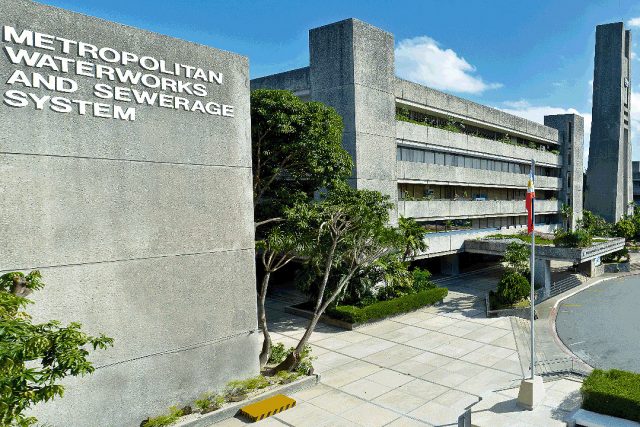
THE Metropolitan Waterworks and Sewerage System (MWSS) said it is still awaiting the approval of the National Economic and Development Authority (NEDA) to proceed with the development of the estimated P12-billion Kanan-Agos project.
“The proposal is still under review, we are still waiting for the approval to proceed with it,” Patrick James Dizon, head of the MWSS Angat/Ipo operations management division, told reporters in a briefing last week.
He said that a private proponent has submitted an unsolicited proposal to develop the project that would provide additional water to Metro Manila and nearby provinces.
Mr. Dizon, however, declined to identify the private proponent, said only that it is a Philippine company.
“We had a meeting with the private proponent to comply with all the requirements set by NEDA; that is why the project was delayed this year,” he said.
Mr. Dizon described the Kanan-Agos project as part of the Kaliwa-Kanan-Agos river basin, which is located in Rizal and Quezon provinces. The project’s supply potential is over 3,000 million liters per day (MLD).
“The Kanan is an unsolicited proposal; the Kaliwa Dam will (involve) a 600-MLD weir which will be diverted through a tunnel with 2,400 MLD capacity,” he said.
The Kaliwa Dam project is expected to be completed by the end of 2026, with commercial operations expected in 2027. As of March, the Kaliwa Dam is 24% complete, the MWSS said.
The Kaliwa Dam is a bulk water supply project which is part of the New Centennial Water Source program of the MWSS.
The Kaliwa-Kanan Dam complex will ultimately supply both MWSS water concessionaires, Maynilad Water Services, Inc. and Manila Water Co., Inc.
“Both Maynilad and Manila Water will share from this because we wanted to (de-load) the Angat Dam, so we needed this additional water source,” Mr. Dizon said. — Ashley Erika O. Jose

THE GOVERNMENT should not grow too dependent on “sin” taxes, which are regressive, and needs to focus on improving tax administration, analysts said.
Ateneo de Manila economics professor Leonardo A. Lanzona said in an e-mail that sin taxes, such as those collected on tobacco products or alcohol, “tend to disproportionately impact low-income individuals who are more likely to be the heaviest users of these taxed products and services, thus resulting in greater inequality.”
The Department of Finance (DoF) estimates that collections generated by sin tax laws improved 23% to P65.3 billion in 2022.
Revenue from excise taxes on tobacco and alcohol products totaled P36.5 billion and P31.8 billion, respectively.
Mr. Lanzona also said the government should not “over-depend” on personal and corporate income taxes.
“Overdependence on these taxes can cause lower demand for products which may eventually lead to higher production costs. As consumers reduce their demand, firms are not able to meet their revenue targets, forcing them to lay off workers and to incur greater severance costs,” he said.
“Additionally, with lower consumer demand, firms cannot operate at full capacity if they have invested in heavy machinery or equipment and cannot negotiate for better prices with raw material suppliers,” he added.
The DoF estimates that income tax foregone as a result of reduced rates last year amounted to P51.1 billion.
Revenue foregone as a result of the Corporate Recovery and Tax Incentives for Enterprises Act amounted to P80.4 billion, against the P68 billion foregone a year earlier. This included P59.2 billion in foregone revenue arising from the reduction in corporate income tax rates.
Mr. Lanzona said that the Tax Amnesty Law is also not expected to generate much revenue.
“The amnesty does not necessarily stop tax evasion. These are voluntary in nature and it does not mean greater compliance with tax laws in the long term. The government and the policymakers usually develop these measures without regard to the main reasons why there was tax evasion in the first place,” he added.
The DoF said that collections from the Tax Amnesty Law fell 69.6% to P1.4 billion in 2022.
On the other hand, Jonathan L. Ravelas, senior adviser at professional services firm Reyes Tacandong & Co., cautioned against adding new taxes and recommended focusing on tax administration.
“Raising additional taxes is contractionary to the economy. We know that we have a fiscal consolidation strategy to bring down the deficit, but spending less will also slow the economy. If you raise taxes by too much, consumers will be burdened and consumption will slow down; we don’t want that. It leaves us no choice but to think about better tax administration,” he said by phone.
“(We need) to up the effort of encouraging people to take the tax amnesty and take advantage of technology to efficiently collect taxes. Computer accounting systems (can be used) to monitor transactions of companies and do the assessment and eventually the compliance. If the computer accounting softwares are enabled to be the monitoring agent, that will enhance collection,” Mr. Ravelas added.
John Paolo R. Rivera, an economist at the Asian Institute of Management, said in a Viber message that the government should address leakages to improve tax collection without imposing new taxes.
“Collection has to be improved and taxes should be spent on productive activities that will generate returns so that the population would be more considerate of additional taxes,” he added.
Mr. Lanzona said that wealth taxes are “reliable sources of revenue especially during times of economic hardship.”
“Policy makers are wary of wealth taxes because of their negative impact on investment. However, under the right economic conditions, these taxes can encourage individuals to divest their wealth into productive assets rather than hoarding it,” he added. — Luisa Maria Jacinta C. Jocson

(Third of three parts)
After learning to live with less during the height of the pandemic, many consumers have shifted to pursuing simpler, less consumerist values, according to the EY Future Consumer Index. The study surveyed over 21,000 consumers in 27 countries to determine how consumers see changes in their values and how they look at life. With consumers less willing to spend, businesses have the opportunity to rethink the concept of growth and how to evaluate it.
In the previous parts of this article, we discussed the drivers that could reshape consumption patterns, the significant changes in those patterns that are predicted to occur over the next few years, the factors affecting drivers of growth, and their implications for consumer companies.
In this last part, we discuss how redefining success will reshape business as we know it and how companies can further understand changing consumer expectations.
HOW REDEFINING SUCCESS WILL RESHAPE BUSINESS
Consumer companies will need to examine their strategies, business models, and operational structures for them to adapt to this shifting consumer climate and make sure they are relevant to the evolving definitions of value. While not all potential changes will occur suddenly, the current trends already show significant changes in how consumer companies will define and assess success.
The Future Consumer Index identified the following drivers that can reshape the existing measures of success:
Peer-to-peer models. Peer-to-peer activities are expanding quickly thanks to community platforms, online marketplaces, social selling, and agile payment systems. This makes it possible for customers to independently sell, buy, trade, exchange, and gift goods and services. While this is not a new concept, the sudden growth of backyard businesses during the pandemic, as we have seen in our Philippine market, has given rise to a new generation of microentrepreneurs.
Pricing at ‘true cost’. The desire for “true prices” that take into account social, environmental, and health concerns is growing despite the fact that algorithms can already optimize prices in real time for commercial impact. Product pricing may become more individualized to user profiles as data quality and analytics capabilities continue to advance.
Well-being as status. As consumers promote lifestyles that emphasize well-being instead of wealth, exercise, sports apparel, healthier meals, and wellness getaways serve as status symbols.
Co-creation with consumers. Through social influencers and crowdsourcing, interactive media has given rise to a wave of user-generated content. According to the Digital 2023 Global Overview Report, a social media study produced in partnership with social media agencies Meltwater and We Are Social, Philippine social media users account for as much as 72.5% of the population. Less restrictive intellectual property laws, 3D printing, and open-source tools may also potentially make it easier for customers to collaborate with brands to co-design, manufacture, market, and share the value of goods and services.
Enhanced leadership through AI. The delivery of optimized insights that support operational and strategic direction will come more frequently via AI and automation. When business leaders outsource certain judgments and make more decisions based on facts and data, this could ultimately redefine functional positions within boardrooms.
UNDERSTANDING CHANGING CONSUMER EXPECTATIONS
Companies will need to adapt to a world where growth and wealth are no longer the exclusive measures for development and success. Businesses will have the ability to control what lies ahead for them by recognizing what factors can potentially influence consumer expectations and behavior through the following points of action:
Developing fresh value pools. While some existing value pools will provide revenue, others will make additional contributions that will help to create a more comprehensive understanding of how “good” is defined. Having strong financial balance sheets alone will not help a business succeed in the market, especially if they come at the expense of other factors, such as environmental, social, and governance (ESG) considerations. A company’s success cannot be determined solely by how many or how much of a product it can sell, but also by the services it can provide, the impact it can make, and the values or communities it can support.
Innovating ways to meet consumer needs. Through scaling AI, releasing new manufacturing techniques, and unlocking efficient operating constructs, technology will allow consumer companies to deliver personalization at a lower cost and with less resource use. By enabling customers to participate in value creation through peer-to-peer selling and brand collaboration, service-based models that span several categories and industries will become more prevalent in order to meet consumer expectations. A new corporate mission that satisfies expectations for wellbeing by evaluating the true costs and benefits beyond those measured in financial currency will be foundational for this development.
Reviewing impact and contribution. Retailers can offer more value in terms of the insights and data they share back to brands, their contributions to employee wellbeing, and their position in the community on top of the revenue generated by their stores. The success of consumer goods companies may also depend just as much on their capacity to address systemic environmental problems or enhance consumer health as it does on their capacity to persuade customers to buy their goods.
REDEFINING SUCCESS TO BUILD LONG-TERM VALUE
Of all the factors discussed, long-term value remains the most important. As social and environmental key performance indicators join financial metrics as drivers of long-term value, intangible assets are likewise becoming more significant in driving value. New definitions of success will challenge the prioritization of growth as stakeholder knowledge and influence expands through increased connectivity and transparency.
Growth and profitability are currently viewed as indicators of how well consumer companies are able to meet the demands of the market. However, given rapidly and dramatically changing consumer behavior and priorities, companies will need to reimagine new strategies to build long-term value and sustainably deliver the products and experiences that consumers, both today and in the near future, truly want.
This article is for general information only and is not a substitute for professional advice where the facts and circumstances warrant. The views and opinions expressed above are those of the author and do not necessarily represent the views of SGV & Co.
Maria Kathrina S. Macaisa-Peña is a business consulting partner and the consumer products and retail sector leader of SGV & Co.

By Kyle Aristophere T. Atienza, Reporter
JAPAN will probably play a key role in the Philippines’ defense posture amid China’s increased assertiveness in the South China Sea, political analysts said on Sunday.
The coast guards of the United States, Philippines and Japan on June 1 kicked off their first-ever three-way maritime exercise, affirming their commitment to keep a free and open Indo-Pacific region.
“Manila and Japan share the same concerns toward a belligerent China with expansive ambitions, and both countries are strongly intertwined within the US alliance network in the region,” geopolitical analyst Don Mclain Gill, who teaches foreign relations at De La Salle University in Manila, said in a Facebook Messenger chat.
“The chance to smoothly assimilate, enhance interoperability and expand the scope of their partnership will be significantly high.”
In a statement at the weekend, the Philippine Coast Guard cited the “importance of conducting periodic exercises to ensure the stability and security of the Indo-Pacific region.”
“The Philippines, Japan and the US also commit to close exchanging information and developing coordination in various fields related to coast guard functions,” it said, adding that they “pledge to pursue more trilateral efforts, especially in human resource development.”
The sea exercise will run until June 7.
The trilateral security partnership would not be the last, Lucio B. Pitlo III, a research fellow at the Asia-Pacific Pathways to Progress Foundation, said in a Messenger chat.
“It may cultivate habits of working together to address shared challenges like illegal fishing and interference in marine resource activities and regular resupply missions in the South China Sea hotspot,” he said.
“It can build interoperability between frontline maritime agencies of the three sides. It may be institutionalized to form part of a broader framework for military-civilian cooperation in the maritime domain,” he added.
Philippine Coast Guard spokesman Armand Balilo earlier said the week-long exercise — packaged as a human resource training — has nothing to do with China’s aggression in Philippine territories in the South China Sea.
The Japanese government in December committed to double its defense budget to 2% from 1% of its gross domestic product, citing China’s aggression and North Korea’s unpredictability.
Earlier this year, Japan Times reported that a possible tripartite security agreement among the Philippines, US and Japan had been agreed in principle during President Ferdinand R. Marcos, Jr.’s visit to Tokyo in February.
Mr. Marcos Jr. said it’s “part of an ongoing process that we are undertaking to make more solid partnerships and alliances that we are beginning to put together in our area.”
The US and Japan have backed the Philippines in its sea dispute with China, which claims more than 80% of the South China Sea based on a 1940s map.
The US and Philippines are also looking at a trilateral security partnership with Australia.
Japan’s role is pivotal in ensuring a free and open Indo-Pacific since the call has been largely drawn from Tokyo’s vision, Mr. Gill said.
He noted that the 47th G7 (Group of Seven) Summit in Tokyo last month “emphasized the need of the members to maximize their efforts to contribute to the stability of the region.”
Japan is the only Asian G7 country.
Mr. Gill said Tokyo’s gradual shift to a more security-driven foreign policy in the Indo-Pacific, Manila’s reinvigorated emphasis on territorial defense and maritime security, and Washington’s desire to enhance its role as a responsible security provider in the region “have allowed all three countries to deepen their strategic partnerships further to safeguard the established rule-based order.”
“As another representation of this growing synergy, the defense ministers of all three countries plus Australia are planning to hold their first-ever quadrilateral talks,” he added.
Chester B. Cabalza, founder of Manila-based International Development and Security Cooperation, said it is natural and logical for Japan and the Philippines to elevate their ties on “vital strategic issues” since they have strong economic ties and similarities in their defense posture.
Tokyo remains as Manila’s top infrastructure donor and supporter, he pointed out.
The Philippines got P109 billion in official development assistance (ODA) from Japan from April 2021 to March 2022, the biggest among Southeast Asian beneficiaries, the Japan International Cooperation Agency said in January.
The Japanese aid agency said it was venturing into more than 80 development projects in the Philippines, covering infrastructure and social development, disparity mitigation, disaster management, urban road congestion mitigation and peace in Mindanao.
One of Japan’s most significant projects in the Philippines to date is the first phase of the Metro Manila Subway project.
Japan’s official development assistance in the Philippines accounted for 36.44% or $11 billion of the Philippines’ total ODA in 2020.
Mr. Cabalza said Japan also has a close military partnership with the US, the Philippines’ oldest treaty ally.
“Aside from the geographic importance and space that Manila and Tokyo share, both states have a maritime and territorial spat with Beijing in the East China Sea and the South China Sea,” he said. “This brings them together to address the complexity of the South China Sea that should be addressed multilaterally.”
Mr. Cabalza said it was Japan which offered the three-way security partnership because it sees Manila as a strategic partner.
The security partnership was a bold decision for the Philippines “as it expands its clout in external defense and cements an iron-clad alliance with both Tokyo and Washington,” he said.
He said the move would probably irritate China “because it is seen as a containment of China and a provocation for maritime disorder.”
“However, the trilateral effort should be construed as a continuous adherence to maritime rule-based norms of freedom of navigation and a promotion of naval diplomacy of like-minded nations,” he said.
During their summit in Tokyo last month, G7 countries condemned China over what they see as a “disturbing rise” of the “weaponization of economic vulnerabilities.”
China in recent years had imposed trade sanctions on countries that have displeased it, including South Korea after it installed an American missile defense system, and Lithuania after it allowed Taiwan to set up a de facto embassy there.
Mr. Marcos’ predecessor, Rodrigo R. Duterte, led a foreign policy pivot to China in 2016 in exchange for investment pledges, few of which had materialized.
“Such drills between like minded democracies should be sustained and enhanced,” Mr. Gill said, referring to the three-way partnership. “It should also be expanded to accommodate other like-minded partners in the region to fortify the stability of the Indo-Pacific region.”

FARMERS’ groups have sought strict protection of agricultural lands from conversion to protect food security under a proposed National Land Use Act.
Kim Alvarez, policy advocacy officer at Kaisahan, said the Philippines has 4 million hectares of prime agricultural lands that must be protected.
“It supplies the food to our population,” she said by telephone on Sunday. “Some might argue that we can import, but this does not assure safety measures on the food we eat. In the event of food shortages, it’s hard to rely on imports given that we are an agricultural country and we can produce our own food.”
Congressmen on March 22 approved on final reading House Bill 8162 or the National Land Use bill, a priority measure of the Marcos government.
During its floor debates, specific measures meant to protect lands devoted to food production were rejected.
Lawmakers rejected a provision proposed by Party-list Rep. Arlene D. Brosas to prevent the conversion of land devoted to food production including rice corn and other vegetables.
Under the bill, lands that are “no longer economically feasible” for agricultural use could be reclassified or converted for housing or residential purposes. These will be exempted from the coverage of any moratorium on land use conversion since they do not interfere with watershed management plans or cause environmental damage.
“Agricultural lands deemed no longer feasible should be agro-ecologically restored, not converted into residential development,” Leon Dulce, campaign support coordinator at Legal Rights and Natural Resources Center, said in a Facebook Messenger chat.
He said the bill should see the “realities on the ground — that agricultural land area and productivity are shrinking.”
Previous Congresses had approved bills on land use, but these got stuck at the Senate committee on environment, natural resources and climate change headed by Senator Cynthia A. Villar.
Ms. Alvarez said a national land use policy would ensure environmental integrity, sustainability and food security.
The bil “resolves conflicting claims and land use policies,” she said in Filipino.
“A land use plan provides a general framework on areas that are deemed no-go zones for infrastructure development, particularly those that may severely impact the environment despite mitigation, or areas that may affect other economic activities such as tourism and agriculture,” Terry L. Ridon, a lawyer and public investment analyst and convenor of Infrawatch PH, said in an e-mail.
“It should be founded on ensuring social justice and democratized participation for the basic sectors of society — one that is committed to a community-led process and recognizes peoples’ rights,” Mr. Dulce said. — Beatriz Marie D. Cruz

THE PHILIPPINES’ first batch of bivalent coronavirus vaccines arrived at the weekend, which the country plans to use on health workers and senior citizens.
The Department of Health (DoH) received more than 390,000 doses of bivalent vaccines donated by the Lithuanian government on Saturday night, it said in a statement at the weekend.
It started negotiations to get supplies of bivalent vaccines as early as August 2022.
“Offered by the Lithuanian government in January this year, the donated bivalent vaccines will help boost the Philippines’ COVID-19 response by providing protection against the original COVID-19 strain, SARS-CoV-2 and Omicron subvariants BA.4 and BA.5,” the agency said.
It said it is also in talks with the World Health Organization’s COVAX Facility “with regard to getting additional doses of bivalent vaccines for the public.”
On March 31, DoH issued a memo on the management and administration of donated bivalent vaccines, prioritizing health workers, senior citizens, people who are seriously ill and those whose immune system is compromised.
Under the memo, a person may be vaccinated with a bivalent vaccine after at least four to six months after their last booster vaccine.
The delivery of bivalent vaccines to the Philippines has faced several delays after a state of calamity declaration due to COVID-19, which set guidelines on indemnification and immunity from liability required by vaccine makers, expired on Dec. 31.
President Ferdinand R. Marcos, Jr., who took office in June last year, has yet to appoint a Health secretary. — Kyle Aristophere T. Atienza
