Home Blog Page 4734

World Bank-backed fishery program to roll out in August

PHILSTAR

THE Bureau of Fisheries and Aquatic Resources (BFAR) said on Tuesday that a seven-year fisheries project will launch in August after obtaining funding approval from the World Bank.

In a statement, the BFAR said that the Philippine Fisheries and Coastal Resiliency (FishCoRe) project, which will take in funding of $209 million part-financed by the World Bank, is designed to improve fisheries management and production.

The World Bank announced on May 30 that its board of executive directors approved a $176-million loan for the project.

“We thank the World Bank and all our partner National Government agencies for helping us prepare for the eventual implementation of the FishCoRe project,” BFAR National Director Demosthenes R. Escoto said.

The FishCoRe project hopes to grow aquaculture and fisheries enterprises into aqua-industrial businesses by providing support measures like climate-resilient technologies, the BFAR said.

The project is expected to benefit over 1.15 million fisherfolk, small to medium enterprises, and residents of coastal communities.

“This project takes a holistic approach, confronting from all sides the various long-standing issues being faced by the fisheries sector; from ensuring the sustainability of our fisheries and coastal resources for food security, to enabling maximized benefits of our fisherfolk towards poverty reduction through improved management on all facets to ensure a robust and resilient fisheries sector,” Mr. Escoto added.

According to the BFAR, fisheries accounted for 12.81% of agricultural gross value added in 2022 while providing livelihood to about 1.49 million individuals.

The project will enhance fisheries management policy in order to address continuing threats and challenges to sustainability, such as illegal, unreported, and unregulated fishing, declining fish catches, high post-harvest losses, and the impact of calamities and climate change.

“The FishCore project hopes to address these challenges through the adoption of the ecosystem-based approach to fisheries management, therefore enhancing the value of fisheries production and elevating income in coastal communities through science, knowledge, and technology,” the BFAR said.

Of the 12 Fisheries Management Areas (FMAs), the project will be implemented in FMAs 6 and 9. FMA 6 covers Pagudpud Bay, Subic Bay, and Manila Bay while FMA 9 consists of the Bohol Sea, Panguil Bay, Iligan Bay, Gingoog Bay, Butuan Bay, and Sogod Bay. — Sheldeen Joy Talavera


Philippines seeks $450-M AIIB loan for health projects

REUTERS

THE PHILIPPINES is seeking a $450-million loan from Beijing-based Asian Infrastructure Investment Bank (AIIB) to support its public health programs, the bank said.

“The proposed policy-based loan will provide financing for the efforts of the government of the Philippines to strengthen public health systems in the post-pandemic era and enhance the country’s preparedness and response to the unanticipated health crises,” AIIB said on its website.

The loan will fund reforms to broaden the coverage of healthcare services and boost efforts to prevent and prepare for a future pandemic.

“It will also help expand primary healthcare facilities across the country and enhance the quantity and quality of second and third-tier health institutions and the capacity of healthcare workers,” it added.

It also aims to support the “nationwide implementation of interoperability of health information systems, monitoring of universal healthcare coverage outputs and outcomes, and performance incentives for UHC-related activities of the local government units.”

The Asian Development Bank will be the lead co-financier for the policy loan. — Luisa Maria Jacinta C. Jocson

CAAP signs Borongan airport upgrade deal

CAAP.GOV.PH

THE Civil Aviation Authority of the Philippines (CAAP) has signed a memorandum of agreement on Tuesday with Borongan City in Eastern Samar covering the development and maintenance of the city’s airport.

“The Borongan City government, recognizing the increasing demand for air travel in the region, partnered with CAAP and air carriers (after) the airport launched commercial flights at the airport last year,” the regulator said.

CAAP said that the local government unit proposed a comprehensive plan to undertake and finance various development and maintenance projects at the airport.

The plan includes the construction of a new passenger terminal building and other essential airport infrastructure.

Jose Ivan Dayan Agda, mayor of Borongan City said that the project will pave the way for the future economic development of Samar.

“The signing of the MoA between CAAP and the Borongan City government sets the stage for a transformative period for Borongan airport,” the CAAP said. — Justine Irish D. Tabile

EV industry lobbying for incentives to support new-vehicle adoption

EREN GOLDMAN-UNSPLASH

THE electric vehicle (EV) industry plans to press the government to provide incentives that will encourage the broad adoption of EVs, the industry organization’s chairman said.

Rommel T. Juan, who chairs the Electric Vehicle Association of the Philippines, said the industry will map out its strategy for a quick EV rollout in an October convention.

The EV Summit, to be held at the SMX Convention Center on Oct. 19-21, will seek to push policymakers and regulators for “supportive policies and incentives that promote widespread EV adoption.”

During his visit to the Periklindo EV show in May in Jakarta, Mr. Juan said international collaboration is needed to advance sustainable transportation solutions.

EV adoption was given a boost by Executive Order (EO) No. 12 issued in January, which reduced the tariffs on certain EVs to zero for five years, effectively lowering vehicle prices.

The EO covers EV segments such as cars, buses, vans, trucks, kick scooters, self-balancing cycles, bicycles, and pocket motorcycles with auxiliary motors not exceeding 250 watts and with a maximum speed of 25 kilometers per hour. However, electric motorcycles were excluded from the EO, and are still subject to a 30% tariff.    

The Philippines is also implementing Republic Act No. 11697 or the EV Industry Development Act (EVIDA), which lapsed into law in April 2022. The law requires government agencies and the private sector to observe a 5% EV quota in their vehicle fleets. — Revin Mikhael D. Ochave

GSIS loan portfolio for end of April declines amid ongoing restructuring of member debt

GSIS FACEBOOK PAGE

THE Government Service Insurance System (GSIS) said on Tuesday that it reduced its loans and receivables at the end of April by 7.84% compared with the end of 2022 after restructuring loans in order to provide relief to borrowers.

The pension fund for public-sector workers said in a statement that outstanding loans totaled P42.01 billion at the end of April, down from P45.58 billion at the close of 2022.

Loans have fallen 39% since 2016, when the outstanding loan portfolio was P74.25 billion, GSIS President Jose Arnulfo A. Veloso said, adding that the Commission on Audit (CoA) recently issued audit findings that the pension fund had uncollected loans in excess of P45 billion.

Mr. Veloso said the GSIS has been actively forgiving or restructuring loans to provide relief to borrowers.

“One such initiative enabled inactive members to repay loans over a three-year period at a 10% annual interest rate,” GSIS said.

It also cleared up discrepancies in the accounts of the GSIS Financial Assistance Loan (GFAL) program, which was launched in 2018.

GSIS said the GFAL Multi-Purpose Loan program was overhauled, with borrowers given the option to consolidate their loans.

Partnerships with third-party companies also bolstered loan collection, the GSIS said.

These partnerships include the Credit Information Corp., CIS Bayad Center, Inc., M. Lhuillier, Land Bank of the Philippines, and UnionBank of the Philippines, Inc.

CoA expressed support for the pension fund’s collection efforts and reiterated CoA Memorandum Circular No. 2017-015 issued on Aug. 8, 2017, which outlines the rules for deductions related to premium and loan payments.

GSIS said it is committed to comply with the commission’s recommendations and to improving its processes. — Aaron Michael C. Sy

DoE registers P6.8B worth of investments in energy efficiency

THE Department of Energy (DoE) said it registered energy efficiency investments by designated establishments (DEs) in 2021 and 2022 totaling P6.8 billion.

“I am very pleased that our DEs are moving forward on EEC (energy efficiency and conservation). These accomplishments bring multiple benefits for the companies such as enhancing the sustainability of the energy system, supporting strategic objectives for economic and social development, promoting environmental goals, and increasing prosperity,” Energy Secretary Raphael P.M. Lotilla said in a statement on Tuesday.

DEs’ energy-intensity classification is based on their energy consumption from the previous year and include commercial, industrial, transport, power, agriculture, and public works companies. 

The DoE said type 1 DEs are those consuming between 500,000 kilowatt-hours (kWh) and 4 million kWh in the prior year, while type 2 DEs consume more than 4 million kWh.

“Industry has a crucial role to play in our quest towards achieving a low carbon-intensive economy and more importantly, integrating this in their business models,” Mr. Lotilla said.

Type 1 DEs had investments totaling P360 million and type 2 DEs registered investments of P6.1 billion. Meanwhile, around 4,782 DEs with energy consumption of more than 100,000 kWh invested P306 million. 

The DoE said energy efficiency investments are projects that use “energy-efficient technologies and practices,” which include new installations, upgrades, or the retrofitting of specific equipment or devices. — Ashley Erika O. Jose

Moody’s raises Philippine growth forecast to 6.1%

PHOTO COURTESY OF ICTSI

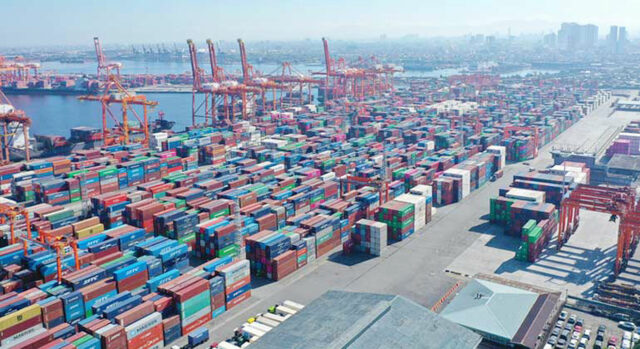
MOODY’s Analytics raised its growth projection for the Philippines to 6.1% this year from 5.7% previously, after identifying the country as a “growth leader” in the region.

Moody’s updated its previous estimate issued in March and aligned its view with the government’s official 6-7% full-year target.

In a research note on Tuesday, Moody’s Analytics Chief Asia-Pacific Economist Steven Cochrane said the region’s growth for 2023 and 2024 will outpace Europe and North America.

“Leaders of growth this year will be the Philippines, India, China and Indonesia,” he said.

“All four will continue to benefit this year from targeted fiscal support that will add to near-term growth. The Philippines and Indonesia both have substantial infrastructure construction programs to improve badly needed highways and transport services,” he added.

The government hopes to spend 5.3% of GDP or around P1.29 trillion on infrastructure this year.

For 2024, Moody’s expects growth to ease to 5.4%, lower than its earlier 6% forecast. This is below the government’s 6.5-8% target for next year.

Meanwhile, Moody’s sees inflation settling at 5.9% this year, against the 6.8% forecast it issued in March. It also maintained its inflation forecast at 2.9% for next year.

Mr. Cochrane said inflation remains high in the region, but has begun to ease since the start of the year.

“The Philippines, India, South Korea, Australia and New Zealand were among those with the highest inflation rates in the second half of last year. All have now eased downward but most are still above central bank target rates,” he said.

In the Philippines, headline inflation eased to 6.1% in May — the lowest level in a year. Still, it was the 14th straight month that inflation breached the central bank’s 2-4% goal.

Inflation has averaged 7.5% this year, higher than the revised 5.5% forecast by the central bank.

“Thus, monetary policy is expected to remain tight through the end of this year in much of the region, with some easing in policy rates early in 2024,” Mr. Cochrane added.

The Bangko Sentral ng Pilipinas paused its monetary policy tightening cycle last month. The Monetary Board has raised key rates by 425 basis points to 6.25% since May 2022.

The Monetary Board is next scheduled to meet on June 22. — Keisha B. Ta-asan

Gas-fired power still critical for PHL amid green-energy transition — Fitch Solutions

BW FILE PHOTO

GAS-FIRED power generation remains key to Philippine energy security despite the government’s efforts to increase the share of renewables on the grid, Fitch Solutions BMI said on Tuesday.

“We believe that the market is working towards increased energy security, mainly in supplying the electricity sector, evidenced by the operating license extension of the Malampaya gas field,” Fitch Solutions BMI Country Risk & Industry Research said.

In May, President Ferdinand R. Marcos, Jr. signed an agreement renewing Service Contract 38, which includes the Malampaya gas field, for 15 years, or until Feb. 22, 2039.

The Malampaya gas field is the country’s only indigenous commercial source of natural gas. It is expected to be commercially depleted by 2027.

“We expect gas-fired power generation to remain a key technology in the Philippines’ power mix, contributing about 19% to the mix over the coming 10 years, behind coal’s 58% and slightly ahead of non-hydropower renewables’ 15%,” it added.

The renewal agreement involves a commitment to drill for two new wells at the gas field, with new wells expected to be put into commercial operation in 2026.

“This will aid the market’s prospects for gas-fired power generation, and place downside risks on the market’s liquefied natural gas (LNG) imports,” BMI said.

“Through the extension of the Malampaya concession agreement, gas-fired power generation will play a critical role in ensuring energy security in the Philippines. This is due to the heavy reliance of several existing natural gas power plants from Malampaya,” Jephraim C. Manansala, chief data scientist at Institute for Climate and Sustainable Cities said in a Viber message to BusinessWorld.

Currently, the Malampaya field supplies four power plants with a combined capacity of 2,011 megawatts.

Fitch Solutions BMI said that the country’s LNG infrastructure expansions, however, will not grow at an unprecedented rate, leaving the gas-fired power sector to remain reliant on domestic natural gas production.

Meanwhile, Fitch Solutions BMI said that the renewable energy industry continues to “receive a boost from energy security concerns,” thanks to the government’s support and ongoing policies favoring the sector.

“We expect momentum to pick up for offshore wind development, though we currently note that the emergence of the sector continues to be an upside risk as projects remain in the early stages of development,” BMI said.

Last month, the Department of Energy (DoE) issued implementing guidelines for Executive Order 21, which calls for expedited processing of permits for offshore wind energy projects.

The DoE is set to conduct the second round of the green energy auction program this month, with a total of 11,600 megawatts in capacity on offer.

“Downside risks remain from the market’s transmission and distribution network, as it grapples with expanding in tandem with the rapidly growing power sector,” it said.

Fitch Solutions BMI said that with the growing power consumption which requires additional power-generating capacity, the transmission networks need to expand to allow new power projects to be integrated into the grid.

“The more ambitious renewable energy policies and targets from the government are also commendable. However, we agree that there are still gaps when it comes to transmission,” Mr. Manansala said.

Mr. Manansala said the recent yellow and red alerts over the Luzon power grid last month highlight the urgent need for an energy transition toward “flexible and distributed energy sources, enabling greater integration of renewable energy into the grid.”

“Ultimately, to achieve energy security in the Philippines, we need to determine the right energy balance between all available sources in our system, and what we need is the increase of renewable energy’s share in order to attain this balance,” he said.

The National Grid Corp. of the Philippines (NGCP) has committed to improve its power transmission services.

“We highlight that the Philippines has plans to expand the network and this will alleviate these downside risks…. continued progress on NGCP’s grids integration will unlock new areas for power project development,” Fitch Solutions BMI said. — Ashley Erika O. Jose

Offshore miners urge DENR to sign off on Japan agreement after one-year delay

REUTERS

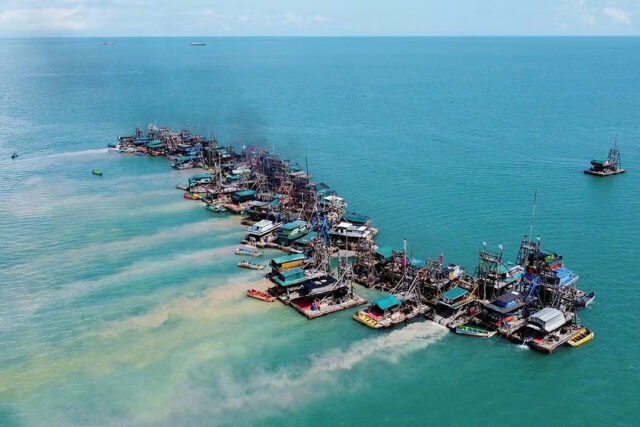
OFFSHORE MINERS asked the Department of Environment and Natural Resources (DENR) to issue a no-objection certification of a pending memorandum of cooperation (MoC) between the Department of Trade and Industry and Japan’s Ministry of Economy, Trade, and Industry (METI) of Japan.

Isang taon nang naka-pending diyan sa DENR, walang naaksyon (There has been no action after one year sitting with the DENR),” Offshore Mining Chamber of the Philippines, Inc. Chairman Michael Raymond A. Aragon told BusinessWorld via phone.

“If the MoC between DTI and METI is signed, Japan will allocate $1 billion in (loans) to Japanese offshore mining companies who would like to operate in the Philippines,” he added.

Mr. Aragon said that the memo covers the trade, industry, and financial aspects of the offshore mining industry in the Philippines. He said that the DENR had been asked to sign off on the memo in February last year.

“We seek only a certification of no objection from DENR — that DENR won’t object if DTI and METI sign a memo of cooperation in offshore mining,” Mr. Aragon said.

The DENR had not replied to a request for comment at the deadline.

Republic Act No. 7942 or the Philippine Mining Act of 1995 requires 60% Filipino ownership of mines.

Mr. Aragon said any foreign companies that plan to mine here will seek “maximum exposure” if ever they enter the market.

He noted that offshore mining operations are cleaner and greener compared to land-based mining.

OMCPI members focus on mining and processing so-called “green minerals” to support the Philippine transition to clean energy.

“The Philippines is very rich in minerals. Things that we can get from the land, we can also get from the waters. The only problem is (the operating costs are) ten times the normal cost” while margins are narrower, he said.

Mr. Aragon said that the investment needed by industry cannot be raised by domestic miners. “The Philippines cannot do it (alone); we need a foreign country to partner with us.” — Sheldeen Joy Talavera

USDA forecasts recovery in PHL biofuel consumption

REUTERS

THE US Department of Agriculture (USDA) said Philippine biofuel consumption is expected to recover this year as demand for fuel ethanol grows.

The USDA added that biodiesel production is also expected to increase by about 8% to meet growing demand.

In a report, the USDA expects Philippine fuel ethanol consumption to increase 8% to 693 million liters in 2023, which would exceed the pre-pandemic level of about 614 million liters in 2019.

The USDA expects biodiesel consumption to grow 14% to 230 million liters, which would exceed the 202 million liters consumed last year. If the 2023 forecast pans out, it would remain lower than the 231 million liters consumed in 2019.

The USDA expects Philippine ethanol production to remain flat at around 375 million liters due to feedstock problems.

“There is no immediate solution to insufficient feedstock for fuel ethanol production. There are recommendations to use corn as feedstock, but this would run counter to the government’s food security program and would require huge investments to establish plants,” it said.

“Domestically-produced bioethanol uses mostly sugarcane molasses as feedstock, while biodiesel feedstock is from coconut. Policy implementation is focused on production and consumption with no policies issued to incentivize lower carbon intensity of existing biofuels over time, another signal of stagnation,” the USDA added.

The biofuel blend in the Philippines is set at 10% ethanol (E10); the biodiesel blend 2% (B2).

The USDA expects Philippine fuel ethanol imports for 2023 to increase 12% to 310 million liters to fill the gap in local production. — Ashley Erika O. Jose

‘Outright lie’: India denies Dorsey’s claims it threatened to shut down Twitter

AKSHAR DAVE-UNSPLASH

WASHINGTON/NEW DELHI — India threatened to shut Twitter down unless it complied with orders to restrict accounts critical of the government’s handling of farmer protests, co-founder Jack Dorsey said, an accusation Prime Minister Narendra Modi’s government called an “outright lie”.

Mr. Dorsey, who quit as Twitter CEO in 2021, said on Monday that India also threatened the company with raids on employees if it did not comply with government requests to take down certain posts.

“It manifested in ways such as: ‘We will shut Twitter down in India’, which is a very large market for us; ‘we will raid the homes of your employees’, which they did; And this is India, a democratic country,” Mr. Dorsey said in an interview with YouTube news show Breaking Points.

Deputy Minister for Information Technology Rajeev Chandrasekhar, a top ranking official in Mr. Modi’s government, lashed out against Mr. Dorsey in response, calling his assertions an “outright lie”.

“No one went to jail nor was Twitter ‘shut down’. Mr. Dorsey’s Twitter regime had a problem accepting the sovereignty of Indian law,” he said in a post on Twitter.

Mr. Dorsey’s comments again put the spotlight on the struggles faced by foreign technology giants operating under Mr. Modi’s rule. His government has often criticized Google, Facebook and Twitter for not doing enough to tackle fake or “anti-India” content on their platforms, or for not complying with rules.

The former Twitter chief executive officer or CEO’s comments drew widespread attention as it is unusual for global companies operating in India to publicly criticize the government. Last year, Xiaomi in a court filing said India’s financial crime agency threatened its executives with “physical violence” and coercion, an allegation which the agency denied.

Mr. Dorsey also mentioned similar pressure from governments in Turkey and Nigeria, which had restricted the platform in their nations at different points over the years before lifting those bans.

Twitter was bought by Elon Musk in a $44-billion deal last year.

Mr. Chandrasekhar said Twitter under Mr. Dorsey and his team had repeatedly violated Indian law. He didn’t name Mr. Musk, but added Twitter had been in compliance since June 2022.

BIG TECH VS MODI
Mr. Modi and his ministers are prolific users of Twitter, but free speech activists say his administration resorts to excessive censorship of content it thinks is critical of its working. India maintains its content removal orders are aimed at protecting users and sovereignty of the state.

The public spat with Twitter during 2021 saw Mr. Modi’s government seeking an “emergency blocking” of the “provocative” Twitter hashtag “#ModiPlanningFarmerGenocide” and dozens of accounts. Farmers’ groups had been protesting against new agriculture laws at the time, one of the biggest challenges faced by the Modi government.

The government later gave in to the farmers’ demands.

Twitter initially complied with the government requests but later restored most of the accounts, citing “insufficient justification”, leading to officials threatening legal consequences.

In subsequent weeks, police visited a Twitter office as part of another probe linked to tagging of some ruling party posts as manipulated. Twitter at the time said it was worried about staff safety.

Mr. Dorsey in his interview said many India content take down requests during the farmer protests were “around particular journalists that were critical of the government.”

Since Mr. Modi took office in 2014, India has slid from 140th in World Press Freedom Index to 161 this year, out of 180 countries, its lowest ranking ever. — Reuters

ADVERTISEMENT
ADVERTISEMENT