Home Blog Page 442

SEC broadens eAMEND portal coverage

SEC.GOV.PH

THE Securities and Exchange Commission (SEC) has issued a memorandum expanding the scope of corporate amendments that can be filed through its eAMEND portal and imposing penalties for late submission of hard-copy documents.

The new guidelines reclassify applications that were previously under simple processing as complex transactions and designate filings under regular processing as highly technical transactions, according to Memorandum Circular No. 3, Series of 2026.

The changes aim to improve procedural efficiency, reduce the administrative burden on corporations, and align with the Ease of Doing Business and Efficient Government Service Delivery Act of 2018.

Under the revised rules, simple processing now covers a broader range of amendments. These include changes to prefatory clauses, corporate or business names, primary and secondary purposes, principal office addresses, terms of existence, the number of board members or trustees, certain share features unless tied to capital stock changes or reclassification, and selected by-law provisions such as fiscal year, audit rules, membership rights, meeting procedures, and quorum requirements.

The SEC also allows up to four by-law provisions to be amended under simple processing, as well as other amendments it may determine eligible.

“This expanded coverage replaces the previous limited scope of simple processing and is intended to reduce procedural burden, improve accessibility, and enhance efficiency, with all approved applications to be issued a digital certificate through the eAMEND portal,” the memorandum read. Physical certificates are released only after a post-evaluation.

Late submission of the hard-copy documents within 15 calendar days from the issuance of the digital certificate can result in penalties of up to P5,000 or cancellation of the application with forfeiture of fees.

Regular processing, now classified as highly technical, will include applications for new by-laws, amendments of by-laws concerning five or more provisions, corporate dissolution through shortening of corporate terms, amendments to articles of partnership, dissolution of partnerships, and all types of corporate conversions. Partnership applications are considered complex transactions but still go through regular processing.

The SEC also noted that non-compliance with directives issued after review may result in the abandonment of applications under regular processing.

The eAMEND portal, launched in July 2024, was designed to streamline the filing, processing, approval, and payment of corporate amendment applications. The revised guidelines clarify classifications, expand the range of amendments covered, and formalize new procedures for fees, certificates, and penalties, ensuring more consistent and timely processing of corporate filings. — Alexandria Grace C. Magno

Treasury fully awards reissued 7-year bonds at lower yields

BW FILE PHOTO

THE GOVERNMENT made a full award of the reissued Treasury bonds (T-bonds) it offered on Tuesday at lower rates as high liquidity drove demand and with players betting on the Bangko Sentral ng Pilipinas’ (BSP) next move.

The Bureau of the Treasury (BTr) borrowed P30 billion as planned via the reissued seven-year bonds, with total bids reaching P95.765 billion or more than triple the amount on offer.

This brought the outstanding volume for the bond series to P125 billion, the Treasury said in a statement.

To accommodate the strong demand seen for the offering, the BTr opened its tap facility window to raise an additional P10 billion via the bonds.

The reissued bonds, which have a remaining life of five years and four days, were awarded at an average rate of 5.71%. Accepted yields ranged from 5.675% to 5.725%.

The average rate of the reissued papers fell by 58.9 basis points (bps) from the 6.299% fetched for the series’ last award on April 2, 2024 and was likewise down by 41.5 bps from the 6.125% coupon for the issue.

This was also 6.5 bps below the 5.775% fetched for the same bond series and 2 bps lower than the 5.73% quoted for the five-year debt — the benchmark tenor closest to the remaining life of the issue — at the secondary market before Tuesday’s auction, based on the PHP Bloomberg Valuation Service Reference Rates data provided by the BTr.

The government fully awarded the T-bonds as the average yield fetched was at the lower end of market expectations amid robust appetite for the offering, the first trader said in a text message.

The auction saw strong demand “as the market is very liquid,” the second trader said in a phone interview. “The average rate was in line with secondary market yields.”

The reissued bonds fetched an average yield lower than comparable secondary market rates as the market continued to digest the latest policy hints from the BSP chief, Rizal Commercial Banking Corp. Chief Economist Michael L. Ricafort said in a Viber message.

Last week, BSP Governor Eli M. Remolona, Jr. said a cut remains on the table at the Monetary Board’s Feb. 19 meeting, even as he noted that the policy rate of 4.5% is already “very close” to where they want it to be, signaling an imminent end to their easing cycle.

“There’s a chance that we may cut some more, and there’s also a chance that we may not move at all. But there’s not a lot of probability that we will raise in 2026,” he said.

The Monetary Board has lowered benchmark borrowing costs by a total of 200 bps since its rate cut cycle began in August 2024.

Meanwhile, analysts have said that the central bank could still ease further to help support domestic demand as prospects have weakened due to a wide-ranging corruption scandal that has stalled both public and private investments, dragging economic expansion. Philippine gross domestic product (GDP) growth slumped to a n over four-year low of 4% in the third quarter of 2025, bringing the nine-month average to 5%.

Mr. Remolona earlier said GDP growth likely averaged 4.6% last year, well below the government’s 5.5%-6.5% full-year goal, which economic managers have already said could be difficult to reach.

The BTr is looking to raise P180 billion from the domestic market this month, or P110 billion via Treasury bills and P70 billion through T-bonds.

The government borrows from local and foreign sources to help fund its budget deficit, which is capped at P1.647 trillion or 5.3% of gross domestic product this year. — Aaron Michael C. Sy

Excellence in orchestral music

SOPRANO Rachelle Gerodias-Park performs “Mutya ng Pasig” with the Manila Symphony Orchestra.

Manila Symphony Orchestra unveils centennial lineup

TO CELEBRATE its 100th year, the Manila Symphony Orchestra (MSO) will be mounting concerts that include collaborations with world-class musicians.

As one of Asia’s oldest orchestras — it was founded in 1926 — it has seen its share of hardship. Even through upheavals like World War II and a global pandemic, it has continued holding accessible concerts around the country and supporting the education of music scholars, said MSO Artistic Director Jeffrey Solares.

“It’s a daily struggle. It’s not only during special years with wars or pandemics that we feel the specialness of keeping this orchestra alive,” he said at a press conference on Jan. 7 in Circuit, Makati. “Every payday is special, making sure that there’s enough funds in the bank. [With] every project, every scholar enrolled in the conservatory, every musician that gets sick, you can feel what it takes to keep the orchestra alive.”

BOUNDLESS TALENT
One of the things that has remained consistent throughout the MSO’s 100 years is being able to champion, celebrate, and collaborate with world-class Filipino and foreign musicians.

A hundred years ago, the MSO performed Beethoven’s Leonore Overture No. 3 at its inaugural concert. For the anniversary concert on Jan. 22, the piece first conducted by the orchestra’s founder Alexander Lippay in 1926 will be brought to life under the baton of Singaporean guest conductor Darrel Ang.

Meanwhile, closing the program will be the Philippine Madrigal Singers, taking on National Artist for Music Ryan Cayabyab’s Misa 2000 and Te Deum, under the direction of Mark Anthony Carpio.

At the press conference, the MSO gave a preview of some pieces that will make up the repertoires of their various concerts this milestone year. One is a Cayabyab song — “Limang Dipang Tao” — and another is Nicanor Abelardo’s “Mutya ng Pasig,” sung by soprano Rachelle Gerodias-Park.

For Mr. Solares, it is important that they highlight Filipino music as well as classical works.

“We want to stick to the original intentions of our predecessors. We want to make orchestral music a part of the daily life of Filipinos,” he explained. “More enriching is how we include Philippine music in our programming alongside international pieces.”

As early as 1926, the MSO has been able to play full-symphony music by the likes of Beethoven, Wagner, and Brahms, showcasing its versatility. At the preview, it proved this by giving the media a glimpse of Brahms’ Longing at Rest and Mozart’s The Marriage of Figaro (Overture).

“The MSO exposes Filipinos to this art form. Symphonic music and concertos are a European form of art, but they were brave enough to do it,” Mr. Solares added.

The orchestra also teamed up with mezzo-soprano Michelle Mariposa to offer a preview of Bizet’s Habanera, from the opera Carmen — sung in Tagalog — which will be part of the MSO’s Concert IV in August.

Mr. Solares said that traditional kinds of music can still be accessible, despite attention spans waning. For him, to “look down on the audience” is completely unnecessary.

“We mix it up as much as possible, but we can also help people appreciate a symphony,” he said.

CONCERT LINEUP
The MSO’s 100th Anniversary Concert takes place on Jan. 22, 7:30 p.m., at the Samsung Performing Arts Theater in Circuit, Makati. It closes the group’s 99th season.

The MSO will then present a special benefit concert which is in addition to its season lineup. LEGACY: Carmen Sipin-Aspiras and Inna Montesclaros, will be held on Jan. 25, 7:30 p.m., at the Proscenium Theater in Rockwell, Makati. The benefit concert features the two generations of pianists along with the MSO under the baton of conductor Darrell Ang. The concert will be featuring works by Brahms and Chopin. Tickets are available at Ticketworld.

After that, the 100th season kicks off with Centennial Opening: The Sleeping Beauty, which will be held from March 13 to 15 at the Aliw Theater, CCP Complex, Pasay City. The Tchaikovsky masterpiece will come to life care of Ballet Manila and Russian guest conductor Alexander Vikulov.

This will be followed by Rising Stars of the Philippines on May 30 at the Proscenium Theater, Rockwell, Makati. Violinist Jeanne Marquez, cellist Damodar Das Castillo, and Venezuelan guest conductor Joshua Dos Santos will join the MSO for the concert, where they will take on Brahms’ Double Concerto in A minor, Op. 10 and other symphonic gems.

The next concert, Symphony of a Nation: 100 Years of Music, 80 Years of Fil-Am Friendship, will be held on July 6 at the Manila Metropolitan Theater in Ermita, Manila. It will feature violinist Emanuel John Villarin and French guest conductor Thanos Adamopoulos, presenting a repertoire devoted to the nation’s most stirring orchestral works.

Another milestone concert will be Legacies in Song: MSO’s 100 Years and the Voice of Conching Rosal on Aug. 29 at the FEU Auditorium in Manila. It will have soprano Rachelle Gerodias-Park, mezzo-soprano Michelle Mariposa, baritone Byeong In Park, and conductor Marlon Chen performing excerpts from Carmen and other operatic treasures with the MSO.

On Oct. 24 at Hyundai Hall in Areté, Ateneo de Manila University in Quezon City, Philippine Master Composers, Past, Present, and Future will unveil a new work by Ryan Cayabyab. It will be the world premiere of this piece, played alongside masterpieces by other national icons.

Closing the season will be the MSO 100th Centennial Finale, to be held in January 2027, with the venue yet to be announced. Its tentative guest is French-Belgian cellist Camille Thomas, to be presented in partnership with UNICEF.

Through these concerts, the MSO hopes to raise funds for its attached organizations — the MSO Foundation, the MSO Music Academy, and the Manila Symphony Junior Orchestra. The MSO is also set to launch a commemorative book chronicling the orchestra’s journey over 100 years.

Tickets for the upcoming concerts are available via TicketWorld. For more information, visit their social media pages. — Brontë H. Lacsamana


Civic mindedness is a must to fight corruption: Focusing on Catholic love

PHILIPPINE STAR/RYAN BALDEMOR

(Part 2)

The third form of love is what the Greek philosophers called Eros (amor in Latin) or romantic love. This is more than sexual desire. It is a deep emotional and romantic attachment to one specific person. In the way God created human beings, this romantic love exists naturally between a man and a woman. The culmination of romantic love is the highest form of human love between two persons of the opposite sex and leads to a marital union which forms the foundation of the family, the basic unit of society. The Philippine Constitution is clear about the family being the basic unit of society and that marriage or the marital union is inviolable.

Eros or romantic love focuses on the entire person. The attraction that is purely sensual and makes sex and sexual pleasure the only end is not love. It is lust and corresponds to what St. James the Apostle called the “concupiscence of the flesh.” Authentic romantic love inspires sacrifice, devotion, and courage. It deepens commitment beyond pleasure and can sanctify sexuality through fidelity. Romantic love draws people out of self-centeredness.

Catholics believe that the marital union blessed by the Sacrament Matrimony is a vocation or a calling from God and is a pathway to heaven for the married couples. The Philippines stands out as the only country in the world where there is no divorce law. Most Western countries (e.g., the US and Europe, including Spain that brought Christianity to the Philippines) have divorce rates of around 30% to 50% of marriages. Traditionally Filipino society emphasizes marriage as sacred and lifelong, often anchored in religion family and community norms. This cultural norm discourages separation or dissolution and contributes to longer-lasting unions on average.

Catholic morality also obliges the couple to be open to having children whom they have the obligation to also lead to heaven through the appropriate upbringing and education. A very important part of that upbringing or child education is the inculcation of virtues related to civic mindedness or love of the common good. Needless to say, this openness to children gives the Philippines the advantage of a young and growing population in a world in which, as Elon Musk, repeatedly warns, the greatest challenge to the global economy is not climate change but depopulation and rapid ageing.

The fourth form of love is Agape in Greek (or caritas in Latin). It is to love as God loves us: completely unselfish, selfless, without expecting anything in return. In all the other forms of love, there is always the expectation of a good or pleasure from the one loved. The very act of affection gives the lover an emotional lift, as in the case of loving one’s child (or even a pet). The same can be said about the love of friendship: there is mutual pleasure in the relationship. It is most obvious in romantic love that there is mutual pleasure seeking between lovers (which is obvious in the conjugal act). Agape, in contrast, is an act of a human being to seek the good of another without expecting something in return. Agape consists of self-giving and unconditional love. Through agape, a person loves even the unlovable. It seeks the true good of the other. It is the basis for loving the common good, which is defined as a social or juridical order that enables every person in society to attain his or her fullest integral human development. This form of love never contradicts truth or justice. Only this fourth type of love, agape, can rightly govern the other forms of love.

All four loves are meant to be ordered, not suppressed or abolished. The problem is not loving too much, but loving the wrong thing (like money) too much. Agape can rightly govern the other three loves, preventing affection from smothering, friendship from excluding, and eros from enslaving.

In the Philippines, storge or affection is strongly manifested in family life. There are strong family bonds, respect for the elders, natural generosity among relatives, and a deep sense of belonging and obligation, especially among the lower-income groups. This is especially manifested by the OFW phenomenon. More than 10 million Filipino overseas workers endure manifold physical, emotional, economic, and spiritual sacrifices in order to earn a comfortable living for their relatives at home.

Many social weaknesses (such as widespread corruption) arise not from lack of love, but from disordered love. For example, affection (storge) without justice leads to nepotism. Philia without agape fosters political dynasties. Eros without law leads to moral laxity, and sentiment without truth spells ineffective charity.

To a Catholic who puts his faith into practice, agape obliges him to love his neighbor as he loves himself. This love is channeled through the corporal and spiritual works of mercy, such as feeding the hungry, giving drink to the thirsty, clothing the naked, sheltering the homeless, visiting the sick, visiting the imprisoned, and burying the dead — which are the corporal works. Among the spiritual works are instructing the ignorant, counseling the doubtful, admonishing sinners, comforting the afflicted, forgiving offenses willingly, and praying for the living and the dead. Filipino Catholics are not generally remiss in practicing these works of mercy.

Unfortunately, we fail miserably working for the common good.

This general failure of the Filipino people to work for the common good, despite the fact that we are well known as a “loving people” all over the world, is perfectly captured by some of the words of the Oratio Imperata for Integrity, Truth and Justice that our Catholic Bishops requested to be prayed at every Catholic Mass celebrated during a relatively long period of time:

“We confess that we ourselves have often walked in darkness. In our silence, in our compromises, and in our indifference, we have allowed corruption to grow and falsehood to spread. Forgive us, Lord, and cleanse our hearts of this grave moral evil that robs the poor of bread and the nation of hope. Give us leaders after the heart of your Son: shepherds who serve, not wolves who devour.

“By the power of your Holy Spirit, give us the courage to reject lies, expose deceit, uphold justice and defend the truth, in all our dealings — whether public or private — that integrity may flourish in our land like a river and righteousness like a mighty stream.”

I am a strong believer in the power of prayer. I am sure that our collective prayers can lead to the conversion of the existing corrupt officials in the various agencies of government as well as their partners in crime in the private sector. I am also confident that the necessary institutional and legislative reforms will be implemented to make it more difficult for the incorrigibly corrupt individuals to perpetrate their crimes.

More importantly, we must implement a long-term character-building program so that future generations of Filipinos will emulate the love for the common good, the patriotism, of such exceptional people as the Japanese and the Singaporeans.

(To be continued.)


Bernardo M. Villegas has a Ph.D. in Economics from Harvard, is professor emeritus at the University of Asia and the Pacific, and a visiting professor at the IESE Business School in Barcelona, Spain. He was a member of the 1986 Constitutional Commission.

bernardo.villegas@uap.asia

AC Health opens first St. Joseph Drug store in Metro Manila

STJOSEPHDRUG.COM

AYALA HEALTHCARE Holdings, Inc. (AC Health) opened the first St. Joseph Drug branch at Healthway FEU-NRMF Medical Center in Quezon City, marking the chain’s entry into Metro Manila.

“For us at AC Health, this reflects how synergy across our ecosystem comes to life. By working together across our ecosystem, we turn integration into real, everyday impact as we continue to Transform Health for Every Filipino,” AC Health President and Chief Executive Officer (CEO) Paolo Maximo F. Borromeo said in a statement on Tuesday.

St. Joseph Drug operates nearly 130 stores across Northern Luzon and has been in the retail pharmacy business for 67 years. Its new outlet is the chain’s first store in the capital region and its initial attempt at an outpatient store format.

“Our mission has always been clear: to serve every community — whether big or small, urban or rural — and to make healthcare accessible to all,” St. Joseph Drug Chief Strategy & Innovations Officer Paolo C. Bernal said.

“This partnership with Healthway FEU-NRMF Medical Center is more than just a collaboration; it is a stepping stone toward AC Health Group’s shared vision of transforming health for every Filipino,” he added.

AC Health is the healthcare subsidiary of listed conglomerate Ayala Corp. Its portfolio includes generic retail pharmacy chain Generika Drugstore; pharmaceutical importer and distributor IE Medica and MedEthix; Healthway Medical Network, which operates multi-specialty clinics, ambulatory centers, and full-service hospitals; and retail pharmacy chain St. Joseph Drug.

Ayala Corp. shares rose 0.4% to close at P504 apiece on Tuesday. — Alexandria Grace C. Magno

Singapore Exchange proposes bond futures for India, Southeast Asia

SINGAPORE Exchange Ltd. (SGX) held multiple calls with treasury officials from global banks about introducing futures tied to some Asian government bond markets, according to people familiar with the matter.

The bourse discussed introducing the futures for countries including India, Indonesia, Malaysia, the Philippines and Thailand, the people said, asking not to be named discussing private matters. Such futures allow investors to hedge their exposure to interest rate swings by buying or selling bonds at a later date on exchanges.

The discussions reflect the growing interest in the region’s debt markets. Indian bonds have been joining global indexes over the past year-and-a-half, while Malaysian securities were investor favorites last year, delivering the strongest performance in emerging Asia.

“For bond futures to be successful, the underlying bonds must be liquid, and traders must be able to trade both futures and onshore bonds to maintain the relationship between the futures and the bonds,” said Rajeev De Mello, global macro portfolio manager at Gama Asset Management SA. “Traders will need the ability to short cash bonds, which is not always easy in some markets.”

For the proposed products, the SGX discussed offering three, five- and 10-year maturities per country, the people said. The futures would be settled in US dollars, with pricing based on average yield of a basket of no more than three sovereign bonds, they said.

For India, the bonds most likely to be considered would fall under the so-called Fully Accessible Route framework, which make them eligible for inclusion in global indexes, the people said. Overseas investors have poured $21 billion into the nation’s sovereign bonds since they were added to JPMorgan Chase & Co.’s flagship index in June 2024, according to clearing house data.

SGX aims to introduce the futures in the first half of 2026, potentially as early as the first quarter, the people said, adding that the discussions are preliminary and details may change.

An SGX spokesperson declined to comment.

At present, the exchange offers Japanese government bond futures, Singapore overnight rate average futures and Tokyo overnight average rate futures, according to its website. The bourse has stepped up its offerings in recent months, as it looks to expand into new segments popular with investors such as crypto futures. — Bloomberg

Charlie brings his Chocolate Factory to Manila

COHEN TOUKATLY (right) and Daniel Plimpton give a preview of their characters Charlie Bucket and Willy Wonka. — BRONTË H. LACSAMANA

WHO DOESN’T KNOW Roald Dahl’s iconic children’s novel Charlie and the Chocolate Factory?

The wonderful, trippy visuals of the iconic 1971 film with Gene Wilder are ingrained in a generation’s brains. The Tim Burton-helmed wackiness of the 2005 film with Johnny Depp has become a fond memory for those approaching middle age. Even kids these days may know Willy Wonka through Timothée Chalamet’s take in the 2023 prequel.

While one can always go back to their film version of choice to revisit dancing Oompa-Loompas and rivers of chocolate, Manila audiences are now being offered the golden ticket to accompany Charlie Bucket on his adventure into a haven of sweets onstage. This July, GMG will bring the Broadway production of Charlie and the Chocolate Factory to the Philippines for the first time.

Filipino theater fans have seen their fair share of musical spectacles which have stopped over in Manila while on global tours — Cats, Wicked, Phantom of the Opera, Les Misérables, The Sound of Music are just a few examples — which has motivated the folks behind this stage musical to step it up.

“The Filipino audiences are very familiar with spectacle and big technical elements, and I think our production picks up the antics just one notch higher,” said director Drew Cipillone at a Jan. 8 press conference.

“What live theater brings to the experience and the overall story is a lot more imagination. It is very, very innovative, with new technology,” he added.

To set the touring version apart from its original Broadway production, the team has modified the pacing and utilized magic and illusion to better tell the story, according to Mr. Cipillone.

Of course, it will still have the movies’ beloved songs, like “Pure Imagination,” “The Candy Man,” and “I’ve Got a Golden Ticket.”

Aside from using LED screens, projection mapping, and immersive technology, the creative team also incorporated magic taught by illusion designer Tim Clothier and his Las Vegas-based company, the Illusions Project.

“What we’ve actually accomplished in this brand-new production is the immersive feel, so you actually feel like you’re part of it,” Mr. Cipillone said.

THE STARS
The role of Charlie Bucket — the boy from an impoverished family whose dream comes true when he gets a golden ticket to Willy Wonka’s Chocolate Factory — falls to Cohen Toukatly. For the young actor, landing the lead role in this musical is like “his very own golden ticket.”

“Being able to bring this character to life, to show people what being kind can get you, is awesome,” he told the press.

Meanwhile, Daniel Plimpton, who plays Willy Wonka, acknowledged that he has big shoes to fill following the iconic actors who have played the eccentric chocolatier in years past — so he will be bringing his unique talents to the role.

“I come into this with a strong tap dance background, so we got to throw a little bit of that into the show, which has never been in the show before,” he explained.

There will be bits of hip-hop and even Bavarian slap dancing alongside classic Broadway-style numbers, incorporated smoothly into the choreography thanks to choreographer Joshua Bergasse.

Mr. Plimpton added that Charlie and the Chocolate Factory cuts across generations, making it a great show for the whole family. “Kids will love seeing themselves in Charlie. Adults will see aspects of themselves in Willy Wonka. It really gives you a chance to reflect on your own childhood dreams and what you want the world to be,” he said.

He explained that there’s a deeper message beneath the vibrant spectacle of the chocolate factory, that “while things can be very shiny, we need to maintain our groundedness and our hope for humanity.”

The actors also teased a special moment that they adjust for each country they stop on the tour. At some point, Willy Wonka suddenly bursts into song in a different language, so Manila audiences can expect him to sing in Filipino.

Charlie and the Chocolate Factory features original music by Grammy and Tony Award winners Marc Shaiman and Scott Wittman, with a book by David Greig based on the novel by Roald Dahl.

The musical will run from July 8 to 26 at The Theatre at Solaire, Solaire Resort & Casino, 1 Aseana Ave., Entertainment City, Parañaque City. Early ticket access is available through UnionBank until Jan. 15, via ticketworld.com.ph. Tickets go on sale to the general public through TicketWorld on Jan. 17. — Brontë H. Lacsamana

Anti-corruption sentiment must translate into results

PEOPLE raise their placards during the 2nd Trillion Peso March at the People Power Monument in Quezon City on Nov. 23, 2025. — PHILIPPINE STAR/MIGUEL DE GUZMAN

The holiday noise has died down, and Filipinos have gone back to their usual routines. With all the difficulties and challenges presented by 2025, many are wondering what this new year holds for the people.

A Stratbase commissioned survey, conducted Dec. 12-15, 2025 by Pulse Asia, revealed that economic issues remained to be top-of-mind of most Filipinos. Some 59% of respondents cited the rising prices of basic goods such as food, and the lack of job opportunities, as a pressing concern at the community level.

This goes to show that many things can be happening in the political sphere, but ultimately the people are concerned about whether they can afford the prices of basic necessities, put food on the table, and find and keep a job that would ensure their income.

A separate, earlier survey, conducted by the Social Weather Stations between Nov. 24 and 30 last year, showed that 51% of Filipino families think of themselves as poor. The majority figure translates to an estimated 14.3 million families across the country.

These survey numbers do not lie. They reflect the worsening pressure being experienced by Filipinos on how they could respond to their basic needs amid the economic hardships and the lack of economic opportunities.

CORRUPTION
But it would be wrong to portray this concern for day-to-day survival as remote and separate from the problem of corruption.

To be sure, the problem of corruption has always been on the minds of Filipinos. Another Pulse Asia survey revealed that 94% of Filipinos believe that corruption is prevalent in the Philippines. Filipinos are split on whether corruption is a normal part of politics in this country. Some 41% agree with this statement, while 43% disagreed.

Thus, while just 31% of respondents identified corruption as a top concern, it remains a significant issue far beyond being a moral or political issue. Filipinos do want an honest government and are angry and frustrated at those in power who abuse their positions for their selfish gain. They wish they could trust their institutions again.

Unfortunately, corruption has farther-reaching consequences. How a government conducts its affairs, proposes a budget, and actually spends people’s money directly affects the perception of investors. These are the people who bring capital to the country and fuel our industries, creating jobs and providing opportunities for sustainable incomes.

Indeed, corruption — an act of misallocating resources and abusing fiscal power for personal gain — has profound economic effects on the life of a nation.

This administration is, at the very least, aware of the intimate link between governance and economics. Despite the challenges now being faced by the various bodies investigating high-profile and high-stakes corruption, it is trying to introduce changes to the way the national budget is drafted.

We saw for the first time how the deliberations at the bicameral conference committee were livestreamed. While the system was not perfect, the public was generally aware of what was going on and which issues were deemed contentious, even how lawmakers were conducting themselves. The public wanted to make sure there were no opportunities for insertions or any similar maneuvers.

The 2026 national budget reflects an attempt to respond to these concerns. Signed into law on Jan. 5 by President Ferdinand “Bongbong” Marcos, Jr., Republic Act No. 12314 or the 2026 General Appropriations Act (GAA) allocates P6.793 trillion — 7.4% higher than in 2025 and equivalent to 22% of GDP. This signals an expansive fiscal response.

In this budget, social services and economic foundations are prioritized. Education has the largest share at P1.345 trillion to fund classrooms, feeding programs, and tertiary education support; infrastructure follows with P530.9 billion to improve connectivity; health gets P448.125 billion to strengthen Universal Health Care, rural health staffing, and PhilHealth benefits.

President Marcos also vetoed seven of 10 unprogrammed items in the budget, amounting to P92.5 billion out of the total P234.4 billion. He said the allowed funds represented the absolute bare minimum.

Then again, deliberating the line items and passing the budget are one thing. Actually implementing the budget as planned is another. Further, ascertaining whether the goods and services are delivered to the public is a sensitive issue altogether. Filipinos have seen and experienced too many inadequate or nonexistent projects, even though the paperwork says otherwise.

In sum, what awaits us in 2026 and onward is what we will want it to be. Do our leaders sincerely want to introduce reforms that would purge the system of corruption? How much do the people want a clean and honest government and are they willing to participate in ensuring this will be realized? Rising prices, weak job opportunities, and corruption-driven inefficiencies are shaping today’s political landscape, and while the 2026 national budget is large and people-centered on paper, its real impact will depend on the implementation that hopefully, directly addresses everyday economic concerns of the Filipino people.


Victor Andres “Dindo” C. Manhit is the president of the Stratbase ADR Institute.

Del Monte completes 1.45% Sundrop stake sale

DELMONTEPACIFIC.COM

DEL MONTE PACIFIC LTD. (DMPL) said it has completed the sale of a 1.45% equity stake in India’s Sundrop Brands Ltd., covering 547.95 million ordinary shares priced at 715 Indian rupees each, to an independent third-party buyer.

In a disclosure on Tuesday, the company said the share purchase agreement closed on Jan. 9, after meeting required conditions.

The deal follows DMPL India Holdco, its indirect subsidiary, completing the first tranche of the Sundrop disposal through a share purchase agreement with CAG-Tech (Mauritius) Ltd., selling 1.88 million ordinary shares or a 4.99% stake for about $15 million.

“Sundrop Brands, a leading player in India’s food and edible oils industry, owns popular brands like ACT II popcorn and Sundrop edible oil,” DMPL said.

The company said the transactions are part of its restructuring efforts to streamline its businesses.

Funds raised from the Sundrop sales will support its main operating subsidiary, Del Monte Philippines, Inc. (DMPI), which handles the Group’s core businesses.

The transactions aim to unlock value from non-core investments, strengthen DMPI’s balance sheet to fund working capital and debt, and refocus management and capital on DMPL’s core strategic businesses.

Del Monte shares remained unchanged at P4.55 apiece on Tuesday. — Alexandria Grace C. Magno

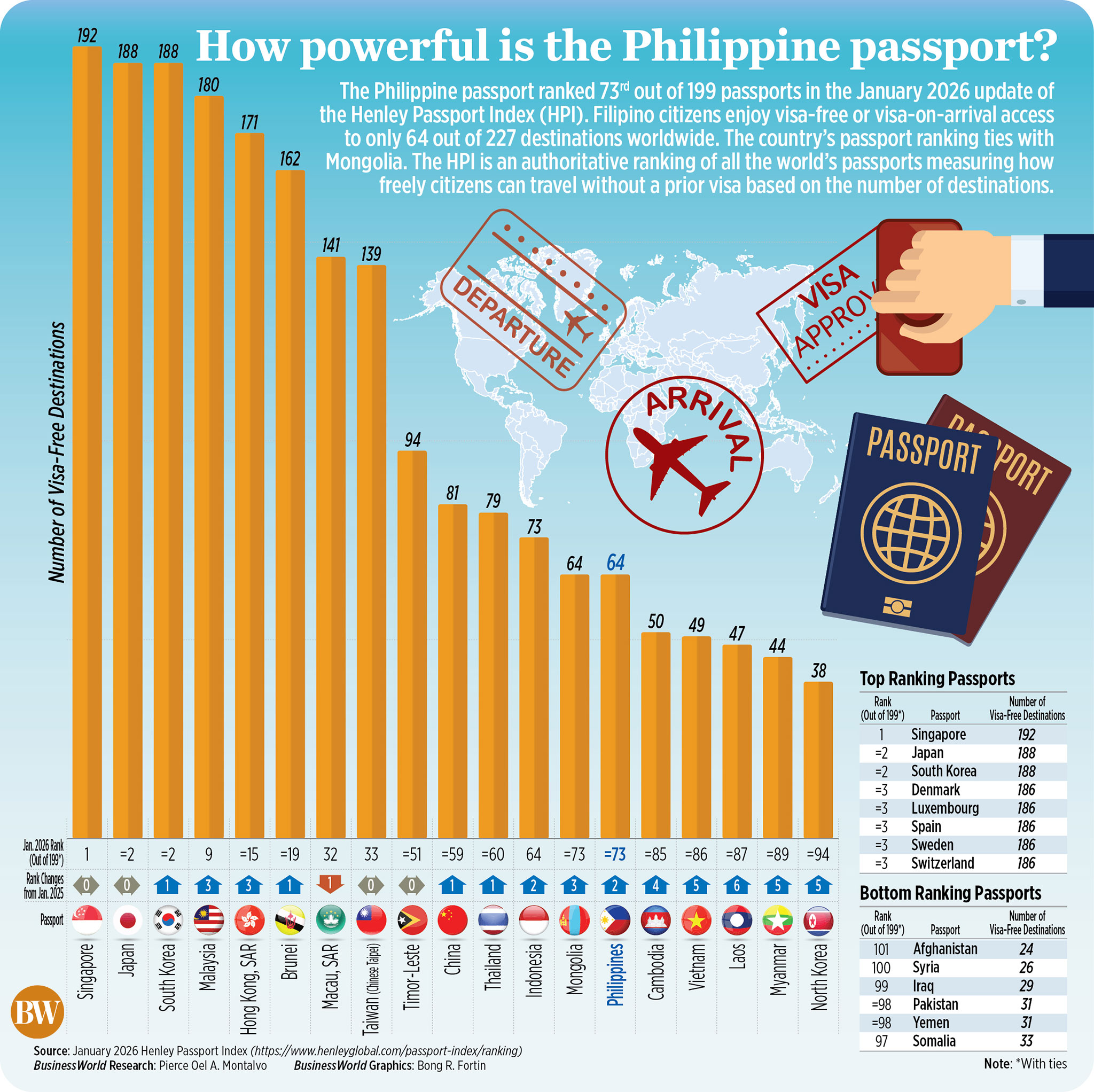
How powerful is the Philippine passport?

The Philippine passport ranked 73rd globally, two ranks higher than a year earlier, in terms of visa-free privileges in global destinations, according to the London-based Henley Passport Index (HPI) on Tuesday. Read the full story.

Atome secures $345-M debt facility

DIGITAL FINANCE platform Atome has closed the renewal of an upsized $345-million debt facility that will help fund its continued expansion in Southeast Asia, including the Philippines.

Atome said in a statement on Tuesday that it has finalized the syndicated facility that was up from the $200 million it secured in 2024 following the entry of new participating banks.

“The expanded facility will accelerate the expansion of Atome Financial’s profitable regional portfolio and products such as buy now, pay later (BNPL), lending and the Atome (PayLater Anywhere) Card across key Southeast Asian markets Singapore, Malaysia and the Philippines,” it said.

“This facility has grown significantly within a year. We’re now even better positioned to support a rapidly growing, healthy and profitable loan book, while scaling transparent and flexible credit solutions to serve both merchants and consumers,” said Andy Tan, Atome chief commercial officer.

HSBC reprised its roles as structuring bank and mandated lead arranger and bookrunner, while DBS also joined as mandated lead arranger and bookrunner.

Returning lenders include Sumitomo Mitsui Banking Corp.’s Singapore branch, Brunei’s Baiduri Bank, and Cathay United Bank. Fubon Bank and Shanghai Pudong Development Bank joined as new participants.

“At HSBC, we support businesses by leveraging our global network, deep sector expertise, and capital strength. Our long-standing partnership with Atome reflects this commitment. We appreciate their continued trust and the opportunity to support them on this milestone transaction. We look forward to more shared successes in the years to come,” HSBC Singapore Head of Banking, Corporate and Institutional Banking Gilbert Ng said.

“DBS is pleased to support Atome as mandated lead arranger and bookrunner, reaffirming our commitment to catalyzing innovative and responsible growth in the digital economy. Atome continues to successfully leverage technology to scale accessible, transparent, and flexible credit solutions for underserved consumers in Southeast Asia within a robust risk framework — supporting DBS’ commitment to creating meaningful impact across the region,” DBS Head of Digital Economy Group Chua Shih Guan added.

Atome is part of Singapore-headquartered Advance Intelligence Group’s wallet platform Atome Financial, which is backed by investors including SoftBank Vision Fund 2 and Warburg Pincus. It is active in the Philippines as a BNPL firm and also offers insurance, savings, cards and lending services across Southeast Asian markets.

In 2025, Atome Financial’s annualized net revenue breached $500 million, supported by annualized gross merchandise value (GMV) of $6 billion. It posted its strongest monthly GMV on record last month, reflecting a 70% annual increase, it added.

In the Philippines, Atome has disbursed over 2 million PayLater Anywhere Cards, with up to 80% of these being to first-time cardholders. — A.M.C. Sy

Bamboo enterprise empowers residents with market access

EDG ADRIAN A. EVA

By Edg Adrian A. Eva, Reporter

ALIMODIAN, Iloilo — A community-based bamboo enterprise in this western Philippine town is helping almost 300 residents earn more from their craft by organizing production, securing buyers and linking small producers to wider markets.

The Alimodian Bamboo Producers Association (ABPA), founded in 2022, brings together farmers, weavers and traders who depend on bamboo for their livelihoods. The group was established by the municipal government’s Local Economic Development and Investment Promotion Office (LEDIPO) to organize a fast-growing but fragmented local industry.

“Eighteen percent of the total land area of our town is bamboo plantations, and on average, 10,000 bamboo poles are sold every month based on the data,” LEDIPO officer Mark Dave A. Botol said in an interview.

ABPA has 278 members from 11 of Alimodian’s 51 villages. Many of them had long worked independently, selling bamboo poles or handcrafted products to middlemen at uneven prices.

“Before, the weavers were scattered and not organized,” Mr. Botol said in Filipino. “They were not intact as a group.”

The association was formed after the local government identified two major gaps: limited access to markets and weak links to government support programs.

By organizing producers under a single entity, ABPA has been able to consolidate supply, standardize products and negotiate better terms for its members.

Through the association, bamboo products from Alimodian have been featured in major trade fairs in Iloilo and Metro Manila. Items made by local weavers are also sold at a well-known mall in Iloilo City and at the town’s One Town, One Product center.

ABPA’s offerings range from practical items such as bamboo baskets used by farmers to transport produce, to decorative home furnishings, including lampshades etched with dried cacao leaves aimed at urban consumers.

Mr. Botol said members are earning more because ABPA buys their products directly and handles marketing and sales with the support of the local government. The enterprise sells about 5,000 items a month, providing producers with more predictable demand and income.

Beyond market access, the association has become a channel for training and assistance. Members have received support from local and national agencies, including the Department of Science and Technology’s Community Empowerment through Science and Technology program, which provided product development training as well as tools and equipment based on scientific standards.

“As we noticed, the farmers do not have a voice to request assistance from government agencies,” Mr. Botol said. “That is why the role of the local government is very important. We should know their needs so that we can act as their voice.”

The initiative also aligns with broader provincial goals. Iloilo aims to position itself as a bamboo hub in Southeast Asia by 2030, focusing on green exports, community enterprises and climate-smart industries.

Governor Arthur R. Defensor, Jr. has said the province is considering more than 9,000 hectares as potential bamboo plantation sites to support that plan.

Still, challenges remain. Poor road conditions in some remote villages have pushed up transport costs, cutting into earnings and forcing producers to raise prices.

The local government is seeking funding from national agencies to improve road access, particularly in areas such as the village of Bugang, Mr. Botol said. Better infrastructure would reduce costs for ABPA members and benefit other farmers as well.

Despite these hurdles, the association’s members remain hopeful. Participation in trade fairs has helped them build links with buyers in nearby towns and Metro Manila, opening doors to repeat orders.

“That’s what I tell them: little by little, they will also achieve what they have been aiming for,” Mr. Botol said.

For ABPA, the goal goes beyond sales figures. The association seeks to improve the long-term stability of its members by turning traditional skills into sustainable livelihoods.

“The dream is really to change lives,” Mr. Botol said, adding that through bamboo, members can work toward more secure incomes and better opportunities for their families.

ADVERTISEMENT
ADVERTISEMENT