Home Blog Page 427

BSP’s ‘nonchalance’ amid peso slump still reasonable
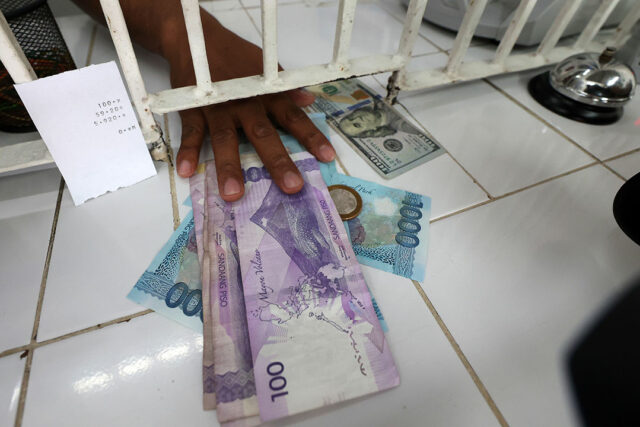
An individual exchanges US dollars for Philippine pesos at a money changer in Quezon City. — PHILIPPINE STAR/MIGUEL DE GUZMAN

By Katherine K. Chan, Reporter

THE BANGKO SENTRAL ng Pilipinas’ (BSP) minimal intervention in the foreign exchange market is deemed reasonable as the peso’s recent swings remain manageable despite successively hitting record lows in the past weeks, analysts said.   

“The BSP’s strategy of minimal intervention is largely reasonable and consistent with its general nonchalance rhetorically about the peso’s weakness,” Miguel Chanco, chief emerging Asia economist at Pantheon Macroeconomics, told BusinessWorld in an e-mail.

“While the level of the peso-dollar exchange rate is understandably attracting more attention these days, what matters ultimately for inflation is its rate of change year over year,” he added. “And, on this basis, panic would be very premature.”

According to Pantheon Macroeconomics, the peso has depreciated against the US dollar by an annual 1.4% as of January. This was slightly higher than the 0.8% decline posted in December, though Mr. Chanco noted that this remains “very manageable in the grand scheme of things.”

Since Jan. 5 or the second trading day of the year, the peso has closed at the P59-per-dollar level.

On Jan. 15, it fell by two centavos to close at P59.46 versus the greenback, breaking the previous all-time low of P59.44 against the dollar on Jan. 14.

BSP Governor Eli M. Remolona, Jr. earlier said that they feel “tremendous pressure” to defend the peso amid its recent volatility, but they choose to disregard it.

Still, he noted that the central bank continues to make minimal interventions in the foreign exchange market to prevent sharp movements that may cause inflationary pressures.

Meanwhile, John Paolo R. Rivera, a senior research fellow at the Philippine Institute for Development Studies, noted that extended peso weakness might worsen inflation on imports and erode confidence in the currency.

“BSP’s light touch forex (foreign exchange) approach is acceptable while markets are orderly, but prolonged PHP (Philippine peso) weakness risks imported inflation and weaker confidence if expectations become unanchored,” Mr. Rivera told BusinessWorld in a Viber message. 

“This depreciation could reduce the likelihood of a near-term rate cut, as the BSP may turn more cautious to avoid fueling price pressures unless inflation stays firmly within target and the PHP stabilizes,” he added.

In December, the Monetary Board delivered its fifth straight 25-basis-point (bp) cut, bringing the benchmark policy rate to an over three-year low of 4.5%. It has so far reduced key borrowing costs by 200 bps since it began its easing cycle in August 2024.

The BSP chief has said that another 25-bp reduction at their Feb. 19 meeting remains on the table but may be unlikely considering current economic data.

Jonathan L. Ravelas, a senior adviser at Reyes Tacandong & Co., said that the peso’s continued slump makes it difficult to justify any further easing soon, putting the BSP in a “tricky spot.”

“By keeping interventions minimal, the BSP preserves its reserves and signals confidence, but the risk is that a weaker peso quietly pushes imported prices higher and keeps inflation sticky,” he told BusinessWorld via Viber. “And because every bout of depreciation widens the rate gap with the Fed, the peso’s weakness makes a February rate cut much harder to justify.”

Mr. Ravelas noted that recent peso movements may be urging the central bank to pivot from easing to maintaining stability.

Still, the prevailing macro backdrop, particularly tepid economic growth, could outweigh peso concerns in shaping the BSP’s monetary policy.

This, Mr. Chanco said, would likely prompt the central bank to deliver a sixth straight 25-bp cut in February to end its easing cycle. 

“Of course, it would be an entirely different story if inflation was above the BSP’s target range and the PHP was wobbling more materially, but we’re nowhere near this scenario,” he added.

Philippines accelerates push to light up rural homes

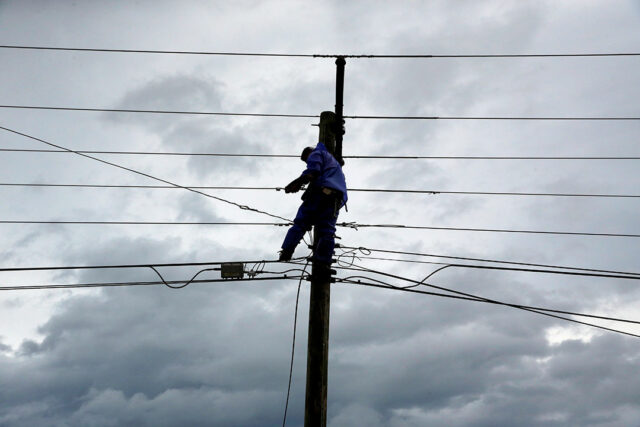
A lineman fixes an electrical post that was damaged during a typhoon in Burgos, Ilocos Norte, Oct. 20, 2016. — REUTERS/ERIK DE CASTRO

By Sheldeen Joy Talavera, Reporter

OVER A MILLION households in the Philippines remain without electricity, a gap the government aims to close within the next three years.

Energy Secretary Sharon S. Garin said the Department of Energy (DoE) and National Electrification Administration (NEA) are deploying a mix of strategies to speed up household energization, including microgrid systems, solarized homes, and streamlined grid connections.

“Just a little more and we’ll be close to 100%,” she said in a speech last year. “For every one peso the government spends on electrification, we get four pesos in return. So, it’s an investment for us and for our children.”

During his fourth State of the Nation Address in July 2025, President Ferdinand R. Marcos, Jr. directed the DoE and NEA to accelerate efforts to fully electrify the country before the end of his term in 2028.

As of June 2025, about 28.27 million households have been energized, accounting for 94.77% of the projected households from the 2020 Philippine Statistics Authority census.

Luzon posted the highest electrification rate at 98.53%, followed by the Visayas at 95.78%, while Mindanao continues to trail at 83.81%, highlighting the difficulty of reaching last-mile communities.

Under the 2024-2028 National Electrification Roadmap, the government was targeting a 96.51% electrification rate by the end of 2025.

The DoE’s Electric Power Industry Management Bureau (EPIMB) said achieving full electrification by 2028 will require an estimated P80.9 billion, with around P68.26 billion expected from government financing and P12.64 billion from private investments.

The funds will cover household connections to existing grids, distribution line extensions, stand-alone home systems, and microgrid projects.

NEA Administrator Antonio Mariano C. Almeda said the agency expected rural electrification to reach 91.7% by the end of 2025, aiming for 94% by the end of 2026 with higher subsidies from Congress.

“With the increase in the budget, it requires an increase in engineers to validate, inspect, liquidate, and issue certificates of final inspection,” he said during a briefing in December, noting that the issue is being discussed with the Commission on Audit.

EPIMB said insufficient funding and subsidies make grid extension and off-grid projects difficult, particularly in areas where electrification is not commercially viable.

“Because rural electrification is often not profitable, private companies are hesitant to invest. The regulatory and institutional frameworks—tariffs, subsidies, and incentives—may not sufficiently offset risk,” the bureau told BusinessWorld.

Much of the work of electrifying last-mile communities has fallen to electric cooperatives and private utilities operating on the ground.

The Philippine Rural Electric Cooperatives Association, Inc. (PHILRECA), which represents cooperatives nationwide, said it is aligning its programs to support the government’s 2028 electrification goal.

“We are aligning all available mechanisms, projects, and assistance to ECs (electric cooperatives) in ensuring the attainment of total electrification by 2028,” PHILRECA Executive Director and General Manager Janeene Depay-Colingan said in a statement to BusinessWorld.

She noted that ECs face obstacles, including difficult terrain, limited infrastructure, high project costs, and logistical constraints, which require innovative and coordinated approaches.

PHILRECA said it is strengthening partnerships with government agencies, optimizing funding mechanisms, deploying modular and renewable energy solutions in off-grid areas, and enhancing the technical capacities of cooperatives.

MICROGRIDS, RENEWABLES
Manila Electric Co. (Meralco), which serves about 3% of the country’s land area, has also expressed support for the national agenda.

“The government’s target of achieving full electrification nationwide by 2028 is ambitious and critical for inclusive development — and Meralco is fully committed to supporting this agenda,” Meralco Executive Vice-President and Chief Operating Officer Ronnie L. Aperocho told BusinessWorld.

Meralco is expanding its role in off-grid electrification through microgrid projects. The company targets to energize more than 1,000 homes and businesses on Cagbalete Island in Mauban, Quezon, with a solar-plus-battery microgrid system and backup diesel generation.

“With the launch of the Cagbalete Microgrid, we reaffirm Meralco’s commitment to power progress with sustainable energy solutions, ensuring that no one is left in the dark,” Mr. Aperocho said.

Renewable energy and microgrids are seen as cost-effective solutions for off-grid areas. Many households in remote communities rely on diesel generators or kerosene lamps, which often incur higher and more volatile costs.

“It offers a way to step back from traditional grid extension, reduce reliance on diesel and imported fuels, improve resilience — especially given the country’s exposure to natural disasters — and support inclusive development,” EPIMB said.

Albert R. Dalusung III, energy transition adviser at the Institute for Climate and Sustainable Cities, said that renewable energy can help lower electricity costs for local communities.

He cautioned that efforts should focus not only on expanding coverage but also on delivering reliable power that enables economic activity.

“I think what is important is not just to target full electrification because it may be ‘full electrification,’ but you’re only delivering eight hours or less of electricity,” he said.

Kenny Rogers Roasters’ Chimichurri makes a comeback with a fresh focus on nutrition

Kenny Rogers Roasters announces the return of its signature Chimichurri line, a long-time guest favorite known for its bold and vibrant profile. This year’s comeback introduces a clearer nutrition story, supported by newly verified nutrition data.

What began as a limited-time offering has since evolved into one of Kenny Rogers Roasters’ most recognizable dining icons. The relaunch brings back three well-loved favorites: Chimichurri Whole Roast, Solo B Chimichurri Plate, and Chimichurri Steak.

Flavor You Know, Nutrition You Can See

Chimichurri has always been associated with bold flavor at Kenny Rogers Roasters. This year, the focus shifts beyond taste, as the brand shares verified nutrition data that brings greater clarity to the role each Chimichurri dish plays in a well-rounded meal.

Chimichurri Whole Roast — Designed for sharing, the Chimichurri Whole Roast centers on Kenny Rogers Roasters’ signature roasted chicken and offers a naturally protein-rich meal. One serving delivers up to 69% of the recommended daily protein intake, along with key nutrients such as Vitamin A, Vitamin C, iron, and potassium, supporting fullness, strength, and everyday wellness. Even the Chimichurri sauce contributes nutritional value, providing Vitamins A and C from real herbs and citrus.

Solo B Chimichurri Plate — For individual diners, the Solo B Chimichurri Plate offers a balance of comfort and nourishment in a complete meal. It delivers 84% of the daily recommended fiber and 61% of the daily recommended protein, alongside essential nutrients including Vitamin A, Vitamin C, iron, and potassium. This nutrient combination supports digestion and everyday vitality, making it a satisfying option for solo dining.

Chimichurri Steak — The Chimichurri Steak provides a hearty, protein-forward option paired with the freshness of Chimichurri sauce. One serving delivers 106% of the daily recommended protein and 216% of the daily recommended iron, nutrients that support strength and energy throughout the day. It also contains Vitamin A, Vitamin C, and calcium, rounding out its overall nutritional profile.

“Chimichurri has become a true KRR signature. What makes this year’s return special is that we are not just bringing back a flavor people love — we are strengthening the story behind it,” said Frederick Siy, President and CEO of Kenny Rogers Roasters Philippines.“With clearer nutrition information, our guests can feel even better about choosing Chimichurri. It reflects our commitment to serving food that is both delicious and healthy.”

With its return, the Chimichurri line continues to reflect Kenny Rogers Roasters’ promise of meals that feel satisfying without feeling complicated — bringing together real ingredients, vibrant flavors, and transparent nutrition.

The Chimichurri line will be available in participating Kenny Rogers Roasters stores nationwide starting Jan. 19.


Spotlight is BusinessWorld’s sponsored section that allows advertisers to amplify their brand and connect with BusinessWorld’s audience by publishing their stories on the BusinessWorld Web site. For more information, send an email to online@bworldonline.com.

Join us on Viber at https://bit.ly/3hv6bLA to get more updates and subscribe to BusinessWorld’s titles and get exclusive content through www.bworld-x.com.

CREC sets P119 billion for solar rollout this year

CREC.COM.PH

RENEWABLE ENERGY developer Citicore Renewable Energy Corp. (CREC) is earmarking a capital expenditure (capex) budget of around $2 billion (P118.86 billion) this year to finance the rollout of more than a gigawatt (GW) of solar power projects.

Speaking to reporters last week, CREC President and Chief Executive Officer Oliver Y. Tan said the company is gearing up for the development of its solar projects awarded under the government’s latest green energy auction.

CREC secured 1.2 GW of renewable energy capacity in the auction, making it one of the largest winners.

The projects are located in Isabela, Batangas, Quezon, and Negros Occidental.

This year’s capex, which doubled from last year, will be funded through internal cash and bank loans.

CREC, directly and through its subsidiaries and joint ventures, manages a diversified portfolio covering renewable energy generation, power project development, and retail electricity supply.

The company currently has a combined gross installed capacity of more than 500 megawatts (MW) from its solar facilities in the Philippines.

CREC is investing in ready-to-build and under-construction projects to scale its capacity to about 5 GW by 2028.

In line with this target, the company plans to energize 850 MW of solar capacity in the first quarter and aims to reach 3 GW by yearend.

“It’s almost done. We’re just sorting the connection points,” Mr. Tan said.

Mr. Tan said the energy sector is bracing for macroeconomic and industry headwinds this year, including peso depreciation and higher input costs.

“So, the high commodity prices and inflationary pressure in the capex — these are the headwinds we’re trying to manage,” he said. — Sheldeen Joy Talavera

T-bill, bond rates may end mixed on BSP bets

BW FILE PHOTO

RATES of the Treasury bills (T-bills) and Treasury bonds (T-bonds) to be offered this week could end mixed, tracking secondary market yields, as players continue to make bets on the Bangko Sentral ng Pilipinas’ (BSP) next move amid benign inflation and a weakening economy.

The Bureau of the Treasury (BTr) will auction off P27 billion in T-bills on Monday, or P9 billion each in 91-, 182-, and 364-day papers.

On Tuesday, the government will offer P30 billion in reissued 20-year T-bonds with a remaining life of seven years and two months.

T-bill and T-bond yields could follow the mixed week-on-week movement at the secondary market on Friday as the market continues to weigh recent comments from BSP Governor Eli M. Remolona, Jr. on the Monetary Board’s policy path, Rizal Commercial Banking Corp. Chief Economist Michael L. Ricafort said in a Viber message.

Meanwhile, a trader said in an e-mail that the T-bonds could fetch rates ranging from 5.875% to 5.925%, with the offering expected to become a test of market appetite for longer tenors.

At the secondary market on Friday, yields on the 91-, 182-, and 364-day T-bills went down by 0.34 basis point (bp), 2.86 bps, and 3.18 bps week on week to end at 4.7975%, 4.8811%, and 4.9428%, respectively, based on PHP Bloomberg Valuation Service Reference Rates data as of Jan. 16 published on the Philippine Dealing System’s website.

Meanwhile, the 20-year bond rose by 8.32 bps week on week to yield 6.4875%, while the seven-year debt, which is the tenor closest to the remaining life of the papers on offer this week, inched up by 0.83 bp to fetch 5.8923%.

The Monetary Board will hold its first meeting for this year on Feb. 19.

The BSP on Dec. 11 delivered a fifth straight 25-bp reduction in benchmark interest rates, bringing the policy rate to an over three-year low of 4.5%.

It has lowered borrowing costs by a total of 200 bps since its rate cut cycle began in August 2024.

Mr. Remolona has left the door open to one more 25-bp cut this year that would likely mark the end of their current easing round to help boost domestic demand and spur economic recovery.

Lingering governance concerns due to a corruption scandal involving state infrastructure projects have dragged both public and private investments, causing Philippine gross domestic product growth to slump to a four-year low of 4% in the third quarter of 2025.

Analysts have said that the central bank could ease further to help prop up the economy as inflation remains under control.

Philippine headline inflation averaged 1.7% in 2025, easing from 3.2% in 2024. This was the slowest rate in nine years or since the 1.3% clip in 2016.

This was also below the BSP’s 2%-4% target but a tad higher than its full-year forecast of 1.6%.

The BSP said higher electricity costs, base effects, and a weakening peso could bring inflation back within its target band this year. The central bank expects the consumer price index to average 3.2% for 2026 and 3% in 2027.

Last week, the Treasury raised P37.8 billion via the T-bills it auctioned off, higher than the P27-billion plan, as the offer was more than four times oversubscribed, with total tenders reaching P113.096 billion. The BTr doubled its acceptance of noncompetitive bids for all tenors to P7.2 billion each.

Broken down, the government awarded P12.6 billion in 91-day T-bills, above the P9-billion plan, as demand for the tenor reached P35.433 billion. The three-month paper fetched an average rate of 4.731%, decreasing by 2.4 bps from yield seen at the previous auction. Yields accepted were from 4.723 to 4.743%.

The Treasury also increased the award for the 182-day debt to P12.6 billion versus the P9-billion program as tenders hit P43.628 billion. The average rate of the six-month T-bill was at 4.85%, easing by 4.5 bps the previous week. Tenders awarded carried yields from 4.843% to 4.863%.

Lastly, the BTr raised the award for the 364-day securities to P12.6 billion from the P9-billion plan as the tenor attracted bids totaling P34.035 billion. The one-year paper’s average yield was at 4.916%, down by 2.1 bps. Accepted rates were from 4.9% to 4.928%.

Meanwhile, the reissued 20-year T-bonds to be offered on Tuesday were last auctioned off on June 29, 2021, where the government raised P35 billion as planned at an average rate of 4.187%, above the 3.625% coupon rate.

The Treasury wants to raise P180 billion from the domestic market this month, or P110 billion via T-bills and P70 billion through T-bonds.

The government borrows from local and foreign sources to help fund its budget deficit, which is capped at P1.647 trillion or 5.3% of gross domestic product this year. — A.M.C. Sy

Globe plans $1-B capex for 2026

GLOBE.COM.PH

GLOBE TELECOM, INC. is likely to set a capital expenditure (capex) budget of about $1 billion (around P59.39 billion) this year as it ramps up network expansion, its president said.

“Most of it will really go to data services. More or less the same level at $1 billion in cash capex,” Globe President and Chief Executive Officer Carl Raymond R. Cruz told reporters on the sidelines of an event on Friday.

Most of the company’s capex will be allocated to network expansion, including data services and its fiber network, he said, adding that Globe is working to strengthen its fiber infrastructure.

“Fiber network is important. It accounts for the data traffic, especially with artificial intelligence (AI), data traffic will really increase by probably tenfold,” Mr. Cruz said.

For 2025, Globe set a capex guidance of below $1 billion, which was allocated to essential network upgrades. As of September 2025, the company said it had invested about P31.4 billion in capital expenditures.

On Friday, Globe partnered with Elon Musk’s Starlink to bring direct-to-cell satellite services to the Philippines, making the country the first in Southeast Asia to offer the technology.

Starlink’s direct-to-cell technology allows mobile devices to connect directly to low-earth orbit (LEO) satellites, providing text, voice, and data connectivity, particularly in remote areas with limited coverage.

The initiative forms part of the Ayala-led telecommunications company’s efforts to ramp up investments in technologies aimed at helping bridge the country’s digital and connectivity gap.

Globe targets the commercial rollout of the service by end-March, the company said.

In the third quarter of 2025, Globe’s attributable net income declined by 12.79% to P5.25 billion from P6.02 billion, while revenues fell by 1.68% to P44.36 billion from P45.12 billion.

For the nine months ended September, net income dropped by 14.04% to P17.69 billion from P20.58 billion, while gross revenues slipped to P131.59 billion from P134.74 billion.

Mr. Cruz said the company continues to see growth opportunities in data centers amid rising demand.

Globe remains on the lookout for potential data center expansion, he said, noting that its data center in Fairview is on track for full completion this year.

“Yes, in fact, we already have a tenant. We have not officially opened it but it is already operational,” he said. — Ashley Erika O. Jose

Focusing on Filipino design excellence

Marcos-era design center resurrected under Marcos Jr.

THE SIGNATURE trade shows of the Center for International Trade Expositions and Missions (CITEM) include Manila FAME, which is centered on home, fashion, and lifestyle goods, and IFEX Philippines, which focuses on food and ingredients. Both a flaw and feature of these shows are their limited weekend runs, creating excitement, scarcity, and three-day selling dates. But when the show is over, the magic is all gone. Now an old-new facility in Pasay City, finished just in time for the 2026 ASEAN Summit, might just change all that.

Originally opened in 1983 as the PhilTrade Center, the new Likhang Filipino Exhibition Halls displays some of the best that Philippine artisans can offer in a variety of sectors — home and lifestyle, fashion and accessories, traditional arts and crafts, food and beverages, and wellness.

The exhibition halls opened on Jan. 15 with much fanfare, attended by President Ferdinand R. Marcos, Jr., his wife, first lady Marie Louise “Liza” Araneta-Marcos, and his mother, former first lady Imelda R. Marcos, amid a crowd of diplomats and other dignitaries. The senior Mrs. Marcos, now in a wheelchair, spearheaded the first PhilTrade Center in 1979, also meant to exhibit the same categories of artisanal goods during her husband Ferdinand E. Marcos, Sr.’s dictatorship, which ended in 1986 with the EDSA Revolution.

Department of Trade and Industry (DTI) Assistant Secretary Al Modesto Valenciano recalled in a press conference prior to the opening that after the Marcos Sr. era, the PhilTrade Center had been used by antique shops, and most recently — prior to the younger Mr. Marcos’ Executive Order No. 75 — had been occupied by restaurants catering to Philippine offshore gambling operators (POGOs).

Executive Order No. 75, “Strengthening the Center for International Trade Expositions and Missions,” says, “For this purpose, within six months from the effectivity of this Order, the CITEM, in coordination with the Department of Budget and Management (DBM) and such other relevant agencies, shall come up with a roadmap that will detail the strategic plans and programs to further strengthen the mandates of CITEM, including among others, the establishment of an exhibition facility and/or permanent showrooms and outlets designed to host trade shows, exhibitions, conferences, and other similar events, subject to existing laws, rules and regulations.” The new facility is part of the fulfillment of this order.

“Three days might not be enough for both the buyers and the exhibitors,” said CITEM Executive Director Leah Pulido Ocampo about the trade shows they currently conduct and their limited scope.

According to her, all of the exhibitors at the refurbished area (numbering about 200, spread out over several galleries with different categories), are from CITEM shows like FAME and IFEX. “It’s an extension of the three-day events. So now, we have a 365-a-year, seven days a week, 10 hours a day exhibition center,” she said.

“The reason why the First Lady Liza Marcos was very urgent in giving us a short period of time [to set up the center]… because this is basically one of the major destinations of the ASEAN delegates for the ASEAN summit,” she said. Mr. Valenciano said that the project began in July 2025 and was finished in December (in contrast, the senior Mrs. Marcos finished the site in the 1970s in 12 days, according to a press release).

Brands represented in the facility include: Calfurn, Contemporaneo, Filipino Creazione, Finali Furniture, JB Woodcraft, and Prizmic & Brill for furniture; Albertina Import and Export, Inc., Allanae Printshop & Paper Products Corp. (APPP.Co), Creativly Studio for gifts and holiday decor; and Carl Jan Cruz, Arnel Papa, Bitagcol, and Jor-el Espina for fashion.

The CITEM trade shows sometimes feature limited supplies due to the nature of their usually artisanal make, but since a year-round supply of goods is needed for the exhibition halls, Ms. Pulido Ocampo noted that “Supply is actually relative as far as CITEM is concerned. What we’re trying to do is to teach our exhibitors to look for their specific niche. You do not entertain buyers if you know that you cannot supply.”

The goods are also available to buyers on a retail basis.

Meanwhile, the Design Center of the Philippines, along with its library and product development facilities, will be moving to the exhibition halls. “[The] Design Center will be moving our offices here; our full operations would come [in] March,” said Rhea Matute, executive director of the Design Center. “The idea is really it’s a one-stop complex for the creative industries.”

Mr. Marcos said in a speech: “This space was conceived and inaugurated in 1979 — Mommy, talaga you are always ahead of your time — under your stewardship, the First Lady Imelda Romualdez Marcos. It was founded on a simple belief: that Filipino design and craftsmanship deserved a place on the world stage. So today, we proudly carry that vision of yours, Mom, we carry it forward to the year 2026.

“There is nothing but immense pride that comes from recognizing our own, from seeing materials shaped by Filipino hands, ideas rooted in Filipino culture, and designs that feel both familiar and exceptional,” he said.

The Likhang Filipino Exhibition Halls is located at the International Trade Center Complex (formerly PhilTrade), Roxas Blvd., Pasay City. It will be open for free to the public starting on Jan. 20. Likhang Filipino’s hours are from Tuesday to Sunday, 10 a.m. to 7 p.m. For details, visit its official website https://likhangfilipino.com.ph. For questions, e-mail info@citem.com.ph. — Joseph L. Garcia

Bank assets grow to P28.7 trillion as of Nov.

DRAZEN ZIGIC-FREEPIK

THE PHILIPPINE banking industry’s total assets rose by 7.44% year on year at end-November, mainly driven by an increase in loans, preliminary data from the Bangko Sentral ng Pilipinas (BSP) showed.

Banks’ combined assets increased to P28.722 trillion as of November 2025 from P26.734 trillion in the same period in 2024.

Month on month, total assets went up by 1.52% from P28.292 trillion as of October.

Banks’ assets are mainly supported by loans, deposits, and investments. These include cash and due from banks as well as interbank loans receivable (IBL) and reverse repurchase (RRP), net of allowances for credit losses.

BSP data showed that universal and commercial banks accounted for the bulk of the industry’s assets with P26.82 trillion as of November.

Thrift banks followed with P1.337 trillion, while digital banks held P158.978 billion in assets.

Meanwhile, rural and cooperative banks had P406.214 billion in assets as of end-September, based on the latest available BSP data.

The banking sector’s total net loan portfolio inclusive of IBL and RRP stood at P15.894 trillion at end-November, growing by 11.66% year on year from P14.234 trillion previously. Month on month, this inched up by 1.91% from P15.596 trillion as of October.

Net investments, or financial assets and equity investments in subsidiaries, climbed by 6.53% to P8.39 trillion during the period from P7.876 trillion a year prior and by 1.54% from P8.263 trillion at end-October.

Net real and other properties acquired likewise jumped by 20.44% year on year to P136.991 billion from P113.746 billion. It also edged up by 0.64% from P136.113 billion the previous month.

Meanwhile, Philippine banks’ other assets rose by 15.91% to P2.248 trillion at end-November from P1.939 trillion a year earlier. Month on month, it slipped by 0.54% from P2.26 trillion.

On the other hand, cash and due from banks dropped by 20.13% to P2.054 trillion from P2.571 trillion in the comparable year-ago period, but climbed by 0.8% from P2.038 trillion at end-October 2025.

Meanwhile, Philippine banks’ total liabilities amounted to P25.07 trillion at end-November 2025, up by 7.14% from P23.399 trillion a year prior and by 1.63% from the P24.668 trillion seen at end-October.

The majority of banks’ liabilities were deposits, which went up by 7.32% year on year to P21.239 trillion from P19.79 trillion.

Broken down, peso-denominated deposits stood at P17.561 trillion, while foreign currency deposits were at P3.678 trillion. — Katherine K. Chan

PAL expects five Airbus A350-1000 deliveries this year

PHILIPPINE AIRLINES unveiled its first Airbus A350-1000 on Jan. 17. — ASHLEY ERIKA O. JOSE

PHILIPPINE AIRLINES (PAL) received its first Airbus A350-1000 aircraft on Saturday and expects to take delivery of five of its nine remaining orders this year.

“With our first Airbus A350-1000, this aircraft represents the very best of modern aviation technology, and will serve as an anchor of our long-haul operations,” PAL Holdings, Inc. President and Chief Operating Officer Lucio C. Tan III said during a media unveiling of the aircraft on Jan. 17.

“Over the past year, we invested in a more modern and efficient fleet. We have also strengthened financial discipline and redesigned our operating model,” he also said.

PAL plans to deploy the aircraft — the first of its kind in Southeast Asia — on flights to North America and other international destinations.

The Airbus A350-1000 is a modern long-haul widebody aircraft designed to carry a large number of passengers on long-distance flights.

PAL’s newest aircraft offers business, premium, and economy class cabins.

Mr. Tan noted that the A350-1000 will diversify and strengthen PAL’s fleet while supporting the airline’s sustainability agenda, as the aircraft is designed to be fuel-efficient.

The national carrier has also outlined a refurbishment plan for its older aircraft as part of its fleet modernization and growth strategy.

PAL is refurbishing 18 Airbus A321ceo aircraft, which will operate across Asia by 2027. Routes include Tokyo (Haneda and Narita), Osaka, Jakarta, Bali, and Guam starting this year, and other key Asian destinations by 2026-2027.

PAL plans to roll out three refurbished aircraft this year, nine in 2026, and six in 2027.

PAL Holdings reported an attributable net income of P9.03 billion for the January-to-September period in 2025, up 33.58% from P6.76 billion a year earlier, supported by higher passenger revenues of P116.56 billion, from P115.66 billion. — Ashley Erika O. Jose

The effort to stop AI nudes is missing a deterrent

STOCK PHOTO | Image by Kjpargeter from Freepik

By Sarah Grundle

WHEN REPORTS spread that users on X were asking the platform’s AI chatbot, Grok, to turn photos of celebrities and non-public figures — including minors — into sexualized images, public outrage rightly focused on the violation inflicted on the victims. The majority of this content targets women, and it causes reputational damage and psychological distress.

But there’s another kind of damage that is being overlooked in the discourse: what this technology does to the people who create these images. This isn’t an attempt to summon sympathy for bad actors. It’s worthy of attention because naming the self-inflicted costs could act as a much-needed deterrent.

Over the years, concerns about pornography’s ubiquity have been about how easy access and exposure may be negatively influencing sexual behavior and even eroding relationship bonds. What we’re seeing with Grok and other tools should heighten those worries.

For all its raw immediacy, traditional pornography is still at arm’s length — a sexual fantasy typically acted out by consenting adults who are strangers to the spectator. But AI-generated pornographic deepfakes can drastically narrow that distance. Suddenly the viewer is the producer, and the images can turn a coworker, a barista, or a date into an explicit simulation, blurring the line between fantasy and a real sexual partner.

In the process, what we’ve been taught should be a respectful, reciprocal pursuit is replaced with a private shortcut that requires no consent.

Throughout history (or at least since women stopped being chattel), the fact that humans are biologically wired to want sex has helped drive the onerous emotional work of connecting to other people. That includes learning to communicate, tolerating the uncertainty and fear that comes with vulnerability, and negotiating needs with another person. These are skills that require effort and mastery, but the prospect of a sexual and romantic connection has often been a powerful motivator.

When someone can generate an AI image of the person they want, looking exactly how they want them to look, and doing exactly what they want them to do without their consent, it encourages the technology’s user to bypass those building blocks. They’ve essentially gotten the “reward,” while skipping the work that’s essential for forming lasting relationships offline, training themselves, click by click, to prefer the controllable to the real.

As a psychologist who specializes in romantic relationships, I’ve seen enough to know that this can quickly become a cycle that’s hard to notice until it’s entrenched. A pattern that I’m noticing more of in my practice are patients, mostly men, who come in dissatisfied with their dating lives, but they don’t always recognize the porn they are consuming as the culprit. These men can perform sexually but struggle with emotional connection. They want partnership, but the negotiation and compromise of opening up in early dating feels exhausting. So, they start using interactive porn like webcam sites and live-streamed content and, without really noticing it, their use increases insidiously.

They’re not consciously choosing to avoid dating; in fact, they say they want a relationship. Over time, though, this more interactive porn becomes a central feature of their lives. Sometimes they come in worried about that habit. But more often, I’m the one who has to point out that their porn use has eroded both their ability to connect and their desire to try.

What I’m seeing isn’t anecdotal. Research suggests that when people move from watching porn alone to using interactive content, they are more likely to struggle with intimacy and relationships. What’s driving the challenge — users getting a feeling of connection without having to risk anything — is instructive. Combined with what’s been found so far about AI’s effects on romantic relationships, it helps explain the healthy societal norms pornographic deepfakes can disrupt.

Every real relationship skill gets built through productive conflict — disappointment, compromise, and communication — not through effortless, frictionless fantasy. If a person never has to subject themselves to someone saying no, stumble through explaining what they want, or suffer the indignity or embarrassment of things going wrong, they’re not developing the capabilities of sustaining a real relationship.

We’re quick to tell people that nonconsensual image generation is wrong because it violates the person depicted. That part of the message is essential. But it’s only half the story. We also need to constantly tell users that they will become less able to find satisfaction with real partners and ultimately lonelier.

As AI rapidly changes and more impressionable young people get access to it, getting that fuller warning out may stop someone before they ever rationalize trying something this harmful.

BLOOMBERG OPINION

Nina Penlington on why suits aren’t dead

INDEPENDENT tailor Nina Penlington poses for a portrait in London, Nov. 27, 2025. — REUTERS/ISABEL INFANTES

WHEN Nina Penlington pivoted from her career in the British civil service to making suits as an apprentice to top tailors, she subsequently stitched herself into the fabric of London’s prestigious Savile Row, the historic street internationally regarded as the golden mile of tailoring, where bespoke menswear has been crafted for icons from Charles Dickens to Winston Churchill and Elton John since the 19th century.

Since leaving London in 2024, she’s launched her bespoke, eponymous tailoring brand. From her attic workshop in Budleigh Salterton, a town in southwest England, Penlington — who is gearing up for her second UK trunk show this February — spoke to Reuters about her time on Savile Row, what the future holds for suits, and why you shouldn’t dress for anyone’s gaze but your own.

This conversation has been edited for length and clarity.

Q: What first attracted you to tailoring?

A: I had a bit of a funny, kind of slow, strange route in. I grew up in North Wales in a seaside town, a bit bigger and less salubrious than (Budleigh Salterton). My mum taught me to sew when I was three years old. I had a little hand crank sewing machine and we used to sew together.

I was a civil servant out of university for five years or (so). I worked for a minister at the House of Lords, which is a bit bonkers. I really felt like I was in the wrong place. I was just so miserable. So I quit my job and I went back to the London College of Fashion, which used to offer a one-year hand tailoring course. It really showed you all of the bits and pieces and allowed the students to figure out whether they had an aptitude. It was a really great opportunity to get my hands back into sewing, but I realized it wasn’t really the sewing that was drawing me in. It was the pattern cutting and that side of it, really.

I graduated from that course and then just happened to get an apprenticeship at Dege & Skinner on Savile Row, which was astounding really because they’re so rare.

Q: You’ve worked for many of Savile Row’s top tailors. Who has had the biggest impact on your style?

A: I had six months in New York where I studied a bit at Parsons (School of Design) and while I was there, I heard of this job on the grapevine back in Savile Row to be a cutter in Davide Taub’s team at Gieves & Hawkes. For me, Davide is the best living cutter in the world. In terms of my outlook on my work, he’s my biggest inspiration for sure.

Q: How has it been to launch your own brand?

A: I feel like I’ve built relationships with people over the last few years that have made them really want to support me, but also customers who have found me or re-found me who were determined to help me through the really tricky stages of setting up a business.

I still don’t have branded hangers or covers for any of that stuff. One of my customers was laughing, he was like, “Well, I’m glad you were thoughtful and frugal enough to not go all in on that stuff now because you could ruin yourself by trying to be too glossy.”

Q: What did it take to develop your Beatles-inspired “Get Back” and rock ‘n’ roll Western suit styles?

A: So, let’s start with the “Get Back” suit. For me, it’s literally a ’60s West End tailored suit; it’s such a classic of its time. I had a customer who wanted me to make that suit around when the Peter Jackson (The Beatles: Get Back) documentary came out. Paul McCartney wears it with a really rummy (collarless) Granddad shirt half the time.

There’s nothing particularly special about it — it’s just a beautifully cut suit in a really classic color that McCartney wears super well. And for me, it’s a really easy shorthand to say to customers: If you want a classic suit from me, that’s what that is. It’s a way of communicating an idea of a really classic suit that can be worn in a beaten-up way.

With the Western Suit, I have a large wardrobe of Western shirts that I’ve been collecting over the years from a great lady who works out of Salt Lake City. The suit was just this idea in the back of my mind for a really long time. I couldn’t quite figure out what cloth to use. It was only when I found this overcoating twill. A really hefty 15 ounces (that’s) rugged and refined; as soon as I landed on that, it all came together.

Q: How do you think dressing for the female gaze versus the male gaze applies to suits and tailoring?

A: I’ve been re-learning this stuff in the last year since I started my own label because for a very long time I just personally felt that neither of those things should matter. You dress for you and tailoring is a great level playing field for that.

The male and female gaze is kind of important in terms of sales; I’ve got to figure out who’s looking at that and who wants to buy it. But for me as a person, I don’t buy into it. When I want to wear a suit, it’s because I really want to feel great and powerful. If I want to feel a bit more feminine, then I have a different part of my wardrobe for that and you can mix those two together.

If someone’s coming to me for the first time and they’re a bit unsure of what they want, I’ll ask them to go back and look at their wardrobe and see what they’ve already got and see what they can wear this suit with already, so you’re not having to buy new things just to wear this one suit.

Q: What does the future hold for tailoring and Savile Row?

A: Every five years or so, the same article appears in the same place — it’s basically a rewrite of “Savile Row’s dead, suits are dead” and it was happening long before the pandemic and working from home.

I think Savile Row and tailors across the world have done really well. We’re moving a lot quicker with fashion and garment making than we have. I always thought that we were quite glacial about how trends move in Savile Row, but now people are making overshirts and all of the things that you can wear in a bit more (of a) casual way. It’s not fashion — we’ve never been fashion — but we’re promoting the craft and sustainability.

People who enjoy wearing good quality garments are going to end up in tailoring at some point because the stuff you’re seeing in high-end luxury goods (and) department stores is nowhere near as well made as our stuff. I think people are starting to realize that going to some brand name and dropping three grand on a suit isn’t worth (it); it’s not the same as coming to someone and spending a little more than that on a bespoke garment that’s yours. — Reuters

The perspectives expressed in Culture Current are the subject’s own and do not necessarily reflect the views of Reuters News.

Debt yields climb on supply pressure

YIELDS on government securities (GS) ended mostly higher last week as investors took positions in anticipation of supply pressure from upcoming bond issuances.

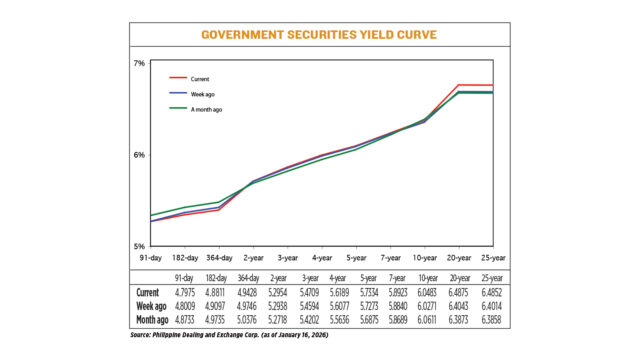
GS yields, which move opposite to prices, went up by an average of 1.48 basis points (bps) week on week, based on the PHP Bloomberg Valuation Service (BVAL) Reference Rates as of Jan. 16 published on the Philippine Dealing System’s website.

At the short end of the curve, rates went down across the board. The 91-, 182- and 364-day Treasury bills (T-bill) dropped by 0.34 bp (to 4.7975%), 2.86 bps (4.8811%), and 3.18 bps (4.9428%), respectively.

Meanwhile, all yields at the belly and the long end ended higher week on week. Rates of the two-, three-, four-, five-, and seven-year Treasury bonds (T-bonds) rose by 0.16 bp (to 5.2954%), 1.15 bps (5.4709%), 1.12 bps (5.6189%), 0.61 bp (5.7334%) and 0.83 bp (5.8923%), respectively.

The 10-, 20-, and 25-year bonds also went up by 2.12 bps, 8.32 bps and 8.38 bps to yield 6.0483%, 6.4875% and 6.4852, respectively.

GS volume traded amounted to P71.97 billion on Friday, higher than the P55.42 billion recorded a week earlier.

“The upward drift in yields was driven largely by de-risking toward the latter part of the week as investors positioned ahead of the upcoming bond auctions scheduled through the end of January, which are concentrated in the longer segments of the curve. With supply pressure building on the long end, investors took a more cautious stance, prompting yields to inch higher,” ATRAM Trust Corp. Chief Investment Officer Alessandra P. Araullo said in a Viber message. “Global cues played a minimal role as local markets mainly responded to supply expectations rather than external macro drivers.”

On Tuesday (Jan. 20), the Bureau of the Treasury (BTr) will auction off P30 billion in reissued 20-year bonds with a remaining life of seven years and two months.

It will also hold a dual-tranche bond auction on Jan. 27, where it will offer reissued three- and 20-year debt.

Ms. Araullo said the market focused on the upcoming issuances amid a lack of fresh leads.

“At this stage, inflation is no longer the primary driver of yield movements. While past CPI (consumer price index) readings provided initial direction, the market has now shifted its focus toward bond supply and auction outcomes… With no fresh catalysts on the local macro front, inflation has taken a back seat; the market is instead positioning for how upcoming issuances will be received.”

Rate cut expectations for the Bangko Sentral ng Pilipinas (BSP) following the below-target 2025 Philippine CPI data released earlier this month caused a slight decline in GS yields early on, but inflation risks for this year also capped the downside, a bond trader said in a Viber message.

“The movers [last] week were mainly from delayed data releases from the US. Both softer US inflation reports with a strong bump in US retail sales underscored the strength of US consumption spending, which solidified views that the Federal Reserve might not need to deliver a rate cut by the end of the month,” the trader added.

US data last week showed inflation pressures were stable in December, but consumers faced higher food prices and rents, Reuters reported.

Though economists expect the Fed will keep its benchmark overnight interest rate in the 3.5%-3.75% range at its Jan. 27-28 meeting, reductions in borrowing costs are anticipated this year to safeguard the labor market.

Economists expect the government to report next Thursday that the personal consumption expenditures (PCE) price index, excluding the volatile food and energy components, increased 0.2% in November, matching the estimate for October. The PCE inflation data, tracked by the Fed for its 2% inflation target, was delayed by the 43-day federal government shutdown.

For this week, the bond trader said GS yields may continue to be range-bound.

“Despite the expected release of PCE inflation and US GDP reports [this] week, yields might move sideways with some downward pressure as the latest economic data from the US and the Philippines are unlikely to change current market expectations for both the Fed and the BSP moves just yet,” the trader said.

Ms. Araullo said yield movements will be largely driven by the results of the BTr’s bond auctions. “With the upcoming issuances concentrated in the longer parts of the curve, investor demand will determine whether yields continue to edge higher or stabilize,” she said. “If the auctions attract strong bidding, this could support buying momentum and help cap or even reverse the recent uptick in yields.”

“However, weak demand — especially for longer-dated bonds that carry heavier supply — could limit bond rallies and keep upward pressure on yields. Given the absence of major local catalysts, the market will be taking its cues primarily from these auctions. Supply dynamics will guide investor behavior across tenors, and the tone set by the first rounds of bidding will likely influence sentiment for the rest of January.” — Lourdes O. Pilar with Reuters

ADVERTISEMENT
ADVERTISEMENT