Home Blog Page 4229

High medicine costs expose widening gap between rich and poor Filipinos

Illustration photo shows various medicine pills in their original packaging in Brussels, Belgium, Aug. 9, 2019. — REUTERS/YVES HERMAN/ILLUSTRATION

By Patricia B. Mirasol, Reporter

KAREN NINA IBAÑEZ-DANAO, a 47-year-old homemaker, knows how expensive life-saving medications can be.

In 2021, she started using Arixtra, an injectable that prevents blood clots, after she was diagnosed with recurring strokes.

“Unfortunately, it’s expensive,” she said in a Facebook Messenger chat. “We spent P60,000 for two weeks’ worth of Arixtra. There was no way we could afford to continue the treatment, so I started raising funds and asked my doctor for cheaper alternatives.”

She switched to oral medication after two months: “I didn’t want to keep raising funds for my medicines because we’ve all been affected by a coronavirus pandemic.”

As the rise in health expenditures outpaces economic growth worldwide, consumers in the Asia-Pacific region without universal health coverage continue to face high out-of-pocket costs, which account for about half of healthcare spending in these countries, according to the Medicines, Technologies and Pharmaceutical Services program of the US Agency for International Development.

“Because pharmaceuticals make up 25% of total health expenditure and, typically, an even larger share of out-of-pocket costs, it is essential to control pharmaceutical costs as a key step toward universal health coverage,” it said in a November 2022 report.

In the Philippines, where a breast cancer patient needs as much as P450,000 to complete 18 treatment cycles, medicine and treatment costs remain an obstacle.

The greatest barrier to medicine access is pricing, according to a report released in January by Takeda, a Japanese pharmaceutical company.

“This is not because specific options aren’t available, but because they are completely out of reach in terms of pricing and are not covered under national insurance schemes,” said Jorge G. Ignacio, a medical oncologist interviewed in the report.

The Philippine Institute for Development Studies (PIDS), a state think tank, also found that the elderly, women, rural and poor Filipinos are more likely to pay out-of-pocket healthcare costs. The Philippine Health Insurance Corp. (PhilHealth) covers only 40% of hospital costs.

Ms. Ibañez-Danao, who spends north of P30,000 a month on medicines out of pocket, says she does not receive help from PhilHealth for medicine expenses.

Mr. Ignacio, who is also chairman of the Philippine General Hospital’s Cancer Institute, said the world is living in an era of precision treatments.

“We look at the genes already and tailor medicines that fit patients in a way that’s more effective,” he said via Zoom. “This would mean that we are going to use medicines that are more technologically advanced, and that would mean higher costs for patients.”

He said the standard treatment of chemotherapy remains effective but adding targeted therapies could mean longer remission time and better survival.

These new therapies are exposing the widening gap between rich and poor Filipinos.

“The rich will be able to live longer and the poor who can’t afford the newer drugs will settle for the older ones that we have,” Mr. Ignacio said.

“Living longer will be a privilege of the richer ones, and that would be terrible,” he said. “We can’t allow things like that to keep on happening. We need to find ways to be able to bridge the gap.”

PRICE CONTROLS
Medications were among the most sent items through Philippine mail, according to Roger M. Tumlos, acting manager at the express mail exchange department of the Philippine Post Office in Manila.

His department ensures that prohibited items are caught during the sorting process. “We encounter all sorts of medications, especially those for cancer, because they’re expensive here,” he said during a tour of the post office.

These medicines, which mostly come from India and Pakistan, are released subject to allowed quantities, he pointed out.

Targeted therapies notwithstanding, the situation today is better than it was two decades ago, when few local companies involved in oncology called the shots in pricing, Mr. Ignacio said. Both the Generics Act of 1988 and the Universally Accessible Quality and Cheaper Medicines Act had helped bring down costs, he added.

“Doxorubicin antibiotic used to be P5,000 per vial,” the doctor said. “Now, you can purchase a 50-milligram one for as little as P800 pesos. Cyclophosphamide used to be P900; now, it’s just P300.”

The prices of many of these drugs have gone down due to the influx of medicines from India, South Korea and Indonesia, Mr. Ignacio said.

The Pharmaceutical and Healthcare Association of the Philippines (PHAP) has been lobbying against price limits on medicines. The Universal Health Care Act regulates health goods and services including drug prices.

The law on cheaper medicines recognizes that price regulation is only a reserve instrument, and that an effective competition policy is still a better tool to lower drug prices, PHAP Executive Director Teodoro B. Padilla said in an e-mail.

“The use of price regulation can result in delays in the introduction of new medicines and forces the withdrawal of existing products from the market,” he added.

Mr. Padilla said only 13% of 460 new medicines launched globally from 2012 to 2021 are made available in the Philippines.

“Aside from depriving patients access to newer, lifesaving therapies, price regulation also negatively impacts trade, and has a chilling effect on potential pharmaceutical investors,” he said.

PhilHealth’s outpatient drug benefit package and pooled procurement at state hospitals could be improved by increasing government funding for medicines, Mr. Padilla said.

Out-of-pocket spending in countries that have embedded access to medicine programs at all levels of care has fallen to less than 50%, Mr. Padilla said. These include Australia at 47%, South Korea at 42% and Thailand at 9%.

He also said it would help to streamline the review process for prescription drugs that qualify for government procurement and PhilHealth reimbursement.

“The power of price negotiation and pooled procurement, both of which are provided for under the Universal Health Care Act, can be seen with the Health department’s earlier experience in lowering the price of a cancer drug by at least 66% when it procured the medicine in bulk,” he added.

“If an oncology society would buy in bulk, you’d be able to bargain for a cheaper price,” Mr. Ignacio said. “The DoH does this. If we can do it for every kind of medicine, we can get all these drugs at cheaper prices.”

Universal healthcare, which became a law in February 2019, “guarantees equitable access to affordable and quality health services.” It also aims to improve doctor-to-patient ratio, upgrade hospital bed capacities and equipment and set up more hospitals in remote areas.

The program’s success, however, depends on having a healthy population that can pay taxes and PhilHealth insurance premiums, leading the Health department to focus on preventive care.

No one sector can lower drug prices alone, Mr. Ignacio said. “We need a lot of help. If we can put our act together, we’ll be able to solve this burden.”
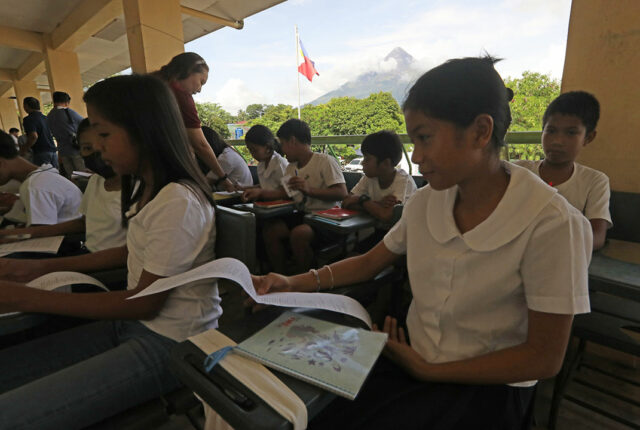

PHL seeks $500-M WB loan for safer school infrastructure

Students attend a class at San Jose Elementary School in Malilipot, Albay province, June 15. The students and their families were forced to evacuate from their homes due to Mayon Volcano’s unrest. — PHILIPPINE STAR/EDD GUMBAN

THE PHILIPPINES is seeking a $500-million loan from the World Bank (WB) to support the rehabilitation of schools affected by natural calamities such as typhoons and earthquakes, as well as strengthen their disaster preparedness.

The proposed Infrastructure for Safer and Resilient Schools project will address the physical rehabilitation needs and boost the resilience of disaster-affected schools in the Philippines, according to a loan document uploaded on the World Bank website.

“It will address the need for recovering affected school infrastructure, which has been impacted mostly by multiple tropical cyclones and earthquakes between 2021 and 2023. This will contribute towards overcoming the problem of learners attending schools in poor physical conditions, including temporary learning spaces,” it said.

The project costs $501.25, according to the World Bank. Its board is expected to take up the loan proposal at its meeting on May 30, 2024.

The project is expected to cover over 3,000 schools mainly in Caraga, Cordillera Administrative Region, and Regions III, V, VI, VII, VIII, and XI. It will be implemented by the Department of Education (DepEd) and Department of Public Works and Highways (DPWH).

The Philippines is one of the most disaster-prone countries in the world. About 20 cyclones enter the country every year.

From 2021 to 2023, there were 3,484 school facilities affected by disasters nationwide, data from DepEd showed.

Data also showed that there are 7,250 schools located in high seismic zones; 8,000 near rivers; 5,000 by coastlines; and 1,200 on islands.

The project will focus on investments for the recovery of disaster-struck school infrastructure; project management and monitoring to ensure effective implementation; and an ex-ante financing mechanism for emergencies, according to the loan document.

“The proposed project will support the integration of vulnerability reduction criteria into rehabilitation designs so that rehabilitated school buildings will have an enhanced performance in the face of future hazard events. To do so, the proposed project will support a damage and vulnerability assessment of affected school facilities,” it added.

It also aims to address the low attendance of students due to the poor physical conditions of schools.

The Philippines’ active official development assistance (ODA) portfolio had inched up by 0.5% to $32.4 billion as of end-2022, according to the National Economic and Development Authority (NEDA).

“This comprised of 106 loans amounting to $30.2 billion and 320 grants totaling $2.2 billion. These loans and grants were provided by 20 development partners and implemented by 84 government agencies,” NEDA said in its ODA 2022 Portfolio Review.

Meanwhile, overall loan disbursements stood at $4.82 billion as of end-2022, lower than $5.52 billion at end-2021.

“For project loans alone, the actual disbursements reached $2.21 billion, reflecting a slight increase of $54 million compared with the disbursements in 2021,” NEDA said.

“Considering drawdowns from previous years, the cumulative disbursements of active loans amounted to $15.84 billion, representing 52% of the total net commitment of $30.2 billion in 2022,” it added.

By source, the Asian Development Bank (ADB) was the country’s top provider of ODA in the Philippines. This accounted for 33.47% of the total portfolio, equivalent to $10.85 billion.

The NEDA noted that the ADB surpassed Japan as the leading source of ODA last year, which “held the top position for the preceding seven consecutive years.”

Japan accounted for 30.75% of the total portfolio or $9.96 billion, followed by the World Bank ($6.86 billion), China ($980 million), and South Korea ($910 million). — Luisa Maria Jacinta C. Jocson

Uy’s PH Resorts finds investor for gaming project

CEBU-BASED property developer AppleOne Properties, Inc. is looking to invest in two subsidiaries of Dennis A. Uy-led PH Resorts Group Holdings, Inc. that could cover the latter’s gaming project. 

In a regulatory filing on Tuesday, PH Resorts said that its subsidiaries Lapulapu Leisure, Inc. and Lapulapu Land Corp. signed a “non-exclusive and non-binding” memorandum of understanding (MoU) with AppleOne for an investment plan.

PH Resorts is the gaming and tourism holding company of Mr. Uy’s Udenna Group. The company previously said that it was looking for investors to help bankroll the Emerald Bay project.

“The MoU establishes broad parameters whereby AppleOne can make an investment in the subsidiaries, with the intention of obtaining at least a majority of the equity interest in the subsidiaries, or an asset purchase of the land and improvements of the Emerald Bay Project,” PH Resorts said. 

The Emerald Bay project, situated in Mactan, Cebu, is a planned integrated resort and casino.

“The consideration for the investment and resulting percentage of ownership are still subject to final negotiations by the parties, which are expected to be completed within 60 days, based on the MoU,” the company added.

The final details of the planned investment have yet to be completed, PH Resorts said, adding that it will release the required disclosures when the deal terms are finalized and the definitive agreements have been signed.   

Meanwhile, PH Resorts said its two subsidiaries had restructured their existing outstanding indebtedness with China Banking Corp. (Chinabank) via the execution of agreements for the sale, leaseback, and an option to buy back certain land and improvements.

The company said the restructuring covers the properties of the two subsidiaries in Lapu-Lapu City spanning 12.5 hectares, plus improvements.

“The restructuring also allows the subsidiaries to repay the peso bridge loan facility extended by Chinabank in 2018, while, at the same time, grants them continued possession and use over the property in order to finish the construction and development of the Emerald Bay Project,” PH Resorts said.

It added that the restructuring’s buyback option allows the subsidiaries or their nominees to reacquire the properties, “if so desired.”

Emerald Bay is planned to have a total of 146 gaming tables, 729 electronic gaming machines, 780 hotel room bays, and five villas. PH Resorts started the construction of the project in December 2017. 

Based on its website, AppleOne is led by enterprising couple Ray and Venus Manigsaca. The company has property development projects in the residential, hotel and resort, commercial, and healthcare sectors.

Some of AppleOne’s projects are the VisayasMed City Center Cebu City, Sheraton Cebu Mactan Resort, and AppleOne Banawa Heights. 

On Tuesday, shares of PH Resorts at the local bourse improved five centavos or 8.06% to close at 67 centavos apiece. — Revin Mikhael D. Ochave

MerryMart says its mini-mart plan will help sari-sari stores

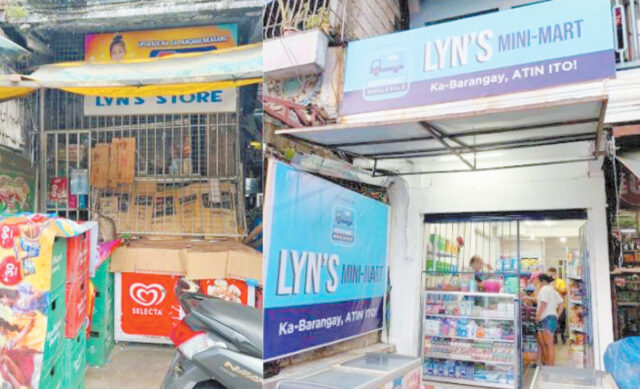
MERRYMART’S project aims to help the transformation of a sari-sari store (left) to become a mini-mart (right) while purchasing its grocery inventory from the MM Wholesale app.

LISTED retailer MerryMart Consumer Corp. is banking on its mini-mart project to help the transformation of sari-sari or small family-owned stores, its top official said.

“We have been observing and studying in detail the sari-sari store industry around the country, and we believe that the true long-term solution for these hundreds of thousands of sari-sari stores to thrive is to transform and become a mini-mart,” MerryMart (MM) Chairman Edgar J. Sia II told the local bourse on Tuesday.   

“From doing the selling of items from a small hole in their window, they transform to become a grocery mini-mart where their customers or ‘suki’ can now enter their ‘tindahan,’ just like the setup of their branded and modern mini-mart competitors that recently opened near their sari-sari stores,” he added. 

Mr. Sia said this as MerryMart announced the opening of its 100th mini-mart member supplied by MM Wholesale. The new store opening is part of a project of MM Wholesale, which helps the transformation of a sari-sari store into a mini-mart while buying their grocery inventory from the MM Wholesale application. 

The MM Wholesale app has more than 180,000 registered users, according to MerryMart.

MerryMart’s mini-marts have a presence in various locations across Manila, Pangasinan, Nueva Ecija, Tarlac, Bulacan, Cavite, Laguna, Rizal, and Bataan. 

Based on its website, MerryMart is engaged in the operation of retail stores in the supermarket and household essentials category.

In the first half, MerryMart logged a 24.8% jump in its net income to P40.24 million, while revenues rose 29% to P3.7 billion. 

On Tuesday, shares of MerryMart at the local bourse increased one centavo or 0.88% to close at P1.14 each. — Revin Mikhael D. Ochave

NDC and Singapore firm tie up to boost startups

The memorandum of understanding was signed in Manila by Antonilo DC. Mauricio, general manager of NDC, and April Ong Vaño, head of environment, social, and governance at Quest Ventures. It was witnessed by Jerahmeel Chen, chief innovation officer at iHub.

STATE-OWNED enterprise investor National Development Co. (NDC) partnered with Singapore-based venture capital firm Quest Ventures to drive startup innovation and investments in the Philippines.

“We are excited to join forces with Quest Ventures in our pursuit of innovation and startup industry growth,” NDC General Manager Antonilo DC. Mauricio said in a statement.

Mr. Mauricio said that Quest Ventures’ footprint in Singapore and across Asia will be valuable in “enhancing local venture capital ecosystem and promoting sustainable investments.”

The collaboration aims to leverage the combined expertise and resources of the two companies.

NDC will be leveraging on its newly established Philippine Innovation Hub, which will house the headquarters of the Startup Venture Fund, the Philippine E-commerce Platform, and the Philippine AI (artificial intelligence) Research Center.

“Quest Ventures is delighted to join the NDC in these important efforts to transform the Philippines’ startup and innovation ecosystem by improving access to venture capital,” said April Ong Vaño, head of environment, social and governance at Quest Ventures.

She added that the firm will be bringing its venture capital courses and accelerators to important hubs in the Philippines.

“We also look forward to implementing Philippine-specific programs to address new sectors of opportunities such as sustainability,” she said.

Quest Ventures’ portfolio companies include Carousell, Shopback, Carro, 99.co, and Vulcan Post. Its innovation clients are Coca-Cola, HP, Nissan, and Tencent, among others.

Aside from the partnership with Quest Ventures, NDC has also signed a memorandum of understanding with De La Salle-College of Saint Benilde, Embiggen Group, and Bizbaz.

Quest Ventures, which operates in more than 150 cities across Asia, has more than 100 companies backed by venture capital. — Justine Irish D. Tabile

When tragedy leads to faith and art

SAINTS and religious icons serve as important anchors for people going through the darkest of days, when they must keep a steadfast hold on their faith to stay sane and to ultimately stay alive. At the Admiral Hotel Manila, one man’s paintings hang on the walls, a testament to how it’s possible to turn grief into hope.

Titled “Fidem,” which is the Latin word for “faith,” photographer-painter Jayson Vicente-Isaac’s very first exhibit shares the power of art in his journey of healing after losing his husband, photographer Raymund Isaac, to the coronavirus.

Making this even more tragic was that their happy marriage was very short lived. In July of 2021, the couple tied the knot in Las Vegas in the United States, but shortly after Raymund contracted the virus. He died in September that year.

This is when Mr. Vicente-Isaac sought solace in painting to express his grief and process his emotions. He had taken up painting during the pandemic, something he had never got to do in all his years as an interior design professional and later as a photographer.

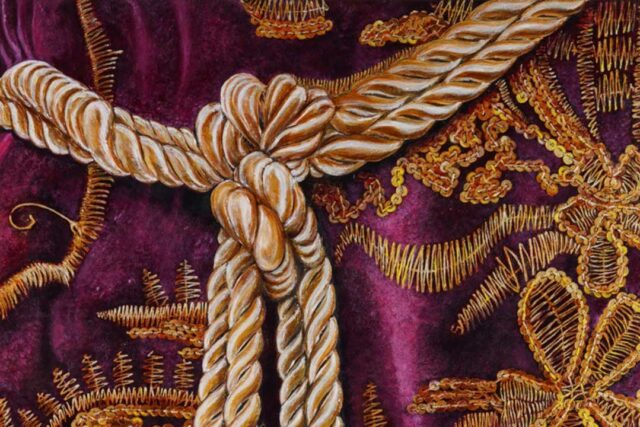
The most striking example of how he dealt with grief through art is his acrylic work Nazareno, which emerged from his constant prayers to the Black Nazarene all throughout his husband’s 43-day hospitalization. It shows neither the entire body nor the face of the famous religious image, instead zooming in on the minute details of the Nazarene figure’s robes, from the maroon velvet cloth with embroidered gold lining to the firm, secure golden ropes that hold the intricately made vestments together.

When Mr. Vicente-Isaac unveiled the painting at the exhibit’s launch, a respectful hush fell over the room as everyone pondered the attention to detail it must have required, compounded by the painter’s need to revisit so frequently the memories of staring up at the religious icon during his darkest days.

He admits that he was never really a religious person, and only truly became so when he fervently prayed for Raymund’s recovery at St. Patrick’s Church in San Francisco, California. “I feel mixed emotions. I can’t even say if I’m proud of this work. I just want to share what I worked on during that time,” he said.

That his devotion led to a remarkable body of work that would become his debut art exhibit, is a cruel twist of fate that is not lost on him.

“I just had to keep busy. The level of grief I experienced is something I wouldn’t want anyone to experience. It’s the darkest ever,” said Mr. Vicente-Isaac.

Aside from Nazareno, his acrylic works on canvas and wood are all named after the various religious images he prayed to in his time of despair, his own perspective shining through by zeroing in only on their partial images. These works include Padre Pio, Guadalupe, Divine Mercy, and St. Expeditus.

Another part of the exhibit shows magnified details of buttons, zippers, prints, and fabrics once worn by Mr. Vicente-Isaac’s loved ones who had passed on. They are named 2016, 2017, 2018, and 2019, and so on, referring to consecutive yearly losses, from Jayson’s parents to Raymund’s mother and younger brother.

The 16-piece art exhibition may seem dark, but it is ultimately a love letter and an avenue for healing and deep faith.

“People who will buy my works are lucky because so many prayers and emotions were invested in it,” he said at the launch.

Most of the pieces are for sale, with proceeds to go to the Positive Action Foundation Philippines, Inc. (PAFPI), a group dedicated to empowering and helping people living with HIV and AIDS.

Fidem” is on view at the Admiral Hotel Manila until Oct. 10. — Brontë H. Lacsamana

Fruitas buys foodpanda kitchen equipment for unit’s operations

LISTED Fruitas Holdings, Inc. has bought kitchen equipment previously owned and used by food delivery platform foodpanda to improve the operations of its cloud kitchen subsidiary.

In a stock exchange disclosure on Tuesday, Fruitas said its wholly owned unit Fly Kitchen, Inc. acquired the kitchen equipment to help expand its cloud kitchen offerings and capabilities.   

“We are pleased to announce this tactical purchase of top-quality kitchen equipment from foodpanda. This decision reflects our dedication to providing outstanding gastronomic experiences to our patrons,” Fruitas President and Chief Executive Officer Lester C. Yu said.

The deal came after Delivery Hero confirmed the potential sale of its foodpanda business in select Southeast Asian markets such as Singapore, Malaysia, Philippines, Thailand, Cambodia, Myanmar, and Laos.

Delivery Hero is the German-based parent firm of foodpanda.

“With the advanced kitchen technology, Fly Kitchen is now able to expand its menu with new methods, processes, and flavors. The use of cutting-edge equipment allows the company to streamline every aspect of its operations, from food preparation to presentation, resulting in even higher service and product quality,” Fruitas said. 

“Additionally, the advanced kitchen equipment will give Fly Kitchen the freedom to experiment with new recipes which will excite the taste buds of its loyal consumers and new customers. Finally, the kitchen equipment will open the door for the company to collaborate with and prepare third-party brands which would fit well with its present cloud kitchen operations,” the company added.

According to Fruitas, some of the brands established by Fly Kitchen include Hatid Pinoy, Jade Express, and Kanin at Sabaw.

In the first half, Fruitas posted a 48% increase in its net income to P43.5 million compared to P29.3 million due to higher revenues.

On Tuesday, shares of Fruitas at the local bourse rose four centavos or 3.57% to end at P1.16 apiece. — Revin Mikhael D. Ochave

NCCA launches Museum and Galleries Month

STUDENTS take pictures at the National Museum of Natural History. — PHOTO FROM NCCA

TO EMPHASIZE the role of art galleries and museums in enriching the Filipino culture, the National Commission for Culture and the Arts (NCCA) unveiled the events to be held during Museum and Galleries Month.

Held every October since 1991 by virtue of Presidential Proclamation No. 798, the celebrations focus on the preservation of artistic heritage, the promotion of artistic expression, and the fostering of a deeper understanding of Philippine history and identity.

“Philippine art has always reflected the conditions and struggles of each society. This year’s theme of celebration embraces art as social responsibility. It leaps away from the general view that art is solely made for entertainment,” said Oscar G. Casaysay, executive director of the NCCA, at the launch.

“Art patrons, collectors are growing in numbers. Filipinos with money wisely spend on and invest in art. The government sees this,” he added.

The kick-off event was held on Oct. 1 at the Old Senate Session Hall in the National Museum of Fine Arts in Manila.

With the theme “Exhibits and Reflections: Crafting Opportunities for the New World,” the NCCA and the National Museum take on the challenge of ensuring the place of museums and galleries in modern-day Philippines.

“What a Filipino today gets from museums is a space for conversation, contemplation. It doesn’t matter if they go there on a date or to make content for Instagram or TikTok. Choosing to go to the museum rather than the mall is already a win. It can then be their entry point to local art and culture,” said Jorell M. Legaspi, the National Museum’s deputy director general for museums.

EVENTS
Arts Month actually kicked off before October, when the Mindanao Art Fair was held from Sept. 25 to Oct. 1. It highlighted how Mindanaoan artists recovered and adapted to the “new normal.” Their works were displayed all throughout SM Lanang in Davao City.

Meanwhile, artworks inspired by the social, cultural, and community environments of the Northern Luzon region were on view at the 13th Tam-Awan International Arts Festival in Tam-Awan Village, Baguio, from Oct. 4 to 8.

The public can visit exhibitions on traditional weaving for free at the NCCA Gallery in General Luna St., Intramuros throughout October. One exhibit, “BUILDA: Contemporary Itneg Weaves,” features the cloth and embroidery of the Agaid-Mina clan, particularly by Normandino Mina, Sr. and his family. Another exhibit, “INUBON a DAYAW (Strings of Hope),” showcases the life and works of Manlilikha ng Bayan Magdalena Gamayo, a rare chance to see the inabel master’s creations framed in clear acrylic sheets.

Meanwhile, the 15th ManilART fair will take place from Oct. 11 to 15 at the SMX Aura Convention Center, Taguig City. Thirty galleries are participating in the art fair, which will also have two special project areas. It also hosts an art tour for over 1,000 students as part of the NCCA’s initiative to expose Filipino youth to local art.

Over in Tarlac City, the Luzon Art Fair will be held from Oct. 26 to 29, with over 75 artists, museums, and galleries participating. It aims to revitalize Central Luzon’s art and culture scene by working with various sectors such as artist-led groups, emerging artists, academia, and business.

“Whichever museum or gallery you choose to go to this month, you will surely be welcome,” said Mr. Legaspi, reiterating that there will always be a place for Filipinos to learn more about their arts, culture, and heritage. “In a world where information feels saturated and fleeting, museums and galleries offer a sanctuary of depth and contemplation.” — Brontë H. Lacsamana

Royal Air set to resume Clark airport operations in October

ROYAL AIR FACEBOOK ACCOUNT

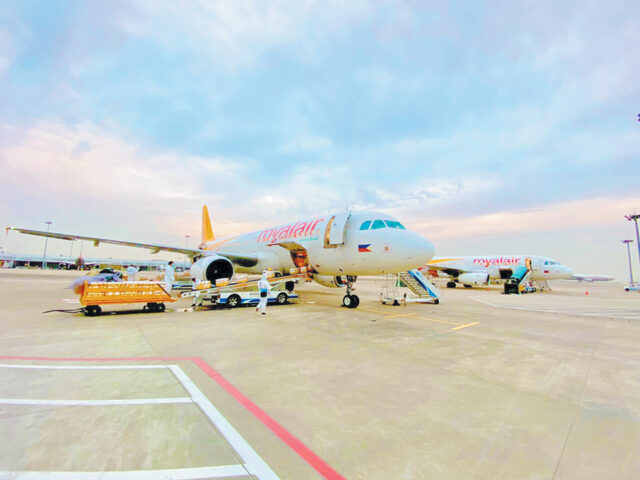
ROYAL AIR Philippines is set to resume its operations at Clark International Airport this month, the local budget airline announced on Tuesday.

In a media release, Royal Air Philippines said its Hong Kong-Clark and Clark-Hong Kong direct flights are set to resume this Sunday to boost travel from the Philippines and Hong Kong.

“Adding a layer of convenience is CRK’s hassle-free travels and seamless journeys,” Royal Air Philippines said, referring to the Clark airport.

“The premier gateway operates from its expansive and innovative passenger terminal building, which offers A-1 amenities, luxury of space, and faster check-in or arrival process,” it added.

In August, the Department of Tourism (DoT) announced that 58 new weekly international flights will be added this year, including Royal Air’s weekly flights.

According to the DoT, Clark in June reported a 180% increase in incoming scheduled weekly frequencies and a 215% rise in incoming weekly seats, which it attributed to increased new routes and resumption of services.

For this year, the Tourism department is targeting 4.8 million international arrivals compared with 2.65 million last year. — Ashley Erika O. Jose

Arts & Culture (10/04/23)


Yasmin Sison, Maya Muñoz solo exhibits at Silverlens

SILVERLENS Manila presents two solo exhibitions this October, highlighting two different forms of artistry. “Time is a Restless Sea” sees Yasmin Sison create autobiographical paintings, as she has done so for over two decades, with fleeting moments captured and memorialized in pigment and canvas. Meanwhile, “Drift and Vapor” explores expanded printmaking, which combines a screen-print process with painting and photography, through Maya Muñoz’s new series of works. Her prints depict landscapes and communities from everyday life. Both exhibitions will have their opening reception on Oct. 5, 4 p.m., at Silverlens Manila, at 2263 Chino Roces Ave., Makati City. They will run until Nov. 4. For inquiries, contact 8816-0044, 0917-587-4011, or e-mail inquiry@silverlensgalleries.com.


Gateway Art Fair runs this weekend

IN CELEBRATION of Museums and Galleries Month, the 2023 Gateway Art Fair opens on Oct. 5, 10 a.m., at the Quantum Skyview, Gateway Mall 2. Organized by Gateway Gallery, the three-day art fair will gather art groups from Metro Manila and nearby provinces to showcase their works and talents. Apart from exhibits and art demonstrations, the Gateway Art Fair will also have local artists selling their artworks, and other creative services.


TP brings back Anak Datu

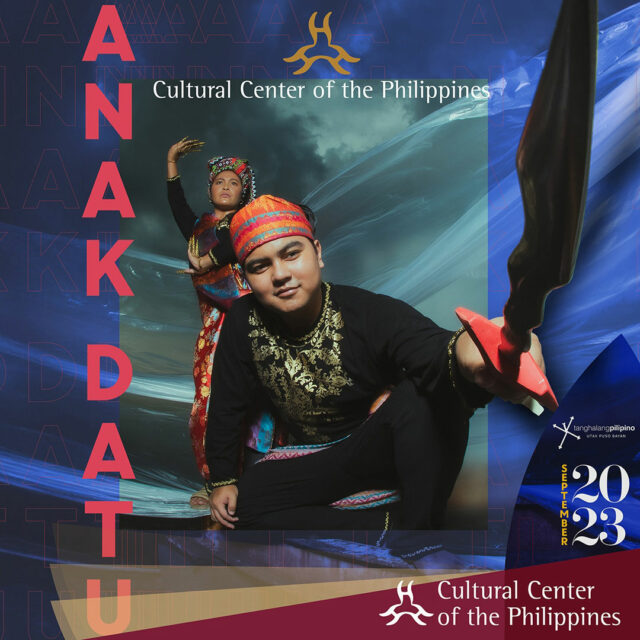
TANGHALANG Pilipino (TP) is currently showing its restaging of National Artist for Visual Arts Abdulmari Imao’s Anak Datu until Oct. 15 at the Tanghalang Ignacio Gimenez (Blackbox Theater) of the Cultural Center of the Philippines. It officially opens TP’s 38th season. A play with music, Anak Datu is based on a story written by Mr. Imao in 1968 and adapted for the stage by veteran playwright Rody Vera. It is about the son of a village chieftain in the Sulu Archipelago in pre-colonial Philippines who grows up believing that his father is a former pirate. When the old man dies, the son discovers the truth. Tickets, costing P1,500, can be booked at https://premier.ticketworld.com.ph/shows/show.aspx?sh=ANAKDATU23.


Madz marks 60th anniversary with a concert

THE PHILIPPINE Madrigal Singers (Madz) is celebrating its 60th anniversary this October. To mark the milestone, a concert entitled Sixty of Plenty will be held from Oct. 6 to 8 at the Samsung Performing Arts Theater in Circuit, Makati. It will celebrate the group’s six decades of being of service to God and the world through music. The shows will also give the audience a glimpse at what is in store for the group in the coming years. Tickets, priced from P400 to P2,500, can be bought at https://premier.ticketworld.com.ph/shows/show.aspx?sh=PMADSING23 .


2TinCans Philippines brings Steel Magnolias to Cebu

THE HEARTWARMING play Steel Magnolias, produced by 2TinCans Philippines, Inc. returns to Cebu this weekend. Mixing seasoned talent and fresh faces, the restaging is set on Oct. 7 to 8 at the Siddhartha Theater, Guang Ming Institute of Performing Arts, V. Rama Ave., Cebu City. It is directed by Vincent Paul Diez Gaton and sees Charlene Virlouvet returning, along with Liana San Diego, Clariza Mae Sevilla, Yvette Yntig, and Marlinda Angbetic Tan. The two additions to the cast are JoAnn Zaldumbilde and Che Solon. Steel Magnolias is a tribute to the bonds of friendship, the strength found in adversity, and the indomitable human spirit. For ticket information and seat reservations, visit  https://2tincans-philippines.yapsody.com.


Women Printmakers exhibit at Ilomoca

THE CULTURAL Center of the Philippines (CCP) brings together prints by women artists from different generations from the CCP 21st Century Art Museum (21AM) Collection for a special exhibition, on view from Oct. 7 to March 2024, at the Iloilo Museum of Contemporary Art (ILOMOCA) in Iloilo City. Dubbed “Potential, Potency, and Women Printmakers: Selection of Prints from the CCP 21st Century Art Museum (21AM) Collection,” the exhibition title comes from the essay written by visual artist Imelda Cajipe Endaya for the 50th anniversary show of the Association of Pinoyprintmakers held at the CCP Main Gallery in 2018. The featured women artists are Ambie Abaño, Glenna Aquino, Ivi Cosio-Avellana, Kristen Cain, Imelda Cajipe-Endaya, Petite Calaguas, Evelyn Collantes, Yas Doctor, Brenda Fajardo, Ofelia Gelvezon-Tequi, Ileana Lee, Lenore R.S. Lim, Araceli Limcaco-Dans, Hershey Malinis, Flora Mauleon, Caroline Ongpin, Henrielle Baltazar Pagkaliwangan, Imelda “Impy” Pilapil, Christina “Ling” Quisumbing-Ramilo, Rhoda Recto, Suchin Teoh, and Phyllis Zaballero. The displayed prints from the 1960s, ’70s, and ’80s were initially shown at the exhibition “WOMAN: Thesis and Antithesis” held at the Yuchengco Museum in March 2023. The exhibit also highlights artist Ileana Lee’s conceptual and abstract explorations in printmaking to illustrate practices by women that visually capture the tactility of the artistic process. The earlier artworks converse with the recent prints from the “20/30: A Limited Edition Print Portfolio,” made in celebration of the CCP’s 50th founding anniversary. “Potential, Potency, and Women Printmakers: Selection of Prints from the CCP 21st Century Art Museum (21AM) Collection” is part of Proven and Printed: ILOMOCA Print Festival, together with two other exhibitions, namely “BAKAS: Filipina Imprints” at the Hulot Gallery and “Print Exchange + @ILOMOCA” at the Ground Floor Lobby. There will be an opening reception and vernissage on Oct. 6, 5:30 p.m., at the ground floor lobby of ILOMOCA. Guided tours will be on Oct. 7, at 11 a.m. and 2 p.m. The CCP Visual Art and Museum Division will have a public program on Oct. 7, 4 p.m., at The Box with Con Cabrera and Desi Tolentino of the CCP VAMD in a two-part discussion on how prints are curated and collected by the CCP. ILOMOCA opens on Tuesdays to Sundays, from 10 a.m. to 5 p.m. The museum is located at Casa de Emperador Festive Walk Parade, Mandurriao, Iloilo City, Iloilo.


CCP brings 21st Century Art Museum to Cebu

THE CULTURAL Center of the Philippines (CCP), in collaboration with Arthaland, presents an exhibition of artworks and artifacts from the CCP 21st Century Art Museum (21AM) Collection at the Arthaland Cebu Exchange in Cebu City. The exhibition, currently on view until Oct. 12 and titled “Udtong Tutok: Art at High Noon,” includes works by National Artists Napoleon Abueva, Federico Alcuaz, Benedicto “Bencab” Cabrera, Ang Kiukok, and Jose Joya, along with works by senior artists Paz Abad Santos, Felix Abesamis, Angelito Antonio, Roderico Jose Daroy, Imelda Cajipe-Endaya, Josefina Escudero, Lao Lianben, David Medalla, Edsel Moscoso, Romulo Olazo, Rod Paras-Perez, Lisa Perez, Manuel Rodriguez, Sr., Solomon Saprid, and Manuel Soriano. Artifacts from different ethnolinguistic groups including the Bagobo, Blaan, Bontoc, Gaddang, Ifugao, Ilongot, Itneg, Kalinga, Mandaya, Manobo, Maranao, and T’boli are also displayed. For more updates, visit CCP’s social media accounts.


Birhen ng La Naval at Gateway

THE IMAGE of the Virgin of La Naval will be enthroned at the Sagrada Familia Church in the New Gateway Mall 2 on Oct. 6. The enthronement at 10 a.m. will be followed by the rosary at 10:30 a.m., and mass at 11 a.m. There will be several activities that afternoon including a video presentation and talk at 1:30 p.m., and the Harana ni Maria concert with the Solemne Choir at 8 p.m., followed by fireworks at 9 p.m. Mass will be held several times throughout the afternoon, along with the recitation of the rosary.


PETA restages Walang Aray

THE PHILIPPINE Educational Theater Association (PETA) is bringing back its recent musical sensation, Rody Vera’s Walang Aray, an irreverent reimagining of Severino Reyes’ classic zarzuela Walang Sugat. This combination of Mr. Vera’s libretto, original catchy tunes by Vince Lim, and director Ian Segarra’s storytelling runs on PETA’s theater stage from Oct. 6 to 22. The musical is led by seasoned theater actors Gio Gahol and Marynor Madamesila, together with Shaira Opsimar and Jon Abella, playing the star-crossed lovers Julia and Tenyong. The feel-good musical romp garnered 21 mid-year citations at the Gawad Buhay Awards in its previous run, including Outstanding Musical, Original Score, Ensemble Performance, and Choreography. The limited three-weekend run of Walang Aray can be seen at the PETA Theater Center, Quezon City. Tickets are now on sale via TicketWorld.


Ang Unang Aswang set to open this October

THE FINAL production in the FEU Theater Guild (FTG)’s 89th season is Ang Unang Aswang. Written by Palanca awardee playwright Rody Vera and directed by FTG’s Artistic Director Dudz Teraña, the play is about the unusual life of a girl, abandoned as a baby in the forest, who is raised by a dog, cat, and boar. The Aswang will alternately be played by Dianne Andallo, Jazzie Alejo, Brigitta Marilla, and Margarita Barrameda. Raffaele Pascua and Arvin Jade Javier alternate as Aso, Davewyn Macawile plays Pusa, Jonas Cunanan is Baboy Ramo, Aaron Bayani is The Binata while The Asawa is played by Kesiah Aritao. The show will run every Wednesday, Thursday, Friday, and Saturday until Dec. 9 at the FCA Studio, Engineering Bldg. at FEU Manila, Nicanor Reyes St., in Sampaloc, Manila. Tickets are priced at P200 for the FEU community and P400 for guests. For details, visit the official webpage of FTG: feutheaterguild.com or FTG’s social media pages.


Maningning Miclat book of poetry winners out now

NINGNING AT LIWANAG, an anthology of Filipino poetry by 10 grand winners of the biennial Gawad Maningning Miclat from 2003 to 2021, is now available. Published by the Maningning Miclat Art Foundation, Inc. (MMAFI) and Erehwon Artworld Corp., the hardbound, full-color book contains 10 photographs by poet and writer Mario I. Miclat to mark the 10 poetry collections. The book and cover design were done by veteran artist and poet Fidel Rillo. The winning collections are by Joselito D. Delos Reyes (Ang Lungsod Namin at Iba Pang mga Tula, 2003), Joseph de Luna Saguid (Pagsilip sa Bunganga ng Araw, 2005), T. Delos Reyes (Bilang Babae, 2007), Kristian Sendon Cordero (Labí, 2009), Enrique S. Villasis (Agua, 2011), Phillip Yerro Kimpo (Hanggitna, 2013), Reparado Galos III (Mga Pagtitig Mula sa Dalampasigan, 2015), Kid Orit (Para Kay P, 2017), Ralph Fonte (Mga Alimbukay ng Agwat, 2019), and Genesis Historillo (Ang Hugis ng Pandemya, 2021). The book is available at the Far Eastern University Tams Bookstore. For inquiries, e-mail maningningfoundation@gmail.com.


Korean novelist holds book talk

THE KOREAN Cultural Center in the Philippines (KCC) is hosting a “Meet the Mentor: K-Novelist Book Talk Show” featuring renowned mystery-thriller author Jeong Youjeong. The award-winning author of the international bestsellers The Good Son and Seven Years of Darkness will talk about the intricacies of her unique storytelling. Translated and published in 22 countries, she has garnered global acclaim for their distinctive style and profound exploration of the “backside of human nature.” She will be lecturing on Oct. 10 and 11 at the National Library of the Philippines, at the Rizal Library at Ateneo de Manila University, and at Fully Booked Bonifacio High Street Branch. Register via this link: bit.ly/K-NovelistTalkReg.


Bencab Museum presents Delotavo’s new paintings

COMING to the Bencab Museum this October is Antipas “Biboy” Delotavo with 10 new paintings. His exhibition, titled “Objet D’Art,” shows how his social realist perspective and skills as a painter go hand in hand with a keen sense of human observation. Here, the humans in his paintings are treated as still lifes, reduced to being objects in his art. The exhibit’s opening reception is on Oct. 14, 4 p.m., at the Bencab Museum at Km 6 Asin Road, Tuba, Baguio City. The exhibition runs until Nov. 26.

AirAsia Philippines aims to sell half-a-million seats by Q4

NEWSROOM.AIRASIA.COM

AIRASIA PHILIPPINES targets to sell about half-a-million seats to air travelers by the fourth quarter amid stronger demand for foreign travel this year.

“AirAsia Philippines continues to herald the return of international tourism through affordable and convenient flights. In fact, we see our performance on international flights increasing to half a million seats sold before the end of December 2023,” Steve F. Dailisan, head for communications and public affairs at AirAsia Philippines, said in a media release.

As of October, the budget airline said that it sold about 300,000 seats for travel in the next 90 days for Taipei, Incheon, Osaka, Narita, Hong Kong, and Bangkok.

“We hope to flourish in the APAC (Asia-Pacific region) next year as we open more destinations following the increase in aircraft fleet,” Mr. Dailisan said.

AirAsia Philippines added that it aims to add more routes to Japan and China via the Clark International Airport, Mactan-Cebu International Airport, and Kalibo International Airport amid increasing demand. 

Earlier, the low-cost carrier said it was optimistic about a better performance in 2024 after the renewal agreement between its parent firm and engine provider CFM International.

The parent firm of AirAsia Philippines — Capital A Berhad — earlier announced that it was aiming to fully reactivate its 204 aircraft after a new agreement with CFM International. — Ashley Erika O. Jose

Four days in a Palawan paradise: Its many peoples

LIONHEARTFARMS.COM.PH

(Part 4)

During the different activities that were part of the celebration, we got a glimpse of the cultural diversity on the entire island. The rich cultures of the various indigenous tribes were in display: Tagbanua, Batak, Palaw’an, Tau’t Bato, Molbog, Agutayon, and Cuyunon are among the area’s very diverse indigenous ethnolinguistic groups. These are the cultures that are co-existing peacefully with the Christian faith. Some of them have actually enriched the outward manifestations of Christianity that is always open to other cultures as regards external practices. The most pervasive of the cultures is that of the Cuyunons which, unlike other tribes, are everywhere in the province, including Puerto Princesa. The Cuyunons have embraced modernization and incorporated it into their daily lives, integrating smoothly into Palawan society. It can be easily observed that the agri-tourism thrust of the largest province in the Philippines is further enriched by the cultures of the different indigenous tribes.

As reported in Wikipedia, a team of anthropologists from the National Museum, led by Dr. Robert Fox, unearthed fossils at Lipuun Point (now known as the Tabon Cave Complex) in Quezon town that were classified as those of Homo sapiens and believed to be 22,000 to 22,400 years old. The recovery of the Tabon Man and other significant findings in the area earned for Palawan the title “The Cradle of Philippine Civilization.” Further research has shown that the Tagbanua and Palaw’an are possible descendants of the Tabon Caves’ inhabitants. Their language and alphabet, farming methods, and common belief in soul relatives are some of their cultural similarities.

Among the ethnic groups is the Batak, which means “mountain people” in Cuyonon. They are a group of indigenous people who reside in the rugged interiors of northeastern Palawan. Living close to the nature, they are a peaceful and shy people, believing in nature spirits with whom they communicate through a babaylan or shaman. Then there are the native-born lowland dwellers called the Palawenos of which the Cuyunon and Agutayanen are sub-groups. The Cuyunons, originally from the town of Cuyo east of northern Palawan, are considered the elite class in this group. They are disciplined and have a highly developed community spirit. Their conversion to Christianity has led to the merging of animistic beliefs with Christian elements to produce a folk Christianity which is the prevailing belief of the Cuyunon. The Agutaynon practice a simpler island lifestyle, with fishing and farming as their main source of livelihood.

Of great interest to tourists focused on indigenous cultures would be the Tau’t Bato which means “people of the rock.” They are a small community of traditional southwestern Palawenos who reside in the crater of an extinct volcano during certain seasons of the year, in houses built on raised floors inside caves, although others have set their homes on the open slopes. They are still primitive in lifestyle, even in their way of dressing. The men still wear G-strings made of bark and cloth, and women wear a piece of cloth made into skirts to cover the lower body. Both of them are half-naked although sometimes the women wear a blouse that is not indigenous but obtained in the local markets.

Because of their uniqueness, the Philippine Government declared that their area is off limits to strangers to protect them from unreasonable exploitation. This tribe subsists on hunting, gathering fruits, and planting crops and rice near the forest. The tribe has recently come under threat from mining concessions that have been granted. The Government, working closely with civil society and private business, must find creative ways of raising their living standards through rural development based on small-scale farming and the establishment of micro-, small- and medium-scale enterprises (MSMEs) while at the same time allowing responsible mining, especially of nickel and copper which are indispensable inputs into the Industrial Revolution 4.0.

Then there are the Tagbanua tribes who are found in central and northern Palawan. They can contribute significantly to the promotion of MSMEs engaged in decorative materials with indigenous designs. They are excellent producers of baskets and wood carvings. They are most famous for their beautifully crafted body accessories such as combs, bracelets, necklaces, and anklets usually made of wood, beads, brass, and copper. The products of these MSMEs can significantly complement the tourism industry.

Of special relevance to religious diversity are the Molbog people who dominate the municipalities of Balabac and Bataraza in southern Palawan. They are the only indigenous people in Palawan where the majority are Muslims. The area constitutes the homeland of the Molbog people since the pre-Spanish era. The Muslim presence was very visible to me in that four-hour road journey I made from Puerto Princesa to Rizal town. I saw many mosques along the highways, interspersed with churches of different Christian denominations. In addition to the physical beauty provided by Nature, the cultural and religious diversity clearly manifest in the island of Palawan is another reason why it can be the tourism center, not only of the Philippines, but at least of the entire ASEAN region.

In fact, the dinner that was held in honor of the Church dignitaries during the 400th Anniversary of Christianity highlighted even more the interweaving of Western, Filipino, and the indigenous cultures. Entertaining the guests were not only the local musical talents (the Church choir that sang during the Mass celebrated by the Papal Nuncio was as good as any Manila-based or internationally known choir) but renown violinist Brian Cimafranca playing (and singing) pieces from Antonio Vivaldi and Brazilian Zequinha de Abreu and local compositions by Louie Ocampo and Ogie Alcasid. There were also the Nightingales combining the beautiful voices of Bernadette Mamaug and Keiko Cayanga — former members of the Madrigal Singers — who have captivated audiences in their most recent performances in China, Canada, the United States, Africa, and Europe. To cap the evening’s musical event was tenor Erwin Notes Lumauag, also a former member of the Madrigal Singers. Combining the natural beauty of the entire province of Palawan with the artistic talents of the Filipinos will be a strong attraction to the millions of tourists in the Indo-Pacific region where the fastest economic growth will be experienced in the coming decades.

Those four days I spent in the paradise that is Palawan gave me a glimpse of what could happen if the Government and the private business sector will closely collaborate to endow the entire province with the necessary infrastructure envisioned in the Build, Build, Build program the BBM Administration is determined to continue with the help of foreign direct investments. To start with, we should seek the help of Spanish, South Korean, or Japanese infrastructure companies, among others, to upgrade the airport in Coron, Puerto Princesa, and San Vicente to world-class levels like that of the Mactan International Airport.


Bernardo M. Villegas has a Ph.D. in Economics from Harvard, is professor emeritus at the University of Asia and the Pacific, and a visiting professor at the IESE Business School in Barcelona, Spain. He was a member of the 1986 Constitutional Commission.

bernardo.villegas@uap.asia

ADVERTISEMENT
ADVERTISEMENT