Home Blog Page 4224

Dining In/Out (10/05/23)



The Pen’s Christmas kicks off on Friday

THE PENINSULA Manila kicks off the holiday season at The Lobby on Friday, Oct. 6 with the annual Christmas Tree Lighting Ceremony and festive music by the Lighter Side Movement Orchestra and The Peninsula Strings. Forty-seven years after its first Christmas tree was lit up, current General Manager Masahisa Oba continues the original message of hope and peace of lighting up the tree with the children from Virlanie Foundation. “At The Peninsula Manila, we make the holiday season easy with planning everything from festive hampers ready for pick-up in our gingerbread house to Christmas decorations in our guest rooms, making it our guests’ home away from home for the holidays,” says Mr. Oba in a release. There will also be a festive concert of holiday tunes that guests can sing along to while enjoying a festive merienda buffet at The Lobby. The Christmas Tree Lighting Ceremony and concert will run from 3 to 6 p.m. The Merienda Buffet costs P3,500 with a flute of Champagne, P2,500 for adults, and P1,250 for children under 12. For inquiries or table reservations, call 887-2888, extensions 6691 and 6694 (Restaurant Reservations), e-mail diningpmn@peninsula.com or visit peninsula.com.


French-Japanese culinary collaboration at Hotel Okura

“A NIGHT of Culinary Craftsmanship” awaits diners as a French-Japanese collaboration will be held at Hotel Okura Manila’s Yawaragi Restaurant at Newport World Resorts on Oct. 11 and 12. The seven-course dinner includes apéritifs from Whyte & Mackay and sake pairing from Philippine Wine Merchants. Leading the kitchen team is chef Gerard Villaret Horcajo, Chef de Cuisine of the Michelin-starred restaurant Elements, inspired by Ciel Bleu of The Okura Prestige Bangkok. Joining him will be chef Keiichiro Fujino, the Japanese executive chef of Yamazato. Reserve a seat for P12,000 net per person, and receive a 20% discount when using a Premier HSBC credit or debit card. A P5,000 down payment is required to avail of the HSBC discount. Seats are limited. For inquiries and reservations, call 5318-2888 or 0917-842-9067 or e-mail chefs.dinner@hotelokuramanila.com.


Oktoberfest at Newport World Resorts

NEWPORT World Resorts has the Weihenstephan Brewery from Bavaria, Germany as its official beverage partner for the Oktoberfest beer festival happening from Oct. 19 to 21, 6 p.m., at The Ballroom, Hilton Manila. The brewery’s seasoned brewmasters fuse traditional processes with state-of-the-art technology to craft Premium Bavaricum, the brewery’s highest standard of quality. Three types of award-winning German beer are coming to Oktoberfest: the Weihenstephaner Original Helle, a light and refreshing drink with a dash of spice; the Hefeweissbier or Yeast White Beer, an elegant, white-foam beer that boasts a balanced and creamy taste with a flavor of bananas and cloves; and the Hefeweissbier Dunkel, a sparkling, full-bodied drink with a note of caramel and a perfect partner to German desserts. This Dark Wheat Beer elicits a velvety mouthfeel and a sweet aroma, winning its spot among locals’ favorites and global beer awards. The festivities also spotlight German sausages and dishes prepared by the integrated resorts’ culinary team. Topping it all off are live performances by the AnTon Showband, drinking games, and special prizes, for P5,200 net per head. For tickets and inquiries, e-mail hiltonmanila_events@hilton.com.


Red Ribbon launches new Rainbow Dedication Cake

FOR SPECIAL celebrations, Red Ribbon suggests its all-new Rainbow Dedication Cake. Covered in rich chocolate icing, it is decorated with rainbow icing and lollipops on top for a party look. Cutting each slice reveals even more rainbow colors, as the soft chiffon comes in blue, pink, and green layers, with chocolate icing between layers. The Rainbow Dedication Cake is available starting at P520 at Red Ribbon branches. It can also be ordered via the delivery website, the Red Ribbon app, the delivery hotline at #87777, or Grab Food and Foodpanda.


DQ releases Floral Cake Collection

DAIRY QUEEN (DQ) has released its new Floral Cake Collection, featuring three new ice cream cakes decorated with a floral touch. First up is the new Strawberry Blizzard Cake, made with DQ’s creamy vanilla soft serve mixed with strawberries, and DQ’s signature fudge and crunch center, finished with pink frosting, and topped with KitKat fingers and pink frosting rosettes. Next is the new Chocolate Blizzard Cake, made with chocolate pieces mixed into DQ’s vanilla soft serve, and DQ’s signature fudge and crunch center. It is then finished with chocolate frosting and topped with KitKat fingers and white frosting rosettes. Finally, there is the new Mango Blizzard Cake, made with creamy vanilla soft serve infused with mangoes, all surrounding DQ’s signature fudge and crunch center. It is then covered in yellow and white frosting rosettes and topped with KitKat fingers. The KitKat Floral Cake Collection has 6” and 8” round cakes. The 6” variant is priced at P749 while the 8” variant is priced at P1,199. Visiting DQ branches for take-out orders or have them delivered by calling the 8911-11-11 hotline or by logging on to dairyqueen.com.ph. They can also be ordered through GrabFood and foodpanda (prices may vary).


Moonleaf Tea Shop holds P13 milk tea promo

MOONLEAF celebrates its 13th birthday with discounts and online giveaways. On Saturdays and Sundays this October, customers can get their second cup of Tall Pearl Milk Tea for P13. Win a free Wintermelon Milk Tea by joining Moonleaf’s weekly community games on its official social media pages. Visit Moonleaf Tea Shop’s website at www.moonleaf.ph or follow their social media via @moonleafteashop on Facebook for inquiries and updates.


New Christmas Chocolate Creations from Jollibee

JOLLIBEE is kicking off the holiday season with the launch of its two new dessert offerings, the Christmas Chocolate Creations. The collection is made up of the Cookie Caramel Sundae and Choco Banana Pie. The Cookie Caramel Sundae, which starts at P59, is a creamy vanilla soft-serve topped with whole and crushed Chips Ahoy! chocolate chip cookies, a chocolate shell coating, and a drizzle of caramel sauce. The Choco Banana Pie, on the other hand, starts at P47 and seamlessly marries sweet banana filling and rich chocolate fudge inside Jollibee’s signature crispy pie crust. Jollibee’s Christmas Chocolate Creations are now available in all Jollibee stores nationwide for a limited time only via dine-in, take-out, or drive-through, via the Jollibee delivery app, JollibeeDelivery.com, #87000, GrabFood, and Foodpanda.


Mang Inasal celebrates nationwide Ihaw Fest this October

MANG INASAL is treating all its customers this October with freebies through the nationwide Ihaw Fest. “As we continue our year-long celebration of our 20th anniversary, Mang Inasal is not only offering the best Ihaw-Sarap deals but also giving our customers free Extra Creamy Halo-Halo for the first two weeks and free Palabok on the second half of our Ihaw Fest,” said Mang Inasal President Mike V. Castro. From Oct. 1 to 15, every purchase of two Chicken Inasal Value Meals (Paa or Pecho) entitles Mang Inasal customers to one free Halo-Halo small (either Extra Creamy Halo-Halo or Crema de Leche Halo-Halo). While from Oct. 16 to 31, every order of Family Fiesta bundles — a bilao of Chicken Inasal and/or Pork BBQ with Java Rice platter and drinks good for up to six people — affords customers the chance to enjoy two free Palabok solos. All offers are available for dine-in, takeout, and delivery. Visit https://manginasaldelivery.com.ph for delivery deals.

Globe boosts ties with local authorities to fight cable theft

GLOBE Telecom, Inc. has strengthened its collaboration with local government units and law enforcement authorities to address the high incidence of cable theft.

“As part of its proactive approach to addressing cable theft, Globe continuously collaborates with our partner local government units and local law enforcement agencies so that together, we can bring a holistic solution to this problem,” said Globe Vice-President for External Affairs Patrick Steven F. Gloria said.

“We look forward to stronger cooperation with our partners to bring cable theft numbers further down,” he added.

Globe said it is seeking to further lower the declining cases in the five months to May, which stood at 476, down 60% from the same period last year.

The company said it is working with local authorities after the 498 cases logged in Cebu City; 171 in Quezon City; 161 in Manila; 118 in Mandaue City, Cebu; 73 in Valenzuela City; 67 in Malabon; 64 in Pasig City; and 62 cases each in Liloan and Consolacion, Cebu.

“Cable theft is a criminal act punishable by law. We work together with authorities and communities to combat this illegal activity to ensure undisrupted service,” Globe At Home Broadband Business Vice-President Raymond Policarpio said.

“With consistently available connectivity, we will be able to support our customers in education, work and livelihood, and provide critical communication services in case of disasters and other emergencies,” he added.

Aside from cable theft, Globe continues to see other incidents of stolen assets in various facilities.

During the first half, Globe recorded 1,545 incidents, including the theft of batteries, fuel, and other electronics and facility hardware. Due to these incidents, Globe recorded 207 outages as of May 2023 in 124 sites.

Meanwhile, the company has been replacing copper wires with fiber optic cables — which have no resale value — to “further discourage unscrupulous persons from targeting copper wires.” — Sheldeen Joy Talavera

Term deposit yields decline on strong demand

BW FILE PHOTO

YIELDS on the term deposits of the Bangko Sentral ng Pilipinas (BSP) went down on Wednesday on strong demand and as inflation is expected to return to the 2-4% target in the coming months.

The central bank’s term deposit facility (TDF) attracted bids amounting to P443.4 billion on Wednesday, above the P380-billion offering and the P421.104 billion in tenders for the P350-billion offer a week ago.

Broken down, tenders for the seven-day papers reached P241.415 billion, higher than the P210 billion auctioned off by the central bank and the P231.567 billion in bids for a P200-billion offer seen the previous week.

Banks asked for yields ranging from 6.4% to 6.469%, narrower than the 6.37% to 6.4895% band seen a week ago. This caused the average rate of the one-week deposits to inch down by 0.67 basis point (bp) to 6.4382% from 6.4449% previously.

Meanwhile, bids for the 14-day term deposits amounted to P201.985 billion, higher than the P170-billion offering and the P189.537 billion in tenders for a P150-billion offer on Sept. 27.

Accepted rates were from 6.4% to 6.475%, slightly tighter than the 6.39% to 6.4913% margin recorded a week ago. With this, the average rate for the two-week deposits declined by 1.06 bps to 6.4543% from 6.4649% logged in the prior auction.

The BSP has not auctioned off 28-day term deposits for almost three years to give way to its weekly offerings of securities with the same tenor.

The term deposits and the 28-day bills are used by the central bank to mop up excess liquidity in the financial system and to help guide market rates.

TDF yields eased for a fifth straight week amid higher demand, which reflects excess liquidity in the financial system, Rizal Commercial Banking Corp. Chief Economist Michael L. Ricafort said in a Viber message.

The lower TDF yields also followed the recent decline in the yield on the overnight reverse repurchase (RRP) facility of the BSP, which stood at 6.143% on Oct. 4, lower than the target RRP rate of 6.25%, he noted.

Latest data from the central bank showed liquidity, as measured by M3, grew by 6.8% year on year to about P16.5 trillion in August. This is faster than the 5.7% expansion in July.

Mr. Ricafort added that the temporary price cap for regular and well-milled rice, which was lifted on Wednesday, helped stabilize rice prices and overall inflation.

Thus, “headline inflation could still reach the BSP’s inflation target of 2-4% by the fourth quarter or the first quarter of 2024 on higher base effects… despite the recent higher prices of rice and oil,” he said.

Inflation may have quickened to 5.4% in September, a BusinessWorld poll of 17 analysts showed.

The Philippine Statistics Authority will release the September inflation data today (Oct. 5).

The central bank sees inflation returning within its 2-4% annual target by November. — K.B. Ta-asan

Financing growth: Reducing interest payments and spending control

(Part 5 of a series)

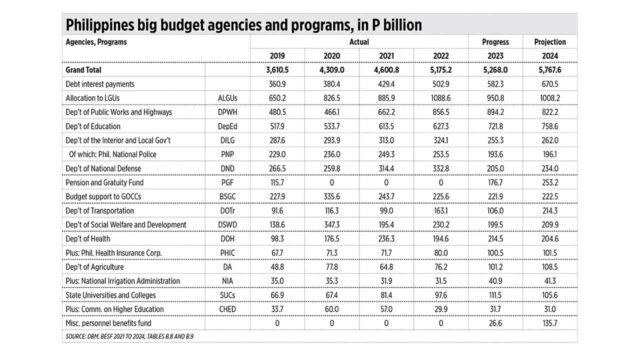
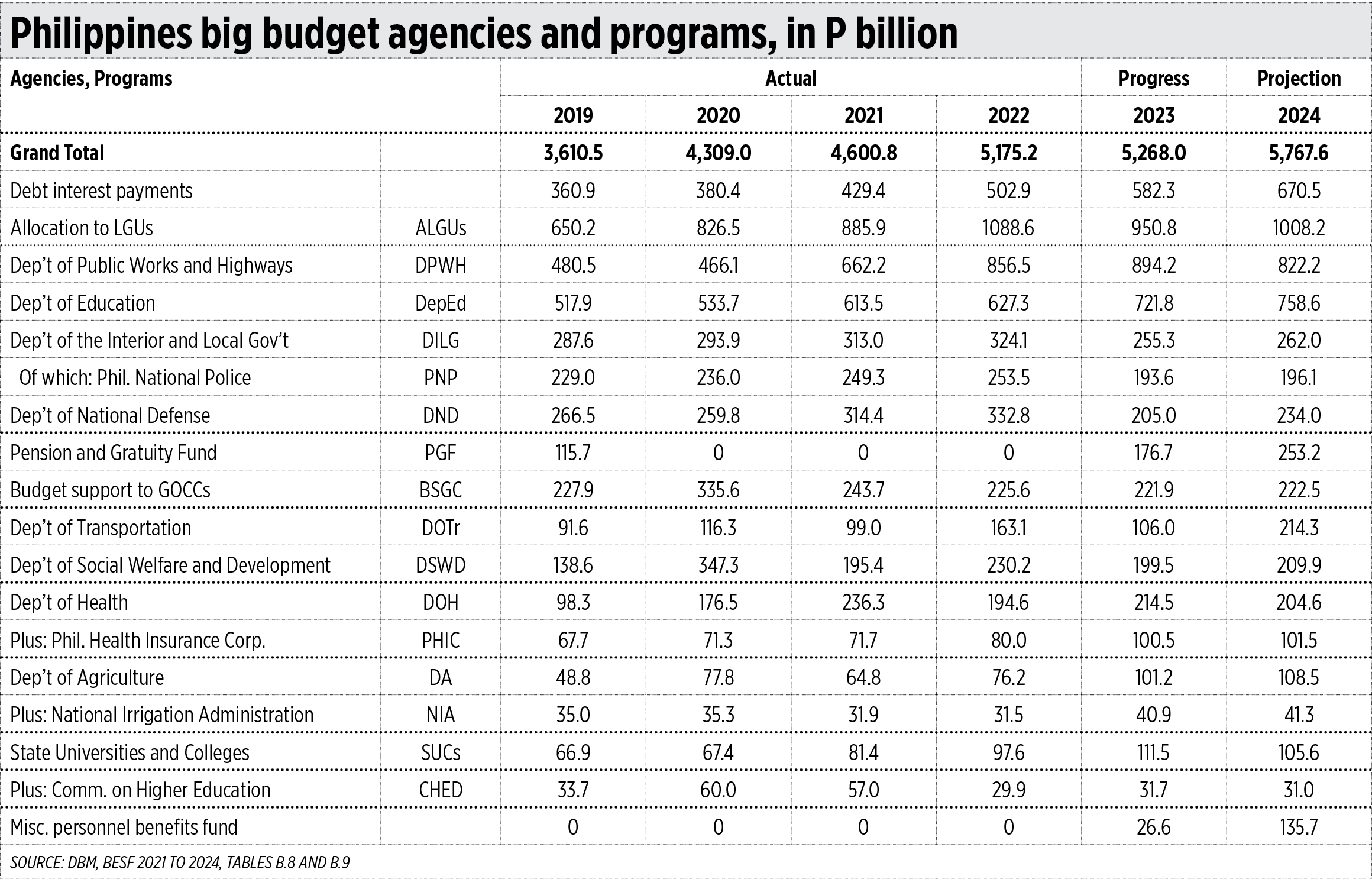
Browsing again through the various tables of the Budget of Expenditures and Sources of Financing (BESF), a key document submitted by the Department of Budget and Management (DBM) to Congress yearly, I was surprised to see that of the P5.68-trillion proposed budget for 2024, P670 billion of it is for interest payments of our public debt alone, with principal amortization not included yet. This year the interest payments come to P582 billion.

This is a huge annual transfer of resources from taxpayers — including taxi drivers and tractor operators — to rich institutional lenders. We have huge annual interest payments because we have huge annual borrowings to cover the huge annual budget deficit due to high expenditures while revenues are not catching up with needs.

The lockdown dictatorship of 2020-2021 was a fiscal monster. Many tax-paying businesses were closed down while the government kept spending for its own personnel — national down to barangay. Their salaries, allowances, and bonuses were given intact, plus there were various subsidies that were also given to the public. The annual borrowing of about P0.8 trillion in 2019 became P2.2 trillion a year from 2020 to 2022. The huge loans of 2020 were immediately felt in the jump in interest payments in 2021 and this has gained momentum since.

BIG BUDGET AGENCIES AND PROGRAMS
The table shows the big agencies and programs, all candidates for some spending cuts.

Here are my proposed budget cuts (in case there are legislators who will bother to listen).

One, the state universities and colleges (SUCs): The government’s big expenditures and subsidies for basic elementary and secondary education is understandable, but its extra big spending for tertiary education is not. The really poor students do not reach college, they start working after high school graduation. Many students in SUCs are car owners and have the means to pay for their school fees. The budget for SUCs and the Commission for Higher Education (CHED) is P143 billion this year and P146 billion next year. A potential cut of 20% — or about P30 billion — will help.

Two, the Department of Health and PhilHealth: They will receive a combined P315 billion this year and P306 billion next year, while other agencies have their own annual health services spending too (the Armed Forces of the Philippines hospital, the Philippine National Police hospital, University of the Philippines-Philippine General Hospital, etc.). Plus, there are LGU hospitals — the City of Manila alone has six city-funded hospitals. A potential cut of 10%, or another P30 billion, will help.

Three, some infrastructure projects of the Department of Public Works and Highways and Department of Transportation can instead be assigned for Public-Private Partnership (PPP) funding, plus Maharlika Investment Fund funding. Long-term obligations and contracts between government and private proponents should be respected and not changed midway to attract more investor confidence.

Four, military and uniformed personnel (MUP) pension: Currently this is about P164 billion a year when it should be zero. Other government employees — doctors and nurses, educators and teachers, engineers and agriculturists, etc. — pay for their own future pension via deductions from their monthly salaries, but MUPs pay zero. And these particular pensioners have their pensions indexed to the pay of current active personnel of the same rank which is rising yearly. And the pension is tax-free, extendable to the spouse when the pensioner has passed away. An average tax of 25% on the P164 billion pension, or P41 billion, will help. Plus, monthly contributions by active MUPs.

Five, the rightsizing of agencies, and the abolition or shrinking of those with duplicating functions and passe mandates. Since LGUs now have more money because of the Mandanas ruling, they can assume more social responsibilities like education and healthcare and, thus, national spending on education and healthcare can step back.

IMF REVIEW MISSION ON FISCAL REFORMS
The International Monetary Fund (IMF) has visited the country and conducted the “2023 Article IV Mission to the Philippines.” Among their observations is “Fiscal consolidation is on track, as envisaged under the Medium-Term Fiscal Framework.”

It noted budgeting reforms by the DBM under Secretary Amenah Pangandaman. The IMF said, “Reforms focusing on enhancing public financial management (PFM) has gained momentum. Key legislative initiatives include the Progressive Budgeting for Better and Modernized Governance bill, and National Government Rightsizing bill. The digital transformation of the PFM…”

I am no fan of the IMF but I agree with them on this assessment. The current DBM leadership is serious when it comes to those budget modernization and rightsizing reforms.

Every single year, the Finance department and the DBM scratch their heads over how to allocate very limited resources because all agencies, from national to local, always say they need more money. Any new revenues are always met by new spending concocted by agencies and their lobbying consultants. Assuming P500 billion in new revenues can be generated next year, one can be 100% sure that there will be moves from various agencies to invent new programs or expand existing ones.

The goal of drastically reducing the budget deficit/GDP ratio from the current 5-6% to 3% by 2028, and reducing the public debt/GDP ratio to 40% or less by 2028, can be attained more via 1.) spending control, 2.) lifting or suspending the VAT-exempt privileges of many sectors, and, 3.) developing simpler, profit-based taxation like the mining tax reforms.

A level playing field, both in business regulations and tax imposition, means that all players in each sector should be levied the same taxes and fees. In the energy sector, for instance, both conventional or fossil fuel power plants and renewable plants should pay VAT, import tax, income tax, and so on.


Bienvenido S. Oplas, Jr. is the president of Bienvenido S. Oplas, Jr. Research Consultancy Services, and Minimal Government Thinkers

minimalgovernment@gmail.com

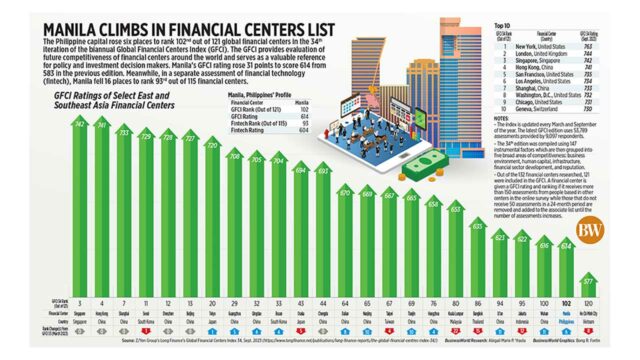
Manila climbs in financial centers list

The Philippine capital rose six places to rank 102nd out of 121 global financial centers in the 34th iteration of the biannual Global Financial Centers Index (GFCI). The GFCI provides evaluation of future competitiveness of financial centers around the world and serves as a valuable reference for policy and investment decision makers. Manila’s GFCI rating rose 31 points to score 614 from 583 in the previous edition. Meanwhile, in a separate assessment of financial technology (fintech), Manila fell 16 places to rank 93rd out of 115 financial centers.

Manila climbs in financial centers list

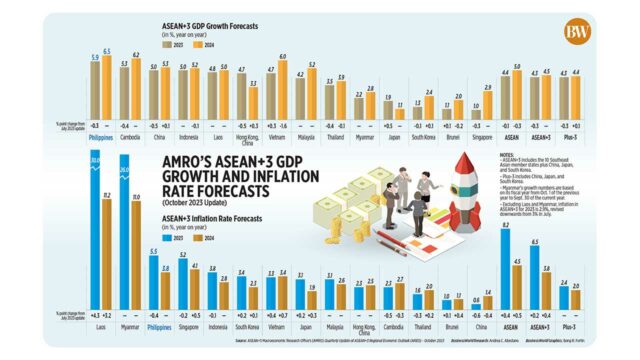
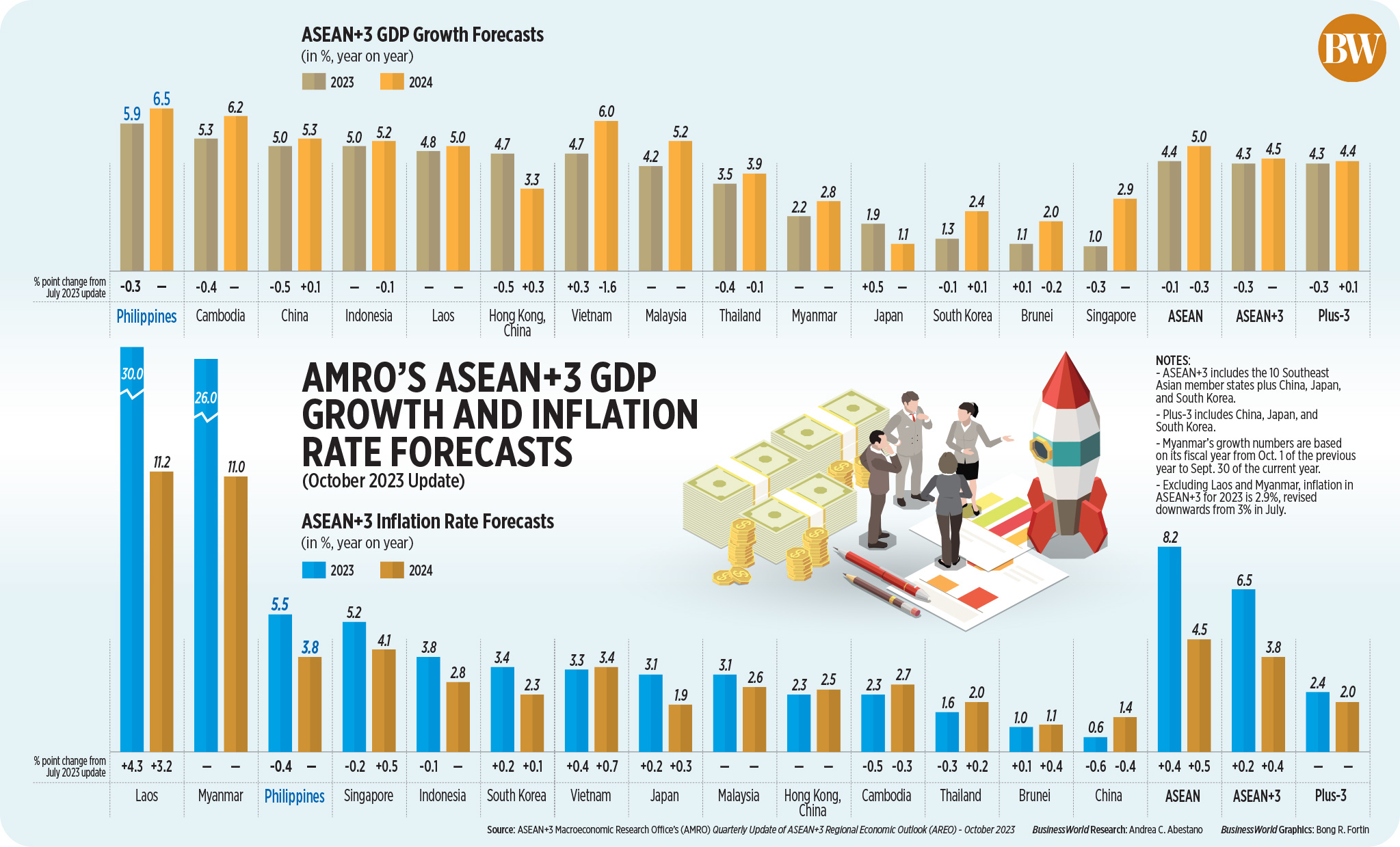
AMRO’s ASEAN+3 GDP growth and inflation rate forecasts

THE PHILIPPINES is projected to be the fastest-growing economy in the region for this year and the next, the ASEAN+3 Macroeconomic Research Office (AMRO) said. Read the full story.

AMRO's ASEAN+3 GDP growth and inflation rate forecasts

Ortigas Malls host Sustainability Yard Sales

THE ORTIGAS Malls make it easy for people to buy and sell preloved items, upcycle, and donate with the Sustainability Yard Sale drive which is held every second Sunday of the month at Greenhills and Estancia, from 8 a.m. to 2 p.m.

The next Yard Sale will take place on Oct. 8.

One of the pivotal aspects of the circular economy in the Philippines is creating awareness and encouraging people to participate in recycling, upcycling, and other sustainable practices that they can incorporate into their daily lives.

Upcycling is about reimagining the potential of items that have outlived their original purpose. Rather than discarding used or unwanted materials, upcycling artists and enthusiasts see opportunities for reinvention. In the hands of innovative creators, old pieces of furniture, containers, textiles, glassware, and even electronic components can be turned into functional works of art.

“The event promotes the reduction of plastic materials that deeply hurt the environment,” said Aireen Cruz, organizer of Yard Sale, in a statement. “It also encourages individuals, organizations and institutions to intensify their environmental campaigns. It’s a convenient way to help organizations and other institutions raise funds by recycling ‘junk’ and showcasing and selling their upcycled products.”

“The best part about the Ortigas Malls Yard Sale is that it brings together buyers and sellers in one event where they can showcase their creations and convert them into cash,” said Renee Bacani, VP of Ortigas Malls, in a statement. “It also makes great use of Ortigas Malls’ multipurpose spaces in Greenhills and Estancia.”

NGOs, a number of LGU (barangays) and schools participate in the Yard Sale every second Sunday of the month. Buyers include Envirocycle, a full-service e-waste recycling company that helps minimize the amount of electronic equipment being deposited in landfills, and the environmental organization Philippine Advocates for the Care of the Planet, Inc. (PACOPI).

Sellers include residents from the barangays of Addition Hills, Wack Wack, Batis and Pasadena; La Salle Greenhills, La Salle Greenhills Alternative Education; and BJMP Dorms. Exhibitors are KILUS Foundation, KILOS, Akbayanihan Eco Store, RVM, RCAM — organizations that help clean up the environment by recycling and upcycling items.

Shoppers get the chance to win raffle prizes from Yard Sale partners. A Zumba session will be held to boost the morning energy of participants and visitors; free coffee and pandesal will be given for free to the first 100 customers to register onsite.

For more information, download the Ortigas Malls app, and like Ortigas Malls on Facebook, and follow @greenhillsph on Instagram.

The secret sauce of digital transformation

TRUSTPAIR.COM

DIGITAL TRANSFORMATION has become an integral part of business growth today. However, modernization can feel overwhelming. In fact, digital transformation is beyond simply deploying new technologies. Rather, it is about maintaining a mindset of customer focus, and bringing the organization together in an approach, free of silos and, thus, empowering teams to work collaboratively. Furthermore, these processes keep changing rapidly at short notice.

Unfortunately, the skills gap is a major sticking point that jeopardizes digital transformation success. International Data Corp. (IDC), for instance, finds that for around 60% to 80% of organizations in the Asia Pacific, the digital skills shortage is a key hurdle in achieving strategic business agility. Naturally, low-code technology has gained more visibility as a result, as this technology makes it easier for those with limited experience to build both web and mobile applications.

TENETS OF DRIVING DIGITAL TRANSFORMATION
For digital transformation to succeed to very important aspects or laws, I would like to term it as — being able to transform the core of any operations in your organization and the other being that transformation is inversely proportional to the separation from the customer. Utilizing cutting-edge methods and technologies inevitably boosts customer engagement — not just in terms of being able to swiftly address any issues that emerge at key touchpoints, but also in terms of safeguarding trust and effectively protecting customer data.

Improved internal collaboration is also crucial in the grand scheme of things, as digital transformation is doomed to failure if employees are not in sync. Low code offers huge potential here, as it can help IT teams and the business teams produce more custom applications faster. Furthermore, this improves digital culture — ensuring that instead of forcing new tools onto your teams, they get a say in how software looks, feels, and works.

Finally, digital transformation must ultimately make processes more efficient. User-friendly workflows and tools are at the heart of low-code technology — enabling employees to spend less time on mundane, repetitive tasks, which allows them to create business value instead. This then positions the business to unlock considerable value, as internal systems and procedures are made simpler and more transparent.

AGILITY AND SUSTAINABILITY IN DIGITAL TRANSFORMATION
The thing about digital transformation is that without clarity about where the business intends to go, bottlenecks will emerge. Messy internal operations and processes will snowball into overgrown spreadsheets, excessive shelf-ware, and shadow IT. To overcome this, organizations need to ensure their modernization initiatives offer agility and factor in sustainability.

Taking advantage of scalable and agile solutions will ensure modernization is aligned with business goals.

Low code can be this secret sauce, offering the scalability required for businesses to be nimble and lean. If this can be adopted by business users as citizen developers, the results can be dramatic, as they know best what they want in the process.

For businesses looking to equip themselves to navigate disruption and be more sustainable, low code can provide the requisite impetus. Not only does it facilitate easy-to-use, sleek apps to be built and deployed quicker, it also enables easier maintenance of said apps, especially by citizen developers. This reduces waste and ensures resources are used as efficiently as possible.

Armed with this enhanced agility, businesses can meet company goals while keeping up with client demands, market advancements, and regulatory changes. A further boon to business’ sustainability agenda is that low code also ensures they are equipped to navigate the toughest corporate requirements. In fact, top applications are more likely to be run on low code by businesses who have the strictest standards for continuing audits and independent security certification, as well as the lowest tolerance for downtime and data loss.

Furthermore, manually generating API is time consuming, especially for legacy systems that weren’t designed for that in the first place. Low code can create interface code that is easily updated when user preferences change. Through low-code API generators, businesses can create APIs from scratch using existing application code.

THE FUTURE IS LOW CODE
With the speed and scope of digital transformation today, conventional software development cannot keep up. Most businesses grapple with a lack of adequate personnel and skills necessary to develop and maintain these efforts.

Unlike traditional backend programming, low-code development platforms use pre-designed templates and a user-friendly drag-and-drop interface. With this more visual approach, organizations can overcome the talent shortages they face. KPMG, for one, finds that these benefits are reasons behind why three quarters of major organizations across sectors employ at least four low-code development tools.

At the end of the day, driving the business into the future hinges on going beyond merely forcing new software onto teams. Instead, putting business benefits and people first by leveraging a flexible low-code development platform ensures that the business can make the most of available resources, positioning the organization to be adaptable as it grows.


Mohan Madhurakavi is Kissflow chief evangelist for digital transformation.

Meralco, Lenovo tie up to donate laptops

MANILA ELECTRIC Co. (Meralco), through its corporate social development arm, has renewed its partnership with Lenovo Philippines in providing laptops to schools located in off-grid areas in Mindanao.

In a media release on Wednesday, the company said One Meralco Foundation (OMF) had signed a deed of donation with Lenovo Philippines involving Lenovo laptops as part of its school electrification program.

The beneficiaries are schools in the provinces of Sarangani, Sultan Kudarat, Palawan, and South Cotabato.

“Being able to reach the most distant island schools in the country gives an even deeper meaning to our work in [OMF]. We are happy that even our partners like Lenovo, join us in these areas and contribute to the meaningful change that help improve communities,” OMF President and Meralco Chief Corporate Social Responsibility Officer Jeffrey O. Tarayao said.

Michael Ngan, president and general manager of Lenovo Philippines, said the partnership with OMF would help empower schools in the digital age.

“Our company has always been driven to provide smarter technology for all. However, we understand that without power, the potential of technology remains untapped. By providing laptops to electrified schools, we light the way for students and educators to access a world of knowledge,” Mr. Ngan was quoted saying.

OMF and Lenovo Philippines teamed up in 2022 to provide laptops to Baliguian Elementary School, Polopiña Elementary School, and Canauillan Elementary School in the province of Iloilo, as well as back-to-school kits in the said schools.

OMF’s school electrification program aims to provide solar power to remote and off-grid public schools to enable multimedia learning for students residing in underserved communities.

Since 2012, OMF and its partners have energized 290 off-grid public schools in remote communities, benefiting 89,235 students and 2,903 teachers, Meralco said.

“Through our electrification initiatives, Meralco and OMF hope to continue changing more lives for the better and contributing to sustainable and inclusive development of communities beyond our franchise area,” said Ronnie L. Aperocho, executive vice-president and chief operating officer of Meralco.

Meralco’s controlling stakeholder, Beacon Electric Asset Holdings, Inc., is partly owned by PLDT Inc.

Hastings Holdings, Inc., a unit of PLDT Beneficial Trust Fund subsidiary MediaQuest Holdings, Inc., has an interest in BusinessWorld through the Philippine Star Group, which it controls. — Sheldeen Joy Talavera

Euro parity is back on the dial for FX markets

LONDON — Resurgent oil prices hurting a deteriorating economy and renewed concerns about Italy’s fiscal position mean headwinds for the euro are getting stronger, raising the risk of a move back towards the psychologically key $1 marker.

The euro, trading at its lowest levels of this year near $1.05, fell 3% versus the dollar in the third quarter. It is poised for a third straight year of losses.

Much of this can be explained by a broadly firm dollar given the US economy’s resilience and cash sucked in from abroad as 10-year Treasury yields creep towards 5%.

Yet increasingly, euro area specific factors, particularly exposure to higher oil prices, risk further weakness in an already stagnating economy, and the single currency.

The euro is especially vulnerable to rising oil prices, with net imports accounting for over 90% of oil products available in the European Union.

“High oil prices are weighing on the euro area’s terms of trade, and if oil prices move above $100 per barrel to $110 per barrel we think it will be difficult for the euro to avoid parity,” said Nomura’s G10 foreign exchange (FX) strategist Jordan Rochester.

Oil prices surged almost 30% in the last quarter alone, nearing $98 last week, as oil producing group OPEC (Organization of the Petroleum Exporting Countries) and its allies squeeze crude supply.

Barclays, among other banks, expects oil to reach $100 in the coming months.

Nomura now expects the euro to weaken to $1.02 by yearend, which would imply a further 3% fall from current levels.

Morgan Stanley Chief Europe Economist Jens Eisenschmidt said besides being more exposed to energy shocks, the euro area is also more exposed to geopolitical risk than the United States.

This hurts the bloc’s competitiveness and dents the euro’s longer-term prospects, the former European Central Bank (ECB) economist added.

Morgan Stanley did not expect a fall to parity, but still expected a further weakening to $1.03.

A weak euro helps boost exporters’ competitiveness. But it also lifts price pressures through higher import costs, compounding the impact from higher oil prices. This suggests the ECB may need to pay more attention although it doesn’t seem too worried now.

On the trade-weighted index closely followed by the ECB, the euro fell just 0.9% last quarter and is roughly 2% higher compared to where it ended 2022.

When the euro hit parity against the dollar last year, for the first time in 20 years, the ECB said it was watching the currency because of its impact on inflation but did not target a specific level.

ITALY WATCH
For ING currency strategist Francesco Pesole, another warning sign is Italy. The closely watched yield premium Italian debt pays on top of Germany last week touched 200 basis points, a threshold, he said, that normally coincides with a pickup of the correlation between that premium and the euro.

“Should we see a material deterioration in the Italian bond market, and barring a swift reaction by the ECB to calm investors, euro/dollar downside risks would extend to the $1.00/$1.02 area,” said Mr. Pesole. He added that a backdrop of solid US data and a hawkish Federal Reserve was also important.

For sure, euro weakness could be limited if the US economy slows along with inflation, which could take the shine off a dollar at 10-month highs versus a basket of peers.

“If we have a combination of higher (US) unemployment and lower inflation, that’s negative for the dollar,” said Athanasios Vamvakidis, global head of G10 FX strategy at Bank of America.

But “you can see euro-dollar at parity if the US economy starts to weaken but inflation is sticky — though that is a risk not our baseline,” he said.

The nearer-term outlook suggests other challenges for the euro.

Investors have held bets on euro strength for some time and latest positioning data shows a net long position worth $13 billion. A further unwind could exacerbate downward momentum.

And with the ECB signalling the end of its most aggressive tightening cycle on record is likely over, the boost from higher rates has faded.

Gilles Moec, chief economist at AXA Investment Managers, said while the ECB’s September rate hike would usually have been a euro positive, expectations for much weaker economic growth dominated.

“Definitely the euro zone is not in a good place right now,” said Mr. Moec, adding that he did not rule out a euro move to parity. — Reuters

Early bird

PRESSFOTO/FREEPIK

IS BEING LATE for an event or an appointment a cultural trait? Even ceremonial commitments, like tossing the ball at the opening of an international sports event, may be missed with tardiness of a few minutes. It’s the international TV arrangements and just the way things are done in the world outside that require this discipline of the clock.

Developed countries, after all, post their departure and arrival schedules for public transport to the minute, like 9:18 a.m. Such precision implies a commitment to punctuality and assures that connections to other hubs are guaranteed. The long lines in our public transport system are not just about the big gap between supply and demand. It is compounded by tardiness and missed schedules. Are there even posted times of arrivals at the stops?

Filipino time is not just about punctuality but accepting ambiguity as the social norm for commitments. No excuses are even proffered when someone is less than an hour late — did you get hit by a bicycle when you intruded on its exclusive lane?

With tardiness as a norm, there are still guidelines that apply, based on venue, occasions, and habits.

A seminar on Artificial Intelligence in a hotel function room can have an ambiguous start time. The first schedule, “registration” at 8 a.m., is a wink to the cognoscenti that the actual event will start maybe an hour later. (Walk, don’t run.) The participants, or even the opening speaker, routinely add a half hour before showing up.

An office meeting called by the CEO to review variable pay, set at 10 a.m., is expected to start on time, unless the one who called the meeting is “still tied up” in his 9 a.m. appointment. Here, the attendees just pretend to be busy with their phones until the boss walks in when the coffee is served — shall we start? Nobody looks at his watch.

Dinners at a residence set at 6:30 p.m. are clearly not going to be serving even cubed cheese on toothpicks at that time. Showing up on the dot is bound to inconvenience the hostess still in her housedress directing the floral arrangements. (Can you google “social time” on your phone while I fix my hair?)

With this game of “reciprocal expectations,” it is impractical to take the designated time for an event too literally. The host provides a time which is expected to be adjusted by the socially aware invitee so that an overly punctual arrival does not cause embarrassment.

Being too early (or even on the dot) can be considered a social faux pas. The “early bird” is a rare specimen in these parts.

I confess that I routinely commit this breach of etiquette by arriving 30 minutes too early for any appointment. My calculation of travel time tries to accommodate stalled trucks in one lane, road rage incidents on the way, and ignoring Waze’s estimate of arrival time — you’re too early, Buddy. This travel assumption results in my arriving ahead of schedule. Waiters fixing tablecloths in their undershirts give me a look of pity. (Is he with the audit team?)

Hotels and malls are ideal for finding something to do if one is too early. A half-hour may allow a browse through a bookstore. (This is useful for looking at titles for eBook purchases later.) Any shopping bag being carried to an event can be hard to explain — somebody gave me a box of dates on the way here.

If the event is running late, say the premier showing of a movie already an hour behind schedule (add another hour for being too early), the prospect of simply leaving before the guest of honor shows up can be appealing. I have yielded too easily to such temptations… after signing the guest book. There is always somebody one meets on the way out — Where are you going?

Showing up too early too often is easily remedied by not showing up at all. It seems that absence is less socially offensive than being punctual. The tardy guest receives no censure at all — so glad you could make it, Sir.

It is the fate of early birds to catch the worms of social graces. They are seen perhaps as having nothing much to do, allowing them to be ahead of time for anything. And they always leave early too… if they’ve even decided to stay.


Tony Samson is chairman and CEO of TOUCH xda

ar.samson@yahoo.com

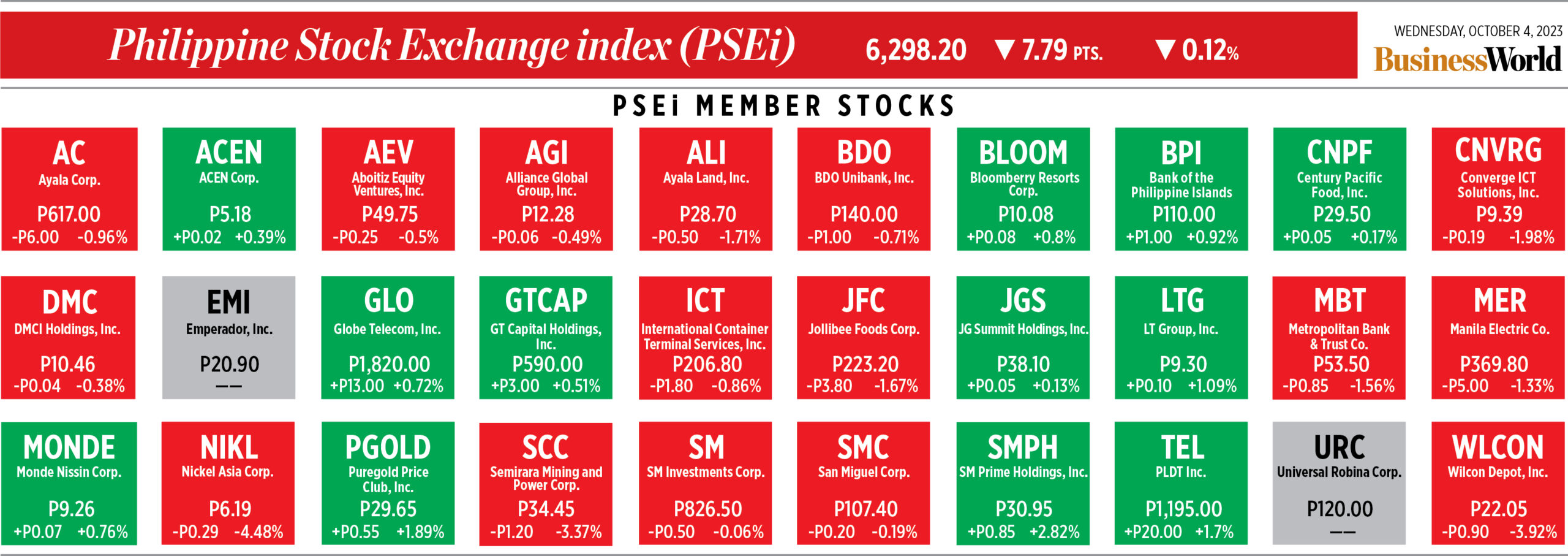
How PSEi member stocks performed — October 4, 2023

Here’s a quick glance at how PSEi stocks fared on Wednesday, October 4, 2023.


ADVERTISEMENT
ADVERTISEMENT